Önerilen Alçak Gerilim Kabul Otomasyon Platformu; alçak gerilim (AG) sistem kabul testlerini otomatikleştirmek için Nesnelerin İnterneti'ni (IoT), görsel iş akışı orkestrasyonunu, uç ve bulut bilişimi, öznitelik mühendisliğini ve makine öğrenmesini entegre eder. Platform; akıllı hata tespiti, gerçek zamanlı karar verme, otomatik kabul, yüksek doğruluk, düşük operasyonel gecikme ve ölçeklenebilir dağıtım imkanı sağlar.
Bu içeriği görüntülemek için JoVE aboneliğiniz gereklidir. Giriş yapın veya ücretsiz denemenizi bugün başlatın.
Araştırma makalesi
Görsel İş Akışı Orkestrasyonu ve Makine Öğrenmesi Doğrulamasına Sahip, Süreç Odaklı Bir Alçak Gerilim Kabul Otomasyon Platformu
Bu makalede
Özet
Özet
The rapid expansion of low-voltage (LV) networks and their integration with distributed energy resources requires intelligent and automated management solutions. Cloud-edge collaborative Internet of Things (IoT) platforms support real-time monitoring, control, and data acquisition. However, existing platforms generally lack workflow automation, visual process orchestration, user-guided decision support, and comprehensive validation. Consequently, they do not provide process-driven solutions for automated LV network acceptance testing. This study presents the design and evaluation of a Low-Voltage Acceptance Automation Platform based on a visualized process canvas. The proposed platform adopts a process-driven architecture in which acceptance workflows are visually created, managed, and executed. The visual process canvas transforms conventional static monitoring into dynamic workflow automation by enabling real-time workflow execution, validation, and decision-making. The framework incorporates the Open LV Network & Smart Meter dataset to support realistic modeling of electrical load behavior. The workflow includes IoT-based data acquisition, data preprocessing, feature engineering, workflow orchestration using the visual process canvas, machine learning-based validation, and real-time dashboard visualization. The proposed framework achieved a fault detection rate of 98.4%, a receiver operating characteristic area under the curve (ROC-AUC) of 0.968, and an operational decision latency of 31 ms, outperforming traditional cloud-centric and IoT-based baseline approaches by approximately 30%–40%.
Giriş
Endüstri 4.0 (I4.0)1, aralarında Endüstriyel Nesnelerin İnterneti'nin (IIoT) en önemlilerinden biri olduğu birçok gelişmekte olan teknoloji ile mümkün kılınmaktadır. IIoT, Nesnelerin İnterneti (IoT) teknolojilerinin, birbirine bağlı cihazların ve makinelerin öncelikle makineden makineye etkileşimler yoluyla iletişim kurduğu endüstriyel ortamlardaki uygulamalarını ifade eder. Endüstriyel sistemlerdeki arızalar ciddi operasyonel kayıplara yol açabileceğinden, IIoT uygulamaları, geleneksel IoT sistemlerine göre çok daha büyük veri hacimleri oluştururken oldukça güvenilir iletişime ihtiyaç duyar2. Ayrıca, bazı çalışmalar IIoT'yi Endüstri 4.0 ile yakından ilişkili bir kavram olarak değerlendirmektedir3. IoT teknolojileri, kesintisiz veri alışverişine sahip daha esnek sistemlere imkan tanıyarak geleneksel hiyerarşik mimarileri dönüştürmektedir4. Son zamanlarda yapılan çok sayıda çalışma, mevcut IIoT mimarilerini incelemiş ve yeni çerçeve tasarımları önermiştir5,6,7,8,9. Bu gelişmelere rağmen, iki temel sınırlama devam etmektedir. Birincisi, önceki mimarilerin eksikliklerini gidermek için sıklıkla yeni çerçeveler önerilmekte, bu da mimari çeşitliliği ve uygulama karmaşıklığını artıran alternatif model sayısının artmasına neden olmaktadır. İkincisi, önerilen birçok mimariyle ilişkili olan yüksek soyutlama düzeyi, bunların endüstriyel ortamlarda pratik olarak benimsenmesini sınırlamaktadır10.
Literatürde çeşitli IIoT mimarileri rapor edilmiştir. Açık Platform Haberleşme (OPC) standardına dayalı bir IIoT mimarisi, OPC iletişimini yönetmek için bir Python ara katman yazılımı ile birlikte sunulmuştur11. Yedi katmanlı bir IIoT mimarisi önerilmiştir; ancak uygulama detayları ve doğrulama deneyleri verilmemiştir12. 5G ve IIoT teknolojilerini entegre eden bir çerçeve, temsili bir kullanım durumuyla birlikte tanımlanmıştır, ancak deneysel doğrulama sınırlı kalmıştır13. Endüstri 4.0 için duygusal bir tasarım çerçevesi tanıtılmış ve potansiyel etkileri deneysel bir doğrulama yapılmaksızın tartışılmıştır14. Çok katmanlı bir IIoT platformu, telekomünikasyon hususlarına vurgu yapılarak gerçek dünyadaki bir test yatağında değerlendirilmiştir15. Benzer şekilde, iç mekan hava kalitesi izleme için modüler bir IoT çerçevesi sunulmuş ve performansı, çocuklu 84 haneden toplanan veriler kullanılarak değerlendirilmiştir16.
Nesnelerin İnterneti (IoT), elektrik güç sektörü uygulamaları için önemli bir potansiyele sahip olan ve hızla gelişen bir teknoloji haline gelmiştir17,18. IoT teknolojilerinin güç sistemi düğümlerine entegre edilmesi; akıllı şebeke içindeki elektrik akışının sürekli gerçek zamanlı izlemesiyle desteklenen otonom karar verme mekanizmaları aracılığıyla daha akıllı ve verimli güç üretimi, iletimi, dağıtımı, işletimi ve kullanımını mümkün kılar. Sonuç olarak, bu akıllı düğümler elektrik şebekesinin genel operasyonel performansını artırır19. İletişim teknolojisi, iki temel bilgi kategorisinin —sensör ölçümleri ve kontrol sinyallerinin— güvenilir şekilde iletilmesi gerektiği için akıllı şebeke uygulamasının temel bir bileşenini oluşturur. Düşük iletişim gecikmesinin yanı sıra, akıllı şebeke uygulamaları, güvenilir bir işletim sağlamak için uygun bir hizmet kalitesi (QoS) ve yeterli veri güvenliği gerektirir20.
Akıllı şebeke uygulamaları için uygun bir iletişim teknolojisinin seçilmesi; iletişim aralıklarının, veri iletim hızlarının ve iletişim maliyetlerinin değerlendirilmesini gerektirir21. IoT iletişim ağları tipik olarak yazılım, güvenlik, hizmet, sistem ve bağlantı katmanlarından oluşur. Bağlantı katmanı içerisinde iletişim protokolleri genellikle üç kategoriye ayrılır. Uzun menzilli protokoller arasında Long Range (LoRa) ve Narrowband-IoT (NB-IoT); orta menzilli protokoller arasında Wi-Fi, 4G/LTE ve 5G; kısa menzilli protokoller arasında ise Bluetooth ve ZigBee yer alır. Elektrik piyasalarının giderek daha fazla serbestleşmesiyle birlikte, hava koşullarının, ekipman arızalarının, mevzuat değişikliklerinin ve diğer operasyonel faktörlerin elektrik hizmetlerinin maliyeti üzerindeki etkilerini değerlendirmek için yük tahmini daha önemli hale gelmiştir. Sonuç olarak, doğru konut yük tahmini; akıllı şebekelerin, mikroşebekelerin ve akıllı binaların işletilmesi ve denetimi için temel bir gereklilik haline gelmiştir22.
Alçak gerilim (AG) şebekelerinin güvenilir işletimi, yüksek güç kalitesinin korunmasına bağlıdır23. Güç kalitesi; gerilim regülasyonunun etkinliği, akım dengesi ve dengesiz çalışma koşulları altında teknik rahatsızlıkların hafifletilmesi ile belirlenir24. Bu faktörler arasında faz dengeleme, fazlar genelinde gerilimlerin ve akımların tekdüze dağılımını belirlediği için özellikle önemlidir25. Yetersiz faz dengeleme; iletken ısınmasını, gerilim sapmalarını ve nötr akımlarını artırarak sistem verimliliğini ve işletme güvenilirliğini azaltabilir26. Sonuç olarak, sistem performansını, işletme kararlılığını ve uzun vadeli güvenilirliği artırmak için tasarım sürecinde faz dengeleme dikkate alınmalıdır. Buna rağmen, bu husus geleneksel mini-şebeke tasarım metodolojilerine nadiren dahil edilmektedir.
İş akışı orkestrasyon sistemlerindeki son gelişmeler, endüstriyel IoT ortamlarında olay güdümlü otomasyonun ve görsel süreç yönetiminin faydalarını ortaya koymuştur. Buna rağmen, bu sistemlerin dağıtım şebekesi doğrulaması ve alçak gerilim kabul testlerine uygulanması sınırlı kalmıştır. Mevcut alçak gerilim otomasyon sistemlerinin çoğu temel olarak izleme ve denetleyici kontrole odaklanırken, iş akışı güdümlü kabul yönetimi veya otomatik uygunluk doğrulaması üzerine yapılan çalışmalar nispeten azdır. Benzer şekilde, makine öğrenimi teknikleri akıllı sayaç anomali tespiti ve güç kalitesi değerlendirmesi için önemli ilgi çekmiş olsa da, bu yaklaşımlar genellikle entegre bir iş akışı orkestrasyon çerçevesinin bileşenleri olarak değil, bağımsız analitik modeller olarak geliştirilmektedir.
Son yıllarda akıllı bina yönetimi ve ev otomasyonu için çeşitli akıllı enerji sayacı çözümleri önerilmiştir27. Üniversite düzeyindeki eğitim kavramlarının akıllı sayaç teknolojilerine entegrasyonunu göstermek amacıyla referans27'de bir akıllı sayaç prototipi sunulmuştur. Geliştirilen akıllı sayaç, çift yönlü IoT iletişimi aracılığıyla enerji tüketimini azaltarak hem şebeke işletmecilerine hem de tüketicilere fayda sağlamış ve enerji yönetimi ile kontrolü konusunda önemli bir potansiyel sergilemiştir. Akıllı enerji izlemesini desteklemek amacıyla daha sonra mikrodenetleyici tabanlı bir akıllı priz sistemi tanıtılmıştır28.
Önerilen akıllı priz sistemi, güç tüketimini Android tabanlı bir grafik kullanıcı arayüzü aracılığıyla gerçek zamanlı olarak görüntüler. Ayrıca cihaz, bağlı elektrikli cihazların varlığını tespit edebilmekte olup bu yetenek invaziv yük ölçümü28 olarak adlandırılmaktadır. Uygulama için düşük maliyetli ticari bir akıllı priz kullanılmıştır. Gelecekteki geliştirmeler arasında etkin değer (RMS) akımının, gerçek gücün, reaktif gücün ve gerilim ile akım arasındaki faz açısının izlenmesi yer almaktadır. Önceki çalışmalarımızda açıklandığı üzere, kısmen şebekeye bağlı bir fotovoltaik mikro şebeke, akıllı sayaç cihazlarıyla bilgi alışverişi yapmak için ZigBee ve LoRa haberleşme protokollerini kullanarak dağıtık enerji sistemleri için IoT destekli haberleşmenin uygulanabilirliğini ortaya koymaktadır29,30.
Geleneksel dağıtım sistemi planlamasının sınırlamalarını gidermek amacıyla mühendislik uygulamaları ve bilimsel araştırmalar birkaç tamamlayıcı yön boyunca ilerlemiştir. Araştırmalardan bir yön, saha seçimi ve ön kaynak değerlendirmesi için coğrafi bilgi sistemleri (GIS) kullanan üst düzey planlamaya odaklanmıştır31,32. Diğer bir yön; iletken seçimi, optimal üretim ve enerji depolama boyutlandırması ile alternatif akım (AC) ve doğru akım (DC) dağıtım sistemlerinin karşılaştırmalı değerlendirmeleri dahil olmak üzere bireysel bileşenlerin ve alt sistemlerin iyileştirilmesine yoğunlaşmıştır33,34,35,36. Üçüncü bir araştırma yönü ise optimizasyon algoritmalarını dağıtım şebekesi planlamasına, besleyici yönlendirmesine ve şebeke topolojisi tasarımına uygulamıştır. Yakın tarihli gelişmeler arasında, cihaz yerleşimini ve şebeke konfigürasyonunu entegre eden ancak doğrulama ve optimizasyon için standart bir güç akışı analizinden yoksun olan araştırmacıların uGrid platformu gibi çerçeveler yer almaktadır. Diğer yaklaşımlar ise topoloji üretimi için manuel parametre ayarlamasına dayanmakta veya düşük güçlü DC mikroşebekeler gibi özel uygulamalara odaklanmaktadır37,38,39. Bu yaklaşımlar önemli ilerlemeler temsil etse de, düşük gerilimli dağıtım sistemlerinin uçtan uca tasarımı için entegre bir metodoloji oluşturmak adına daha fazla çalışma gereklidir. Ayrıca, tek fazlı, üç fazlı ve hibrit düşük gerilimli sistemlerin kapsamlı tekno-ekonomik değerlendirmeleri sınırlı kalmaya devam etmektedir.
Yapay zeka (AI) ve makine öğrenimindeki son gelişmeler, akıllı güç sistemlerinin yeteneklerini daha da genişletmiştir. Kapsamlı bir derleme; Federated Learning, Generative AI, Büyük Dil Modelleri, Nesnelerin Yapay Zekası (AIoT) ve Dijital İkizler gibi gelişmekte olan teknolojiler dahil olmak üzere, akıllı şebekelerdeki yapay zeka ve makine öğrenimi uygulamalarını özetle sunmuştur40. Bu derleme, birlikte çalışabilirlik, gizlilik, ölçeklenebilirlik, dayanıklılık ve etik hususlarla ilgili süregelen zorlukları vurgularken; yük tahmini, kestirimci bakım, anomali tespiti, talep tarafı yönetimi ve elektrikli araç entegrasyonundaki uygulamalara dikkat çekmiştir. Bir diğer güncel derleme ise IoT-uç-bulut altyapılarında dağıtık enerji yönetimi için AI yöntemlerini değerlendirerek, merkezi olmayan enerji kontrolü için makine öğrenimi, pekiştirmeli öğrenme ve çok ajanlı sistemlere odaklanmıştır41.
Kolektif olarak, önceki çalışmalar düşük gerilimli (LV) dağıtım sistemleri için IoT destekli izleme, akıllı ölçüm, bulut-uç bilişim, yapay zeka ve akıllı enerji yönetimini geliştirmiştir. Ancak, bu teknolojiler büyük ölçüde birbirinden bağımsız olarak geliştirilmiştir. İş akışı orkestrasyonu, otomatik kabul yönetimi, süreç odaklı doğrulama ve entegre karar desteği sınırlı kalmaya devam etmektedir ve bu durum, birleşik bir iş akışı odaklı otomasyon çerçevesine olan ihtiyacı vurgulamaktadır.
Bu doğrultuda, bu çalışma Görselleştirilmiş Süreç Tuvali tabanlı bir Alçak Gerilim Kabul Otomasyon Platformu sunmaktadır. Önerilen çerçeve; gerçek dünya akıllı sayaç verilerini kullanarak güvenilir ve otomatik AG şebekesi kabul testlerini desteklemek amacıyla IoT tabanlı veri toplama, veri ön işleme, öznitelik mühendisliği, iş akışı orkestrasyonu, makine öğrenimi tabanlı doğrulama, bulut-uç bilişim ve gerçek zamanlı görselleştirmeyi birleşik bir mimari içinde entegre eder. Şekil 1, önerilen platformun iş akışı odaklı mimarisinin genel bir görünümünü sunmaktadır. İş akışı; veri toplama, ön işleme, öznitelik mühendisliği, iş akışı orkestrasyonu, akıllı karar verme ve bulut-uç entegrasyonundan oluşarak süreç odaklı bir çerçeve aracılığıyla AG dağıtım şebekelerinin otomatik doğrulamasını sağlar. Platform, geleneksel yaklaşımlarla karşılaştırıldığında operasyonel karar gecikmesini ve iş akışı yürütme süresini azaltırken yüksek doğrulama doğruluğu sergilemiştir.
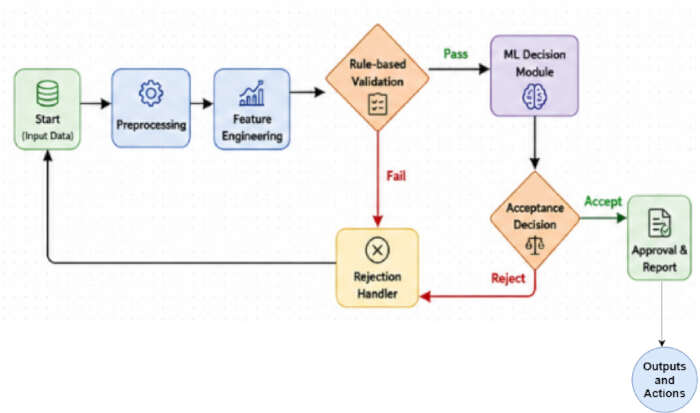
Şekil 1. Önerilen düşük gerilim kabul otomasyon platformunun iş akışı odaklı mimarisi. Önerilen süreç odaklı düşük gerilim (LV) kabul otomasyon platformunun üst düzey mimarisi. Çerçeve; IoT destekli veri toplama, veri ön işleme, öznitelik mühendisliği, iş akışı orkestrasyonu, akıllı karar verme, bulut-uç etkileşimi ve LV dağıtım şebekesi doğrulaması için otomatik kabulün ardışık entegrasyonunu göstermektedir. IoT = Nesnelerin İnterneti; LV = düşük gerilim; ML = makine öğrenimi. Bu şeklin daha büyük bir versiyonunu görüntülemek için lütfen buraya tıklayın.
Erişim kısıtlı. Bu içeriği görüntülemek için lütfen giriş yapın veya deneme sürümünü başlatın.
Protokol
This study did not involve human participants, animals, or identifiable personal data. The analyses were performed using a publicly available dataset (UK Power Networks Open LV Network & Smart Meter dataset) together with synthetically generated data for validation; therefore, ethics committee approval and informed consent were not required. The research tools used in the protocol are listed in the Table of Materials.
1. Data acquisition
The Low-Voltage (LV) Acceptance Automation Platform was developed using electrical measurements acquired from smart meters, IoT sensors, and the Open LV Network & Smart Meter Dataset. Electrical parameters, including voltage, current, active power, reactive power, and energy consumption, were collected through Wi-Fi-, PLC-, and RS-485-based communication protocols. Real-time measurements were used for live system monitoring, whereas historical data supported model development and validation.
The proposed framework used the Open LV Network & Smart Meter Dataset provided by UK Power Networks42. The dataset comprises household smart meter consumption, feeder-level load profiles, and feeder voltage measurements. Time-series subsets containing load consumption and voltage data were selected for model training and evaluation. In addition, a simulated smart meter dataset was generated to represent operational conditions and fault scenarios required for workflow validation and machine learning model evaluation. The simulated dataset included timestamped measurements of voltage, current, active power, reactive power, energy consumption, total harmonic distortion (THD), and voltage imbalance. Fault samples were generated by simulating undervoltage, overvoltage, excessive harmonic distortion, and voltage imbalance based on established low-voltage operational thresholds. The dataset characteristics are summarized in Table 1.
| Attribute | Description |
| Dataset Name | Open LV Network & Smart Meter Dataset |
| Simulated Smart Meter Dataset | Geneated 1000 smaples for Fault simulation and workflow validation |
| Data Type | Time-series (historical smart meter data) |
| Data Granularity | Household-level and feeder-level measurements |
| Key Features | Voltage, current, active power, reactive power, energy consumption, timestamps |
| Data Frequency | High-resolution (e.g., half-hourly / minute-level depending on subset) |
| Coverage | Residential low-voltage distribution networks |
| Usage in Proposed Work | Model training, validation, load behavior analysis, and acceptance workflow evaluation |
Table 1: Dataset description. Summary of the Open LV Network & Smart Meter dataset used for model development and performance evaluation. The table presents the dataset components, measured electrical variables, sampling characteristics, and dataset partitioning for training, validation, and testing.
Because the Open LV Network & Smart Meter Dataset does not contain predefined fault labels, a rule-based labeling strategy was applied to both the real and simulated datasets. Samples satisfying normal operating limits were assigned a label of 0 (Normal), whereas samples exceeding operational thresholds (e.g., voltage deviations greater than ±10% of the nominal voltage, THD > 5%, or voltage unbalance > 2%) were assigned a label of 1 (Fault). These labels served as the ground truth during model training, validation, and testing. The proposed rule engine also allows threshold values to be configured in accordance with regional standards or utility-specific acceptance criteria.
The dataset was partitioned into training (70%), validation (15%), and testing (15%) subsets. Missing values were addressed using linear interpolation, mean imputation, and forward-fill techniques as described in the preprocessing stage. To ensure statistical robustness and reproducibility, all experiments were repeated five times using different random seeds.
2. Data preprocessing
Raw data from the Open LV Network & Smart Meter Dataset and IoT sensor measurements were preprocessed to improve data quality prior to feature extraction and model development. Missing values, noise, and inconsistencies caused by communication interruptions and sensor malfunctions were identified and corrected using interpolation, mean imputation, and forward-fill techniques. The detailed mathematical derivations are provided in Supplementary File 1 (Section S1).
The preprocessed time-series data were segmented into representative operational intervals (S₁–S₅ and Sk). Statistical and electrical features, including average load, peak load, minimum load, standard deviation, voltage deviation, and power consumption, were extracted from each segment. The extracted features are summarized in Table 2 and served as inputs for the subsequent feature engineering stage.
| Segment ID | Mean Load (kW) | Peak Load (kW) | Min Load (kW) | Std Deviation (kW) | Voltage Deviation (p.u.) | Power Consumption (kWh) | Time Interval |
| S₁ | 2.45 | 3.8 | 1.2 | 0.65 | 0.032 | 58.4 | 00:00–01:00 |
| S₂ | 2.9 | 4.1 | 1.5 | 0.72 | 0.028 | 64.2 | 01:00–02:00 |
| S₃ | 3.25 | 4.85 | 1.8 | 0.81 | 0.035 | 71.6 | 02:00–03:00 |
| S₄ | 3.8 | 5.2 | 2.1 | 0.9 | 0.041 | 78.9 | 03:00–04:00 |
| S₅ | 4.1 | 5.75 | 2.4 | 0.95 | 0.045 | 85.3 | 04:00–05:00 |
| Sk | 3.6 | 5.1 | 2 | 0.88 | 0.038 | 76.5 | tk |
Table 2: Representative feature representation extracted from time-series segments. Representative statistical, electrical, load behavior, voltage stability, and power quality features extracted from segmented LV time-series data during feature engineering. The values illustrate the engineered feature representation and are not experimental performance results. LF = Load Factor; PAR = Peak-to-Average Ratio; VSI = Voltage Stability Index; PF = Power Factor; THD = Total Harmonic Distortion.
3. Feature engineering
Feature engineering was performed to improve the representation of the preprocessed data for workflow orchestration and intelligent decision-making. Principal Component Analysis (PCA)^43 was applied to reduce data dimensionality by removing redundant and highly correlated variables while retaining the most informative feature components. The mathematical derivations are provided in Supplementary File 1 (Section S2).
Statistical descriptors, load behavior indicators, voltage stability indices, and power quality metrics were derived from the segmented time-series data. These engineered features included Load Factor (LF), Peak-to-Average Ratio (PAR), Voltage Stability Index (VSI), Voltage Unbalance Index, Power Factor (PF), and Total Harmonic Distortion (THD). The resulting feature set was used as the input to the workflow orchestration and intelligent decision-making modules.
The feature engineering workflow is summarized in Supplementary File 1 (Supplementary Algorithm 1). The procedure consisted of segmenting the preprocessed data, extracting statistical and electrical features, calculating load behavior, voltage stability, and power quality indicators, and applying PCA to generate the final feature vector used for model training and validation.
4. Visualized process canvas design
The Visualized Process Canvas was developed as a graph-based workflow orchestration framework for automating low-voltage (LV) acceptance procedures. The workflow was represented as a directed graph, G = (N, E), where N = {n1, n2, …, nm}denotes the workflow nodes corresponding to individual processing stages (e.g., data input, preprocessing, validation, and decision-making), and E = {eij}represents the directed edges defining the execution sequence between nodes. This graph-based representation enabled the creation of configurable workflows and their automated execution without manual coding.
Each workflow node performed a specific processing task by receiving input data, executing predefined operations, and forwarding the processed output to subsequent nodes. Acceptance criteria, including voltage and load thresholds, were implemented as configurable validation rules that could be updated without modifying the workflow structure. The workflow supported both sequential and parallel execution to improve computational efficiency. Machine learning models were integrated into designated workflow nodes to perform anomaly detection and automated acceptance validation (Figure 2).
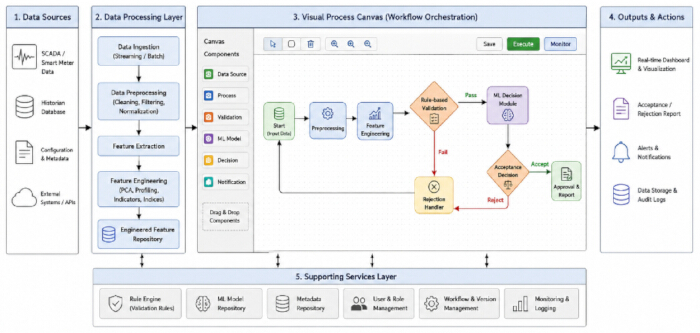
Figure 2: Visualized process canvas architecture for LV acceptance automation. Overview of the visual workflow orchestration framework used for LV acceptance automation. The process canvas illustrates the graphical organization of workflow nodes for data processing, feature engineering, rule-based validation, intelligent decision-making, and output generation to support workflow design, execution, and monitoring. Please click here to view a larger version of this figure.
The mathematical formulation describing information flow through the workflow graph is provided in Supplementary File 1 (Section S3). Supplementary File 1 (Supplementary Algorithm 2) describes the workflow orchestration procedure, including workflow traversal, node execution, rule validation, decision generation, and output aggregation.
The Visualized Process Canvas was implemented using a microservice-oriented software architecture to support scalability and modular deployment. The graphical workflow interface was developed using React.js to provide drag-and-drop workflow configuration. Backend orchestration services were implemented using Flask/FastAPI, while Eclipse Mosquitto served as the MQTT message broker for communication between workflow modules. EdgeX Foundry provided edge device management and IoT integration. Machine learning services were implemented with Scikit-learn, TensorFlow, and PyTorch, and containerized with Docker and Kubernetes.
5. Workflow orchestration engine
The workflow orchestration engine coordinated execution of the configured acceptance workflow. A detailed description is provided in Supplementary File 1 (Section S4), and the execution sequence is summarized in Supplementary Figure 1.
The workflow execution process consisted of validating the workflow definition, initializing the execution environment, scheduling workflow nodes according to their dependencies, executing nodes sequentially or in parallel, applying rule-based validation, aggregating intermediate outputs, and generating the final acceptance or rejection decision based on rule-based and machine learning evaluation. Execution results were published through dashboards, reports, application programming interfaces (APIs), and data storage services. The overall workflow orchestration process is illustrated in Figure 3.
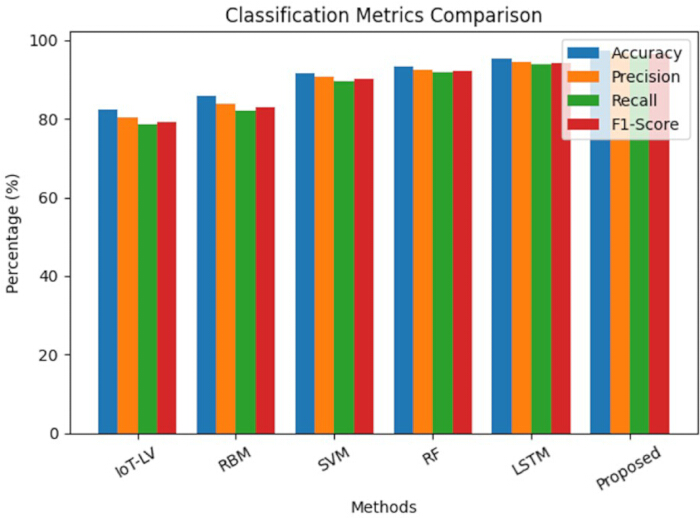
Figure 3: Comparison of classification performance metrics across different methods. Comparison of the classification performance of IoT-LV, RBM, Support Vector Machine (SVM), Random Forest (RF), Long Short-Term Memory (LSTM), and the proposed framework using the Open LV Network & Smart Meter dataset. Performance is evaluated using Accuracy, Precision, Recall, and F1-score. Results are presented as mean ± standard deviation (SD) from five independent experimental runs using a 70%/15%/15% training/validation/testing split. Error bars represent one standard deviation. Please click here to view a larger version of this figure.
6. Intelligent decision module
The Intelligent Decision Module was developed to automate low-voltage (LV) acceptance decisions using supervised machine learning models. Classification and regression algorithms were applied to the engineered feature vectors to support operational decision-making. Classification models identified normal and abnormal operating conditions, whereas regression models estimated future energy consumption and operational trends.
The input feature vector, X ∈ ℝd, comprised the statistical, voltage stability, load behavior, and power quality features extracted during the feature engineering stage. Standalone Support Vector Machine (SVM)44, Random Forest (RF)45, and Long Short-Term Memory (LSTM)46 models were implemented as baseline classifiers for comparative evaluation. The mathematical formulation of the learning models is provided in Supplementary File 1 (Section S5).
For classification, the output variable y ∈ {0,1} represented normal (0) and abnormal (1) operating conditions. When abnormal operating conditions or overload events were detected, the workflow generated a fault notification and flagged the acceptance process as invalid; otherwise, the process was classified as accepted.
The workflow orchestration engine integrated machine-learning predictions with rule-based validation, using a priority-based conflict-resolution strategy. Safety-critical operational rules and regulatory acceptance criteria were treated as hard constraints and therefore took precedence over machine-learning predictions when conflicts occurred. Final acceptance decisions were generated using the combined outputs of the rule-based validation and intelligent decision modules.
7. Cloud–edge integration and visualization dashboard
A cloud-edge computing architecture was implemented to support scalable data processing, storage, and visualization for the LV acceptance automation platform. Smart meters, SCADA systems, and IoT devices continuously collect electrical measurements, which are processed at the edge layer via filtering, normalization, feature extraction, and real-time inference to reduce communication overhead and enable low-latency decision-making. The mathematical derivations are provided in Supplementary File 1 (Section S6).
Processed data were transmitted to the cloud layer for long-term storage, advanced analytics, feature engineering, model training, and model management. Interactive dashboards provided real-time system monitoring, alerts, reporting, and operational decision support. The cloud-edge architecture is illustrated in Supplementary Figure 2, and the implementation details are summarized in Table 3.
| Layer | Component | Hardware / Software | Specification / Version | Purpose / Description |
| Edge Layer | Edge Device | Raspberry Pi 4 / NVIDIA Jetson Nano | Quad-core CPU, 4–8 GB RAM | Real-time data acquisition and local processing |
| IoT Gateway | Industrial IoT Gateway | MQTT / Modbus / OPC-UA support | Communication between sensors and edge/cloud | |
| Sensors / Smart Meters | Digital Smart Meters | Voltage, Current, Power Measurement | Data collection from LV network | |
| Edge Software | Python, EdgeX Foundry, MQTT Broker | Python 3.x | Data preprocessing, filtering, local inference | |
| Communication Protocols | Wi-Fi / PLC / RS-485 | Standard protocols | Data transmission to cloud layer | |
| Cloud Layer | Cloud Platform | AWS / Microsoft Azure / Google Cloud | Scalable cloud services | Data storage, analytics, and model training |
| Storage | AWS S3 / Azure Blob / InfluxDB | Time-series database | Storing historical and real-time data | |
| Compute & ML | Python, TensorFlow, PyTorch, Scikit-learn | ML libraries (latest versions) | Model training, evaluation, deployment | |
| Containerization | Docker, Kubernetes | Latest stable versions | Workflow orchestration and scalability | |
| Data Processing | Apache Spark / Pandas | Distributed processing | Large-scale data analytics | |
| Visualization Layer | Dashboard Tools | Grafana / Apache Superset / Plotly Dash | Web-based tools | Real-time monitoring and visualization |
| Web Framework | React.js / Angular / Flask / FastAPI | Modern web stack | UI development and API integration | |
| Notification System | Email / SMS Gateway / Push Notifications | Twilio / Firebase | Alert generation and communication | |
| API Services | REST APIs | JSON-based communication | Integration between modules |
Table 3: System implementation details. Summary of the hardware configuration, software environment, communication protocols, and cloud–edge computing components used for implementing the proposed LV acceptance automation platform.
Erişim kısıtlı. Bu içeriği görüntülemek için lütfen giriş yapın veya deneme sürümünü başlatın.
Sonuçlar
The performance of the proposed Low-Voltage (LV) Acceptance Automation Platform was evaluated using the Open LV Network & Smart Meter Dataset together with a synthetic smart meter dataset generated to represent additional operating conditions and fault scenarios. The synthetic dataset enabled controlled evaluation of workflow orchestration, intelligent decision-making, and fault detection under abnormal operating conditions. The Open LV Network & Smart Meter Dataset comprised household smart meter measurements, f...
Erişim kısıtlı. Bu içeriği görüntülemek için lütfen giriş yapın veya deneme sürümünü başlatın.
Tartışma
The experimental evaluation demonstrated that the proposed workflow-oriented Low-Voltage (LV) Acceptance Automation Platform consistently outperformed the benchmark approaches in classification, forecasting, fault detection, operational decision latency, and scalability. These performance improvements resulted from the integration of advanced feature engineering, workflow orchestration, cloud-edge collaboration, and hybrid rule-based and machine learning decision-making rather than from the use of a single machine learni...
Erişim kısıtlı. Bu içeriği görüntülemek için lütfen giriş yapın veya deneme sürümünü başlatın.
Açıklamalar
Yazarlar, herhangi bir finansal veya finansal olmayan çıkar çatışması bulunmadığını beyan ederler.
Teşekkürler
The authors thank the UK Power Networks Open Data Portal for providing the publicly available Open LV Network & Smart Meter dataset used in this study. This research received no external funding.
Erişim kısıtlı. Bu içeriği görüntülemek için lütfen giriş yapın veya deneme sürümünü başlatın.
Malzemeler
| Ad | Şirket | Katalog numarası | Yorumlar |
|---|---|---|---|
| Apache Spark | Apache Software Foundation | Sürüm 3.4+ | Büyük ölçekli veri analitiği |
| Apache Superset | Apache Software Foundation | Sürüm 3.x | Analiz paneli |
| Docker Engine | Docker Inc. | Sürüm 24.x | Uygulama dağıtımı |
| Eclipse Mosquitto MQTT Broker | Eclipse Foundation | Sürüm 2.x | Veri değişimi |
| EdgeX Foundry (Jakarta Release veya sonrası) | LF Edge (Linux Foundation) | Jakarta / Cenevre Versiyonu | Uç cihaz yönetimi |
| Flask / FastAPI | Palet Projeleri / Sebastián Ramírez | Flask 2.3+ / FastAPI 0.100+ | Arka uç API entegrasyonu |
| Grafana | Grafana Labs | Sürüm 10.x | Görselleştirme ve izleme |
| Endüstriyel IoT Ağ Geçidi | Advantech / Siemens | ECU-1251 / SIMATIC IOT2040 | Sensörden buluta iletişim |
| IoT Sensörleri (Voltaj/Akım Sensörleri) | Texas Instruments / Analog Devices | INA219 / ACS712 | Gerçek zamanlı ağ izleme |
| Jetson Nano Geliştirici Kiti | NVIDIA Corporation | 945-13450-0000-100 | Uç yapay zeka çıkarımı |
| Kubernetes | Cloud Native Computing Foundation (CNCF) | Sürüm 1.27+ | İş akışı ölçeklenebilirliği |
| LSTM Modeli (Keras/TensorFlow) | Google (TensorFlow/Keras) | TF 2.12+ sürümüne dahildir | Yük tahmini ve öngörüsü |
| PLC (Güç Hattı Haberleşmesi) Modülü | STMicroelectronics | ST7580 | Akıllı şebeke iletişimi |
| Plotly Dash | Plotly Inc. | Sürüm 2.x | İnteraktif görselleştirme |
| Python 3.10 | Python Software Foundation | Sürüm 3.10.x | Veri işleme ve analitik |
| PyTorch | Meta AI | Sürüm 2.0+ | Derin öğrenme uygulaması |
| Rastgele Orman Algoritması | Scikit-learn | v1.3+ sürümüne dahildir | Hata sınıflandırması |
| Raspberry Pi 4 Model B (4 GB RAM) | Raspberry Pi Foundation | RPI4-MODBP-4GB | Kenar işleme |
| React.js / Angular | Meta / Google | React 18.x / Angular 16+ | Kullanıcı arayüzü geliştirme |
| RS-485 Alıcı-Verici Modülü | Maxim Integrated (Analog Devices) | MAX485 | Endüstriyel cihaz bağlantı erişimi |
| Scikit-learn | Scikit-learn Geliştiricileri | Sürüm 1.3+ | Makine öğrenmesi modelleri |
| Destek Vektör Makinesi (SVM) | Scikit-learn | v1.3+ sürümüne dahildir | Sınıflandırma ve doğrulama |
| TensorFlow | Google LLC | Sürüm 2.12+ | Model eğitimi |
| Twilio / Firebase Bulut Mesajlaşma | Twilio Inc. / Google | Uygulanamaz | Uyarılar ve bildirimler |
| Wi-Fi Modülü | Espressif Systems | ESP8266 / ESP32 | Veri iletimi |
| XGBoost | DMLC (Dağıtık ML Topluluğu) | Sürüm 1.7+ | Akıllı karar destek |
Kaynaklar
- Tong L, Zhou J, Li J. IoT-based low-voltage power distribution system management and control platform. Front Energy Res. 2022;10:902715. https://doi.org/10.3389/fenrg.2022.902715
- Babayigit B, Abubaker M. Industrial Internet of Things: A review of improvements over traditional SCADA systems for industrial automation. IEEE Syst J. 2023;18:120–133.
- Nakagawa EY, et al. Industry 4.0 reference architectures: State of the art and future trends. Comput Ind Eng. 2021;156:107241. https://doi.org/10.1016/j.cie.2021.107241
- Ladegourdie M, Kua J. Performance analysis of OPC UA for industrial interoperability towards Industry 4.0. Internet Things. 2022;3:507–525.
- Bader SR, Maleshkova M, Lohmann S. Structuring reference architectures for the industrial Internet of Things. Future Internet. 2019;11:151. https://doi.org/10.3390/fi11070151
- Fun TS, Samsudin A. Recent technologies, security countermeasure and ongoing challenges of industrial Internet of Things (IIoT): A survey. Sensors (Basel). 2021;21:6647. https://doi.org/10.3390/s21196647
- Mirani AA, et al. Key challenges and emerging technologies in industrial IoT architectures: A review. Sensors (Basel). 2022;22:5836. https://doi.org/10.3390/s22155836
- Fraile F, et al. Reference models for digital manufacturing platforms. Appl Sci. 2019;9:4433. https://doi.org/10.3390/app9204433
- Serôdio C, et al. Software and architecture orchestration for process control in Industry 4.0 enabled by cyber-physical systems technologies. Appl Sci. 2024;14:2160. https://doi.org/10.3390/app14052160
- Ungurean I, Gaitan NC. A software architecture for the industrial Internet of Things—A conceptual model. Sensors (Basel). 2020;20:5603. https://doi.org/10.3390/s20195603
- Hsiao CH, Lee WP. OPIIoT: Design and implementation of an open communication protocol platform for industrial Internet of Things. Internet Things. 2021;16:100441. https://doi.org/10.1016/j.iot.2021.100441
- Domínguez-Bolaño T, et al. An overview of IoT architectures, technologies, and existing open-source projects. Internet Things. 2022;20:100626. https://doi.org/10.1016/j.iot.2022.100626
- Sasiain J, et al. Towards flexible integration of 5G and IIoT technologies in Industry 4.0: A practical use case. Appl Sci. 2020;10:7670. https://doi.org/10.3390/app10217670
- Cañas H, et al. A conceptual framework for smart production planning and control in Industry 4.0. Comput Ind Eng. 2022;173:108659. https://doi.org/10.1016/j.cie.2022.108659
- Cabrini FH, et al. Enabling the industrial Internet of Things to cloud continuum in a real city environment. Sensors (Basel). 2021;21:7707. https://doi.org/10.3390/s21227707
- Gabriel MF, et al. Implementation of an IoT architecture for promoting healthy air quality in 84 homes of families with children. Build Environ. 2024;266:112040. https://doi.org/10.1016/j.buildenv.2024.112040
- Silva BN, Khan M, Han K. Internet of Things: A comprehensive review of enabling technologies, architecture, and challenges. IETE Tech Rev. 2018;35:205–220.
- Dhaou ISB, et al. Internet of Things technologies for smart grid. In: Research Anthology on Smart Grid and Microgrid Development. IGI Global; Hershey; 2022. p. 805–832.
- Kondoro A, et al. A low latency secure communication architecture for microgrid control. Energies. 2021;14:6262. https://doi.org/10.3390/en14196262
- Tightiz L, Yang H. A comprehensive review on IoT protocols' features in smart grid communication. Energies. 2020;13:2762. https://doi.org/10.3390/en13112762
- Kondoro A, et al. Real-time performance analysis of secure IoT protocols for microgrid communication. Future Gener Comput Syst. 2021;116:1–12.
- Rodrigues R, et al. A review of solid-state circuit breakers. IEEE Trans Power Electron. 2020;36:364–377.
- IEEE. IEEE Std 1159-2019: IEEE recommended practice for monitoring electric power quality. IEEE; Piscataway (NJ); 2019. https://doi.org/10.1109/IEEESTD.2019.8800097
- Otcenasova A, et al. The influence of power quality indices on active power losses in a local distribution grid. Energies. 2019;12:1389. https://doi.org/10.3390/en12071389
- Ma K, et al. Review of distribution network phase unbalance: Scale, causes, consequences, solutions, and future research direction. CSEE J Power Energy Syst. 2020;6:479–488.
- Peppanen J, et al. Modeling power electronic equipment to improve distribution feeder current and voltage balance [Presentation]. Presented at: IEEE PES Transmission and Distribution Conference and Exposition (T&D); Denver, CO; 2018. Available from: https://ieeexplore.ieee.org/ https://doi.org/10.1109/TDC.2018.8440261
- Sayed S, et al. Design and realization of an open-source and modular smart meter. Energy Sci Eng. 2019;7:1405–1422.
- Satapathy LM, et al. Arduino based home automation using Internet of Things (IoT). Int J Pure Appl Math. 2018;118:769–778.
- Shaban M, et al. Design of a partially grid-connected photovoltaic microgrid using IoT technology. Appl Sci. 2021;11:11651. https://doi.org/10.3390/app112411651
- Shaban M, Dhaou IB. Design of an IoT-enabled microgrid architecture for a partial grid-connected mode [Presentation]. Presented at: 18th International Multi-Conference on Systems, Signals and Devices (SSD); Virtual; 2021. Available from: https://ieeexplore.ieee.org/ https://doi.org/10.1109/SSD52085.2021.9429443
- Taye BZ, et al. Rural electrification planning using geographic information system (GIS). Cogent Eng. 2020;7:1836730. https://doi.org/10.1080/23311916.2020.1836730
- Huld T, et al. Geospatial analysis of photovoltaic mini-grid system performance. Energies. 2017;10:218. https://doi.org/10.3390/en10020218
- Domínguez J, et al. IntiGIS-Local: A geospatial approach to assessing rural electrification alternatives for sustainable socio-economic development in isolated communities—A case study of Guasasa, Cuba. Energies. 2024;17:3835. https://doi.org/10.3390/en17153835
- Tafula JE, et al. Multicriteria decision-making approach for optimum site selection for off-grid solar photovoltaic microgrids in Mozambique. Energies. 2023;16:2894. https://doi.org/10.3390/en16062894
- Isihak S, et al. Evolution of GIS-based rural electrification planning models and an application of OnSSET in Nigeria. Renew Sustain Energy Transit. 2022;2:100019. https://doi.org/10.1016/j.rset.2022.100019
- Korkovelos A, et al. The role of open access data in geospatial electrification planning and the achievement of SDG7: An OnSSET-based case study for Malawi. Energies. 2019;12:1395. https://doi.org/10.3390/en12071395
- Cicilio P, et al. uGrid: Reliable minigrid design and planning toolset for rural electrification. IEEE Access. 2019;7:163988–163999.
- Nasir M, et al. Optimal planning and design of low-voltage low-power solar DC microgrids. IEEE Trans Power Syst. 2018;33:2919–2928.
- Vai V, et al. Optimal low-voltage distribution topology with integration of PV and storage for rural electrification in developing countries: A case study of Cambodia. J Mod Power Syst Clean Energy. 2020;8:531–539.
- Banad Y, Sharif S, Rezaei Z. Artificial intelligence and machine learning for smart grids: from foundational paradigms to emerging technologies with digital twin and large language model-driven intelligence. Energy Convers Manag X. 2025;28:101329. https://doi.org/10.1016/j.ecmx.2025.101329
- Álvarez-López C, González-Briones A, Li T. Explainable AI and multi-agent systems for energy management in IoT-edge environments: a state-of-the-art review. Electronics. 2026;15(2):385. https://doi.org/10.3390/electronics15020385
- UK Power Networks. Open data portal [Online]. Available from: https://www.ukpowernetworks.co.uk/our-company/open-data-portal (Accessed June 2026).
- Jolliffe IT. Principal Component Analysis. 2nd ed. Springer; New York; 2002. https://doi.org/10.1007/b98835
- Cortes C, Vapnik V. Support-vector networks. Mach Learn. 1995;20:273–297.
- Breiman L. Random forests. Mach Learn. 2001;45:5–32.
- Hochreiter S, Schmidhuber J. Long short-term memory. Neural Comput. 1997;9:1735–1780.
- Fawcett T. An introduction to ROC analysis. Pattern Recognit Lett. 2006;27:861–874.
- Montgomery DC, Runger GC. Applied Statistics and Probability for Engineers. 8th ed. John Wiley & Sons; Hoboken (NJ); 2020.
- Montgomery DC. Design and Analysis of Experiments. 10th ed. John Wiley & Sons; Hoboken (NJ); 2020.
Erişim kısıtlı. Bu içeriği görüntülemek için lütfen giriş yapın veya deneme sürümünü başlatın.