Gastrointestinal surgery can reshape whole-body metabolism through hormonal, bile acid, microbial, immune, and regenerative pathways. Recognizing these effects may enable more precise surgical selection and long-term metabolic care.
Derleme makalesi
Surgery as Metabolic Therapy: Expanding the Role of Gastrointestinal Surgery Beyond Anatomical Reconstruction
Bu makalede
Özet
Özet
Gastrointestinal surgery comprises procedures used to treat diseases and injuries of the digestive tract. Evidence now shows that some gastrointestinal procedures are also systemic metabolic interventions. Bariatric and metabolic surgery intentionally treats obesity and associated metabolic disease and can improve type 2 diabetes, metabolic dysfunction-associated steatotic liver disease, and cardiometabolic risk, sometimes before substantial weight loss occurs. Other procedures, including hepatectomy, pancreatic resection, and bowel resection, are generally performed for non-metabolic indications; their metabolic consequences may be adaptive, neutral, or adverse, including pancreatogenic diabetes and intestinal failure. This narrative review examines how major gastrointestinal operations affect whole-body metabolism and discusses metabolic phenotyping for personalized patient selection, preoperative optimization, postoperative management, and long-term monitoring. The review highlights bariatric and metabolic surgery as the reference model while distinguishing its established therapeutic effects from the metabolic consequences of other resections. It proposes that surgery should be considered both a correction of anatomy and a perturbation of physiology, enabling plans that preserve structural integrity, support metabolic adaptation, and limit metabolic harm.
Giriş
Traditionally, gastrointestinal surgery has been guided primarily by anatomy, focusing on tumor removal, infection drainage, restoration of continuity, bypass surgery for obstruction, or functional recovery after trauma. While anatomically valid, this perspective does not fully capture the systemic metabolic dimensions of gastrointestinal surgery. The gut also has endocrine, immune, microbial and metabolic functions. Changes in structure modify the distribution of nutrients and bile acids, regulate incretin release, microbial ecology, inflammatory signaling and substrate use across the liver, pancreas, adipose tissue, muscle and brain.
The most compelling clinical evidence comes from bariatric and metabolic surgery. The 2022 guidelines of the American Society for Metabolic and Bariatric Surgery (ASMBS) and the International Federation for the Surgery of Obesity and Metabolic Disorders (IFSO) explicitly recognize metabolic disease burden, alongside body mass index (BMI), in determining indications for surgery1. This change has its origins in observations that gastric bypass could achieve long-term control of type 2 diabetes mellitus (T2DM) in adults with obesity; thus, it was no longer viewed as merely a reduction of stomach capacity2. At the Diabetes Surgery Summit II, metabolic surgery was subsequently added to the treatment algorithm for T2DM3. These developments also raise the broader question of how metabolic consequences should inform the management of other gastrointestinal procedures.
For this review, metabolic therapy denotes surgery undertaken with an explicit metabolic treatment goal, supported by clinical evidence in the indicated population and a favorable benefit–risk assessment. Bariatric and metabolic surgery meets this definition in selected patients with obesity and T2DM. Hepatectomy, pancreatic resection and intestinal resection are generally undertaken for oncological or other anatomical indications; postoperative metabolic adaptation or injury alone does not justify reclassifying them as metabolic therapy. Their inclusion here supports metabolic risk assessment and care, rather than an expanded metabolic indication for resection.
Targeted narrative synthesis is used to address this question. It does not aim to cover all gastrointestinal surgeries and all molecular pathways. Instead, four representative surgical settings—bariatric and metabolic surgery, hepatectomy, pancreatic resection, and intestinal resection—are integrated into a unified metabolic framework. As illustrated in Figure 1, gastrointestinal surgery can alter systemic metabolism through gut hormones, bile acid signaling, gut microbiota, immune regulation, nutrient partitioning, and inter-organ communication. These pathways have different levels of supporting evidence across procedures and do not imply that all operations are metabolic therapies. This conceptual framework forms the basis for metabolic phenotyping, precision patient selection, perioperative optimization, and long-term metabolic management discussed throughout this review.
This focused narrative review provides a selective synthesis of literature on metabolic effects across four representative gastrointestinal surgical settings. Topic-directed searches were conducted in PubMed and Google Scholar in July 2026. Topic-directed searches concerned bariatric and metabolic surgery, hepatectomy, pancreatic resection and intestinal resection, with attention to metabolic outcomes and candidate mechanistic pathways. Studies were selected for their relevance to these topics. The cited literature includes randomized clinical trials, observational cohorts, clinical guidelines and experimental studies. Representative examples include the STAMPEDE trial for glycemic outcomes, the placebo-controlled teduglutide trial for intestinal failure, and FXR-deficient mouse studies for bile acid mechanisms. No prespecified systematic search strategy, fixed keyword set, exhaustive study-selection procedure or formal risk-of-bias assessment was undertaken. Evidence is interpreted qualitatively according to study design, population, procedure and outcome, distinguishing randomized clinical findings from observational associations and preclinical mechanisms. Evidence descriptors refer to the cited literature: established denotes demonstrated clinical efficacy or recognized physiological consequences; moderate denotes human physiological or biomarker support with unresolved mediation; limited denotes sparse or indirect human evidence; associative denotes non-interventional relationships; and preliminary denotes exploratory or predominantly preclinical mechanisms. These descriptors are not formal certainty ratings. Animal studies inform biological plausibility rather than establish human clinical efficacy. No pooled effect estimate is provided. The selective approach limits the completeness and reproducibility of the literature coverage.
İnceleme ve perspektif
Bariatric and metabolic surgery as the reference model
Bariatric and metabolic surgery has provided randomized evidence of improved glycemic outcomes in adults with T2DM and obesity. At 5 years in the Surgical Treatment and Medications Potentially Eradicate Diabetes Efficiently (STAMPEDE) trial, glycated hemoglobin (HbA1c) ≤ 6.0%, with or without diabetes medication, was achieved by 14/49 patients (29%) after Roux-en-Y gastric bypass (RYGB), 11/47 (23%) after sleeve gastrectomy, and 2/38 (5%) with intensive medical therapy alone4. These completer results describe glycemic control, not medication-free remission; intention-to-treat comparisons for this primary endpoint were not statistically significant (p = 0.08 and p = 0.17, respectively)4. A separate randomized trial reported medication-free diabetes remission at 5 years in 7/19 patients (37%) after RYGB and 12/19 (63%) after biliopancreatic diversion, compared with 0/15 medically treated patients (p = 0.0007 for pooled surgery versus medical treatment)5. The non-randomized Swedish Obese Subjects study associated bariatric surgery with lower long-term mortality6. In a matched observational cohort of adults with T2DM and obesity, surgery was associated with a lower risk of an extended six-component adverse-outcome composite, including cardiovascular and renal events and mortality (adjusted hazard ratio, 0.61; 95% confidence interval [CI], 0.55–0.69)7. Residual confounding limits causal interpretation of these cohort findings.
These are not the only outcomes. In a prospective single-center cohort with biopsy-proven nonalcoholic steatohepatitis (NASH), 84% of the 64 patients with a 5-year liver biopsy had NASH resolution without worsening fibrosis (95% CI, 73.1%–92.2%), and 70.2% had fibrosis regression (95% CI, 56.6%–81.6%)8. These proportions apply to the repeat-biopsy subset, not to all 180 enrolled patients or all patients with metabolic dysfunction-associated steatotic liver disease (MASLD); attrition and the absence of a randomized control group limit generalizability. This review uses MASLD and metabolic dysfunction-associated steatohepatitis (MASH) for current terminology, while retaining NASH when reporting studies that used historical diagnostic criteria. MASLD links obesity, insulin resistance, dyslipidemia, inflammation and cardiovascular risk. Bariatric and metabolic surgery can therefore address several associated metabolic disorders in appropriately selected patients.
The timing of improvement is also instructive. Improved glycemic control can occur before substantial weight loss, particularly after procedures that reroute nutrient flow. Early caloric restriction, altered gastrointestinal hormone responses, and subsequent weight loss interact; temporal improvement alone does not establish a weight-independent surgical mechanism. Altered nutrient sensing, incretin secretion, bile acid signaling and microbial activity may contribute to the integrated postoperative metabolic state, with the strength of human causal evidence varying by pathway. Procedure-specific nutrient partitioning and inter-organ signaling remain integrative mechanistic explanations, with limited direct human evidence separating their contributions to clinical outcomes.
Mechanistic axes of surgery-induced metabolic remodeling
The first early and measurable response involves gut hormones. RYGB increases the secretion of postprandial incretins and enhances the incretin effect within a few weeks, providing human physiological evidence consistent with early improvement in beta-cell function and insulin secretion9. Glucagon-like peptide-1 (GLP-1), peptide YY (PYY), ghrelin and other enteroendocrine signals change according to the procedure performed, the speed of nutrient delivery and the amount of functioning intestine exposed to luminal nutrients. These physiological observations do not establish the relative contribution of each hormone to long-term remission. The same anatomical reconstruction can be favorable or unfavorable, as illustrated by postprandial hypoglycemia in vulnerable patients. Human physiological evidence for the incretin response is moderate; evidence attributing long-term remission to any individual hormone remains limited.
The second axis is bile acid signaling. Serum bile acids are elevated following gastric bypass, but the cited human study establishes an association rather than a causal contribution to improved glucose and lipid metabolism10. Farnesoid X receptor (FXR)-dependent effects of sleeve gastrectomy were demonstrated using FXR-deficient mice11; these findings provide mechanistic plausibility but do not establish the same receptor dependence in humans. Bile acids aid fat absorption and also signal through receptors including FXR and Takeda G protein-coupled receptor 5 (TGR5), affecting hepatic glucose production, lipid metabolism, intestinal hormone secretion, energy expenditure and the gut microbiota. Thus, the cited human evidence is associative, whereas receptor-specific mediation is predominantly preclinical and remains preliminary for human surgical outcomes.
The intestinal microbiota is the third axis. Transfer of microbiota from gastric-bypass-operated mice to germ-free mice reduced recipient weight and adiposity, supporting a causal effect within that experimental model12. Human studies describe postoperative microbiome changes and interindividual variation13, but these observations do not establish that modifying the microbiota improves clinical surgical outcomes. The microbiota interacts with bile acids, short-chain fatty acids (SCFAs), the intestinal barrier and immunity. Its clinical contribution remains difficult to separate from concurrent dietary, medication and weight changes. Evidence for a microbiota-mediated effect is therefore causal in the cited mouse model but associative in humans.
Systemic inflammation also changes after metabolic surgery. A meta-analysis found lower levels of serum inflammatory markers after bariatric surgery14. This matters because obesity-related inflammation increases insulin resistance, endothelial dysfunction, MASLD progression and cardiovascular disease. The anti-inflammatory effect may involve reduced adipose-tissue stress, changes in gut-barrier function, altered microbial communities, modified bile acid signaling and lower ectopic lipid accumulation. The pooled biomarker findings do not isolate an inflammation-specific causal effect; differences in procedures, weight loss and sampling limit mechanistic interpretation. Human evidence for postoperative biomarker changes is moderate; evidence for inflammation as an independent mediator of clinical benefit is associative.
Metabolic phenotyping and precision surgical selection
Metabolic changes after surgery are not uniform. Patients with a similar BMI may vary significantly in diabetes duration, beta-cell reserve, insulin use, visceral adiposity, liver fat, inflammatory tone, microbiota composition, eating behavior and genetic susceptibility. These differences partly explain why one patient achieves long-term diabetes remission while another has only partial improvement.
Clinically available phenotyping includes HbA1c and fasting glucose, diabetes duration and medication/insulin use, BMI, liver biochemistry and imaging, and assessment of nutritional status and muscle mass. C-peptide can help assess beta-cell reserve when the result would inform counseling. Before hepatectomy, bilirubin, international normalized ratio (INR), remnant liver volumetry and locally validated functional assessment inform reserve. Pancreatic and intestinal surgery additionally require assessment of exocrine symptoms and residual anatomy, respectively. These established assessments should be distinguished from exploratory inflammatory, microbiome and multi-omics signatures.
Clinical prediction tools can inform counseling in metabolic surgery. DiaRem incorporates age, HbA1c, insulin use and the type of antidiabetic medication, with a score of 0–22; it was developed in a retrospective RYGB cohort and assessed in two additional cohorts15. In the derivation cohort, early partial or complete remission occurred in an estimated 88% of patients scoring 0–2 (95% CI, 83%–92%) versus 2% scoring 18–22 (95% CI, 0%–5%)15. The Individualized Metabolic Surgery (IMS) score uses diabetes duration, number of diabetes medications, insulin use and glycemic control (HbA1c < 7%). It was derived in 659 patients undergoing RYGB or sleeve gastrectomy and externally assessed in 241 patients; intermediate diabetes severity showed greater remission after RYGB, whereas severe disease showed low remission with either procedure16. These are population- and procedure-dependent predictions, not randomized proof that score-guided selection improves outcomes. Calibration, remission definitions and follow-up duration affect performance, and neither tool can be extrapolated automatically to hepatectomy, pancreatic surgery or intestinal resection.
Omics technologies are beginning to refine this approach. A transcriptome study in 26 adults with obesity and T2DM identified postoperative expression changes and exploratory baseline predictors17. A microbiome subanalysis of a randomized surgical trial found associations between postoperative microbial features and metabolic outcomes18; randomization of the operation does not randomize the microbiome mediator. These findings are exploratory biomarker associations. They require external validation and interventional clinical evidence before omics-guided surgical or nutritional decisions can be recommended routinely.
Artificial intelligence (AI) and digital health may support this transition. A convolutional neural network predicted diabetes remission after RYGB from Swedish registry data19. Its held-out test area under the receiver operating characteristic curve was 0.82 for complete remission, but a split from the same registry does not establish generalizability to other countries or operations19. Future approaches could combine electronic health records, continuous glucose monitoring, body-composition data, imaging, microbiome information and patient-reported outcomes. Prospective validation, calibration and evidence of improved clinical decisions are needed before routine use.
Hepatectomy: regeneration as a metabolic program
Another type of postoperative metabolic change follows a reduction in liver size. After liver resection, the remaining liver must regenerate mass while continuing detoxification, bile production, protein synthesis, immune defense and glucose-lipid regulation. Liver regeneration is therefore not simply cell division; it is a coordinated metabolic program involving hepatocytes, non-parenchymal cells, cytokines, growth factors, bile acids and substrate redistribution20.
Bile acid signaling is also relevant here. Nuclear receptor-mediated bile acid signaling was necessary for normal liver regeneration in the cited mouse experiments21. Liver resection alters bile acid flux, and experimental studies describe shifts in glucose and fat metabolism that support tissue growth and energy demand22. These findings explain biological plausibility; they do not establish that receptor-targeted treatment improves human outcomes after hepatectomy. Bile acid-dependent regenerative mechanisms and substrate redistribution remain predominantly preclinical, with limited evidence for pathway-targeted benefit in humans.
Clinically, these adaptations help explain why metabolic reserve is required after major hepatectomy. The International Study Group of Liver Surgery (ISGLS) defines posthepatectomy liver failure by increased INR and concomitant hyperbilirubinemia on or after postoperative day 523. Even if the estimated remnant liver volume appears acceptable, patients with steatosis, steatohepatitis, cholestasis, sarcopenia, diabetes or chemotherapy-induced liver injury may have impaired metabolic flexibility. Future risk models should test whether functional, inflammatory and metabolic markers add predictive value to remnant volume, rather than presume clinical benefit from a mechanistic pathway.
Pancreatic surgery: endocrine and exocrine trade-offs
Pancreatic surgery shows how anatomical success can create metabolic vulnerability. Pancreaticoduodenectomy, distal pancreatectomy and total pancreatectomy alter insulin and glucagon secretion, pancreatic enzyme delivery, gastric emptying, intestinal hormone release and nutrient absorption. These changes can cause pancreatogenic diabetes, maldigestion, sarcopenia and unstable glucose control. Type 3c diabetes mellitus (T3cDM) differs from other forms of diabetes because its biology often includes endocrine loss, exocrine insufficiency, malnutrition, altered counter-regulation and pancreatic disease24.
The risk is not static. A systematic review and meta-analysis of partial pancreatectomy has identified global patterns of new-onset, worsening and resolved diabetes after pancreatic resection25. Exocrine pancreatic insufficiency is also frequent after pancreatic surgery and may be under-recognized without active surveillance26. These findings support proactive metabolic planning before pancreatic surgery. Preoperative assessment should identify diabetic status, nutritional risk, degree of sarcopenia, pancreatic texture and volume, and expected exocrine insufficiency. Postoperative care should not end with complication detection; it should include enzyme replacement therapy when indicated, dietary and nutritional counseling, regular blood glucose monitoring and long-term assessment of body composition. Loss of endocrine and exocrine tissue has established physiological consequences; clinical estimates of risk after partial resection are primarily observational and vary with procedure and underlying disease.
Intestinal resection: adaptation, hormones, and energy balance
Intestinal resection is another example of surgery-induced metabolic adaptation. The metabolic consequences depend on the length and segment removed, the presence of the colon, preservation of the ileocecal valve, bile-acid malabsorption, microbial shifts and the capacity of the remaining intestine to adapt27. Short bowel syndrome is therefore not only a problem of limited surface area; it also involves nutrient recognition, fluid and ion regulation, enterohepatic recirculation, microbial metabolism and enteroendocrine secretion.
Glucagon-like peptide-2 (GLP-2) is a typical adaptive signal. In a 24-week placebo-controlled trial in short bowel syndrome with intestinal failure, teduglutide, a GLP-2 receptor agonist, produced a > 20% reduction in parenteral support at weeks 20 and 24 in 27/43 patients (63%), versus 13/43 (30%) receiving placebo (p = 0.002)28. This demonstrates a pharmacological benefit for selected patients with established intestinal failure, not a metabolic indication for intestinal resection itself. An early human study without a colon provided physiological evidence of improved absorption29, whereas the cited resection-adaptation experiment was performed in rats30. Thus, GLP-2 receptor agonism has established clinical efficacy for reducing parenteral support in selected patients, whereas the early human absorption findings provide limited physiological evidence and the endogenous resection-adaptation mechanism remains predominantly preclinical.
The remaining intestine therefore needs to be managed as an adaptive metabolic organ after resection. Enteral stimulation, individualized nutrition and hydration should be tailored to residual anatomy, fluid losses and absorptive capacity27. GLP-2-based therapy may be considered for eligible patients with established short bowel syndrome and intestinal failure28. Bile-acid management depends on the extent of ileal loss; routine microbiome-directed treatment remains investigational. The resection report should state residual bowel length, segments and continuity, including colon and ileocecal valve preservation, to guide expectations for adaptation and nutritional support.
Clinical implications for precision gastrointestinal surgery
Considering procedure-specific metabolic effects changes preoperative, intraoperative and postoperative priorities. Metabolic phenotyping can identify both opportunity and risk. Diabetes duration, insulin use, beta-cell reserve, severity of MASLD and cardiometabolic risk all inform expected outcomes of bariatric surgery. Steatosis, cholestasis, sarcopenia and reduced liver function decrease regenerative capacity in hepatectomy. Endocrine and exocrine reserve shape postoperative risk in pancreatic surgery. In intestinal resection, residual anatomy predicts adaptation and nutritional dependence. Table 1 summarizes established assessments, postoperative risks, monitoring parameters and potential interventions across these four surgical settings.
Preoperative planning should connect anatomy with the goal of the operation. Two operations may be technically feasible, but they can have different hormonal, bile-acid, microbial and nutritional effects. Sleeve gastrectomy and RYGB differ in nutrient routing and risk profiles. Distal pancreatectomy and pancreaticoduodenectomy remove different endocrine and exocrine compartments. Ileal resection has different bile-acid and vitamin consequences from jejunal resection. Metabolic goals should therefore be established in the operative plan.
After surgery, follow-up should monitor adaptation and complications. Enhanced Recovery After Surgery (ERAS) Society recommendations support structured perioperative nutrition, mobility and pain management in bariatric surgery31. Lifelong metabolic and nutritional follow-up is required after bariatric and metabolic surgery, particularly bypass procedures. The British Obesity and Metabolic Surgery Society (BOMSS) 2020 guidance recommends specialist follow-up for at least 2 years, then lifelong nutritional monitoring at least annually; selected biochemical checks are recommended at 3, 6 and 12 months in the first year and at least annually thereafter32. HbA1c and medication requirements track sustained glycemic control and diabetes relapse; micronutrients and nutritional status identify deficiencies. Hypoglycemia, recurrent hyperglycemia, vomiting, unintended weight loss or symptoms of malabsorption warrant earlier assessment. After hepatectomy, early serial bilirubin and INR assess functional recovery; after pancreatic surgery, glucose, weight, stool symptoms and enzyme adequacy assess endocrine and exocrine loss; after intestinal resection, fluid balance, electrolytes and parenteral-support requirements assess adaptation23,24,26,27. Follow-up intervals for non-bariatric surgery should be individualized to anatomy and clinical trajectory. A universal monitoring schedule or integrated omics/AI pathway has not been validated across these procedures.
Limitations and future directions
Several cautions are important. First, the most compelling evidence for surgery as metabolic therapy comes from bariatric and metabolic surgery. Prospective, controlled mechanistic trials are needed in non-bariatric surgery to connect specific pathways with clinically meaningful outcomes; current evidence is heterogeneous, often observational or preclinical. Second, the mechanisms are interconnected. Clinical outcomes reflect interactions among hormonal, bile acid, microbial and immune pathways rather than a single mechanism. Third, given the risk of metabolic impairment, including hypoglycemia, malnutrition, sarcopenia, micronutrient deficiency, pancreatogenic diabetes and intestinal failure, metabolic benefits should be weighed against these harms.
Future work should move from correlation to actionable prediction. Multi-omics, imaging, continuous glucose monitoring and digital phenotyping should all be tested in prospective studies to determine whether these data can change decisions on surgical selection and postoperative management. Metabolic endpoints should be standardized for each procedure. For bariatric surgery, these include remission, relapse, hypoglycemia, MASLD response and cardiovascular outcomes. For hepatectomy, regenerative reserve and posthepatectomy liver failure should be related to functional metabolism. The endocrine and exocrine effects of pancreatic surgery should be assessed. After intestinal resection, adaptation, parenteral support, hydration and body composition should be tracked longitudinally.
Sonuçlar
Gastrointestinal surgery affects both anatomy and metabolism. Bariatric and metabolic surgery is an established treatment for obesity and T2DM in appropriately selected patients. Hepatectomy requires metabolic recovery, pancreatic surgery can impair endocrine and exocrine function, and intestinal resection triggers altered hormonal and absorptive responses. These procedures share a physiological framework but do not all qualify as metabolic therapy. Recognizing procedure-specific metabolic effects can inform patient selection, perioperative planning, nutritional care and long-term surveillance. Precision gastrointestinal surgery aims to achieve anatomical objectives while supporting metabolic health and limiting harm. Future prospective studies should define procedure-specific metabolic endpoints and determine whether phenotyping and digital monitoring improve outcomes.
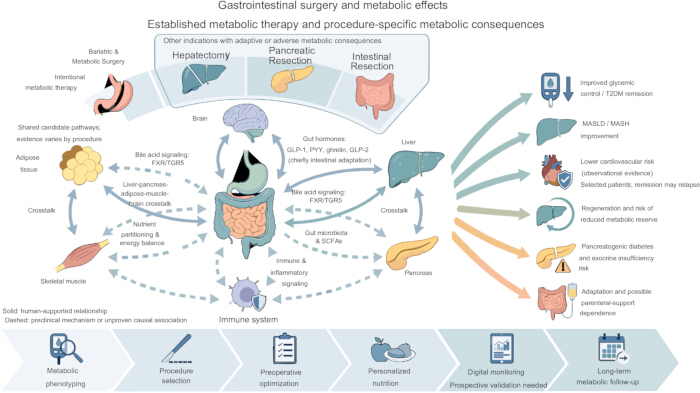
Figure 1. Gastrointestinal surgery and procedure-specific metabolic effects. Bariatric and metabolic surgery intentionally treats metabolic disease; hepatectomy, pancreatic resection and intestinal resection are usually performed for other indications and may produce adaptive, neutral or adverse metabolic consequences. Shared candidate pathways are distinguished from procedure-specific effects. Solid arrows denote human-supported physiological or clinical relationships; dashed arrows denote preclinical mechanisms or associations without established human causality. Arrow direction indicates the stated relationship, not its magnitude or universal occurrence. Abbreviations: GLP-1 = glucagon-like peptide-1; GLP-2 = glucagon-like peptide-2; PYY = peptide YY; FXR = farnesoid X receptor; TGR5 = Takeda G protein-coupled receptor 5; SCFAs = short-chain fatty acids; T2DM = type 2 diabetes mellitus; MASLD = metabolic dysfunction-associated steatotic liver disease; MASH = metabolic dysfunction-associated steatohepatitis. Please click here to view a larger version of this figure.
| Procedure | Metabolic risks and outcomes | Preoperative assessments | Postoperative monitoring and timing | Potential interventions | Evidence and limits |
| Bariatric and metabolic surgery | Diabetes remission or relapse; hypoglycemia; micronutrient deficiency and malnutrition. | HbA1c and fasting glucose; diabetes duration, insulin and other medications; BMI; nutrition and micronutrients; liver disease assessment. DiaRem/IMS may inform counseling in their validated settings. | Glucose/HbA1c, medications, weight, nutritional intake and symptoms. Selected biochemical checks at 3, 6 and 12 months, then at least annually; lifelong follow-up. Earlier review for hypoglycemia, vomiting or deficiency. | Adjust diabetes medication; individualized diet and micronutrient replacement; investigate symptomatic hypoglycemia or malabsorption. | Clinical trial evidence for glycemic effects [4,5]; observational liver outcomes [8]; prediction tools [15,16]; nutritional follow-up guidance [31,32]. Omics/AI selection remains investigational. |
| Hepatectomy | Reduced functional reserve and posthepatectomy liver failure; metabolic demands of regeneration. | Bilirubin, INR, liver biochemistry; remnant volumetry and locally validated functional assessment; steatosis, cholestasis, diabetes and nutritional/muscle status. | Serial bilirubin and INR during early recovery; glucose and nutritional status. ISGLS criteria apply on or after postoperative day 5. Later follow-up depends on functional recovery and underlying disease. | Optimize nutrition and diabetes management; tailor resection planning to reserve; evaluate persistent functional deterioration. | Regeneration mechanisms are largely experimental [20-22]; clinical failure definition [23]. Receptor-directed metabolic treatment and added omics risk markers require validation. |
| Pancreatic resection | New or worsening T3cDM; pancreatic exocrine insufficiency, maldigestion and weight loss. | Glucose/HbA1c and existing diabetes therapy; nutritional and muscle status; exocrine symptoms; planned extent of resection and residual pancreas. | Glucose during early recovery and HbA1c on follow-up; weight, dietary intake, stool symptoms and micronutrients as indicated. Evaluate exocrine function when symptoms or nutritional decline occur; interpret stool tests in context. | Pancreatic enzyme replacement when indicated; dietetic support; individualized glucose treatment and hypoglycemia education. | Clinical observational evidence and heterogeneous diagnostic methods [24-26]. No single metabolic follow-up interval is validated across all pancreatic resections. |
| Intestinal resection | Dehydration, electrolyte and micronutrient loss; malabsorption; short bowel syndrome and parenteral-support dependence. | Document residual bowel length and segments, colon continuity and ileocecal valve; baseline nutrition, fluid balance and support requirements. | Fluid balance, urine/stool output, electrolytes, renal function, weight and anatomy-specific micronutrients; track parenteral-support volume/days. Frequent assessment while unstable, then individualized follow-up during adaptation. | Enteral stimulation and individualized nutrition/hydration; anatomy-dependent management of bile-acid symptoms; parenteral support and GLP-2 therapy for eligible intestinal-failure patients. | Anatomical/physiological basis [27]; controlled teduglutide evidence [28], early human physiology [29] and rat adaptation [30]. Routine microbiome-directed treatment remains investigational. |
| Abbreviations | HbA1c: glycated hemoglobin | BMI: body mass index | DiaRem: diabetes remission score | IMS: Individualized Metabolic Surgery score | AI: artificial intelligence |
| INR: international normalized ratio | ISGLS: International Study Group of Liver Surgery | T3cDM: type 3c diabetes mellitus | GLP-2: glucagon-like peptide-2 | BOMSS: British Obesity and Metabolic Surgery Society |
Table 1: Procedure-specific metabolic assessment and follow-up. The table summarizes metabolic risks, preoperative assessment, postoperative monitoring and potential interventions. Established clinical practices are separated from proposed research extensions; the bariatric nutritional schedule is based on BOMSS guidance, while non-bariatric intervals require individualization.
Açıklamalar
The authors declare that they have no conflicts of interest. OpenAI ChatGPT was used to assist with language editing, editorial revisions and checking selected cited sources during manuscript revision. The authors reviewed and verified all content and take full responsibility for the final manuscript.
Teşekkürler
This work received no funding. There are no additional acknowledgments.
Kaynaklar
- Eisenberg D et al. 2022 American Society for Metabolic and Bariatric Surgery (ASMBS) and International Federation for the Surgery of Obesity and Metabolic Disorders (IFSO): Indications for metabolic and bariatric surgery. Surg Obes Relat Dis. 2022;18(12):1345-56.
- Pories WJ et al. Who would have thought it? An operation proves to be the most effective therapy for adult-onset diabetes mellitus. Ann Surg. 1995;222(3):339-50; discussion 350-2.
- Rubino F et al. Metabolic surgery in the treatment algorithm for type 2 diabetes: a joint statement by international diabetes organizations. Diabetes Care. 2016;39(6):861-77.
- Schauer PR et al. Bariatric surgery versus intensive medical therapy for diabetes - 5-year outcomes. N Engl J Med. 2017;376(7):641-51.
- Mingrone G et al. Bariatric-metabolic surgery versus conventional medical treatment in obese patients with type 2 diabetes: 5 year follow-up of an open-label, single-centre, randomised controlled trial. Lancet. 2015;386(9997):964-73.
- Sjöström L et al. Effects of bariatric surgery on mortality in Swedish obese subjects. N Engl J Med. 2007;357(8):741-52.
- Aminian A et al. Association of metabolic surgery with major adverse cardiovascular outcomes in patients with type 2 diabetes and obesity. JAMA. 2019;322(13):1271-82.
- Lassailly G et al. Bariatric surgery provides long-term resolution of nonalcoholic steatohepatitis and regression of fibrosis. Gastroenterology. 2020;159(4):1290-1301.e5.
- Laferrère B et al. Incretin levels and effect are markedly enhanced 1 month after Roux-en-Y gastric bypass surgery in obese patients with type 2 diabetes. Diabetes Care. 2007;30(7):1709-16.
- Patti ME et al. Serum bile acids are higher in humans with prior gastric bypass: potential contribution to improved glucose and lipid metabolism. Obesity (Silver Spring). 2009;17(9):1671-7.
- Ryan KK et al. FXR is a molecular target for the effects of vertical sleeve gastrectomy. Nature. 2014;509(7499):183-8.
- Liou AP et al. Conserved shifts in the gut microbiota due to gastric bypass reduce host weight and adiposity. Sci Transl Med. 2013;5(178):178ra41.
- Aron-Wisnewsky J et al. Major microbiota dysbiosis in severe obesity: fate after bariatric surgery. Gut. 2019;68(1):70-82.
- Askarpour M, Khani D, Sheikhi A, Ghaedi E, Alizadeh S. Effect of bariatric surgery on serum inflammatory factors of obese patients: a systematic review and meta-analysis. Obes Surg. 2019;29(8):2631-47.
- Still CD et al. Preoperative prediction of type 2 diabetes remission after Roux-en-Y gastric bypass surgery: a retrospective cohort study. Lancet Diabetes Endocrinol. 2014;2(1):38-45.
- Aminian A et al. Individualized metabolic surgery score: procedure selection based on diabetes severity. Ann Surg. 2017;266(4):650-7.
- Rashid M et al. Transcriptome changes and metabolic outcomes after bariatric surgery in adults with obesity and type 2 diabetes. J Endocr Soc. 2024;8(1):bvad159.
- Olsson LM et al. Gut microbiota responses to bariatric surgery are associated with metabolic outcomes and type 2 diabetes remission. Nat Metab. 2026;8(5):1212-28.
- Cao Y et al. Using a convolutional neural network to predict remission of diabetes after gastric bypass surgery: machine learning study from the Scandinavian Obesity Surgery Register. JMIR Med Inform. 2021;9(8):e25612.
- Michalopoulos GK, Bhushan B. Liver regeneration: biological and pathological mechanisms and implications. Nat Rev Gastroenterol Hepatol. 2021;18(1):40-55.
- Huang W et al. Nuclear receptor-dependent bile acid signaling is required for normal liver regeneration. Science. 2006;312(5771):233-6.
- Huang J, Rudnick DA. Elucidating the metabolic regulation of liver regeneration. Am J Pathol. 2014;184(2):309-21.
- Rahbari NN et al. Posthepatectomy liver failure: a definition and grading by the International Study Group of Liver Surgery (ISGLS). Surgery. 2011;149(5):713-24.
- Hart PA et al. Type 3c (pancreatogenic) diabetes mellitus secondary to chronic pancreatitis and pancreatic cancer. Lancet Gastroenterol Hepatol. 2016;1(3):226-37.
- Wei J et al. Mapping global new-onset, worsening, and resolution of diabetes following partial pancreatectomy: a systematic review and meta-analysis. Int J Surg. 2024;110(3):1770-80.
- Di Martino M et al. Pancreatic exocrine insufficiency after pancreatic resection: a systematic review. BMC Surg. 2025;25(1):53.
- Tappenden KA. Pathophysiology of short bowel syndrome: considerations of resected and residual anatomy. JPEN J Parenter Enteral Nutr. 2014;38(1 Suppl):14S-22S.
- Jeppesen PB et al. Teduglutide reduces need for parenteral support among patients with short bowel syndrome with intestinal failure. Gastroenterology. 2012;143(6):1473-81.e3.
- Jeppesen PB et al. Glucagon-like peptide 2 improves nutrient absorption and nutritional status in short-bowel patients with no colon. Gastroenterology. 2001;120(4):806-15.
- Scott RB, Kirk D, MacNaughton WK, Meddings JB. GLP-2 augments the adaptive response to massive intestinal resection in rat. Am J Physiol. 1998;275(5):G911-21.
- Stenberg E et al. Guidelines for perioperative care in bariatric surgery: enhanced recovery after surgery (ERAS) Society recommendations: a 2021 update. World J Surg. 2022;46(4):729-51.
- O'Kane M et al. British Obesity and Metabolic Surgery Society guidelines on perioperative and postoperative biochemical monitoring and micronutrient replacement for patients undergoing bariatric surgery-2020 update. Obes Rev. 2020;21(11):e13087.