Mental Rotation

1. Stimulus design.
- Present the stimuli for this experiment—letters and numbers, along with their mirror images (Figure 1)—in various rotations.

Figure 1. Sample stimuli for a mental rotation task. The top rows show two characters (R and 4) and a copy of each rotated. The bottom row shows a mirror image of each (on the right side of each pair) and a rotated version of each, as well. The mental rotation task involves identifying rotated versions of familiar characters and distinguishing them from rotated versions of their mirror images. - Use PowerPoint, Keynote, or a similar program to generate the stimuli.
- For this experiment, use the uppercase letter ‘R’ and the lowercase letter ‘g,’ along with the numbers ‘4’ and ‘7.’
- In PowerPoint, make one copy of each of the four characters. Use the Helvetica Light font for this experiment.
- Make a second copy of each character and flip them to produce a mirror image of each.
- Make 12 copies of each of the four characters and their mirror images.
- Rotate each of the 12 copies by an increasing increment of 15°. The original copy of each is 0°, the next is 15°, then 30°, and so on, until 180°. Reference Figure 2 to see the full set of stimuli used for this experiment.

Figure 2. A complete set of stimuli for the mental rotation task. Four characters (3, R, 4, and g), each paired with their mirror images and rotated in 15° increments between 0 and 180. - From the 13 rotated copies of each stimulus and its mirror image, generate the stimuli for each individual trial. A trial consists of one of the four non-mirror images printed at the top of a page. The bottom of the page includes that letter or number and its mirror image at one of the 12 rotations (Figures 3 and 4).
- Make a page for each trial of the experiment. Each of the four numbers/letters have 13 trial pages, so make sure there are 52 pages total and print them out.
- Number the backs of the pages 1-52. The number on each page is the number tag. The number a page is labelled with does not matter. However, when numbering the pages, also make a key, a table that reports the nature of the trial on each page and the correct answer (left or right), so responses can be associated with individual trials later. Create the key to look something like an Excel spreadsheet labelled “Mental Rotation Key” (Table 1).
| Number Tag | Character | Angle | Correct Answer |
| 1 | 3 | 60 | RIGHT |
| 2 | g | 75 | RIGHT |
| 3 | g | 30 | RIGHT |
| 4 | g | 60 | LEFT |
| 5 | g | 165 | RIGHT |
| 6 | 4 | 105 | LEFT |
| 7 | 3 | 15 | LEFT |
| 8 | 3 | 165 | LEFT |
| 9 | 4 | 180 | LEFT |
| 10 | R | 15 | RIGHT |
| 11 | g | 180 | RIGHT |
| 12 | g | 45 | RIGHT |
| 13 | g | 105 | RIGHT |
| 14 | 3 | 45 | RIGHT |
| 15 | 4 | 15 | LEFT |
| 16 | R | 60 | LEFT |
| 17 | R | 45 | LEFT |
| 18 | R | 150 | LEFT |
| 19 | g | 0 | RIGHT |
| 20 | R | 30 | LEFT |
| 21 | 3 | 120 | LEFT |
| 22 | 4 | 90 | LEFT |
| 23 | R | 75 | LEFT |
| 24 | 4 | 135 | RIGHT |
| 25 | 3 | 180 | LEFT |
| 26 | 4 | 45 | LEFT |
| 27 | R | 90 | RIGHT |
| 28 | 4 | 0 | LEFT |
| 29 | 4 | 120 | LEFT |
| 30 | 3 | 135 | RIGHT |
| 31 | R | 135 | LEFT |
| 32 | 3 | 30 | LEFT |
| 33 | 4 | 75 | LEFT |
| 34 | 3 | 105 | LEFT |
| 35 | 3 | 150 | LEFT |
| 36 | R | 105 | RIGHT |
| 37 | 4 | 60 | RIGHT |
| 38 | 4 | 30 | LEFT |
| 39 | R | 120 | RIGHT |
| 40 | R | 180 | RIGHT |
| 41 | g | 135 | RIGHT |
| 42 | 3 | 0 | LEFT |
| 43 | 3 | 90 | LEFT |
| 44 | 4 | 150 | RIGHT |
| 45 | 4 | 165 | LEFT |
| 46 | 3 | 75 | RIGHT |
| 47 | R | 165 | LEFT |
| 48 | g | 90 | RIGHT |
| 49 | g | 150 | RIGHT |
| 50 | g | 15 | LEFT |
| 51 | R | 0 | RIGHT |
| 52 | g | 120 | RIGHT |
Table 1. An example of a key that reports the nature of the trial on each page and the correct answer (left or right).

Figure 3. A sample test page for one trial of the mental rotation experiment. The participant must report whether the character on the left or the right (below the line) is the rotated ‘R’ (as opposed to its mirror image rotation).
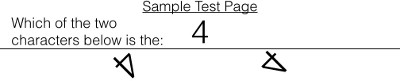
Figure 4. A sample test page for one trial of the mental rotation experiment. The participant must report whether the character on the left or the right (below the line) is the rotated ‘4’ (as opposed to its mirror image rotation).
- In order to associate results with the content of each trial, a place to record the results is needed, so make another spreadsheet with a column for the trial number, a column for the number tag of that trial, a column for the response given (right or left), and a column for the time it takes the participant to produce a response. Print out this response sheet.
- In addition, make a demo page to use in order to explain the instructions. Have it show an example of one of the characters, its mirror image, and some examples of the character at one of the rotations. Label it clearly (Figure 5).

Figure 5. An instruction sheet. This sheet presents one of the characters, its mirror image, and a rotation of each in order to facilitate explanation of the procedure to the participant.
- In addition to printed versions of the trial and demo pages, acquire a stopwatch for the experiment, and it is also useful to have an assistant to help with timing and recording responses.
2. Procedure.
- Use the demo page to explain the instructions to the participant: “This experiment will investigate your ability to rotate objects using visual imagery. On each trial, you will be asked to decide which one of two images is a rotated version of a familiar number or letter. The alternative will be a mirror image rotation of the same number or letter. Here is one example: the number 3. And here is its mirror image. In a trial, you will see the original 3, along with something like the two examples on the bottom of the page, the rotated 3 and a rotation of its mirror image. You will say “left” or “right” to indicate which one you think is the original. You should respond as quickly as possible without sacrificing accuracy. In other words, respond as soon as you are sure of the answer, but not sooner.”
- Shuffle the 52 test pages to randomize the order. After shuffling, enter the number tags of the trials in the order they will be presented in on the response sheet.
- Start the experiment. Place the stack of pages face-down between the experimenter and the participant, the number tags facing up.
- Have the assistant hold the stopwatch.
- On each trial, have the assistant say, “Go,” when they start the timer. At this signal, flip over the page for that trial. Have the participant study the page and say “right” or “left” to indicate which character is the answer for that trial.
- When the participant reports a response, have the assistant stop the timer. Then, record the response time and the answer given on the response sheet.
- Repeat this procedure for all 52 trials.
3. Analysis.
- When the experiment is done, analyze the data.
- Enter the handwritten number tags, responses, and response times into a digital copy of the response sheet, and save it with a new name, for example, “Participant 1 MR responses” (Table 2).
| Trial # | Number Tag | Response Given | Response Time | Number Tag2 | Character | Angle | Correct Answer | Answer Correct? |
| 4 | 1 | RIGHT | 4876 | 1 | 3 | 60 | RIGHT | 1 |
| 38 | 2 | RIGHT | 6758 | 2 | g | 75 | RIGHT | 1 |
| 40 | 3 | RIGHT | 3579 | 3 | g | 30 | RIGHT | 1 |
| 26 | 4 | LEFT | 8752 | 4 | g | 60 | LEFT | 1 |
| 10 | 5 | RIGHT | 6494 | 5 | g | 165 | RIGHT | 1 |
| 49 | 6 | LEFT | 6587 | 6 | 4 | 105 | LEFT | 1 |
| 16 | 7 | LEFT | 3434 | 7 | 3 | 15 | LEFT | 1 |
| 45 | 8 | LEFT | 9172 | 8 | 3 | 165 | LEFT | 1 |
| 35 | 9 | LEFT | 1856 | 9 | 4 | 180 | LEFT | 1 |
| 17 | 10 | RIGHT | 6818 | 10 | R | 15 | RIGHT | 1 |
| 12 | 11 | RIGHT | 4797 | 11 | g | 180 | RIGHT | 1 |
| 5 | 12 | RIGHT | 5378 | 12 | g | 45 | RIGHT | 1 |
| 21 | 13 | RIGHT | 3301 | 13 | g | 105 | RIGHT | 1 |
| 25 | 14 | RIGHT | 1393 | 14 | 3 | 45 | RIGHT | 1 |
| 33 | 15 | LEFT | 3937 | 15 | 4 | 15 | LEFT | 1 |
| 42 | 16 | LEFT | 5827 | 16 | R | 60 | LEFT | 1 |
| 31 | 17 | LEFT | 6004 | 17 | R | 45 | LEFT | 1 |
| 9 | 18 | LEFT | 6174 | 18 | R | 150 | LEFT | 1 |
| 46 | 19 | RIGHT | 6619 | 19 | g | 0 | RIGHT | 1 |
| 3 | 20 | LEFT | 2276 | 20 | R | 30 | LEFT | 1 |
| 18 | 21 | LEFT | 4176 | 21 | 3 | 120 | LEFT | 1 |
| 28 | 22 | LEFT | 7819 | 22 | 4 | 90 | LEFT | 1 |
| 24 | 23 | LEFT | 7368 | 23 | R | 75 | LEFT | 1 |
| 6 | 24 | RIGHT | 4984 | 24 | 4 | 135 | RIGHT | 1 |
| 47 | 25 | LEFT | 4495 | 25 | 3 | 180 | LEFT | 1 |
| 7 | 26 | LEFT | 5476 | 26 | 4 | 45 | LEFT | 1 |
| 50 | 27 | RIGHT | 7919 | 27 | R | 90 | RIGHT | 1 |
| 27 | 28 | LEFT | 7182 | 28 | 4 | 0 | LEFT | 1 |
| 48 | 29 | LEFT | 5793 | 29 | 4 | 120 | LEFT | 1 |
| 13 | 30 | RIGHT | 8986 | 30 | 3 | 135 | RIGHT | 1 |
| 36 | 31 | LEFT | 9457 | 31 | R | 135 | LEFT | 1 |
| 11 | 32 | LEFT | 7903 | 32 | 3 | 30 | LEFT | 1 |
| 29 | 33 | LEFT | 9703 | 33 | 4 | 75 | LEFT | 1 |
| 51 | 34 | LEFT | 9565 | 34 | 3 | 105 | LEFT | 1 |
| 1 | 35 | LEFT | 9341 | 35 | 3 | 150 | LEFT | 1 |
| 8 | 36 | RIGHT | 2849 | 36 | R | 105 | RIGHT | 1 |
| 52 | 37 | RIGHT | 2355 | 37 | 4 | 60 | RIGHT | 1 |
| 2 | 38 | LEFT | 2094 | 38 | 4 | 30 | LEFT | 1 |
| 32 | 39 | RIGHT | 7338 | 39 | R | 120 | RIGHT | 1 |
| 43 | 40 | RIGHT | 5431 | 40 | R | 180 | RIGHT | 1 |
| 37 | 41 | RIGHT | 2734 | 41 | g | 135 | RIGHT | 1 |
| 19 | 42 | LEFT | 5978 | 42 | 3 | 0 | LEFT | 1 |
| 14 | 43 | LEFT | 3305 | 43 | 3 | 90 | LEFT | 1 |
| 22 | 44 | RIGHT | 5273 | 44 | 4 | 150 | RIGHT | 1 |
| 41 | 45 | LEFT | 4472 | 45 | 4 | 165 | LEFT | 1 |
| 23 | 46 | RIGHT | 2353 | 46 | 3 | 75 | RIGHT | 1 |
| 34 | 47 | LEFT | 8211 | 47 | R | 165 | LEFT | 1 |
| 20 | 48 | RIGHT | 2049 | 48 | g | 90 | RIGHT | 1 |
| 44 | 49 | RIGHT | 9719 | 49 | g | 150 | RIGHT | 1 |
| 39 | 50 | LEFT | 9562 | 50 | g | 15 | LEFT | 1 |
| 15 | 51 | RIGHT | 1282 | 51 | R | 0 | RIGHT | 1 |
| 30 | 52 | RIGHT | 3548 | 52 | g | 120 | RIGHT | 1 |
Table 2. An example of a completed response sheet.
- Open the response key and sort by number tag. Cut and paste the contents of the response key into the sheet with the participant responses, so now there are columns reporting both the responses and response times of the participant, and the details of each trial.
- Add one more column to the end of the sheet, labelled “Response Correct?” Compare the response given with the correct response in each row, and enter a 1 in the response correct row if the answer given was correct or a 0 if it was not.
- Summarize the results. Average the “Response Correct?” column to see the overall proportion of trials with correct responses. This should be very high or perfect for most participants. Average the response time column to get a sense of the overall response times. That column can also be averaged while filtering by the letter on the trial and/or the orientation of the letter.
Source: Laboratory of Jonathan Flombaum—Johns Hopkins University
Visual mental imagery refers to the ability to conjure images in one’s mind’s eye. Th…
Chapters in this video
0:00
Overview
0:58
Experimental Design
2:16
Running the Experiment
3:45
Representative Results
4:28
Applications
5:35
Summary
Copyright © 2026 MyJoVE Corporation. All rights reserved.