Rodent Identification I

All animal procedures described here must be conducted in accordance with institutional animal ethics guidelines and approved by IACUC. All procedures must follow the principles of the 3Rs—Replacement, Reduction, and Refinement—and must be performed by trained personnel.
1. Ear punch identification
Ear punch codes have been developed as a quick and inexpensive method to label individual animals. There are three styles of ear punches: the scissor punch, the thumb punch, and the lever punch. The animal's right ear is used for single digits, the left ear for tens, and the middle of the ears for hundreds.
- Restrain the animal so that the ears are easily accessible. Most mice are ear tagged for individual identification at weaning. This requires gentle handling due to their smaller, more fragile size. Some mice are less likely to struggle if the hind limbs can rest on a surface such as a cage top or a counter top.
- Determine the ear punches needed to correspond to the animal's experimental number or to identify it within a cage.
- Punches will be notches or holes depending on the code used.
- The last number on the ear tag is often used as the ear punch identifier when it is the secondary method of identification.
- If animals are on a short-term study in stable cage groups, they can be given sequential numbers. This is often done when there are no ear tags present.
- Make the ear punch.
- To make a notch, the punch is placed on the edge of the ear pinna.
- To make a hole, place the ear in the punch so that the hole of the punch is positioned away from the pinna margin in the desired position.
- Apply pressure to the thumb or lever punch, or close the scissor punch quickly and firmly to cut through the skin of the ear.
- Gently lift the punch away from the ear when using the thumb or lever punches. Open the scissor punch to remove it from the ear.
- Avoid pulling or twisting the punch to prevent tearing the ear.
- Punches do dull after time. Should a punch fail to cut through the ear, release the punch and select a new ear punch. Reposition the new punch in the same spot.
- Clean the punches after each use.
- All punch types will dull if autoclaved. It is recommended that they be cleaned with a disinfectant and rinsed with alcohol. Dry them thoroughly to prevent rusting.
- Ear punches to be used for PCR are routinely soaked for 3 minutes in a solution to remove residual DNA or RNA. Before use they are rinsed in alcohol and wiped dry.
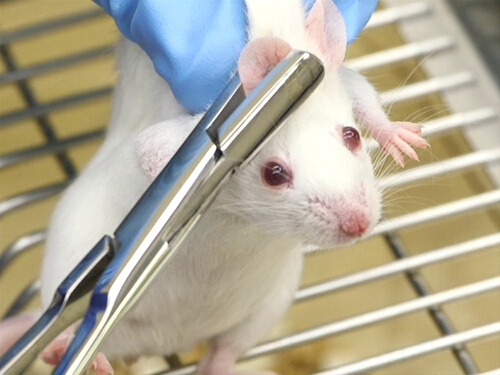
Figure 1. Ear punching in mice using scissor punch.
2. Ear tag identification
Customized ear tags can be ordered from manufacturers with alphabetical and/or numerical codes, which allows for the differentiation of mouse strains or investigators. Ear tags can be made of metal or plastic. Some plastic tags have QR codes which require the use of a compatible scanner or reader to access the encoded information. Unlike visual identification methods, QR codes cannot be interpreted without external devices such as smartphones or dedicated scanners. This reliance on external scanning devices represents a practical limitation, as access to appropriate equipment may not always be immediate in all facility settings and can impact workflow efficiency during routine procedures.
- Select the ear tags appropriate for the animals to be identified. There are several styles of appliers available from ear tag manufacturers. Be sure to order the applier that is for the specific size and style of ear tags being used.
- Gently remove a tag from the cardboard holder, and orient it into the applier so that the end with the hole is positioned over the notched area of the applier. The pointed end of the tag should be opposite the notch.
- Restrain the animal so that the ears are easily accessible. Animals may be less likely to struggle if the hind limbs can rest on a surface, such as a cage top or a counter top.
- Properly position the ear tag for placement.
- Position the point of the ear tag as deeply in the concha of the ear as possible, so the tag numbers face the back of the animal.
- To have the ear tag numbers facing the nose of the animal, place the point of the tag at the base of the pinna on the back of the ear.
- Apply the tag.
- Firmly squeeze the applier closed. The ear tag will pierce the ear and lock together.
- Release the applier, and the tagged ear will fall out of the applier.
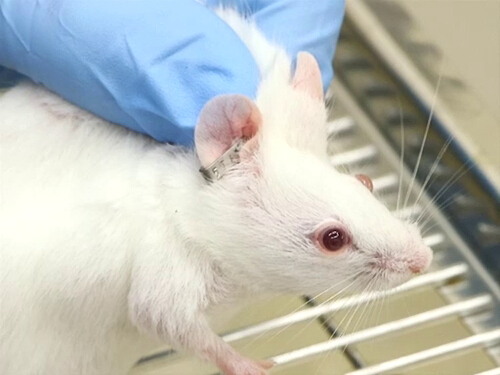
Figure 2. A mouse with an ear tag that is properly positioned on the pinna.
- Remove the metal ear tags.
NOTE: On occasion, metal ear tags can cause irritation and swelling of the ear. The swelling and irritation often leads to infections of the pinna. Treatment should include the removal of the tag; however, in cases of severe irritation or infection, the animal may need to be anesthetized.- Remove debris from around the tag with a cotton-tipped applicator moistened with an antiseptic solution.
- Cut across the top of the tag loop from edge-to-edge with wire cutters. Do not cut across the flat surface, as this will compress the tag, pinch the ear, and cause further damage.
- Avoid applying torque while cutting to prevent tearing the ear.
- Use hemostats to spread the cut ends of the ear tag apart.
- Gently guide the ear tag through-and out of-the ear using hemostats. Reduce trauma by avoiding the enlargement of the piercing hole and slipping the tag out so that the crimped end does not pass through the ear.
- Once the tag is gone, wipe the ear with an antiseptic-soaked cotton applicator stick.
- If there is a purulent discharge from the ear, follow-up treatment may be necessary and consultation with the veterinary staff for assessment is recommended.
Key Terms and Definitions
Ear tags are inexpensive and easy to perform, and as a result are commonly used for the identification of individual mice and rats. Tags can be custom-made with a series of numbers and/or letters. Assigning specific codes to a mouse/rat strain, or to a Principle Investigator (PI), aides in recordkeeping and database management, especially in large breeding colonies where there are multiple strains and PIs. In addition, there are a variety of tags commercially available. Metal tags have characters etched on them. Although this etching is clear, when working with a mouse it is often necessary to pick it up in order to read the code on the tags due to the small size of the tags. Other options are plastic tags with either numbers and/or letters on brightly colored backgrounds, or plastic tags with a barcode on the front surface. Both of these options allow the tags to be read without having to handle the animals. Another advantage to plastic tags is their compatibility with MRI imaging.
The positioning of the tag on the ear is critical, as improper positioning can have several unfortunate consequences. Tags must be placed such that they do not cause a bend in the pinna, interfere with the animal's mobility, or catch on any part of the caging. If the tag is placed too close to the edge of the ear it can easily be torn from the pinna tissue. If positioned too close to the head, the skin of the neck area can catch in the tag, which will create irritation, pain, and restricted movement. This can then lead to self-trauma from the animal scratching at the tag, ripping it from the ear, or getting a foot caught in the tag. Training for proper placement and technique is essential.
While tags provide individual identifiers for mice or rats, they are not infallible. Tags can be lost due to fighting, over-grooming, dermatitis in susceptible strains, infection, or self-trauma. Adult rats in particular are less tolerant of ear tags and often remove them, inflicting self-trauma. The more aggressive breeding behavior in rats can also lead to an ear tag being torn from the pinna. If mice or rats are paired or group-housed, the loss of an ear tag on more than one animal can be troublesome. To circumvent this problem, a secondary form of identification-such as a punch code used on the ear opposite of the tag, or a tail or toe tattoo-should be utilized. A facility should standardize both the choice of ear to be tagged and the code to be used on the other ear or on the toes. All codes should be indicated on the cage card.
The use of ear punch codes allows for a quick and simple method of identification, but the technique has limitations. Commonly used codes have an upper limit for numbers available for use, usually a maximum of 100 to 399. To read the ear punch codes, most animals must be grasped at the scruff. The punches can double as tissue samples for PCR genotyping, which allows for animal identification and genotype sampling to be accomplished simultaneously. This results in less stress to the animals from repeated handling.
There are three styles of ear punches: the scissor punch, the thumb punch, and the lever punch. Although all are equally effective, there are advantages and disadvantages to each. For example, as rats age, the skin of their ears thickens. It is best to perform the ear punches on young rats as they are weaned. For adult rats that require identification, the use of inhalant anesthesia should be considered. Ergonomically, the level punch is easier to use than a thumb punch, especially for the thicker ears of older rats. However, both of these punches require a pinching motion of the fingers. The scissor punch has the ergonomic advantage of not requiring a pinching motion, thus avoiding carpal tunnel fatigue and injury. In contrast, the thumb punch is advantageous for collecting genotyping samples, as the tips with the tissue material will fit into an Eppendorf tube. The style of punch to use should be determined by the individuals performing the task and the age of the rats.
For rats, although metal tags are most often used, studies have shown that there are consequences to using them. Inflammation, neoplastic changes, and even chronic pain have been observed in animals that have worn metal ear tags for several months.The tags should be promptly removed from the ear if there is an adverse reaction, and the subsequent injury should be examined and treated, if necessary, by the veterinary staff.
Proper care and maintenance of punches will extend their usage. All types of punches will dull if autoclaved, so it is recommended to clean them with a disinfectant and rinse them with alcohol. Then, they must be thoroughly dried to prevent rusting. If the punches are used for PCR, they should be soaked for 3 minutes in a solution that removes residual DNA or RNA. Before use they are rinsed in alcohol and wiped dry.
Questions that this video will help you answer
When choosing the appropriate identification method, many factors must be deliberated. Each technique has advantages and disadvantages that must be considered in relation to the experimental needs. While the costs must be weighed along with other factors, the ease of the technique and the level of discomfort to the animals should be the primary considerations.
Ear punching/notching is commonly used in mice and rats because there is little cost, and the procedure is easily done. To read the ear punch codes, most animals must be grasped at the scruff. However, the punches can double as tissue samples for PCR genotyping, which allows for identification and genotype sampling to be accomplished simultaneously, thus resulting in less stress to the animals from repeat handling.
Source: Kay Stewart, RVT, RLATG, CMAR; Valerie A. Schroeder, RVT, RLATG. University of Notre Dame, IN
A fundamental requirement of biomedical research…
Chapters in this video
0:00
Overview
0:47
Ear Punching: Code, Types, Benefits and Disadvantages
3:35
Method of Ear Punching
4:40
Ear Tagging: Types, Benefits and Disadvantages
5:56
Method of Applying and Removing an Ear Tag
9:05
Applications
10:20
Summary
Copyright © 2026 MyJoVE Corporation. All rights reserved.