Decision-making and the Iowa Gambling Task

Source: Laboratories of Jonas T. Kaplan and Sarah I. Gimbel—University of Southern California
Decision-making is an important component of human execu…
1. Participant recruitment
- Patient recruitment
- Recruit 10 patients with damage to the ventromedial sector of the prefrontal cortices.
- Damage to this region is confirmed by neuroimaging with MRI. The ventromedial prefrontal cortex is located at the most anterior medial wall of the cerebral cortex, on the ventral surface. Damage can be unilateral or bilateral, but should not extend beyond the ventromedial prefrontal cortex. An example of the brain of such a patient is shown in Figure 1.
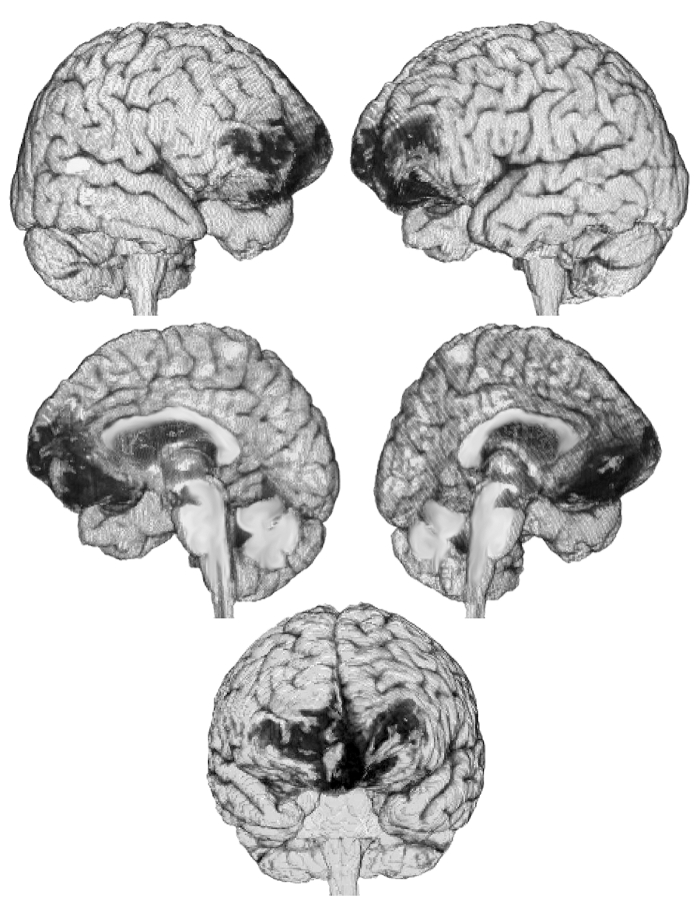
Figure 1: Computer reconstruction of the brain of a patient with VMPFC damage. This patient has bilateral damage to the medial prefrontal cortex, as shown in this 3D reconstruction made from MRI images. Images courtesy of Hanna Damasio.
- Control recruitment
- Recruit 20 participants without brain damage, who are matched in age and intellect with the patient population.
- Make sure that the participants have been fully informed of the research procedures and have signed all the appropriate consent forms.
2. Data collection
- In order to examine decision-making deficits in patients with ventromedial prefrontal cortex damage, patients and control participants will perform the Iowa Gambling Task.1
- Seat the participant at a table in front of four decks of identical-looking cards.
- Give the participant $2000 in play money.
- Provide instructions to the participant about how the experiment will unfold.
- Tell the participant that the game requires a series of card selections, turning over one card at a time from any of the four piles of cards.
- Tell the participant that the goal of the task is to maximize profit on the loan money.
- Tell the participant that after turning each card, they will receive a certain amount of money (predetermined for each card turn from each deck).
- Tell the participant they are free to switch from any deck to another, at any time, as often as they want.
- There is no time limit for the participant to choose a deck.
- Begin the task.
- After turning some cards, the participant is given money but also has to pay a penalty. The amount of the penalty is announced after the card is turned, and is predetermined for each card turn from each deck (known only to the experimenter; Figure 2). Give the participant the amount of play money that they earn, and tell them to hand the experimenter any money they have lost, before proceeding to the next turn.
- Turning a card from deck A or B yields $100, turning a card from deck C or D yields $50. Penalty amounts are higher in decks A and B than in decks C and D.
- Decks A and B are equivalent in terms of overall net loss over trials, but in deck A the punishment is more frequent and of lower magnitude than in deck B.
- Decks C and D are equivalent in terms of overall net gain, but in deck C the punishment is more frequent and of lower magnitude than in deck D.
- Use the preprogrammed schedule of reward and punishment on the score card (Figure 2).
- For example, if the participant first chooses a card from Deck A, they get a $100 reward and no punishment.
- If the second card choice is also from Deck A, they get a $100 reward and no punishment.
- If the third card choice is also from Deck A, they get a $100 reward and a $150 punishment.
- Keep track of the card turns by marking each of the 100 turns in the appropriate cell in Figure 2.
- The participant makes 100 card turns, choosing a card from any deck each time. Since there are only 40 cards in each deck, they might run out of cards in a given deck before the end of the experiment.
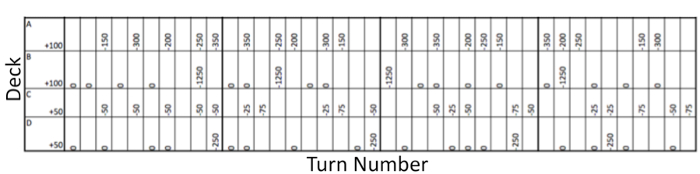
Figure 2: Programmed schedule of reward and punishment. This chart is used by the experimenter to determine the reward and punishment for each card turn. The participant is rewarded with the dollar amount in the first column, and is presented with a punishment based on the schedule detailed in the following columns. Each row represents one deck of cards, either A, B, C, or D. For each card turn from that deck, the participant receives the dollar amount in the first cell. Each column represents the card turn from that deck. For example, the first two turns from deck A have no penalty, then the third turn from deck A has a $150 penalty. There are 40 cards in each deck, each represented by a column in the chart. Please click here to view a larger version of this figure.
3. Data analysis
- Observe and compare the timeline of responses for control and patient populations. Then, to analyze patients' performance and compare their performance to normal performance, use an analysis of variance (ANOVA) to examine the number of cards from each deck chosen by normal controls and by patients. The ANOVA should have the variables of group (controls vs. patients) and choice (A, B, C, D).
- A subsequent Newman-Keuls t-test can be used to show which pairwise differences contribute to significance of the ANOVA.
Decision-making is an important component of human executive function, one in which a choice about a course of action is made from many possibilities.
For instance, a person?s ability to obtain a beverage could result from making good decisions, like choosing to go to the cash register and pay for it, or?poor ones, such as running out the door without paying.
This latter example?the risky act of stealing?is considered an undesirable decision, one that occurs as a result of damage to the frontal lobes?and in particular, the ventromedial prefrontal cortex, VMPFC for short.
This video demonstrates how to design and execute the Iowa Gambling Task?a highly sensitive measure of complex decision-making ability?where individuals must integrate information about losses and gains over the course of a high-risk card game.
In this experiment, two groups of participants?patients with known damage to the VMPFC and controls, individuals without such damage?perform the Iowa Gambling Task, which examines decision-making ability dealing with reward and punishment.
All are shown four decks?labeled A through D?that contain identical-looking cards and given play money to use, as the overall goal is to maximize profit.
During each turn, participants choose one card from any of the four piles and subsequently receive a certain amount of predetermined money that only the researcher knows.
For instance, they might pick a card that results in not only winning money but also losing some. Or, they may even lose more than they win. The trick then is to understand the risk associated with every deck.
Although A and B yield greater rewards than C and D, they also result in higher penalties and thus, lead to losses in the long term. Decks A and B result in the same long term losses, but the punishment in A is more frequent and of lower magnitude than in B.
Overall, choosing from A and B will result in net losses, while choosing from C and D will result in net gains, which is why sets A and B are referred to as bad, and C and D as good.
Thus, to make advantageous choices, participants must integrate information about losses and gains over time and avoid the bad sets.
The dependent variable here is the number of card turns the participant makes from each of the four decks.
Based on previous work by Bechara, Damasio, and colleagues, patients with VMPFC damage are expected to make more selections from the bad ones?A and B?and avoid choosing from the good?C and D?mimicking their real-life inability to make valuable decisions.
For the purpose of this demonstration, test a patient with known cortical damage. Note that their data will be compared to those collected from controls without brain damage, who are also matched in age and intellect.
In preparation for the task, seat the patient at a table in front of four decks of identical-looking cards, and hand them $2000 in play money.
Instruct them that they must choose one card at a time from any of the four piles, and after flipping each card, they will receive a certain amount of money.
Further inform them that they are free to switch between decks at any time, as often as they want, and to take their time, in order to maximize their profit on the loan money.
Begin by having the patient make their first selection, and announce the amount of the reward or penalty according to the scorecard. Give them the amount of play money that they earn, and tell them to hand back any money they have lost before proceeding to the next turn.
Keep track of every card turn by marking the appropriate cell of the scorecard. In the event that a deck is completed before the experiment is over, notify the patient that they can now only choose from the three remaining decks. End the task when 100 cards have been turned.
To examine participants? decisions over time, plot the deck selections across the course of the 100 trials?separately for controls versus patients with VMPFC damage.
While controls initially sampled from the bad decks, they eventually learned to avoid them. Patients, on the other hand, continued to sample from the bad ones throughout the experiment.
To make group comparisons, summarize these data into a bar graph, where the total number of card turns is plotted across decks.
Notice how normal controls made more selections from the good decks?C and D?and avoided the bad?A and B. On the other hand, patients with VMPFC damage made more selections from the bad sets, and largely avoided the good ones.
These results indicate that patients with frontal brain damage perform differently in this task compared to healthy controls, such that they more frequently draw from the high reward/high punishment decks, even though those decisions result in long-term losses.
Now that you are familiar with using the Iowa Gambling Task to quantify risky outcomes in patients with frontal lobe damage, let?s look at how the paradigm can be used to assess decision-making in a variety of populations, including individuals with amygdala damage and those diagnosed with schizophrenia.
While the role of the PFC in decision-making is well studied, other brain regions contribute to implementing advantageous versus disadvantageous choices.
Given the amygdala?s role in processing incentive stimuli, damage to this region would likely disrupt the integration of reward and punishment states vital to the gambling task.
Using a similar paradigm, researchers have shown that patients with bilateral amygdala damage also show severe decision-making impairments.
Just like patients with VMPFC damage, individuals with schizophrenia also choose from bad decks; however, they show a distinctive pattern of choices, making more selections from the low frequency but high magnitude losses?decks B and D.
These results indicate that schizophrenic patients are sensitive to reward versus punishment, but fail to advantageously take into account the magnitude of the punishment.
Thus, the Iowa Gambling task can be used to reveal a range of cognitive contributions to decision-making that may be associated with different underlying deficits.
You?ve just watched JoVE?s introduction to quantifying decision-making in the laboratory using the Iowa Gambling Task. Now you should have a good understanding of how to administer this paradigm by observing and responding to different card choices, as well as how to analyze and interpret the results.
Thanks for watching!
View the full transcript and gain access to JoVE Science Education videos
Q1: What is the Iowa Gambling Task and why is it used in research?
The Iowa Gambling Task is a laboratory measure designed to assess complex decision-making ability by having participants choose cards from four decks while managing rewards and penalties. It mimics real-life decision-making and is widely used in research and clinical studies as a highly sensitive tool for quantifying decision-making deficits that are difficult to measure outside the laboratory.
Q2: How do the four decks in the Iowa Gambling Task differ in terms of risk and reward?
Decks A and B offer higher immediate rewards but carry substantial penalties, resulting in long-term net losses. Decks C and D provide lower payoffs with smaller penalties, yielding long-term net gains. Deck A has frequent, low-magnitude punishments, while Deck B has infrequent, high-magnitude punishments. Advantageous decision-making requires participants to integrate information about losses and gains over time and favor the good decks.
Q3: What brain region is critical for making advantageous decisions in the gambling task?
The ventromedial prefrontal cortex (VMPFC) is essential for advantageous decision-making. Damage to this region impairs the ability to integrate reward and punishment information, leading individuals to persistently choose from high-risk, high-penalty decks despite long-term losses. This mirrors real-life decision-making deficits observed in patients with frontal lobe damage.
Q4: How do patients with VMPFC damage perform differently from healthy controls on the task?
Healthy controls initially sample from bad decks but eventually learn to avoid them and prefer good decks. Patients with VMPFC damage, by contrast, continue selecting from bad decks throughout the experiment and largely avoid good ones. This pattern demonstrates that frontal lobe damage disrupts the learning mechanism necessary for making advantageous choices over time.
Q5: What does amygdala damage reveal about decision-making in the gambling task?
Patients with bilateral amygdala damage show severe decision-making impairments similar to those with VMPFC damage. Because the amygdala processes incentive stimuli, its damage disrupts the integration of reward and punishment states vital to advantageous gambling task performance, indicating that multiple brain regions contribute to complex decision-making.
Q6: How do individuals with schizophrenia differ from other patient groups in their gambling task choices?
Individuals with schizophrenia also prefer bad decks but show a distinctive pattern: they make more selections from decks with low-frequency but high-magnitude losses. This indicates they are sensitive to reward versus punishment but fail to account for penalty magnitude when making decisions, revealing a different underlying cognitive deficit than VMPFC or amygdala damage.
Q7: How is the Iowa Gambling Task administered and what data does it generate?
Participants receive play money and choose one card per turn from four decks, receiving predetermined rewards or penalties. The researcher tracks card selections across 100 trials. Data are analyzed by plotting deck selections over time and comparing total card turns per deck between groups. This reveals whether participants learn to avoid disadvantageous choices and how brain damage affects decision-making patterns.