15.18
View the full transcript and gain access to JoVE Core videos
Q1: What is the mechanism of E1 elimination in aldol dehydration?
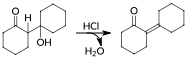
The E1 elimination mechanism proceeds through two distinct steps: ionization and deprotonation. First, the acid protonates the hydroxyl group to form a hydrated hydroxyl group, which then departs as a water molecule to generate a tertiary carbocation intermediate. Finally, a chloride ion abstracts a hydrogen atom from the α carbon to form the enone product.
Q2: How does a β-hydroxy ketone transform into an enone under acidic conditions?
Under acidic conditions, the β-hydroxy ketone undergoes dehydration via an E1 elimination reaction to form an enone. The process begins when acid protonates the hydroxyl group, creating a hydrated hydroxyl group that departs to form a tertiary carbocation intermediate. Subsequent deprotonation at the α carbon yields the enone as the final product.
Q3: What role does the tertiary carbocation play in aldol dehydration?
The tertiary carbocation intermediate is a critical intermediate formed after the hydrated hydroxyl group departs from the β-hydroxy ketone. This carbocation is then attacked by a chloride ion, which abstracts a hydrogen atom from the α carbon, completing the E1 elimination and forming the enone product.
Q4: Why is acid catalysis necessary for converting β-hydroxy ketones to enones?
Acid catalysis is essential because it protonates the hydroxyl group, converting it into a better leaving group. This protonation enables the hydroxyl group to depart as a neutral water molecule, facilitating the formation of the tertiary carbocation intermediate that drives the E1 elimination mechanism forward.
Q5: What is the relationship between aldol condensation and enone formation?
Aldol condensation produces a β-hydroxy ketone intermediate, which then undergoes dehydration to form an enone. This dehydration step completes the overall aldol condensation reaction, converting the initial aldol addition product into a conjugated enone through acid-catalyzed E1 elimination and forming the final product.
Q6: How does the α carbon participate in the final step of aldol dehydration?
In the final step of aldol dehydration, the α carbon is the site where a hydrogen atom is abstracted by a chloride ion. This deprotonation of the α carbon generates a double bond between the α and β carbons, completing the formation of the enone product and the E1 elimination mechanism.
Q7: What distinguishes acid-catalyzed aldol dehydration from base-catalyzed dehydration?
Acid-catalyzed aldol dehydration uses an E1 elimination mechanism to convert β-hydroxy ketones into enones through protonation and carbocation formation. Base-catalyzed dehydration proceeds through a different mechanism to form enals rather than enones, representing a distinct pathway for aldol product transformation.