33.7
View the full transcript and gain access to JoVE Core videos
Q1: Why must electric and magnetic fields be perpendicular in electromagnetic waves?
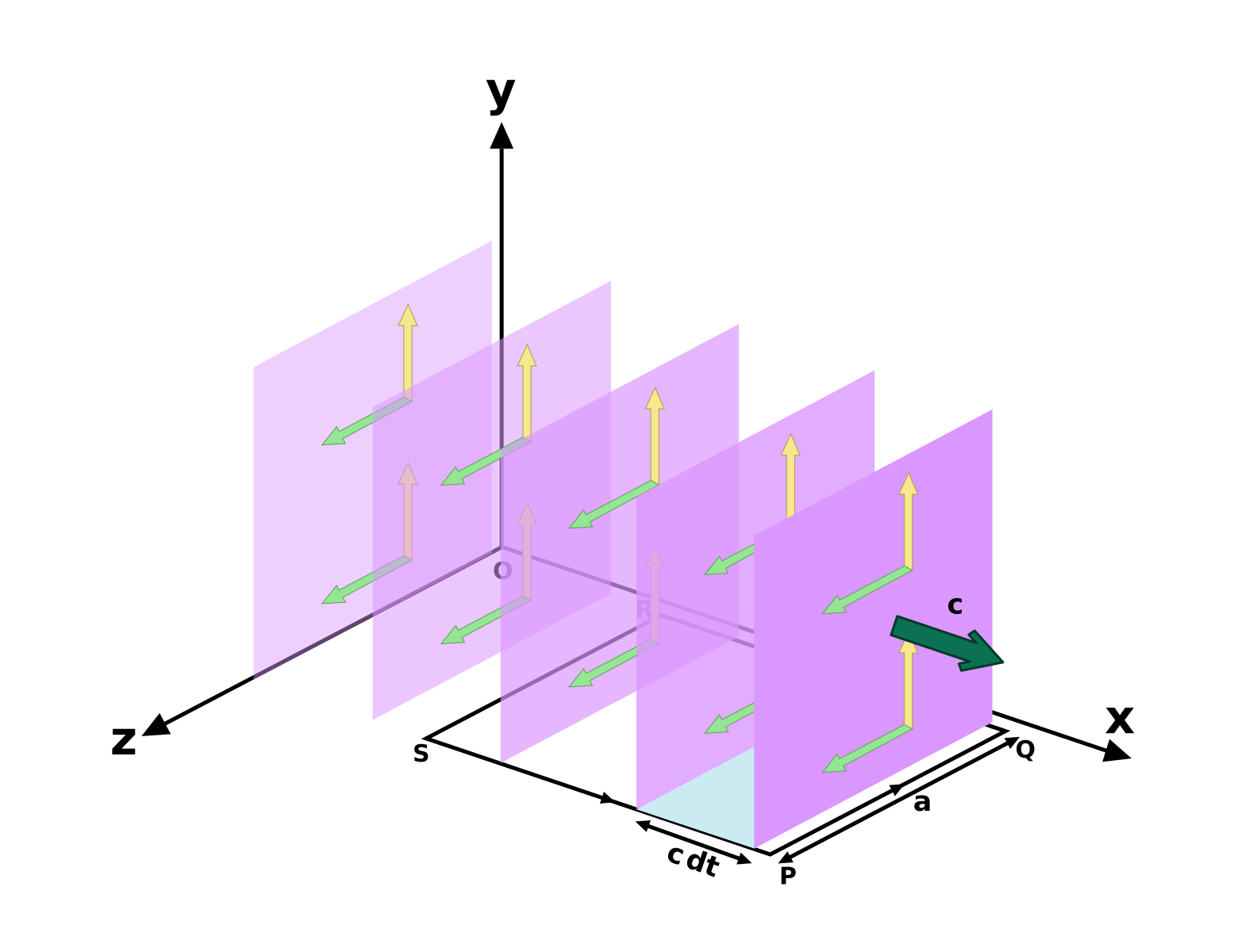
Ampere's law requires a non-zero magnetic field contribution around a rectangular loop in a plane wavefront. For this to occur, the electric field must have a component perpendicular to the loop's plane, enabling a time-varying electric flux. This geometric constraint forces the electric and magnetic fields to remain mutually perpendicular throughout the wave's propagation.
Q2: How does Ampere's law relate to electromagnetic wave propagation?
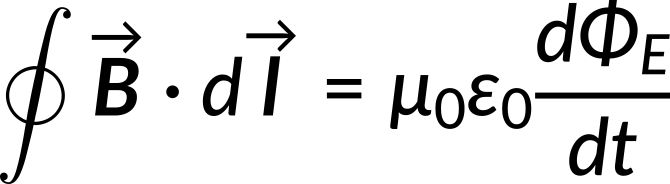
Ampere's law states that a changing electric flux produces a magnetic field. In a plane wavefront traveling through space, the time-varying electric field creates a non-zero magnetic field circulation around a rectangular loop. This mutual relationship between changing electric and magnetic fields, combined with Faraday's law, determines the wave's propagation speed through vacuum.
Q3: What does it mean when electromagnetic waves are consistent with Maxwell's equations?
Electromagnetic waves satisfy all four Maxwell's equations simultaneously. When expressions derived from Ampere's law and Faraday's law are compared for a propagating plane wavefront, they yield identical wave speed predictions. This consistency confirms that electromagnetic waves are fundamental solutions to Maxwell's equations, validating the theoretical framework of electromagnetism.
Q4: How is the speed of light derived from electromagnetic theory?
By applying Ampere's law and Faraday's law to a plane wavefront, the propagation speed can be expressed in terms of vacuum permeability and permittivity. Substituting the numerical values of these constants yields a speed of 299,792,458 m/s, which is recognized as the speed of light. This derivation demonstrates that light is an electromagnetic wave.
Q5: What role does the time derivative of electric flux play in Ampere's law?
The time derivative of electric flux represents the displacement current in Ampere's law. As the electric field in a plane wavefront changes with time, this changing flux generates a magnetic field. The rate of change of electric flux is directly proportional to the magnetic field circulation, establishing the dynamic coupling between electric and magnetic fields in propagating waves.
Q6: Why does only one side of a rectangular loop contribute to the magnetic field integral?
In a plane wavefront traveling in the x-direction, the magnetic field is either zero or perpendicular to most loop segments. Only the segment parallel to the magnetic field direction contributes a non-zero value to the line integral around the rectangle. This selective contribution reflects the spatial orientation of the electromagnetic wave and determines the net circulation needed to satisfy Ampere's law.
Q7: How do Ampere's law and Faraday's law work together to determine wave speed?
Ampere's law relates changing electric flux to magnetic field circulation, while Faraday's law relates changing magnetic flux to electric field circulation. When both laws are applied to a plane wavefront, they produce expressions for propagation speed. Comparing these independent expressions yields the same result, confirming that electromagnetic waves propagate at the speed of light through vacuum.
Explore Related Chapters