This protocol outlines a comprehensive neuropeptidomics workflow in rat brain tissue that combines data-dependent acquisition-parallel accumulation-serial fragmentation (DDA-PASEF) and data-independent acquisition (DIA) mass spectrometry.
Method Article
Neuropeptide Characterization Workflow from Sampling to Data-Independent Acquisition Mass Spectrometry
Opens in a new tab
In This Article
Summary
Loading...
$$\rightleftharpoonup{xx}$$
$$\longleftharp{xx}$$,
$$\longrightharp{xx}$$,
Abstract
Loading...
$$\rightleftharpoonup{xx}$$
$$\longleftharp{xx}$$,
$$\longrightharp{xx}$$,
Endogenous neuropeptides are key modulators of brain function, playing critical roles in behavior, stress, pain, and homeostatic regulation, yet their analysis remains difficult. Biologically, they are low in abundance, rapidly degraded, and processed variably from precursor proteins, with expression limited to small, localized cell populations. Technically, their detection is complicated by a wide dynamic range, diverse post-translational modifications, and sparse signals in mass spectrometry datasets. This protocol outlines a comprehensive workflow for neuropeptide analysis in Rattus norvegicus brain tissue using both data-dependent acquisition (DDA) and data-independent acquisition (DIA) mass spectrometry (MS) on a timsTOF platform. Following optimized brain sample preparation, including dissection, peptide extraction and clean-up, nano liquid chromatography (LC)-MS is performed with ion mobility gas-phase fractionation to improve detection sensitivity and accuracy. The DDA-generated spectral library supports DIA-based quantification in Skyline, enabling high-confidence MS2-level measurements. This integrated workflow increases neuropeptide coverage and enhances quantitative reproducibility, providing a robust platform for studying neuropeptides in complex brain tissue.
Introduction
Loading...
$$\rightleftharpoonup{xx}$$
$$\longleftharp{xx}$$,
$$\longrightharp{xx}$$,
Neuropeptides are a functionally diverse class of endogenous signaling molecules that serve as critical modulators of neuronal communication, nervous and neuroendocrine system functions. Acting as neuromodulators, hormones, or co-transmitters, they influence a wide range of physiological processes, including pain modulation, stress response, circadian regulation, and appetite control. Unlike classical neurotransmitters, which are synthesized as small molecules, neuropeptides are encoded within large precursor proteins that are synthesized through translation of mRNA. Precursor proteins, or prohormones, then undergo proteolytic processing to release the active peptides, which are packaged into dense-core vesicles (DCVs). Upon stimulation, neuropeptides are released to exert modulatory, typically slower and more prolonged effects through interactions with G-protein-coupled receptors. Their importance in maintaining central and peripheral nervous system function has made them an area of intense biological and clinical interest1,2,3,4,5.
Despite their relevance, neuropeptides remain analytically challenging to characterize. Their highly heterogeneous structures -- ranging from short to extended sequences, often bearing diverse post-translational modifications (PTMs) such as amidation, acetylation, phosphorylation, amino acid isomerization, or truncation -- lead to variability in ionization and fragmentation behaviors in mass spectrometry (MS)1,6,7,8. Furthermore, they are typically present at low concentrations relative to biological matrix components, easily degraded, and are localized in a spatially restricted manner within the complex tissue of the nervous system. These features complicate both identification and quantification, particularly when using traditional proteomics approaches that rely on predictable enzymatic digestion and uniform peptide properties9,10,11.
Here, we present a comprehensive strategy for the identification and quantification of endogenous peptides in the brain of Rattus norvegicus, with a specific emphasis on neuropeptides. The workflow here begins with optimized brain sampling procedures, followed by extensive liquid chromatography (LC) separations, and concludes with high-resolution MS analysis using parallel accumulation-serial fragmentation (PASEF) on a trapped ion mobility spectrometry (TIMS) platform12,13,14,15,16. By incorporating ion mobility gas-phase fractionation (IM-GPF) prior to precursor selection, the data-dependent acquisition-PASEF (DDA-PASEF) approach enables improved precursor separation and the enhanced detection of low-abundance neuropeptides, many of which would otherwise be missed in unidimensional DDA workflows17.
While DDA remains the most commonly used strategy in peptide identification due to its high-quality MS/MS spectra, it is inherently limited by its reliance on precursor ion selection by intensity, which biases against low-abundance species18,19,20. Moreover, its semi-stochastic sampling leads to missing values across replicates, hindering reproducible quantification. To overcome these limitations, we constructed a robust spectral library using our DDA-PASEF data, which can be subsequently employed for data-independent acquisition (DIA) analysis. In contrast to DDA, DIA samples all precursor ions within defined m/z windows, ensuring consistent sampling of both abundant and rare peptides, and when combined with the spectral library and targeted analysis in Skyline, allows for sensitive and reproducible MS2-level quantification21,22,23,24.
This integrative approach -- spanning brain peptide extraction, chromatographic separation, ion mobility-enhanced MS acquisition, and hybrid DDA/DIA-based quantification -- was developed with the complexity of neuropeptides in mind. It maximizes peptide coverage while minimizing data loss, addressing key limitations of a simpler DDA-driven peptidomics. As such, we present a flexible and powerful platform for exploring the neuropeptide landscape in the mammalian brain, which can be readily adapted to a wide range of experimental questions and tissue samples.
Protocol
Loading...
$$\rightleftharpoonup{xx}$$
$$\longleftharp{xx}$$,
$$\longrightharp{xx}$$,
All animal experiments in this study were conducted in accordance with the animal use protocol approved by the Illinois Institutional Animal Care and Use Committee (23228) with strict adherence to both national and ARRIVE standards for the ethical treatment and care of animals.
1. Animal dissection and brain isolation
- Perform cold saline perfusion immediately followed by tissue snap freezing to preserve neuropeptide integrity, minimize degradation artifacts, and enhance data quality for downstream peptidomic analysis.
- Euthanize the rat using the CO2 method following institutional animal care guidelines. Confirm death by absence of heartbeat and lack of reflexes.
- Place the rat supine; make an incision to expose the thoracic cavity.
- Make a small incision in the left ventricle of the heart.
- Make a small incision in the right atrium to allow blood and perfusion solution outflow.
- Insert a cut-to-size plastic pipette tip attached to a 60 mL syringe filled with 50 mL of ice-cold physiological solution (e.g., 0.9% saline or mGBSS) into the left ventricle.
- Perfuse the animal body with the solution. Decapitate the rat using sharp scissors or a guillotine.
- Remove skin and skull overlying the brain with rongeurs or fine scissors.
- Carefully lift the brain from the cranial cavity, cutting cranial nerves as needed.
- Immediately freeze the brain on dry ice or snap-freeze in isopentane chilled on dry ice.
- Transfer to labeled cryovials or foil, then store at -80 °C.
2. Peptide extraction from rat brain tissue
- For whole brain samples, weigh each frozen tissue quickly using an analytical balance. Homogenize the tissue using LC-MS grade solution containing 10% glacial acetic acid and 1% water in methanol, using a 10:1 (v/w) solvent-to-tissue ratio.
- Incubate the homogenized samples on ice for 20 min.
- Centrifuge the samples at 16,000 × g for 20 min at 4 °C. Carefully collect the supernatant without disturbing the pellet.
- Resuspend the pellet in LC-MS grade water, using a 10:1 (v/w) solvent-to-tissue ratio, and repeat the incubation on ice for 20 min.
- Centrifuge again under the same conditions (16,000 × g, 20 min, 4 °C), and collect the second supernatant.
- Combine both supernatants and transfer 1/10 of the total volume to a new tube for downstream processing. Dry this aliquot using a vacuum concentrator until completely dry. Store the remaining extract at -80 °C for future use.
3. Solid phase extraction (SPE) using C18 spin columns
NOTE: All solvents should be LC-MS grade. Unless otherwise noted, centrifugation steps are performed at 1,500 × g at room temperature using a benchtop centrifuge.
- Reagent preparation
- Prepare activation solution (A): 50% acetonitrile/50% 0.1% formic acid in water.
- Prepare equilibration and wash solution (B): 0.1% formic acid in water.
- Prepare elution solution (C): 50% acetonitrile/50% 0.1% formic acid in water.
- Sample preparation
- Reconstitute the dried peptide extract in 200 µL of solution (B).
- Centrifuge the sample at 16,000 × g for 10 min at 4 °C.
- Carefully collect the supernatant for SPE.
- Column conditioning and equilibration
- Add 150 µL of solution (A) to the C18 spin column.
- Centrifuge for 1 min at 1,500 × g.
- Repeat steps 3.3.1 and 3.3.2 two times to ensure complete activation.
- Add 150 µL of solution (B).
- Centrifuge for 1 min.
- Repeat steps 3.3.4 and 3.3.5 two times.
- Sample loading and washing
- Load 200 µL of the prepared sample solution onto the column.
- Centrifuge for 1 min.
- Reload the flowthrough back onto the column three times to maximize peptide retention.
- Add 150 µL of solution (B).
- Centrifuge for 1 min.
- Repeat steps 3.4.4 and 3.4.5 three times to remove non-retained contaminants.
- Peptide elution
- Add 150 µL of elution solution (C) to the column.
- Centrifuge for 1 min.
- Repeat elution steps 3.5.1-3.5.2 once more.
- Combine both eluates and store on ice or proceed to drying under vacuum.
4. LC-MS/MS Analysis
- Prepare solution (A): 0.1% formic acid in water, solution; (B): 0.1% formic acid in acetonitrile, solution; (C): 25 fmol/µL retention time standard (iRT) 0.1% formic acid in water.
- Resuspend the samples in 20 µL solution (C) prior to LC-MS injection.
NOTE: Two biological samples were analyzed, and each was injected five times for both DDA and DIA runs, resulting in five technical replicates per method per sample. - Perform the peptide separation using a high-performance liquid chromatography (HPLC) system, with mobile phase A consisting of solution (A) and mobile phase B consisting of solution (B).
- Load 1 µL of samples onto a twenty-five C18 analytical column (150 µm × 250 mm, 1.9 µm particles, 120 Å pore size) and maintain at 40 °C throughout the run.
- Carry out the LC separation at a flow rate of 600 nL/min using the following gradient profile: 0-5 min: 2-10% B; 5-85 min: 10-45% B; 85-87 min: 45-50% B; followed by high organic wash and re-equilibration.
NOTE: The LC was directly coupled to a timsTOF MS via an ion source. - For DDA analysis, use the default application method DDA PASEF-standard_1.1sec_cycletime on timsTOF MS.
- Briefly, operate the mass spectrometer in PASEF mode with dynamic exclusion enabled. Set each cycle to consist of 10 PASEF MS/MS scans over a 1.1 s duty cycle.
- Set the mass range to m/z 100-1700, and the ion mobility range from 0.60 to 1.60 V·s/cm2, using a ramp time of 100.0 ms. Ramp the collision energy from 20.0 to 59.0 eV as a function of ion mobility.
- Ion mobility gas phase fractionation (IM-GPF)
- Segment the ion mobility range of 0.6-1.6 V·s/cm2 into three overlapping windows: 0.6-1.0, 0.9-1.3, and 1.2-1.6 V·s/cm2.
- To do this, change the mobility start and end values in the TIMS setting tap of timsControl or timsControl editor to the corresponding window values.
- Acquire data for each window. For all ion mobility acquisition windows, use a constant accumulation and ramp time of 100 ms.
- Acquire data in DDA-PASEF mode using the same parameters detailed in step 4.6.
- For DIA analysis, employ an isolation window width of 25 m/z across the mass range of 400-1200 m/z. Employ the same ion mobility experimental (IMEX) settings used in the DDA method.
- Additional DIA settings include one MS1 ramp followed by 16 MS/MS ramps per cycle, yielding a total cycle time of 1.8 s.
- Use the default proteomics DIA-PASEF method as a template for DIA method development. After creating the DIA method, load it into the method tab of Hystar. No activation of DIA mode is required.
NOTE: The DIA method will automatically be registered once successfully loaded.
5. Data processing
NOTE: Following data acquisition, peptide identification should be performed using bioinformatics tools such as PEAKS Online, PEAKS Studio, MSFragger, Maxquant, or similar platforms. This study used Peaks Online, capable of working with raw data in .d format.
- Database search
- Use an appropriate reference database for peptide searches, such as a curated rat signaling peptide database, a rat proteome, or the human proteome, or a curated signaling peptide database based on the sample source.
NOTE: These databases can be obtained from reliable sources such as NCBI or UniProt (https://www.uniprot.org/). Note only protein or peptides in the database will be identified. Rat signal data was curated by filtering the rat proteome by the "Signal peptide" annotation in UniProt. In the Uniprot terms, filtering by "Signal peptide" means narrowing down the proteome to proteins involved in secretion, membrane localization, or compartmental trafficking. This custom database contains 5630 proteins. Limiting the size of the protein database from 50,000 to 5,000 offers several advantages. First, it enhances identification confidence by reducing the likelihood of random peptide-spectrum matches, thereby increasing the accuracy of peptide assignments. Second, a smaller database improves computational efficiency, allowing for faster processing times and reduced demand for computational resources. Third, a more concise database can lead to better control of the false discovery rate (FDR), resulting in more reliable and statistically robust protein identifications. However, the database needs to be relatively large to avoid artificial inflation of confidence scores and inaccurate FDR estimation. - Configure the database search in the program GUI with the following recommended parameters: Precursor mass error tolerance: 10-25 ppm; fragment mass error tolerance: 0.01-0.05 Da; enzyme specificity: none (unspecific digestion); peptide length range: 4-45 amino acids.
- Define the set of PTMs to be included in the search.
- After completing the database search, export the pepxml and mzXML (or MGF) files corresponding to each ion mobility window, including the standard full mobility range (0.6-1.6 V·s/cm2).
- Use an appropriate reference database for peptide searches, such as a curated rat signaling peptide database, a rat proteome, or the human proteome, or a curated signaling peptide database based on the sample source.
- Skyline library construction
- Open Skyline and create a new document, ensure the Proteomics interface is selected, and use the default settings unless otherwise specified.
- Navigate to File > Import > Peptide Search.
- In the Import Peptide Search Wizard, select Build and add the relevant pepxml files (ensure the corresponding mzXML or MGF files are in the same directory).
- Set iRT standard peptides to Automatic, choose DIA as the workflow, then click Next.
- After library construction, choose approximately 10-15 peptides as iRT standards for alignment across replicates. If prompted to recalibrate iRT, click OK to proceed.
- In the Extract Chromatograms page, click Browse to select and import all DIA raw files, then click continue.
- In the Transition Settings window, set precursor charges range to 1-5, product charges range to 1-3, Ion types to ,p,y,b and define product ion selection From ion 2 To last ion. Other recommended settings: ion match tolerance: 0.05 Da, Peaks to pick: 5.
- In the Peptide Settings window, set modifications that match the Peaks search setting described in 4.1.3.
- On the Isolation Scheme page, enter a name for the isolation and scheme and select Prespecified Isolation Windows. Click on import and load one of the DIA files to automatically import the experiment's isolation window configuration.
- Set Full scan acquisition settings with the following parameters. Acquisition method: DIA; Product mass analyzer: Centroided; Isolation scheme: Use the one defined above; Mass accuracy: 10-20 ppm; Mobility resolving power: 30-50; Enable Use only scans within 5 min of predicted RT; Optionally, modify MS1 Filtering if importing MS1 chromatograms is needed. Select an appropriate mass analyzer and resolution for optimum MS1 chromatogram extraction.
- Import FASTA and Generate Decoys. Set Decoy generation method: Shuffle Sequence.
- Select enzyme: digestion is unspecific in endogenous peptide analysis. Edit the enzyme by selecting add from the drop-down enzyme menu. Set the name of the enzyme, Type to both, cleave c-terminal to KR and cleave the N-terminal to KR, allow semi-cleavage, and click OK. Set missed cleavages to 3.
- Import the target FASTA file, then click Finish. Confirm the Associated Proteins Page if prompted.
- Ensure that the spectral library has been successfully created and that DIA data has been imported. Manually inspect the list of identified peptides and proceed with downstream quantitative and qualitative analysis.
- Qualitative and quantitative measurements
NOTE: The qualitative and quantitative analyses are done in Skyline. For details on the analysis of DIA data in Skyline, visit https://skyline.ms/wiki/home/software/Skyline/page.view?name=tutorial_dia_swath. - If DDA data is loaded, select Settings > Transition Setting from the menu, choose DDA in Acquisition Method; in Settings > Peptide Setting, choose MS 1 level for quantification.
- If DIA data is loaded, Settings > Transition Setting, choose DIA in Acquisition Method; in Settings > Peptide Setting, choose MS 2 level for quantification.
- In View > Document Grid, select Peptide Quantification, then Export the spreadsheet. Combine the spreadsheets from DDA results and DIA results.
NOTE: The spreadsheet summarizes the peak areas for all the peptides in the library across all samples. In this experiment, peptide peak areas were normalized to the retention time standard peptide GISNEGQNASIK, which is part of the Pierce retention time mixture. Normalization was performed by calculating the ratio of each peptide's peak area to that of the standard.
Results
Loading...
$$\rightleftharpoonup{xx}$$
$$\longleftharp{xx}$$,
$$\longrightharp{xx}$$,
A representative experimental scheme is shown in Figure 1. Analysis of the DDA-PASEF data (Figure 2) acquired using both the standard ion mobility range and IM-GPF revealed a substantially higher peptide coverage for the IM-GPF approach (Figure 2B). Notably, most peptides identified using the standard DDA-PASEF method overlapped with those found in the IM-GPF dataset. To maximize peptide identification coverage, a comprehensive spectral library was generated by integrating identifications from both approaches.
Further database analysis of replicate datasets acquired via DDA- and DIA-PASEF (Figure 3), using a curated rat signaling peptide database, revealed 217 proteins common to both methods. Additionally, 115 proteins were uniquely identified by DIA-PASEF, while 69 were exclusive to DDA-PASEF. Exploratory analyses utilizing spectral libraries derived from DDA and IM-GPF data demonstrated that DIA-PASEF enabled the confident detection of neuropeptides such as NPAFLFQPQRF (neuropeptide SF) and YGGFMRRVGRPEWWMDYQ (derived from proenkephalin). These neuropeptides were not reliably detected in the corresponding DDA-PASEF datasets due to poor peak assignment (Figure 3B,C).
From a quantitative perspective, the scatter plot in Figure 4A reveals a moderate positive correlation between DDA precursor intensity and DIA fragment ion intensity, as expected given that both approaches quantify the same peptides but capture different ion types. The box plots for selected peptides shown in Figure 4B further illustrate the reproducibility of the quantitative measurements obtained by both approaches. The box plots show the relative peak areas for each peptide measured by DIA and DDA, with error bars representing measurement variability across technical replicates. The selected peptides are derived from opioid prohormones, including proenkephalin (PENK) and prodynorphin (PDYN), both of which play central roles in modulating pain and analgesia.
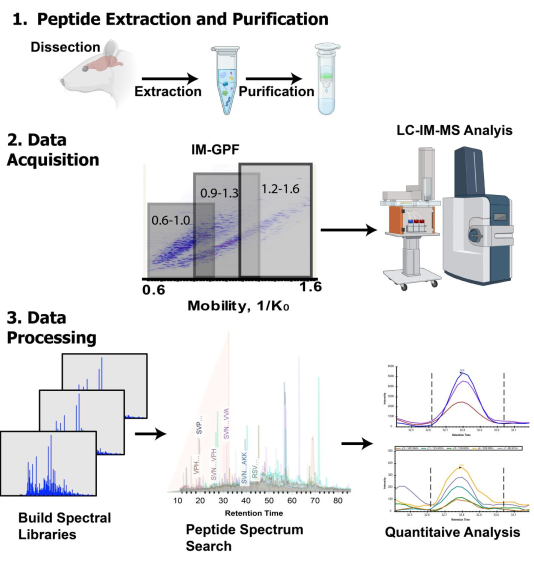
Figure 1: Overview of the peptidomics workflow for identification and quantification of endogenous peptides from rat brain tissue. The workflow includes tissue dissection, peptide extraction and purification, LC-ion mobility-MS (LC-IM-MS) data acquisition using gas-phase fractionation (IM-GPF), and data processing to generate spectral libraries and perform quantitative analysis. Portions of the Figure were created in BioRender. Tan, Y. (2025) https://BioRender.com/vrejrsk. Please click here to view a larger version of this figure.
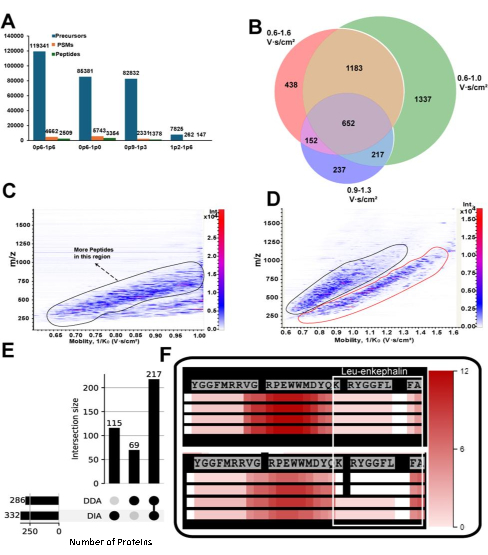
Figure 2: Database Peptide and Protein Identification. (A) Bar chart comparing the total number of precursors, peptide-spectrum matches (PSMs), and unique peptides identified across different ion mobility windows. (B) Pie chart illustrating the proportion of peptides commonly identified across all mobility windows and those uniquely detected within individual windows. (C,D) Heatmaps depicting the distribution of ion signals across the m/z and ion mobility dimensions for the full mobility range (0.6-1.6 V·s/cm2) (C) and the restricted mobility window (0.6-1.0 V·s/cm2) (D). (E) Upset plot showing the number of proteins identified in datasets acquired using DDA and DIA methods, highlighting shared and unique protein identifications. (F) Heatmap representing peptides derived from the proenkephalin precursor identified in DIA-acquired replicates (top panel) and DDA-acquired replicates (bottom panel). Leu-enkephalin was not detected in two of the four DDA replicates, indicating potential missing values in DDA-based acquisition. Please click here to view a larger version of this figure.

Figure 3: Comparative and exploratory analysis of DDA-PASEF and DIA-PASEF data using spectral libraries. (A) Retention time alignment of neuropeptide SF across DIA and DDA-PASEF replicates. (B) EIC of PENK (212-229) fragments ions from DIA (top) and DDA (bottom) datasets. (C) Fragment ion chromatograms of neuropeptide SF from DIA replicates demonstrating high co-elution and spectral quality. Please click here to view a larger version of this figure.

Figure 4: Comparison of quantitative measurements between DIA-PASEF (MS2-level) and DDA-PASEF (MS1-level). (A) This scatter plot compares peptide signal intensities obtained using DIA and DDA modes. Specifically, the x-axis represents the log10-transformed precursor peak area from DDA, while the y-axis shows the log10-transformed fragment peak area from DIA for each peptide. (B) Box plots represent the relative peak areas of four representative peptides, PENK 107-133, PENK 188-195, PDYN 221-233, and PDYN 235-248. Error bars represent variability across technical replicates. Please click here to view a larger version of this figure.
Discussion
Loading...
$$\rightleftharpoonup{xx}$$
$$\longleftharp{xx}$$,
$$\longrightharp{xx}$$,
In peptidomics, particularly when analyzing endogenous peptides, preserving the native peptide profile is essential for data integrity and biological interpretation. Cold saline perfusion not only removes blood but also chills the brain, which significantly reduces postmortem proteolytic degradation occurring rapidly due to the activity of endogenous proteases. By lowering the brain temperature, enzymatic activity is slowed and circulating proteases are flushed from the vasculature, while also reducing postmortem metabolic changes25,26. Perfusing with ice-cold saline also flushes out blood from the brain's vasculature. This step is especially important, as blood contains high-abundance proteins (such as albumin and globulins) and circulating proteases that can interfere with neuropeptide detection. Postmortem degradation of abundant blood proteins can increase the complexity of neuropeptide extracts and mask low-abundance signals, ultimately compromising both identification and quantification25,26,27. Immediate freezing of the brain tissue, either on dry ice or via snap-freezing in chilled isopentane, halts enzymatic processes almost instantly. This preservation is especially important for detecting low-abundance and full-length mature neuropeptides and ensuring reliable quantification. Without these steps, peptide degradation can lead to increased variability and artifacts that compromise both identification and quantification. Thus, blood removal, cold perfusion, and rapid brain chilling are foundational techniques that directly impact the quality, sensitivity, and reproducibility of peptidomics data prior to measurements.
Analysis of peptides extracted from rat brain revealed the presence of two distinct ion mobility plumes (Figure 2C,D). This phenomenon may be attributed either to different molecular classes or to varying charge states of the peptides. If the plumes correspond to distinct molecular classes, coeluting non-peptide species may compete with peptides for selection and fragmentation. Also, if the separation arises from differences in charge states, the plume containing highly charged peptides would be expected to yield higher-quality MS/MS spectra, facilitating more confident peptide identification.
To investigate this, we implemented an ion mobility fractionation strategy, acquiring data across three discrete mobility windows: 0.6-1.0, 0.9-1.3, and 1.2-1.6 V·s/cm². These windows collectively span the full ion mobility range typically analyzed in standard DDA-PASEF experiments for peptides. As illustrated in Figure 2, although the total number of precursors detected was highest in the full scan range (0.6-1.6 V·s/cm2), a significantly greater number of peptide-spectrum matches (PSMs) were observed within the 0.6-1.0 V·s/cm2 window. This finding suggests that the presence of two plumes may indeed be due to interference from other molecules.
Ion mobility-based precursor fractionation resulted in a 30% increase in peptide coverage compared to the conventional full-scan method. Approximately 82% of peptides identified in the full-scan dataset overlapped with peptides identified using fractionation (Figure 2B), highlighting the consistency and robustness of the fractionation strategy. Based on these observations, we employed the ion mobility fractionation and the full-scan data to construct spectral libraries for the quantitative analysis of neuroendocrine peptides using DIA-PASEF.
Database analysis of replicate datasets acquired via DDA and DIA revealed a higher number of peptide and protein identifications in the DIA data, including 115 proteins uniquely identified by DIA (Figure 2E). These included neuropeptides such as Pro-FMRFamide-related peptides FF and VF. In contrast, 69 proteins were exclusively identified by DDA, many of which are associated with cell adhesion and neuronal development. These findings suggest that DDA and DIA methodologies can be applied in a complementary manner to achieve broader peptide coverage.
Further analysis demonstrated that DIA acquisition effectively addresses some of the missing value problem frequently encountered in endogenous peptide analysis using DDA. For example, Leu-enkephalin was detected in only two out of four DDA replicates (Figure 2F, bottom panel), whereas it was consistently identified across all four DIA replicates (Figure 3F, top panel).
Skyline, a platform widely used for quantitative proteomics, was utilized to analyze both DDA and DIA-PASEF datasets28. The software facilitates peptide identification through spectral library matching, fragment ion co-elution, and retention time alignment. To evaluate the ability of DIA-PASEF to reduce missing identification, we performed a qualitative assessment of peptides exclusively detected in the DIA dataset.
As shown in Figure 3D, neuropeptide SF was consistently detected across all DIA replicates within the same retention time window. Detection in the DDA replicates exhibited considerable variability, with retention times ranging from 25 min to 45 min (Figure 3A). The observed inconsistencies, including peak misassignments with low confidence scores, were likely due to limited or low-quality fragment ion coverage, as shown in Figure 3B. In contrast, Figure 3C shows that fragment ions corresponding to neuropeptide SF were well aligned across all DIA replicates, supporting confident automated identification.
A comparison of MS/MS spectral quality for the PENK (212-229) peptide, derived from proenkephalin, further demonstrated the advantages of DIA-PASEF. Spectra obtained from DIA exhibited higher intensity and improved fragment ion quality relative to DDA (Figure 3), which is particularly beneficial for detecting low-abundance endogenous peptides.
Quantitative analysis confirmed that DIA-PASEF yielded consistent and reproducible measurements across biological replicates, with performance comparable to DDA (Figure 4). Moreover, DIA enabled quantification at the MS2 level, offering fragment ion-level specificity and increased confidence in peptide identification relative to MS1-based DDA. These findings support the use of DIA-PASEF as a reliable and efficient approach for targeted neuropeptide quantification in complex biological matrices, particularly when data completeness and reproducibility are critical.
This protocol outlines a comprehensive strategy for neuropeptide analysis and quantification. The IM-GPF approach facilitates the construction of high-quality spectral libraries. While DIA-PASEF offers improved reproducibility and increased peptide coverage compared to DDA-PASEF, it also enhances MS2-based quantification. Combining both acquisition strategies increases overall peptide coverage, as each method uniquely contributes to the identification of distinct peptides (Figure 2E). The limitation of this protocol is the requirement for ample sample material to support both spectral library generation and data acquisition via DDA- and DIA-PASEF methods.
Disclosures
Loading...
$$\rightleftharpoonup{xx}$$
$$\longleftharp{xx}$$,
$$\longrightharp{xx}$$,
The authors have no competing interests to disclose.
Acknowledgements
Loading...
$$\rightleftharpoonup{xx}$$
$$\longleftharp{xx}$$,
$$\longrightharp{xx}$$,
This work was supported by the National Institute on Drug Abuse of the National Institutes of Health under Award Number P30DA018310 (J.V.S.).
Materials
| Name | Company | Catalog Number | Comments |
|---|---|---|---|
| 0.1% Formic Acid Water | Fisher Scientific | LS118-500 | LC/MS grade |
| Acetic Acid | Fisher Scientific | A11350 | LC/MS grade |
| Acetonitrile | Fisher Scientific | AA47138K7 | LC/MS grade |
| Formic Acid | Fisher Scientific | PI28905 | LC/MS grade |
| Methanol | Fisher Scientific | AA47192K7 | LC/MS grade |
| nanoELute2 | Bruker | N/A | |
| Pierce C18 spin columns | Fisher Scientific | AA47192K8 | |
| Pierce Peptide Retention Time Calibration Mixture | Thermo Fisher | A11351 | LC/MS grade |
| SpeedVac vacuum concentrator | Genevac | https://scientificproducts.com/product_cat/benchtop-solvent-evaporators/ | The specific model used in this study is no longer available from the manufacturer. A link to the current equivalent model is provided for reference |
| timsTOF Pro2 | Bruker | https://www.bruker.com/en/products-and-solutions/mass-spectrometry/timstof/timstof-pro-2.html | |
| Water | Fisher Scientific | AA47146M6 | LC/MS grade |
References
Loading...
$$\rightleftharpoonup{xx}$$
$$\longleftharp{xx}$$,
$$\longrightharp{xx}$$,
- Peptides in the brain: mass spectrometry-based measurement approaches and challenges. Annu Rev Anal Chem. 1, 451-483 (2008).">Li, L., Sweedler, J. V. Peptides in the brain: mass spectrometry-based measurement approaches and challenges. Annu Rev Anal Chem. 1, 451-483 (2008).
- Advances in mass spectrometric tools for probing neuropeptides. Annu Rev Anal Chem. 8 (1), 485-509 (2015).">Buchberger, A., Yu, Q., Li, L. Advances in mass spectrometric tools for probing neuropeptides. Annu Rev Anal Chem. 8 (1), 485-509 (2015).
- What are neuropeptides. Methods Mol Biol. 789, 1-36 (2011).">Burbach, J. P. H. What are neuropeptides. Methods Mol Biol. 789, 1-36 (2011).
- WormBook. , (2008).">Li, C., Kim, K. Neuropeptides. WormBook. , (2008).
- Development of neurotransmitter systems during critical periods. Exp Neurol. 190 (Suppl 1), S8-S21 (2004).">Herlenius, E., Lagercrantz, H. Development of neurotransmitter systems during critical periods. Exp Neurol. 190 (Suppl 1), S8-S21 (2004).
- Analysis of mouse brain peptides using mass spectrometry-based peptidomics: implications for novel functions ranging from non-classical neuropeptides to microproteins. Mol Biosyst. 6 (8), 1355-1365 (2010).">Fricker, L. D. Analysis of mouse brain peptides using mass spectrometry-based peptidomics: implications for novel functions ranging from non-classical neuropeptides to microproteins. Mol Biosyst. 6 (8), 1355-1365 (2010).
- Historical perspective of peptidomics. EuPA Open Proteomics. 3, 171-182 (2014).">Schrader, M., Schulz-Knappe, P., Fricker, L. D. Historical perspective of peptidomics. EuPA Open Proteomics. 3, 171-182 (2014).
- Five decades of research on opioid peptides: current knowledge and unanswered questions. Mol Pharmacol. 98 (2), 96-108 (2020).">Fricker, L. D., Margolis, E. B., Gomes, I., Devi, L. A. Five decades of research on opioid peptides: current knowledge and unanswered questions. Mol Pharmacol. 98 (2), 96-108 (2020).
- The renin-angiotensin system in the mammalian central nervous system. Curr Protein Pept Sci. 6 (4), 355-371 (2005).">von Bohlenund Halbach, O. The renin-angiotensin system in the mammalian central nervous system. Curr Protein Pept Sci. 6 (4), 355-371 (2005).
- Mass spectrometry approaches empowering neuropeptide discovery and therapeutics. Pharmacol Rev. 74 (3), 662-679 (2022).">Anapindi, K. D. B., Romanova, E. V., Checco, J. W., Sweedler, J. V. Mass spectrometry approaches empowering neuropeptide discovery and therapeutics. Pharmacol Rev. 74 (3), 662-679 (2022).
- Peptidomics. Nat Rev Methods Primers. 3 (1), 1-21 (2023).">Hellinger, R., et al. Peptidomics. Nat Rev Methods Primers. 3 (1), 1-21 (2023).
- Detection of bioactive peptides including gonadotrophin-releasing factors (GnRHs) in horse urine using ultra-high performance liquid chromatography-high resolution mass spectrometry (UHPLC/HRMS). Drug Test Anal. 12 (9), 1274-1286 (2020).">Kwok, K. Y., et al. Detection of bioactive peptides including gonadotrophin-releasing factors (GnRHs) in horse urine using ultra-high performance liquid chromatography-high resolution mass spectrometry (UHPLC/HRMS). Drug Test Anal. 12 (9), 1274-1286 (2020).
- Ion mobility coupled to a time-of-flight mass analyzer combined with fragment intensity predictions improves identification of classical bioactive peptides and small open reading frame-encoded peptides . Front Cell Dev Biol. 9, 720570(2021).">Peeters, M. K. R., Baggerman, G., Gabriels, R., Pepermans, E., Menschaert, G., Boonen, K. Ion mobility coupled to a time-of-flight mass analyzer combined with fragment intensity predictions improves identification of classical bioactive peptides and small open reading frame-encoded peptides . Front Cell Dev Biol. 9, 720570(2021).
- Recent advances in mass spectrometry-based peptidomics workflows to identify short-open-reading-frame-encoded peptides and explore their functions. Curr Opin Chem Biol. 60, 122-130 (2021).">Fabre, B., Combier, J. -P., Plaza, S. Recent advances in mass spectrometry-based peptidomics workflows to identify short-open-reading-frame-encoded peptides and explore their functions. Curr Opin Chem Biol. 60, 122-130 (2021).
- An accessible workflow for high-sensitivity proteomics using parallel accumulation-serial fragmentation (PASEF). Nat Protoc. 20 (6), 1700-1729 (2025).">Skowronek, P., Wallmann, G., Wahle, M., Willems, S., Mann, M. An accessible workflow for high-sensitivity proteomics using parallel accumulation-serial fragmentation (PASEF). Nat Protoc. 20 (6), 1700-1729 (2025).
- Mass spectrometry measurements of neuropeptides: from identification to quantitation. Annu Rev Anal Chem. 15, 83-106 (2022).">Toba, E. A. D. L., Bell, S. E., Romanova, E. V., Sweedler, J. V. Mass spectrometry measurements of neuropeptides: from identification to quantitation. Annu Rev Anal Chem. 15, 83-106 (2022).
- Isoaspartate-containing galanin in rat hypothalamus. Commun Chem. 8 (1), 1-10 (2025).">Okyem, S., Mast, D. H., Romanova, E. V., Rubakhin, S. S., Sweedler, J. V. Isoaspartate-containing galanin in rat hypothalamus. Commun Chem. 8 (1), 1-10 (2025).
- Multiplexed and data-independent tandem mass spectrometry for global proteome profiling. Mass Spectrom Rev. 33 (6), 452-470 (2014).">Chapman, J. D., Goodlett, D. R., Masselon, C. D. Multiplexed and data-independent tandem mass spectrometry for global proteome profiling. Mass Spectrom Rev. 33 (6), 452-470 (2014).
- Mass spectrometry in the discovery of peptides involved in intercellular communication: from targeted to untargeted peptidomics approaches. Mass Spectrom Rev. 42 (6), 2404-2425 (2023).">Fan, K. -T., Hsu, C. -W., Chen, Y. -R. Mass spectrometry in the discovery of peptides involved in intercellular communication: from targeted to untargeted peptidomics approaches. Mass Spectrom Rev. 42 (6), 2404-2425 (2023).
- Peptidomics: a review of clinical applications and methodologies. J Proteome Res. 20 (8), 3782-3797 (2021).">Foreman, R. E., George, A. L., Reimann, F., Gribble, F. M., Kay, R. G. Peptidomics: a review of clinical applications and methodologies. J Proteome Res. 20 (8), 3782-3797 (2021).
- Data independent acquisition mass spectrometry method for improved neuropeptidomic coverage in crustacean neural tissue extracts. Anal Chem. 91 (8), 5150-5158 (2019).">DeLaney, K., Li, L. Data independent acquisition mass spectrometry method for improved neuropeptidomic coverage in crustacean neural tissue extracts. Anal Chem. 91 (8), 5150-5158 (2019).
- Data-independent acquisition mass spectrometry-based proteomics and software tools: a glimpse in 2020. Proteomics. 20 (17-18), e1900276(2020).">Zhang, F., Ge, W., Ruan, G., Cai, X., Guo, T. Data-independent acquisition mass spectrometry-based proteomics and software tools: a glimpse in 2020. Proteomics. 20 (17-18), e1900276(2020).
- Data-independent acquisition (DIA) is superior for high precision phospho-peptide quantification in Magnaporthe oryzae. J Fungi. 9 (1), 63(2023).">Bersching, K., Michna, T., Tenzer, S., Jacob, S. Data-independent acquisition (DIA) is superior for high precision phospho-peptide quantification in Magnaporthe oryzae. J Fungi. 9 (1), 63(2023).
- Data-independent acquisition peptidomics. Methods Mol Biol. 2758, 77-88 (2024).">Bichmann, L., Gupta, S., Röst, H. Data-independent acquisition peptidomics. Methods Mol Biol. 2758, 77-88 (2024).
- Peptidomics methods for the identification of peptidase-substrate interactions. Curr Opin Chem Biol. 17 (1), 83-89 (2013).">Lone, A. M., Kim, Y. -G., Saghatelian, A. Peptidomics methods for the identification of peptidase-substrate interactions. Curr Opin Chem Biol. 17 (1), 83-89 (2013).
- Sample-dependent effects on the neuropeptidome detected in rat brain tissue preparations by capillary liquid chromatography with tandem mass spectrometry. Anal Chem. 77 (19), 6331-6338 (2005).">Parkin, M. C., Wei, H., O'Callaghan, J. P., Kennedy, R. T. Sample-dependent effects on the neuropeptidome detected in rat brain tissue preparations by capillary liquid chromatography with tandem mass spectrometry. Anal Chem. 77 (19), 6331-6338 (2005).
- Optimization of neuropeptide extraction from the mouse hypothalamus. J Proteome Res. 6 (12), 4667-4676 (2007).">Che, F. -Y., Zhang, X., Berezniuk, I., Callaway, M., Lim, J., Fricker, L. D. Optimization of neuropeptide extraction from the mouse hypothalamus. J Proteome Res. 6 (12), 4667-4676 (2007).
- Skyline: an open source document editor for creating and analyzing targeted proteomics experiments. Bioinformatics. 26 (7), 966-968 (2010).">MacLean, B., et al. Skyline: an open source document editor for creating and analyzing targeted proteomics experiments. Bioinformatics. 26 (7), 966-968 (2010).
Reprints and Permissions
Request permission to reuse the text or figures of this JoVE article
Request Permission