This study establishes a mouse model of menopausal hot flashes by combining ovariectomy with exercise-induced thermogenesis and continuous high-resolution tail skin temperature monitoring.
Method Article
A Treadmill-Based Mouse Model for Investigating Hot Flashes with Continuous Skin Temperature Monitoring
Zhicheng Cui*1
20110700022@fudan.edu.cn
tiemin_liu@fudan.edu.cn
z_zhang@fudan.edu.cn
1State Key Laboratory of Genetics and Development of Complex Phenotypes, School of Life Sciences, Fudan University, 2Department of Endocrinology, Jinshan Hospital, Fudan University, 3Institutes of Biomedical Sciences, School of Life Sciences, Inner Mongolia University, 4Department of Endocrinology and Metabolism, Zhongshan Hospital, Human Phenome Institute, Fudan University
Corresponding Authors: Zhicheng Cui <20110700022@fudan.edu.cn>, Tiemin Liu <tiemin_liu@fudan.edu.cn>, Zhi Zhang <z_zhang@fudan.edu.cn>
* These authors contributed equally
Opens in a new tab
In This Article
Summary
Loading...
$$\rightleftharpoonup{xx}$$
$$\longleftharp{xx}$$,
$$\longrightharp{xx}$$,
Abstract
Loading...
$$\rightleftharpoonup{xx}$$
$$\longleftharp{xx}$$,
$$\longrightharp{xx}$$,
Hot flashes significantly impair the quality of life in menopausal women, yet the underlying neural mechanisms and effective therapies remain poorly understood. A major challenge in this field has been the lack of reliable animal models and non-invasive methods for continuous skin temperature monitoring. Here, a mouse model combining ovariectomy with exercise-induced thermogenesis was developed to study hot flashes. Using a telemetric logger secured by a 3D-printed tail sleeve, tail skin temperature was continuously monitored in a stress-free state. Additionally, infrared cameras provided a complementary method to monitor heat production and dissipation, allowing for a more comprehensive assessment of body temperature. Using this model, ovariectomized mice were found exhibiting higher skin temperature increases and lower core body temperature, effectively mimicking the hot flash phenotype observed in menopause. This approach establishes a precise model for hot flash monitoring and will be valuable for researchers in thermoregulation, neuroscience, and clinical menopausal studies.
Introduction
Loading...
$$\rightleftharpoonup{xx}$$
$$\longleftharp{xx}$$,
$$\longrightharp{xx}$$,
Hot flashes are among the most prevalent and disruptive symptoms of menopause, significantly impairing quality of life1. These episodes are characterized by a sudden surge in skin temperature followed by a transient drop in core body temperature2, often accompanied by increased heart rate, anxiety, and dizziness3. Despite their profound impact, effective treatments remain limited4, underscoring the need for a deeper understanding of their underlying mechanisms.
A critical step in studying hot flashes is the development of reliable animal models that accurately replicate thermoregulatory dysfunction. Currently, the primary approach involves ovariectomy (OVX), which induces altered skin and core body temperatures5. However, these changes are often inconsistent, as they can be confounded by stress or ambient temperature fluctuations6. Moreover, capturing sporadic hot flash-like events remains challenging. Alternative methods employ pharmacological agents (e.g., senktide, capsaicin, tamoxifen, or naloxone) to trigger acute cutaneous vasodilation in rodents7,8,9. While these compounds produce rapid, measurable skin temperature increases, their invasive administration and dose-dependent effects complicate the interpretation of thermoregulatory responses. Furthermore, it remains unclear whether drug-induced vasodilation fully recapitulates the physiological conditions of natural hot flashes. Thus, a more refined and reliable animal model is urgently needed.
Exercise is a well-known modulator of body temperature and has been linked to hot flash induction in humans10. Some studies have leveraged forced exercise in mice to mimic heat dissipation patterns resembling hot flashes11,12,13. Although this approach provides a non-invasive means to provoke temperature fluctuations, monitoring skin temperature in active mice, particularly via infrared thermography, is technically challenging. Additionally, a comprehensive assessment of hot flash-like symptoms requires continuous, long-term recording of both tail (skin) and core body temperatures.
To overcome these limitations, an optimized mouse model was developed combining ovariectomy with treadmill-induced exercise to reliably evoke hot flash-like thermoregulatory responses. In the experiment, C57BL/6J mice from 8-10 weeks were housed under standard conditions (12:12 light-dark cycle, 22 °C ±1 °C, 50% ± 10% humidity). Furthermore, a telemetric temperature logger secured by a 3D-printed tail sleeve was designed to enable stress-free, continuous tail temperature monitoring in freely moving mice. Infrared thermography was also incorporated to provide complementary data on heat production and dissipation. This model will serve as a valuable tool for investigating the mechanisms of hot flashes and evaluating potential therapeutic interventions.
Protocol
Loading...
$$\rightleftharpoonup{xx}$$
$$\longleftharp{xx}$$,
$$\longrightharp{xx}$$,
These methods were designed for mouse models. Mice studies were approved by the Institutional Animal Care and Use Committee of Fudan University (2021JS0040). Prior to the implementation of the protocol, animals were housed in conformance with the Guide for the Care and Use of Laboratory Animals. In this study, 8- to 10-week-old female C57BL/6J mice, weighing 20-23 g, were housed under standard conditions (12:12 h light-dark cycle, 22 °C ± 1 °C, 50% ± 10% humidity). The details of the reagents and the equipment used are listed in the Table of Materials.
1. Experimental preparation
- Prepare ten 8-10 week-old female mice housed under standard conditions (12:12 light-dark cycle, 22 °C ±1 °C, 50% ± 10% humidity) with ad libitum food and water.
- Randomly allocate mice into OVX and sham groups (n = 5/group). Grouped house to help with the synchronization of estrous cycles.
- Treadmill protocol setup
- Open the treadmill control software "TSE TreadMill (USB) 5.1.7_2" on the connected computer (Supplementary Figure 1).
- Initialize a new experimental file by selecting File > Initialize a New File from the menu bar.
- Program the running protocol:
- Set the first segment: 0-20 s acceleration from 0-0.17 m/s.
- Set the second segment: 20-150 s constant speed at 0.17 m/s.
- Set the third segment: 150-170 s acceleration from 0.17-0.25 m/s.
- Set the final segment: 170-600 s constant speed at 0.25 m/s10,12.
NOTE: Do not use electrical stimulation in this experiment to avoid extra stress.
2. Estrous cycle monitoring
- Smear vaginal swabs on a staining slide daily at the same time each day for 8 consecutive days by flushing with 100 µL of sterile PBS using a pipette.
- Air-dry samples on slides for 24 h in a fume hood.
- Briefly dunk the samples in 100% methanol at room temperature.
CAUTION: Methanol is toxic by inhalation, ingestion, or skin contact. Use in a well-ventilated fume hood, wear nitrile gloves, and avoid sparks/flames. - Dilute commercial 20× Giemsa dye to 1× using PBS.
- Stain the methanol fixed slideswith 1× Giemsa in the dark for 1-2 h.
- Examine the vaginal cytology to determine the estrous stages based on these studies14,15.
- Proceed with experiments when the mice are in proestrus (Figure 2B).
NOTE: Handle mice gently to avoid stress-induced cycle disruption. Avoid deep insertion of pipette tips to prevent pseudo-pregnancy.
3. Ovariectomy surgery
- Record the weight of the mice and anesthetize the mice with isoflurane. Use a heating pad to maintain the animal's body temperature during the operation.
- Shave the hair on the dorsolateral region bilaterally before the hind legs and disinfect with 70% ethanol and iodine alternatively for 3 times.
- Make a 1 cm long paravertebral incision on the skin and use a blunt-tipped instrument to separate the skin from the underlying muscle tissue. Then, make the incision in the muscle wall. Expose the ovarian fat pads with cotton sticks.
- Ligate ovarian blood vessels with sutures. Excise ovaries with surgical scissor16.
- Close the incision in layers, muscle, and skin with non-absorbable sutures. Clean skin around the surgical site gently with saline to remove any dried blood or residual antiseptic scrub.
- For sham controls, cut a piece of the fat pad without touching the ovaries.
- Monitor the health of mice daily for 7 days post-operation.
NOTE: Ensure the mice are kept on a heating pad at around 35 °C throughout the anesthesia process.
4. Core temperature logger implantation
- Logger Programming and Initialization (Supplementary Figure 2).
- Insert the temperature logger vertically into the docking station.
- Click on Recorder > Connect in the software menu bar.
- Select Edit > New Measurement Seq. Def. from the menu bar.
- Choose Multiple Record Intervals from the recording mode options.
- Set parameters: Start date: [YYYY-MM-DD HH:MM], End date: [YYYY-MM-DD HH:MM], Recording interval: 5 min.
- Add the intervals setting to the sequence.
- Click on Recorder > Start New Measurement Sequence.
- Under anesthesia, shave and sanitize the skin of the abdomen.
NOTE:This abdominal temperature logger implantation procedure can be performed along with OVX surgery to avoid multiple surgeries. - Make a 2 cm midline skin incision approximately 1 cm below the diaphragm.
- Extend the incision along the linea alba to open the peritoneal cavity.
- Gently insert the core temperature logger into the abdominal cavity along the sagittal plane.
NOTE: Proper placement is critical for accurate temperature readings. Avoid superficial positioning near the skin, as ambient temperature may interfere with measurements. - Suture the abdominal incision using 5-0 non-absorbable sutures.
- Disinfect the abdomen with iodine solution.
NOTE: Monitor the animal closely during recovery. Maintain a warm environment using a heating pad until the mice are fully awake.
5. Tail-mounted temperature logger attachment
- Logger Programming and Initialization (Refer to step 4.1 procedure, modifying the recording interval to 2 min).
- Clean the tail with an ethanol swipe. Disinfect the 3D sleeve with 70% ethanol and fasten the temperature logger inside the sleeve.
- Apply fast-curing adhesive to the sleeve. Position the logger 1 cm from the tail base (Figure 1A). Make sure the detection face of the logger is in close contact with the skin. Ensure the logger is fixed on the ventral side of the tail to minimize movement burden.
- Hold it in place with pressure for 2 min. Use brief anesthesia if needed for precise placement.
NOTE: Monitor for tail swelling or logger detachment post-placement daily. A properly attached device could stay well for at least 3 days.
6. Treadmill running and data collection
- Acclimate mice to the treadmill during the light phase for 3 days using the protocol in step 1.3.
- Place mice individually on the stationary treadmill belt. Allow 10 min for environmental exploration and habituation.
- Execute the protocol:
- Click on the Measure button. Click on Start to initialize the treadmill.
- Select Start Profile to begin the programmed running protocol.
- Attach the tail temperature logger 24 h before experiments for good habituation (see step 5).
- Treadmill running on the light phase of experimental day:
- Record baseline temperature for 30 s using an infrared camera 10 min prior to exercise. The core temperature is recorded simultaneously using the implanted abdominal temperature logger.
- Run mice on the treadmill per the protocol in step 1.3.
NOTE: Ensure mice run continuously for 600 s. If mice stop running, gently encourage continued movement using a hairbrush. - After treadmill running, transfer mice to clean cages. Measure tail temperature via infrared thermography at 0 min, 5 min, 10 min, and 15 min post-exercise.
7. Data analysis
- For infrared and core temperature data:
- Calculate baseline as the average pre-exercise temperature.
- Plot ΔT (post-exercise temperature-baseline) for each time point.
- For tail temperature logger data:
- Use the 10-min pre-exercise average as baseline.
- Compute ΔT at 2 min intervals for 15 min post-exercise.
Results
Loading...
$$\rightleftharpoonup{xx}$$
$$\longleftharp{xx}$$,
$$\longrightharp{xx}$$,
Development of a reliable thermoregulatory monitoring system
To establish a reliable model for measuring core and skin temperature, a custom 3D-printed tail sleeve was designed to securely attach a temperature logger 1 cm from the base of the tail (Figure 1A), enabling continuous and precise measurement of heat dissipation during exercise-triggered hot flashes.
This system permitted uninterrupted 24 h tail temperature monitoring (Figure 1B). Recorded data revealed a clear diurnal rhythm, characterized by lower temperature during the active (nighttime) phase and higher temperature during the resting (daytime) phase. Notably, tail skin temperature showed a nice negative correlation with core body temperature, suggesting a skin heat dissipation mechanism for core body temperature regulation. This circadian pattern not only validates the model's physiological relevance but also demonstrates the sleeve's reliability for long-term thermoregulatory assessments.
Validation of OVX and estrous cycle staging
To optimize exercise-induced hot flashes, the estrous cycle was first monitored via vaginal cytology (Figure 2A). Exercise experiments were conducted when the mice reached proestrus, when estrogen is at a high level17 (Figure 2B). This strategy also served to validate OVX efficacy: vaginal smears from OVX mice exclusively displayed small, rounded leukocyte-like cells, consistent with low-estrogen diestrus, whereas sham-operated controls maintained normal cyclic fluctuations (Figure 2B). Together, these findings confirm the successful induction of a surgical menopausal model.
Exercise-induced thermoregulatory dysregulation in OVX mice
To evoke hot flash-like responses, OVX and sham-operated mice underwent controlled treadmill running following surgical recovery (Figure 3A). After a one-day acclimation to the tail logger, thermoregulatory responses were continuously monitored during exercise using a customized treadmill apparatus (Figure 3B). Tail heat dissipation was quantified via both infrared thermography at baseline and at 0 min, 5 min, 10 min, and 15 min post-exercise, and continuous recording of the tail temperature logger.
OVX mice exhibited exaggerated peripheral vasodilation compared to sham controls. Infrared thermography showed significantly greater tail temperature elevation in OVX mice compared to Sham controls (mean ΔT: 6.748 °C ± 1.590 °C vs. 3.103 °C ± 0.807 °C; *p < 0.05, Figure 4A,B), despite similar cooling rates returning to baseline by 15 min post-exercise. Notably, the 3D-printed tail sleeve enabled stress-free continuous monitoring, capturing consistent temperature differences that intermittent infrared measurements missed (peak ΔT at the end of exercise: 4.248 °C ± 0.439 °C in OVX vs. 1.683 °C ± 0.388 °C in Sham; **p < 0.01, Figure 4C). This implantable sensor provided superior temporal resolution (2 min intervals) without disrupting locomotion. Furthermore, OVX mice not only displayed enhanced peripheral heat dissipation but also exhibited significant core hypothermia post-exercise (Figure 4D), mirroring the classic sweating-chill sequence observed in menopausal hot flashes.
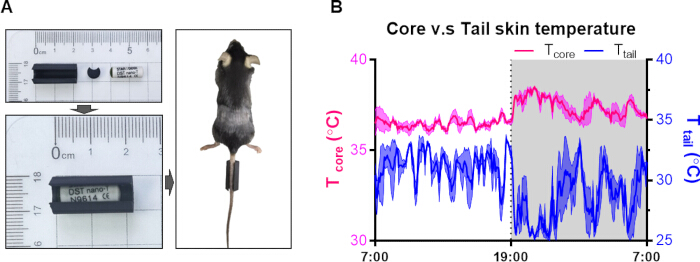
Figure 1: Simultaneous recording of core body temperature and tail temperature via 3D-printed tail sleeve. (A) 3D-printed sleeve and schematic diagram of its installation on the mouse tail. (B) 24 h core temperature and tail temperature measurements in naïve mice (n = 3). Please click here to view a larger version of this figure.
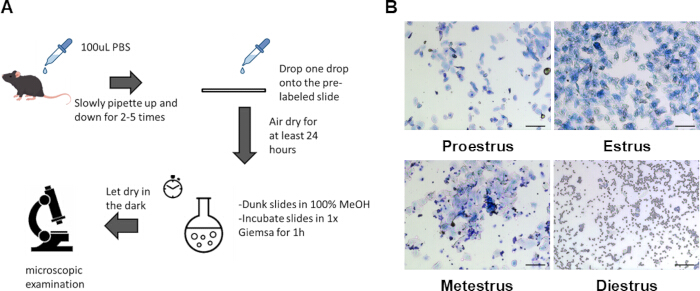
Figure 2: The estrous cycle of mice. (A) The schematic diagram of testing the estrous cycle. (B) Regular estrous cycles include proestrus, estrus, metestrus, and diestrus. Scale bar: 50 µm. Please click here to view a larger version of this figure.

Figure 3: Investigation of hot flashes using an exercise-induced heat dissipation model. (A) The schematic diagram of the experiment protocol. (B) Facility images of treadmills. Please click here to view a larger version of this figure.
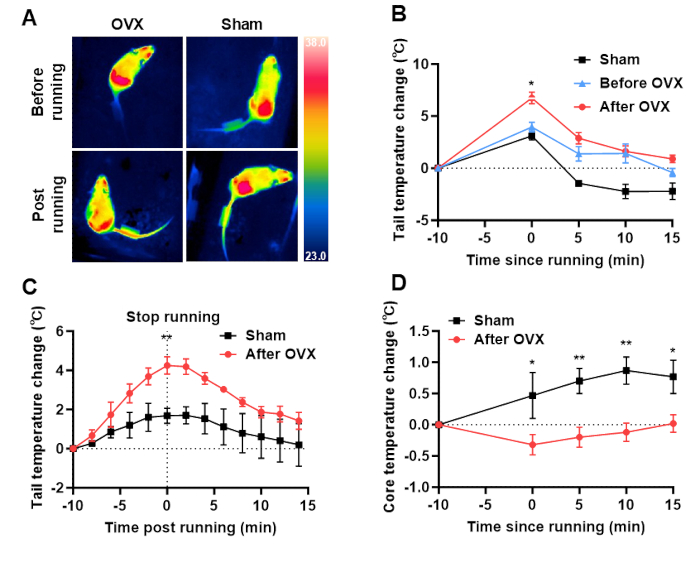
Figure 4: Thermometry profiles in ovariectomized mice during and post-exercise. (A) Representative infrared images. (B) Infrared thermography-measured tail temperature changes (n = 5/group). (C) Tail-attached thermal logger showing dynamic skin temperature changes (n = 4/group). (D) The abdominal logger-measured core temperature changes. Data shown as mean ± SEM. *p < 0.05, **p < 0.01 vs. Sham group. Please click here to view a larger version of this figure.
Supplementary Figure 1: Interface and workflow of the TSE treadMill software for treadmill experiment control. (A) The logo and main icon of the TSE Treadmill software. (B) The 'Initialize New File' interface for establishing a new experimental project or loading a pre-configured protocol. (C) The speed configuration module, allowing for the setting of treadmill belt speed. (D) The main control dashboard for initiating and monitoring an experiment. This panel provides controls to start/stop the treadmill and displays speed data. Please click here to download this figure.
Supplementary Figure 2: Interface of the temperature logger configuration software. (A) Device synchronization interface for establishing bidirectional communication between the temperature logger and the host computer. (B) The parameter configuration interface for setting the sampling interval of temperature recordings. (C) The command confirmation dialog box to initiate the temperature measurement protocol and begin data acquisition. Please click here to download this figure.
Discussion
Loading...
$$\rightleftharpoonup{xx}$$
$$\longleftharp{xx}$$,
$$\longrightharp{xx}$$,
This study establishes a practical and quantitative mouse model for investigating menopausal hot flashes, addressing a critical gap in the field. The integration of ovariectomy with exercise-induced thermogenesis successfully recapitulates core features of human hot flashes, namely, a rapid rise in tail skin temperature followed by a decline in core body temperature18. This model combines and extends the strengths of existing approaches by amplifying temperature variations and allowing precise temporal control over hot flash induction. As such, it provides a robust platform for investigating the neurobiological mechanisms underlying menopausal thermoregulation and for evaluating potential therapeutic interventions.
The tail-mounted temperature logger demonstrated several significant advantages over traditional wired core body temperature monitors commonly used in previous studies6,19. First, its secure attachment via a 3D-printed holder enabled continuous, high-resolution thermal data collection without restricting movement or altering natural behavior, a major limitation of the wired core body temperature monitoring system. Importantly, the device weighs less than 2.3 g and does not impair locomotion or cause observable tail damage. Its open design also preserves normal heat dissipation, which is essential for accurate skin temperature measurement. Second, in combination with an intraperitoneal sensor recording core body temperature, the logger detected a clear "increased heat dissipation-core hypothermia" response, which closely parallels the physiological features of human hot flashes1,18. Furthermore, the non-invasive, motion-compatible design supports its application in chronic studies of thermoregulatory dynamics throughout menopause, as well as in other contexts such ashyperthermia and fever models.
While the 3D-printed logger is designed for continuous thermal monitoring across various physiological states, certain limitations should be acknowledged. Artificial fluctuations due to tail curling or body contact, particularly during sleep phases when mice frequently curl their tails, may introduce confounding variability. However, these effects are minimal during exercise, when the tail remains extended and thermoregulatory responses are reliably captured. In rare cases of scratching or biting that result in tail irritation, topical application of veterinary-approved ointments or moisturizers can prevent further tissue damage.
Strict environmental control is essential to ensure consistent tail temperature responses. If no temperature elevation is observed following exercise, verify that the ambient temperature is maintained around 22 °C. Deviations above or below this range may interfere with heat dissipation measurements: excessively warm environments may elevate baseline tail temperature, masking further increases, while overly cool conditions may suppress tail vasodilation. Additionally, if an animal exhibits stress-induced hyperthermia, it should be allowed to rest on the treadmill for 10 min to normalize body temperature. Trials should be postponed and repeated on a subsequent day if the animal fails to calm within this period.
Running speed and duration are also critical experimental parameters. A 10 min running protocol was adopted, guided by prior literature on mouse tail thermoregulation and exercise physiology in mice10,12. Prolonged sessions (e.g., 30 min) tended to attenuate group differences, while shorter durations produced inconsistent thermal responses. The 10 min protocol offers an optimal balance between eliciting robust thermogenic effects and maintaining animal welfare.
Despite the promising results, this study has several limitations. The relatively small sample size limits statistical power and precludes detection of subtler thermoregulatory differences. Future studies should include larger cohorts and investigate the underlying hormonal and neural mechanisms. In this study, vaginal cytology was used to determine estrous cycle stages; however, this method is susceptible to misclassification due to pseudo-pregnancy20. Incorporating serum estradiol measurements would provide a more precise assessment of estrogen status. Additionally, individual variability in thermal responses to exercise highlights the need for pre-screening mice for baseline running performance, which could help control for variations in heat generation.
The present study describes a non-invasive, stress-free system for continuous skin temperature monitoring in freely moving mice. This platform enables precise investigation of the physiological and neural basis of menopausal hot flashes. Beyond pharmacological studies, the model also facilitates the exploration of behavioral and lifestyle interventions aimed at modulating thermoregulatory function. Overall, this model represents a significant advancement toward understanding and ultimately mitigating a condition that profoundly impacts millions of women worldwide.
Disclosures
Loading...
$$\rightleftharpoonup{xx}$$
$$\longleftharp{xx}$$,
$$\longrightharp{xx}$$,
The authors declare no competing interests.
Acknowledgements
Loading...
$$\rightleftharpoonup{xx}$$
$$\longleftharp{xx}$$,
$$\longrightharp{xx}$$,
We would like to thank the lab members for their assistance with this manuscript. This work was supported by funds from the National Natural Science Foundation of China 32171144, and the Noncommunicable Chronic Diseases-National Science and Technology Major Project (2024ZD0530300).
Materials
| Name | Company | Catalog Number | Comments |
|---|---|---|---|
| Animal implantable temperature logger | Star-Oddi | DST nano-T | |
| C57BL/6J mice | GemPharmatech | N000013 | |
| Giemsa Staining Solution | Beyotime | C0133 | |
| Infrared thermal images | VarioCAM | VC HD head 980 | |
| Treadmill Systems | TSE | Treadmill_6M |
References
Loading...
$$\rightleftharpoonup{xx}$$
$$\longleftharp{xx}$$,
$$\longrightharp{xx}$$,
- Hot flushes. Lancet. 360 (9348), 1851-1861 (2002).">Stearns, V., et al. Hot flushes. Lancet. 360 (9348), 1851-1861 (2002).
- Effects of menopause on temperature regulation. Temperature. 12 (2), 92-132 (2025).">Gombert-Labedens, M., Kristine, V., Andrea, F., Maloney, S. K., Baker, F. C. Effects of menopause on temperature regulation. Temperature. 12 (2), 92-132 (2025).
- Menopausal hot flashes: A review of physiology and biosociocultural perspective on methods of assessment. J Nutr. 140 (7), 1380S-1385S (2010).">Kronenberg, F. Menopausal hot flashes: A review of physiology and biosociocultural perspective on methods of assessment. J Nutr. 140 (7), 1380S-1385S (2010).
- New advances in menopause symptom management. Best Pract Res Clin Endocrinol Metab. 38 (1), 101774(2024).">Koysombat, K., Mcgown, P., Nyunt, S., Abbara, A., Dhillo, W. S. New advances in menopause symptom management. Best Pract Res Clin Endocrinol Metab. 38 (1), 101774(2024).
- Elevation of tail skin temperature in ovariectomized rats in relation to menopausal hot flushes. Am J Physiol Regul Integr Comp Physiol. 278 (4), R863-R869 (2000).">Kobayashi, T., et al. Elevation of tail skin temperature in ovariectomized rats in relation to menopausal hot flushes. Am J Physiol Regul Integr Comp Physiol. 278 (4), R863-R869 (2000).
- Estradiol alters body temperature regulation in the female mouse. Temperature (Austin). 5 (1), 56-69 (2018).">Krajewski-Hall, S. J., Blackmore, E. M., Mcminn, J. R., Rance, N. E. Estradiol alters body temperature regulation in the female mouse. Temperature (Austin). 5 (1), 56-69 (2018).
- A comprehensive method to quantify adaptations by male and female mice with hot flashes induced by the neurokinin B receptor agonist senktide. Endocrinology. 158 (10), 3259-3268 (2017).">Krull, A. A., Larsen, S. A., Clifton, D. K., Neal-Perry, G., Steiner, R. A. A comprehensive method to quantify adaptations by male and female mice with hot flashes induced by the neurokinin B receptor agonist senktide. Endocrinology. 158 (10), 3259-3268 (2017).
- The effect of estrogens and antiestrogens in a rat model for hot flush. Maturitas. 30 (3), 307-316 (1998).">Merchenthaler, I., et al. The effect of estrogens and antiestrogens in a rat model for hot flush. Maturitas. 30 (3), 307-316 (1998).
- Estrogen receptor alpha in the brain mediates tamoxifen-induced changes in physiology in mice. Elife. 10, e63333(2021).">Zhang, Z., et al. Estrogen receptor alpha in the brain mediates tamoxifen-induced changes in physiology in mice. Elife. 10, e63333(2021).
- Acute increases in physical activity and temperature are associated with hot flash experience in midlife women. Menopause. 31 (7), 600-607 (2024).">Witkowski, S., et al. Acute increases in physical activity and temperature are associated with hot flash experience in midlife women. Menopause. 31 (7), 600-607 (2024).
- A hop extract Lifenol improves postmenopausal overweight, osteoporosis, and hot flash in ovariectomized rats. Evid Based Complement Alternat Med. 2018 (1), 2929107(2018).">Ban, Y. -H., et al. A hop extract Lifenol improves postmenopausal overweight, osteoporosis, and hot flash in ovariectomized rats. Evid Based Complement Alternat Med. 2018 (1), 2929107(2018).
- Forced exercise-induced flushing of tail skin in ovariectomized mice, as a new experimental model of menopausal hot flushes. J Pharmacol Sci. 98 (3), 323-326 (2005).">Shuto, H., et al. Forced exercise-induced flushing of tail skin in ovariectomized mice, as a new experimental model of menopausal hot flushes. J Pharmacol Sci. 98 (3), 323-326 (2005).
- CGRP is critical for hot flushes in ovariectomized mice. Front Pharmacol. 9, 1452(2018).">Wilhelms, D. B., et al. CGRP is critical for hot flushes in ovariectomized mice. Front Pharmacol. 9, 1452(2018).
- Mouse estrous cycle identification tool and images. PLoS One. 7 (4), e35538(2012).">Byers, S. L., Wiles, M. V., Dunn, S. L., Taft, R. A. Mouse estrous cycle identification tool and images. PLoS One. 7 (4), e35538(2012).
- Vaginal cytology of the laboratory rat and mouse: Review and criteria for the staging of the estrous cycle using stained vaginal smears. Toxicol Pathol. 43 (6), 776-793 (2015).">Cora, M. C., Kooistra, L., Travlos, G. Vaginal cytology of the laboratory rat and mouse: Review and criteria for the staging of the estrous cycle using stained vaginal smears. Toxicol Pathol. 43 (6), 776-793 (2015).
- Murine orchiectomy and ovariectomy to reduce sex hormone production. J Vis Exp. (201), e64379(2023).">Rowe, A. A., Issioui, Y., Johnny, B., Wert, K. J. Murine orchiectomy and ovariectomy to reduce sex hormone production. J Vis Exp. (201), e64379(2023).
- The rodent estrous cycle: Characterization of vaginal cytology and its utility in toxicological studies. Birth Defects Res B Dev Reprod Toxicol. 80 (2), 84-97 (2007).">Goldman, J. M., Murr, A. S., Cooper, R. L. The rodent estrous cycle: Characterization of vaginal cytology and its utility in toxicological studies. Birth Defects Res B Dev Reprod Toxicol. 80 (2), 84-97 (2007).
- Physiology of hot flashes. Am J Hum Biol. 13 (4), 453-464 (2001).">Freedman, R. R. Physiology of hot flashes. Am J Hum Biol. 13 (4), 453-464 (2001).
- Estrogen-sensitive medial preoptic area neurons coordinate torpor in mice. Nat Commun. 11 (1), 6378(2020).">Zhang, Z., et al. Estrogen-sensitive medial preoptic area neurons coordinate torpor in mice. Nat Commun. 11 (1), 6378(2020).
- Comparative study on the estimation of estrous cycle in mice by visual and vaginal lavage method. J Clin Diagn Res. 11 (1), Ac05-Ac07 (2017).">Ekambaram, G., Sampath Kumar, S. K., Joseph, L. D. Comparative study on the estimation of estrous cycle in mice by visual and vaginal lavage method. J Clin Diagn Res. 11 (1), Ac05-Ac07 (2017).
Reprints and Permissions
Request permission to reuse the text or figures of this JoVE article
Request Permission