This protocol describes a method for integrating continuous renal replacement therapy (CRRT) into exsitu normothermic liver perfusion by connecting it to the perfusion reservoir. This configuration supports hemodynamic stability, helps prevent excessive intravascular pressures, and may reduce the risk of tissue edema, in particular during extended perfusion.
Method Article
Integrating Continuous Renal Replacement Therapy into Ex-situ Normothermic Liver Machine Perfusion
Jordi Vengohechea1,2,3 , Soraya Rodríguez4 , Alicia Izquierdo4 , Javier Muñoz3 , Paula P. Burgos5 , Joaquim Albiol6 , Carlota Largo7 , Mingju Liang8 , Fen Huo9 , Amelia J. Hessheimer*2,3 , Constantino Fondevila*2,3,10
1Department of Surgery and Surgical Specializations, University of Barcelona, 2General & Digestive Surgery Service, Hospital Universitario La Paz, 3Centro de Investigación Biomédica en Red de Enfermedades Hepáticas y Digestivas (CIBERehd), 4NorrDia A.B., 5Pediatric Cardiovascular Surgery Service, Hospital Universitario La Paz, 6Donation & Transplantation Institute Foundation, 7Department of Experimental Surgery, Hospital Universitario La Paz, 8Guangdong Shunde Innovative Design Institute, 9General Hospital of Southern Theater Command of PLA, 10Department of Surgery and Surgical Specializations, Autonomous University of Madrid
Opens in a new tab
In This Article
Summary
Loading...
$$\rightleftharpoonup{xx}$$
$$\longleftharp{xx}$$,
$$\longrightharp{xx}$$,
Abstract
Loading...
$$\rightleftharpoonup{xx}$$
$$\longleftharp{xx}$$,
$$\longrightharp{xx}$$,
Ex situ normothermic machine perfusion (NMP) of the liver has emerged as a dynamic preservation strategy, enabling the maintenance of metabolic activity and assessment of grafts prior to transplantation. Prolonged perfusions, however, are limited by the accumulation of metabolic waste, electrolyte imbalances, and inflammatory mediators that can compromise graft function. Continuous renal replacement therapies (CRRT), especially continuous venovenous hemodiafiltration (CVVHDF), offer a potential means to support solute clearance and homeostatic regulation during extended perfusion periods.
In this protocol, we describe a reproducible and safe method for integrating CVVHDF into an ex situ liver NMP system by connecting the filtration circuit independently from the main organ perfusion circuit. This configuration supports hemodynamic stability, helps prevent excessive intravascular pressures, and may reduce the risk of tissue edema. The physical connection, priming, and monitoring of the CRRT circuit are explained in detail, along with instructions on how to utilize a Hoffman clamp to simulate physiological venous pressure. When compared to direct in-line circuit integration, representative results suggest that the out-of-circuit approach is associated with reduced graft edema, while maintaining stable circuit pressure and solute clearance. This approach can be easily integrated into other similar perfusion devices in order to improve solute handling while maintaining stable perfusion dynamics.
Introduction
Loading...
$$\rightleftharpoonup{xx}$$
$$\longleftharp{xx}$$,
$$\longrightharp{xx}$$,
Ex situ normothermic machine perfusion (NMP) is a dynamic preservation strategy that aims to maintain the metabolic activity of the organ, providing oxygen and metabolic substrates at physiological temperatures1,2,3. Under these conditions, it is possible to assess injury in and to some degree the functionality of organs prior to their transplantation. As well, ex situ NMP offers a potential platform for the reconditioning, treatment, and evaluation of organs, for both transplant and non-transplant purposes3,4.
Ex situ organ perfusion duration is conditioned by different pathophysiological processes arising consequent to the perfusion itself. Most perfusions in both preclinical and clinical studies reported to date have been performed for relatively limited durations of time, commonly 6-24 h in standard protocols, with selected reports extending to or exceeding days to weeks under experimental conditions5,6,7,8. Adverse processes and events that arise during ex situ NMP include the accumulation of metabolic waste substances, alteration of the perfusate electrolyte composition, production of intermediates and inflammatory mediators, such as damage-associated molecular patterns (DAMPs), and edema/weight gain related to fluid shifts, which can alter graft viability9. Consequently, incorporation of extracorporeal blood purification (EBP) methods has been evaluated as an important means to regulate and remove these different products10. Of all those available, the most widely used are continuous renal replacement therapies (CRRT).
CRRT comprises a set of techniques typically used in patients with renal failure to filter blood and clear different components, thereby regulating acidosis and electrolyte imbalances and eliminating waste products11,12. These include hemodialysis (HD), hemofiltration (HF), and hemodiafiltration (HDF)13. HD relies on diffusion to remove small (<15 kDa) solutes, such as urea or β2-microglobulin, and is effective in correcting electrolyte imbalances14,15,16,17. HD has limitations, however, such as low efficacy in the removal of larger or protein-bound toxins and induction of immune activity due to membrane contact17,18,19. HF relies on convective mechanisms to remove larger molecules, including pro- and anti-inflammatory cytokines, though it can also remove essential plasma components, such as vitamins, trace elements, and micronutrients20,21,22,23. HDF combines both diffusion and convection mechanisms to achieve broader clearance of medium-sized toxins and inflammatory mediators, thereby allowing for more effective modulation of the inflammatory milieu24,25,26,27,28.
CRRT relies on carefully controlled gradients to facilitate the exchange of solutes and fluids across membranes. In the case of HD, diffusion is driven by concentration differences, while HF and HDF require transmembrane pressure gradients to enable convective transport29. When these systems are integrated into ex situ perfusion circuits, controlling pressure dynamics becomes especially relevant. Organ perfusion systems depend on a precise balance of pressures to maintain adequate flow, tissue oxygenation, vascular integrity, and organ metabolic function30. The addition of a CRRT system introduces pressure changes that can alter the delicate balance within the organ perfusion circuit.
Herein, we describe a practical and reproducible strategy to connect CRRT during ex situ liver NMP independently from the main perfusion circuit, by interfacing both access and return lines with the perfusion reservoir rather than the vascular loop. Compared with direct "in-circuit" integration (i.e., connecting to a vascular perfusion circuit), this out-of-circuit configuration hydraulically decouples CRRT from organ vasculature, supporting more stable pressure and flow regulation and helping to mitigate pressure-induced edema formation caused by the in-line configuration. This approach helps to preserve hemodynamic stability and solute handling during extended organ perfusions. In addition, the reservoir-based connection facilitates operational steps, such as priming and filter exchange, without interrupting the main NMP circuit. This protocol is readily adaptable to perfusion platforms that provide reservoir access, and its principles can be applied across CRRT modalities with minor configuration adjustments.
Access restricted. Please log in or start a trial to view this content.
Protocol
Loading...
$$\rightleftharpoonup{xx}$$
$$\longleftharp{xx}$$,
$$\longrightharp{xx}$$,
Animal care and experimental protocols were approved by the institutional and regional ethics committees (Division of Agriculture, Livestock, and Food of the Community of Madrid and the Animal Welfare Body [OEBA] of the Autonomous University of Madrid). All animals were housed and procedures conducted at the Experimental Surgery Service of Hospital Universitario La Paz, in accordance with current national and European regulations, accredited by the International Standards Organization (ISO9001:2015) and authorized by the regional authority (ES280790001941). Seventeen livers were obtained from healthy porcine donors and subjected to a minimal-injury model.
1. Minimal-injury model
- Induce relative in vivo warm ischemia (13 ± 5 min) in order to recover donor blood for use on the machine, followed by cold ischemia (77 ± 16 min).
- For each experiment, initiate CRRT using CVVHDF with the following operational parameters: blood flow rate (BFR) 100 mL/min, dialysate flow rate (DFR) 250 mL/h, and replacement fluid flow delivered post-filter (PBP) 100 mL/h. Set net ultrafiltration (UF) to 20 mL/h to account for fluid inputs (e.g., heparin, parenteral nutrition, antibiotics) and outputs (e.g., bile), aiming for near-neutral fluid balance.
- Ensure that the hemofilter employs a polyethersulfone high-flux membrane with an effective surface area of approximately 0.3 m2 and a molecular-weight cut-off of about 40 kDa.
- Anticoagulate the entire ex situ perfusion circuit, including the CRRT system, with unfractionated heparin (UFH), administered directly into the perfusion reservoir as an initial bolus of 5,000 IU followed by continuous infusion at 1,500 IU/h diluted in normal saline to prevent clotting and ensure circuit patency.
- Maintain the NMP circuit at 37.0 ± 0.2 °C using an integrated heat exchanger within the perfusion device. Ensure that the CRRT machine utilizes an inline fluid warmer so that return flow enters the reservoir at 37 °C, mitigating cooling from replacement/dialysate solutions. Monitor temperature continuously both in the perfusate and by the CRRT internal sensors.
2. Physical and functional connection of CRRT to the ex situ machine perfusion system
- Identify connection points.
- Identify an appropriate outflow port on the perfusion system reservoir to serve as the access (draw) point for the CRRT circuit.
- Identify an appropriate inflow port on the perfusion system reservoir to serve as the return (reinfusion) point.
- Install sterile tubing ensuring contact with the reservoir perfusate, if not already present.
NOTE: Both access and return ports should ideally be outside the pressure-regulated circuit of the ex situ perfusion system, to avoid disturbing vascular resistance, impairing flow stability, and ultimately damaging the graft. The blood reservoir is the preferred site for connection.
- Purge and secure connection lines.
- Attach sterile male Luer-lock connectors to both the access and return ports of the perfusion system, if not already present.
- Prime the outflow line from the perfusion system with the perfusate using a syringe to eliminate air.
- Clamp the outflow line to prevent backflow until final connection.
- Connect the CRRT system to the perfusion system.
- Connect the access line to the purged outflow port of the perfusion system using the Luer-lock connector.
- Place a Hoffman clamp or equivalent on the CRRT return line near its connection to the perfusion system to simulate physiological venous pressure (Figure 1).
NOTE: The Hoffman clamp serves to provide sufficient downstream resistance, preventing alarms or back pressure interruptions during CRRT. Ensure the clamp is not fully closed and return flow is continuous and visible once treatment begins. - Connect the return line to the inflow port of the perfusion system using the Luer-lock connector.
- Initiate perfusate purification treatment.
- Unclamp both the access line and the outflow port of the perfusion system before starting the CRRT treatment.
- Confirm that the system begins treatment and that blood flow is visible through both lines.
- WARNING: All system components, including the perfusate and organ, should be treated as potentially infectious biological material. Always use appropriate personal protective equipment (PPE), including gloves, face shields, and lab coats, during setup, operation, and waste disposal.
- Monitor CRRT circuit functionality.
- Record system temperature and pressure values hourly, including access pressure, return pressure, prefilter pressure, transmembrane pressure (TMP), and effluent pressure.
- Observe blood flow through the tubing and ensure no air bubbles are present.
- Confirm dialysate and replacement fluid flows are occurring as programmed.
CAUTION: Sudden deviations from normal values may indicate clotting, filter blockage, line kinking, or inadequate venous resistance at the return site. Typical reference values and their deviations and justifications during CRRT can be found in Table 1 and Table 2, respectively.
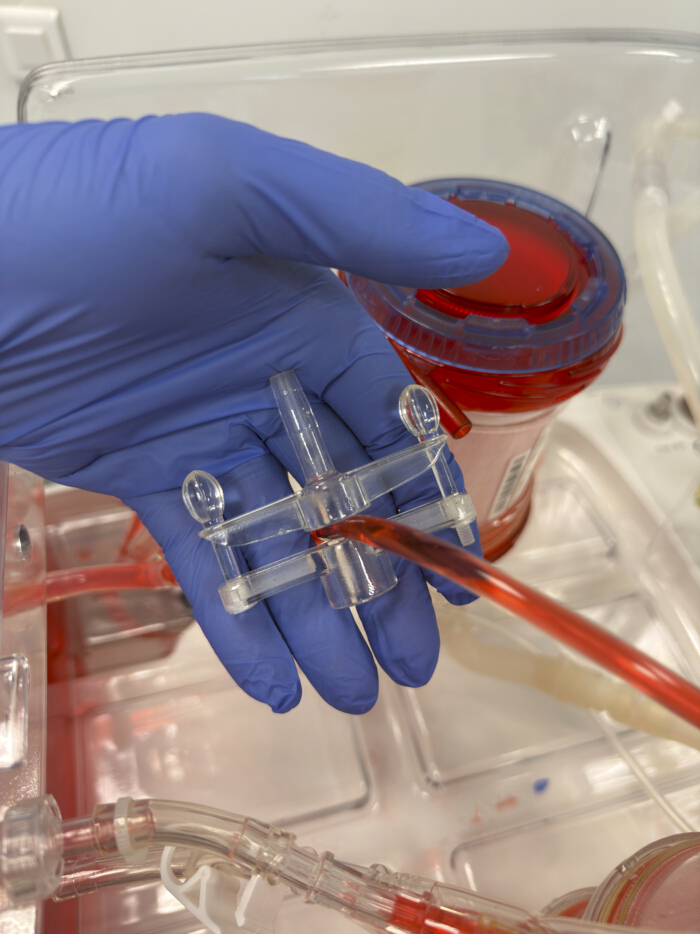
Figure 1: Hoffman clamp positioned on tubing to regulate venous return pressure. The clamp is installed on the return line before connection to the reservoir of the normothermic perfusion system. This configuration enables fine regulation of flow resistance and simulates physiological venous pressure, which is crucial in preventing negative return pressures and false alarms in the CRRT machine. Please click here to view a larger version of this figure.
| Parameter | Expected Range (mmHg) | Interpretation |
| Access pressure | –50 to –200 | Negative pressure due to blood draw from reservoir. |
| Return pressure | < 200 | Reflects mild resistance in the return line. |
| Pre-filter pressure | 100–300 | Indicates blood entry to filter under standard flow. |
| Transmembrane pressure (TMP) | < 300 | Marker of filter performance and clot risk. |
| Effluent pressure | < 300 | Variable depending on bag fill and resistance. |
Table 1: Reference pressure ranges for continuous renal replacement therapy during ex situ perfusion. This table summarizes the expected pressure ranges (in mmHg) for key monitoring points in the extracorporeal circuit, including access pressure, return pressure, pre-filter pressure, transmembrane pressure, and effluent pressure. These reference values serve as baseline indicators of circuit stability, hydraulic efficiency, and filter performance when CRRT is integrated into an ex situ perfusion system. Deviation for these ranges may suggest flow, resistance, occlusion, or filter clotting requiring circuit assessment. Abbreviations: CRRT = continuous renal replacement therapy; TMP = transmembrane pressure.
| Parameter | Abnormal Finding (mmHg) | Possible Cause | Recommended Action |
| Access pressure | > –50 | Poor reservoir contact, line occlusion, kinked or clamped line, air in line or low blood flow | Check reservoir fluid level and position, remove kinks, ensure line is fully submerged and unclamped, increase blood flow |
| Return pressure | > 200 | Return line submerged too deep, line occlusion, clamp too tight, kinking, or clotting | Adjust return line depth, loosen clamp, reposition line, or check for kinks or clots, consider filter change |
| Pre-filter pressure | > 300 | Flow obstruction, excessive viscosity, filter clotting, or clamps left on | Verify circuit patency, reduce flow, check for clots, remove clamps. |
| Transmembrane pressure (TMP) | > 300 | Filter clotting, high resistance, filtrate line or bag clamped, air in filter | Change filter, check for clots or kinks, unclamp lines, remove air, re-prime if needed. |
| < -30 | Low blood flow from reservoir, or filtrate pump slower than treatment pump. | Check reservoir level or increase flow | |
| Effluent pressure | > 300 | Effluent bag full, line occlusion, or bag not hanging freely | Change effluent bag, check for kinks, ensure bag is hanging freely |
| Sudden drop in any pressure | Leak or disconnection | Inspect entire circuit immediately. |
Table 2: Troubleshooting guide for continuous renal replacement therapy during ex situ perfusion. This table provides a systematic guide for identifying and resolving abnormal pressure readings or performance deviations in the CRRT circuit. For each pressure parameter, common abnormal findings are listed with their possible causes and recommended corrective actions. This troubleshooting reference supports rapid detection of circuit malfunctions, maintenance of adequate filtration performance, and prevention of pressure-related complications during ex situ organ perfusion.
3. Waste disposal
- Collect the effluent generated by the CRRT circuit in sealed waste collection bags directly connected to the effluent lines of the machine. Once filled, securely seal and dispose of these bags as liquid biohazard waste, in accordance with institutional and local biosafety regulations.
- Discard the used perfusate, together with any residual pharmacological agents or additives, into designated clinical waste containers intended for liquid and sharp biohazard materials.
- Upon completion of perfusion, drain filters and tubing into liquid waste bags to remove any residual perfusate before disposal. Place all components that have been in contact with biological material in approved clinical waste containers for regulated medical waste and process them according to institutional procedures.
- Place the perfused organ in sealed biological waste bags and discard through certified biohazard waste disposal channels, following applicable institutional and regional biosafety protocols.
WARNING: All system components, including the perfusate and organ, should be treated as potentially infectious biological material. Always use appropriate personal protective equipment (PPE), including gloves, face shields, and lab coats, during setup, operation, and waste disposal.
Access restricted. Please log in or start a trial to view this content.
Results
Loading...
$$\rightleftharpoonup{xx}$$
$$\longleftharp{xx}$$,
$$\longrightharp{xx}$$,
The aim of this protocol is to enable the integration of CRRT during ex situ liver NMP in a manner that preserves perfusion stability. CRRT operates under negative pressure and flow conditions that, when directly connected to a perfusion circuit within the system, can disrupt circuit hemodynamics (Figure 2A). To overcome this, the protocol introduces a configuration in which the CRRT circuit interfaces with the graft/perfusate reservoir, maintaining functional independence between t...
Access restricted. Please log in or start a trial to view this content.
Discussion
Loading...
$$\rightleftharpoonup{xx}$$
$$\longleftharp{xx}$$,
$$\longrightharp{xx}$$,
This protocol presents a detailed and reproducible method for integrating a CRRT device during ex situ liver NMP by connecting the filtration circuit to the perfusion reservoir. The key advantage of this approach is the preservation of perfusion circuit hemodynamics and prevention of the deleterious pressure alterations typically observed with direct in-circuit CRRT integration. Critical steps include the correct placement of CRRT lines within the reservoir to prevent air entrapment, the use of a Hoffman clamp t...
Access restricted. Please log in or start a trial to view this content.
Disclosures
Loading...
$$\rightleftharpoonup{xx}$$
$$\longleftharp{xx}$$,
$$\longrightharp{xx}$$,
The authors have no other conflicts of interest to declare. The funding bodies had no role in study design, data collection and analysis, interpretation of results, or manuscript preparation.
Acknowledgements
Loading...
$$\rightleftharpoonup{xx}$$
$$\longleftharp{xx}$$,
$$\longrightharp{xx}$$,
The authors thank Guangdong Shunde Innovative Design Institute for lending the perfusion system and for their research funding support, as well as NorrDia Spain Medical Device S.L., for providing a CRRT system for liver perfusion experiments. Jordi Vengohechea, Joaquim Albiol, Amelia Judith Hessheimer, and Constantino Fondevila have received research funding from Guangdong Shunde Innovative Design Institute. This study was also supported by funds from the Instituto de Salud Carlos III (ISCIII), PI18/00894 and PI23/00364, and co-funded by the European Union. Jordi Vengohechea was supported by a predoctoral fellowship from the University of Barcelona (PREDOCS-UB 2020).
Access restricted. Please log in or start a trial to view this content.
Materials
| Name | Company | Catalog Number | Comments |
|---|---|---|---|
| 20 mL syringe Luer slip | Nipro Medical Spain SL | SY3-10ESC-GEC | |
| Accusol 35 K+ 2 (Potassium 2 mmol/L) | NIKKISO Europe GmbH | PPE02 | Replacement fluid for CRRT |
| AqualineS Bloodline | NIKKISO Europe GmbH | AQUASET03LV | Pediatric bloodline set for CRRT |
| Aquamax Filter HF03 | NIKKISO Europe GmbH | AQUASET03LV | Pediatric hemofilter (up to 30 kg donors) |
| AquariusTM System | NIKKISO Europe GmbH | Continuous renal replacement therapy machine | |
| Ex situ liver perfusion system | Guangdong Devocean Medical Instrument Co., Ltd. | Devocean-Liver&Kidney 3000 | Main organ perfusion platform composed by two centrifugal pumps with pulsatile/continual pressure perfusion, control panel (sensors for pressure, flow and temperature) and heater unit |
| Fresenius isotonic saline solution 500 mL | Fresenius Kabi | 138900 | |
| Hoffman clamp | Guangdong Devocean Medical Instrument Co., Ltd. | Custom made | Regulation of return line pressure |
| Male Luer-lock connectors | Provided by the Hospital | N/A | For the connection between the perfusion system tubing and the bloodline of the CRRT machine |
| Sodium Heparin 25.000 UI | Laboratorios Farmacéuticos Rovi S.A | 641639.6 | |
| Sterile tubing set | Guangdong Devocean Medical Instrument Co., Ltd. | Custom made | For reservoir access and return connections |
| Universal hose clamp | Achim SchuLz-Lauterbach Vertrieb medizinischer Producte GmbH | KL 20 |
References
Loading...
$$\rightleftharpoonup{xx}$$
$$\longleftharp{xx}$$,
$$\longrightharp{xx}$$,
- Jing, L., Yao, L., Zhao, M., Peng, L., Liu, M. Organ preservation: from the past to the future. Acta Pharmacol Sin. 39 (5), 845-857 (2018).
- Ozgur, O. S., et al. Current practice and novel approaches in organ preservation. Front Transplant. 2 (1), 1156845(2023).
- Ramos, P., et al. Abdominal organ preservation solutions in the age of machine perfusion. Transplantation. 107 (2), 326-340 (2023).
- Broere, R., Luijmes, S. H., De Jonge, J., Porte, R. J. Graft repair during machine perfusion: a current overview of strategies. Curr Opin Organ Transplant. 29 (4), 248-254 (2024).
- Lascaris, B., Hoffmann, R. F., Nijsten, M. W. N., Porte, R. J., De Meijer, V. E. Continuous renal replacement therapy during long-term normothermic machine perfusion of human donor livers for up to 7 d. Transplant Direct. 10 (2), e1568(2024).
- Huang, J., et al. Incorporating a hemodialysis filter into a commercial normothermic perfusion system to facilitate long-term preservation of human split livers. Artif Organs. 48 (9), 1008-1017 (2024).
- Clarke, G., et al. A reproducible extended ex vivo normothermic machine liver perfusion protocol utilising improved nutrition and targeted vascular flows. Commun Med. 4 (1), 214(2024).
- Cillo, U., Nalesso, F., Bertacco, A., Indraccolo, S., Gringeri, E. Normothermic perfusion of a human tumoral liver for 17 days with concomitant extracorporeal blood purification therapy: case description. J Hepatol. 81 (3), e96-e98 (2024).
- Nalesso, F., et al. The rationale for combining normothermic liver machine perfusion with continuous renal replacement therapy to maintain physiological perfusate during ex vivo organ perfusion. J Clin Med. 13 (17), 5214(2024).
- Vengohechea, J., Vaquero-Rey, A., Fondevila, C., Hessheimer, A. J. The role of renal replacement therapy in improving normothermic machine perfusion of liver grafts. Gastroenterol Hepatol. 48 (4), 502336(2025).
- Ostermann, M., et al. Nomenclature of extracorporeal blood purification therapies for acute indications: the Nomenclature Standardization Conference. Blood Purif. 53 (5), 358-372 (2024).
- Saunders, H., Rehan, A., Hashmi, M. F., Sanghavi, D. K. Continuous renal replacement therapy. StatPearls. , (2024).
- Verma, S., Palevsky, P. M. Prescribing continuous kidney replacement therapy in acute kidney injury: a narrative review. Kidney Med. 3 (5), 827-836 (2021).
- Jörres, A. Hemofiltration or hemodialysis for acute kidney injury. Crit Care. 16 (4), 147(2012).
- Kellum, J. A., Romagnani, P., Ashuntantang, G., Ronco, C., Zarbock, A., Anders, H. -J. Acute kidney injury. Nat Rev Dis Primers. 7 (1), 52(2021).
- Maduell, F. Hemodiafiltration. Hemodial Int. 9 (1), 47-55 (2005).
- Perez-Garcia, R., Alcazar-Arroyo, R., De Sequera-Ortiz, P. What is the role of expanded hemodialysis in renal replacement therapy in 2020. Nefrol Engl Ed. 41 (3), 227-236 (2021).
- Campo, S., Lacquaniti, A., Trombetta, D., Smeriglio, A., Monardo, P. Immune system dysfunction and inflammation in hemodialysis patients: two sides of the same coin. J Clin Med. 11 (13), 3759(2022).
- Losappio, V., et al. Molecular mechanisms of premature aging in hemodialysis: the complex interplay between innate and adaptive immune dysfunction. Int J Mol Sci. 21 (10), 3422(2020).
- Finkel, K. W., Waguespack, D. R. Renal replacement therapies. Onco-Nephrol. , 290-298 (2020).
- Fishman, G., Singer, P. Metabolic and nutritional aspects in continuous renal replacement therapy. J Intensive Med. 3 (3), 228-238 (2023).
- Harbord, N., Winchester, J. F., Charen, E., Sheth, N., Bhansali, A. Extracorporeal therapies in acute intoxication and poisoning. Crit Care Nephrol. , 588-594 (2019).
- Tolwani, A. J., Connor, M. J., Palevsky, P. M. Renal replacement therapy for acute kidney injury. Chronic Kidney Dis Dial Transplant. , 739-753 (2019).
- Ağbaş, A., et al. Hemodiafiltration is associated with reduced inflammation, oxidative stress and improved endothelial risk profile compared to high-flux hemodialysis in children. PLoS One. 13 (6), e0198320(2018).
- Canaud, B., Blankestijn, P. J., Grooteman, M. P. C., Davenport, A. Why and how high-volume hemodiafiltration may reduce cardiovascular mortality in stage 5 chronic kidney disease dialysis patients? A comprehensive literature review. Semin Dial. 35 (2), 117-128 (2022).
- Canaud, B., Davenport, A. The rationale and clinical potential of online hemodiafiltration as renal replacement therapy. Semin Dial. 35 (5), 380-384 (2022).
- Guimarães, M. G. M., et al. Hemodiafiltration versus hemodialysis in end-stage kidney disease: a systematic review and meta-analysis. Kidney Med. 6 (6), 100829(2024).
- Maduell, F., Rodríguez-Espinosa, D., Broseta, J. J. Latest trends in hemodiafiltration. J Clin Med. 13 (4), 1110(2024).
- Saunders, H., Rehan, A., Hashmi, M. F., Sanghavi, D. K. Continuous renal replacement therapy. StatPearls. , (2025).
- Machine perfusion for donor organ repair: from vision to everyday clinical practice. Organ Repair Regen. , 43-73 (2021).
- Abraham, N., et al. Orthotopic transplantation of the full-length porcine intestine after normothermic machine perfusion. Transplant Direct. 8 (11), e1390(2022).
- Banan, B., et al. Normothermic extracorporeal liver perfusion for donation after cardiac death livers. Surgery. 158 (6), 1642-1650 (2015).
- Banan, B., Watson, R., Xu, M., Lin, Y., Chapman, W. Development of a normothermic extracorporeal liver perfusion system toward improving viability and function of human extended criteria donor livers. Liver Transpl. 22 (7), 979-993 (2016).
- Bitsch, R. G., Düx, M., Helmberger, T., Lubienski, A. Effects of vascular perfusion on coagulation size in radiofrequency ablation of ex vivo perfused bovine livers. Invest Radiol. 41 (4), 422-427 (2006).
- Clavien, P. -A., et al. Transplantation of a human liver following 3 days of ex situ normothermic preservation. Nat Biotechnol. 40 (11), 1610-1616 (2022).
- De Haan, M. J. A., et al. A cell-free nutrient-supplemented perfusate allows four-day ex vivo metabolic preservation of human kidneys. Nat Commun. 15 (1), 3818(2024).
- Eshmuminov, D., et al. An integrated perfusion machine preserves injured human livers for 1 week. Nat Biotechnol. 38 (2), 189-198 (2020).
- Kappler, B., et al. Attenuated cardiac function degradation in ex vivo pig hearts. Int J Artif Organs. 43 (3), 173-179 (2020).
- Schuler, M. J., et al. Observations and findings during the development of a subnormothermic/normothermic long-term ex vivo liver perfusion machine. Artif Organs. 47 (2), 317-329 (2023).
- Clark, W., Villa, G., Ronco, C. Continuous renal replacement therapy machine technology. Crit Care Nephrol. , 853-860 (2019).
- Berger, D., Takala, J. Hypotension and hypovolemia during hemodialysis: is the usual suspect innocent. Crit Care. 20 (1), 140(2016).
- Canaud, B., Chazot, C., Koomans, J., Collins, A. Fluid and hemodynamic management in hemodialysis patients: challenges and opportunities. Braz J Nephrol. 41 (4), 550-559 (2019).
- Inal, M. T., Memiş, D., Karamanlıoglu, B., Sut, N. Effects of polygeline and hydroxyethyl starch solutions on liver functions assessed with LIMON in hypovolemic patients. J Crit Care. 25 (2), 361.e1-361.e5 (2010).
- Prowle, J., Mehta, R. Fluid balance management during continuous renal replacement therapy. Semin Dial. 34 (6), 440-448 (2021).
- Li, P., et al. Effect of dynamic circuit pressures monitoring on the lifespan of extracorporeal circuit and the efficiency of solute removal during continuous renal replacement therapy. Front Med. 8 (1), 621921(2021).
- Tsujimoto, Y., Fujii, T. How to prolong filter life during continuous renal replacement therapy. Crit Care. 26 (1), 62(2022).
- Akhoundi, A., et al. Incidence of adverse events during continuous renal replacement therapy. Blood Purif. 39 (4), 333-339 (2015).
- Bell, M., et al. Modern CRRT systems are associated with lower risk of hypothermia. Sci Rep. 14 (1), 74977(2024).
- Morsch, C. M. F., et al. Hypothermia related to continuous renal replacement therapy: incidence and associated factors. Rev Bras Ter Intensiva. 33 (1), 111-118 (2021).
Access restricted. Please log in or start a trial to view this content.
Reprints and Permissions
Request permission to reuse the text or figures of this JoVE article
Request Permission