This review examines the potential of the scikit-learn machine learning library for predicting transfusion adverse reactions. It outlines a data-driven framework to improve risk assessment, address limitations of conventional approaches, and support the development of precision transfusion medicine.
A subscription to JoVE is required to view this content. Sign in or start your free trial.
Review Article
Machine Learning Approaches for Precision Risk Assessment of Transfusion Adverse Reactions: A Scikit-learn-Based Review
* These authors contributed equally
In This Article
Summary
Abstract
Transfusion adverse reactions (TARs) encompass undesirable effects occurring during or after blood transfusion, resulting from the administration of blood, blood products, or transfusion-associated materials. These reactions may cause mild to severe clinical manifestations, including allergic reactions, hemolysis, and transfusion-related acute lung injury (TRALI). Current conventional approaches -- such as ABO/Rh blood group matching and massive transfusion protocols -- can improve patient outcomes but fail to address complex patient-specific factors. Consequently, developing a dedicated TAR risk model is essential. Machine learning (ML) algorithms can leverage large-scale clinical and laboratory datasets to construct diagnostic and prognostic models, advancing personalized and precision medicine. Notably, the scikit-learn (SK-learn) ML algorithmhas not yet been directly applied to TAR risk assessment; nevertheless, its efficacy in constructing similar medical risk prediction models has gained significant recognition. This review presents an ML-based framework for predicting and preventing TAR, with a specific emphasis on the role of SK-learn across diverse clinical contexts. Our analysis lays the groundwork for future precision diagnosis of TAR and the development of SK-learn algorithms. Crucially, our synthesis of the literature indicates that sklearn offers a versatile and powerful toolkit for this task; however, its successful translation into clinical practice is contingent upon overcoming key challenges, including multi-center data heterogeneity and the need for robust model interpretability.
Introduction
Blood transfusion is a life-saving intervention used in various clinical contexts, including trauma care, surgical procedures, obstetric emergencies, oncological treatments, and the management of chronic hematological disorders1,2. Despite significant therapeutic benefits, transfusions may cause various adverse events, collectively termed Transfusion Adverse Reactions (TARs)3,4. TAR represents a multifactorial condition with manifestations ranging from mild allergic reactions to severe complications. The most frequent reactions include febrile non-hemolytic transfusion reactions (FNHTRs) and allergic reactions, with reported incidences of approximately 26 and 21 per 100,000 transfused units, respectively5,6. While ABO/Rh blood group matching and standardized transfusion procedures can significantly reduce TAR risk, thereby increasing patient safety7,8,9. They cannot fully prevent these events, particularly those with complex or immune-mediated etiologies.
The evidence suggests that ML, a subfield of artificial intelligence (AI), facilitates the integration of complex, multimodal data. This capability enhances clinical decision-making, facilitates personalized treatment, and optimizes medical services, ultimately improving patient outcomes10,11. Introduced in 2007, SK-learn is an open-source Python machine learning library. Its core functionalities include regression analysis implemented through ML algorithms, along with classification, clustering, dimensionality reduction, model selection, and preprocessing capabilities12. In medical applications, SK-learn is employed primarily for disease prediction, diagnostic classification, and clinical risk stratification13,14. For example, a study utilized the SK-learn library to construct a predictive model that effectively differentiated between diabetic nephropathy and nondiabetic nephropathy, thereby assisting in clinical diagnosis and treatment15. Leveraging the advantages of the sklearn algorithm, its efficacy in constructing posttransfusion adverse reaction (TAR) risk prediction models has gained significant recognition16,17.
This review synthesizes current advancements in SK-learn machine learning algorithms and delineates their translational applications across diverse disease contexts. Furthermore, it also establishes a framework for future clinical implementation of SK-learn in risk-stratified TAR diagnosis and predictive modeling.
Access restricted. Please log in or start a trial to view this content.
Review and Perspective
Overview of TAR
Pathogenesis of TAR
TAR encompasses a diverse spectrum of clinical manifestations and pathophysiological mechanisms (Table I). These reactions are primarily categorized into immune-mediated and nonimmune-mediated subtypes7,9,18,19. Immune-mediated reactions typically involve antigen-antibody interactions, leading to hemolysis or systemic inflammatory responses. A representative example is ABO incompatibility, which can trigger acute hemolytic transfusion reactions (AHTRs). This condition manifests as fever, flank pain, hypertension, disseminated intravascular coagulation (DIC), and acute renal failure7,9,20. Furthermore, type I hypersensitivity reactions may trigger allergic transfusion reactions, with clinical manifestations ranging from mild urticaria to life-threatening anaphylaxis. Notably, these reactions are frequently associated with platelet products due to the presence of residual donor plasma proteins, including subpollen allergen molecules18,21,22,23. TRALI is clinically defined by the acute onset of hypoxemia and noncardiogenic pulmonary edema within 6 hours post-transfusion. The pathogenesis primarily involves donor-derived antibodies against human leukocyte antigens (HLAs) or granulocyte-specific antigens21,22,24. Notably, certain blood group antigens, such as Kidd system antigens, can trigger delayed hemolytic transfusion reactions, also known as DHTRs, when targeted by donor-derived anti-HLA antibodies. Separately, TRALI, which is a type of transfusion-related acute lung injury, represents a distinct pathological entity mediated by donor anti-HLA antibodies through neutrophil activation mechanisms6,22. Nonimmune-mediated transfusion reactions encompass several clinical entities, including septic reactions due to bacterial contamination, volume overload, mechanical or thermal hemolysis, and transfusion-associated circulatory overload (TACO)9,23. Septic transfusion reactions result from the infusion of blood products contaminated with bacteria, most commonly Staphylococcus spp., Staphylococcus aureus, and Escherichia coli in platelets, and Yersinia enterocolitica in red blood cells. Clinically, they present with high fever, rigors, hypotension, and can rapidly progress to shock. Notably, with the implementation of highly sensitive pathogen screening, the risk of classic transfusion-transmitted infections (TTIs, e.g., HIV, HCV) has been drastically reduced. Consequently, septic reactions, particularly from platelet transfusions which are stored at room temperature, are now a more frequently reported infectious complication of transfusion than TTIs. Transfusion-transmissible infections, which may be caused by diverse pathogens, such as viruses, bacteria, and parasites, can trigger TAR by activating the innate immune system. Recent systematic reviews highlight that comprehensive screening of immunogenic pathogens remains the primary challenge in preventing infection-related TAR25,26,27,28 (Table 1).
Epidemiology of TAR
In developed countries, the overall incidence of TAR remains relatively low. Current surveillance data indicate that allergic reactions and febrile nonhemolytic transfusion reactions (FNHTRs) are among the most frequently reported adverse events, with allergic reactions now being more common than FNHTRs in many reporting systems. Delayed serologic transfusion reactions (DSTRs) are less commonly reported5,9,29. Nevertheless, TAR continues to pose substantial clinical challenges in developing countries and specific populations, with this elevated risk profile stemming from multifactorial determinants, including variations in standardized screening protocols, suboptimal blood product handling procedures, heterogeneous transfusion practices, and population-specific genetic predispositions26,27. Patients with sickle cell disease are particularly susceptible to hemolytic transfusion reactions and alloimmunization. This elevated risk is attributed to chronic inflammation, phenotypic differences in RBC antigens between predominantly Caucasian donor and African-descent SCD patient populations, and a high lifetime exposure to transfusions, rather than the presence of sickle hemoglobin itself20,30. Notably, recent surveillance data from major Chinese medical centers revealed a higher incidence of allergic TAR in pediatric and neonatal populations than in adults, which is attributable to distinct transfusion thresholds and clinical practices. Conversely, European cohorts demonstrate an opposing epidemiological pattern in these age groups19,31,32. For example, Guo, K. et al. 19 reported that children in a major Chinese national center experienced allergic reactions more frequently than adults, whereas in neonates, transfusion thresholds and practices vary significantly across Europe33.
Current clinical trials developing TAR risk assessment models employ three core strategic approaches encompassing risk-stratified preventive measures, continuous real-time monitoring systems, and personalized management protocols for high-risk populations. These risk models demonstrate a bimodal classification system, comprising both comprehensive screening tools with universal applicability to transfusion recipients and specialized predictive algorithms designed for identifying specific adverse reaction subtypes34,35. Generalized risk assessment tools, exemplified by the UK Serious Hazards of Transfusion (SHOT) system, utilize population-level datasets to stratify transfusion recipients. These systems demonstrate particular efficacy in identifying high-risk cohorts, including patients with histories of multiple transfusions or autoimmune disorders36. The conventional Transfusion Risk and Clinical Knowledge (TRACK) score methodology employs static performance metrics with predetermined cutoff values to quantify model performance within predefined decision boundaries. This approach characterizes the predictive capability of a model under constrained operational parameters37. Recent advancements have yielded novel risk stratification tools for transfusion prediction. The newly developed SCORE system incorporates six clinically validated predictive factors to estimate the probability of transfusion. Comparative analyses demonstrate that this simplified model achieves comparable predictive accuracy and calibration performance to the conventional TRACK score when forecasting transfusion requirements in cardiac surgical procedures38.
In addition to specific reaction models, many in vivo models have been recently studied39. TRALI is a clinically significant complication whose risk profile is determined by an interplay of donor-derived anti-human leukocyte/neutrophil antigen (anti-HLA/HNA) antibodies, elevated recipient inflammatory biomarkers, including interleukin-6, and the administered transfusion volume34,39,40. Transfusion-associated circulatory overload (TACO) risk is often evaluated using clinical scoring systems that incorporate parameters such as elevated B-type natriuretic peptide (BNP or NT-proBNP) levels, a history of cardiac dysfunction, high transfusion rate, and positive fluid balance. The risk of immune-mediated hemolysis is preemptively assessed through antibody screening via the indirect antiglobulin test (indirect Coombs test), which detects clinically significant alloantibodies in the recipient's plasma. Identifying these antibodies enables the selection of antigen-negative blood units for transfusion, thereby preventing the antigen-antibody reactions that would otherwise cause hemolysis. A patient's transfusion history is also critical for identifying prior sensitization and risk for delayed hemolytic reactions. These mechanistic models integrate multidimensional clinical and laboratory parameters to increase the precision of adverse reaction prediction34,39,41. In addition, massive transfusion protocols (MTPs) have been generated to reduce mortality related to hemorrhagic shock in severely bleeding trauma or surgical patients by standardizing the ratio of RBCs, plasma, and platelets42,43. However, these practices have lowered transfusion-related morbidity, and they do not fully capture the intricate interplay of immunologic and nonimmunologic variables that define transfusion safety. Many existing scoring systems and protocols have been validated under controlled conditions or narrower patient cohorts, making them suboptimal in real-world, heterogeneous environments16,44,45,46. Evolving pathogen profiles, changes in donor populations, and the complexity of modern medical care further challenge static approaches25,26,47. This backdrop has spurred growing interest in applying machine learning to refine transfusion risk assessment, combining clinical data, laboratory findings, and emerging fields such as multiomics to create more powerful predictive models (Figure 1)48,49,50.
Current clinical risk assessment model construction via machine learning
Machine learning (ML), as a foundational artificial intelligence paradigm, empowers adaptive decision-making through the automated discovery of latent data patterns and the inductive generation of predictive models, thereby circumventing explicit procedural programming and enabling continuous performance refinement in complex, evolving domains, including medical diagnostics and forecasting51. The evolution of machine learning has traversed three distinct phases: (1) the foundational era, which established the theoretical groundwork52; (2) the algorithmic renaissance, marked by significant advancements in support vector machines and ensemble methods53; and (3) the deep learning revolution, where convolutional and recurrent neural networks, fueled by GPU acceleration and big data, have instigated transformative paradigm shifts across multiple fields54. In medical applications, they have revolutionized medical image diagnosis and biomarker detection55.
Current machine learning systems are categorized into three core paradigms based on their learning mechanisms: (1) supervised learning, which relies on labeled training sets for predictive modeling; (2) unsupervised learning, which uncovers latent structures from unannotated data; and (3) deep learning, which leverages hierarchical neural architectures for automated feature abstraction. Together, these paradigms constitute the foundational methodologies underpinning contemporary AI applications56.
In recent years, ML has gained widespread application in the development of medical diagnostic markers, prognosis evaluation, and risk model construction57,58. Medical data frequently exhibit high dimensionality, which poses significant challenges for effective analysis via traditional methods14,59. ML techniques are excellent at extracting critical features from such complex datasets, thereby facilitating the identification of crucial features. The application of ML in transfusion medicine is rapidly emerging. For instance, ML models have demonstrated superior performance in tasks such as medical image classification and pathological analysis, leading to substantial improvements in the accuracy of early diagnosis and prognosis stratification60,61. By leveraging patient-specific data, such as genomic and metabolomic profiles, ML can predict personalized treatment responses, advancing the field of precision medicine62. Beyond predicting the need for transfusion, ML is also being applied to optimize blood product management. Studies have leveraged ML for tasks such as forecasting platelet usage and personalizing preoperative blood order schedules, demonstrating potential to improve inventory management and reduce wastage.
Furthermore, ML enables the integration of multisource data, including imaging, genomics, and electronic health records (EHRs), to construct comprehensive predictive models63. Additionally, ML supports real-time risk alerts, such as sepsis prediction for ICU patients, and automates diagnostic workflows, thereby alleviating the workload on healthcare professionals64. ML has significantly advanced the precision of cancer prognosis models and target development by integrating multiomics data, mining complex patterns, and accelerating drug design. In addition, machine learning enhances diagnostic accuracy by identifying both known and unknown patterns indicative of cancer presence or absence65. A simulation study demonstrated that radiologists could skip predicted negative cases, reducing their workload to read only 80.7% of mammograms while maintaining overall sensitivity and specificity. It has been demonstrated that CNN models can be used to segment functional tissues from breast ultrasound images, thereby assisting clinicians in the interpretation and diagnosis of these images66. Prognosis and treatment selection rely heavily on tumor characteristics, many of which can be predicted via image-based ML models. Some researchers have applied 3D CNNs to predict the EGFR mutation status in lung adenocarcinoma from manually selected regions of interest (ROIs) in CT scans, offering a noninvasive alternative for cancer genotyping and informing potential therapeutic strategies67. Emerging genomic technologies, such as single-cell transcriptomics and spatial transcriptomics, hold significant promise for revolutionizing the histopathological characterization of solid tumors. Specifically, single-cell transcriptomics enables detailed analysis of the cellular composition, allowing ML models to predict cancer treatment responses and potential drug resistance mechanisms68.
Deep learning (DL), as a subfield of ML, leverages multilayer neural network algorithms inspired by the neural architecture of the brain for predictive modeling69. In contrast to ML methods, such as logistic regression, which leverage their neural network architecture, DL enables models to scale exponentially with increasing data volume and dimensionality69. DL has been extensively applied in medical applications. In recent years, emerging deep learning techniques have been widely adopted for cancer diagnosis, prognosis, and the identification of therapeutic regimens. Various neural network architectures, including multilayer perceptrons (MLPs), recurrent neural networks (RNNs), and convolutional neural networks (CNNs), serve as foundational components for advanced methodologies69. Studies have introduced a CNN model capable of predicting cancer risk not only at the image level but also at the pixel level, providing heatmaps that highlight regions most likely to develop malignancies70. The integration of deep CNNs into histology-based cancer grading systems has proven successful, with studies indicating that these models can achieve performance comparable to that of human pathologists in grading prostate, breast, colon, and lymphoma cancers71,72,73,74,75. Researchers have demonstrated that segmenting cancerous tissues with a CNN-based generator can assist a CNN-based classifier in predicting prostate cancer grade76. Some researchers have utilized a hybrid graph convolutional neural network (GCNN) model to map gene expression profiles onto the STRING protein-protein interaction (PPI) network, enabling the prediction of breast cancer molecular subtypes69,77. Machine learning has also demonstrated significant applicability in noncancer diseases, particularly in diagnostic modeling. For example, studies have conducted external and prospective training and validation of machine learning models to predict mortality and critical events among COVID-19 patients across various timeframes. These models successfully identified high-risk patients and elucidated the underlying relationships contributing to the predictive outcomes78. Traditional radiomic models predominantly depend on manually engineered features derived explicitly from medical images. Researchers have explored whether deep features extracted via transfer learning could be utilized to generate radiomic signatures for predicting the overall survival (OS) of glioblastoma multiforme (GBM) patients79. In recent years, ML has demonstrated significant advancements in microbiology80. A key application within this domain involves enabling healthcare professionals to rapidly and accurately diagnose the microorganisms responsible for infectious diseases in patients, which is critical for determining appropriate treatment strategies. ML models can achieve precise diagnoses when provided with suitable input data80. It has been demonstrated that using a pre-trained convolutional neural network (CNN) as a feature extractor, combined with patient-level cross-validation, can effectively distinguish between malaria-infected cells and uninfected cells, thereby enhancing disease screening processes81. A machine learning model based on a cohort of 1,839 bacterial isolates from the UK was developed to classify the resistance profiles of Mycobacterium tuberculosis (M. tuberculosis) to eight antituberculosis drugs (isoniazid, rifampicin, ethambutol, pyrazinamide, ciprofloxacin, moxifloxacin, ofloxacin, and streptomycin), including multidrug-resistant tuberculosis. Compared with previous methods, the best-performing model improved the sensitivity for isoniazid, rifampicin, and ethambutol by 2-4%, achieving a sensitivity of 97% (P < 0.01). The sensitivity for ciprofloxacin and multidrug-resistant tuberculosis increased to 96%. For moxifloxacin and ofloxacin, the sensitivity increased from 83% and 81%, respectively, based on known resistance alleles, to 95% and 96% (P < 0.01), representing improvements of 12% and 15%, respectively. Notably, compared with rule-based approaches, the model enhanced the sensitivity for pyrazinamide and streptomycin by 15% and 24%, respectively, reaching 84% and 87% (P < 0.01). The top-performing model also increased the area under the ROC curve for pyrazinamide and streptomycin by 10% (P < 0.01) and for other drugs by 4-8% (P < 0.01).
For example, DL models are commonly trained to analyze mammographic images to predict the likelihood of a patient developing cancer in the future82. Additionally, some researchers have emphasized the advantages of this direct risk prediction method, indicating that the breast cancer risk score generated by the Inception-ResNet-v2 convolutional neural network model is more accurate than the score derived from clinical breast density assessment83. Similarly, some researchers have developed a DL-based mammography model that outperforms the Tyrer-Cuzick risk model, which relies on clinical features such as patient age, in predicting the five-year risk of breast cancer development among women84.
Additionally, machine learning has been applied in transfusion medicine. The growing interest in applying AI to transfusion medicine is underscored by its inclusion in major professional forums, such as a dedicated conference hosted by the International Society of Blood Transfusion (ISBT) Clinical Transfusion Working Party, which explores the potential of AI in TM practice, education, and research85. Blood transfusion (BT) is a critical component of medical care for surgical patients in the ICU. This study analyzed data from 9,118 surgical ICU patients in the UMC database, utilizing machine learning to predict blood transfusion requirements. By comparing the performance of XGBoost and logistic regression (LR) algorithms using data from 6 hours before ICU admission through 1, 2, 3, and 6 h post admission, the research revealed significant differences in patient characteristics between transfusion and non-transfusion groups. These findings confirm the feasibility of machine learning in predicting blood transfusion needs for surgical ICU patients86. Allogeneic blood transfusions are frequently required in hip joint surgeries but are associated with increased morbidity risks. Accurate prediction of transfusion requirements is essential for minimizing blood product waste and optimizing preoperative decision-making. Recent studies have established 14 machine learning algorithms to predict transfusion risks, incorporating patient demographic data, preoperative laboratory results, and surgical information. Model performance was assessed via discrimination, calibration, and decision curve analysis. SHapley additive explanations (SHAPs) were employed to interpret the models, with the ridge classifier demonstrating the highest predictive accuracy, achieving an AUC of 0.85 (95% CI: 0.81-0.88) and a Brier score of 0.21. This study's machine learning model demonstrated high predictive performance for perioperative transfusion needs in hip joint surgeries, utilizing available clinical variables87.
Furthermore, machine learning has been successfully integrated into drug design, addressing challenges such as time and computational costs while enhancing reliability88,89. By leveraging the three-dimensional ligand-binding environment of proteins, machine learning facilitates the determination of target protein structures, a pivotal step in drug discovery90. For example, AlphaFold, an AI-driven tool, can be trained directly on the Protein Data Bank (PDB) data and is capable of predicting protein 3D structures from amino acid sequences91. AlphaFold employs a two-step process: first, a CNN converts the protein's amino acid sequence into distance and torsion angle matrices; second, gradient optimization techniques transform these matrices into the protein's 3D structure92.
Scikit-learn (sklearn) is a Python-based machine learning library widely acclaimed for its ease of use, extensive documentation, and robust community support93. It provides a comprehensive collection of supervised methods, such as logistic regression, support vector machines, and random forests, as well as unsupervised methods, including clustering and dimensionality reduction93. It also provides Pipelines that streamline data preprocessing, model training, cross-validation, and hyperparameter tuning in a unified framework93. Tools for model interpretability, including permutation feature importance and partial dependence plots, alongside advanced ensemble methods such as random forest and gradient boosting, consistently exhibit robust predictive performance in healthcare contexts45,93.
Given these features, SK-learn has been extensively utilized in medical research for tasks such as disease diagnosis12,94, predicting survival times95, analyzing large imaging datasets96, and building risk prediction models for transfusion usage97. This section provides a detailed examination of the specific application cases and technical implementation and demonstrates the advantages of SK-learn in constructing disease diagnosis and risk assessment models (Figure 2). With a particular focus on the cancer domain, where its applications are most extensive and mature, we analyze successful practices and address existing challenges12,93,95,98. Furthermore, we explore how these insights can serve as valuable references and inspirations for the development of TAR risk prediction models.
SK-learn provides a robust algorithmic framework that integrates traditional machine learning techniques -- including support vector machines (SVMs), random forests, and logistic regression -- with deep learning approaches such as the multilayer perceptron (MLP) classifier, rendering it well-suited for modelling diverse cancer datasets. For example, in the development of a novel histological system for diagnosing adrenocortical carcinoma, researchers have utilized the sklearn library in Python to construct a multidimensional mathematical model. This model achieved an overall diagnostic accuracy of 100%, demonstrating broad applicability across all morphological variants99.
Furthermore, SK-learn, GridSearchCV, and RandomizedSearchCV tools enable automated hyperparameter optimization. For example, when predicting lymph node metastasis, the parameters of an XGBoost model were fine-tuned via cross-validation, resulting in an AUC value of 0.95212. For example, the support vector machine (SVM) exhibits superior performance in breast cancer classification tasks. Its nonlinear kernel function enables effective processing of high-dimensional imaging data. A study analyzing spectral data from oral cancer patients revealed that SVM, when combined with recursive feature elimination (RFE), achieved a sensitivity of 95% and a specificity of 96%, significantly surpassing traditional Fisher linear discriminant analysis (FLD)100. Additionally, a comparative analysis conducted on the UCI breast cancer dataset demonstrated that SVM outperformed both K-means clustering and artificial neural networks in terms of classification accuracy and generalization capability101. The ability of SVM to handle high-dimensional data is equally relevant for TAR prediction, where models must integrate numerous clinical and laboratory parameters.
The random forest method demonstrates superior performance in feature importance analysis. Some researchers have utilized random forests to integrate genomic and clinical data and identify key features related to breast cancer prognosis. The clustering results were significantly correlated with clinical outcomes102. This approach can be directly transferred to TAR modeling to identify the most influential risk factors, such as specific donor antibodies or recipient inflammatory markers, from a wide array of candidate features.
XGBoost, as a representative gradient boosting algorithm, demonstrates outstanding performance in cancer staging prediction. A study based on multiomics data from TCGA indicated that XGBoost, combined with DNA methylation features, can further enhance the predictive performance of the classification model103. In another study on breast cancer metastasis, XGBoost optimized its hyperparameters through Grid-Search CV and was combined with SHAP value visualization. Six key genes, such as SQSTM1 and GDF9, were successfully identified. The model's AUC reached 0.82, providing new biomarkers for metastasis risk prediction104. The combination of high-performing ensemble methods like XGBoost with SHAP explanation is a powerful paradigm that can be adopted for TAR models to provide clinicians with transparent and actionable risk assessments.
SK-learn provides a standardized data preprocessing toolkit that effectively addresses the high dimensionality, imbalance, and missing values in cancer data. For example, in the prediction of colorectal cancer, a logistic regression model that screens four core indicators, such as CEA and hemoglobin, was used to construct a non-invasive diagnostic model with an area under the curve (AUC) of 0.849, significantly outperforming detection via a single tumour marker105. In terms of imbalanced data processing, by combining the SMOTE oversampling technique from the imbalanced-learn library, XGBoost improved the sensitivity of the minority class (malignant samples) by 8.36% in breast cancer classification, and the F1 value reached 96.2%106.
The combination of SK-learn with tools such as SHAP and eli5 provides transparent interpretability for cancer models. In the prediction of sentinel lymph node metastasis in breast cancer, the XGBoost model visualized through SHAP values shows that ultrasound features such as "suspicious lymph nodes" and "marginal spiculation" have the greatest contribution to the risk of metastasis, which is highly consistent with clinical diagnostic logic12.
SK-learn has demonstrated substantial advantages in research related to noncancer diseases. Noncancer diseases frequently necessitate the integration of multisource data, including electronic health records (EHR), imaging, genomics, proteomics, and others. SK-learn is capable of consolidating patient EHRs, genetic profiles, and lifestyle information to predict the risk of associated diseases with enhanced precision. For example, a random forest algorithm from SK-learn was used to integrate EHR data for predicting cardiovascular disease risk. This approach not only significantly improved the accuracy of cardiovascular risk prediction but also increased the number of patients who could benefit from preventive interventions while minimizing unnecessary treatments for others107. Researchers have utilized Python's SK-learn machine learning library to develop and train five distinct AI models-logistic regression, random forest, AdaBoost, CATBoost, and LightGBM-for predicting postoperative rotator cuff re-tears following arthroscopic rotator cuff repair (ARCR). The trained models were subsequently applied to a test dataset for evaluation. Notably, the LightGBM model achieved an AUC of 0.87, demonstrating its superior predictive performance in estimating the likelihood of re-tearing after ARCR108.
Although sklearn has been widely used in the field of medical prediction, there is currently no direct literature on its application in predicting adverse transfusion reactions. This gap does not indicate a technical defect but rather highlights the unique challenges and untapped potential of predicting adverse transfusion reactions.
The traditional methods for assessing the risks of adverse reactions from blood transfusion mainly rely on static clinical indicators, retrospective analysis of medical history, and standardized screening questionnaires, which have multiple limitations109,110,111. TAR events are extremely rare. The incidence of transfusion reactions in the general adult population is approximately 2%, which results in an extremely unbalanced category112. This imbalance causes standard classifiers to prioritize the accuracy of the majority class over the minority class. To address this issue, the sklearn imbalanced-learn module, such as SMOTE+ENN, provides a well-established solution for rebalancing the dataset. Numerous factors contribute to the occurrence of adverse reactions following blood transfusions113. SK-learn enables effective preprocessing of collected data, facilitating subsequent analysis. The use of column transformers for heterogeneous preprocessing and feature union for multimodal feature fusion allows seamless integration of structured data114,115. In clinical decision-making, model transparency is crucial. SHAP/LIME is compatible with sklearn models, including TreeExplainer for random forests, ensuring regulatory compliance while preserving predictive performance116,117.
To translate the discussed capabilities of sklearn into a tangible strategy for TAR prediction, we propose a practical modeling pipeline following the established machine learning roadmap (Figure 3). This framework is designed to address the specific challenges of TAR, such as data heterogeneity and extreme class imbalance.
The development of a robust predictive model for transfusion adverse reactions necessitates an end-to-end analytical pipeline. This process begins with the integration and preprocessing of multimodal clinical data, encompassing patient demographics, vital signs, laboratory values, transfusion details, and donor characteristics. Heterogeneous data types are efficiently consolidated using sklearn's ColumnTransformer within a Pipeline to apply appropriate scaling and encoding, creating a unified dataset for analysis. A critical subsequent step involves addressing the profound class imbalance inherent to rare TAR events; the target labels, defined by rigorously adjudicated outcomes, can be rebalanced using techniques like SMOTE-ENN from the compatible imbalanced-learn library to prevent model bias. Following data preparation, multiple algorithms are trained and evaluated using sklearn's consistent API, with hyperparameter tuning and calibration conducted via GridSearchCV to optimize performance and ensure reliable probability estimates. To foster clinical trust and provide mechanistic insights, the model's predictions are interpreted using tools like SHAP, which can quantify the contribution of specific features to an individual's risk score. The model's generalizability is then rigorously validated using robust techniques like nested cross-validation on data from distinct patient cohorts. Finally, for potential clinical translation, the entire trained pipeline can be serialized and integrated into electronic health record systems, functioning as a real-time decision support tool that provides interpretable risk scores to clinicians at the point of care.
In this review, we begin by introducing TAR, summarize existing TAR models, present the concept of machine learning, highlight the advantages of machine learning, and discuss its applications in disease prediction. We further explore the potential application of machine learning in TAR, providing guidelines for future researchers in the development of TAR-SK learning models. In addition, we elaborate on the potential role of SK-learn in assessing TAR risk but emphasize that notable limitations significantly constrain its clinical application. Current TAR models predominantly rely on retrospective, single-center datasets, which may fail to capture regional variations in transfusion practices, demographic characteristics such as age-related differences between pediatric and adult populations, or genetic susceptibility across diverse populations19,26,31,32. Moreover, these models inadequately integrate multiomics data, including donor HLA antibody profiles and recipient inflammatory proteomics, which are critical for understanding immune-mediated TAR mechanisms such as TRALI. This limitation restricts their ability to differentiate between immune and nonimmune subtypes25,40. Interpretability remains a key challenge: while SK-learn provides tools such as SHAP values, if algorithmic predictions, such as rare genetic markers, lack biological validation as risk factors, clinicians may be hesitant to adopt these models, leading to a disconnect between machine learning results and clinical intuition14,50. Practical implementation also faces challenges, such as the need for robust computational infrastructure and standardized preprocessing of electronic health record (EHR) data, which are often unavailable in resource-limited settings47,87.
To address these gaps, future research should prioritize prospective multicenter data collection, such as integrating datasets from international TAR registries, including the UK SHOT system and Chinese pediatric cohorts, to reduce selection bias and enhance model generalizability19,36. The incorporation of multimodal data, including single-cell RNA sequencing of donor blood and inflammatory protein markers, into the SK-learn pipeline could improve TAR subtype classification, similar to the 12-24% improvement in sensitivity observed in tuberculosis drug resistance prediction studies73. Collaborating with immunologists to validate mechanisms, such as linking SK-learn-identified risk features -- specific HLA antibody combinations -- with in vitro complement activation assays, can bridge the gap between algorithmic predictions and biological mechanisms22,24. The development of user-friendly clinical decision support tools capable of automatically extracting real-time features from EHRs, such as transfusion volume and BNP levels, and providing interpretable risk scores alongside traditional diagnostic criteria, is essential for seamless integration into clinical workflows97,107.
Compared with traditional TAR models, such as ABO/Rh matching and TRACK scores, SK-learn has significant advantages. For example, ensemble algorithms such as LightGBM excel at modelling nonlinear interactions between risk factors, such as donor anti-HLA antibodies and recipient IL-6 levels, resulting in a 12-24% increase in sensitivity in antibiotic resistance prediction studies. Data-driven feature prioritization tools, such as permutation feature importance, can identify novel risk indicators, including blood storage duration and undetected complications, beyond predefined clinical knowledge45,93. Furthermore, its open-source architecture and moderate computational requirements make it applicable in resource-constrained environments, unlike deep learning frameworks69,93.
To translate this potential into clinical impact, future work must focus on several key areas. First, prospective, multicenter data collection is essential to overcome selection bias and improve model generalizability across diverse populations. Second, integrating multimodal data (e.g., donor antibody profiles, recipient inflammatory markers) will provide a more comprehensive feature set, enabling sklearn models to better distinguish between TAR subtypes and capture complex risk interactions. Third, biological validation of algorithm-identified risk features (e.g., linking specific HLA antibodies to in vitro assays) is crucial to bridge the gap between statistical prediction and mechanistic understanding, thereby building clinical trust. Finally, developing user-friendly, interpretable clinical tools that provide real-time risk scores will facilitate the seamless integration of these models into routine workflow, shifting the paradigm from reaction management to pre-emptive prevention.
In conclusion, this review underscores the transformative potential of SK-learn in blood transfusion risk assessment, addressing the limitations of traditional rule-based methods. By integrating complex clinical data, prioritizing risk features, and providing interpretable predictions, SK-learn serves as a cornerstone for precision transfusion medicine. However, realizing this potential requires interdisciplinary collaboration, large-scale multicenter validation of SK-learn models, integration of multiomics and real-time clinical data, and development of clinician-friendly tools to connect algorithmic insights with biological mechanisms.
Access restricted. Please log in or start a trial to view this content.
Conclusions
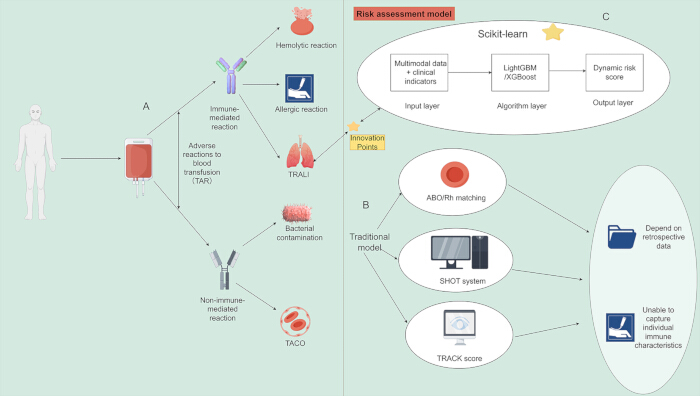
Figure 1: Illustration of TAR categories and the current risk assessment model combined with potential strategies of SK-learn in TAR risk assessment. (A) TAR can be divided into two types: immune-mediated reactions and nonimmune-mediated reactions. (B) Current risk assessment models targeting TAR. (C) Hypothesis...
Access restricted. Please log in or start a trial to view this content.
Disclosures
The authors declare that they have no competing interests.
Acknowledgements
This work was supported by the Luzhou Science and Technology Bureau, No. 2024JYJ034, Title: Effects of Irradiation and Storage Time on Extracellular Vesicles in Platelet Concentrates.
Access restricted. Please log in or start a trial to view this content.
References
- Tanhehco, Y. C. Red blood cell transfusion. Clin Lab Med. 41 (4), 611-619 (2021).
- Albright, C. M., Spillane, T. E., Hughes, B. L., Rouse, D. J. A regression model for prediction of cesarean-associated blood transfusion. Am J Perinatol. 36 (9), 879-885 (2019).
- Abdallah, R., Rai, H., Panch, S. R. Transfusion reactions and adverse events. Clin Lab Med. 41 (4), 669-696 (2021).
- Wang, Y., Rao, Q., Li, X. Adverse transfusion reactions and what we can do. Expert Rev Hematol. 15 (8), 711-726 (2022).
- Chen, C., et al. Incidence and risk factor of blood transfusion after abdominal radical hysterectomy for cervical cancer: A 10-year retrospective study of the us nationwide inpatient sample. BMC Cancer. 24 (1), 1454(2024).
- Deb, J., et al. Delayed haemolytic transfusion reaction due to kidd antibodies. Transfus Clin Biol. 29 (3), 269-272 (2022).
- Gehrie, E. A., Savani, B. N., Booth, G. S. Risk factors for hemolytic transfusion reactions resulting from abo and minor red cell antigen incompatibility: From mislabeled samples to stem cell transplant and sickle cell disease. Blood Rev. 45, 100719(2021).
- Maitland, K., et al. Transfusion management of severe anaemia in african children: A consensus algorithm. Br J Haematol. 193 (6), 1247-1259 (2021).
- McCullagh, J., et al. Assessing the risks of haemolysis as an adverse reaction following the transfusion of abo incompatible plasma-containing components - a scoping review. Blood Rev. 56, 100989(2022).
- Beam, A. L., Kohane, I. S. Big data and machine learning in health care. Jama. 319 (13), 1317-1318 (2018).
- Nwanosike, E. M., Conway, B. R., Merchant, H. A., Hasan, S. S. Potential applications and performance of machine learning techniques and algorithms in clinical practice: A systematic review. Int J Med Inform. 159, 104679(2022).
- Zhang, G., et al. A machine learning model based on ultrasound image features to assess the risk of sentinel lymph node metastasis in breast cancer patients: Applications of scikit-learn and shap. Front Oncol. 12, 944569(2022).
- Poly, T. N., Islam, M. M., Li, Y. J. Early diabetes prediction: A comparative study using machine learning techniques. Stud Health Technol Inform. 295, 409-413 (2022).
- Esteva, A., et al. Dermatologist-level classification of skin cancer with deep neural networks. Nature. 542 (7639), 115-118 (2017).
- Zhou, D., et al. A machine learning model for predicting diabetic nephropathy based on tg/cys-c ratio and five clinical indicators. Diabetes Metab Syndr Obes. 18, 955-967 (2025).
- Li, N., Down, D. G. Deep learning for platelet transfusion. Blood. 142 (26), 2231-2232 (2023).
- Lou, S. S., et al. Personalized surgical transfusion risk prediction using machine learning to guide preoperative type and screen orders. Anesthesiology. 137 (1), 55-66 (2022).
- Kulhas Celik, I., et al. Frequency and clinical characteristics of allergic transfusion reactions in children. Transfus Apher Sci. 60 (4), 103152(2021).
- Guo, K., et al. Transfusion reactions in pediatric patients: An analysis of 5 years of hemovigilance data from a national center for children's health in china. Front Pediatr. 9, 660297(2021).
- Thein, S. L., et al. Hemolytic transfusion reactions in sickle cell disease: Underappreciated and potentially fatal. Haematologica. 105 (3), 539-544 (2020).
- Chin, J. L. J., et al. Poor utility of current nomograms assessing the risk of intraoperative blood transfusion in patients undergoing liver resection for hepatocellular carcinoma and proposal of a new model. Surgery. 172 (5), 1442-1447 (2022).
- Nguyen, N. T., Titze, T. L., Nissen-Meyer, L. S. H. Evaluation of transfusion reactions in patients following transfusion of blood components containing antibodies to hla class i - an attempt to prevent trali in patients. Transfus Apher Sci. 63 (4), 103970(2024).
- Saadah, N. H., et al. Transition from fresh frozen plasma to solvent/detergent plasma in the netherlands: Comparing clinical use and transfusion reaction risks. Haematologica. 105 (4), 1158-1165 (2020).
- Yanagisawa, R., Yamanaka, M., Kawakami, F., Nakazawa, H. Sub-pollen in platelet products: A potential cause of allergic transfusion reactions. Allergol Int. 73 (1), 184-186 (2024).
- Kiely, P., et al. Erratum to "emerging infectious diseases and blood safety: Modeling the transfusion-transmission risk" (transfusion medicine reviews 31/3 [2017] 154-164). Transfus Med Rev. 32 (1), 66-68 (2018).
- Mangala, C., et al. Prevalence and factors associated with transfusion-transmissible infections (hiv, hbv, hcv and syphilis) among blood donors in gabon: Systematic review and meta-analysis. PLoS One. 19 (8), e0307101(2024).
- McManus, H., et al. Risk of variant creutzfeldt-jakob disease transmission by blood transfusion in australia. Vox Sang. 117 (8), 1016-1026 (2022).
- Shahi, N., et al. Decision-making in pediatric blunt solid organ injury: A deep learning approach to predict massive transfusion, need for operative management, and mortality risk. J Pediatr Surg. 56 (2), 379-384 (2021).
- Rogers, M. A., Rohde, J. M., Blumberg, N. Haemovigilance of reactions associated with red blood cell transfusion: Comparison across 17 countries. Vox Sang. 110 (3), 266-277 (2016).
- Shah, N., et al. Real-world effectiveness of voxelotor for treating sickle cell disease in the us: A large claims data analysis. Expert Rev Hematol. 15 (2), 167-173 (2022).
- Hanson, S. J., et al. Transfusion practices in pediatric cardiac surgery requiring cardiopulmonary bypass: A secondary analysis of a clinical database. Pediatr Crit Care Med. 22 (11), 978-987 (2021).
- Kohorst, M. A., et al. Transfusion reactions in pediatric and adolescent young adult haematology oncology and immune effector cell patients. EClinicalMedicine. 26, 100514(2020).
- Houben, N. A. M., et al. Platelet transfusion in neonatal intensive care units of 22 european countries: A prospective observational study. Lancet Reg Health Eur. 47, 101086(2024).
- Semple, J. W., Rebetz, J., Kapur, R. Transfusion-associated circulatory overload and transfusion-related acute lung injury. Blood. 133 (17), 1840-1853 (2019).
- Murphree, D., et al. Ensemble learning approaches to predicting complications of blood transfusion. Annu Int Conf IEEE Eng Med Biol Soc. 2015, 7222-7225 (2015).
- Bolton-Maggs, P. H., Cohen, H. Serious hazards of transfusion (shot) haemovigilance and progress is improving transfusion safety. Br J Haematol. 163 (3), 303-314 (2013).
- Leff, J., Romano, C. A., Gilbert, S., Nair, S. Validation study of the transfusion risk and clinical knowledge (track) tool in cardiac surgery patients: A retrospective analysis. J Cardiothorac Vasc Anesth. 33 (10), 2669-2675 (2019).
- Madhu Krishna, N. R., et al. Evaluation of risk scores in predicting perioperative blood transfusions in adult cardiac surgery. Ann Card Anaesth. 22 (1), 73-78 (2019).
- Roubinian, N. Taco and trali: Biology, risk factors, and prevention strategies. Hematology Am Soc Hematol Educ Program. 2018 (1), 585-594 (2018).
- Tung, J. P., et al. Transfusion-related acute lung injury (trali): Potential pathways of development, strategies for prevention and treatment, and future research directions. Blood Rev. 53, 100926(2022).
- Hendrickson, J. E., Fasano, R. M. Management of hemolytic transfusion reactions. Hematology Am Soc Hematol Educ Program. 2021 (1), 704-709 (2021).
- Nunez, T. C., Young, P. P., Holcomb, J. B., Cotton, B. A. Creation, implementation, and maturation of a massive transfusion protocol for the exsanguinating trauma patient. J Trauma. 68 (6), 1498-1505 (2010).
- Ohbe, H., et al. Trends in massive transfusion practice for trauma in japan from 2011 to 2020: A nationwide inpatient database study. J Intensive Care. 11 (1), 46(2023).
- Ahmadzia, H. K., et al. Machine learning models for prediction of maternal hemorrhage and transfusion: Model development study. JMIR Bioinform Biotechnol. 5, e52059(2024).
- Maynard, S., et al. Machine learning in transfusion medicine: A scoping review. Transfusion. 64 (1), 162-184 (2024).
- Mitterecker, A., et al. Machine learning-based prediction of transfusion. Transfusion. 60 (9), 1977-1986 (2020).
- Shang, G., Biggerstaff, B. J., Richardson, A. M., Gahan, M. E., Lidbury, B. A. A simulation model to estimate the risk of transfusion-transmitted arboviral infection. Transfus Apher Sci. 55 (2), 233-239 (2016).
- D'Alessandro, A. Red blood cell omics and machine learning in transfusion medicine: Singularity is near. Transfus Med Hemother. 50 (3), 174-183 (2023).
- Lopes, M. G. M., et al. Big data in transfusion medicine and artificial intelligence analysis for red blood cell quality control. Transfus Med Hemother. 50 (3), 163-173 (2023).
- Roubinian, N. H., et al. Donor genetic and nongenetic factors affecting red blood cell transfusion effectiveness. JCI Insight. 7 (1), e152598(2022).
- Toma, A., Diller, G. P., Lawler, P. R. Deep learning in medicine. JACC Adv. 1 (1), 100017(2022).
- Stilgoe, J. We need a weizenbaum test for ai. Science. 381 (6658), eadk0176(2023).
- Valkenborg, D., Rousseau, A. J., Geubbelmans, M., Burzykowski, T. Support vector machines. Am J Orthod Dentofacial Orthop. 164 (5), 754-757 (2023).
- Sarker, I. H. Deep learning: A comprehensive overview on techniques, taxonomy, applications and research directions. SN Comput Sci. 2 (6), 420(2021).
- Howell, M. D., Corrado, G. S., DeSalvo, K. B. Three epochs of artificial intelligence in health care. Jama. 331 (3), 242-244 (2024).
- Rauschert, S., Raubenheimer, K., Melton, P. E., Huang, R. C. Machine learning and clinical epigenetics: A review of challenges for diagnosis and classification. Clin Epigenetics. 12 (1), 51(2020).
- Darcy, A. M., Louie, A. K., Roberts, L. W. Machine learning and the profession of medicine. Jama. 315 (6), 551-552 (2016).
- Obermeyer, Z., Emanuel, E. J. Predicting the future - big data, machine learning, and clinical medicine. N Engl J Med. 375 (13), 1216-1219 (2016).
- Topol, E. J. High-performance medicine: The convergence of human and artificial intelligence. Nat Med. 25 (1), 44-56 (2019).
- McKinney, S. M., et al. International evaluation of an ai system for breast cancer screening. Nature. 577 (7788), 89-94 (2020).
- Coudray, N., et al. Classification and mutation prediction from non-small cell lung cancer histopathology images using deep learning. Nat Med. 24 (10), 1559-1567 (2018).
- Jiang, P., et al. Signatures of t cell dysfunction and exclusion predict cancer immunotherapy response. Nat Med. 24 (10), 1550-1558 (2018).
- Ardila, D., et al. End-to-end lung cancer screening with three-dimensional deep learning on low-dose chest computed tomography. Nat Med. 25 (6), 954-961 (2019).
- Tomašev, N., et al. A clinically applicable approach to continuous prediction of future acute kidney injury. Nature. 572 (7767), 116-119 (2019).
- Swanson, K., Wu, E., Zhang, A., Alizadeh, A. A., Zou, J. From patterns to patients: Advances in clinical machine learning for cancer diagnosis, prognosis, and treatment. Cell. 186 (8), 1772-1791 (2023).
- Xu, Y., et al. Medical breast ultrasound image segmentation by machine learning. Ultrasonics. 91, 1-9 (2019).
- Wang, S., et al. Predicting egfr mutation status in lung adenocarcinoma on computed tomography image using deep learning. Eur Respir J. 53 (3), 1800986(2019).
- Wu, Z., et al. Single-cell techniques and deep learning in predicting drug response. Trends Pharmacol Sci. 41 (12), 1050-1065 (2020).
- Tran, K. A., et al. Deep learning in cancer diagnosis, prognosis and treatment selection. Genome Med. 13 (1), 152(2021).
- Ha, R., et al. Convolutional neural network based breast cancer risk stratification using a mammographic dataset. Acad Radiol. 26 (4), 544-549 (2019).
- Ryu, H. S., et al. Automated gleason scoring and tumor quantification in prostate core needle biopsy images using deep neural networks and its comparison with pathologist-based assessment. Cancers (Basel). 11 (12), 1860(2019).
- Nir, G., et al. Comparison of artificial intelligence techniques to evaluate performance of a classifier for automatic grading of prostate cancer from digitized histopathologic images. JAMA Netw Open. 2 (3), e190442(2019).
- Ström, P., et al. Artificial intelligence for diagnosis and grading of prostate cancer in biopsies: A population-based, diagnostic study. Lancet Oncol. 21 (2), 222-232 (2020).
- Ehteshami Bejnordi, B., et al. Using deep convolutional neural networks to identify and classify tumor-associated stroma in diagnostic breast biopsies. Mod Pathol. 31 (10), 1502-1512 (2018).
- El Achi, H., Khoury, J. D. Artificial intelligence and digital microscopy applications in diagnostic hematopathology. Cancers (Basel). 12 (4), 797(2020).
- Poojitha, U. P., Lal Sharma, S. Hybrid unified deep learning network for highly precise gleason grading of prostate cancer. Annu Int Conf IEEE Eng Med Biol Soc. 2019, 899-903 (2019).
- Szklarczyk, D., et al. String v10: Protein-protein interaction networks, integrated over the tree of life. Nucleic Acids Res. 43 (Database issue), D447-D452 (2015).
- Vaid, A., et al. Machine learning to predict mortality and critical events in a cohort of patients with covid-19 in new york city: Model development and validation. J Med Internet Res. 22 (11), e24018(2020).
- Lao, J., et al. A deep learning-based radiomics model for prediction of survival in glioblastoma multiforme. Sci Rep. 7 (1), 10353(2017).
- Goodswen, S. J., et al. Machine learning and applications in microbiology. FEMS Microbiol Rev. 45 (5), fuab015(2021).
- Rajaraman, S., et al. Pre-trained convolutional neural networks as feature extractors toward improved malaria parasite detection in thin blood smear images. PeerJ. 6, e4568(2018).
- Hamidinekoo, A., Denton, E., Rampun, A., Honnor, K., Zwiggelaar, R. Deep learning in mammography and breast histology, an overview and future trends. Med Image Anal. 47, 45-67 (2018).
- Dembrower, K., et al. Comparison of a deep learning risk score and standard mammographic density score for breast cancer risk prediction. Radiology. 294 (2), 265-272 (2020).
- Yala, A., et al. Toward robust mammography-based models for breast cancer risk. Sci Transl Med. 13 (578), eaba4373(2021).
- Al-Riyami, A. Z., Gammon, R. R., Seheult, J., Arora, S., Goel, R. Artificial intelligence and transfusion education, research and practice: The view from the isbt clinical transfusion working party. Vox Sang. , 1-7 (2025).
- Sheikhalishahi, S., et al. Predicting blood transfusion demand in intensive care patients after surgery by comparative analysis of temporally extended data selection. BMC Med Inform Decis Mak. 24 (1), 397(2024).
- Zang, H., Hu, A., Xu, X., Ren, H., Xu, L. Development of machine learning models to predict perioperative blood transfusion in hip surgery. BMC Med Inform Decis Mak. 24 (1), 158(2024).
- Lavecchia, A., Cerchia, C. In silico methods to address polypharmacology: Current status, applications and future perspectives. Drug Discov Today. 21 (2), 288-298 (2016).
- Gupta, R., et al. Artificial intelligence to deep learning: Machine intelligence approach for drug discovery. Mol Divers. 25 (3), 1315-1360 (2021).
- Smith, J. S., Roitberg, A. E., Isayev, O. Transforming computational drug discovery with machine learning and ai. ACS Med Chem Lett. 9 (11), 1065-1069 (2018).
- Powles, J., Hodson, H. Google deepmind and healthcare in an age of algorithms. Health Technol (Berl). 7 (4), 351-367 (2017).
- Senior, A. W., et al. Improved protein structure prediction using potentials from deep learning. Nature. 577 (7792), 706-710 (2020).
- Abraham, A., et al. Machine learning for neuroimaging with scikit-learn. Front Neuroinform. 8, 14(2014).
- Dreizin, D., et al. Deep learning-based quantitative visualization and measurement of extraperitoneal hematoma volumes in patients with pelvic fractures: Potential role in personalized forecasting and decision support. J Trauma Acute Care Surg. 88 (3), 425-433 (2020).
- Nayshool, O., Kol, N., Javaski, E., Amariglio, N., Rechavi, G. Surviveai: Long term survival prediction of cancer patients based on somatic rna-seq expression. Cancer Inform. 21, 11769351221127875(2022).
- Tanaka, T. [[fundamentals] 5. Python+scikit-learn for machine learning in medical imaging]. Nihon Hoshasen Gijutsu Gakkai Zasshi. 79 (10), 1189-1193 (2023).
- Cohen, O., Barzilai, M., Cohen, O. Ai applications in transfusion medicine: Opportunities, challenges, and future directions. Acta Haematol. 148 (5), 516-526 (2025).
- Tang, M., et al. An artificial intelligence-assisted clinical framework to facilitate diagnostics and translational discovery in hematologic neoplasia. EBioMedicine. 104, 105171(2024).
- Urusova, L., et al. The new histological system for the diagnosis of adrenocortical cancer. Front Endocrinol (Lausanne). 14, 1218686(2023).
- Majumder, S. K., Ghosh, N., Gupta, P. K. Support vector machine for optical diagnosis of cancer. J Biomed Opt. 10 (2), 024034(2005).
- Liu, H. X., et al. Diagnosing breast cancer based on support vector machines. J Chem Inf Comput Sci. 43 (3), 900-907 (2003).
- Quist, J., Taylor, L., Staaf, J., Grigoriadis, A. Random forest modelling of high-dimensional mixed-type data for breast cancer classification. Cancers (Basel). 13 (5), 991(2021).
- Ma, B., et al. Diagnostic classification of cancers using extreme gradient boosting algorithm and multi-omics data. Comput Biol Med. 121, 103761(2020).
- Li, Q., et al. Xgboost-based and tumor-immune characterized gene signature for the prediction of metastatic status in breast cancer. J Transl Med. 20 (1), 177(2022).
- Li, H., et al. Colorectal cancer detected by machine learning models using conventional laboratory test data. Technol Cancer Res Treat. 20, 15330338211058352(2021).
- Tran, T., Le, U., Shi, Y. An effective up-sampling approach for breast cancer prediction with imbalanced data: A machine learning model-based comparative analysis. PLoS One. 17 (5), e0269135(2022).
- Weng, S. F., Reps, J., Kai, J., Garibaldi, J. M., Qureshi, N. Can machine-learning improve cardiovascular risk prediction using routine clinical data. PLoS One. 12 (4), e0174944(2017).
- Shinohara, I., et al. Re-tear after arthroscopic rotator cuff tear surgery: Risk analysis using machine learning. J Shoulder Elbow Surg. 33 (4), 815-822 (2024).
- Roubinian, N. H., et al. Incidence and clinical characteristics of transfusion-associated circulatory overload using an active surveillance algorithm. Vox Sang. 112 (1), 56-63 (2017).
- Vlaar, A. P. Transfusion-related acute lung injury: Current understanding and preventive strategies. Transfus Clin Biol. 19 (3), 117-124 (2012).
- Allain, J. P., Goodrich, R. Pathogen reduction of whole blood: Utility and feasibility. Transfus Med. 27 (Suppl 5), 320-326 (2017).
- Hendrickson, J. E., et al. Incidence of transfusion reactions: A multicenter study utilizing systematic active surveillance and expert adjudication. Transfusion. 56 (10), 2587-2596 (2016).
- Wang, K., et al. Improving risk identification of adverse outcomes in chronic heart failure using smote+enn and machine learning. Risk Manag Healthc Policy. 14, 2453-2463 (2021).
- Lipkova, J., et al. Artificial intelligence for multimodal data integration in oncology. Cancer Cell. 40 (10), 1095-1110 (2022).
- Ahn, S. Building and analyzing machine learning-based warfarin dose prediction models using scikit-learn. Transl Clin Pharmacol. 30 (4), 172-181 (2022).
- Nayebi, A., Tipirneni, S., Foreman, B., Reddy, C. K., Subbian, V. An empirical comparison of explainable artificial intelligence methods for clinical data: A case study on traumatic brain injury. AMIA Annu Symp Proc. 2022, 815-824 (2022).
- Contreras, J., Winterfeld, A., Popp, J., Bocklitz, T. Spectral zones-based shap/lime: Enhancing interpretability in spectral deep learning models through grouped feature analysis. Anal Chem. 96 (39), 15588-15597 (2024).
Access restricted. Please log in or start a trial to view this content.