Here, we present a protocol for generating an interactive three-dimensional visualization of microbial counts and pH across a poultry pen using grid-based sampling data.
Method Article
Generating Interactive 3D Spatial Visualizations of Microbial Abundance in Poultry Litter Using RStudio
Opens in a new tab
In This Article
Summary
Loading...
$$\rightleftharpoonup{xx}$$
$$\longleftharp{xx}$$,
$$\longrightharp{xx}$$,
Abstract
Loading...
$$\rightleftharpoonup{xx}$$
$$\longleftharp{xx}$$,
$$\longrightharp{xx}$$,
Traditional assessments of poultry litter microbiology and physicochemical composition often rely on static tables or two-dimensional visualizations that may not capture the spatial heterogeneity within the pen environment. This protocol describes interactive three-dimensional (3D) visualizations that integrate microbial enumeration data and environmental parameters across a poultry pen. A grid-based layout was used to approximate pen sampling, and simulated datasets were first generated to demonstrate the workflow. The experimental dataset was used to evaluate spatial gradients relative to environmental features, including the water line, feeders, and pen entrance. Data were processed in RStudio using plotly to generate interactive 3D plots. Aerobic bacterial loads ranged from 5.9 to 8.6 log₁₀ CFU/g, with significantly higher abundance near the water line (P = 0.023) and lower counts at increasing distance from the feature. The resulting surface plots visually highlighted clustering of microbial populations around moisture-rich areas and demonstrated the utility of the framework for interpreting spatial patterns of microbial communities in poultry litter. Although further evaluation under commercial poultry conditions is needed, the current protocol provides a reproducible method for visualizing and analyzing spatial heterogeneity in poultry litter datasets.
Introduction
Loading...
$$\rightleftharpoonup{xx}$$
$$\longleftharp{xx}$$,
$$\longrightharp{xx}$$,
The poultry industry includes layer and broiler production systems, each of which generates substantial amounts of poultry litter through the accumulation of bedding material, excreta, feed particles, feathers, broken eggshells, and moisture over time1,2,3. This litter can support various microbial populations, originating from the birds, insects, rodents, and aerosols2,3. Some of the microorganisms can include pathogens, such as Salmonella, that can cause disease in birds and represent a public health concern2. Because poultry litter may be land-applied as fertilizer4,5, understanding microbial distribution has implications for environmental monitoring, flock health, and food safety.
Representative poultry litter sampling is thus important for characterizing microbial communities and detecting potential pathogens. Approaches for sampling of poultry litter have been explored for several decades, including drag swabs, collection of fecal droppings, direct litter collection, disposable shoe covers, or boot socks6,7. However, the location of sample collection strongly dictates how well the data represent overall poultry litter conditions. Because birds move throughout the house and environmental features such as waterers, feeders, fans, and cooling or heating pads, create localized environments, poultry litter microbial populations and nutrient factors are not uniformly distributed3,8,9,10. Therefore, accounting for heterogeneity when interpreting litter-associated data is vital for effective management and maintaining flock health.
Spatial mapping approaches have been widely applied in agronomy and soil science to visualize microbial and physicochemical heterogeneity and localized hotspots11,12. However, when poultry litter data are collected across multiple regions within a pen, spatial trends can be difficult to interpret from numerical values8,9. Three-dimensional (3D) visualization offers a practical approach for integrating microbial and physicochemical measurements with spatial coordinates to generate interactive surface models13,14. Compared with static 2D models, 3D models allow rotation, zooming in and out, and depth-based visualization of gradients across the sampling grid, which may improve the interpretation of spatial patterns within the poultry house environment.
The current protocol describes a structured and reproducible approach for generating interactive 3D visualizations of poultry litter microbial and physicochemical data collected using a grid-based layout and analyzed in RStudio. Simulated microbial and physicochemical data are first used to demonstrate the visualization workflow, followed by application of the approach to experimental poultry litter microbial counts. The goal of this protocol is to provide a reproducible framework for visualizing spatial heterogeneity in poultry litter datasets and to support the interpretation of microbial distribution patterns in relation to poultry house features.
Protocol
Loading...
$$\rightleftharpoonup{xx}$$
$$\longleftharp{xx}$$,
$$\longrightharp{xx}$$,
This protocol uses a simulated dataset for microbial and pH values to demonstrate each step of the visualization workflow, followed by application to experimental poultry litter microbial counts to illustrate use with experimental data and support statistical interpretation of distance-related microbial associations. No live animal procedures were performed. Litter samples were collected from a poultry pen without direct contact with the animals. Institutional animal care approval was therefore not required.
1. Collect poultry litter samples and generate microbial abundance data
- Establish a grid-based sampling layout across the broiler pen using consistent spacing across the pen.
NOTE: In smaller pens, this can be done using a string grid system, while larger pens may use flag markers to mark each sampling location. The grid typically begins at the lower-left corner of the pen, which is treated as the starting point. Each sampling location is recorded using its grid position. - Record the X and Y coordinates of each sampling location and environmental points such as feeders, water line, heating lamp, and entrance within the same grid using either a single location or a line representing their position.
NOTE: The X direction runs along the length of the pen, and the Y direction runs across the width. - Include a “Pen” column in the dataset to identify the pen or treatment group for each sampling location (e.g., “P1”, “P2”).
NOTE: Grouping by pen ensures that spatial analyses are conducted within the correct housing environment. For this demonstration, a structured 6 × 10 grid was defined across the pen footprint, yielding 60 sampling locations (n = 60) from 1 pen. The 6 × 10 grid was chosen to provide uniform spatial coverage across the pen, with a symmetrical, evenly spaced layout. An example of the grid layout is shown in Figure 1. - At each sampling location, collect three litter samples for microbial or physicochemical analysis. For microbial testing, weigh 10 g of litter per replicate and place it into 90 mL of sterile buffered peptone water to make the first dilution (10⁻1). Mix the sample thoroughly to homogenize the suspension.
- Prepare 10-fold serial dilutions of the mixed litter sample and plate 0.1 mL of each dilution onto agar plates.
NOTE: Different media can be used depending on the group of bacteria being measured. For example, aerobic bacteria may be plated on tryptic soy agar (TSA), lactic acid bacteria on MRS agar, and Enterobacteriaceae on MacConkey agar. - Incubate the plates at 37 °C for 24 h, then count the visible colonies. Calculate microbial abundance as colony-forming units per gram of litter (CFU/g) using:
CFU/g = (colonies counted × dilution factor) ÷ plated volume - Report the average value across replicates.
NOTE: The limit of detection is determined by the plated volume (0.1 mL), corresponding to approximately 10 CFU/mL in the plated suspension, or 100 CFU/g of litter in the original sample. - Record microbial enumeration results in a spreadsheet in numerical format for subsequent statistical analysis and visualization.
- Create a CSV file with the following columns: Sample ID, X (spatial coordinate), Y (spatial coordinate), Xnum (numeric sort order for X, optional), and microbial counts or physicochemical parameters such as pH. An example of the simulated table sheet is shown in Figure 2.
- Generate simulated microbial abundance values using normally distributed random values. Define the mean, standard deviation, and range based on empirical measurements. Apply a fixed random seed to ensure reproducibility. Introduce spatial gradients across the grid and add minor random variation to avoid uniform patterns.
NOTE: Simulation parameters used for data generation, including distribution type, range, and spatial structure, are summarized in Table 1.
2. Set up the computing environment
- Install and load the necessary statistical computing packages.
install.packages(c("plotly"))
library(plotly) - Import the CSV data set into the computing environment and set a working directory.
setwd("path/to/your/folder")
dataset <- read.csv("path_to_your_file.csv")
NOTE: The input dataset should be organized in spreadsheet format (CSV file), with each row representing a single sampling location. The required input data structure and variable definitions are summarized in Table 2.
3. Prepare and format data
- Check the CSV file for missing or inconsistent data values.
summary(dataset)
any(is.na(dataset)) - Clean the dataset as needed by removing ‘NA’ values.
dataset <- na.omit(dataset) - To normalize and improve the visualization of the graphs, log-transform microbial counts.
- Standardize variable names using consistent underscore-based notation (e.g., log10_CFU_A and log10_CFU_B) to improve readability and reproducibility.
- Apply log10 transformation to microbial count data to stabilize variance and align with standard CFU reporting practices.
dataset$Log10_CFU_A <- log10(dataset$OrganismA_counts + 1)
dataset$Log10_CFU_B <- log10(dataset$OrganismB_counts + 1) - Ensure that the X and Y coordinate values are numerical. If the data are alphabetical, convert to numerical values to accurately correspond with the sampling locations on the grid.
NOTE: The final dataset should include all unique identifiers within the pen coordinate system, numerical spatial coordinates, and log-transformed microbial counts.
4. Generate interactive 3D visualizations
- Before constructing the spatial matrix, verify the dataset structure to ensure the grid can be generated correctly. Then, prepare spatial data matrices by combining multiple parts, such as spatial coordinates and log-transformed bacterial counts, to match the pen’s grid layout.
NOTE: The code groups observations by Pen, X, and Y, calculates the mean Log10_CFU_A at each grid point, and then reshapes the values into a matrix based on the unique X and Y coordinates in the dataset.
org1_means <- aggregate(Log10_CFU_A ~ Pen + Y + X,
data = dataset,
FUN = mean,
na.rm = TRUE)
org1_P1 <- subset(org1_means, Pen == "P1") - Order the points so the matrix maps correctly
x_vals <- sort(unique(org1_P1$X))
y_vals <- sort(unique(org1_P1$Y))
ncol_grid <- length(x_vals)
nrow_grid <- length(y_vals)
org1_mat_P1 <- matrix(org1_P1$Log10_CFU_A,
nrow = nrow_grid,
ncol = ncol_grid,
byrow = FALSE) - Ensure that there are no missing values for a smooth-looking graph.
for(i in 1:ncol(org1_mat_P1)) {
org1_mat_P1[is.na(org1_mat_P1[,i]), i] <- mean(org1_mat_P1[,i], na.rm=TRUE)
} - Visualize the microbial counts spatially as 3D.
NOTE: For this graph, the grid size reflected the spatial layout of the dataset
figA <- plot_ly(
x = x_vals,
y = y_vals,
z = org1_mat_P1,
type = "surface", colorscale = list(
c(0, "darkblue"),
c(1, "green")
)
) - Add environmental features, such as a water line, to help visualize the distance of microbial counts or other litter parameters to that point, allowing users to see spatial patterns.
figA <- figA %>%
add_trace(
x = c(1, 5),
y = c(6, 6),
z = c(8.5, 8.5),
type = "scatter3d",
mode = "lines",
line = list(color = "#1f77b4", width = 8),
name = "Water Line"
) %>%
add_text(
x = 3, y = 6, z = 8.6,
text = "Water Line",
textfont = list(size = 14, color = "darkblue"),
showlegend = FALSE
) %>%
layout(
title = "Simulated Organism A",
scene = list(
xaxis = list(title = "X coordinate", tickvals = x_vals),
yaxis = list(title = "Y coordinate", tickvals = y_vals),
zaxis = list(title = "log10 CFU")
)
)
figA - Refer to Supplementary File 1 for code used to visualize pH levels within the poultry pen.
5. Application of the 3D model to experimental poultry litter microbial counts
- Collect poultry litter samples from a defined grid layout within the pen and record sampling locations using spatial coordinates.
NOTE: In this study, samples were collected from a poultry pen at the University of Wisconsin, Madison, WI, using a defined grid layout. Samples were collected using a 5 × 7 m grid layout. - Weigh a defined amount of litter from each sampling location and suspend it in phosphate-buffered saline (PBS) or equivalent diluent to prepare an initial dilution.
NOTE: In this study, 1 g of litter was collected per location using Whirl-Pak bags and diluted 1:10 in phosphate-buffered saline (PBS). - Perform microbial enumeration by plating litter samples on appropriate growth media and incubating them under suitable conditions.
NOTE: In this study, samples were plated in duplicate using a dot-plating method on tryptic soy agar (TSA) and incubated at 37 °C for 24 h. Materials required for microbial enumeration are listed in Table of Materials. - Quantify microbial abundance as colony-forming units (CFU) and apply log₁₀ transformation to the data for analysis.
- Integrate the processed microbial data into the computational workflow and format it according to the required input structure.
- Generate a 3D spatial visualization using the methods described above to represent microbial abundance across the pen.
NOTE: In this study, the visualization was generated to depict aerobic bacterial abundance across the sampled pen.
6. Statistical analysis
- Perform basic statistical analyses to summarize spatial patterns in microbial abundance and environmental variables.
- Conduct statistical analyses only on the experimental poultry litter dataset. Use the simulated datasets solely for visualization demonstrations and do not include them in statistical testing.
- Calculate mean values for each grid location when replicate measurements were available.
- Use linear regression analysis to evaluate relationships between microbial abundance and distance from environmental landmarks.
- Calculate distances from environmental landmarks using their known grid positions within the pen. Treat distances as continuous variables.
- Use the results to explore spatial trends and support visualization interpretation rather than to establish causal biological relationships.
Results
Loading...
$$\rightleftharpoonup{xx}$$
$$\longleftharp{xx}$$,
$$\longrightharp{xx}$$,
Simulated microbial and physicochemical data for illustrating the 3D model
The current study provides code to visualize the abundance of microbial organisms (Organism A and Organism B) and the pH of litter within a poultry pen, based on simulated data. The resulting 3D plots visualized microbial counts (Figure 3A,B) and pH (Figure 3C; for the interactive experience, see Supplementary File 3) based on the grid-based model. The simulated pH values showed spatial variation across the pen, with gradual changes along the grid that corresponded to the imposed spatial gradients. The full code, free of textual interruptions, is available in Supplementary File 1.
Application of the 3D model to experimental poultry litter microbial counts
To demonstrate how the model works with actual ecological data, aerobic bacterial counts from poultry litter were mapped and statistically analyzed to assess the effect of distance from environmental points, such as feeders and water lines, on bacterial abundance using a linear regression model (LRM). The experimental dataset used for analysis is provided in Supplementary File 2.The 3D visualization showed clear differences in aerobic counts across the pen, demonstrating that the approach can effectively display real microbial distributions within poultry housing environments (Figure 4; for interactive experience, see Supplementary File 3). These visualizations revealed a heterogeneous spatial distribution, with localized areas of higher bacterial abundance near specific environmental features. Across the poultry pen, aerobic counts ranged from 5.9 to 8.6 log₁₀ CFU/g, with the highest concentrations detected near the water line and lower counts observed around central feeders and distal to the water line. The mean aerobic abundance decreased from 8.0 log₁₀ CFU/g near the water line to 7.4 log₁₀ CFU/g at the farthest recorded distance. Microbial counts represent the mean values of replicate measurements at each sampling location. Moreover, distance from the water line was a significant predictor of aerobic bacterial load (LRM, P < 0.05), whereas distances from the feeders and entrance were not (LRM, P > 0.05). These quantitative results corroborate the visual trend observed in the 3D surface plots, demonstrating a clear decline in microbial abundance with increasing distance from moisture sources. Ultimately, these results show that the 3D grid-based framework provides a practical approach for the visualization and analysis of spatial heterogeneity in poultry litter datasets. Using both simulated and experimental data, this model captured localized microbial distribution patterns and further allowed statistical interpretation of the association between bacterial abundance and environmental features within the pen.

Figure 1: Grid layout of poultry pen for sample collection. Schematic representation of the grid-based sampling framework used to define spatial coordinates and sampling locations across the poultry pen. Please click here to view a larger version of this figure.
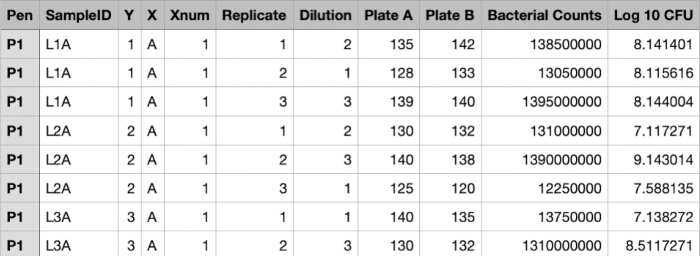
Figure 2: Example layout of simulated data in spreadsheet format. Representative spreadsheet structure showing sample identifiers, spatial coordinates (X and Y), and microbial or physicochemical variables used for analysis. Please click here to view a larger version of this figure.
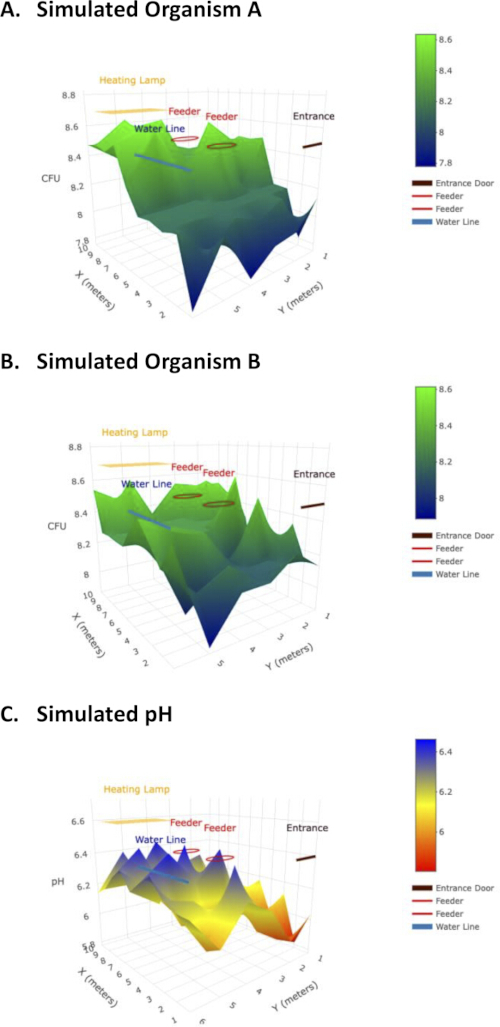
Figure 3: Simulated spatial distributions of microbial counts and pH across the poultry pen. (A) Simulated Organism A counts, (B) simulated Organism B counts, and (C) simulated pH values visualized using a grid-based 3D spatial model. Please click here to view a larger version of this figure.
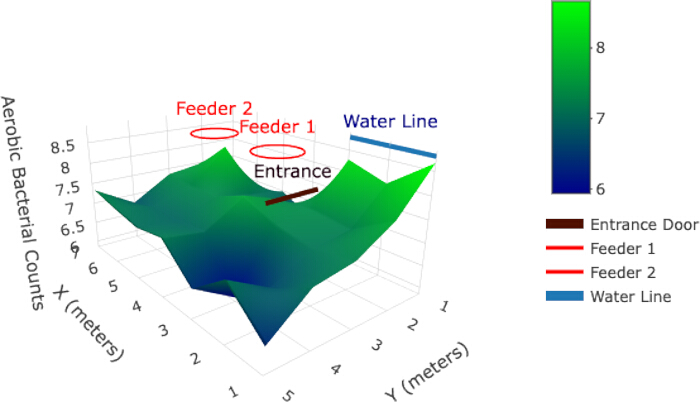
Figure 4: Spatial distribution of aerobic bacterial counts across the poultry pen. 3D surface plot shows variation in aerobic bacterial counts (log CFU/g) across distances (X–Y coordinates). Please click here to view a larger version of this figure.
| Parameter | Value |
| Distribution | Normal |
| Mean (μ) | 8.26 |
| SD (σ) | 0.77 |
| Range | 7.10–9.37 |
| Spatial pattern | Linear gradient (Y-direction) |
| Noise | Normal (μ=0, small variance) |
| Random seed | 10 |
Table 1: Parameters used for the simulated microbial dataset generation. Summary of distribution parameters, including mean, standard deviation, value range, and spatial gradient settings used to generate simulated microbial data.
| Column Name | Description | Data Type | Required |
| Pen | Identifier for pen or treatment group | Text | Yes |
| X | X-coordinate location on grid | Numeric | Yes |
| Y | Y-coordinate location on grid | Numeric | Yes |
| Log10_CFU_A | Log-transformed microbial count (Organism A) | Numeric | Yes |
| Log10_CFU_B | Log-transformed microbial count (Organism B) | Numeric | Optional |
| pH | Measured pH value | Numeric | Optional |
| Landmark Distance | Distance from environmental feature (e.g., water line) | Numeric | Optional |
Table 2: Required input dataset structure for spatial analysis. List of required variables, including sample identifiers, spatial coordinates, and microbial or physicochemical measurements, along with corresponding data formats.
Supplementary File 1: Code for generating simulated microbial and pH spatial visualizations.R script used to process simulated datasets and generate 3D surface plots for Organism A, Organism B, and pH across the poultry pen. Please click here to download this file.
Supplementary File 2: Experimental poultry litter microbial dataset. Spreadsheet containing aerobic bacterial counts and associated spatial coordinates used for 3D visualization and statistical analysis.Please click here to download this file.
Supplementary File 3: Interactive 3D visualization access links and QR codes. QR codes and corresponding web links for accessing interactive 3D plots of simulated and experimental datasetsPlease click here to download this file.
Discussion
Loading...
$$\rightleftharpoonup{xx}$$
$$\longleftharp{xx}$$,
$$\longrightharp{xx}$$,
The simulation-based plots presented in this study were developed to demonstrate the potential of 3D spatial mapping to enhance visualization of microbial and physicochemical distributions within poultry litter environments (Supplementary File 3). Furthermore, we combined this approach with microbial enumeration data and environmental and spatial markers within the pen to assess localized distribution patterns and identify distance-dependent relationships (Supplementary File 3).
A critical step in the current protocol is the accurate establishment of the grid-based sampling framework. Because the 3D surface depends on reliable spatial coordinates, the correct designation of origin points, uniform spacing, and precise recording of X and Y positions are essential. The most labor-intensive part of the method is laying out the grid and confirming that each sample corresponds to its assigned coordinate and environmental landmark, such as feeders, water lines, entry points, or heating zones. Small positional errors at this stage may affect later analyses. In larger or commercial settings, laser-based measurement tools or similar positioning aids may reduce labor and improve reproducibility. Careful annotation of pen landmarks is also important because these features provide ecological context for understanding microbial gradients in litter environments, created by bird activity, moisture, and nutrient distribution2.
The current protocol is adaptable toward broader agricultural applications. In addition to microbial counts and pH, it can be applied to other litter- or floor-associated variables, including moisture, temperature, nutrient distribution, ammonia-related measures, or sequencing-derived microbial community features. Practical modifications include grouping data by pen, dynamically generating matrices from recorded datasets, and screening for missing values before plotting. Common problem-solving steps include converting coordinate labels to numeric values, averaging replicate values at shared points, checking for duplicate or missing coordinates, and confirming that the matrix structure corresponds to the original pen layout. The framework can also be expanded to include multivariate analyses and litter depth, allowing assessment of both horizontal and vertical heterogeneity.
Several limitations should also be acknowledged. The method does not essentially improve sampling resolution or biological representation; instead, it improves the spatial organization and interpretation of data after collection. Thus, the quality of the final model still depends on the sampling design and consistency of field execution. Grid construction can be physically demanding and time-consuming. Additionally, successful implementation requires computer access and basic data-processing skills. Errors in naming patterns, coordinate entry, or missing grid cells may disrupt matrix generation or produce misleading visualizations. Overall, the current approach should be viewed as an exploratory, visualization-based framework rather than a substitute for formal spatial statistics or mechanistic inference.
In spite of these limitations, the protocol provides clear advantages over typical approaches that rely on pooled samples and isolated point measurements, which can mask fine-scale spatial variation within a pen or house3,4,5,6,7. In the current study, applying the framework to aerobic bacterial counts demonstrated that microbial populations can spatially cluster within poultry litter. Specifically, bacterial abundance was higher near the waterline and declined toward the center of the pen, producing a clear gradient in the 3D surface plot (Supplementary File 3). This pattern supports the interpretation that distinct localized environmental conditions, particularly moisture, may strongly influence microbial distribution in poultry litter. Additional variables, such as pH and nutrient composition, may further clarify these relationships. Previous work has similarly shown that poultry litter microbial communities and environmental conditions vary across space in relation to pH, feed spillage, and bird activity2. By linking microbial or physicochemical measurements to defined positions within the animal environment, this method makes those patterns more visible and interpretable. It also parallels spatial mapping approaches used in soil and agronomic sciences to identify gradients, patchiness, and localized focal points, while applying these concepts to animal production system11,12,13. In the future, repeated spatial mapping across pens, flocks, and production cycles may support predictive modeling of microbial hotspots and more targeted management of high-risk ecological zones.
Although 3D visualization does not improve the accuracy or precision of the data, it does enhance the interpretation of statistically relevant factors influencing microbial patterns and trends in poultry litter. More accessible visualization may support communication and informed decision-making regarding litter amendments, bird health, and bedding replacement14,15,16. Beyond research applications, this tool has practical value for poultry producers and academic extension personnel17. These 3D plots can serve as effective tools for presenting complex microbial data in a more accessible and actionable format for farm managers, stakeholders, and small poultry producers17. The ability to access these plots on a mobile phone through a QR code may further increase their utility for field-based technical support. As poultry production continues to advance in sensor technology and data generation, such approaches may become increasingly useful within integrative poultry informatics18,19.
Disclosures
Loading...
$$\rightleftharpoonup{xx}$$
$$\longleftharp{xx}$$,
$$\longrightharp{xx}$$,
The authors have no conflicts of interest to declare.
Acknowledgements
Loading...
$$\rightleftharpoonup{xx}$$
$$\longleftharp{xx}$$,
$$\longrightharp{xx}$$,
This work was supported by funding from Barnwell Bio. The authors gratefully acknowledge their support of applied research in poultry environmental monitoring. We also thank laboratory members and collaborators who contributed to data collection and project coordination.
Materials
| Name | Company | Catalog Number | Comments |
|---|---|---|---|
| Analytical balance | Fisher Scientific | 15997490 | For weighing litter (e.g., 10 g/sample) |
| Computer with internet access | Any | N/A | For running RStudio |
| Incubator (37 °C) | Thermo Scientific | 50125590H | For 24 h bacterial growth |
| Microbiological media (TSA) | BD Difco | 236950 | To enumerate for aerobic bacteria |
| Phosphate-buffered saline (PBS) | Thermo Fisher Scientific | 10010023 | Used for dilutions and microbial suspensions |
| Poultry litter samples | Poultry broiler house or research pen | N/A | Fresh litter collected using a grid-based design |
| R packages: plotly, dplyr, htmlwidgets | CRAN | https://cran.r-project.org | For 3D visualization and data handling |
| R statistical computing environment (v4.3 or later) | R Project | https://cran.r-project.org | cran.r-project.org |
| RStudio (v2024.12.0.467 or later) | Posit | https://posit.co/download/rstudio-desktop | posit.co |
| Spreadsheet software (Excel, Google Sheets) | Microsoft/Google | https://www.microsoft.com/exce | To organize data before import into RStudio |
| Sterile 10 mL conical tubes | Thermo Fisher Scientific | 339650 | For transporting aliquots |
| Sterile pipettes & tips | Fisher Scientific | N/A | For accurate and sterile liquid handling |
| Sterile Whirl-Pak bags | Nasco | B01062 | For sample collection and homogenization |
| Vortex mixer | VWR | 10153-838 | For homogenizing samples |
Reprints and Permissions
Request permission to reuse the text or figures of this JoVE article
Request Permission