This article presents the size and shape variation of the cochlea from the Russian population. The study also reports a new cochlear parameter that defines the longest straight segment of the cochlear basal turn, with implications for safe cochlear implant electrode insertion.
Research Article
Cochlear Size and Shape Variation from the Russian Population and a New Cochlear Parameter for a Safe Cochlear Implant Electrode Insertion
Opens in a new tab
In This Article
Summary
Loading...
$$\rightleftharpoonup{xx}$$
$$\longleftharp{xx}$$,
$$\longrightharp{xx}$$,
Abstract
Loading...
$$\rightleftharpoonup{xx}$$
$$\longleftharp{xx}$$,
$$\longrightharp{xx}$$,
This study investigates the size and shape variation of cochleae in the Russian population. Also, introduces a new cochlear parameter that defines the longest straight segment of the basal turn, with the implication of a safe cochlear implant electrode insertion. A medical-grade, CE-marked DICOM viewer (OTOPLAN) was used to measure cochlear parameters, including A- and B-values, which define the length and width of the basal turn. The shape of the cochlear basal turn was estimated by the ratio between B-and A-values. The new cochlear parameter, I-value, defines the effective straight segment of the basal turn as the longest straight line connecting the cochlear entrance to the lateral wall at the opposite end, passing tangentially to the inner wall. Ratio between B-, and A-value determines the shape of the cochlear basal turn, with the cut-off value ≥0.75 for round-shaped and <0.75 for elliptical-shaped cochlear basal turn. CT scans of the temporal bone from 112 ears with normal inner ear anatomy were used in this study. The cochlear size of the Russian population, as measured by A-value, ranged from 8.04–10.03 mm, with a mean of 9.03 mm. The B-value ranged from 5.84–7.59 mm, with a mean of 6.70 mm. A round-shaped cochlear basal turn was observed in 48% of the population, leaving the remaining 52% of the population with an elliptical-shaped basal turn. The I-value that defines the effective straight segment of the basal turn ranged from 6.7–9.6 mm, with an average of 8.3 mm. The trend line indicates that the I-value is approximately 0.7–0.8 mm shorter than the A-value. For the first time in the literature, cochlear size, as measured by A-value, is presented for the Russian-speaking population. The round-shaped cochlear basal turn is seen in 48% of the population. The new cochlea parameter, the I-value, is approximately 0.7–0.8 mm shorter than the A-value.
Introduction
Loading...
$$\rightleftharpoonup{xx}$$
$$\longleftharp{xx}$$,
$$\longrightharp{xx}$$,
Cochlear Implantation (CI) is a prescribed treatment solution for several indications, including severe-to-profound hearing loss, partial deafness, asymmetric hearing loss, auditory neuropathy, and single-sided deafness1,2. CI electrode insertion is a key surgical step, and preservation of intra-cochlear structures during insertion has become mandatory in every CI surgery. This is because structural damage during electrode insertion has been reported to negatively affect hearing outcomes with CI3. Intra-cochlear structural damage is influenced by multiple factors, including electrode design and stiffness4, insertion approach (round window vs cochleostomy)5, insertion speed6, surgeon’s skill in handling electrode insertion7, and anatomical variation of the inner ear8.
Eshraghi et al. have scaled CI electrode insertion trauma into 5 different grades (0-4). Grade 0 refers to no observable damage, grade 1 refers to elevation of the basilar membrane, grade 2 refers to rupture of the basilar membrane, grade 3 refers to electrode in the scala vestibuli, and grade 4 refers to severe trauma such as fracture of the osseous spiral lamina or modiolus or tear of stria vascularis9. Electrode scalar deviation (ESD) is considered grade 3 trauma, well reported in the literature, with a higher rate of ESD associated with a pre-curved peri-modiolar electrode compared to a straight lateral wall electrode10,11. Rau et al. reported that by electrode design, a peri-modiolar electrode must be inserted inside the initial straight segment of the cochlea for a certain insertion depth before the stylet wire is pulled out to enable the electrode to curl around the modiolus wall12. The new peri-modiolar electrode that comes with a polymer sheath follows the same technique: it enters the initial segment of the basal turn to a certain insertion depth, then the polymer sheath is pulled out so the electrode wraps around the modiolus wall13. This is the reason for the Contour Advance electrode from Cochlear to have a white marker in the electrode array at channel 10 from the apical end (8.5mm from the electrode tip)14, and the Mid-Scala electrode from Advanced Bionics LLC to have a blue marker at channel 5 from the apical end to indicate the electrode insertion depth before retracting the stylet wire15. In other words, these coloured markers indicate the insertion depth before the electrode tip encounters the lateral wall. Depending on the overall size variation of the cochlea, the straight segment of the basal turn will vary, and this is where the initial segment of the basal turn gains attention when it comes to the pre-curved peri-modiolar electrode.
The well-known cochlear parameters measured in the basal turn are the basal turn diameter and width, also called A- and B-values, respectively, which are useful for estimating cochlear duct length and for selecting electrode length and frequency-mapping based on cochlear size. Dhanasingh et al. reported a new cochlear parameter, the S-value, that connects the cochlear entrance to the lower end of the B-value in the straight portion of the basal turn16. But the S-value does not count if the straight portion of the cochlear basal turn extends beyond this point. This motivated us to investigate the straight segment of the basal turn from the cochlear entrance and to name it a new cochlear parameter to indicate the effective straight segment for safe insertion of the CI electrode. The measurement of the straight segment of the cochlear basal turn will be a clinically useful indicator of the insertion depth at which the CI electrode tip encounters the lateral wall during electrode insertion.
Protocol
Loading...
$$\rightleftharpoonup{xx}$$
$$\longleftharp{xx}$$,
$$\longrightharp{xx}$$,
This study was approved by the local institutional review board of St. Petersburg ENT and Speech Research Institute (IRB_23_001) to access anonymized radiographs from the image database without any patient involvement. No patient was directly involved in the study by any means. The software and equipment used are listed in the Table of Materials.
1. Data source and inclusion criteria
Computed tomography (CT) scans of potential cochlear implant (CI) candidates with normal inner ear anatomy were included in this study. Images acquired between 2000 and 2023 were provided by the Radiology Department of the St. Petersburg ENT and Speech Research Institute. Subjects diagnosed with malformed inner ear anatomy were excluded.
2. CT image acquisition and analysis
CT images were acquired using an expert-class 64-slice helical CT scanner with 64 detector channels. The slice thickness of the acquired images ranged from 0.36 mm to 1 mm. The CT images were analyzed using the DICOM viewer, OTOPLAN version 4.0 on a desktop computer workstation. No resampling or reformatting of images was required prior to analysis.
3. Cochlear measurement procedure
After loading the DICOM images in the DICOM viewer, the cochlea view is established by rotating the images using the crosshair feature. The A-and B-values were measured manually following the procedure described earlier by Escude et al.17. Briefly, the A-value is measured as the longest distance connecting the center of the round window (RW) passing through the modiolus to the lateral wall (length of the basal turn). The B-value (width of the basal turn) is measured by the straight line drawn perpendicular (90°) to the A-value connecting the lateral wall points above and below the A-value, as shown in Figure 1B. The steps for measuring the A-, B-, and I-values are available (see Table of Materials). All measurements were made by a single author (ES) supervised by another author (DA). Therefore, no intra- and or inter-rater differences were reported.
4. Determination of Cochlear shape (B/A Ratio)
Ratio between B-, and A-value determines the shape of the cochlear basal turn, with the cut-off value ≥0.75 for round-shaped and <0.75 for elliptical-shaped cochlear basal turn as first described by Khurayzi et al.18.
5. Measurement of the I-value
I-value, the new cochlear parameter, refers to the straight segment of the cochlear basal turn. This measurement is the longest straight line connecting the center of the RW entrance to the lateral wall at the opposite end, passing tangentially to the inner wall, as shown in Figure 1B. This measurement is made in the same plane as the A-and B-values.
6. Statistical analysis
Regression estimates between the I- and A-values (confidence level 0.95) were determined using the data analysis tool in Microsoft Excel for Microsoft 365 MSO (Version 2512, Build 16.0.19530.20226), 32-bit (https://www.microsoft.com/en-us/microsoft-365/excel).
Results
Loading...
$$\rightleftharpoonup{xx}$$
$$\longleftharp{xx}$$,
$$\longrightharp{xx}$$,
The data acquired is from 112 ears. Description of the data is given below:
Diameter of basal turn: A-value; Width of basal turn: B-value; Straight segment of basal turn: I-value. Of the 112 CT scans, 61 were from the left side, and 51 were from the right side. 98 ears were from bilateral CI patients, and the remaining 14 ears from unilateral CI subjects.
Basic cochlear parameters and shape of the cochlear basal turn
CT scans of the temporal bone from a total of 112 ears that were found with normal inner ear anatomy were used in this study. The cochlear size of the Russian-speaking subjects, as measured by the A-value, ranged from 8.04 mm to 10.03 mm, with a mean of 9.03 mm. The B-value ranged from 5.84 mm to 7.59 mm, with a mean of 6.70 mm. The ratio between B-and A-value ranged between 0.64 and 0.83. A round-shaped cochlear basal turn, as determined by the B/A ≥ 0.75, was observed in 48% of the population, leaving the remaining 52% of the population to have an elliptical-shaped basal turn with B/A < 0.75. Figure 2 shows two cochlear samples, with one having an elliptical-shaped basal turn (left) and the other a round-shaped basal turn (right).
I-value- The new cochlear parameter
The I-value that defines the effective straight segment of the basal turn ranged from 6.7 mm to 9.6 mm, with an average of 8.3 mm. Regression analysis between A-, and I-values showed a linear positive correlation with r = 0.87, as shown in Figure 3. The I-value is smaller than the A-value by an average of 0.77mm.
Cochlear size, as measured by the A-value, is presented for the Russian-speaking population, with 48% having a round-shaped basal turn and the remaining 52% having an elliptical-shaped basal turn. The newly presented cochlear parameter, the I-value, which is the longest distance from the center of the RW entrance to the lateral wall, passing tangentially through the inner ear, can be easily estimated from the A-value. The I-value presented in this study is potentially a useful measure during electrode insertion, as it indicates when the electrode tip reaches the outer wall at the end of the straight portion of the basal turn, to minimize the risk of electrode scalar translocation.
DATA AVAILABILITY:
Data supporting the findings of this study are provided in Supplementary File 1.
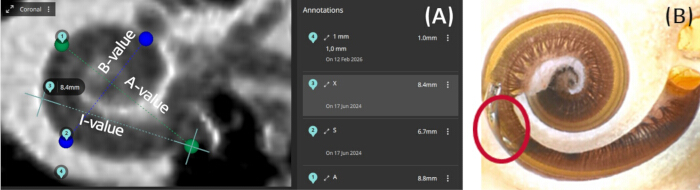
Figure 1: Cochlear view. Cochlear view showing the basic cochlear parameters (A-and B-values) along with the effective straight portion of the basal turn (I-value) (A). Dissected cochlear sample showing the electrode tip of a peri-modiolar electrode penetrating the spiral ligament at the end of the straight portion of the cochlear basal turn from the scala tympani (ST) and translocating to scala vestibuli (SV) (B). Please click here to view a larger version of this figure.
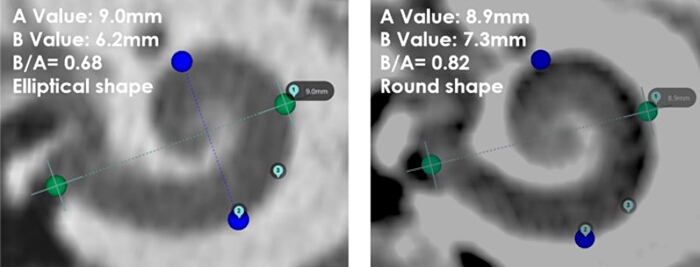
Figure 2: Two samples of the cochlea, one being elliptically shaped on the left and the other being round-shaped on the right. Please click here to view a larger version of this figure.
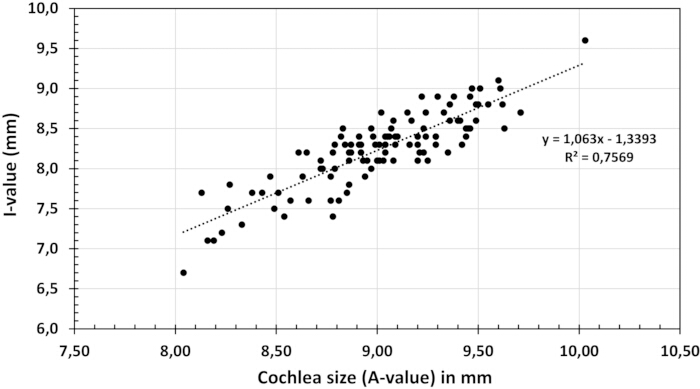
Figure 3: Cochlear size as measured by the A-value plotted against the straight portion of the basal turn as measured by the I-value. Please click here to view a larger version of this figure.
Supplementary File 1: Data supporting the findings of this study.Please click here to download this file.
Discussion
Loading...
$$\rightleftharpoonup{xx}$$
$$\longleftharp{xx}$$,
$$\longrightharp{xx}$$,
The primary aim of this study was to investigate variation in cochlear size (length (A-value) and width (B-value)) and shape in the basal turn of the Russian population. The secondary aim was to investigate the relationship between cochlear basal turn length (A-value) and a new cochlear parameter (I-value) representing the effective straight portion of the basal turn of the cochlea. The cochlear size of the Russian population is reported for the first time in the literature, with an average of 9.03 mm and a range of 8.04–10.03 mm, which is in line with cochlear size in other populations reported in the literature19. From this cohort, we found that 48% of the population had round-shaped basal turns, and the remaining 52% had elliptical-shaped basal turns. The effective straight portion of the basal turn (the I-value) is found to be 8.3 mm on average. This matches very well with the 8.5 mm distance of the safety white marker from the electrode tip in the Contour Advance (peri-modiolar) electrode. However, the variation in the I-value, ranging from 6.7 mm to 9.6 mm, explains why a peri-modiolar electrode provides inhomogeneous modiolar hugging fit from case to case20, a higher rate of scalar deviation, and tip fold-over complications10.
One reason for reporting the I-value is to relate it to peri-modiolar electrode design; the I-value is not clinically validated as a preoperative marker for electrode selection, particularly for choosing between electrode types. Recent literature indicates that peri-modiolar electrodes have a higher rate of tip fold-over and scalar translocation than straight configuration electrodes10,11,21. From the peri-modiolar electrode design point of view, the electrode is inserted with the stylet wire or the polymer sheath into the straight portion of the basal turn for a defined insertion depth before the stylet wire or the polymer sheath is retracted, causing the electrode to curl around the modiolus wall12. The defined insertion depth is indicated by coloured markers in the intra-cochlear array part or by the length of the polymer sheath, which are fixed, whereas the length of the straight portion of the basal turn is found to vary between 6.7 mm and 9.6 mm. This can partially explain the higher rate of tip fold-over and scalar translocation associated with the peri-modiolar electrode. In cases where the straight portion of the basal turn is longer than the defined insertion depth marker, the stylet wire or polymer sheath is retracted before the natural curvature of the basal turn begins, causing tip fold-over. On the other hand, in cases where the straight portion of the basal turn is shorter than the defined insertion depth marker in the electrode, the electrode tip with the stylet wire contacts the spiral ligament of the cochlea, increasing the risk of scalar translocation.
Dhanasingh et al. reported a new cochlear parameter, the S-value, in 2021, which is the straight-line distance from RW to the lower end of the B-value as measured in the cochlear view13. The S-value does not tangentially pass from the RW entrance to the lateral wall, making it shorter than the I-value introduced in the current work. Pai et al reported in 2024 that the level of the facial nerve in the posterior tympanotomy to the RW has an impact on the rate of electrode scalar translocation, mainly with peri-modiolar electrode21. A slightly elevated facial nerve at the RW level could result in the electrode contacting the basilar membrane, leading to electrode scalar translocation. Knowing the length of the straight portion of the basal turn from the round window entrance, as measured by both S- and I-values, and the level of the facial nerve to the RW, are useful measures to be cautious when inserting any electrode, in general, and a peri-modiolar electrode in particular. From the current study findings, the I-value does not need to be measured manually but can be estimated from the A-value using the equation:
I value = A value – 1.3.
Limitations of the current work include the lack of clinical validation of the I-value's impact on surgical outcome, particularly when using peri-modiolar electrodes. Moreover, the new cochlea parameter measured is from a very specific population and needs to be studied across different populations to determine whether the I-value is 0.7–0.8 mm shorter than the A-value, as reported in this study.
Conclusion
For the first time in the literature, cochlear size, as measured by the length of the cochlear basal turn (A-value), is presented for the Russian population. The A-value ranged between 8.04 mm and 10.03 mm with a mean value of 9.03 mm. A round-shaped cochlear basal turn is seen in 48% of the population, leaving the remaining 52% of the population with an elliptical-shaped cochlear basal turn. The new cochlea parameter, the I-value that represents the effective straight segment of the cochlea's basal turn, is shorter than the A-value by an average of 0.77 mm.
Disclosures
Loading...
$$\rightleftharpoonup{xx}$$
$$\longleftharp{xx}$$,
$$\longrightharp{xx}$$,
No funding was specifically provided for this study. Affiliation number 2 corresponds to the R&D department of a cochlear implant manufacturer.
Acknowledgements
Loading...
$$\rightleftharpoonup{xx}$$
$$\longleftharp{xx}$$,
$$\longrightharp{xx}$$,
The authors acknowledge Prof. Peter Roland from Southwestern University, Texas, USA, for providing the image used in Figure 1.
Materials
| Name | Company | Catalog Number | Comments |
|---|---|---|---|
| 64-slice CT scanner (Aquilion) | Toshiba | N/A | 64-detector helical CT system used for temporal bone imaging |
| Desktop computer workstation | N/A | N/A | Used for running OTOPLAN and image analysis |
| Microsoft Excel (Microsoft 365) | Microsoft | N/A | Used for statistical analysis (regression analysis; Version 2512 Build 16.0.19530.20226) |
| OTOPLAN (version 4.0) | Cascination AG | SWOTO01 | CE-marked DICOM viewer used for cochlear measurements (A-, B-, and I-values) |
References
Loading...
$$\rightleftharpoonup{xx}$$
$$\longleftharp{xx}$$,
$$\longrightharp{xx}$$,
- Deep, N. L., Dowling, E. M., Jethanamest, D., Carlson, M. L. Cochlear implantation an overview. J Neurol Surg B Skull Base. , (2019).
- Cosetti, M., Roland, T. Cochlear implant electrode insertion. Oper Tech Otolaryngol Head Neck Surg. , (2010).
- Shaul, C., Dragovic, A. S., Stringer, A. K., O'Leary, S. J., Briggs, R. J. Scalar localisation of peri-modiolar electrodes and speech perception outcomes. J Laryngol Otol. , (2018).
- Rebscher, S. J., Hetherington, A., Bonham, B., Wardrop, P., Whinney, D., et al. Considerations for design of future cochlear implant electrode arrays electrode array stiffness size and depth of insertion. J Rehabil Res Dev. , (2008).
- Jiam, N. T., Jiradejvong, P., Pearl, M. S., Limb, C. J. The effect of round window vs cochleostomy surgical approaches on cochlear implant electrode position a flat-panel computed tomography study. JAMA Otolaryngol Head Neck Surg. , (2016).
- Kontorinis, G., Lenarz, T., Stöver, T., Paasche, G. Impact of the insertion speed of cochlear implant electrodes on the insertion forces. Otol Neurotol. , (2011).
- Khater, A., El-Anwar, M. W. Methods of hearing preservation during cochlear implantation. Int Arch Otorhinolaryngol. , (2017).
- Fatani, N., Abdelsamad, Y., Alsanosi, A. Influence of cochlear anatomy on intraoperative electrically evoked compound action potentials. J Clin Med. , (2024).
- Eshraghi, A. A., Yang, N. W., Balkany, T. J. Comparative study of cochlear damage with three perimodiolar electrode designs. Laryngoscope. , (2003).
- Jwair, S., Prins, A., Wegner, I., Stokroos, R. J., Versnel, H., et al. Scalar translocation comparison between lateral wall and perimodiolar cochlear implant arrays a meta-analysis. Laryngoscope. , (2021).
- Van de Heyning, P., Roland, P., et al. Suitable electrode choice for robotic-assisted cochlear implant surgery a systematic literature review of manual electrode insertion adverse events. Front Surg. , (2022).
- Rau, T. S., Lenarz, T., Majdani, O. Individual optimization of the insertion of a preformed cochlear implant electrode array. Int J Otolaryngol. , (2015).
- Risi, F. Considerations and rationale for cochlear implant electrode design past present and future. J Int Adv Otol. , (2018).
- Contour Advance Electrode (CI612). , Cochlear Ltd. Available from: https://www.cochlear.com/us/en/professionals/products-and-candidacy/nucleus/implant/electrodes/contour-advance (2026).
- Downing, M. Electrode designs for protection of the delicate cochlear structures. J Int Adv Otol. , (2018).
- Dhanasingh, A., Swords, C., Bance, M., Van Rompaey, V., Van de Heyning, P. Cochlear size assessment predicts scala tympani volume and electrode insertion force implications in robotic assisted cochlear implant surgery. Front Surg. , (2021).
- Escudé, B., James, C., Deguine, O., Cochard, N., Eter, E., et al. The size of the cochlea and predictions of insertion depth angles for cochlear implant electrodes. Audiol Neurootol. , (2006).
- Khurayzi, T., Dhanasingh, A., Almuhawas, F., Alsanosi, A. Shape of the cochlear basal turn an indicator for an optimal electrode to modiolus proximity with precurved electrode type. Ear Nose Throat J. , (2021).
- Khurayzi, T., Almuhawas, F., Alsanosi, A., Abdelsamad, Y., Doyle, Ú, et al. A novel cochlear measurement that predicts inner-ear malformation. Sci Rep. , (2021).
- Lee, S. Y., Jung Bae, Y., Carandang, M., Kim, Y., Hee Han, J., et al. Modiolar proximity of slim modiolar electrodes and cochlear duct length correlation for potential basis of customized cochlear implantation with perimodiolar electrodes. Ear Hear. , (2021).
- Pai, I., Connor, S., Komninos, C., Ourselin, S., Bergeles, C. The impact of the size and angle of the cochlear basal turn on translocation of a pre-curved mid-scala cochlear implant electrode. Sci Rep. , (2024).
Reprints and Permissions
Request permission to reuse the text or figures of this JoVE article
Request Permission