This review charts the technological and conceptual evolution of ocular microcirculation assessment. It analyzes the paradigm shift from invasive, dye-based angiography to non-invasive, quantitative imaging modalities. The future integration of multi-modal data with artificial intelligence to create predictive, personalized diagnostic models is highlighted as the next frontier.
Method Article
The Trajectory of Retinal Microcirculation Imaging: From Angiography to Artificial Intelligence
Xiang Xu*1,2 , Weiqi Liu*1,2 , Haowen Li*3 , Yingyu Wang1,2 , Yuan Li1,2,4 , Bing Wang1,2,4 , Mingming Liu1,2,4 , Yang Li3,5
1Institute of Microcirculation, Chinese Academy of Medical Sciences & Peking Union Medical College, 2International Center of Microvascular Medicine, Chinese Academy of Medical Sciences, 3Beijing Tongren Eye Center, Beijing Key Laboratory of Intraocular Tumor Diagnosis and Treatment, Beijing Tongren Hospital, Capital Medical University, 4Diabetes Research Center, Chinese Academy of Medical Sciences, 5Beijing Institute of Ophthalmology, Beijing Tongren Hospital, Beijing Ophthalmology and Visual Science Key Lab, Capital Medical University
* These authors contributed equally
Opens in a new tab
In This Article
Summary
Loading...
$$\rightleftharpoonup{xx}$$
$$\longleftharp{xx}$$,
$$\longrightharp{xx}$$,
Abstract
Loading...
$$\rightleftharpoonup{xx}$$
$$\longleftharp{xx}$$,
$$\longrightharp{xx}$$,
Retinal and choroidal microcirculation are highly specialized vascular networks essential for vision and are increasingly recognized as indicators of systemic diseases. For decades, its assessment relied on invasive dye-based angiography, which infers pathology from secondary effects such as vascular leakage. A paradigm shift is now underway, driven by non-invasive imaging modalities that directly visualize and quantify the microvasculature with unprecedented resolution. Chief among these is optical coherence tomography angiography, which provides depth-resolved, three-dimensional maps of perfused vessels, enabling the generation of objective biomarkers for vascular integrity and ischemia. Complementary techniques further probe absolute blood flow, high-frequency hemodynamics, and cellular-level perfusion, creating a rich, multi-scale dataset. This technological evolution is transforming clinical practice, facilitating preclinical detection of diabetic retinopathy, refining therapeutic strategies for neovascular age-related macular degeneration, and providing new insights into the vascular contributions to glaucoma. Looking ahead, integrating these multimodal data streams with artificial intelligence promises to convert the wealth of information into predictive models of disease risk and progression. This heralds a new era in precision ophthalmology and oculomics (the large-scale, data-driven analysis of ocular imaging biomarkers to assess systemic health and predict disease risk), with transformative gains in processing, quantification, and access.
Introduction
Loading...
$$\rightleftharpoonup{xx}$$
$$\longleftharp{xx}$$,
$$\longrightharp{xx}$$,
The microcirculation, comprising arterioles, capillaries, and venules with diameters under 150 µm, represents the fundamental interface for oxygen and nutrient exchange within tissues1. In ocular imaging, however, the definition requires a functional expansion. While the choriocapillaris represents the true microvascular interface, its hemodynamic status is coupled to the larger vessels of the underlying Sattler's and Haller's layers. Hence, in this review, the choroidal vasculature is considered as an integrated hemodynamic unit, in which the macrovascular layers of Sattler's and Haller's serve as upstream regulators that modulate choriocapillaris perfusion and the microcirculatory environment. The network of the eye is complex, featuring a dual supply system to the retina and a highly metabolically active choroid, all of which are governed by sophisticated autoregulatory mechanisms essential for preserving neuronal and photoreceptor functions. Consequently, abnormalities in the retino-choroidal microcirculation not only signify local ophthalmic pathology but also act as powerful biomarkers for systemic, vascular, metabolic2, and neurodegenerative conditions3. The concept of the eye as a window to systemic health is evolving from qualitative clinical assessment into a quantifiable diagnostic reality, driven by technological innovation4.
Historically, the assessment of (micro)vasculature was limited to qualitative, morphological observations via fundus photography5. The advent of dye-based angiography, such as fluorescein angiography (FA) and indocyanine green angiography (ICGA), revolutionized the field, introducing a functional dimension by imaging perfusion dynamics and vascular integrity6. However, the invasive nature of these techniques and their conceptual reliance on secondary pathological phenomena, such as dye leakage, imposed significant limitations7. The last decade has witnessed a second, more profound paradigm shift, marked by the emergence of non-invasive, high-resolution, and quantitative imaging technologies. Spearheaded by optical coherence tomography angiography (OCTA), these methods visualize the microvasculature directly through motion contrast, providing unprecedented structural detail and enabling objective quantification of parameters like vessel density (VD) and perfusion area8,9,10. This review aims to analyze technological and conceptual development (Table 1) and compare the principles, advantages, and limitations of established and emerging techniques, evaluate their clinical utility across key disease states, and explore the future landscape, where multi-modal data fusion and artificial intelligence (AI) are poised to redefine the diagnostic and prognostic framework for ocular and systemic diseases.
Table 1: Comparison of posterior segment microcirculation assessment technologies. The primary imaging modalities are compared across several key domains, including their operational principles, degree of invasiveness, key output parameters, spatial and temporal resolution, primary clinical applications, and fundamental advantages and limitations. Abbreviations: FA = fluorescein angiography; ICGA = indocyanine green angiography; OCTA = optical coherence tomography angiography; DOCT = Doppler optical coherence tomography; LSFG = laser speckle flowgraphy; AOSLO = adaptive optics scanning laser ophthalmoscopy; VD = vessel density; FAZ = foveal avascular zone; MBR = mean blur rate. Please click here to download this Table.
Protocol
Loading...
$$\rightleftharpoonup{xx}$$
$$\longleftharp{xx}$$,
$$\longrightharp{xx}$$,
Dye-based angiography as the foundational gold standard
For decades, dye-based angiography has been the cornerstone of retinal vascular disease diagnosis. Fluorescein angiography (FA) relies on the intravenous injection of sodium fluorescein, a small molecule that leaks from vessels with a compromised blood-retinal barrier (BRB), creating hyperfluorescence that is the hallmark of active disease. Its ability to visualize leakage remains a unique and indispensable strength, making it the gold standard for assessing BRB integrity and disease activity, a capability OCTA currently lacks. Furthermore, ultra-widefield (UWF) FA provides a panoramic view of the peripheral retina, which is crucial for managing conditions such as diabetic retinopathy (DR) and retinal vein occlusion (RVO). Indocyanine green angiography (ICGA) employs a larger, protein-bound dye that remains largely within the choriocapillaris11. Its near-infrared fluorescence penetrates pigmented structures like the retinal pigment epithelium (RPE), making it the definitive tool for visualizing the choroidal circulation and diagnosing pathologies like polypoidal choroidal vasculopathy (PCV) and occult12.
The primary limitation of both techniques is their invasiveness, which carries a risk of adverse reactions and curtails their use for frequent monitoring. However, their constraint is conceptual. These technologies define pathology by its secondary effects, leakage (FA) or filling defects (ICGA), rather than by visualizing the primary vascular structure itself. In many cases, severe leakage can obscure the neovascular complex under investigation and treatment. This fundamental limitation created a clear clinical need for a technology that could image the vascular structure directly, irrespective of its functional state, paving the way for the OCTA revolution.
The paradigm shift to optical coherence tomography angiography
Optical coherence tomography angiography (OCTA) represents a functional extension of structural optical coherence tomography (OCT), generating three-dimensional maps of blood flow without any dye injection. It operates on the principle of motion contrast, using high-speed, repeated OCT B-scans at the same location to detect the signal decorrelation caused by moving red blood cells. By isolating these decorrelated signals, OCTA computationally reconstructs the perfused vascular network with exceptional detail13.
The revolutionary impact of this technology stems from several key technical advantages. Its non-invasive nature allows for rapid, safe, and frequent imaging, transforming the management of chronic diseases from episodic intervention to continuous monitoring14. Providing depth-resolved, three-dimensional data, the technology also enables the segmentation and independent analysis of distinct vascular plexuses (e.g., superficial and deep retinal capillary plexuses, choriocapillaris), revealing depth-specific pathology that is invisible to two-dimensional FA15. Perhaps its most critical contribution is its inherently quantitative nature. OCTA generates objective and repeatable biomarkers of microvascular health16, including VD, which measures the proportion of tissue area occupied by perfused vessels; parameters of the foveal avascular zone (FAZ), a physiologically avascular region whose enlargement or irregularity serves as a sensitive indicator of para-foveal ischemia17; and perfusion density (PD)18. By imaging flow rather than dye, OCTA is unimpeded by leakage, allowing for the precise delineation of neovascular complexes in conditions like wet age-related macular degeneration (AMD)19.
Despite its advantages, OCTA has limitations. Its field of view is typically smaller than that of UWF-FA, though this is improving with montage and swept-source technologies. It is susceptible to artifacts, including motion artifacts from patient movement and projection artifacts where signals from superficial vessels are erroneously mapped onto deeper layers. Furthermore, OCTA image quality is heavily dependent on signal strength and is easily degraded by media opacities, such as cataracts or vitreous hemorrhage, which can cause segmentation errors. Most significantly, OCTA cannot detect leakage, the key indicator of inflammatory activity and BRB breakdown. Finally, the technology is limited by its detection thresholds; it may fail to visualize vessels with extremely slow or low flow that falls below the decorrelation noise floor, potentially underestimating the prevalence of lesions like microaneurysms compared to FA.
The pursuit of absolute flow and higher resolution
While OCTA has revolutionized the morphological visualization of microvascular networks, it remains fundamentally limited by its inability to quantify absolute blood flow velocity. Standard OCTA provides binary information, flow versus no-flow, or relative intensity metrics, but it cannot determine the actual speed of erythrocyte movement. The quantitative gap supports the continued relevance of Doppler optical coherence tomography (DOCT). Unlike amplitude-based OCTA, DOCT utilizes the phase shift of the backscattered light to calculate absolute flow velocity. While OCTA provides a surrogate map of perfusion, other technologies aim to measure blood flow more directly or with greater resolution. DOCT is an OCT-based technique that measures the Doppler frequency shift of light backscattered by moving erythrocytes to calculate blood flow velocity20,21. By combining velocity with vessel cross-sectional area, DOCT can provide absolute quantification of blood flow (in µL/min) in individual retinal vessels22,23, which provides the most direct physiological data, but its clinical utility has been severely hampered by its dependence on the Doppler angle, the angle between the imaging beam and the vessel. Inaccurate estimation of the angle leads to significant errors in flow calculation, making the technique challenging and limiting its widespread adoption. The contrast between the widespread clinical success of OCTA and the niche research role of DOCT illustrates a key principle in medical technology development: a repeatable, albeit indirect, biomarker (like VD from OCTA) is often more clinically valuable than a direct but technically demanding measurement (like absolute flow from DOCT).
Two other optical techniques push the boundaries of either temporal or spatial resolution. Laser speckle flowgraphy (LSFG) creates real-time, two-dimensional maps of relative blood flow velocity by using the blurring of a laser speckle pattern24,25. The key advantage of LSFG is a superb temporal resolution of around 30 Hz, allowing for the capture of blood flow pulsatility over the cardiac cycle26. The capability establishes LSFG as a powerful tool for studying vascular autoregulation and blood flow dynamics27, particularly in glaucoma24, where altered ocular perfusion pressure and pulsatility are implicated in pathogenesis. Primary drawbacks are a lack of depth resolution, as retinal and choroidal signals are superimposed, and the provision of a relative metric, the mean blur rate (MBR), rather than absolute flow28. At the other end of the spectrum, adaptive optics scanning laser ophthalmoscopy (AOSLO) achieves diffraction-limited imaging by combining a wavefront sensor and a deformable mirror to correct for the eye's optical aberrations29. Unparalleled spatial resolution is achieved, enabling visualization of individual photoreceptors, nerve fibers30, and even single blood cells flowing through the finest capillaries31. As a tool for fundamental research, AOSLO provides a cellular-level view of microcirculatory pathophysiology. However, a narrow field of view, high cost, and complexity restrict the application of AOSLO to specialized research centers. The contrast between LSFG and AOSLO illustrates the fundamental trade-off in imaging between temporal and spatial resolution; one answers when and how fast flow changes, while the other answers what and where the finest structures are.
AI architectures for microvascular segmentation and reconstruction
The analytical precision of retinal microcirculation is fundamentally constrained by the physical boundaries of imaging technologies. While dye-based angiography and OCTA provide visual data, AI has evolved to overcome the inherent limitations of these modalities, creating a complementary diagnostic system. In color fundus photography (CFP), which remains the primary modality for large-scale screening, AI applications focus on extracting macro-vascular topological structures. Although CFP lacks the depth resolution to visualize the deep capillary plexus, AI algorithms can quantify parameters such as the arteriole-to-venule ratio (AVR), vessel caliber, and global tortuosity. Conversely, in OCTA, AI addresses high-dimensional challenges. Deep learning models are employed to eliminate motion artifacts, enhance flow signals, and perform automated layer segmentation, transitioning analysis from pixel-level observation to morphological quantification.
The evolution from qualitative imaging to quantitative analysis relies on precise vessel segmentation. Retinal vessels exhibit a tree-like bifurcation structure with multi-scale variations that are difficult to segment in pathological states. Current standards utilize U-Net architectures and their variants. To address the loss of small vessels in low-contrast regions, a critical limitation in microcirculation analysis, architectures like the enhanced feature dynamic fusion network (EFDG-UNet) have been developed. By incorporating feature aggregation modules and adaptive residual blocks, these models capture long-range dependencies, demonstrating robustness against hemorrhages and vessel crossovers with AUC scores reaching 0.9932 on standard datasets. Furthermore, to mitigate the scarcity of annotated microvascular masks, research has shifted toward unsupervised learning. Frameworks such as BioVessel-Net integrate vascular biostatistics with generative adversarial networks (GANs) and employ space colonization algorithms to enforce topological consistency without relying on large-scale manual annotation.
Clinical application as a disease-specific, multimodal strategy
The optimal diagnostic paradigm is not a wholesale replacement of one technology with another, but rather a sophisticated, disease-specific integration of modalities to address precise clinical questions grounded in pathophysiology. The transition is from a universal tool to a tailored diagnostic arsenal (Table 2).
Table 2: Paradigm shifts in clinical management driven by multimodal microcirculation imaging. Major retinal diseases are aligned with key pathophysiological questions and the complementary insights of different imaging modalities, reflecting a shift from descriptive, lesion-based diagnosis to quantitative assessment, including early risk stratification (DR), differentiation of anatomical presence and functional activity (nAMD), evaluation of ischemic burden (RVO), and recognition of vascular contributions to neurodegeneration (glaucoma). Abbreviations; AMD = age-related macular degeneration; DR = diabetic retinopathy; ETDRS = early treatment diabetic retinopathy study; FA = fluorescein angiography; FAZ = foveal avascular zone; ICGA = indocyanine green angiography; LSFG = laser speckle flowgraphy; nAMD = neovascular age-related macular degeneration; OCTA = optical coherence tomography angiography; PCV = polypoidal choroidal vasculopathy; RVO = retinal vein occlusion. Please click here to download this Table.
Diabetic retinopathy
In DR, OCTA's utility extends far beyond simple early detection; it is compelling a redefinition of the disease's natural history. By revealing microvascular dropout, capillary non-perfusion, and FAZ remodeling before any lesions are visible ophthalmoscopically, OCTA identifies a preclinical, sub-morphological stage of ischemic disease32, which challenges the traditional ETDRS classification and provides a quantitative biomarker for risk stratification at the earliest possible time point. Furthermore, its ability to precisely localize microvascular abnormalities within specific retinal plexuses is not merely an anatomical curiosity; it provides a potential mechanistic basis for clinical findings and may refine therapeutic decision-making33. For instance, distinguishing deep capillary plexus IRMA from early neovascularization can fundamentally alter the threshold for initiating anti-VEGF therapy34. However, a critical clinical challenge emerges from the dissociation between structure and function. OCTA quantifies structural non-perfusion effectively, mapping the cumulative, often historic footprint of ischemic damage. In contrast, FA demonstrates the functional breakdown of the blood-retinal barrier, typically a marker of acute or active disease pathology. A patient may exhibit extensive capillary loss on OCTA with minimal leakage on FA (representing chronic, irreversible structural deficit), or vice versa. The distinction is pivotal for therapeutic decision-making, as it differentiates between permanent tissue loss and treatable active exudation. Therefore, the most complete clinical picture requires an integrated assessment, OCTA for the integrity of the microvascular architecture, and FA for the functional status of the barrier.
Age-related macular degeneration (AMD)
In neovascular AMD, OCTA has reshaped clinical decision-making by providing superior delineation of the morphology and extent of the choroidal neovascularization (CNV) network. Accurate delineation of CNV morphology and extent is important for guiding and monitoring therapy35. Yet, the clarity introduces new clinical questions. OCTA visualizes the vascular structure, which may persist anatomically even after anti-VEGF therapy has resolved the leakage. In contrast, FA visualizes the active leakage, which is the direct therapeutic target. This reframes the core clinical question from: "Is a CNV present?" to "Is the CNV active?". The distinction is crucial for modern treat-and-extend regimens, where decisions to re-treat often hinge on evidence of activity. Moreover, OCTA has been instrumental in identifying non-exudative or quiescent CNV, challenging the long-held paradigm that the mere presence of a neovascular complex mandates treatment and shifting the focus towards risk-stratifying these lesions for future conversion. In the complex landscape, the role of ICGA remains secure and indispensable as the gold standard for identifying polypoidal choroidal vasculopathy (PCV), a critical AMD subtype whose distinct vascular features (terminal polyps) are best characterized by the unique properties of ICG dye36.
Retinal vein occlusion (RVO)
The layer-specific analytical power of OCTA provides a crucial pathophysiological window into RVO that was previously inaccessible. The consistent finding that the deep capillary plexus is more severely and preferentially damaged than the superficial plexus offers a potent mechanistic explanation for the development of the recalcitrant macular edema often seen in the condition37. The deep plexus resides in a vascular border zone between arterial supply regions, making it exquisitely vulnerable to ischemic insult38. The finding enhances the pathophysiological interpretation of the diseases. Furthermore, the strong correlation demonstrated between macular OCTA parameters (e.g., vessel density) and the extent of peripheral non-perfusion on ultra-widefield FA is a finding of major clinical significance39. It suggests that the macular microvasculature can serve as a non-invasive surrogate for the global ischemic status of the retina; therefore, it could revolutionize patient management by allowing for risk stratification for neovascular complications using a rapid, non-invasive macular scan, potentially reducing the burden of more invasive ultra-widefield fluorescein angiography (UWF-FA) examinations for routine monitoring40.
Glaucoma
In glaucoma, the application of advanced imaging directly addresses the central etiological debate: is vascular dysregulation a primary cause of neurodegeneration? Or is vascular attenuation a secondary consequence of reduced metabolic demand from atrophied axons?41 OCTA and LSFG provide complementary data to probe the question. OCTA offers a high-resolution, static snapshot of the microvascular structure, quantifying vessel density in the optic nerve head and peripapillary region42,43; these structural metrics correlate strongly with existing neural tissue loss and functional visual field defects. It effectively measures the damage that has been done. In contrast, LSFG provides dynamic, real-time data on perfusion and blood flow pulsatility44. It captures the physiological process of blood flow, potentially identifying pathological autoregulatory dysfunction before irreversible structural loss becomes apparent on OCTA or structural OCT. Therefore, the integration of static structural data from OCTA with dynamic perfusion data from LSFG is not merely an additive process44; it represents a strategic effort to disentangle cause from effect in the glaucomatous disease process. Identifying patients with abnormal flow dynamics on LSFG despite preserved structure on OCTA could become a powerful paradigm for identifying individuals at the highest risk of rapid progression, paving the way for targeted, neuroprotective therapies aimed at the vascular component of the disease.
Uveitis and inflammatory choriocapillaris evaluation
The evaluation of posterior uveitis and inflammatory chorioretinopathies represents a frontier for multimodal imaging, particularly in assessing the inaccessible choriocapillaris. Historically, ICGA served as the sole modality capable of visualizing choroidal inflammation, revealing hypo-fluorescent dark spots indicative of stromal inflammation or ischemia. However, the interpretation of these hypo-fluorescent lesions remained qualitative and was limited by the dye's invasive nature. The advent of OCTA has fundamentally refined this assessment by providing a non-invasive, depth-resolved view of choriocapillaris, enabling the identification and quantification of flow voids and areas of signal loss corresponding to capillary non-perfusion or transient ischemia.
In inflammatory chorioretinal conditions such as Vogt-Koyanagi-Harada (VKH) syndrome and white dot syndrome, OCTA has shown that these flow voids correlate with hypofluorescent areas on ICGA but offer superior resolution for monitoring disease activity. Crucially, longitudinal OCTA imaging has revealed the reversible nature of these flow voids following corticosteroid therapy, establishing choriocapillaris reperfusion as a novel, objective biomarker for therapeutic response. Furthermore, inflammatory CNV presents a unique diagnostic challenge due to the confounding presence of inflammatory leakage and retinal edema. By relying on motion contrast rather than dye permeability, OCTA effectively suppresses the signal from inflammatory exudation, allowing for the distinct visualization of the neovascular network. The capability is particularly vital in distinguishing active inflammatory CNV from inflammatory lesions, thereby preventing unnecessary immunosuppression or anti-VEGF therapy. Consequently, the integration of ICGA for panoramic disease mapping and OCTA for quantitative monitoring of choriocapillaris perfusion constitutes the modern standard for precision management in uveitis.
Beyond the image, navigating large volumes of data and the path to systemic integration
The transition from high-resolution imaging to actionable intelligence requires bridging the gap between raw data acquisition and clinical interpretation. As the field enters its quantitative era, it faces a paradox where a deluge of data does not automatically translate into clinical wisdom (Figure 1), creating a challenge to impact decision-making45,46. AI, particularly deep learning (DL), has emerged not merely as an analytical adjunct but as a fundamental component of the imaging pipeline itself, addressing challenges ranging from signal reconstruction to systemic prognostication.
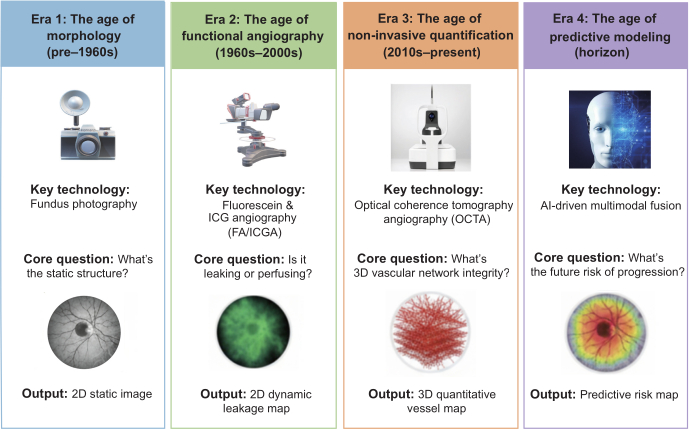
Figure 1: The historical and conceptual evolution of retinal and choroidal microcirculation assessment, charting the trajectory from static morphological observation to dynamic predictive modeling. The timeline conceptualizes the four major paradigm shifts in the field. The journey begins in the age of morphology, where fundus photography provided a foundational but limited, two-dimensional, static view of vascular structures. The first revolution arrived with the age of functional angiography, which introduced a dynamic, physiological dimension by using invasive dyes (FA/ICGA) to answer questions about perfusion and vascular integrity, though often by observing secondary effects like leakage. The current Age of non-invasive quantification, driven by OCTA, represents a pivotal shift towards directly visualizing and quantifying the three-dimensional microvascular architecture itself, moving the core clinical question towards assessing structural integrity without the confounding factor of dye leakage. The timeline culminates in the projected future age of predictive modeling, where the focus transcends diagnostics. The era will be defined by the fusion of multi-modal data through artificial intelligence (AI) engines, transforming the fundamental clinical question from "what the pathology is" to "what the patient's future risk is", thereby enabling a proactive, prognostic, and truly personalized approach to disease management. Abbreviations; FA = fluorescein angiography; ICG = indocyanine green; OCTA = optical coherence tomography angiography; AI = artificial intelligence. Please click here to view a larger version of this figure.
The first important application of AI lies in image enhancement and artifact mitigation to resolve the current issue, where disparate scanning protocols and proprietary algorithms render outputs non-comparable47 . OCTA acquisition is susceptible to motion artifacts, projection artifacts, and low signal-to-noise ratios, which can obscure microvascular details. Deep learning architectures, particularly GANs, are currently being deployed to reconstruct microvascular topology from degraded inputs. By training on high-quality, averaged scans, these generative models learn to denoise single-acquisition images, effectively removing projection artifacts and restoring vessel continuity in areas of signal dropout without the need for extended acquisition times. Algorithmic reconstruction is essential for standardizing image quality across different hardware platforms and establishing transparent, reproducible analytical methods necessary for multicenter trials.
Following image reconstruction, the second tier of AI application involves automated quantification through semantic segmentation. Manual delineation of pathological features, such as capillary non-perfusion (CNP) areas or the irregular boundaries of the FAZ, is labor-intensive and subject to significant inter-grader variability. Convolutional neural networks (CNNs), specifically those utilizing U-Net architectures with skip connections, have demonstrated performance parity with human experts in segmenting these features. These algorithms provide instantaneous, reproducible quantification of perfusion density and vessel skeletal density, facilitating the necessary validation pathway required to definitively answer that one should measure (Supplementary Information).
The most transformative frontier, however, is the application of AI to oculomics, the identification of systemic biomarkers within ocular imaging. The retinal microvasculature serves as a direct extension of the systemic circulation, yet the subtle vascular signatures of systemic disease are often imperceptible to the human eye. DL models trained on large-scale population datasets (e.g., UK Biobank) have successfully predicted systemic parameters, including age, gender, smoking status, and systolic blood pressure, solely from retinal images (Table 3). More advanced models are now capable of predicting major adverse cardiovascular events (MACE) and estimating biological age gaps as markers of mortality risk. By integrating these microvascular insights with genomic and clinical data, AI is converting the eye from traditional observation into a clinical decision-support tool48,49 . Furthermore, the fusion of these validated biomarkers with tele-ophthalmology platforms holds the promise of equitable healthcare. By deploying AI-driven risk prediction at scale, advanced diagnostics can be extended to community settings and underserved populations, effectively expanding access to preventive cardiovascular and neurodegenerative care. Ultimately, the capability positions retinal microcirculation as a potential surrogate endpoint for therapeutic efficacy in systemic disease trials. For instance, quantifiable changes in retinal capillary density could serve as early indicators of microvascular protection, potentially shortening drug development timelines compared to waiting for major adverse events. Realizing this vision demands unprecedented cross-disciplinary collaboration between ophthalmologists, cardiologists, nephrologists, endocrinologists, and pharmaceutical scientists. It marks the clinical translation of ophthalmic imaging, empowering modern medicine as a whole by providing a direct in vivo window into a therapy's systemic effects.
Table 3: Summary of AI algorithms and performance in retinal microvascular applications Representative deep learning models applied to clinical tasks ranging from vessel segmentation to systemic disease prediction, with core neural network architectures, targeted microvascular features, clinical applications, and reported performance metrics summarized. Abbreviations; AD = Alzheimer's disease; AI = artificial intelligence; AUC = area under the receiver operating characteristic curve; CNN = convolutional neural network; CVD = cardiovascular disease; FAZ = foveal avascular zone; GNN = graph neural network; LLM = large language model; PD = Parkinson's disease; RNFL = retinal nerve fiber layer. Please click here to download this Table.
Results
Loading...
$$\rightleftharpoonup{xx}$$
$$\longleftharp{xx}$$,
$$\longrightharp{xx}$$,
The field of retinal and choroidal microcirculation assessment is in the midst of a transformative shift, moving from an era defined by invasive, qualitative techniques to one dominated by non-invasive, quantitative, and multi-modal imaging. While dye-based angiography retains its vital role for specific questions, particularly the assessment of vascular leakage, OCTA has become the new cornerstone for evaluating microvascular structure and perfusion. Its ability to provide objective, repeatable metrics has fundamentally altered disease management, enabling earlier detection and data-driven monitoring. The future lies not in a single, superior technology, but in the intelligent fusion of complementary data streams. The next frontier is the integration of multi-modal data with artificial intelligence. AI algorithms are already being developed to enhance image quality by removing artifacts, automating quantitative analysis, and eliminating operator dependency50,51. The goal is to harness deep learning to move beyond description and into prediction52. By training models on vast datasets incorporating structural OCT, OCTA, LSFG, clinical data, and genomics, AI can identify subtle, subclinical microvascular fingerprints that are predictive of future disease onset or progression53.
However, the path to integration is fraught with challenges. A primary limitation is the lack of interpretability of deep learning, which obscures the biological rationale behind predictions, complicating clinical trust. Specifically, the distinction between structural and functional anomalies remains a critical hurdle; predictive AI models should be validated to ensure they differentiate true physiological flow deficits from signal attenuation caused by overlying opacities or segmentation errors. Furthermore, the generalizability of these algorithms is currently limited by the heterogeneity of multi-modal datasets and the risk of algorithmic bias. Bridging the gap between algorithmic potential and clinical utility will require technological refinement and prospective trials to ensure that these predictive tools are robust across diverse populations. A predictive capability will transition clinical practice from reacting to manifest damage to a proactive, risk-based paradigm of preemptive intervention (Figure 2). The eye's window to systemic health will be transformed from morphological inspection into an active, intelligent sensor, realizing the full potential of precision, predictive, and personalized medicine.
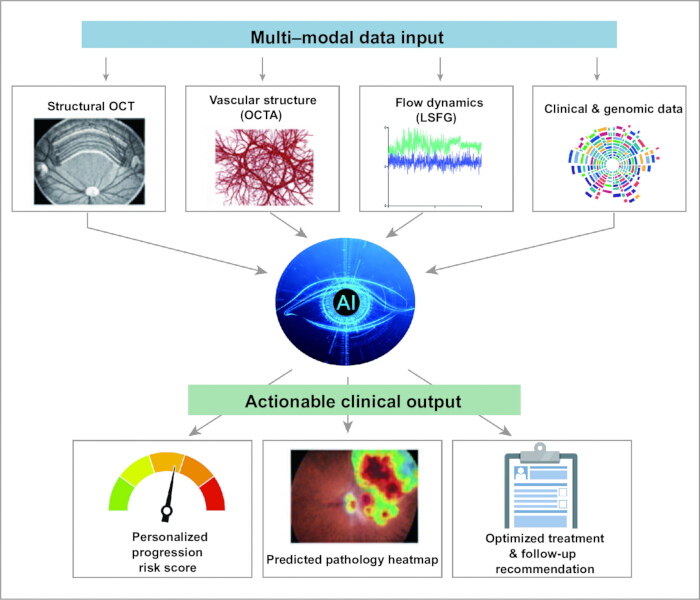
Figure 2: Conceptual framework for the next generation of AI-driven ophthalmic diagnostics, illustrating the paradigm shift from raw data interpretation to predictive clinical insight. This model visualizes a transformative diagnostic process, conceptualized as a data-refinement funnel. The process begins with the aggregation of high-dimensional, heterogeneous data (Layer 1: multi-modal data input), which creates a holistic digital representation of the patient's ocular status by combining static anatomical information (Structural OCT), detailed microvascular architecture (OCTA), dynamic physiological function (LSFG), and systemic patient context (Clinical & Genomic Data). These disparate data streams are then synthesized within a sophisticated AI Engine (Layer 2), which employs deep learning models for data fusion and the extraction of complex, multi-dimensional biomarkers that are often imperceptible to human observers. Systematic processing illustrates the synthesis of the vast informational complexity into a concise, clinically meaningful output. The ultimate goal is the generation of actionable clinical outputs (Layer 3) that are not merely descriptive, but fundamentally predictive and personalized. These outputs empower clinicians with prognostic risk scores, spatial predictions of future pathology (e.g., pathology heatmaps), and optimized, patient-specific management recommendations. The framework signifies the fundamental transition from reactive, pattern-based medicine to a proactive, data-driven, and truly predictive healthcare paradigm. Abbreviations; AI = artificial intelligence; LSFG = laser speckle flowgraphy; OCT = optical coherence tomography; OCTA = optical coherence tomography angiography. Please click here to view a larger version of this figure.
Disclosures
Loading...
$$\rightleftharpoonup{xx}$$
$$\longleftharp{xx}$$,
$$\longrightharp{xx}$$,
The authors declare that they have no conflicts of interest.
Acknowledgements
Loading...
$$\rightleftharpoonup{xx}$$
$$\longleftharp{xx}$$,
$$\longrightharp{xx}$$,
The authors wish to acknowledge the grant from the Beijing Natural Science Foundation (7252093).
References
Loading...
$$\rightleftharpoonup{xx}$$
$$\longleftharp{xx}$$,
$$\longrightharp{xx}$$,
- Advances in translational imaging of the microcirculation. Microcirculation. 28 (3), e12683(2021).">Guerraty, M., Bhargava, A., Senarathna, J., Mendelson, A. A., Pathak, A. P. Advances in translational imaging of the microcirculation. Microcirculation. 28 (3), e12683(2021).
- Retinal microcirculation: A window into systemic circulation and metabolic disease. Exp Eye Res. 242, 109885(2024).">Yuan, Y., Dong, M., Wen, S., Yuan, X., Zhou, L. Retinal microcirculation: A window into systemic circulation and metabolic disease. Exp Eye Res. 242, 109885(2024).
- Ocular blood flow as a clinical observation: Value, limitations and data analysis. Prog Retin Eye Res. , 100841(2020).">Harris, A., et al. Ocular blood flow as a clinical observation: Value, limitations and data analysis. Prog Retin Eye Res. , 100841(2020).
- Functional assessments of the ocular circulation. Front Med (Lausanne). 10, 1222022(2023).">Heitmar, R., Link, D., Kotliar, K., Schmidl, D., Klee, S. Functional assessments of the ocular circulation. Front Med (Lausanne). 10, 1222022(2023).
- Current and novel multi-imaging modalities to assess retinal oxygenation and blood flow. Eye (Lond). 35 (11), 2962-2972 (2021).">Marino, M. J., Gehlbach, P. L., Rege, A., Jiramongkolchai, K. Current and novel multi-imaging modalities to assess retinal oxygenation and blood flow. Eye (Lond). 35 (11), 2962-2972 (2021).
- Photoacoustic imaging for microcirculation. Microcirculation. 29 (6-7), e12776(2022).">Mirg, S., Turner, K. L., Chen, H., Drew, P. J., Kothapalli, S. R. Photoacoustic imaging for microcirculation. Microcirculation. 29 (6-7), e12776(2022).
- Optical coherence tomography angiography. Invest Ophth Vis Sci. 57 (9), 27-36 (2016).">Gao, S. S., et al. Optical coherence tomography angiography. Invest Ophth Vis Sci. 57 (9), 27-36 (2016).
- Retinal and choroidal blood flow changes in dialysis patients assessed by wide-field swept-source optical coherence tomography angiography. Front Med. 12, 1524503(2025).">Li, W., et al. Retinal and choroidal blood flow changes in dialysis patients assessed by wide-field swept-source optical coherence tomography angiography. Front Med. 12, 1524503(2025).
- Non-invasive measurement techniques for quantitative assessment of optic nerve head blood flow. Eur J Ophthalmol. 30 (2), 235-244 (2020).">Vosborg, F., Malmqvist, L., Hamann, S. Non-invasive measurement techniques for quantitative assessment of optic nerve head blood flow. Eur J Ophthalmol. 30 (2), 235-244 (2020).
- New findings and challenges in OCT angiography for diabetic retinopathy. Ann Eye Sci. 3 (8), 44-44 (2018).">Sorour, O., Arya, M., Waheed, N. New findings and challenges in OCT angiography for diabetic retinopathy. Ann Eye Sci. 3 (8), 44-44 (2018).
- Identification of structures labeled by indocyanine green in the rat choroid and retina can guide interpretation of indocyanine green angiography. Invest Ophthalmol Vis Sci. 65 (1), 25-25 (2024).">Mejlachowicz, D., et al. Identification of structures labeled by indocyanine green in the rat choroid and retina can guide interpretation of indocyanine green angiography. Invest Ophthalmol Vis Sci. 65 (1), 25-25 (2024).
- Indocyanine green angiography in chorioretinal diseases: indications and interpretation: an evidence-based update. Ophthalmology. 110 (1), 15-21 (2003).">Stanga, P. E., Lim, J. I., Hamilton, P. Indocyanine green angiography in chorioretinal diseases: indications and interpretation: an evidence-based update. Ophthalmology. 110 (1), 15-21 (2003).
- Optical coherence tomography angiography. Prog Retin Eye Res. 64, 1-55 (2018).">Spaide, R. F., Fujimoto, J. G., Waheed, N. K., Sadda, S. R., Staurenghi, G. Optical coherence tomography angiography. Prog Retin Eye Res. 64, 1-55 (2018).
- Optical coherence tomography angiography in retinal vascular disorders. Diagnostics. 13 (9), 1620(2023).">Ong, C. J. T., et al. Optical coherence tomography angiography in retinal vascular disorders. Diagnostics. 13 (9), 1620(2023).
- Optical coherence tomography angiography (OCTA): a review of the current literature. J. Int. Med. Res. 51 (7), 3000605231187933(2023).">Javed, A., et al. Optical coherence tomography angiography (OCTA): a review of the current literature. J. Int. Med. Res. 51 (7), 3000605231187933(2023).
- Optical coherence tomography (OCT) and OCT angiography (OCTA) biomarkers for diabetic retinopathy in type 2 diabetes mellitus: a scoping review. J Health Sci Med Res. 42 (6), 20241102(2024).">Naqaweh, A., Mohamed, S. O., Saliman, N. H. Optical coherence tomography (OCT) and OCT angiography (OCTA) biomarkers for diabetic retinopathy in type 2 diabetes mellitus: a scoping review. J Health Sci Med Res. 42 (6), 20241102(2024).
- Evaluation of macular ischemia in eyes with central retinal vein occlusion: an optical coherence tomography angiography study. Retina. 38 (8), 1571-1580 (2018).">Ghashut, R., et al. Evaluation of macular ischemia in eyes with central retinal vein occlusion: an optical coherence tomography angiography study. Retina. 38 (8), 1571-1580 (2018).
- Optical coherence tomography angiography (OCTA) of the eye: a review on basic principles, advantages, disadvantages and device specifications. Clin Hemorheol Microcirc. 83 (3), 247-271 (2023).">Koutsiaris, A. G., et al. Optical coherence tomography angiography (OCTA) of the eye: a review on basic principles, advantages, disadvantages and device specifications. Clin Hemorheol Microcirc. 83 (3), 247-271 (2023).
- Indocyanine green angiography and optical coherence tomography angiography of choroidal neovascularization in age-related macular degeneration. Invest Ophthalmol Vis Sci. 58 (9), 3690-3696 (2017).">Eandi, C. M., et al. Indocyanine green angiography and optical coherence tomography angiography of choroidal neovascularization in age-related macular degeneration. Invest Ophthalmol Vis Sci. 58 (9), 3690-3696 (2017).
- Doppler optical coherence tomography. Prog Retin Eye Res. 41, 26-43 (2014).">Leitgeb, R. A., Werkmeister, R. M., Blatter, C., Schmetterer, L. Doppler optical coherence tomography. Prog Retin Eye Res. 41, 26-43 (2014).
- Measurement of total blood flow in the normal human retina using doppler fourier-domain optical coherence tomography. Br J Ophthalmol. 93 (5), 634-637 (2009).">Wang, Y., et al. Measurement of total blood flow in the normal human retina using doppler fourier-domain optical coherence tomography. Br J Ophthalmol. 93 (5), 634-637 (2009).
- Total retinal blood flow measurement with ultrahigh speed swept source/Fourier domain OCT. Biomed Opt Express. 2 (6), 1539-1552 (2011).">Baumann, B., et al. Total retinal blood flow measurement with ultrahigh speed swept source/Fourier domain OCT. Biomed Opt Express. 2 (6), 1539-1552 (2011).
- Pilot study of optical coherence tomography measurement of retinal blood flow in retinal and optic nerve diseases. Ophthalmol Vis Sci. 52 (2), 840-845 (2011).">Wang, Y., et al. Pilot study of optical coherence tomography measurement of retinal blood flow in retinal and optic nerve diseases. Ophthalmol Vis Sci. 52 (2), 840-845 (2011).
- Use of laser speckle flowgraphy in ocular blood flow research. Acta Ophthalmol. 88 (7), 723-729 (2010).">Sugiyama, T., Araie, M., Riva, C. E., Schmetterer, L., Orgul, S. Use of laser speckle flowgraphy in ocular blood flow research. Acta Ophthalmol. 88 (7), 723-729 (2010).
- Laser speckle flowgraphy in ophthalmology. Ophthalmol Rep. 18 (2), 77-86 (2025).">Zhazybaev, R. S., Kolenko, O. V., Sorokin, E. L. Laser speckle flowgraphy in ophthalmology. Ophthalmol Rep. 18 (2), 77-86 (2025).
- Ocular blood flow evaluation by laser speckle flowgraphy in pediatric patients with anisometropia. Front Public Health. 11, 1093686(2023).">Itokawa, T., Matsumoto, T., Matsumura, S., Kawakami, M., Hori, Y. Ocular blood flow evaluation by laser speckle flowgraphy in pediatric patients with anisometropia. Front Public Health. 11, 1093686(2023).
- Optic nerve head and retinal blood flow regulation during isometric exercise as assessed with laser speckle flowgraphy. PloS one. 12 (9), e0184772(2017).">Witkowska, K. J., et al. Optic nerve head and retinal blood flow regulation during isometric exercise as assessed with laser speckle flowgraphy. PloS one. 12 (9), e0184772(2017).
- Use of laser speckle flowgraphy in ocular blood flow research. Acta Ophthalmol. 88 (7), 723-729 (2010).">Sugiyama, T., Araie, M., Riva, C. E., Schmetterer, L., Orgul, S. Use of laser speckle flowgraphy in ocular blood flow research. Acta Ophthalmol. 88 (7), 723-729 (2010).
- Assessment of choroidal blood flow using laser speckle flowgraphy. Br J Ophthalmol. 102 (12), 1679-1683 (2018).">Calzetti, G., et al. Assessment of choroidal blood flow using laser speckle flowgraphy. Br J Ophthalmol. 102 (12), 1679-1683 (2018).
- Adaptive optics scanning laser ophthalmoscopy. Optics express. 10 (9), 405-412 (2002).">Roorda, A., et al. Adaptive optics scanning laser ophthalmoscopy. Optics express. 10 (9), 405-412 (2002).
- Ocular and systemic factors affecting laser speckle flowgraphy measurements in the optic nerve head. Transl Vis Sci Technol. 10 (1), 13(2021).">Anraku, A., et al. Ocular and systemic factors affecting laser speckle flowgraphy measurements in the optic nerve head. Transl Vis Sci Technol. 10 (1), 13(2021).
- Applications of adaptive optics scanning laser ophthalmoscopy. Optom Vis Sci. 87 (4), 260-268 (2010).">Roorda, A. Applications of adaptive optics scanning laser ophthalmoscopy. Optom Vis Sci. 87 (4), 260-268 (2010).
- Optical coherence tomography-angiography in diabetic retinopathy diagnosis and monitoring. Ophthalmol Rep. 14 (3), 49-60 (2021).">Pomytkina, N. V., Sorokin, E. L. Optical coherence tomography-angiography in diabetic retinopathy diagnosis and monitoring. Ophthalmol Rep. 14 (3), 49-60 (2021).
- Optical coherence tomography angiography: technical principles and clinical applications in ophthalmology. Taiwan J Ophthalmol. 7 (3), 115-129 (2017).">Hagag, A. M., Gao, S. S., Jia, Y., Huang, D. Optical coherence tomography angiography: technical principles and clinical applications in ophthalmology. Taiwan J Ophthalmol. 7 (3), 115-129 (2017).
- Methods to measure blood flow and vascular reactivity in the retina. Front Med (Lausanne). 9, 1069449(2023).">Böhm, E. W., Pfeiffer, N., Wagner, F. M., Gericke, A. Methods to measure blood flow and vascular reactivity in the retina. Front Med (Lausanne). 9, 1069449(2023).
- Microvascular contributions to age-related macular degeneration (AMD): from mechanisms of choriocapillaris aging to novel interventions. Geroscience. 41 (6), 813-845 (2019).">Lipecz, A., et al. Microvascular contributions to age-related macular degeneration (AMD): from mechanisms of choriocapillaris aging to novel interventions. Geroscience. 41 (6), 813-845 (2019).
- Choroidal vasculitis as a biomarker of inflammation of the choroid. Indocyanine green angiography (ICGA) spearheading for diagnosis and follow-up, an imaging tutorial. J Ophthalmic Inflamm Infect. 14 (1), 63(2024).">Papasavvas, I., Tucker, W. R., Mantovani, A., Fabozzi, L., Herbort, C. P. Jr Choroidal vasculitis as a biomarker of inflammation of the choroid. Indocyanine green angiography (ICGA) spearheading for diagnosis and follow-up, an imaging tutorial. J Ophthalmic Inflamm Infect. 14 (1), 63(2024).
- Fundus fluorescein angiography versus optical coherence tomography angiography in evaluation of retinal changes in cases of retinal vein occlusion. Med J Cairo Univ. 86, 297-303 (2018).">Mostafa, A., HASHEM, H. G., TAMER, E. W., MAGDY, S. M. Fundus fluorescein angiography versus optical coherence tomography angiography in evaluation of retinal changes in cases of retinal vein occlusion. Med J Cairo Univ. 86, 297-303 (2018).
- Biomarkers of peripheral nonperfusion in retinal venous occlusions using optical coherence tomography angiography. Transl Vis Sci Technol. 8 (3), 7(2019).">Cabral, D., et al. Biomarkers of peripheral nonperfusion in retinal venous occlusions using optical coherence tomography angiography. Transl Vis Sci Technol. 8 (3), 7(2019).
- Optical coherence tomography angiography in retinal vein occlusion: correlations between macular vascular density, visual acuity, and peripheral nonperfusion area on fluorescein angiography. Retina. 38 (8), 1562-1570 (2018).">Seknazi, D., et al. Optical coherence tomography angiography in retinal vein occlusion: correlations between macular vascular density, visual acuity, and peripheral nonperfusion area on fluorescein angiography. Retina. 38 (8), 1562-1570 (2018).
- Non-invasive imaging of microcirculation: a technology review. Med Devices (Auckl). 7, 445-452 (2014).">Eriksson, S., Nilsson, J., Sturesson, C. Non-invasive imaging of microcirculation: a technology review. Med Devices (Auckl). 7, 445-452 (2014).
- Current state of knowledge in ocular blood flow in glaucoma: a narrative review. Clin. Ophthalmol. 17, 2599-2607 (2023).">Alasbali, T. Current state of knowledge in ocular blood flow in glaucoma: a narrative review. Clin. Ophthalmol. 17, 2599-2607 (2023).
- Relations between pulsatility in the optic nerve head or peripapillary retinal vessels and the rate of progression in glaucoma. Invest Ophthalmol Vis Sci. 66 (12), 34-34 (2025).">Gardiner, S. K., et al. Relations between pulsatility in the optic nerve head or peripapillary retinal vessels and the rate of progression in glaucoma. Invest Ophthalmol Vis Sci. 66 (12), 34-34 (2025).
- Increased optic nerve head capillary blood flow in early primary open-angle glaucoma. Invest. Ophthalmol. Vis. Sci. 60 (8), 3110-3118 (2019).">Gardiner, S. K., Cull, G., Fortune, B., Wang, L. Increased optic nerve head capillary blood flow in early primary open-angle glaucoma. Invest. Ophthalmol. Vis. Sci. 60 (8), 3110-3118 (2019).
- Optical coherence tomography angiography (OCTA) differences in vessel perfusion density and flux index of the optic nerve and peri-papillary area in healthy, glaucoma suspect and glaucomatous eyes. Clin Ophthalmol. 17, 3011-3021 (2023).">Yospon, T., Rojananuangnit, K. Optical coherence tomography angiography (OCTA) differences in vessel perfusion density and flux index of the optic nerve and peri-papillary area in healthy, glaucoma suspect and glaucomatous eyes. Clin Ophthalmol. 17, 3011-3021 (2023).
- A ophthalmology study on eye glaucoma and retina applied in ai and deep learning techniques. J. Phys. Conf. Ser. 1947 (1), 012053(2021).">Vaishnavi, S., Deepa, R., Nanda kumar, P. A ophthalmology study on eye glaucoma and retina applied in ai and deep learning techniques. J. Phys. Conf. Ser. 1947 (1), 012053(2021).
- Machine learning in optical coherence tomography angiography. Exp Biol Med. 246 (20), 2170-2183 (2021).">Le, D., Son, T., Yao, X. Machine learning in optical coherence tomography angiography. Exp Biol Med. 246 (20), 2170-2183 (2021).
- Oct images diagnosis based on deep learning-a review. Indones J Comput Sci. 13 (1), (2024).">Abdi, A., Abdulazeez, A. M. Oct images diagnosis based on deep learning-a review. Indones J Comput Sci. 13 (1), (2024).
- Adaptive optics scanning laser ophthalmoscope imaging: technology update. Clin Ophthalmol. 10, 743-755 (2016).">Merino, D., Loza-Alvarez, P. Adaptive optics scanning laser ophthalmoscope imaging: technology update. Clin Ophthalmol. 10, 743-755 (2016).
- Advances in retinal imaging biomarkers for the diagnosis of cerebrovascular disease. Front Neurol. 15, 1393899(2024).">Zhang, Y., et al. Advances in retinal imaging biomarkers for the diagnosis of cerebrovascular disease. Front Neurol. 15, 1393899(2024).
- Using artificial intelligence to analyse the retinal vascular network: the future of cardiovascular risk assessment based on oculomics? A narrative review. Ophthalmol Ther. 12 (2), 657-674 (2023).">Arnould, L., et al. Using artificial intelligence to analyse the retinal vascular network: the future of cardiovascular risk assessment based on oculomics? A narrative review. Ophthalmol Ther. 12 (2), 657-674 (2023).
- Artificial intelligence in ophthalmology: The path to the real-world clinic. Cell Rep Med. 4 (7), 101095(2023).">Li, Z., et al. Artificial intelligence in ophthalmology: The path to the real-world clinic. Cell Rep Med. 4 (7), 101095(2023).
- Deep learning and computer vision techniques for microcirculation analysis: A review. Patterns. 4 (1), 100641(2023).">Helmy, M., Truong, T. T., Jul, E., Ferreira, P. Deep learning and computer vision techniques for microcirculation analysis: A review. Patterns. 4 (1), 100641(2023).
- Advances and prospects of multi-modal ophthalmic artificial intelligence based on deep learning: a review. Eye Vis (Lond). 11 (1), 38(2024).">Wang, S., et al. Advances and prospects of multi-modal ophthalmic artificial intelligence based on deep learning: a review. Eye Vis (Lond). 11 (1), 38(2024).
Reprints and Permissions
Request permission to reuse the text or figures of this JoVE article
Request Permission