This protocol describes detailed surgical techniques for stimulating the sacral, tibial, and peroneal nerves in anesthetized rats. These models enable investigation of neuromodulation effects on bladder function, aid in determining optimal stimulation parameters, and allow for the study of the mechanisms of action of sacral and peripheral nerve stimulation therapies.
Method Article
Rat Animal Models for Evaluation of the Effects of Sacral and Peripheral Nerve Stimulation on Bladder Function
Opens in a new tab
In This Article
Summary
Loading...
$$\rightleftharpoonup{xx}$$
$$\longleftharp{xx}$$,
$$\longrightharp{xx}$$,
Abstract
Loading...
$$\rightleftharpoonup{xx}$$
$$\longleftharp{xx}$$,
$$\longrightharp{xx}$$,
Neuromodulation, a therapeutic approach to the dysfunction of various organs, has proven effective in treating lower urinary tract dysfunctions. Despite its clinical success, the mechanisms underlying neuromodulation remain incompletely understood, emphasizing the need for standardized and reproducible animal models. Preclinical models of urinary bladder neuromodulation using sacral and peripheral nerve stimulation have been established for more than two decades; however, the existing literature provides limited methodological detail regarding the surgical procedures. This article offers a detailed description and visual representation of well-established techniques for sacral nerve stimulation. It also describes a modified approach to tibial nerve stimulation and introduces a novel bladder neuromodulation method using peroneal nerve stimulation in a rat model. The modified tibial nerve stimulation approach involves exposing and stimulating the tibial nerve at its origin, as a branch of the sciatic nerve, rather than at the medial ankle, as described in previous studies. Given the recent introduction of peroneal nerve stimulation for bladder neuromodulation in clinical practice, this article proposes a unique rat model to investigate its mechanisms in the control of lower urinary tract function. Step-by-step guidance for all three neuromodulation methods is outlined for nerve exposure, electrode placement, and verification of successful electrode placement based on characteristic motor responses. A representative example of the effect of peroneal nerve stimulation on bladder function in a rat model of acetic acid–induced bladder overactivity is included to demonstrate its applicability. This article presents a standardized, technically accessible protocol for studying neuromodulation mechanisms, including alterations in bladder sensory signaling, spinal and supraspinal regulatory pathways, optimization of stimulation parameters, and comparison of the efficacy of different stimulation targets.
Introduction
Loading...
$$\rightleftharpoonup{xx}$$
$$\longleftharp{xx}$$,
$$\longrightharp{xx}$$,
Neuromodulation uses low-amplitude electrical stimulation to alter the function of the end organ1. In the context of lower urinary tract dysfunction, such as overactive bladder syndrome (OAB), non-obstructive urinary retention, neurogenic bladder, and bladder pain syndrome, neuromodulation is employed as a third-line treatment for patients who failed behavioral therapy and pharmacotherapy2. For neuromodulation in patients with OAB, posterior tibial nerve stimulation and sacral nerve stimulation (SNS) have been widely used in clinical practice. Experimental neuromodulation approaches targeting additional peripheral nerves, including the pudendal and peroneal nerves, are being studied3,4,5,6.
Although neuromodulation has been used in the treatment of bladder and bowel disease for several decades, its mechanism of action is not fully understood. As stated in the multidisciplinary expert group review, currently used stimulation parameters were mostly chosen by manufacturers based on a trial-and-error approach7. It is therefore important to continue using animal models to elucidate underlying pathways and optimize stimulation parameters to improve therapeutic effect. Several preclinical experiments have been conducted, using awake and anesthetized animals, including mice, rats, sheep, dogs, and cats4. With ethical guidelines and research policies worldwide encouraging the use of less complex, smaller species, rodent models have been employed most frequently in recent years.
SNS in rat models of bladder dysfunction has predominantly employed two methodological approaches. The first, described by Zvara et al., involves implanting a stimulating electrode into the sacral foramen using an angiocatheter or a spinal needle8. The second approach requires the exposure of the L6 nerve root and positioning stimulating electrodes under the L6 nerves, with silicone glue used to secure the contact between the electrode and the nerve9. The technique involving electrode placement in sacral foramen mirrors the clinical approach. The method using exposure of the L6 root, while technically challenging, provides precise localization and more consistent access to the nerve.
Rat animal models mimicking the posterior tibial nerve stimulation have been described in the literature. Most frequently used method involves surgical exposure of the tibial nerve on the medial aspect of the hindlimb above the ankle10,11,12,13,14,15,16. Another method consists of percutaneous insertion of needle electrodes near the tibial nerve17. This article aims to provide a detailed description of tibial nerve stimulation at its origin, between the gluteus maximus and biceps femoris muscles, where the sciatic nerve splits into three branches: the tibial, common peroneal, and sural nerves. In addition, this study introduces peroneal nerve stimulation as a novel animal model for investigating a new neuromodulation method. The translational relevance of this rat model is supported by the recent clinical introduction of peroneal nerve stimulation for bladder neuromodulation18,19.
Protocol
Loading...
$$\rightleftharpoonup{xx}$$
$$\longleftharp{xx}$$,
$$\longrightharp{xx}$$,
The animals were housed at the University of Southern Denmark Animal Care Facility following institutional guidelines. All animal experiments were carried out in accordance with the National Institutes of Health guide for the care and use of laboratory animals. The Ethics Committee of the Danish Animal Experiments Inspectorate approved the study procedures (Protocol No. 2022-15-0201-01158). The reagents and the equipment used are listed in the Table of Materials.
1. Preparation of the electrodes
NOTE: For tibial, peroneal, and L6 nerve stimulation, bipolar hook-shaped electrodes were used20. The following steps provide a brief description of electrode design and construction.
- Cut two equal-length 125 µm polytetrafluoroethylene (PTFE)-coated silver wires and twist them together.
- Strip 4–5 mm of PTFE from one end of the wires, trim the exposed ends evenly, and bend the tips upwards over a 23 G needle to form two parallel hooks spaced 2 mm apart.
- Secure the electrode to a plate and position the hooks facing upward and extending over the edge of the plate.
- Mix the two-component silicon glue for 5 s. Apply a drop 1–2 mm from the hooks and allow it to dry for approximately 5 min.
- Strip a 1–2 cm long section of the PTFE coating from the opposite end of the electrode to allow connection to the stimulator.
2. Animal preparation
NOTE: Under sterile conditions, PE-50 catheters, with an end flared by heat, were implanted into the bladder dome of female Sprague-Dawley rats (250–300 g) and secured with a purse string suture. The distal end of the tubing was externalized at the animal's back and coiled in a subcutaneous pouch21. Five days were allowed for the bladder to recover after the surgery.
- Anesthetize the animal with urethane (1.5 g/kg, intraperitoneally) (following institutionally approved protocols). Administer urethane in three divided doses at 15-min intervals, approximately 2 h before the start of the experiment.
- Transfer the animal onto a heating pad and place it in a prone position.
- For tibial and peroneal nerve stimulation, shave the rat’s hindlimb around the thigh region as well as the lower half of the back. Place the tail and a 5 mL syringe under the left hindlimb of the rat and fix the tail and the leg as shown in Figure 1A.
- For SNS, shave the rat’s back from the tail to the thoracic spine and place a 50 mL centrifuge tube under the abdomen to elevate the lumbar and sacral region.
NOTE: All neurostimulation experiments represent non-survival procedures. Use clean surgical techniques.
3. Dissection of the peroneal and tibial nerve and implantation of the electrodes
- Use a scalpel to make a 3–3.5 cm incision in the center between the knee joint and the ischial tuberosity (Figure 1B).
- Separate the skin from the muscle by sliding the scissors under the skin and cutting the connective tissue.
- Spread the skin open using retractors and expose the fascia connecting the gluteus maximus to the biceps femoris muscles (Figure 1C).
- Use straight scissors to cut the fascia and dissect the space between the gluteus maximus and the biceps femoris until the sciatic nerve is visualized (Figure 1D,E).
- Reposition the retractors on the biceps femoris to achieve good exposure of the sciatic nerve and its branches - the tibial, peroneal, and sural nerves (Figure 2A). In this context, “peroneal nerve” refers to the common peroneal nerve prior to its division into deep and superficial peroneal nerves. The tibial nerve is the largest branch; the sural nerve is the smallest and the peroneal has an intermediate diameter.
- Separate the peroneal nerve from the surrounding connective tissue using curved forceps and micro scissors. Then use microforceps to carefully spread the tissue on both sides and beneath it to isolate a 5 mm-long section of the nerve. Repeat the same procedure with the tibial nerve for tibial nerve stimulation (Figure 2B).
NOTE: Avoid crushing the nerve by picking it up with the forceps and reduce pulling on the nerve to a minimum. - Make a 5 mm-long incision on the lower half of the back using a scalpel and slide a hemostat under the skin through the incision to create a subcutaneous channel. Advance the hemostat carefully until the tip emerges at the hindlimb incision (Figure 2C).
- Using the hemostat, grasp the unhooked end of the electrode and slowly withdraw the instrument through the incision at the lower half of the back. Using two forceps, bend the other end of the electrode (hooked end) to a 90° angle with respect to the subcutaneous plane and ensure that the hooks of the electrode are positioned adjacent and perpendicular to the nerve (peroneal or tibial) (Figure 2D).
NOTE: Proper positioning of the electrode is important to avoid stretching the nerve. - Use curved micro forceps to lift the nerve and slide the hooks of the electrode under the nerve. Mix the two-component silicon glue for 5 s, use a Q-tip to dry the nerve, and apply enough glue to cover the hooks and the area adjacent to the nerve (Figure 2E–G).
NOTE: Before applying glue, connect the electrodes to the stimulator, and stimulate the nerve at the level of the motor threshold to confirm proper placement of the electrode. The motor threshold was determined as the minimum voltage required to provoke consistent phasic foot movement. Stimulation of the peroneal nerve generates a phasic dorsal flexion of the foot, whereas tibial nerve stimulation generates a plantar flexion. In the absence of the motor response to stimulation, check the connection between the stimulator and the electrode. - Place a 5-0 nylon stay suture in the connective tissue at the back incision, leaving both suture ends sufficiently long. These ends are used to secure the electrode in place, ensuring stable positioning.
- Close the skin at the hindlimb incision using a 4-0 Vicryl suture.
4. Exposure of the L6 nerve and implantation of the electrode
- Use a scalpel to make a 4–5 cm midline incision over the lumbar region and sacrum. Place retractors to open the incision, expose the underlying back muscles, and the tips of the vertebral spinous processes (Figure 3A).
- Palpate the iliac crest and use it as a landmark to locate the spinous processes of L6. It can be identified as the first spinous process located just below the iliac crest (Figure 3B).
- Use scissors to remove the fascia on top of the vertebrae from L5 to S2. Then carefully isolate and detach the paravertebral muscles bilaterally to expose the spinous processes, laminae, and articular processes. Remove the remaining connective tissue and muscle with micro scissors until the bony structures are clearly visible (Figure 4A,B).
NOTE: This creates an anatomical window that exposes landmarks and provides access to the L6 nerve trunk. Identify the posterior facet joint of L6; the L6 nerve trunk runs caudal to this joint. Also, identify the sacrum and the sacroiliac joints. The L6 nerve trunk runs caudal and medial to this joint (Figure 4B). - Use a rongeur to carefully remove the spinous process of S1 and gradually break and remove small fragments of the sacral bone in the region between the S1 and S2 vertebrae to expose the L6 nerve trunk (Figure 4C).
- Separate the L6 nerve from the surrounding tissue using curved forceps and micro scissors. Hook the nerve onto a bipolar PTFE-coated silver wire electrode and isolate it from the surrounding tissue using biocompatible silicone glue, as described in step 3.9 (Figure 4D).
NOTE: Stimulation of the L6 nerve generates pelvic floor muscle contraction and tail twitch. - Repeat the same procedure on the opposite side for bilateral nerve stimulation.
- Close the skin with a 4-0 Vicryl suture.
5. Insertion of a stimulating electrode into the sacral foramen
- Use a scalpel to make a midline incision over the sacrum and use retractors to open the incision and expose the underlying back muscles.
NOTE: Palpate the iliac crest as mentioned in step 4.2 to locate the L6/S1 landmarks. - Separate the paravertebral muscles from the spinous processes using blunt dissection. Reposition the retractors on the muscles to obtain exposure of the spinous processes and facilitate access to the S1 sacral foramen (Figure 5A).
- Identify the location of the S1 foramen, which lies caudal and lateral to the S1 spinous process. Probe the S1 sacral foramen with an 18-gauge needle preloaded with the monopolar electrode (Figure 5B).
NOTE: A 180 µm PTFE-coated stainless steel wire is used, with 5 mm of insulation stripped from both ends. - Position the needle tip at the S1 foramen, keeping it parallel to the spine and angled approximately 30° relative to the animal’s back. Gently advance the wire along the nerve trajectory while slowly withdrawing the needle. Repeat the procedure on the contralateral S1 foramen for bilateral stimulation.
NOTE: To confirm the correct positioning of the electrode, connect the distal end of the wire to the stimulator. Electrical stimulation generates a tail twitch. - Secure the wires to the adjacent spinous process (L6) using a 5-0 Vicryl suture (Figure 5C).
- Make a 1 cm incision at the back of the neck using a scalpel and create a subcutaneous tunnel using a hemostat from the incision at the back of the neck to the incision at the sacral level.
- Pass the distal end of the wire through the tunnel and exteriorize it at the back of the neck (Figure 5D).
- Close the fascia and the skin at the sacral level, as well as the skin at the back of the neck, using 4-0 Vicryl suture.
6. Cystometry recording
- After 5 days, prior to performing the stimulation experiments, externalize the PE-50 tubing and connect it to the pressure transducer and infusion pump.
- Infuse the bladder continuously at a rate of 3 mL/h for 2 h to allow for stabilization of bladder parameters.
- Evaluate cystometry parameters, including baseline pressure, threshold pressure, bladder compliance, micturition pressure, and bladder capacity before, during, and after nerve stimulation using a single micturition cycle intravesical infusion21.
- At the conclusion of each experiment, in compliance with ethical standards, euthanize animals by anesthetic overdose.
Results
Loading...
$$\rightleftharpoonup{xx}$$
$$\longleftharp{xx}$$,
$$\longrightharp{xx}$$,
To demonstrate the experimental design for assessing the effect of neuromodulation on the lower urinary tract function, a study is presented in which peroneal nerve stimulation was applied in a rat model of bladder overactivity induced by intravesical infusion of 0.5% acetic acid. Bladder function was recorded using a single micturition cycle cystometry before, during, and after stimulation (Figure 6 A,B). The experimental setup included two different durations of peroneal nerve stimulation using the biphasic stimulation waveform, frequency of 10 Hz, pulse duration 0.2 ms, and stimulation intensity 3x the motor threshold (1.2–3 V).
Successful stimulation of the peroneal nerve was confirmed by phasic dorsal flexion of the hindfoot throughout the stimulation period.
Peroneal nerve stimulation has induced clear changes in the micturition pattern, including a decrease in bladder capacity both during and after stimulation. Micturition pressure increased during prolonged (1 h) stimulation, and changes in baseline, threshold, and micturition pressures were observed post short-term (10 min) stimulation.
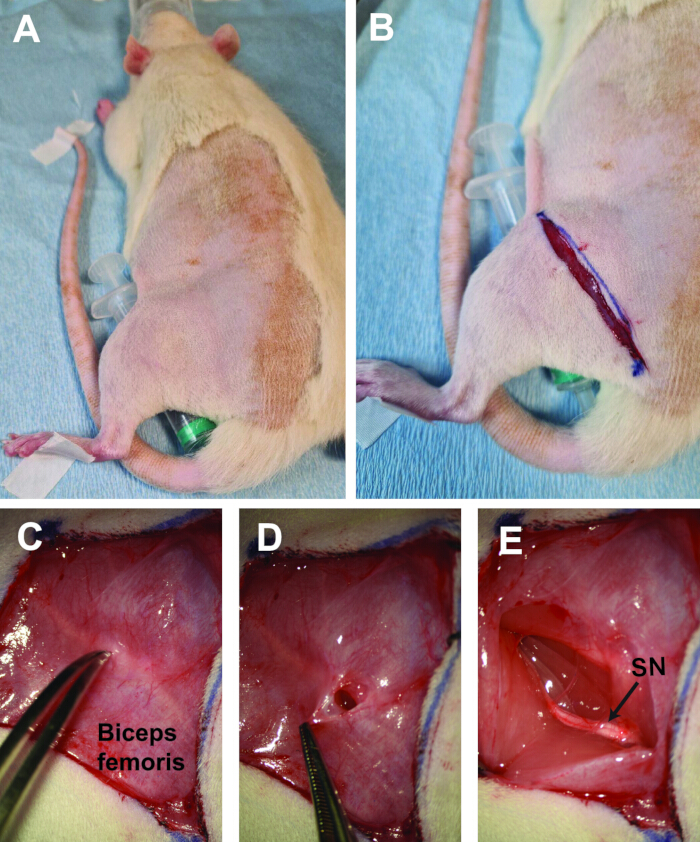
Figure 1: Animal positioning and identification of surgical landmarks for tibial and peroneal nerve stimulation. (A) The hindlimb region around the thigh and lower back is shaved, and the rat is placed in a prone position with the tail and a 5 mL syringe positioned under the hindlimb. (B) A 3–3.5 cm skin incision is made between the knee and the ischial tuberosity. (C) The fascia connecting the biceps femoris and gluteus maximus muscles is identified. (D) The muscles are separated by cutting the fascia. (E) The incision is held open with a retractor placed on the biceps femoris. The sciatic nerve (SN) can be visualized, emerging midway between the ischial tuberosity and the hip joint and running distally toward the knee joint. Please click here to view a larger version of this figure.
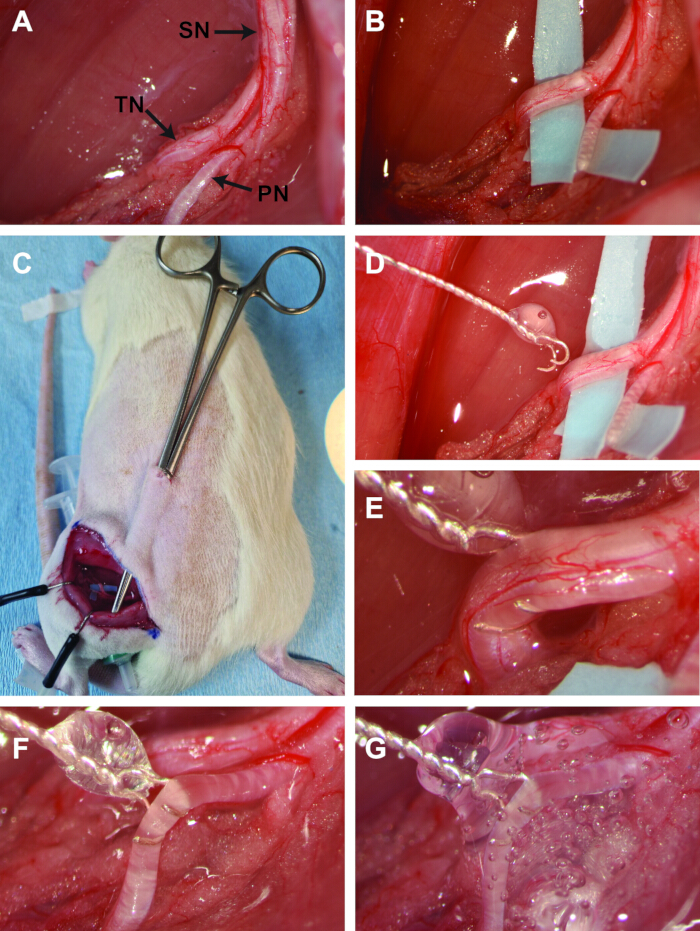
Figure 2: Dissection of the tibial and peroneal nerve and placement of the electrodes. (A) The sciatic nerve is dissected distally, exposing its bifurcation into two of its three branches: the tibial nerve (TN) and the common peroneal nerve (PN). (B) The tibial and peroneal nerves are carefully cleaned and separated from the surrounding tissue. (C) Subcutaneous tunneling for electrode placement: a 5 mm skin incision is made on the lower back, and a hemostat is advanced subcutaneously to the hindlimb incision to guide the electrode placement. (D) Positioning of the bipolar PTFE-coated silver electrode, with the hooks oriented perpendicular to the nerve. Note the tightly braided, PTFE-coated portion of the electrode, separated from the hooks (stripped of PTFE coating) by a small drop of silicone glue. (E) The tibial nerve resting on the hooks of the electrode. (F) The peroneal nerve on the hooks of the electrode. (G) The peroneal nerve and electrode hooks are isolated from surrounding tissue using biocompatible silicone glue. Please click here to view a larger version of this figure.
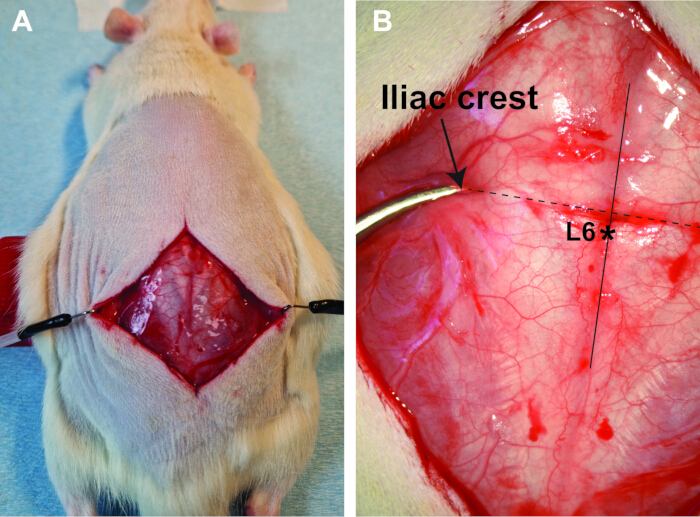
Figure 3: Animal positioning and identification of landmarks for L6 nerve stimulation. (A) The rat’s back is shaved, and the rat is placed in a prone position with a 50 mL centrifuge tube placed under the abdomen. A midline incision is made at the lower lumbar and sacral levels. (B) The iliac crests are palpated bilaterally and used as a reference (dashed line) to identify the spinous process of L6 (*). Please click here to view a larger version of this figure.
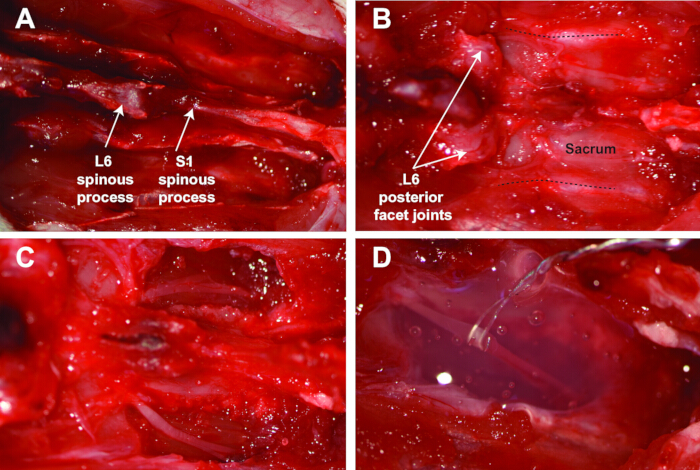
Figure 4: Anatomical landmarks, dissection of L6 nerve, and electrode implantation. (A) Dorsal view showing the L6 and S1 spinous processes after bilateral detachment and removal of the paravertebral muscles. (B) The L6 posterior facet joints, sacrum, and the sacro-iliac joints (dashed lines) are identified, providing guidance for surgical access to L6 nerves. (C) The L6 nerves are exposed by removing the sacral bone at the space between the S1 and S2 vertebrae. (D) A bipolar silver electrode is hooked to the L6 nerve and isolated from surrounding tissue using biocompatible silicone glue. Please click here to view a larger version of this figure.
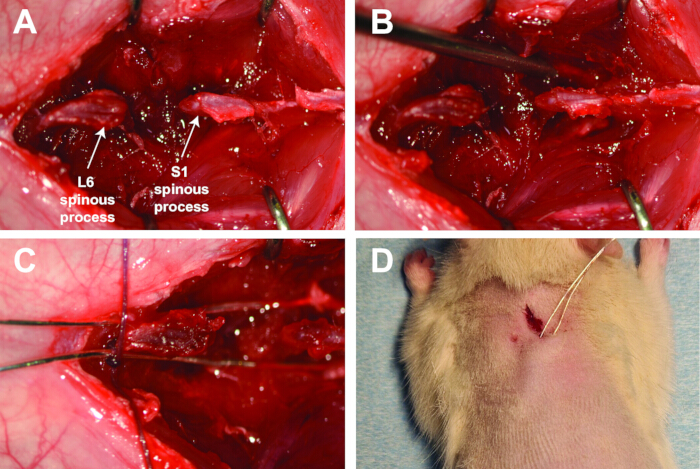
Figure 5: Electrode placement in the sacral foramen. (A) Paravertebral muscles are detached from L6 and S1 spinous processes by blunt dissection. (B) The S1 sacral foramen is probed with an 18 G needle preloaded with a monopolar stainless steel electrode. (C) The electrodes are secured to the L6 spinous processes with a 5-0 Vicryl suture, aligned with the trajectory of the nerve. (D) Dorsal view of the animal showing the externalized electrode leads tunneled subcutaneously. Please click here to view a larger version of this figure.
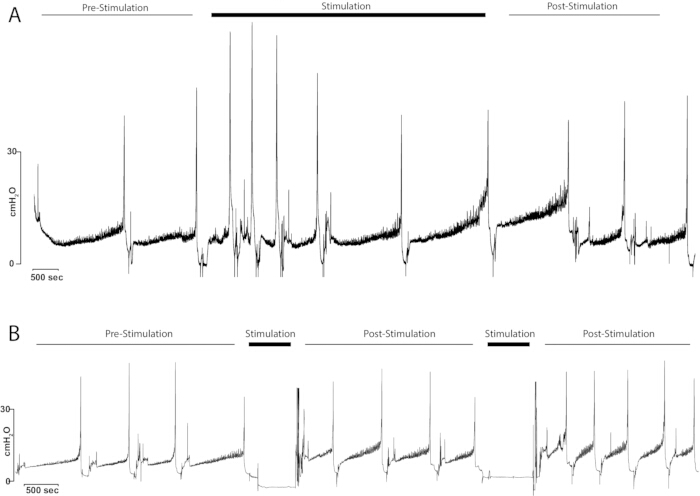
Figure 6: Cystometrogram. Representative traces of intravesical bladder pressure during individual micturition cycles with intravesical infusion of acetic acid. The traces shown in (A) and (B) are representative recordings obtained from two different animals. These traces are typical of all observations (N = 10 per experimental group). Each animal served as its own control, and no sham stimulation or untreated group was included. (A) Micturition cycles before, during, and after a 1 h long peroneal nerve stimulation (3x motor threshold, 10 Hz). (B) Micturition cycles before and after the first and second 10 min peroneal nerve stimulation (3x motor threshold, 10 Hz). Please click here to view a larger version of this figure.
Discussion
Loading...
$$\rightleftharpoonup{xx}$$
$$\longleftharp{xx}$$,
$$\longrightharp{xx}$$,
This article provides a detailed description of the surgical methods for implantation of electrodes for sacral, tibial, and peroneal nerve stimulation in an anesthetized rat.
Implantation of a lead electrode into the sacral foramen for continuous low-amplitude stimulation of the S3 sacral nerve is a broadly accepted treatment of lower urinary tract (LUT) dysfunction and fecal incontinence. In the patients, the electrode is typically placed in the S3 foramen and targets a mix of myelinated and unmyelinated axons22. This location corresponds to the L6–S1 segment of the spinal cord in rats. Accurately locating the target nerves in a rat is challenging. This highlights the need for a detailed, step-by-step protocol with clear visual guides and the use of neurostimulation to elicit the motor response, confirming the stimulation of the targeted nerve.
Studies using tibial nerve stimulation in rats employed either nerve dissection and stimulation above the ankle at the medial side of the leg or transcutaneous stimulation using needle electrodes. The method presented in this article exposes the tibial and peroneal nerves at their origin from the sciatic nerve through a single incision, allowing simultaneous stimulation of both nerves while significantly simplifying the procedure and reducing surgical invasiveness.
The use of peroneal nerve stimulation as a neuromodulation method for the treatment of patients suffering from OAB was first introduced by Krhut et al in 202123. Unlike sacral neuromodulation and percutaneous tibial nerve stimulation, which are invasive procedures, the peroneal nerve is selectively stimulated transcutaneously in a fully noninvasive manner. Although the proposed rat model does not replicate the noninvasive aspect of peroneal nerve stimulation, the underlying mechanisms of action at the spinal and supraspinal levels are expected to be similar. Sacral, tibial, and peroneal nerve stimulation target nerves that project to the spinal micturition center24. Preclinical animal experiments studying peroneal nerve stimulation using a cuff electrode placed on the nerve have previously been conducted in cats25,26,27,28. In the present methods article, the protocol is adapted for peroneal nerve stimulation in rats. The availability of rat models that allow direct nerve stimulation in all three neuromodulation methods will enable comparison of their efficacy, optimization of stimulation parameters, and investigation of common underlying mechanisms.
In clinical practice, motor response to stimulation is used to determine correct positioning of the stimulating electrode and to adjust the amplitude of neurostimulation29. The same approach is used in preclinical settings. While tibial and peroneal nerve stimulation consistently evoke characteristic motor responses, studies of sacral neuromodulation (typically through L6 or S1 spinal nerve stimulation) in rats list a variety of motor responses, including pelvic floor contraction, tail twitch, and/or hindlimb movements8,9,30. In rats, L6 and S1 spinal nerves merge to form a single trunk, which then divides into smaller branches, the pelvic nerve, the pudendal nerve, and the levator ani nerve, that innervate the pelvic organs and perineal structures31. The sciatic nerve receives contributions from the L6 and S1 spinal segments, thus explaining the hindlimb movements reported in some studies. However, the spinal segmental contribution to the sciatic nerve in rodents is characterized by strain-dependent variability32. In addition, a recent study demonstrated that recruitment of the sciatic nerve fibers during L6 stimulation is approximately seventy times smaller compared to tibial nerve stimulation, indicating that the nerve cuff placed on L6 stimulates only a small subset of fibers within the sciatic nerve33. This may explain the absence of hindlimb movement in the present study.
The peroneal and tibial nerve stimulation approaches described in this article were performed in an acute experiment, with animals under anesthesia throughout the procedure. Anesthetics are known to influence LUT function by altering the neural and muscular components of the bladder and the urethral sphincter function. They can affect the micturition reflex and synaptic transmission at the level of the spinal cord and brain stem34. Urethane is the most commonly used anesthesia in studies of LUT function, as it is known to preserve the micturition reflex. However, due to its carcinogenic potential, its use is generally limited to acute procedures34. Furthermore, the effect of anesthesia on the sacral and peripheral nerve stimulation has not been fully elucidated, but it has been suggested that anesthesia may contribute to the lack of effect observed with low-amplitude stimulation in animal studies. In addition, chronic stimulation used in clinical practice, which is set below the motor threshold, may engage different mechanisms of action on bladder function compared to the acute stimulation at the level above the motor threshold used in preclinical experiments33. Therefore, comparing results from anesthetized animal experiments with clinical data remains challenging, highlighting the need to optimize and standardize experimental procedures.
Recent studies have investigated sacral and peripheral nerve stimulation in non-anesthetized freely moving animals to avoid the confounding effect of anesthesia. They used chronically implanted electrodes on tibial and sacral nerves in rats, enabling the study of the effect of neuromodulation on bladder function in a physiologically relevant setting35,36. However, these studies may be subject to significant inter-individual variability, as awake experiments are influenced by stress and can produce motion artifacts that complicate data interpretation. Sacral nerve stimulation experiments performed chronically in unanesthetized animals in the past two decades were mostly performed in models of spinal cord injury8,30.
Many basic and clinical research studies examined the specific effects of neuromodulation on the urinary bladder function and its neuroregulation; however, its mechanisms of action remain insufficiently understood. Neuromodulation is thought to exert its therapeutic effects mainly by inhibiting bladder afferent signaling and modulating spinal and supraspinal pathways4. While functional magnetic resonance imaging, performed in patients and volunteers, proved to be valuable in the study of the effects on the central nervous system, the effects at the level of peripheral and spinal neuroregulation can only be studied in animal models.
Animal studies documented that both activation and suppression of the micturition reflex can be achieved by applying stimulation of the same nerve using different parameters, yet most of the currently used neuromodulation techniques have the parameters chosen based on a trial-and-error method. Therefore, optimization of the stimulation parameters can be significantly aided by animal studies, leading to the development of these technologies to their full potential.
These experiments are technically challenging, requiring good knowledge of anatomy and skill in microsurgery. Nerves may be damaged during dissection, electrode placement, or fixation; therefore, they must be handled carefully and should never be stretched or crushed. Accurate identification of the targeted nerves is essential and should always be confirmed by the corresponding motor response.
Disclosures
Loading...
$$\rightleftharpoonup{xx}$$
$$\longleftharp{xx}$$,
$$\longrightharp{xx}$$,
The authors have nothing to disclose.
Acknowledgements
Loading...
$$\rightleftharpoonup{xx}$$
$$\longleftharp{xx}$$,
$$\longrightharp{xx}$$,
This study was funded by Odense University Hospital research fund.
Materials
| Name | Company | Catalog Number | Comments |
|---|---|---|---|
| 18 G disposable injection needle | KRUUSE | 121282 | |
| Dumont forceps style 5TM | DUMONT | 1708-5TM-PO | Curved |
| Dumont forceps style 7XL | DUMONT | 0508-7XL-PO | Curved |
| Grass SD9 square pulse stimulator | Somatco | 1077/183 | |
| Hemostat | Fine Science Tools/Teleflex | 13018-14/PO181059 | ≥ 14 cm, fine tip |
| Iris scissors | World Precision Instruments | 14218 | Straight scissors |
| Kwik-Sil silicone Elastomer | World Precision Instruments | KWIK-SIL | Two-component glue |
| Micro Adson forceps | World Precision Instruments | 501245 | |
| Microscissors | S&T | SAC-15 R-8 | curved tip ≤ 10mm long |
| NaCl 0.9% 100 mL | B.Braun | N/A | |
| PE-50 tubing | Instech | BTPE-50 | |
| Prolene 5-0 suture | Ethicon | EH7257 | |
| Rongeur | George Tiemann & Co | 160-424-08 | Fine curved tip |
| Surgical Scalpel | Swann-Morton | 0505 | |
| Urethane | Sigma-Aldrich | U2500 | |
| Vicryl 4-0 suture | Ethicon | V451 | |
| Vicryl 5-0 suture | Ethicon | V303 | |
| Wire Silver Teflon-coated 0.125 mm | World Precision Instruments | AGT0525 | |
| Wire Stainless Steel Teflon-coated 0.18 mm | World Precision Instruments | SST30407-50 |
References
Loading...
$$\rightleftharpoonup{xx}$$
$$\longleftharp{xx}$$,
$$\longrightharp{xx}$$,
- Van Kerrebroeck, P. E. V., Van Den Hombergh, U. The history of neuromodulation for lower urinary tract dysfunction: An overview. Continence. 11, 101328(2024).
- Cameron, A. P., et al. The AUA SUFU guideline on the diagnosis and treatment of idiopathic overactive bladder. Neurourol Urodyn. 43 (8), 1742-1752 (2024).
- De Groat, W. C., Tai, C. Chapter 19 Mechanisms of Action of Sacral Nerve and Peripheral Nerve Stimulation for Disorders of the Bladder and Bowel. Neuromodulation second edition. Krames, E. S., Peckham, P. H., Rezai, A. R. , Academic Press. 221-236 (2018).
- Krhut, J., et al. The mechanism of action of neuromodulation in the treatment of overactive bladder. Nat Rev Urol. 22, 414-426 (2025).
- Abello, A., Das, A. K. Electrical neuromodulation in the management of lower urinary tract dysfunction: Evidence experience and future prospects. Ther Adv Urol. 10 (5), 165-173 (2018).
- Hokanson, J. A., et al. Stimulation of the sensory pudendal nerve increases bladder capacity in the rat. Am J Physiol Renal Physiol. 314 (4), F543-F550 (2018).
- Knowles, C. H., et al. The science behind programming algorithms for sacral neuromodulation. Colorectal Dis. 23 (3), 592-602 (2021).
- Zvara, P., et al. An animal model for the neuromodulation of neurogenic bladder dysfunction. Br J Urol. 82 (2), 267-271 (1998).
- Su, X., et al. Role of the endogenous opioid system in modulation of urinary bladder activity by spinal nerve stimulation. Am J Physiol Renal Physiol. 305 (1), F52-F60 (2013).
- Su, X., et al. Differentiation and interaction of tibial versus spinal nerve stimulation for micturition control in the rat. Neurourol Urodyn. 34 (1), 92-97 (2015).
- Matsuta, Y., et al. Poststimulation inhibition of the micturition reflex induced by tibial nerve stimulation in rats. Physiol Rep. 2 (1), e00205(2014).
- Su, X., et al. Comparison of neural targets for neuromodulation of bladder micturition reflex in the rat. Am J Physiol Renal Physiol. 303 (8), F1196-F1206 (2012).
- Kovacevic, M., Yoo, P. B. Reflex neuromodulation of bladder function elicited by posterior tibial nerve stimulation in anesthetized rats. Am J Physiol Renal Physiol. 308 (4), F320-F329 (2015).
- Choudhary, M., et al. Effect of tibial nerve stimulation on bladder afferent nerve activity in a rat detrusor overactivity model. Int J Urol. 23 (3), 253-258 (2016).
- Choudhary, M., et al. The frequency spectrum of bladder non voiding activity as a trigger event for conditional stimulation: Closed loop inhibition of bladder contractions in rats. Neurourol Urodyn. 37 (5), 1567-1573 (2018).
- Park, E., et al. The long lasting post stimulation inhibitory effects of bladder activity induced by posterior tibial nerve stimulation in unanesthetized rats. Sci Rep. 10 (1), 19897(2020).
- Mai, J., et al. Prolonged inhibitory effects of repeated tibial nerve stimulation on the micturition reflex in decorticated rats. Neuromodulation. 25 (8), 1115-1121 (2022).
- Krhut, J., et al. Peroneal electrical transcutaneous neuromodulation as a new treatment for patients with overactive bladder: An initial clinical experience. Urol Int. 106 (7), 658-663 (2022).
- Krhut, J., et al. Prospective randomized multicenter trial of peroneal electrical transcutaneous neuromodulation vs solifenacin in treatment naïve patients with overactive bladder. J Urol. 209 (4), 734-741 (2023).
- Hox, M., et al. Cavernous nerve stimulation and recording of intracavernous pressure in a rat. J Vis Exp. (134), e56807(2018).
- Mann-Gow, T. K., et al. Evaluating the procedure for performing awake cystometry in a mouse model. J Vis Exp. (123), e55588(2017).
- Hauck, E. F., et al. Measurements and mapping of 282420 nerve fibers in the S1 5 nerve roots. J Neurosurg Spine. 11 (3), 255-263 (2009).
- Krhut, J., et al. Peroneal electric transcutaneous neuromodulation ETNM A novel method for the treatment of the overactive bladder. J Healthc Eng. 2021, 4016346(2021).
- Baima, J., Krivickas, L. Evaluation and treatment of peroneal neuropathy. Curr Rev Musculoskelet Med. 1 (2), 147-153 (2008).
- Chen, J., et al. Superficial peroneal neuromodulation of persistent bladder underactivity induced by prolonged pudendal afferent nerve stimulation in cats. Am J Physiol Regul Integr Comp Physiol. 320 (5), R675-R682 (2021).
- Yu, M., et al. An excitatory reflex from the superficial peroneal nerve to the bladder in cats. Am J Physiol Renal Physiol. 313 (5), F1161-F1168 (2017).
- Zhao, J., et al. Superficial peroneal neuromodulation of non obstructive urinary retention in cats. Neurourol Urodyn. 39 (6), 1679-1686 (2020).
- Chen, J., et al. Superficial peroneal neuromodulation of non obstructive urinary retention induced by prolonged pudendal afferent activity in cats. Am J Physiol Regul Integr Comp Physiol. 322 (2), R136-R143 (2022).
- Tilborghs, S., et al. Motor response matters: Lead placement and urologic efficacy linked in sacral neuromodulation. Neuromodulation. 28 (5), 865-872 (2025).
- Wang, Y., Hassouna, M. M. Neuromodulation reduces c fos gene expression in spinalized rats: A double blind randomized study. J Urol. 163 (6), 1966-1970 (2000).
- Pastelín, C. F., et al. Neural pathways of somatic and visceral reflexes of the external urethral sphincter in female rats. J Comp Neurol. 520 (14), 3120-3134 (2012).
- Rigaud, M., et al. Species and strain differences in rodent sciatic nerve anatomy: Implications for studies of neuropathic pain. Pain. 136 (1-2), 188-201 (2008).
- Hokanson, J. A., et al. Pathways and parameters of sacral neuromodulation in rats. Am J Physiol Renal Physiol. 325 (6), F757-F769 (2023).
- Abdelkhalek, A. S., et al. Anesthetic protocols for urodynamic studies of the lower urinary tract in small rodents a systematic review. PLoS One. 16 (6), e0253192(2021).
- Park, E., et al. The long lasting post stimulation inhibitory effects of bladder activity induced by posterior tibial nerve stimulation in unanesthetized rats. Sci Rep. 10 (1), 19897(2020).
- Langlois, L., et al. Development of a remote controlled implantable rat sacral nerve stimulation system. Neuromodulation. 22 (6), 690-696 (2019).
Reprints and Permissions
Request permission to reuse the text or figures of this JoVE article
Request Permission