This study finds that student-centered teaching, strategic ChatGPT use, and digital literacy are positively associated with Chinese EFL learners' motivation. This higher motivation, in turn, is associated with lower anxiety and greater creativity, suggesting a mediating role. The findings support teacher training that integrates pedagogy, AI tools, and digital skills.
A subscription to JoVE is required to view this content. Sign in or start your free trial.
Research Article
From Digital Literacy to Student’s Creativity: The Motivational Pathway in AI-Supported Language Learning
In This Article
Summary
Abstract
This study examines how teaching style, ChatGPT usage, and digital literacy collectively influence motivation, anxiety, and creativity among Chinese EFL learners, while investigating motivation’s mediating role in these relationships. Adopting a quantitative approach, data were collected from n =290 undergraduate students using validated scales and analysed through structural equation modelling. The findings indicate that student-cantered teaching, strategic ChatGPT integration, and digital literacy are positively associated with higher motivation. Higher motivation, in turn, is associated with lower anxiety, and lower anxiety is associated with higher creativity. Furthermore, motivation fully mediates the associations between the three antecedents (teaching style, ChatGPT use, digital literacy) and anxiety, highlighting its central role in emotional outcomes within the tested model. The study contributes to self-determination theory by demonstrating how pedagogical and technological factors synergistically support learners’ psychological needs, while extending the cognitive-affective theory of learning with media by clarifying motivation’s mediational function. Practical implications highlight the need for teacher training programs that combine innovative pedagogy, AI tool utilization, and digital literacy development to optimize language learning experiences. The research underscores the importance of motivation-centered approaches in technology-enhanced EFL education, particularly in high-stakes learning environments.
Introduction
Artificial intelligence (AI) has advanced educational technology by creating new opportunities for interaction, personalization, and creativity in language learning1. ChatGPT, an AI-based conversational tool, provides interactive and adaptive feedback that supports language development2. In parallel, digital literacy has emerged as an essential skill for navigating and utilizing technology effectively in learning environments3. Despite growing interest in AI-supported language learning and the increasing use of ChatGPT in EFL contexts4, several important gaps remain. First, existing studies have largely examined teaching style, AI tool usage, and digital literacy in isolation; limited research has integrated all three within a single motivational framework5. Second, although motivation is widely recognized as a key driver of language learning, few studies have investigated its mediating role in linking pedagogical and technological factors to emotional outcomes (e.g., language learning anxiety) and cognitive outcomes (e.g., creativity)6. This gap is particularly salient in Chinese EFL contexts, where technology integration is still evolving. Furthermore, while anxiety is well documented as an inhibitor in EFL learning7, it is rarely studied together with motivational and technological variables. Similarly, creativity an increasingly valued skill in language learning has not been strongly associated with AI-assisted learning environments8. Unlike prior research that focuses on either pedagogy or technology alone, the present study bridges both domains to examine how teaching style, ChatGPT use, and digital literacy jointly relate to motivation, and in turn to anxiety and creativity.
This study draws on three theoretical frameworks, each corresponding to specific measured constructs in our structural equation model. First, self-determination theory (SDT)9 posits that autonomy-supportive teaching satisfies learners’ basic psychological needs (autonomy, competence, relatedness), thereby enhancing intrinsic motivation. In our model, this is operationalized through the construct of student-centered teaching style, which is hypothesized to be positively associated with motivation. Second, the technology acceptance model (TAM)10 suggests that perceived usefulness and ease of use influence technology adoption. Here, digital literacy is conceptualized as a precursor that enables learners to perceive ChatGPT as useful and easy to use, thereby strengthening its positive association with motivation. Third, the cognitive-affective theory of learning with media (CATLM)11, emphasizes that affective factors (e.g., anxiety) mediate the relationship between media features and cognitive outcomes (e.g., creativity). In our model, this is tested via the pathway: motivation → anxiety → creativity. Importantly, while constructivist learning theory informs the design of student-centered pedagogy, it is not operationalized as a distinct measured construct in our model; accordingly, we discuss it only as background rather than as a directly tested framework.
Previous applications of SDT in EFL contexts have focused primarily on teacher-driven autonomy support, without examining how AI tools like ChatGPT might independently satisfy learners’ needs for competence and autonomy12. Similarly, TAM has explained technology adoption but has not accounted for motivational and emotional outcomes such as anxiety and creativity13. CATLM has highlighted emotional and cognitive processing but lacks empirical testing in AI-supported EFL settings14. The present study addresses these gaps by integrating the three frameworks into a unified, empirically testable model in which teaching style, ChatGPT use, and digital literacy are associated with motivation, which in turn is associated with lower anxiety and higher creativity (via the anxiety–creativity link).
ChatGPT is a generative language model capable of human-like dialogue, immediate feedback, and adaptive responses, making it a potentially powerful tool for EFL instruction15. Recent studies indicate that ChatGPT aids vocabulary acquisition, grammatical accuracy, and conversational fluency through simulated interactions16. However, critical gaps remain regarding its psychological effects on learners. On one hand, ChatGPT’s low-stakes, accessible nature may reduce language learning anxiety17. On the other hand, its unpredictability (e.g., occasional inaccuracies or inconsistent responses) could increase stress for less confident learners18. Moreover, the effectiveness of ChatGPT likely depends on learners’ digital literacy not only technical skills but also critical evaluation and ethical awareness19. This moderating role requires further examination in EFL contexts where students’ technological readiness varies20.
Teaching methodology has been acknowledged as an important aspect that defines student activity and performance in learning a language21. Based on the constructivist and sociocultural issues, the modern trend in pedagogical research has highlighted the effectiveness of student-centered teaching practices like communicative language teaching and tasks-based learning22, according to some practices, that students in student-centered practices achieve higher grades and better results than students using teacher-dominated styles23. Such learner-now-centric paradigms resonate with self-determination theory, according to which teaching is autonomy-supportive, which instils intrinsic motivation by fulfilling the psychological needs of learners, need competence, need autonomy, and need relatedness24. This is further supported by empirical research findings that show that flexible, interactive patterns of teaching improve engagement of language learners and relieve the negative consequences of anxiety25. But the fast implementation of AI such as ChatGPT adds complexity to this process26. Although certain researchers claim that AI technology can deepen the positive advantages of student-centered pedagogy by introducing individualized learning pathways27.
Motivation takes the focal position between mediating the connections of pedagogical, technological, and affective variables in language learning28. The difference between autonomous and controlled motivation described by SDT gives a sound perspective on examining learner engagement through the usage of ChatGPT and the teaching styles29. In early evidence, researchers have indicated that AI tools are related to living out the autonomous motivation by supporting self-paced and interest-based learning30, although such effect was dependent on teachers being able to combine the technology to not take away the agency of the learners31. In its turn, anxiety, which may appear to be an omnipresent obstacle in the EFL setting, is in many cases caused by the fear of the negative assessment or communication anxiety. Although the integration of AI in learning practice has been revealed to dampen such anxiety32, little research has been conducted to figure out how the process works, especially through the aspect of mediation by motivation33. Figure 1 the study's key variables. It illustrates the proposed relationships between a teacher's instructional style, students' use of ChatGPT, and the resultant impacts on learner motivation, anxiety, creativity, and digital literacy in an EFL context.
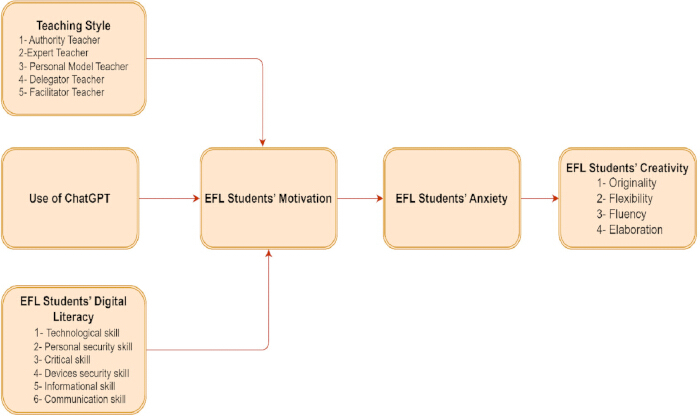
Figure 1. Research model. Schematic representation of the proposed relationships among teaching style, use of ChatGPT, EFL students’ digital literacy, EFL students’ motivation, EFL students’ anxiety, and EFL students’ creativity. Please click here to view a larger version of this figure.
Based on the theoretical framework, the following hypotheses (H1-H8) are proposed:
H1: Teaching style is positively associated with students’ motivation.
H2: ChatGPT usage is positively associated with students’ motivation.
H3: Digital literacy is positively associated with students’ motivation.
H4: Motivation is negatively associated with anxiety.
H5: Anxiety is negatively associated with creativity.
H6: Motivation is associated with the relationship between teaching style and anxiety.
H7: Motivation is associated with the relationship between ChatGPT usage and anxiety.
H8: Motivation is associated with the relationship between digital literacy and anxiety.
Access restricted. Please log in or start a trial to view this content.
Protocol
Ethics statement
This study was conducted in accordance with the ethical standards of the Institutional Review Board (IRB) of Chengdu University, China (Approval No: 202509). All participants provided written informed consent prior to participation. The study adhered to institutional guidelines for research involving human subjects, ensuring voluntary participation, confidentiality, and the right to withdraw at any time without penalty.
To maintain confidentiality, all collected data were anonymized using coded identifiers, and personal information was stored separately from research data in password-protected files accessible only to the principal investigators. The questionnaire design incorporated measures to minimize psychological discomfort, particularly for questions about anxiety, and participants were provided with contact information for university counselling services should any distress arise from survey participation. To address potential power imbalances in the teacher-student relationship, recruitment and data collection were conducted by trained research assistants rather than course instructors, and participants were assured that their responses would not affect their academic standing or relationship with faculty.
This study employed a quantitative, cross-sectional design involving 290 Chinese undergraduate EFL students from a public university. Participants representing diverse academic years and disciplines were recruited through convenience sampling with proportional representation and completed paper-based questionnaires in controlled classroom settings during regular sessions, requiring approximately 25 min. The questionnaire battery included validated scales measuring teaching style, digital literacy, ChatGPT usage, motivation, anxiety, and creativity. To minimize bias, trained research assistants administered the questionnaires using procedural countermeasures such as psychological separation of items. Following data collection, the responses were analyzed using statistical software and Partial Least Squares Structural Equation Modeling (PLS-SEM) software, including data screening, measurement model evaluation, structural model testing, and mediation analysis using a bootstrapping procedure with 5,000 resamples.
Research Design
This study employed a quantitative, cross-sectional research design to examine the relationships between teaching style, ChatGPT usage, digital literacy, motivation, anxiety, and creativity among EFL learners. A cross-sectional approach was deemed appropriate for capturing a snapshot of these variables at a specific point in time, allowing for the analysis of their interrelationships without the temporal demands of longitudinal research. The design facilitated the testing of a hypothesized mediation model in which motivation serves as the mechanism linking teaching style, ChatGPT usage, and digital literacy to reduced anxiety and enhanced creativity.
Data and Sample
The sampling frame consisted of all undergraduate students enrolled in English as a Foreign Language (EFL) courses at a public university in China during the 2024–2025 academic year. Eligibility criteria required participants to be (a) native Chinese speakers, (b) currently enrolled in at least one required EFL course, and (c) without prior formal training in AI-based language learning tools beyond general coursework. A stratified convenience sampling approach was used, with proportional allocation across academic years (freshman, sophomore, junior, senior) and disciplinary areas (humanities, social sciences, natural sciences, engineering). Target strata sizes were set at 25% per academic year and 25% per disciplinary area, based on the university’s overall student distribution. The final sample comprised 290 undergraduate EFL students. Of the 328 students approached during regular class sessions, 11 declined to participate (non-participation rate = 3.4%) and 27 provided incomplete questionnaires (incomplete response rate = 8.2%), yielding a final usable response rate of 88.4% (290/328). The a priori sample‑size calculation was performed using G*Power 3.1 with the F tests family, linear multiple regression: fixed model, R2 deviation from zero as the test. Input parameters were: effect size f2 = 0.15 (conventional medium effect size for behavioural research), α err prob = 0.05, power (1‑β err prob) = 0.95, and number of predictors = 3 (teaching style, ChatGPT use, digital literacy) for the motivation outcome. The calculation yielded a minimum required sample size of 119 for detecting a significant R2. To further account for the full SEM model (including indirect paths and additional endogenous variables), we applied the more conservative rule of 10 cases per estimated parameter. With 29 estimated parameters in our model, the required sample size was 290, which exactly matches the final sample. Thus, the obtained sample is fully powered for both regression‑based and SEM analyses.
Participants and Procedure
Participants were recruited through stratified convenience sampling to ensure proportionality across academic years (freshman to senior) and disciplinary backgrounds (humanities, sciences, and engineering). Strata sizes in the final sample were: freshmen (n = 72, 24.8%), sophomores (n = 74, 25.5%), juniors (n = 71, 24.5%), seniors (n = 73, 25.2%); and humanities (n = 76, 26.2%), social sciences (n = 68, 23.4%), natural sciences (n = 72, 24.8%), engineering (n = 74, 25.5%). The sample comprised 62% female and 38% male students, with an average age of 20.3 years (SD = 1.7). Data collection occurred during regular EFL class sessions. Trained research assistants administered paper‑based questionnaires in controlled classroom settings to ensure standardization. Prior to survey administration, all eligible students present in class were informed of the study’s purpose, voluntary nature, and confidentiality measures (anonymous responses, secure data storage). Students who did not meet eligibility criteria (n = 6, no EFL enrolment) or declined participation (n = 11) were excluded; reasons for declination included time constraints (n = 7) and discomfort with self‑reported technology use (n = 4). The questionnaire battery took approximately 25 minutes to complete and included validated scales for all constructs. To mitigate common method bias, procedural countermeasures were applied (e.g., psychological separation of scale items, anonymity of responses). In addition, common method bias was assessed using Harman’s single-factor test, and the first factor accounted for less than 50% of the total variance, indicating that common method bias was not a major concern in this study.
Study Measures
All scales were adapted to the Chinese EFL context through a rigorous translation and adaptation procedure. Two bilingual researchers independently translated the original English items into Chinese, and a third researcher reconciled discrepancies to produce a preliminary version. This version was back‑translated into English by two different translators, and any inconsistencies were resolved through discussion with the research team. The Chinese versions were then pilot‑tested with 30 undergraduate EFL students (not part of the main sample) to check clarity and comprehension, resulting in minor wording adjustments. For each scale, responses were collected on a 5‑point Likert scale ranging from 1 (strongly disagree) to 5 (strongly agree). Summed or averaged scores were used for each construct, with higher scores indicating higher levels of the respective variable. All adapted scales were used with permission from the original authors or under open‑license terms where applicable. No items were removed from the original scales except where noted below; item retention was based on factor loadings > 0.40 and theoretical relevance. Regarding ChatGPT usage, the study assessed students’ self‑reported interaction with the free version of ChatGPT (GPT‑3.5/4 available via web or mobile app during the 2024–2025 academic year). All participants had equal access to the tool as the university did not restrict ChatGPT; however, actual usage varied individually. The scale measured the frequency of ChatGPT use (ranging from “never” to “daily”), the types of language learning tasks for which it was employed (e.g., vocabulary building, grammar checking, essay drafting, conversation practice, and error correction), and the perceived quality of interaction (e.g., usefulness, clarity of feedback). The scale did not distinguish between specific ChatGPT versions, as version updates occurred during the data collection period; instead, participants reported the version they primarily used, with over 90% reporting GPT‑3.5 or GPT‑4. Detailed item examples and adaptation notes for each construct are provided below.
This study employed rigorously validated scales, thoughtfully adapted to the EFL education context, to assess the key variables: teaching approaches, digital competence, ChatGPT integration, language learning anxiety, learner motivation, and creative thinking. The measurement tools were chosen for their demonstrated reliability and ability to comprehensively evaluate each construct. To examine instructional methods, the research utilized a modified version of Grasha's Teaching Style Inventory34 which evaluates five distinct pedagogical approaches: authoritative, expert, Personal model Teacher, facilitative, and delegatory. To assess digital Literacy, the study incorporated a modified version of the scale developed by Rodríguez-de-Dueños et al.35, consisting of 29 items across six key domains: (1) technical literacy, (2) personal data protection literacy, (3) critical evaluation literacy, (4) device security literacy, (5) information processing literacy, and (6) digital communication literacy. This multidimensional framework provided a thorough evaluation of learners' digital capabilities necessary for contemporary education. The usage of ChatGPT was evaluated using an 8-item scale adapted from Abbas et al.36, focusing on students’ interaction with the AI tool for language learning tasks. This scale captures students perceived and self-reported use of ChatGPT in language learning tasks rather than objective usage frequency. Foreign language classroom anxiety (FLCA) was measured using an adapted scale based on Briesmaster and Briesmaster37. This instrument examined anxiety across three critical dimensions: Communication Apprehension, Test Anxiety, and Fear of Negative Evaluation, with 10, 10, and 7 items, respectively. Students’ motivation was assessed using a scale adapted from Kanoksilapatham et al.38, measuring three key dimensions: Instrumentality Promotion and Prevention, Ethnocentrism and Integrativeness, and Attitude Towards Learning English. The scale included a total of 20 items. EFL students’ creativity was measured using a scale adapted from Govindasamy et al.39, which assessed four dimensions: Originality, Flexibility, Fluency, and Elaboration. Each dimension was measured using three items.
Data Analysis Methods
The collected data were analysed using a two-stage analytical approach combining SPSS (Version 27) and Partial Least Squares Structural Equation Modeling (PLS-SEM) through SmartPL software. Initial data screening and preliminary analyses were conducted using SPSS to examine data quality, including checks for missing values, outliers, and normality assumptions. Less than 2% of data points were missing completely at random (MCAR), as confirmed by Little's MCAR test (χ2 = 18.24, p = 0.212), and were handled using the expectation-maximization algorithm to preserve statistical power. The dataset demonstrated acceptable univariate normality (skewness < |2|, kurtosis < |7|) and multivariate normality (Mardia's coefficient = 18.37, p < 0.001), justifying the use of both parametric tests and PLS-SEM, which is robust to non-normality. Although univariate normality was acceptable, Mardia’s coefficient indicated a violation of multivariate normality (p < 0.001). However, this does not pose a concern as PLS-SEM is robust to non-normal data distributions.
Reliability analysis revealed strong internal consistency for all scales (Cronbach's α > 0.82, composite reliability > 0.85), while exploratory factor analysis confirmed the anticipated factor structures with all items loading cleanly on their respective constructs (loadings > 0.65, cross-loadings < 0.40).
For hypothesis testing, PLS-SEM was selected over covariance-based SEM due to its superior handling of complex models with small-to-medium sample sizes and its ability to maximize explained variance in endogenous constructs. The analysis followed the two-step procedure, first evaluating the measurement model and then assessing the structural model. The reflective measurement model demonstrated adequate convergent validity (average variance extracted > 0.50 for all constructs) and discriminant validity as confirmed by both Fornell-Larcker criterion and heterotrait-monotrait ratio (HTMT < 0.85). In the structural model, path coefficients were estimated using a bootstrapping procedure with 5,000 resamples to generate stable estimates and confidence intervals. The model's predictive power was evaluated through R2 values for endogenous variables (motivation = 0.53, anxiety = 0.41, creativity = 0.38) and predictive relevance (Q2 > 0), with effect sizes (f2) calculated to determine substantive impact. Mediation analyses employed the bias-corrected bootstrap method to test indirect effects, with significant mediation established when 95% confidence intervals excluded zero.
All constructs were modelled as reflective (mode A) based on theoretical considerations, as each latent variable was assumed to cause its observed indicators. No items were dropped from any scale, as all items demonstrated outer loadings above the 0.50 threshold (ranging from 0.62 to 0.89) and all average variance extracted (AVE) values exceeded 0.50, confirming convergent validity. For mediation testing, the structural model included direct paths from the three antecedents (teaching style, ChatGPT use, digital literacy) to motivation, from motivation to anxiety, and from anxiety to creativity. Direct paths from antecedents to anxiety and from antecedents to creativity were also estimated to test for partial vs. full mediation. Full mediation was determined based on the criteria that (a) the indirect effects (antecedents → motivation → anxiety) were significant (95% bias-corrected bootstrap confidence interval excluding zero), and (b) the direct effects from antecedents to anxiety became non-significant after including the mediator, while the direct effects from antecedents to creativity were never significant. All analyses used the PLS-SEM algorithm in SmartPLS 4 with path weighting scheme, maximum iterations set to 300 and stop criterion of 1.0e-7. Bootstrapping was performed with 5,000 subsamples, bias-corrected and accelerated (BCa) confidence intervals at 95%, and no sign changes option. Model fit was assessed using the standardized root mean square residual (SRMR = 0.061), which falls below the recommended 0.08 threshold.
Access restricted. Please log in or start a trial to view this content.
Results
Descriptive Statistics and Correlation Analysis
The descriptive statistics for all study variables revealed normally distributed data with acceptable ranges of variability, as evidenced by skewness and kurtosis values within the recommended thresholds of ± 2.
Table 1 reveal important characteristics of the study variables across our sample of 290 EFL learners. Teaching style (M = 4.32, SD = 0.72), digital literacy (M = 4.15, SD = 0.68), and motivation (M =...
Access restricted. Please log in or start a trial to view this content.
Discussion
The current study provides useful insight into the associations among teaching style, ChatGPT usage, digital literacy, motivation, anxiety, and creativity among EFL students. The findings suggest that student-centered teaching style, greater use of ChatGPT, and higher digital literacy are positively associated with students’ motivation. In turn, motivation is negatively associated with anxiety, while anxiety is negatively related to creativity. These results should be interpreted as model-supported associations rat...
Access restricted. Please log in or start a trial to view this content.
Disclosures
All authors declare no conflicts of interest.
Acknowledgements
This Research did not receive funding.
Access restricted. Please log in or start a trial to view this content.
Materials
| Name | Company | Catalog Number | Comments |
|---|---|---|---|
| Survey Instruments (Scales) | Teaching Style Scale | NA | Modified version of Grasha's Teaching Style Inventory (Grasha, 1996), evaluating five pedagogical approaches: authoritative, expert, personal model, facilitative, and delegatory. Catalog Number: NA |
| Digital Literacy Scale | NA | 29-item scale adapted from Rodríguez-de-Dueños et al. (2016), covering six dimensions: Technical Proficiency, Personal Data Protection, Critical Evaluation, Device Security Management, Information Processing, and Digital Communication. Catalog Number: NA | |
| ChatGPT Usage Scale | NA | 8-item scale adapted from Abbas et al. (2024), focusing on students’ interaction with the AI tool for language learning tasks. Catalog Number: NA | |
| Foreign Language Classroom Anxiety (FLCA) Scale | NA | Scale adapted from Briesmaster and Briesmaster (2015), with subscales for Communication Apprehension (10 items), Test Anxiety (15 items), and Fear of Negative Evaluation (7 items). Catalog Number: NA | |
| Motivation Scale | NA | 20-item scale adapted from Kanoksilapatham et al. (2021), measuring three dimensions: Instrumentality (Promotion/Prevention), Ethnocentrism/Integrativeness, and Attitude Towards Learning English. Catalog Number: NA | |
| Creativity Scale | NA | 12-item scale adapted from Govindasamy et al. (2024), measuring four sub-constructs: Originality, Flexibility, Fluency, and Elaboration. Catalog Number: NA | |
| Software | SPSS Statistics Version 27 | IBM Corp. | Statistical analysis software. Catalog Number: NA |
| SmartPLS Version 4 | SmartPLS GmbH | Structural equation modeling software. Catalog Number: NA | |
| Equipment & Other Materials | Data Collection Instrument | NA | Anonymous, self-administered paper-and-pencil questionnaire battery. Catalog Number: NA |
| Informed Consent Documents | NA | Written information sheet and consent form detailing study purpose, procedures, risks/benefits, and the right to withdraw. Catalog Number: NA | |
| Data Storage System | NA | Password-protected digital files with coded identifiers; personal information stored separately from research data. Catalog Number: NA | |
| Analytical Procedures | PLS-SEM Algorithm and Bootstrapping | SmartPLS GmbH | SmartPLS 4 internal routines (PLS Algorithm and Bias-Corrected Bootstrapping with 5,000 resamples). Catalog Number: NA |
| Validity and Reliability Checks | SmartPLS GmbH; IBM Corp. | SmartPLS 4 and SPSS routines for Cronbach’s alpha, composite reliability, average variance extracted (AVE), Fornell-Larcker criterion, and heterotrait-monotrait (HTMT) ratio. Catalog Number: NA | |
| Predictive Relevance Assessment | SmartPLS GmbH | Blindfolding procedure in SmartPLS 4 to calculate Stone-Geisser’s Q² value. Catalog Number: NA | |
| Preliminary Data Screening | IBM Corp. | SPSS procedures for handling missing data (Expectation-Maximization algorithm) and checks for normality, outliers, and factor structure (exploratory factor analysis). Catalog Number: NA |