This study established a three-dimensional (3D) culture model that sustains human follicle development from the secondary to antral stage in vitro. This system enables follicle growth and antrum formation while preserving somatic cell molecular features, providing a critical model for human folliculogenesis research.
Research Article
A Three-Dimensional Culture Model Supporting Human Secondary-to-Antral Follicle Development In Vitro
Jianfei Gong*1,2,3,4 , Zhiyun Zhu*5 , Jinze Yang1,2,3,4 , Jian Han1,2,3,4 , Mengyuan Tian1,2,3,4 , Tianren Wang6 , Haiyan Wang2 , Huanmin Wang5 , Jie Yan1,2,3,4 , Jie Qiao1,2,3,4
1State Key Laboratory of Female Fertility Promotion, Center for Reproductive Medicine, Department of Obstetrics and Gynecology, Peking University Third Hospital, 2National Clinical Research Center for Obstetrics and Gynecology, Peking University Third Hospital, 3Key Laboratory of Assisted Reproduction (Peking University), Ministry of Education, 4Beijing Key Laboratory of Collaborative Innovation in Frontier Technologies for Population Quality, 5Department of Surgical Oncology, Beijing Children's Hospital, Capital Medical University, National Center for Children's Health, 6The University of Hong Kong- Shenzhen Hospital
Opens in a new tab
In This Article
Summary
Loading...
$$\rightleftharpoonup{xx}$$
$$\longleftharp{xx}$$,
$$\longrightharp{xx}$$,
Abstract
Loading...
$$\rightleftharpoonup{xx}$$
$$\longleftharp{xx}$$,
$$\longrightharp{xx}$$,
Human ovarian folliculogenesis is a complex, tightly regulated process that is challenging to study directly in vivo. Although in vitro models are essential for mechanistic research, existing systems remain suboptimal because they cannot recapitulate the spatiotemporal dynamics of follicle development. This study presents a 3D culture model that supports human follicle development from the secondary to the antral stage. This model successfully recapitulates key in vivo morphological events, including sustained follicular growth, a distinct diameter expansion phase from day 10, and antral cavity formation around day 20. Importantly, this developmental progression culminated in the successful retrieval of viable oocytes at the germinal vesicle (GV) stage. Furthermore, immunofluorescence analysis revealed distinct expression patterns of gonadotropin receptors in somatic cells, consistent with granulosa and theca cell identity. Inner granulosa-like cells exhibited high follicle-stimulating hormone receptor (FSHR), whereas outer theca-like cells showed high luteinizing hormone receptor (LHR) expression. This model offers a valuable platform for studying human folliculogenesis and reproductive toxicology and provides a reference for optimizing in vitro follicle culture systems for secondary-to-antral stage development.
Introduction
Loading...
$$\rightleftharpoonup{xx}$$
$$\longleftharp{xx}$$,
$$\longrightharp{xx}$$,
The physiological process of ovarian follicle development, from the primordial to the preovulatory stage, is fundamental to female fertility1. This process involves a highly coordinated series of events, including oocyte growth/maturation and granulosa cell proliferation/differentiation2. Disruptions in these intricate mechanisms represent a major cause of infertility and ovarian dysfunction. A detailed understanding of the regulatory networks underlying folliculogenesis—encompassing paracrine signaling, oocyte-somatic cell interactions, and extracellular matrix dynamics—is therefore of critical pathophysiological importance. However, direct investigation of human folliculogenesis in vivo remains constrained by ethical and practical limitations, driving the need for reliable in vitro models to elucidate these mechanisms. Despite advancements, there remains a critical lack of a long-term culture model that supports human follicle development, particularly from the secondary to the antral stage.
While the human follicle culture in two-dimensional (2D) or three-dimensional (3D) matrices has advanced understanding of early follicular development3,4, such systems remain limited in supporting progression to later stages. It is noteworthy that achieving human folliculogenesis in vitro through later developmental stages remains particularly challenging due to their larger follicle size and extended maturation timeline5. Even among the limited number of human in vitro follicle culture systems that have successfully yielded MII oocytes, maturation rates remain low (approximately 20% at most)6,7,8,9. Perhaps a more fundamental challenge is the recapitulation of the secondary-to-antral transition, a critical and structurally complex phase that has yet to be adequately modeled in vitro.
This study established a 3D culture model that supports the in vitro development of human secondary follicles into antral follicles with distinct cavity structures. This model provides a foundational platform for further investigation of the regulatory mechanisms underlying human follicle development and serves as a reference for future optimization of follicle culture systems targeting secondary-to-antral development.
Protocol
Loading...
$$\rightleftharpoonup{xx}$$
$$\longleftharp{xx}$$,
$$\longrightharp{xx}$$,
This study protocol was reviewed and approved by the Ethics Committee of Peking University Third Hospital (Approval No. M2024151). All the legal guardians of minors participating in the study have signed the informed consent form.
Tissue source
The human ovarian medullary tissue used in this protocol was obtained from four pediatric patients diagnosed with ovarian teratoma (aged 2, 6, 13, and 16 years) who donated ovarian tissue for research purposes (Table 1). The ovarian cortex was used for ovarian tissue cryopreservation studies, while the remaining medullary tissue was employed for in vitro follicle culture in this study. A total of 33 secondary follicles were isolated, with 16 follicles assigned to the control group and 17 assigned to the 3D culture group.
Reagent preparation
Transport medium consisted of Leibovitz's L-15 medium supplemented with 10% serum substitute supplement and was stored at 4 °C. Complete digestion solution was prepared by supplementing MEMα with 0.04 mg/mL Liberase DH, 10 IU/mL DNase I, and 100 IU/mL penicillin‑streptomycin and stored at -20 °C. Digestion stop solution was DPBS supplemented with 10% serum substitute supplement and stored at 4 °C. Complete growth medium was prepared by supplementing MEMα with 10% serum substitute supplement, 1% insulin‑transferrin‑selenium, 50 µg/mL L‑ascorbic acid, 2 mM sodium pyruvate, and 100 IU/mL penicillin‑streptomycin. The medium was stored at 4 °C. Recombinant human follicle‑stimulating hormone (FSH) was added to a final concentration of 100 mIU/mL at culture initiation, as described in a previous study10. Upon visual detection of early antrum formation (around day 20), recombinant human luteinizing hormone (LH) was supplemented to a final concentration of 10 mIU/mL during medium changes. The solid culture matrix was prepared by mixing 70% (v/v) basement membrane matrix with 30% (v/v) ice‑cold complete growth medium and kept on ice during all handling steps.
Tissue digestion and secondary follicle isolation
Ovarian tissue was placed in transport medium and transported to the laboratory at 4 °C. Under sterile conditions, the ovarian medulla was dissected using a scalpel. The tissue was sectioned into thin pieces (~3 × 3 × 1 mm) and further minced into small fragments (~0.5 × 0.5 × 1 mm) with a tissue chopper, keeping the tissue moist throughout. The minced tissue was transferred to a 35 mm dish, and pre‑warmed complete digestion solution was added at 2 mL per 100 mg tissue. Incubation was carried out at 37 °C for 45–80 min (mean: 60 ± 15 min), with gentle mixing every 10 min. Digestion was terminated when microscopic examination revealed loosening of the stromal matrix and release of individual follicles (Figure 1). Healthy secondary follicles (diameter 100–200 µm, with ≥ 2 granulosa cell layers and a visible oocyte) were selected under a stereomicroscope using a glass mouth‑controlled pipette (inner diameter 200 µm) and washed twice with pre‑warmed complete growth medium.
3D embedding and long‑term culture
A cell culture insert was placed in a 35 mm dish moistened with 2 mL complete growth medium and pre‑equilibrated in an incubator (37 °C, 5% CO₂) for 2 h. Selected secondary follicles were transferred into the insert and pre‑cultured overnight under the same conditions. At the end of pre‑culture, follicles in the control group were cultured directly within the insert (2D culture). In contrast, follicles designated for the 3D‑culture group were prepared for embedding in a growth factor-reduced basement membrane matrix (total protein 8~12 mg/mL). The matrix was thawed on ice and mixed with 30% (v/v) ice‑cold complete growth medium. Droplets of 40 µL of the mixture were placed in a 35 mm dish (maximum six droplets per dish), to form a uniform gel layer approximately 1.5 mm in height. Then, a single secondary follicle was transferred into each droplet using a glass mouth‑controlled pipette, carefully positioned in the middle‑to‑upper third of the droplet to prevent it from sinking. The dish was placed in an incubator (37 °C, 5% CO₂) for 30 min to allow gelation. After solidification, 2 mL of complete growth medium was gently added to the dish to initiate long‑term culture.
Culture maintenance and monitoring
A 50% medium change with fresh complete growth medium (containing FSH) was performed every 48 h. The follicles were observed daily under a stereomicroscope, and their diameters and morphological characteristics were recorded. Upon visual detection of early antrum formation (around day 20), recombinant human LH was added to the medium during subsequent changes. Culture was maintained for up to 30 days or until follicles reached the antral stage (diameter > 400 µm with a clearly defined fluid‑filled cavity).
Post‑culture cell dissociation
At the end of culture, antral follicles were transferred to a dish containing fresh DPBS and mechanically dissociated using a sterile 29‑gauge syringe. The isolated cumulus‑oocyte complexes (COCs) were transferred to a separate dish for further analysis. The remaining granulosa and theca cell suspension was transferred to a new 35 mm dish containing 2 mL pre-warmed complete growth medium, gently swirled for even distribution, and incubated for 48 h (37 °C, 5% CO₂).
Immunofluorescence analysis
Following culture, cells were fixed with 4% paraformaldehyde for 30 min at room temperature. Then, the samples were washed three times with PBS, permeabilized with 0.5% Triton X‑100 for 20 min, and then blocked overnight at 4 °C using 1% BSA in PBS. Cells were incubated overnight at 4 °C with primary antibodies. The primary antibodies used were anti‑FSHR (rabbit, 1:200) and anti‑LHR (mouse, 1:100). Following incubation, cells were washed three times for 15 min each with PBS containing 1% BSA. Subsequently, they were incubated with fluorescent secondary antibodies (anti‑rabbit and anti‑mouse, 1:200) for 2 hours at room temperature in the dark. Finally, the cells underwent three final washes, each lasting 20 min. Nuclei were stained with DAPI for 5 min at room temperature. Then the samples were washed three times for 5 min with PBS containing 1% BSA. Imaging was performed using an Operetta CLS high-content imaging system in confocal mode. Fluorescence signals were captured using the following channels: DAPI (405 nm), Alexa Fluor 488 (LHR), and Alexa Fluor 647 (FSHR), with consistent exposure settings across all samples.
Statistical analysis
Comparisons of follicle diameter between the control group and 3D culture group at days 5, 10, and 15 were performed using an independent samples t‑test. A p-value < 0.05 was considered statistically significant. Statistical analysis of follicle diameter was not conducted beyond day 15, as nearly all follicles in the control group failed to survive after day 15. This resulted in an inadequate sample size, thus precluding reliable and meaningful group comparisons. All statistical analyses were performed using GraphPad Prism (version 9.0).
Results
Loading...
$$\rightleftharpoonup{xx}$$
$$\longleftharp{xx}$$,
$$\longrightharp{xx}$$,
Development of a 3D culture model supporting human follicle growth to the antral stage
A major challenge in ovarian follicle research is developing an in vitro culture system that supports complete follicle development, with antral cavity formation as a key milestone. Hence, this study established a 3D culture model for human follicles in vitro (Figure 2). A total of 33 secondary follicles were isolated from 4 donors, with 16 assigned to the control group (2D insert-based culture) and 17 to the 3D culture group (Table 1). On day 10 of culture, 9 follicles survived in the control group (survival rate: 56.3%), while 10 follicles survived in the 3D culture group (survival rate: 58.8%) (Table 1). By day 20, no follicles survived in the control group (survival rate: 0%), whereas 6 follicles remained viable in the 3D culture group (35.3%) (Table 1). By day 25 and day 30, one follicle remained viable in the 3D culture group, corresponding to a survival rate of 5.9% (Table 1). Notably, no antral cavity formation was observed in the control group, whereas 5 follicles in the 3D culture group successfully formed antral cavities (antral formation rate: 29.4%) (Table 1). Collectively, the 3D culture model was superior to the 2D culture system in both long-term follicle survival and antral cavity formation.
Morphological features of follicle development
Morphologically (Figure 3), control follicles arrested development after approximately 10 days. Internal cell necrosis appeared by day 10, with complete degeneration and shrinkage by day 15. In contrast, follicles in the 3D culture group regained a spherical shape by day 5, with the oocyte centrally located and uniformly surrounded by granulosa cells. From approximately day 10 of culture, granulosa cells underwent rapid proliferation, accompanied by the gradual migration of oocytes toward the follicular wall. Initial antrum formation was observed around day 20. By day 25, the antral cavity had expanded distinctly, accompanied by a marked increase in surrounding stromal cells. At the endpoint of the 30-day culture, the COC was isolated from a viable follicle. Following denudation, a viable germinal vesicle (GV)-stage oocyte was successfully retrieved (Figure 3). Taken together, the 3D culture model supports the maintenance of normal follicular architecture and facilitates the achievement of key morphological milestones.
Temporal progression of follicle development
To quantitatively assess the growth dynamics of human follicles in the 3D culture model, follicle diameter was systematically measured at 5-day intervals throughout the 30-day culture period. During the first 5 days, the growth patterns were similar between the 3D culture group and the control group (Figure 4). There was no significant difference in follicle diameter at day 1 (172.5 ± 8.2 µm vs. 167.9 ± 9.2 µm, p > 0.05) or day 5 (182.4 ± 11.5 µm vs. 175.4 ± 11.0 µm, p > 0.05) (Figure 4). In contrast, follicles in the 3D culture model exhibited significantly larger diameters than controls from day 10 onward (Figure 4). By day 10, the mean diameter was 215.1 ± 25.8 µm in the 3D culture group compared to 183.5 ± 16.2 µm in the control group (p < 0.05) (Figure 4). By day 15, the mean diameter was 278.7 ± 25.0 µm in the 3D culture group versus 180.8 ± 10.1 µm in the control group (p < 0.01) (Figure 4). These follicles continued to grow rapidly, reaching diameters of over 600 µm by day 30 (Figure 4). These findings demonstrate that the 3D culture model supports sustained follicle growth during the critical expansion phase.
Somatic cell gonadotropin receptor expression
To assess somatic cell characteristics after prolonged culture, dissociated follicular cells were analyzed by immunofluorescence for gonadotropin receptor expression. Distinct morphological features and receptor expression patterns were observed (Figure 5). Outer layer cells exhibited elongated or spindle-shaped morphologies with high LHR immunoreactivity, consistent with theca-like cell identity. In contrast, inner layer cells were more clustered and cobblestone-like, displaying strong FSHR staining and weaker LHR signal, consistent with granulosa-like cell identity. These expression patterns provide preliminary evidence that somatic cell characteristics were maintained throughout the culture period.
DATA AVAILABILITY:
All data supporting the findings of this study are available within the article.
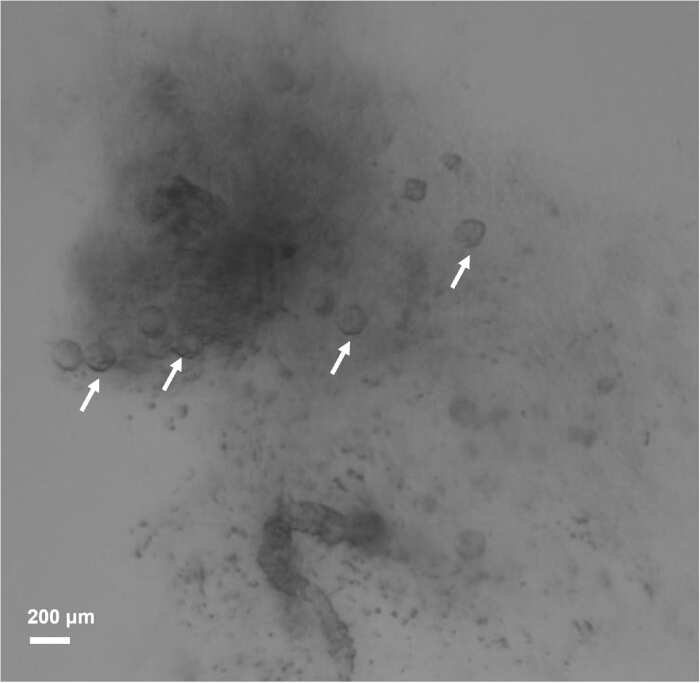
Figure 1: Digestion outcome of human ovarian medullary tissue. White arrows indicate intact secondary follicles exposed after digestion. Scale bar = 200 µm. Please click here to view a larger version of this figure.
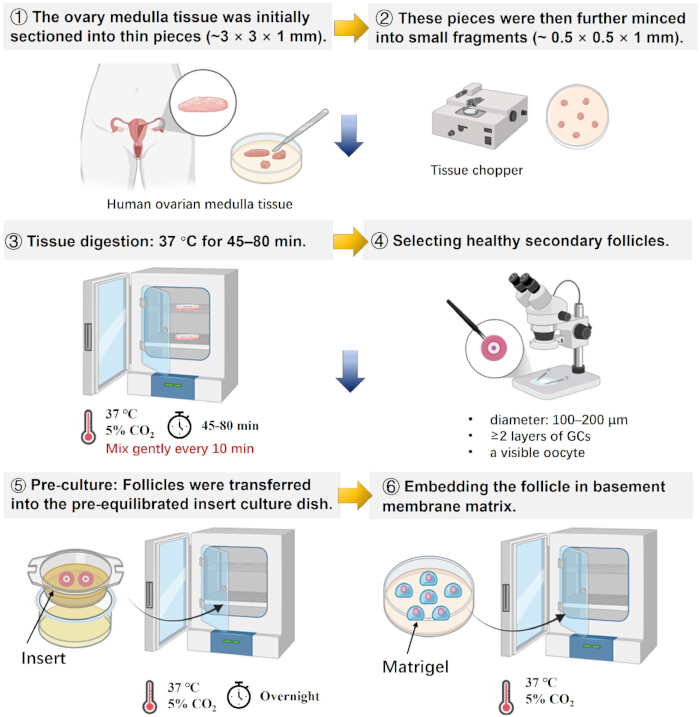
Figure 2: Schematic overview of the 3D in vitro culture system for human ovarian follicles. Please click here to view a larger version of this figure.
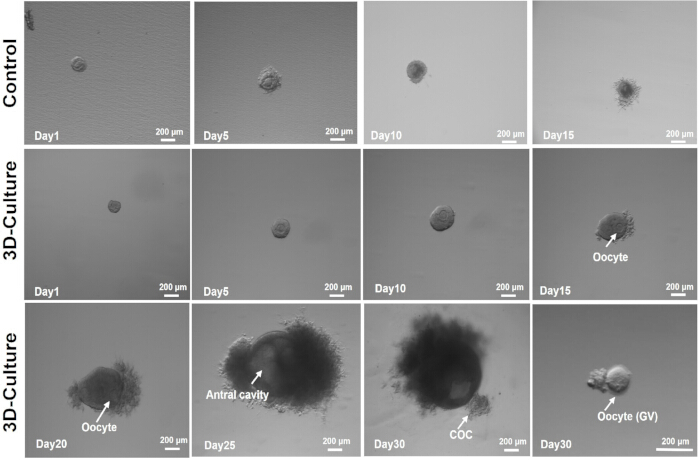
Figure 3: Morphological progression of human follicles during culture. Representative images of follicles from the control (2D insert-based) and 3D culture group. White arrows indicate the oocyte (days 15 and 20), antral cavity (day 25), and COC (day 30). Scale bar = 200 µm. Please click here to view a larger version of this figure.
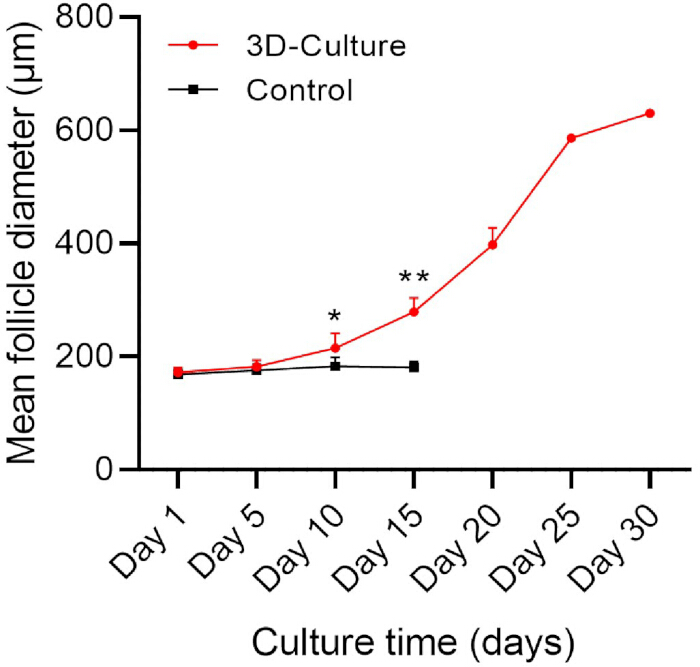
Figure 4: Growth dynamics of human follicles. Data are shown as mean absolute diameter (µm) ± standard deviation (SD). Sample sizes: control group, n = 16; 3D culture group, n = 17. Error bars are not shown for days 25 and 30 due to limited sample size (n < 3). Comparisons between control and 3D culture groups at each time point were performed using unpaired t-tests. * = p < 0.05, ** = p < 0.01. No control follicles survived beyond day 15, precluding statistical comparison at later time points. Please click here to view a larger version of this figure.
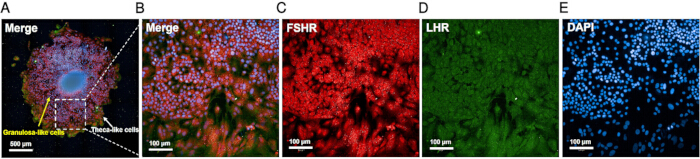
Figure 5: Immunofluorescence analysis of FSHR and LHR expression in cultured human ovarian somatic cells. (A) Stitched panoramic merged image. Scale bar = 500 µm. (B) Magnified view of the boxed area in (A), showing the merged channels (Merge). (C) FSHR (red, Alexa Fluor 647). (D) LHR (green, Alexa Fluor 488). (E) DAPI (blue, 405 nm). Scale bars = 100 µm. White arrows indicate theca-like cells. Yellow arrows indicate granulosa-like cells. The oocyte is absent from these images because the COC was removed prior to plating. Please click here to view a larger version of this figure.
| Donors ID | Age | Total number of follicles (n) | Group | Follicles cultured (n) | Survival at day 10 (n) | Survival at day 20 (n) | Survival at day 30 (n) | Antral formation (n) |
| 1 | 2 | 4 | Control | 2 | 1 | 0 | 0 | 0 |
| 3D culture | 2 | 1 | 0 | 0 | 0 | |||
| 2 | 6 | 8 | Control | 4 | 2 | 0 | 0 | 0 |
| 3D culture | 4 | 1 | 1 | 0 | 1 | |||
| 3 | 13 | 12 | Control | 6 | 4 | 0 | 0 | 0 |
| 3D culture | 6 | 5 | 3 | 1 | 2 | |||
| 4 | 16 | 9 | Control | 4 | 2 | 0 | 0 | 0 |
| 3D culture | 5 | 3 | 2 | 0 | 2 |
Table 1: Summary of donor characteristics and follicle culture outcomes.
Discussion
Loading...
$$\rightleftharpoonup{xx}$$
$$\longleftharp{xx}$$,
$$\longrightharp{xx}$$,
The successful maintenance of human ovarian follicles in vitro through the secondary-to-antral transition represents a significant technical advancement. In this study, a 3D culture system providing appropriate biophysical support and stage-specific hormonal cues enabled this progression. These results align with recent evidence underscoring the need for 3D culture systems to recapitulate tissue physiology. While conventional 2D monolayers are operationally simple, they lack the spatial architecture needed for native cell-cell and cell-matrix interactions, often leading to altered differentiation and function11,12. In the present study, the 16 follicles in the control group derived from 4 donors exhibited consistent degenerative dynamics across all patient samples, initiating degeneration at day 10, with no viable follicles remaining after day 15, and no antral cavity formation observed throughout the culture period. In contrast, the 3D culture system exhibited markedly superior follicle survival and developmental efficacy, with follicle survival rates reaching 58.8%, 35.3%, and 5.9% at day 10, day 20, and day 30 of culture, respectively, and an antral formation rate of 29.4%. Recent studies utilizing approaches such as microfluidic encapsulation, alginate droplet-based encapsulation, and 3D-printed microporous scaffolds have demonstrated the capacity of 3D platforms to preserve follicular morphology and support its development13,14,15,16,17. This system extends the existing paradigm by demonstrating that a 3D matrix, combined with stage-specific hormonal cues, supports sustained follicular growth, antrum formation, and the maintenance of spatially organized somatic cell populations. These populations exhibit receptor expression patterns consistent with granulosa and theca cell lineages.
In the current study, follicles in the 3D culture group displayed a significant increase in diameter on day 10 of culture, with antral cavity morphogenesis initiated at approximately day 20, ultimately yielding viable GV-stage oocytes. This developmental timeline is consistent with previous studies reporting the emergence of antral cavity structures within 2–3 weeks6. The distinct expression patterns of FSHR and LHR in the cultured somatic cells indicate the preservation of granulosa-like and theca-like cell characteristics. The inner layer exhibited high FSHR expression and low LHR expression, along with a uniform cobblestone-like morphology. These features are consistent with the characteristics of granulosa cells, which primarily respond to FSH to drive follicular growth and estrogen synthesis. Conversely, the outer cell layer exhibited high LHR expression and an elongated, spindle-like morphology, features that strongly align with the expected phenotype of theca cells. These cells are responsible for androgen production in response to LH in vivo18. During folliculogenesis, early FSH exposure promotes granulosa cell proliferation and estrogen synthesis, whereas subsequent LH priming is essential for antrum expansion and oocyte developmental competence acquisition2,19,20. The staged hormone supplementation strategy used in this study was designed to mimic this physiological gonadotropin dependence. While these findings suggest that 3D-cultured follicles maintain key features of somatic cell identity, it is acknowledged that additional lineage-specific markers (e.g., FOXL2 for granulosa cells, CYP17A1 for theca cells) would further strengthen cell-type confirmation in future studies.
The successful progression of human secondary follicles to the antral stage in this system likely reflects the integration of several key refinements in the culture protocol. These include optimization of the culture medium with a stage-specific hormone supplementation strategy designed to mimic physiological transitions, and a pre-culture step in inserts to allow recovery from isolation stress before matrix embedding. Collectively, these modifications helped maintain follicle viability and somatic cell function during prolonged culture, thereby enabling progression to the antral stage. Despite these promising outcomes, certain limitations warrant consideration. The efficiency of progression to the antral stage and the developmental competence of the GV oocytes remain to be optimized. Additionally, validation of the culture system’s quantitative reproducibility would be strengthened by a larger donor cohort that includes adult ovarian tissue samples, building on the results generated from four pediatric donors in the present study. Notably, the hormone concentrations employed in this study were not systematically optimized, and the animal-derived basement membrane matrix used may further limit the system’s reproducibility and clinical translatability. Future studies should therefore explore defined, xeno-free synthetic matrices and optimize gonadotropin dosing regimens to address these key limitations.
Collectively, this 3D culture model represents a valuable platform for studying human follicle development in vitro. Its potential for translational applications remains to be determined and will require further optimization of culture conditions and validation of oocyte developmental competence.
Disclosures
Loading...
$$\rightleftharpoonup{xx}$$
$$\longleftharp{xx}$$,
$$\longrightharp{xx}$$,
All the authors declare that they have no competing interests.
Acknowledgements
Loading...
$$\rightleftharpoonup{xx}$$
$$\longleftharp{xx}$$,
$$\longrightharp{xx}$$,
This work was supported by the Beijing Natural Science Foundation (Z230013); the National Natural Science Foundation of China (T2293764, 82501980, 82288102); the National Key Technology R&D Program of China (2022YFC2703000); the Clinical Medicine Plus X - Young Scholars Project of Peking University (PKU2025PKULCXQ033); the Peking University Third Hospital Clinical Key Project (BYSYZD2021019); the High Innovation Plan (202504841089); and the China Postdoctoral Science Foundation (GZC20230145). The schematic diagram was created in https://BioRender.com.
Materials
| Name | Company | Catalog Number | Comments |
|---|---|---|---|
| Anti-FSHR | HuaBio | ER1909-08 | |
| Anti-LHR | Santa Cruz | sc-293165 | |
| Anti-mouse(secondary) | Abcam | AB150113 | |
| Anti-rabbit(secondary) | Abcam | AB205718 | |
| Basement membrane matrix for organoid culture | MCE | K6004 | |
| BSA | Sigma | A1933 | |
| Cell culture insert | Millipore | PICMORG50 | |
| Culture dish | Corning | 430165 | |
| DAPI | Beyotime | C1006 | |
| DNase I | Thermo | EN0525 | |
| DPBS | Gibco | 14190144 | |
| FSH | Merck | F4021 | |
| Incubator | Thermo | Heracell 3111 | |
| Insulin-Transferrin-Selenium | Gibco | 41400045 | |
| L-Ascorbic acid | MCE | HY-B0166 | |
| Leibovitz's L-15 medium | Gibco | 11415064 | |
| LH | Merck | L6420 | |
| Liberase DH | Roche | 5401054001 | |
| McIlwain Tissue chopper | Mickle Laboratory Engineering Co. Ltd. | MP10180-220 | |
| MEMα | Gibco | 41061029 | |
| Paraformaldehyde | Solarbio | P1110 | |
| PBS | Gibco | 10010023 | |
| Penicillin-Streptomycin | Gibco | 15140122 | |
| Serum substitute supplement | FUJiFILM Irvine | 90194 | |
| Sodium pyruvate | Gibco | 11360070 | |
| Stereomicroscope | Nikon | SMZ1270 | |
| The high-content imaging system | PerkinElmer | Operetta CLS | |
| Triton X-100 | Sigma | X100 |
References
Loading...
$$\rightleftharpoonup{xx}$$
$$\longleftharp{xx}$$,
$$\longrightharp{xx}$$,
- Zhang, H., Liu, K. Cellular and molecular regulation of the activation of mammalian primordial follicles: somatic cells initiate follicle activation in adulthood. Hum Reprod Update. 21 (6), 779-786 (2015).
- McGee, E. A., Hsueh, A. J. Initial and cyclic recruitment of ovarian follicles. Endocr Rev. 21 (2), 200-214 (2000).
- Hovatta, O. Cryopreservation and culture of human primordial and primary ovarian follicles. Mol Cell Endocrinol. 169 (1-2), 95-97 (2000).
- Wang, T. R., et al. Basic fibroblast growth factor promotes the development of human ovarian early follicles during growth in vitro. Hum Reprod. 29 (3), 568-576 (2014).
- Telfer, E. E. Future developments: In vitro growth (IVG) of human ovarian follicles. Acta Obstet Gynecol Scand. 98 (5), 653-658 (2019).
- Guo, Y., et al. Neurotrophin-4 promotes in vitro development and maturation of human secondary follicles yielding metaphase II oocytes and successful blastocyst formation. Hum Reprod Open. 2024 (1), hoae005(2024).
- Xiao, S., et al. In vitro follicle growth supports human oocyte meiotic maturation. Sci Rep. 5, 17323(2015).
- McLaughlin, M., Albertini, D. F., Wallace, W. H. B., Anderson, R. A., Telfer, E. E. Metaphase II oocytes from human unilaminar follicles grown in a multi-step culture system. Mol Hum Reprod. 24 (3), 135-142 (2018).
- Xu, F., et al. Matrix-free 3D culture supports human follicular development from the unilaminar to the antral stage in vitro yielding morphologically normal metaphase II oocytes. Hum Reprod. 36 (5), 1326-1338 (2021).
- Wang, H., et al. Rejuvenation of aged oocyte through exposure to young follicular microenvironment. Nat Aging. 4 (9), 1194-1210 (2024).
- Brevini, T. A. L., Pennarossa, G., Gandolfi, F. A 3D approach to reproduction. Theriogenology. 150, 2-7 (2020).
- Kapałczyńska, M., et al. 2D and 3D cell cultures - a comparison of different types of cancer cell cultures. Arch Med Sci. 14 (4), 910-919 (2018).
- Francés-Herrero, E., et al. Bioengineering trends in female reproduction: a systematic review. Hum Reprod Update. 28 (6), 798-837 (2022).
- He, X. Microfluidic Encapsulation of Ovarian Follicles for 3D Culture. Ann Biomed Eng. 45 (7), 1676-1684 (2017).
- Healy, M. W., et al. Creating an Artificial 3-Dimensional Ovarian Follicle Culture System Using a Microfluidic System. Micromachines (Basel). 12 (3), 261(2021).
- Aziz, A. U. R., et al. A Microfluidic Device for Culturing an Encapsulated Ovarian Follicle. Micromachines (Basel). 8 (11), 335(2017).
- Laronda, M. M., et al. A bioprosthetic ovary created using 3D printed microporous scaffolds restores ovarian function in sterilized mice. Nat Commun. 8, 15261(2017).
- Hugues, J. N., Massart, P., Cedrin-Durnerin, I. Assessment of theca cell function: a prerequisite to androgen or luteinizing hormone supplementation in poor responders. Fertil Steril. 99 (2), 333-336 (2013).
- Zhu, Z., et al. LSD1 promotes the FSH responsive follicle formation by regulating autophagy and repressing Wt1 in the granulosa cells. Sci Bull. 69 (8), 1122-1136 (2024).
- Shao, T., et al. Autophagy regulates differentiation of ovarian granulosa cells through degradation of WT1. Autophagy. 18 (8), 1864-1878 (2022).
Reprints and Permissions
Request permission to reuse the text or figures of this JoVE article
Request Permission