This integrative review examines nursing's role in Enhanced Recovery After Surgery (ERAS) for gynecologic laparoscopy. It synthesizes evidence on perioperative care, psychological support, patient outcomes, nursing leadership, and digital health integration, highlighting nurses' contributions to protocol adherence, recovery optimization, continuity of care, and improved perioperative outcomes.
Review Article
The Central Role of Nursing in Enhanced Recovery After Surgery for Gynecologic Laparoscopy
In This Article
Summary
Abstract
Enhanced Recovery After Surgery (ERAS) has become increasingly prominent in gynecologic laparoscopic practice, yet the specific contributions of nursing to its implementation and outcomes remain poorly characterized in the existing literature. This integrative review aimed to synthesize and critically appraise current evidence on the role of nursing across the full perioperative continuum of ERAS in gynecologic laparoscopic surgery, covering both benign and oncologic indications. Guided by the Whittemore and Knafl framework, an integrative review design was employed to synthesize heterogeneous evidence. Five databases (PubMed/MEDLINE, CINAHL, Scopus, Embase, and Web of Science) were searched for peer-reviewed studies published between January 2014 and March 2026 using terms related to ERAS, nursing, perioperative care, and gynecologic laparoscopy. Eligible studies reported nursing interventions, roles, or leadership within gynecologic laparoscopic or minimally invasive gynecologic surgery settings. Of 912 records identified, 34 studies met the inclusion criteria after duplicate removal and sequential screening. The findings demonstrate that nurses play a pivotal role throughout the ERAS perioperative continuum, contributing to structured patient education, psychological support, preoperative optimization, maintenance of normothermia, multimodal opioid-sparing analgesia, early mobilization, nurse-led discharge planning, and sustained long-term follow-up after hospital discharge. Long-term follow-up serves not only a supportive function but also an important patient-safety role by facilitating early detection of rare but serious late complications. Across these domains, nursing contributions are consistently associated with shorter hospital stays, reduced opioid use, improved patient satisfaction, and enhanced continuity of care. The expanding role of nurse coordinators as clinical leaders further strengthens protocol adherence and multidisciplinary collaboration. Nursing is therefore a foundational component of effective ERAS delivery in gynecologic laparoscopy. Addressing workforce constraints, generating nursing-specific outcome data, and expanding long-term follow-up capacity are important priorities, while strengthening nursing leadership and thoughtfully integrating digital health tools may further extend and sustain the benefits of ERAS.
Introduction
Enhanced Recovery After Surgery (ERAS) is a multimodal, evidence-based perioperative care model designed to minimize surgical stress, preserve physiological homeostasis, and accelerate recovery1. It represents a shift from traditional perioperative practices, including prolonged fasting, routine opioid analgesia, and delayed mobilization, toward coordinated interventions that actively engage patients throughout the surgical journey2. Core ERAS elements include structured preoperative counseling, nutritional optimization, opioid-sparing multimodal analgesia, prevention of nausea and vomiting, early oral intake, and prompt mobilization, all of which have demonstrated benefits across surgical specialties3.
Evidence supporting ERAS has accumulated steadily. Across surgical settings, ERAS pathways reduce hospital length of stay (LOS), postoperative morbidity, and healthcare costs while improving patient satisfaction and recovery4,5. Gynecologic surgery has been among the specialties most receptive to ERAS, incorporating its principles into both benign and oncologic practice2,6,7. ERAS is therefore best viewed not as a collection of isolated interventions but as a coordinated care model whose success depends on consistent implementation throughout the perioperative continuum8.
Gynecologic laparoscopy, including hysterectomy, myomectomy, adnexal surgery, and staging procedures, is particularly well suited to ERAS principles. The minimally invasive nature of these procedures reduces physiological disruption, and when combined with ERAS, results in shorter hospital stays, reduced opioid requirements, and improved patient-reported outcomes9,10,11,12,13. Consequently, ERAS has become integrated into contemporary gynecologic laparoscopic practice14. This review includes both benign gynecologic and oncologic laparoscopy, reflecting the available evidence. However, pathways developed for oncologic populations may not always translate directly to benign indications, and vice versa.
Among the disciplines involved in ERAS, nursing occupies a uniquely central role. Nurses are present throughout the perioperative pathway and translate protocol recommendations into clinical practice through patient education, physiological monitoring, mobilization support, and family engagement15,16,17. They also serve as key coordinators within ERAS pathways and often advocate for protocol adherence when operational pressures challenge implementation18. In gynecologic laparoscopy, nursing additionally encompasses psychological support, particularly for younger patients facing concerns related to fertility, body image, or a new diagnosis. Complex presentations, such as ovarian tumor-related autoimmune encephalitis managed by laparoscopy, further highlight nursing responsibilities in recognizing neuropsychiatric symptoms and coordinating multidisciplinary psychological care19.
Despite this central role, nursing contributions to ERAS in gynecologic laparoscopy are rarely examined as an independent area of inquiry. Major ERAS reviews in gynecologic surgery, including Nelson et al.2 and Bisch and Nelson5, provide comprehensive overviews of the pathway but do not focus specifically on nursing practice. Nursing literature has itself identified the need for dedicated synthesis, noting that without it, nursing roles within ERAS cannot be adequately standardized, evaluated, or resourced15,17. Addressing this gap is the purpose of the present review.
An integrative review methodology was selected because the evidence base on nursing within ERAS is heterogeneous, encompassing randomized trials, observational studies, clinical guidelines, and qualitative reports. Unlike traditional systematic reviews, which may exclude important evidence because of study design, or scoping reviews, which map literature without drawing evidence-based conclusions, integrative reviews allow rigorous synthesis across diverse evidence types while generating clinically relevant insights.
The literature search was conducted across five databases: PubMed/MEDLINE, CINAHL, Scopus, Embase, and Web of Science. Publications from January 2014 to March 2026 were searched using the Boolean strategy ("enhanced recovery after surgery" OR "ERAS" OR "fast-track surgery") AND ("nursing" OR "nurse" OR "perioperative nursing") AND ("gynecology" OR "laparoscopy" OR "minimally invasive surgery"), supplemented with terms such as "patient education," "nurse coordinator," "discharge planning," and "digital health." Manual reference searching was also performed. Studies were eligible if they reported nursing interventions, nursing roles, or nursing-specific outcomes in gynecologic laparoscopic or minimally invasive gynecologic surgery settings and were published in English in any peer-reviewed study design. Studies focused exclusively on non-nursing surgical or anesthetic outcomes, open surgery, conference abstracts, or non-peer-reviewed reports were excluded. The search identified 912 records. After removal of 198 duplicates, 714 records underwent title and abstract screening, resulting in 83 full-text articles assessed for eligibility and 34 studies included in the final review. This review synthesizes evidence on nursing interventions across the perioperative continuum, examines evolving nursing leadership and coordination roles within ERAS teams, evaluates nursing-related clinical and patient-reported outcomes, and explores how digital health technologies may extend nursing-led care beyond hospitalization. A conceptual framework of nursing-centered ERAS is presented in Figure 1.
Review and Perspective
Overview of the ERAS pathway in gynecologic laparoscopy
ERAS in gynecologic laparoscopy is best understood not as a checklist but as a physiologically coherent care philosophy, one that applies evidence-based interventions across the preoperative, intraoperative, and postoperative phases in a deliberate, mutually reinforcing way1,2. The underlying aim is to blunt the surgical stress response, maintain homeostasis, and enable patients to resume function as early as safely possible. Gynecologic laparoscopy, with its inherently lower tissue trauma and favorable recovery baseline, is ideally positioned to benefit from this approach.
The preoperative phase marks the beginning of sustained nurse-patient engagement. Structured education, delivered by nurses in most settings, is associated with better engagement in early mobilization, nutritional intake, and pain management throughout recovery15. An often-overlooked aspect of this phase is psychological preparation. Younger patients presenting for gynecologic laparoscopy frequently carry anxieties that do not always surface without prompting: fear of the diagnosis, concerns about fertility, uncertainty about what recovery will feel like. These are not merely peripheral concerns; they affect how patients experience and recover from surgery19. Alongside psychological preparation, contemporary ERAS replaces prolonged fasting with preoperative oral carbohydrate loading, which reduces postoperative insulin resistance, protects lean body mass, and helps patients feel well enough to participate actively in early recovery3. Inadequate preoperative preparation, whether metabolic or psychological, can compound anxiety and delay the milestones that ERAS depends upon13.
Intraoperatively, the objectives shift to minimizing physiological disruption and maintaining patient stability. Laparoscopic technique already reduces tissue trauma, inflammatory response, and postoperative pain relative to open surgery9,12, and opioid-sparing multimodal anesthesia builds on this advantage by limiting nausea, ileus, and sedation20. Maintaining normothermia throughout the procedure matters more than it is sometimes given credit for: perioperative hypothermia carries real consequences, such as coagulopathy, surgical site infection, and a measurably slower recovery that nursing vigilance in the operating room can prevent21.
In the postoperative phase, the emphasis shifts again, this time toward restoring normal function as quickly as possible. Early oral nutrition and prompt mobilization are the cornerstones of this phase, reducing the risks of pulmonary complications, thromboembolism, and the muscle deconditioning that sets patients back far beyond what the surgery itself would justify7. Multimodal analgesia continues to play a key role here, managing pain effectively while keeping opioid exposure to a minimum and preserving the gastrointestinal and mobility recovery that ERAS depends on14. When these elements are implemented consistently, patients undergoing gynecologic laparoscopy experience shorter hospital stays and improved readiness for discharge5.
None of this is automatic, and the effectiveness of any ERAS pathway rises and falls with the consistency of execution; even in a minimally invasive surgical setting, gaps in adherence can substantially erode expected outcomes8. Nursing is central to maintaining that consistency. It is also worth noting that the evidence informing this review spans both benign and oncologic gynecologic laparoscopy, and outcome data should be read with that heterogeneity in mind6,7. Table 1 summarizes the key nursing interventions across the perioperative ERAS continuum, along with their associated rationales, outcomes, and references.
Effect of nursing on patient outcomes and protocol adherence
It is difficult to overstate how closely the quality of nursing care and the degree of ERAS protocol adherence are linked and how much both influence whether patients actually benefit from the pathway. Evidence from multiple surgical specialties consistently identifies nursing-led implementation as a key determinant of ERAS effectiveness, and gynecologic laparoscopy is no exception4,5. The guidelines set the standard; nursing practice is what determines whether that standard is met at the bedside.
On the clinical side, the most consistently reported benefits associated with nursing-led ERAS are shorter hospital stays, fewer complications, and reduced opioid use. Meta-analyses of randomized trials confirm that ERAS pathways can significantly reduce LOS without increasing readmissions or mortality, with gains largely mediated by early mobilization, effective pain management, and structured discharge planning, all of which nurses primarily coordinate and deliver4,22. In the gynecologic laparoscopy context specifically, nurse-managed discharge criteria grounded in objective recovery indicators have been shown to be both safe and satisfying from the patient's perspective22,23.
Patient-centered outcomes tell a similarly encouraging story. When nurses lead multimodal analgesia coordination, patients report better pain scores and less opioid exposure, with downstream improvements in nausea, ileus, and alertness20,24. When nursing care is continuous, from the preoperative assessment through post-discharge telephone follow-up, patients are more confident, better equipped to manage their symptoms, and more satisfied with their recovery25,26. What this tells us is that nursing's influence on recovery is not confined to the physiological; it extends into how patients feel about their experience and how well they cope once they leave the hospital. That said, it is important to hold this evidence honestly. Most of the studies reporting improved ERAS outcomes measure the effect of multidisciplinary programs, not nursing in isolation. Nursing is a central contributor, but attributing specific outcome improvements exclusively to nursing would overstate what the evidence currently supports.
Protocol adherence is perhaps the domain where nursing's influence is most direct and best documented. Higher adherence to ERAS elements reliably produces better outcomes, and the gains are proportional to the degree of compliance8. Nurses are the people at the bedside ensuring that the patient eats early, gets out of bed on schedule, and has the catheter removed when the protocol says so, even when the clinical day is busy, and shortcuts are tempting. The literature consistently identifies nursing engagement as one of the strongest predictors of sustained adherence over time15,16.
This does not mean the barriers are trivial. Workforce shortages, time pressure, and patchy interdisciplinary commitment are recurring obstacles that no amount of individual nursing commitment can fully overcome27,28. The staffing research makes clear that the skill mix and number of nurses on a ward are directly associated with ERAS outcomes, which means that organizational investment, not just individual dedication, is part of what makes ERAS work29.
What the evidence collectively supports is a picture of nursing as the critical link between ERAS protocol design and the recovery outcomes that protocols are intended to produce. Nurses operationalize ERAS protocols for individual patients within everyday clinical practice. The heterogeneity of the evidence, including different study designs, settings, patient populations, and outcome measures, means that findings should be generalized with care rather than assumed to apply uniformly across all gynecologic laparoscopy contexts.
Evolving role of nurses as coordinators and clinical leaders in ERAS
The arrival of ERAS in gynecologic laparoscopy has quietly but significantly changed what it means to be a perioperative nurse. The traditional model, executing tasks assigned by physicians and working within a clearly bounded scope, has given way to something considerably more demanding and more meaningful: coordination, clinical leadership, and patient advocacy across the entire surgical care journey16,18. This shift has not happened by accident; it reflects the demands of a care model that only works when someone takes responsibility for holding all of its pieces together.
The nurse coordinator role is perhaps the clearest expression of this evolution. ERAS nurse coordinators, whether advanced practice nurses or experienced perioperative clinicians, serve as a central coordinating link connecting patients to the multidisciplinary team, from the first preoperative assessment to the last post-discharge follow-up call15,16. They deliver and schedule education, track adherence to pathway elements, catch protocol deviations early, and respond when recovery is not progressing as expected. The evidence suggests that ERAS programs incorporating dedicated nurse coordinator roles are associated with higher compliance and more consistent outcomes8,15,16.
Beyond coordination, nurses in ERAS increasingly function as clinical leaders, contributing to ward rounds, informing care decisions, and assessing the full picture of a patient's recovery: pain levels, functional ability, psychological state, and readiness for discharge26. This matters especially in gynecologic laparoscopy, where two patients undergoing the same procedure can recover very differently, and where clinical judgment about when to push forward and when to slow down requires someone who knows the patient. The psychological dimension of this leadership deserves more recognition than it typically receives. For younger patients in particular, gynecologic laparoscopy can carry an emotional weight that does not show up in vital signs or mobilization charts: anxiety about fertility, distress about a new diagnosis, fear of what the surgery means for the future. Nurses who ask about these concerns and adjust their care accordingly are practicing a form of clinical leadership that is essential but rarely measured. In more complex presentations, such as cases of ovarian tumor-related autoimmune encephalitis requiring emergency laparoscopy19, nursing vigilance extends to recognizing neuropsychiatric signs and ensuring that the right referrals happen without delay. These are high-stakes nursing competencies that the ERAS literature has yet to adequately acknowledge.
Nurses also play an advocacy role that goes beyond the individual patient. They are often the ones who push back when institutional habits or interprofessional resistance threaten to erode adherence to protocol. Sustained nursing engagement in ERAS programs has been associated with real cultural change: more consistent early mobilization, wider acceptance of opioid-sparing approaches, and a shift in the default assumptions about what recovery should look like8,28. Such influence extends beyond written protocols and depends on sustained nursing engagement.
The workforce implications of all this should not be underestimated. Whether nurse-led coordination and leadership within ERAS actually deliver on their potential depends heavily on how nurses are supported: the skill mix of the team, access to ERAS-specific training, and whether staffing levels allow for the individualized, attentive care that ERAS requires29. Viewed from a systems perspective, ERAS exposes nursing leadership as a structural requirement, not a professional aspiration, and makes a compelling case for organizational investment that reflects that reality.
Translating evidence into practice: Strategic application of nursing-centered ERAS
Knowing what nursing can contribute to ERAS is only useful if that knowledge can be reliably translated into clinical practice. In gynecologic laparoscopy, the promise of nursing-centered ERAS is the combination of standardized, evidence-based care with the flexibility to respond to what individual patients actually need, a balance that requires not just motivated nurses, but the right tools, education, and institutional structures to support them8,15.
Structured nursing tools such as care pathway documents, clinical checklists, and decision algorithms are the scaffolding that enables consistent ERAS delivery. They allow nurses to provide education systematically, monitor recovery milestones without relying on memory or intuition alone, and act quickly when something is not going according to plan22. One of the most thoroughly evaluated examples of nursing-specific ERAS implementation is nurse-led discharge planning based on objective recovery criteria: when nurses apply these criteria consistently, patients leave the hospital sooner without an increase in readmissions or safety events23.
Education is the other side of that coin. Nurses who understand the physiological rationale behind ERAS interventions, not just the steps, but the reasons, adhere to protocols more consistently and are more confident in clinical judgment calls15,18. Programs that explicitly position nurses as clinical leaders, rather than protocol followers, appear to generate something harder to manufacture: genuine ownership of the pathway, and the kind of sustained cultural change that determines whether ERAS programs succeed over the long term. Psychological support deserves a deliberate place in that education. Younger patients presenting for gynecologic laparoscopy may carry concerns about fertility, body image, and their diagnosis that nursing education interventions can meaningfully address. Preoperative psychological preparation has been shown to improve perioperative outcomes, and its integration into nursing-led ERAS education is both feasible and warranted15.
The economic argument for investing in nursing-centered ERAS is straightforward. Shorter stays and fewer complications translate into savings that consistently outweigh the costs of ERAS-related training, staffing, and coordination functions4,30. Research from health systems with mature ERAS programs identifies adequate nursing staffing and appropriate skill mix as preconditions, not nice-to-haves, for achieving sustainable clinical and financial outcomes29. The implication is uncomfortable but clear: underfunding nursing infrastructure is not a neutral resource decision; it is a decision that limits what ERAS can achieve.
Technology is extending the reach of nursing-led care in ways that would not have been possible a decade ago. Nurse-led telephone follow-up and digital communication tools improve symptom monitoring, reinforce discharge education, and reduce avoidable post-discharge healthcare contacts following gynecologic surgery25. But beyond convenience, sustained post-discharge nursing contact has a patient safety dimension that deserves explicit recognition. Some complications of gynecologic laparoscopy are delayed in presentation and may develop over months or even years. Parasitic fibroid formation following power morcellation is one such example: the condition may not become apparent until years after the original procedure, and in healthcare settings where long-term follow-up is not routinely maintained, it can go undetected until it has caused significant harm31. Nurses who maintain longitudinal contact with patients may play an important role in facilitating earlier recognition of delayed complications.
There are certain limits to these strategies. Nursing-centered ERAS works best in well-resourced settings with functioning multidisciplinary teams, digital infrastructure, and organizational commitment to the pathway. In resource-limited environments, many of these conditions cannot be assumed, and implementation must be planned with that reality in mind. Similarly, approaches developed and validated in gynecologic oncology settings may need meaningful adaptation before they are applied to patients undergoing surgery for benign indications, and vice versa. Figure 2 illustrates nursing roles, contributions, and impacts across the full ERAS trajectory in gynecologic laparoscopy.
Future perspectives, challenges, and research gaps in nursing-led ERAS
ERAS pathways in gynecologic laparoscopy are increasingly well-established, but the evidence base for nursing's specific role within them remains thinner than it should be. The effectiveness of ERAS as a program is not in question; what remains unclear is how much of that effectiveness is directly attributable to nursing practice, which makes it difficult to set standards, justify staffing levels, or evaluate nursing innovations with any precision15,17.
The most obvious gap is the near-absence of randomized controlled trials designed around nursing-specific ERAS components. The evidence base is largely built on multidisciplinary program evaluations, which indicate that ERAS works, but not how much of that is attributable to nursing education, nursing-led discharge criteria, or nursing-led follow-up, as distinct from surgical technique, anesthetic management, or institutional culture32. Future studies that isolate these nursing-led components and measure their effects on nursing-sensitive endpoints, such as protocol adherence rates, patient activation, symptom burden, and long-term quality of life, would substantially advance the field26.
Long-term outcomes are a related and largely unexplored territory. The ERAS literature is dominated by short-term metrics: LOS, inpatient complication rates, and 30-day readmission rates. What happens to patients over the months and years that follow is rarely captured. This gap is not just an academic limitation but has real clinical consequences. Late complications of gynecologic laparoscopy, including parasitic fibroids arising years after morcellation-based procedures31, cannot be detected or studied if follow-up ends at discharge. Nursing-led surveillance over the longer term represents both a research priority and a practical patient safety measure, particularly in healthcare settings where formal multidisciplinary follow-up is inconsistently maintained.
Psychological outcomes represent another domain where the evidence is sparse relative to the clinical need. The physiological dimensions of ERAS are well-mapped, but the psychological recovery of patients, particularly younger women with fertility concerns, body image anxieties, or a new cancer diagnosis, has received far less rigorous attention. Nursing interventions targeting psychological preparation, anxiety reduction, and psychosocial adaptation have not been systematically evaluated within ERAS contexts, despite growing recognition that psychological well-being shapes recovery in ways that are just as important as hemodynamics or mobilization timing. Rare cases of ovarian pathology presenting with neuropsychiatric features19 illustrate the importance of nursing competencies in psychological assessment and multidisciplinary coordination.
Organizational barriers are unlikely to disappear without deliberate action. Workforce shortages, unsustainable nurse-to-patient ratios, and intermittent interdisciplinary commitment remain the most frequently cited obstacles to reliable ERAS adherence, and they are structural rather than individual problems27,28. Health services research confirms that staffing levels and skill mix directly affect ERAS outcomes29, which means that health system leaders, not just clinical teams, need to be part of the conversation about what it takes to make ERAS work.
Digital health offers genuine promise for extending nursing-led ERAS care beyond the inpatient episode, and it includes telehealth follow-up, remote monitoring, and precision nursing approaches that tailor interventions to individual patient data33,34. But the evidence is still in its early stages, and enthusiasm for technology should not outrun evaluation. These tools need rigorous, implementation science-driven assessment before they can be recommended with confidence, particularly regarding equity: not all patients have equal access to digital platforms, and ERAS strategies that assume connectivity risk widening rather than closing the recovery gap.
The governance of nursing leadership within ERAS programs also needs attention. Nurse coordinator roles have shown consistent promise, but research on their long-term effects on program sustainability, interdisciplinary team dynamics, and cost outcomes is still limited16. This is not a trivial gap; it is the kind of evidence that health system decision-makers need to justify investment in nursing coordination infrastructure.
Several limitations of this review are worth acknowledging directly. As with any integrative review, the inclusion of heterogeneous study designs across populations, institutional settings, and outcome measures introduces variability that cannot be fully resolved through synthesis, and no meta-analytic comparison across studies was possible. Most of the evidence on nursing-led ERAS describes multidisciplinary programs rather than nursing practice in isolation, which means that the specific contribution of nursing to observed outcomes cannot always be cleanly separated from the contributions of other disciplines; readers should be cautious about inferring causality from associations. The evidence base is also heavily weighted toward high-income, resource-rich healthcare settings, limiting what can be said about nursing-led ERAS in lower-resource contexts. Nursing-specific randomized controlled trials remain uncommon, limiting the strength of the evidence supporting certain recommendations. Finally, the inclusion of both benign and oncologic gynecologic laparoscopy reflects the composition of the literature rather than a deliberate comparative design, and findings should not be assumed to apply equally to both patient populations without adaptation. These are inherent features of the methodology and the current evidence landscape rather than correctable oversights; collectively, they point to where the field most needs to go next.
Conclusions
Nursing is not peripheral to ERAS in gynecologic laparoscopy; it is foundational. Nurses are the clinicians who turn protocol recommendations into patient experiences: the ones who explain what recovery will look like before the procedure, who monitor physiological parameters and advocate for adherence during it, and who remain in contact with patients after they leave the hospital. Those conversations and interventions, covering not just physiology but also pain, anxiety, nutrition, mobilization, and long-term follow-up, contribute substantially to the shorter hospital stays, reduced opioid use, and improved patient satisfaction associated with ERAS programs. The role that nurses play in ensuring that rare but serious late complications are caught early is an additional dimension that this field has only recently begun to articulate.
For nursing to fulfill this role consistently and sustainably, several things are needed: formal recognition of nursing leadership within ERAS governance structures; education that encompasses psychological care competencies alongside clinical ones; staffing levels and skill mix that make individualized care genuinely possible; and nursing-sensitive outcome measures that make nursing's contribution visible in the data. Digital health tools offer real possibilities for extending nursing-led care beyond hospitalization, but their implementation should be driven by evidence rather than enthusiasm. Most fundamentally, the field needs more nursing-focused research that isolates nursing-led interventions, evaluates long-term and psychologically informed outcomes, and generates the evidence clinicians, educators, and health system leaders need to support investment in nursing leadership within ERAS programs.
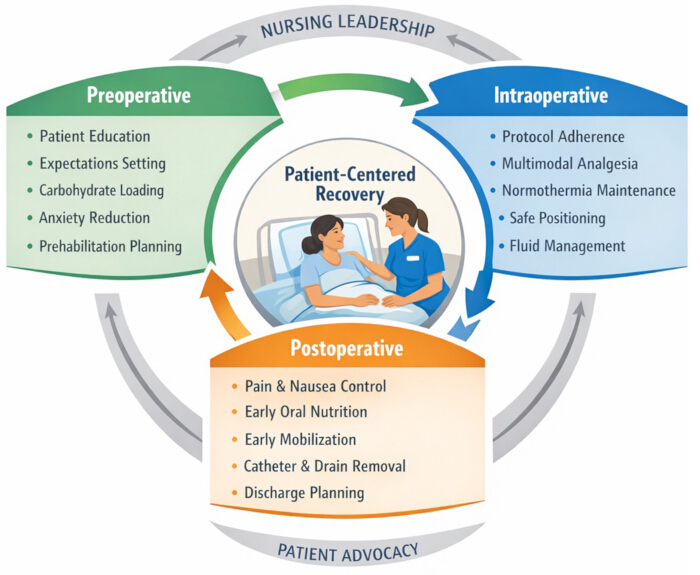
Figure 1: Enhanced recovery after surgery nursing-centered framework of gynecologic laparoscopy. This figure illustrates nursing's central role across the preoperative, intraoperative, and postoperative phases of ERAS. Nursing-led education (including psychological support), protocol coordination, adherence monitoring, and patient advocacy form the structural backbone of patient-centered perioperative care and are associated with improved recovery outcomes throughout the surgical episode. Please click here to view a larger version of this figure.
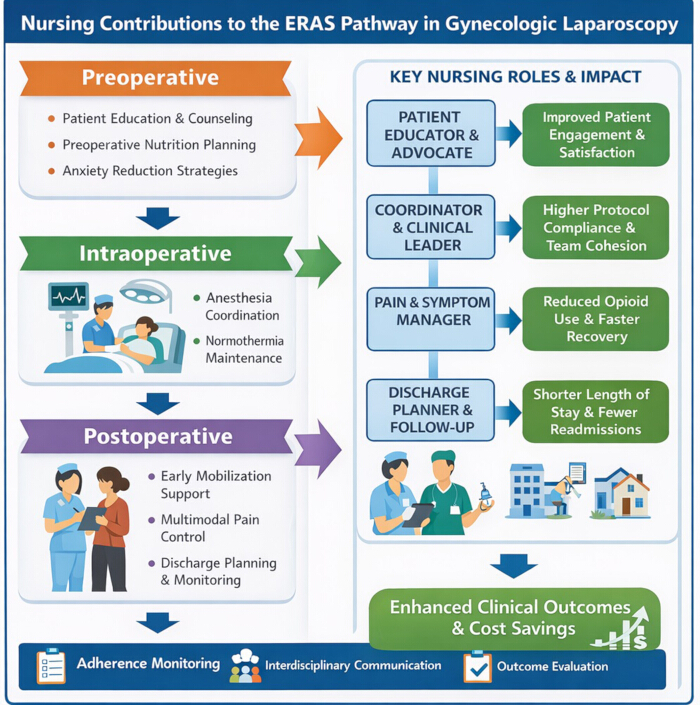
Figure 2: Nursing contributions to the ERAS pathway in gynecologic laparoscopy. This figure maps the spectrum of nursing roles and interventions across the full ERAS perioperative trajectory, showing their relationships to positive clinical and patient-reported outcomes, including improved engagement, reduced opioid use, shorter hospital length of stay, and enhanced clinical and economic performance. Please click here to view a larger version of this figure.
Table 1: Nursing interventions across the ERAS pathway in gynecologic laparoscopy: Rationale, outcomes, and supporting evidence. This table presents nursing-led interventions for each ERAS phase, the clinical rationale underpinning each, associated patient outcomes, and citations for supporting evidence. Abbreviations: LOS = length of stay; VTE = venous thromboembolism; SSI = surgical site infection. Please click here to download this Table.
Disclosures
All authors declare that the research was conducted without any commercial or financial relationships that could be considered a potential conflict of interest.
Acknowledgements
This study was supported by Wenzhou Municipal Bureau of Science and Technology (Project Title: 'The role of surgical nursing pathway combined with comfort care in laparoscopic myomectomy', Grant No. Y20240540).
References
- Ljungqvist O, Scott M, Fearon KC. Enhanced recovery after surgery: a review. JAMA Surg. 2017;152(3):292-298.
- Nelson G, et al. Guidelines for perioperative care in gynecologic oncology: Enhanced Recovery After Surgery (ERAS) Society recommendations—2019 update. Int J Gynecol Cancer. 2019;29(4):651-668.
- Gustafsson UO, et al. Guidelines for perioperative care in elective colorectal surgery: Enhanced Recovery After Surgery (ERAS) Society recommendations: 2018. World J Surg. 2019;43(3):659-695.
- Sauro KM, et al. Enhanced recovery after surgery guidelines and hospital length of stay, readmission, complications, and mortality: a meta-analysis of randomized clinical trials. JAMA Netw Open. 2024;7(6):e2417310.
- Bisch SP, Nelson G. Outcomes of enhanced recovery after surgery (ERAS) in gynecologic oncology: a review. Curr Oncol. 2022;29(2):631-640.
- Marchand GJ, et al. Systematic review of the effect of implementing enhanced recovery after surgery on selected attributes of surgical recovery in gynecology. Turk J Obstet Gynecol. 2021;18(3):245.
- Bogani G, et al. Enhanced recovery after surgery (ERAS) in gynecologic oncology. Eur J Surg Oncol. 2021;47(5):952-959.
- Gramlich LM, et al. Implementation of Enhanced Recovery After Surgery: a strategy to transform surgical care across a health system. Implement Sci. 2017;12(1):67.
- Levy L, Tsaltas J. Recent advances in benign gynecological laparoscopic surgery. Fac Rev. 2021;10:60.
- Aubrey C, Nelson G. Enhanced Recovery after Surgery (ERAS) for minimally invasive gynecologic oncology surgery: a review. Curr Oncol. 2023;30(10):9357-9366.
- Wesevich V, Webster EM, Baxley SE. Overcoming challenges in minimally invasive gynecologic surgery. Gynecol Pelvic Med. 2020;3:35.
- Rockall TA, Demartines N. Laparoscopy in the era of enhanced recovery. Best Pract Res Clin Gastroenterol. 2014;28(1):133-142.
- Jin O, et al. Impact of enhanced recovery after surgery concept process optimization on the perioperative period of gynecologic laparoscopic surgery. BMC Womens Health. 2025;25(1):120.
- Zorrilla-Vaca A, Lasala JD, Mena GE. Updates in enhanced recovery pathways for gynecologic surgery. Anesthesiol Clin. 2022;40(1):157-174.
- Achrekar MS. Enhanced recovery after surgery (ERAS) nursing programme. Asia Pac J Oncol Nurs. 2022;9(7):100041.
- Watson DJ. Nurse coordinators and ERAS programs. Nurs Manag. 2018;49(1):42-49.
- Mendes DIA, Ferrito CRAC, Gonçalves MIR. Nursing interventions in the enhanced recovery after surgery: scoping review. Rev Bras Enferm. 2018;71(Suppl 6):2824-2832.
- Jensen BT, Retinger NL, Lauridsen SV. From fast-track to enhanced recovery after surgery in radical cystectomy pathways: a nursing perspective. Asia Pac J Oncol Nurs. 2022;9(7):100048.
- Pham TH, Nguyen PN, Ho QN. Timely laparoscopic intervention for ovarian tumor-related autoimmune encephalitis: a challenging pathology at Tu Du Hospital in Vietnam and literature review. Gynecol Minim Invasive Ther. 2023;12:185-188.
- Kaye AD, et al. Dexmedetomidine in enhanced recovery after surgery (ERAS) protocols for postoperative pain. Curr Pain Headache Rep. 2020;24(5):21.
- Kalogera E, et al. Enhanced recovery in gynecologic surgery. Obstet Gynecol. 2013;122(2 Pt 1):319-328.
- Modesitt SC, et al. Enhanced recovery implementation in major gynecologic surgeries: effect of care standardization. Obstet Gynecol. 2016;128(3):457-466.
- Yang B, et al. Nurse-led discharge versus consulting surgeon-led discharge for patients who underwent laparoscopic surgeries: an evaluation of follow-up outcome, readmission frequencies, cost of care, and satisfaction of patients. BMC Nurs. 2025;24(1):218.
- Zhu T, et al. Effect of patient-controlled epidural analgesia (PCEA) based on ERAS on postoperative recovery of patients undergoing gynecological laparoscopic surgery. Evid Based Complement Alternat Med. 2022;2022:6458525.
- Kassymova G, et al. Effect of nurse-led telephone follow-up on postoperative symptoms and analgesics consumption after benign hysterectomy: a randomized, single-blinded, four-arm, controlled multicenter trial. Arch Gynecol Obstet. 2023;307(2):459-471.
- Jenkins ES, Crooks R, Sauro K, Nelson G. Enhanced recovery after surgery (ERAS)-guided gynecologic oncology surgery—the patient's perspective. Gynecol Oncol Rep. 2024;55:101510.
- Akbuğa GA, Yılmaz K. Obstacles to compliance and implementation of ERAS protocol from nursing perspective: a qualitative study. J Perianesth Nurs. 2025;40(2):331-336.
- Aoun E, Iniesta MD. The challenges of implementing the ERAS protocol in obstetrics and gynecology. Clin Obstet Gynecol. 2025;68(4):525-531.
- Griffiths P, et al. Costs and cost-effectiveness of improved nurse staffing levels and skill mix in acute hospitals: a systematic review. Int J Nurs Stud. 2023;147:104601.
- Faujour V, et al. Implementing enhanced recovery after surgery programmes in a healthcare facility: issues and economic impacts. J Gynecol Obstet Hum Reprod. 2022;51(5):102375.
- Pham TH, Nguyen VH, Nguyen PN. Abdominal parasitic fibroids after laparoscopic surgery using a power morcellation: a novel insight from Vietnam and a narrative review of the literature. J Med Ultrasound. 2025;33:402-406.
- Munday J, Kynoch K, Hines S, Coyer F. Nurse-led randomized controlled trials in the perioperative setting: a scoping review. J Multidiscip Healthc. 2020;13:647-660.
- Huiqin J, Dailan X, Ruiying Z. Application status and prospects of precision nursing under the concept of enhanced recovery after surgery. J Sichuan Univ (Med Sci). 2023;54(4):712-716.
- Zhen L, Hejing L, Shuli G, Na G. Research progress in precision nursing for enhanced recovery after surgery. J Sichuan Univ (Med Sci). 2023;54(4):717-720.