This cross-sectional study examined the association between overall media exposure and intrinsic-capacity impairment among community-dwelling older adults in China using questionnaire-based assessment and multivariable regression analysis.
Research Article
Association Between Overall Media Exposure and Intrinsic Capacity Among Community-Dwelling Older Adults in China: A Cross-Sectional Study
Opens in a new tab
In This Article
Summary
Loading...
$$\rightleftharpoonup{xx}$$
$$\longleftharp{xx}$$,
$$\longrightharp{xx}$$,
Abstract
Loading...
$$\rightleftharpoonup{xx}$$
$$\longleftharp{xx}$$,
$$\longrightharp{xx}$$,
Population ageing and the digitalization of society have transformed how older adults access information, health services, and social resources. Intrinsic capacity (IC), defined as the composite of physical and mental capacities underlying functional ability, may be influenced by media exposure through its effects on health knowledge, behaviors, and social interaction. However, evidence on the relationship between overall media exposure and IC among community-dwelling older adults in China remains limited. This cross-sectional study investigated the association between overall media exposure, including traditional and digital media use, and IC impairment among older adults in China. A survey was conducted between April and June 2024 among community-dwelling adults aged ≥60 years in three communities in Wuhan, China (N = 269). Media exposure was assessed using a single-item frequency measure (never/sometimes/often). IC was measured using the World Health Organization 9-item screening tool (score range: 0–9; higher scores indicate greater impairment and poorer IC). Multivariable linear and ordered logistic regression analyses were performed after adjustment for age, gender, marital status, income, education, grip strength, and social participation. The mean age of participants was 69.8 years (standard deviation [SD] 8.5), and 57.2% were women. The mean IC impairment score was 2.45 (SD 1.87). Frequent media exposure (“often” vs “never”) was associated with lower IC impairment scores in adjusted linear regression (B = –0.804; 95% confidence interval [CI] –1.53 to –0.08; p = 0.031), indicating better IC. Ordered logistic regression showed consistent findings. Older age was associated with poorer IC, whereas higher income, greater grip strength, being married, and social participation were associated with better IC. More frequent media exposure was associated with better IC among community-dwelling older adults, although longitudinal studies are needed to clarify causality and platform-specific effects.
Introduction
Loading...
$$\rightleftharpoonup{xx}$$
$$\longleftharp{xx}$$,
$$\longrightharp{xx}$$,
The world is aging at an unprecedented rate. The World Health Organization (WHO) has reported that the life expectancy (LE) of the global population increased by 6.6 years between 2000 and 2019, whereas healthy LE (HALE) increased by only 5.4 years, indicating that older adults spend a substantial proportion of later life living with illness and disability1. In China, the population aged 65 years and older has reached approximately 200 million people, accounting for 14.2% of the total population and reflecting the country’s transition into an aged society2. The LE in China was reported as 77.3 years, whereas the HALE was 69 years, leaving an 8.3-year gap that may be associated with functional decline and long-term care needs1. In response to these challenges, the World Report on Ageing and Health emphasized the importance of maintaining functional ability (FA) and preventing declines in intrinsic capacity (IC)3. IC refers to the composite of an individual’s physical and mental capacities and includes domains such as locomotion, cognition, psychological well-being, sensory function, and vitality/nutrition4,5.
Media exposure has increasingly become an important social and behavioral determinant of healthy ageing. Among older adults, engagement with media may influence IC through multiple pathways, including improved access to health information, increased health literacy, enhanced cognitive functioning, promotion of healthy behaviors, and facilitation of social interaction and participation. These pathways align with behavioral and social determinants of health frameworks, which suggest that access to information and social connectivity can shape health behaviors, healthcare utilization, and functional outcomes in later life. At the same time, disparities in access, skills, usability, and digital literacy contribute to a persistent digital divide among older populations6,7.
The impact of digital technologies on the lives of older adults has increased substantially and has influenced lifestyle behaviors, cognitive functioning, social well-being, and social participation8,9,10. Existing evidence suggests that older Chinese adults continue to rely heavily on traditional media, particularly television, while also gradually adopting digital platforms such as smartphones and internet-based media11,12. Therefore, in the present study, “media exposure” refers collectively to engagement with both traditional and digital media platforms. This combined approach was adopted because older adults in China often use multiple forms of media simultaneously, and both traditional and digital media may contribute to information access, social engagement, and health-related behaviors.
Although previous studies have examined the relationship between media use and selected health outcomes among older adults, evidence regarding its association with IC remains limited and inconsistent12,13,14,15,16. Specifically, prior research has largely focused on isolated outcomes such as cognition, depression, or social participation rather than the multidimensional construct of IC. Furthermore, findings across studies remain mixed because of variations in study populations, definitions of media exposure, and outcome measurements. In particular, limited evidence is available regarding overall media exposure, including both traditional and digital media engagement, in relation to IC among community-dwelling older adults in China12,13,16. Therefore, the present study aimed to (1) characterize patterns of overall media exposure and IC according to sociodemographic and health-related factors and (2) examine the association between overall media exposure and IC among community-dwelling older adults in China.
Protocol
Loading...
$$\rightleftharpoonup{xx}$$
$$\longleftharp{xx}$$,
$$\longrightharp{xx}$$,
The study was approved by the Biomedical Ethics Committee of Wuhan University (approval number: WHU-LFMD-IRB2023079). Written informed consent was obtained from all participants before questionnaire administration and physical assessment. For participants with limited literacy, trained interviewers read the consent form aloud, and verbal confirmation was obtained before written consent or thumbprint documentation. All questionnaires and interviews were administered in Mandarin Chinese. Assessments were conducted in quiet community settings with adequate lighting and minimal distractions to support standardized administration.
All data were anonymized and used exclusively for research purposes. Data were entered into a secure electronic database by trained research staff and reviewed for completeness and consistency before analysis. Random verification of entered data was performed to minimize data-entry errors. Access to the dataset was restricted to the core research team.
Study Design and Setting
This cross-sectional study involved community-dwelling older adults aged 60 years and above in Wuhan, China. Data collection was conducted between April and June 2024. Participants were recruited from three communities—Jiangdayuan, Jinyulanwan, and Lvdao—located in the Caidian District of Wuhan. Wuhan is the capital city of Hubei Province and serves as a major economic, educational, and transportation center in central China. The three communities were selected because they served as internship and field-practice sites for the research team, facilitating access to community-dwelling older adults and supporting the feasibility of data collection. These communities are predominantly urban residential communities with mixed socioeconomic backgrounds and established community health-service centers that regularly provide health-management services for older adults. Therefore, convenience sampling was applied at both the community and participant levels.
Participants and Recruitment
Recruitment was conducted in community activity centers, residential common areas, and community health-service areas within the three selected communities. Potential participants were approached in person by trained research staff during scheduled community visits and informational sessions. Eligibility screening was conducted using a standardized checklist based on the predefined inclusion and exclusion criteria. Participant comprehension and ability to respond were assessed through brief verbal interactions with trained interviewers to confirm the ability to understand study instructions, communicate responses, and complete the questionnaire independently or with interviewer assistance. Individuals who were unable to communicate effectively, demonstrate basic understanding, or complete the interview process, even with assistance, were excluded from participation.
Eligible individuals received a verbal explanation of the study and were invited to participate. Exclusion criteria were assessed through participant self-report, interviewer-administered screening questions, and available community health information, where applicable. Written informed consent was obtained before questionnaire administration and physical assessment.
The inclusion criteria were as follows: (1) aged 60 years and above; (2) able to understand and respond to the questionnaire independently or with interviewer assistance; and (3) willing to participate in the study and provide informed consent. The exclusion criteria included severe psychiatric diseases, severe comorbid organ diseases (e.g., advanced cardiovascular, renal, hepatic, or respiratory diseases), terminal illness, or enrollment in other geriatric-related studies. These exclusion criteria were determined primarily based on participants’ self-reports of prior medical diagnoses.
A total of 280 eligible community residents were approached for participation. Of these, 269 participants completed the survey and were included in the final analysis, resulting in an effective response rate of 96.1%. The remaining 11 participants were excluded because of incomplete questionnaire responses, withdrawal during the survey process, or inability to complete the physical-assessment procedures.
Data Collection
Data were collected through face-to-face interviews conducted within the three participating communities. The research team consisted of four undergraduate students and two graduate students with nursing experience. Data collectors completed a one-day training session conducted by the investigators covering study objectives, participant recruitment procedures, informed-consent procedures, questionnaire administration, physical measurements, ethical considerations, and standardized interviewing techniques.
Mock interviews and supervised practice sessions were conducted before data collection to promote consistency across investigators. Following training, all data collectors completed supervised mock interviews and standardized practice assessments under investigator observation. Interviewer competency was evaluated based on adherence to the interview protocol, accuracy of questionnaire administration, and consistency of physical-measurement procedures. Minor discrepancies identified during pilot practice were discussed and corrected before formal data collection. Formal statistical inter-rater reliability testing was not performed because assessments were conducted using highly standardized procedures and interviewer-administered questionnaires.
The questionnaire was self-administered for participants who were able to read and complete the questionnaire independently. Interviewer-administered questionnaires were used for participants with visual impairment, limited literacy, or difficulty writing. During interviewer-administered sessions, interviewers followed a standardized administration protocol that included reading questions verbatim, avoiding interpretation or prompting, maintaining neutral responses, and recording participant responses directly without modification.
Completed questionnaires were reviewed on-site immediately after administration to minimize missing data and ensure completeness. Participants were asked to clarify unanswered or unclear items whenever possible. The questionnaire and interviewer-administration materials are provided in Supplementary File 1.
Measures
Sociodemographic and health characteristics:
Sociodemographic variables included gender, age (years), marital status, educational attainment, personal monthly income, and health-insurance status. Monthly income was categorized as ≤1000 RMB, 1001–4000 RMB, and ≥4001 RMB. Educational attainment was categorized as primary school or below, middle/high school, and junior college or above.
Health-related variables included self-reported chronic conditions, smoking status, alcohol consumption, and body mass index (BMI). Chronic conditions included hypertension, diabetes mellitus, cardiovascular disease, cerebrovascular disease, and hyperlipidemia. Chronic disease burden was categorized as none, one to two chronic diseases, and three or more chronic diseases. Chronic disease status was determined primarily through participant self-report of prior physician diagnoses and current medication use.
Smoking status and alcohol consumption were assessed through self-report. Smoking status was categorized as current smoker and non-smoker (including former smokers and never smokers). Alcohol consumption was categorized as current alcohol consumption versus no current alcohol consumption. Responses were coded dichotomously for statistical analysis (0 = no; 1 = yes).
BMI was calculated as weight (kg)/height (m2) and categorized as normal weight versus underweight/overweight/obesity according to Chinese adult BMI guidelines. Height and weight measurements were obtained with participants wearing light clothing and no shoes. Weight was measured using a calibrated digital weighing scale, and height was measured using a wall-mounted stadiometer. Two measurements were obtained for each participant, and the average value was used for BMI calculation.
Grip strength:
Grip strength was measured using a handheld grip-strength dynamometer. Participants stood upright with their arms naturally hanging at the sides and elbows fully extended. Measurements were obtained alternately for the right and left hands with approximately 30 s of rest between trials. Each hand was measured twice, and the maximum recorded value was used for analysis. Standardized verbal instructions were provided before testing, and the device was calibrated according to the manufacturer’s instructions before data collection. Participants were asked whether they had any current hand pain, upper-limb injury, or condition affecting grip performance before assessment. Individuals reporting severe pain or inability to safely perform the test were excluded from grip-strength measurement. Dominant hand status was not formally recorded, and the highest value obtained from either hand was used for analysis.
Grip strength was recorded in kilograms (kg). According to the 2019 Asian Working Group for Sarcopenia consensus, low grip strength was defined as <28 kg for men and <18 kg for women17. Grip strength was included as an objective indicator of physical function and muscular strength associated with the locomotion domain of IC and overall functional decline among older adults.
Media exposure:
Media exposure was assessed using a single-item measure: “In your daily life, how frequently do you engage with traditional media (e.g., newspapers, radio, television) and digital media (e.g., internet, social media)?” Responses were rated on a three-point scale (1 = never, 2 = sometimes, 3 = often). Participants were asked to report their usual frequency of engagement with traditional and digital media during daily life over the previous several months. The question was administered verbally or self-completed, depending on participant preference and literacy level. For descriptive interpretation, “sometimes” generally referred to occasional or irregular media engagement (e.g., several times per month or week), whereas “often” referred to frequent or routine engagement (e.g., daily or nearly daily use).
The item was developed based on previous ageing and media-use literature examining overall engagement with information and communication media among older adults. Because older adults in China commonly use both traditional and digital media, the study assessed overall media exposure rather than platform-specific use18. The single-item measure was intended to capture general patterns of media engagement rather than specific platform use, duration, or purpose of media consumption.
Intrinsic capacity:
IC was assessed using the WHO Integrated Care for Older People (ICOPE) screening tool4. The ICOPE screening tool is a standardized instrument developed by the WHO for assessing declines in IC among older adults and has been widely used in ageing research and community-based geriatric assessments. A Mandarin Chinese version of the ICOPE screening tool was used in this study and was administered by trained interviewers19. Previous studies have reported acceptable reliability and validity of Chinese versions of the ICOPE screening tool among older adult populations20,21.
The tool includes nine items across five domains: locomotion (1 item), vitality (2 items), sensory function (2 items), cognition (2 items), and psychological well-being (2 items). All abnormal responses were coded as 1, resulting in a total score ranging from 0 to 9, with higher scores indicating greater impairment and poorer IC. IC impairment was defined as impairment in at least one domain.
Specific assessment criteria were as follows:
Locomotion: The five-times sit-to-stand test was conducted using a standard chair approximately 43–45 cm in height without armrests. Participants were instructed to rise from the seated position and sit down five times as quickly as possible without using their arms. Timing began at the command “start” and ended when the participant completed the fifth stand. Completion time ≥14 s or inability to complete the test without arm support was considered indicative of locomotion impairment. One untimed practice trial was permitted before formal testing to ensure participant understanding of the procedure and standardized test administration.
Vitality: Vitality was assessed through self-reported unintentional weight loss of ≥3 kg during the previous three months and/or self-reported loss of appetite. Participants were asked, “Have you unintentionally lost more than 3 kg during the past three months?” and “Have you experienced a loss of appetite recently?” Response options for appetite assessment were recorded as yes/no.
Sensory: Sensory function was assessed using self-reported hearing impairment, visual impairment, and the whisper test. The whisper test was performed at an approximate distance of 60 cm behind the participant to minimize visual cues. One ear was gently masked while standardized whispered numbers (e.g., “4–7–2”) or common two-syllable words were presented to the opposite ear. Two attempts were administered per ear. Inability to correctly repeat the presented items was considered indicative of hearing impairment.
Cognition: Cognitive assessment included orientation and delayed recall tasks administered in Mandarin Chinese. Participants were asked to identify the current date and location and to recall three common words after a brief delay. The three recall words used were “bag,” “flag,” and “tree” (Mandarin equivalents). The recall delay duration was approximately 3–5 min during completion of other questionnaire items. Incorrect orientation responses or inability to recall the words were considered indicative of cognitive impairment.
Psychological well-being: Psychological well-being was assessed using two screening questions regarding low mood and loss of interest during the previous two weeks: “During the past two weeks, have you often felt down, depressed, or hopeless?” and “During the past two weeks, have you experienced little interest or pleasure in doing things?” Responses were recorded as yes/no, and the presence of either symptom was considered indicative of psychological impairment.
Data Analysis
Data collection was conducted during daytime community visits between April and June 2024, and each participant's interview and assessment required approximately 20–30 min. Completed questionnaires were reviewed immediately after administration to identify missing or incomplete responses, and participants were asked to clarify unanswered items whenever possible.
Sociodemographic characteristics, health-related variables, media exposure, and IC impairment scores were summarized using descriptive statistics. Continuous variables were presented as means and standard deviations (SDs), whereas categorical variables were presented as frequencies and percentages. Graphical analyses included bar charts for media-exposure categories and mean plots with error bars representing standard errors of the mean (SEM) for IC impairment scores across sociodemographic groups.
Missing data handling:
The extent of missing data was examined for each study variable before analysis. Overall, missingness was low (<5% for all variables). Given the minimal level of missing data and the absence of systematic patterns based on Little’s missing completely at random (MCAR) test (p > 0.05), complete-case analysis was applied for regression models. Little’s MCAR test was performed using the Missing Value Analysis module in the IBM SPSS Statistics (version 29.0) statistical analysis software package. Sensitivity analyses comparing participants with complete data to those with any missing values showed no statistically significant differences in age, gender, education, or IC scores (all p > 0.05), supporting the robustness of the complete-case approach.
To address Research Question 1, independent-samples t-tests, one-way analysis of variance (ANOVA), and correlation analyses were performed to examine bivariate relationships between participant characteristics, media exposure, and IC impairment scores.
To address Research Question 2, variables demonstrating statistically significant associations (p < 0.05) in univariate analyses and variables considered conceptually relevant based on prior literature were included in multivariable analyses. Categorical variables were transformed into dummy variables using binary 0/1 coding before regression analyses. For educational attainment, two dummy variables were created: middle/high school versus primary school or below (Edu2: 0 = no, 1 = yes) and junior college or above versus primary school or below (Edu3: 0 = no, 1 = yes). For monthly income, two dummy variables were created: 1001–4000 RMB versus ≤1000 RMB (Income2: 0 = no, 1 = yes) and ≥4001 RMB versus ≤1000 RMB (Income3: 0 = no, 1 = yes). For media exposure, two dummy variables were created: “sometimes” versus “never” exposure (Media2: 0 = no, 1 = yes) and “often” versus “never” exposure (Media3: 0 = no, 1 = yes). Reference categories were primary school or below, monthly income ≤1000 RMB, and “never” media exposure.
Multiple linear regression was first conducted, treating the IC score (range: 0–9) as a continuous outcome. Model assumptions were evaluated using the Durbin–Watson statistic for independence of residuals, variance inflation factor (VIF < 5) for multicollinearity, and residual histograms, Q–Q plots, and scatterplots to assess normality, linearity, and homoscedasticity.
To account for the ordinal distribution of IC scores, ordered logistic regression (proportional odds model) was additionally conducted, treating IC as an ordinal outcome. The proportional-odds assumption was evaluated using the test of parallel lines. Adjusted odds ratios (AORs) with 95% confidence intervals (CIs) were reported. Model fit was assessed using likelihood-ratio chi-square statistics and pseudo-R2 indices. Consistency in direction, magnitude, and statistical significance of associations across linear and ordered logistic regression models was used to assess the robustness of findings. For the ordered logistic regression analysis, total IC impairment scores (range: 0–9) were treated as ordered ordinal categories representing increasing levels of IC impairment, with higher scores indicating poorer IC and greater functional impairment.
All analyses were conducted using IBM SPSS Statistics version 29.0 and R version 4.3.1. Statistical significance was set at p < 0.05.
Results
Loading...
$$\rightleftharpoonup{xx}$$
$$\longleftharp{xx}$$,
$$\longrightharp{xx}$$,
Participant Characteristics
The study sample included 269 community-dwelling older adults, including 154 women (57.2%) and 115 men (42.8%). The mean participant age was 69.8 years (SD = 8.46 years). Most participants were married (76.6%), and the majority had health insurance coverage (96.7%). More than two-thirds of participants reported at least one chronic disease (70.3%).
The mean IC impairment score was 2.45 (SD = 1.87), with higher scores indicating greater impairment and poorer IC. No statistically significant differences in IC impairment scores were observed according to health-insurance status, body mass index category, smoking status, alcohol consumption, or chronic disease burden (all p > 0.05). Detailed participant characteristics and univariate analyses are presented in Table 1.
| Variables | Categories | N (%) / Mean (SD) | t/F/r | p-value |
| Gender | Male | 115 (42.8) | ||
| Female | 154 (57.2) | 3.49 | <0.001 | |
| Marital status | Married | 206 (76.6) | ||
| Unmarried/divorced/widowed | 63 (23.4) | 4.567 | <0.001 | |
| Monthly income (RMB) | ≤1000 | 77 (28.6) | ||
| 1001–4000 | 126 (46.8) | |||
| ≥4001 | 66 (24.6) | 3.069 | 0.002 | |
| Educational attainment | Primary school or below | 107 (39.8) | ||
| Middle/high school | 125 (46.5) | |||
| Junior college or above | 37 (13.8) | 2.357 | 0.014 | |
| Health insurance | Yes | 260 (96.7) | ||
| No | 9 (3.3) | 1.837 | 0.069 | |
| Chronic disease burden | None | 80 (29.7) | ||
| 1–2 chronic diseases | 152 (56.9) | |||
| ≥3 chronic diseases | 37 (13.8) | |||
| Body mass index (BMI) | Normal weight | 153 (56.9) | ||
| Underweight/Overweight/Obesity | 116 (43.1) | −1.126 | 0.261 | |
| Smoking status | Never/quit | 180 (66.9) | ||
| Yes | 89 (33.1) | −1.873 | 0.063 | |
| Alcohol consumption | Never/quit | 178 (66.2) | ||
| Yes | 91 (33.8) | −1.566 | 0.119 | |
| Social participation | Yes | 168 (62.5) | ||
| No | 101 (37.5) | 2.299 | 0.022 | |
| Media exposure | Never | 23 (8.6) | ||
| Sometimes | 77 (28.6) | |||
| Often | 169 (62.8) | 4.437 | <0.001 | |
| Age (years) | — | 69.78 (8.46) | −0.377** | <0.001 |
| Grip strength (kg) | — | 25.53 (9.45) | −0.383** | <0.001 |
| Intrinsic-capacity domains | IC total score | 2.45 (1.87) | ||
| Locomotion | 0.27 (0.45) | |||
| Vitality | 0.29 (0.56) | |||
| Sensory | 0.65 (0.69) | |||
| Cognition | 0.85 (0.76) | |||
| Psychological well-being | 0.39 (0.65) |
Table 1: Participant characteristics and univariate associations with IC impairment scores among community-dwelling older adults in Wuhan, China (N = 269). Values are presented as n (%) or mean ± standard deviation (SD). IC was assessed using the WHO ICOPE 9-item screening tool, with higher IC scores indicating greater impairment and poorer IC. Group differences for categorical variables were assessed using independent-samples t-tests or one-way analysis of variance (ANOVA), whereas Pearson correlation analyses were used for continuous variables. Media exposure was categorized as “never,” “sometimes,” and “often” based on self-reported frequency of engagement with traditional and digital media. BMI categories were classified according to Chinese adult BMI guidelines. Statistical significance was defined as p < 0.05. Asterisks indicate statistically significant correlations (*p < 0.05; **p < 0.01).
Univariate Analysis
Univariate analyses demonstrated significant differences in IC impairment scores according to gender, marital status, educational attainment, monthly income, social participation, media exposure, age, and grip strength (all p < 0.05). No statistically significant differences in IC impairment scores were observed according to health-insurance status, BMI category, smoking status, alcohol consumption, or chronic disease burden (all p > 0.05).
Older age was significantly associated with higher IC impairment scores (r = 0.377, p < 0.001), indicating poorer IC among older participants. In contrast, greater grip strength was significantly associated with lower IC impairment scores (r = –0.383, p < 0.001), indicating better IC among participants with greater physical strength. Detailed univariate analysis results are presented in Table 1.
Media Exposure Across Sociodemographic and Health-Related Groups
Most participants (91.4%) reported at least some level of media exposure (“sometimes” or “often”). Limited media exposure was more frequently observed among participants without health insurance (22.2%), those with lower grip strength (17.6%), and participants aged 90 years and above (33.3%). Distribution patterns of media exposure across sociodemographic and health-related groups are presented in Figure 1.
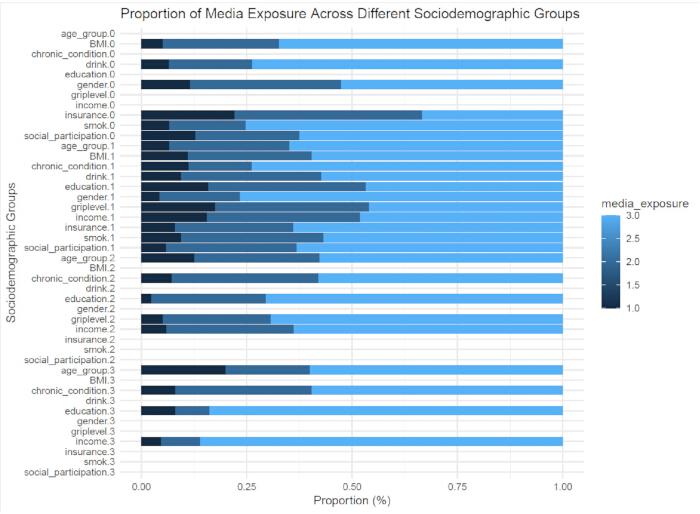
Figure 1. Distribution of media-exposure categories across sociodemographic and health-related groups among community-dwelling older adults in Wuhan, China (N = 269). Media exposure was assessed using a single-item measure evaluating frequency of engagement with traditional and digital media and categorized as “never,” “sometimes,” and “often.” Values are presented as percentages within each subgroup. Sociodemographic and health-related variables included age group, gender, educational attainment, monthly income, health-insurance status, body mass index (BMI) category, chronic disease burden, smoking status, alcohol consumption, grip-strength category, and social participation. Higher proportions indicate greater representation of participants within each media-exposure category. Please click here to view a larger version of this figure.
IC Impairment Across Sociodemographic and Health-Related Groups
Participants with lower grip strength had higher mean IC impairment scores (mean = 3.56, SD = 0.25) compared with those with normal grip strength (mean = 2.04, SD = 0.11), indicating poorer IC among individuals with weaker physical strength. Similarly, participants with monthly incomes below 1000 RMB had higher mean IC impairment scores (mean = 2.97, SD = 0.19) than participants in higher-income categories.
Female participants had higher mean IC impairment scores than male participants (mean = 2.78, SD = 0.16 vs mean = 2.02, SD = 0.15), indicating relatively poorer IC among women. Participants with primary-school education or below had the highest mean IC impairment scores (mean = 2.92, SD = 1.89), whereas lower impairment scores were observed among participants with higher educational attainment. Participants aged 90 years and above had the highest IC impairment scores among all age groups (mean = 7.67, SD = 0.33), indicating substantially poorer IC in the oldest age group. Mean IC impairment scores across sociodemographic and health-related groups are presented in Figure 2.
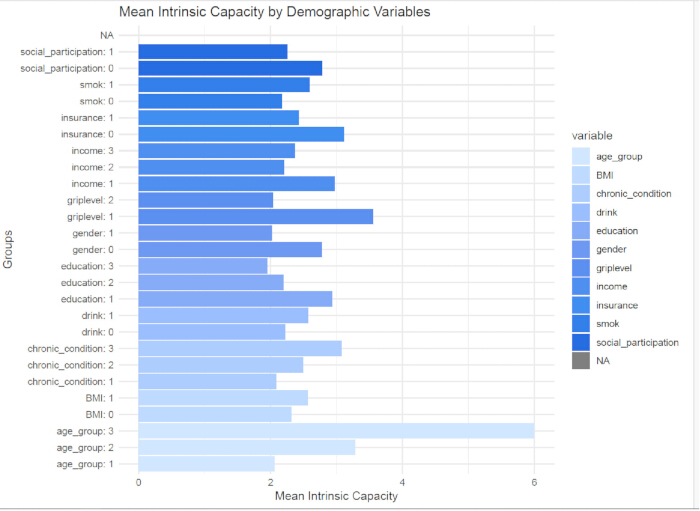
Figure 2. Mean intrinsic-capacity (IC) impairment scores across sociodemographic and health-related groups among community-dwelling older adults in Wuhan, China (N = 269). Bars represent mean IC impairment scores across participant subgroups stratified by sociodemographic and health-related variables, including age group, gender, educational attainment, monthly income, health-insurance status, BMI category, chronic disease burden, smoking status, alcohol consumption, grip-strength category, and social participation. IC was assessed using the WHO Integrated Care for Older People (ICOPE) 9-item screening tool (score range: 0–9). Higher scores indicate greater impairment and poorer IC. Error bars represent standard errors of the mean (SEM). Please click here to view a larger version of this figure.
Multiple Linear Regression Analysis of Factors Associated with IC
Univariate analyses demonstrated a significant association between media exposure and IC impairment scores (p < 0.001). Variables demonstrating statistically significant associations in univariate analyses, together with variables considered conceptually relevant based on prior literature, were included in the multivariable regression model.
In the multiple linear regression analysis (Table 2), after adjustment for age, gender, marital status, educational attainment, monthly income, grip strength, and social participation, frequent media exposure (“often” vs “never”) was significantly associated with lower IC impairment scores (B = –0.804; 95% CI –1.53 to –0.08; p = 0.031), indicating better IC among participants with more frequent media engagement.
| Variables | B | SE | β | t | p-value | Tolerance | VIF |
| Constant | 1.454 | 1.228 | — | 1.184 | 0.237 | — | — |
| Age | 0.055 | 0.014 | 0.250 | 3.916 | <0.001 | 0.626 | 1.597 |
| Gender | 0.143 | 0.271 | 0.038 | 0.530 | 0.597 | 0.493 | 2.028 |
| Marital status | −0.856 | 0.269 | −0.195 | −3.181 | 0.002 | 0.681 | 1.469 |
| Grip strength | −0.036 | 0.016 | −0.182 | −2.25 | 0.025 | 0.389 | 2.568 |
| Social participation | −0.681 | 0.204 | −0.177 | −3.343 | <0.001 | 0.910 | 1.099 |
| Educational attainment | |||||||
| Middle/high school | 0.071 | 0.232 | 0.019 | 0.308 | 0.758 | 0.662 | 1.510 |
| Junior college or above | −0.104 | 0.359 | −0.019 | −0.291 | 0.771 | 0.579 | 1.728 |
| Monthly income (RMB) | |||||||
| 1001–4000 | −0.682 | 0.239 | −0.182 | −2.847 | 0.005 | 0.625 | 1.600 |
| ≥4001 | −0.339 | 0.368 | -0.067 | −0.919 | 0.359 | 0.486 | 2.059 |
| Media exposure | |||||||
| Sometimes | 0.058 | 0.380 | 0.014 | 0.153 | 0.878 | 0.299 | 3.342 |
| Often | −0.804 | 0.371 | −0.208 | −2.169 | 0.031 | 0.276 | 3.624 |
Table 2: Multiple linear regression analysis of factors associated with IC impairment scores among community-dwelling older adults in Wuhan, China (N = 269). Multiple linear regression analysis examining factors associated with IC impairment scores among community-dwelling older adults in Wuhan, China. Higher IC scores indicate greater impairment and poorer IC. The regression model was adjusted for age, gender, marital status, educational attainment, monthly income, grip strength, social participation, and media exposure. Reference categories were primary school or below for educational attainment, monthly income ≤1000 RMB, unmarried/divorced/widowed for marital status, and “never” for media exposure. Regression coefficients are presented as unstandardized coefficients (B), standardized coefficients (β), and SEs. Variance inflation factor (VIF) and tolerance statistics were used to assess multicollinearity. Model assumptions were evaluated using residual plots and the Durbin–Watson statistic. Model summary statistics were as follows: R2 = 0.345, adjusted R2 = 0.317, and overall model significance p < 0.001. ANOVA demonstrated significant overall model fit (F = 12.333, p < 0.001). The Durbin–Watson statistic was 1.855, indicating acceptable residual independence. Negative regression coefficients indicate lower IC impairment scores and better IC. Statistical significance was defined as p < 0.05.
Older age was associated with higher IC impairment scores (B = 0.055; 95% CI 0.03–0.08; p < 0.001), indicating poorer IC with increasing age. In contrast, being married (B = –0.856; p = 0.002), monthly income between 1001 and 4000 RMB compared with ≤1000 RMB (B = –0.682; p = 0.005), greater grip strength (B = –0.036; p = 0.025), and social participation (B = –0.681; p < 0.001) were associated with lower IC impairment scores and better IC.
Model diagnostics indicated acceptable model fit (R2 = 0.345; adjusted R2 = 0.317; F = 12.333; p < 0.001). The Durbin–Watson statistic was 1.855, indicating no evidence of residual autocorrelation. VIF values ranged from 1.099 to 3.624, indicating no evidence of problematic multicollinearity.
Ordered Logistic Regression Analysis
Ordered logistic regression analyses (Table 3) demonstrated findings consistent with those of the multiple linear regression model. Frequent media exposure (“often” vs “never”) remained significantly associated with lower IC impairment scores (Estimate = –0.848; 95% confidence interval [CI] –1.685 to –0.010; p = 0.047), indicating better IC among participants with more frequent media engagement.
| Variables | Estimate | Std. Error | Wald | p-value | 95% CI Lower Bound | 95% CI Upper Bound |
| Age | 0.057 | 0.016 | 11.899 | <0.001 | 0.025 | 0.089 |
| Grip strength | −0.044 | 0.019 | 5.543 | 0.019 | −0.081 | −0.007 |
| Marital status | −0.946 | 0.314 | 9.068 | 0.003 | −1.562 | −0.330 |
| Social participation | −0.802 | 0.239 | 11.299 | <0.001 | −1.270 | −0.335 |
| Educational attainment | ||||||
| Middle/high school | 0.03 | 0.267 | 0.013 | 0.91 | −0.494 | 0.554 |
| Junior college or above | −0.264 | 0.416 | 0.403 | 0.526 | −1.079 | 0.551 |
| Monthly income (RMB) | ||||||
| 1001–4000 | −0.809 | 0.279 | 8.407 | 0.004 | −1.356 | −0.262 |
| ≥4001 | −0.315 | 0.425 | 0.552 | 0.458 | −1.148 | 0.517 |
| Media exposure | ||||||
| Sometimes | 0.144 | 0.436 | 0.11 | 0.74 | −0.710 | 0.998 |
| Often | −0.848 | 0.427 | 3.934 | 0.047 | −1.685 | −0.010 |
Table 3: Ordered logistic regression analysis of factors associated with IC impairment scores among community-dwelling older adults in Wuhan, China (N = 269). Ordered logistic regression analysis examining factors associated with IC impairment scores among community-dwelling older adults in Wuhan, China. Higher IC scores indicate greater impairment and poorer IC, whereas negative regression estimates indicate lower IC impairment and better IC. The regression model included age, grip strength, marital status, social participation, educational attainment, monthly income, and media exposure. Reference categories were primary school or below for educational attainment, monthly income ≤1000 RMB, unmarried/divorced/widowed for marital status, and “never” for media exposure. Regression estimates are presented with SEs, Wald statistics, p-values, and 95% confidence intervals (CIs). Model-fitting information demonstrated acceptable overall model performance (Chi-square = 104.159, p < 0.001). Goodness-of-fit analysis was statistically significant (F = 12.333, p < 0.001). The proportional-odds assumption was evaluated using the Test of Parallel Lines (Chi-square = 17.338, p = 1.000), supporting the appropriateness of the ordered logistic regression model. Statistical significance was defined as p < 0.05.
Older age remained associated with higher IC impairment scores and poorer IC, whereas being married, greater grip strength, social participation, and monthly income between 1001 and 4000 RMB were associated with lower IC impairment scores and better IC.
Model-fit statistics indicated acceptable overall model performance (Chi-square = 104.159; p < 0.001). The proportional-odds assumption was satisfied based on the Test of Parallel Lines (p = 1.000), supporting the appropriateness of the ordered logistic regression model.
Overall, frequent media exposure was consistently associated with lower IC impairment scores across both regression models. In contrast, older age, lower income, weaker grip strength, and lower social participation were associated with poorer IC.
Missing-data analyses demonstrated low overall missingness (<5% across all variables). Little’s MCAR test was non-significant (p > 0.05), and sensitivity analyses showed no statistically significant differences between participants with complete and incomplete data, supporting the robustness of the analytical approach.
Data Availability:
The anonymized participant-level dataset and statistical analysis files supporting the findings of this study are provided as supplementary materials associated with this manuscript. Supplementary Table 1 contains the anonymized participant-level dataset, including sociodemographic characteristics, health-related variables, media-exposure measures, and IC assessment data. Supplementary Table 2 contains statistical analysis output files, including descriptive statistics, univariate analyses, multiple linear regression analyses, and ordered logistic regression analyses. Supplementary File 1 provides the English-language questionnaire and interviewer-assessment materials used for data collection among community-dwelling older adults in Wuhan, China. Supplementary Coding File 1 contains the original Mandarin Chinese version of the questionnaire and coding materials used during participant data collection and is provided for methodological reference only.
Supplementary File 1. English-language questionnaire and interviewer-assessment materials used for data collection among community-dwelling older adults in Wuhan, China.
This supplementary file contains the English-translated versions of the sociodemographic questionnaire, media-exposure assessment, IC screening items based on the WHO Integrated Care for Older People (ICOPE) framework, physical-activity measures, activities-of-daily-living assessment, and health-personality assessment instruments administered during participant interviews.Please click here to download this file.
Supplementary Coding File 1 contains the original Mandarin Chinese version of the questionnaire used during participant data collection and is provided for methodological reference only.Please click here to download this file.
Discussion
Loading...
$$\rightleftharpoonup{xx}$$
$$\longleftharp{xx}$$,
$$\longrightharp{xx}$$,
This study investigated patterns of media exposure and their associations with IC among community-dwelling older adults in China. Most participants reported at least some level of media exposure, and the mean IC impairment score was relatively low. After adjustment for sociodemographic and health-related variables, more frequent media engagement was associated with lower IC impairment scores, indicating better IC. Similar findings were observed across both multiple linear regression and ordered logistic regression models, supporting the robustness and consistency of the observed associations. Older age, lower income, weaker grip strength, and lower social participation were associated with poorer IC. To our knowledge, few studies in China have examined overall media engagement, including both traditional and digital media exposure, in relation to multidimensional IC among community-dwelling older adults22,23. These findings may reflect inequalities in overall media engagement and access to informational and social resources among older adults. From a social determinants and biopsychosocial perspective, media engagement may represent more than simple information access and may also reflect broader social participation, cognitive engagement, and interaction with supportive environments relevant to healthy ageing. Older adults with greater engagement with informational and social resources may have more opportunities to maintain physical, cognitive, and psychological functioning over time. However, because the present study assessed overall media exposure rather than platform-specific use, it was not possible to distinguish the relative contributions of traditional media and digital media engagement.
This study demonstrated that poorer IC was associated with advanced age, lower income, lower educational attainment, weaker grip strength, and lower social participation. These findings are consistent with WHO recommendations and previous studies reporting that IC declines with increasing age because of cumulative biological changes and greater chronic disease burden24. The mean IC impairment score observed in the present study was lower than scores reported in studies involving older community residents in Beijing13 and hospitalized geriatric populations15. This difference may be related to the younger age and comparatively better baseline health status of the community-dwelling participants included in the present study. These comparisons highlight the importance of considering population characteristics, study settings, and sampling strategies when interpreting IC outcomes across studies. Lower income was associated with poorer IC, consistent with findings reported in studies conducted in China25 and Brazil26. Older adults with higher income levels may have greater access to healthcare services, health-related information, and healthier lifestyles that support the maintenance of physical, cognitive, and psychological functioning24. Similarly, social participation was associated with better IC, consistent with previous findings from studies conducted in China27,28. Within a biopsychosocial framework, social participation may contribute to emotional well-being, cognitive stimulation, and maintenance of daily functioning through continued interpersonal engagement and participation in meaningful activities16. Grip strength was also identified as an important correlate of IC, consistent with previous research24,29. Because grip-strength assessment is simple, objective, and feasible in community settings, it may serve as a practical indicator for monitoring age-related declines in physical and functional capacity30.
Although media exposure was common in this sample, lower levels of media exposure were more frequently observed among older participants, individuals without health insurance, and those with weaker grip strength. These findings may reflect inequalities in overall media engagement and access to informational and social resources among older adults, although the present study could not distinguish between traditional and digital media use. Previous studies have reported associations between media or digital-technology use and outcomes such as cognition, loneliness, depressive symptoms, and quality of life among older adults31,32,33,34,35. The present findings extend this literature by examining IC as a multidimensional healthy-ageing construct among community-dwelling older adults. From a biopsychosocial and social determinants perspective, media engagement may reflect not only informational access but also cognitive engagement35, social participation6, and interaction with supportive environments relevant to healthy ageing. However, because the present study used an overall media-exposure measure, it was not possible to determine whether the observed associations were primarily related to traditional media use, digital technologies, or broader patterns of social and informational engagement.
The findings suggest that disparities in media exposure and IC may coexist among socioeconomically disadvantaged older adults. Participants with lower socioeconomic resources, weaker physical functioning, and lower social participation were less likely to report frequent media exposure and tended to have poorer IC. These findings may have implications for healthy-ageing strategies and community-based support programmes aimed at improving equitable access to informational and social resources among older adults. In China, many older adults continue to engage with both traditional and emerging digital media platforms, approaches that combine conventional communication methods with age-friendly digital initiatives may support broader engagement among older populations7,36. Community programmes promoting digital literacy, accessible communication technologies, and social participation may be particularly relevant for older adults at greater risk of social or informational exclusion37,38. Healthcare professionals may also consider incorporating IC screening and identification of socially or physically vulnerable older adults into routine community-based care. However, the present findings should not be interpreted as evidence of causality because of the cross-sectional study design, and future longitudinal and intervention studies are required before specific media-based interventions can be recommended.
This study provides exploratory evidence regarding associations between overall media exposure and IC among community-dwelling older adults in China. A key strength of the study is the inclusion of both traditional and digital media exposure, which may better reflect real-world media-engagement patterns among older Chinese adults. Another strength is the use of two complementary analytical approaches, multiple linear regression and ordered logistic regression, which demonstrated consistent findings and strengthened the robustness of the analysis. In addition, IC was assessed using the WHO Healthy Ageing framework, which captures multiple dimensions of physical and mental functioning.
However, several limitations should be considered. First, the cross-sectional design precludes causal inference and does not permit the determination of temporal relationships between media exposure and IC. Reverse causation is also possible, whereby older adults with better IC may be more likely to engage with media. Second, convenience sampling was applied at both community-selection and participant-recruitment levels within a single city, which may limit representativeness and generalisability to other populations. Third, media exposure was assessed using a single-item self-reported measure reflecting overall engagement with both traditional and digital media. This measure did not capture media type, duration, intensity, purpose of use, or platform-specific engagement, thereby limiting construct validity and preventing separation of traditional-media and digital-media effects. Fourth, interviewer-administered questionnaires were used for some participants, which may have introduced reporting bias. Additional limitations include small subgroup sizes, residual confounding from unmeasured variables such as digital literacy, cognitive reserve, and social support, and the absence of detailed clinical assessment of cognitive disorders and multimorbidity burden. Overall, the findings may contribute to future healthy-ageing research and community-based strategies aimed at improving equitable access to informational and social resources among older adults. However, the findings should not be interpreted as evidence of causality, and future longitudinal and intervention studies are needed to clarify directionality, underlying mechanisms, and the relative contributions of traditional and digital media engagement to healthy-ageing outcomes.
Disclosures
Loading...
$$\rightleftharpoonup{xx}$$
$$\longleftharp{xx}$$,
$$\longrightharp{xx}$$,
The authors declare no conflicts of interest.
Acknowledgements
Loading...
$$\rightleftharpoonup{xx}$$
$$\longleftharp{xx}$$,
$$\longrightharp{xx}$$,
The authors acknowledge the support provided by the Sanming Project of Medicine in Shenzhen (No. SZSM20241103) and the Shenzhen Medical Research Fund (No. C2501016). The authors also thank the participating community residents and community staff members for their assistance and cooperation during participant recruitment and data collection.
Materials
| Name | Company | Catalog Number | Comments |
|---|---|---|---|
| Digital weighing scale | Omron Healthcare Co., Ltd., Kyoto, Japan | Model HN-286 | Used for body-weight measurement for body mass index (BMI) calculation; calibrated before measurements. |
| Five-times sit-to-stand test protocol | Standard geriatric functional assessment | N/A | Used for locomotion-domain assessment; completion time ≥14 s was considered indicative of locomotion impairment. |
| Grip-strength dynamometer | Xiangshan Medical Equipment Co., China | Model EH101 | Used for grip-strength measurement in kilograms (kg); low grip strength defined as <28 kg for men and <18 kg for women. RRID:SCR_022163 |
| IBM SPSS Statistics | IBM Corp., Armonk, NY, USA | Version 29.0 | Used for descriptive statistics and regression analyses. RRID:SCR_002865 |
| Media-exposure assessment item | Developed by research team | Single-item questionnaire | Three-point scale assessing overall engagement with traditional and digital media. Supplementary File 1 includes the questionnaire item and coding scheme. |
| R statistical software | R Foundation for Statistical Computing, Vienna, Austria | Version 4.3.1 | Used for ordered logistic regression and additional statistical analyses. RRID:SCR_001905 |
| Sociodemographic and health questionnaire | Developed by research team | Custom questionnaire | Included age, gender, education, income, marital status, insurance, smoking, alcohol consumption, and chronic conditions. Full questionnaire provided as Supplemenatry File 1. |
| Stadiometer | Seca GmbH & Co. KG, Hamburg, Germany | Seca 213 Portable Stadiometer | Used for height measurement for BMI calculation. |
| Three-word recall and orientation test | Standard cognitive screening items | N/A | Used for cognition-domain assessment. Supplementary material includes orientation questions, recall words, recall-delay duration, and scoring criteria. |
| WHO Integrated Care for Older People (ICOPE) screening tool | World Health Organization | ICOPE screening tool | Used to assess locomotion, vitality, sensory function, cognition, and psychological well-being domains. Mandarin Chinese versions reported in previous validation studies; citation provided in Methods section. |
| Whisper-test assessment items | Standardized clinical hearing-screening procedure | N/A | Used for sensory-domain hearing assessment. Methods section includes whispered words/numbers and number of testing attempts per ear. |
Reprints and Permissions
Request permission to reuse the text or figures of this JoVE article
Request Permission