This study of 1,300 students shows that physical exercise is associated with lower PSQI scores, lower mobile phone addiction, and lower rumination. Mobile phone addiction and rumination form a sequential mediating pathway linking physical exercise to sleep quality, highlighting behavioral and cognitive-emotional factors associated with sleep quality in college students.
A subscription to JoVE is required to view this content. Sign in or start your free trial.
Method Article
How Physical Activity is Associated With Sleep Quality Through Mobile Phone Addiction and Rumination in University Students
In This Article
Summary
Abstract
Physical exercise is associated with sleep quality; however, the underlying mechanisms remain underexplored. This study examined whether mobile phone addiction and rumination mediate the relationship between physical exercise and sleep quality among college students. A cross-sectional survey was conducted among 1,300 college students from seven universities. Physical exercise, sleep quality, mobile phone addiction, and rumination were assessed using the Physical Activity Rating Scale, the Pittsburgh Sleep Quality Index, the Mobile Phone Addiction Tendency Scale, and the Rumination Scale, respectively. Physical exercise negatively predicted mobile phone addiction, rumination, and PSQI scores (β = -0.039, p < 0.01; β = -0.011, p < 0.01; β = -0.022, p < 0.01, respectively). Because higher PSQI scores indicate poorer sleep quality, this negative association suggests better sleep quality. Mobile phone addiction positively predicted rumination and PSQI scores (β = 0.388, p < 0.01; β = 0.244, p < 0.01, respectively), and rumination positively predicted PSQI scores (β = 0.272, p < 0.01). The chain mediation model linking physical exercise to PSQI scores through mobile phone addiction and rumination was statistically significant. Physical exercise was associated with lower mobile phone addiction and rumination, which in turn were associated with lower PSQI scores and, therefore, better sleep quality. These findings support a chain mediation model in which mobile phone addiction and rumination explain part of the relationship between physical exercise and sleep quality and may inform interventions targeting sleep problems in college students.
Introduction
College students, as a key population for national development, have long attracted attention regarding their physical and mental well-being, with declining health becoming increasingly evident1,2. Social progress and rising academic pressure have been associated with worsening sleep quality among college students3. According to the 2024 China Resident Sleep Health White Paper, average sleep duration among Chinese residents is 6.75 hours, with 28% sleeping less than 6 hours; among college students, 51% go to sleep after midnight and 19% after 2:00 AM, with a sleep disorder detection rate of 23.8%4. Adequate sleep is essential for academic performance and overall well-being, whereas poor sleep is associated with anxiety, depression, cognitive dysfunction, and increased health risks5. Identifying modifiable factors associated with sleep quality is therefore of significant theoretical and practical importance.
Physical exercise is widely recognized as an important factor associated with sleep quality. Moderate and well-structured physical activity can regulate circadian rhythms, reduce stress, and stabilize emotional states, thereby being associated with better sleep quality6,7,8,9,10,11. Its effects arise from combined physiological and psychological mechanisms, including reduced fatigue, improved energy metabolism, enhanced emotional regulation, and improved cognitive function. However, the specific mechanisms through which physical exercise is associated with sleep quality in college students remain insufficiently understood. Negative psychological factors, particularly mobile phone addiction and rumination, have also been shown to be associated with sleep quality12. Excessive smartphone use before bedtime may lead to dependency and disrupt sleep13,14,15, while rumination, characterized by repetitive negative thinking, increases cognitive arousal and interferes with the transition to restorative sleep16,17,18,19. Despite these findings, integrated research examining these factors and their underlying mechanisms remains limited.
Sleep quality in college students is influenced by both protective and risk factors, and single-factor approaches fail to fully explain real-world patterns. This study, therefore, examines the relationship between physical exercise and sleep quality and investigates the mediating roles of mobile phone addiction and ruminative thinking, aiming to provide theoretical insight and practical guidance for the prevention and intervention of sleep-related problems among college students.
Physical exercise refers to structured physical activity performed regularly with defined frequency, duration, and intensity to meet physical and psychological needs. It has been widely recognized as an effective approach for promoting positive psychological traits and balanced physical and mental development among college students20. Participation in physical exercise is associated with improved physical fitness by reducing obesity and disease incidence and supporting overall health21. Regular exercise is also associated with improved resilience, better sleep quality, reduced aggressive behaviors and mobile phone addiction, and increased awareness of mental well-being22.
Sleep plays a fundamental role in recovery and the regulation of physical and mental functions. However, rapid socioeconomic development and widespread internet use have increased the prevalence of insomnia, delayed sleep onset, and stress-related sleep disturbances. A 2020 report indicated that nearly half of the population engages in screen use before bedtime, with 52.5% among individuals born in the 1990s and 2000s, contributing to declining sleep quality23. Additional research shows that college students average less than 7 h of sleep per day, with a sleep deprivation rate of 34.7% and increasing prevalence of poor sleep habits24. These findings highlight the importance of studying sleep quality in this population.
According to neurotransmitter regulation theory, physical exercise stimulates the release of neurotransmitters such as serotonin and dopamine, which are closely associated with mood regulation and sleep processes25. These changes may reduce stress, alleviate anxiety, enhance emotional well-being, regulate sleep cycles, and increase deep sleep duration. Physical exercise is therefore considered an important approach associated with sleep quality26. Empirical studies further show that exercise is associated with reduced negative emotions and rumination, thereby being linked to better sleep outcomes27. Moderate exercise frequency has been associated with improvements in subjective sleep quality, sleep duration, and daytime functioning28, although some studies report inconsistent findings, including reduced sleep quality under certain conditions. Additionally, activities such as dance, group, and racket sports may be associated with improved sleep quality by reducing environmental and academic stress, enhancing resilience, and promoting positive psychological states.
Hypothesis 1: Physical exercise is associated with lower PSQI scores among college students, indicating better sleep quality.
Mobile phone addiction refers to excessive smartphone use that affects cognition, emotion, behavior, and sleep, potentially impairing social functioning29. Self-determination theory proposes that autonomy, relatedness, and competence are basic psychological needs30. With the development of smartphone technology, mobile applications increasingly fulfill these needs, and when unmet in real life, individuals may rely on smartphones, leading to addiction. Physical exercise may reduce such dependence by fulfilling psychological needs through bodily control, achievement, and social interaction31. Empirical studies indicate that physical exercise negatively predicts smartphone addiction and may serve as an effective approach32,33,34.
According to immersion theory, mobile applications and games are designed to sustain engagement through progressive challenges and rewards, which may lead to addiction35. Excessive engagement reduces self-control and distorts time perception, thereby interfering with sleep. Evidence shows that mobile phone addiction is associated with poorer sleep quality36,37,38,39.
Hypothesis 2: Mobile phone addiction plays a mediating role in the relationship between physical exercise and college students’ sleep quality, as reflected by PSQI scores.
Ruminative thinking involves repetitive focus on negative experiences and their consequences, leading to impaired psychological functioning40. Neuroplasticity theory suggests that regular physical exercise enhances neural adaptability and cognitive regulation41. Exercise is associated with improved emotional regulation and reduced susceptibility to rumination42,43,44,45,46. Conversely, rumination increases cognitive arousal and prolongs stress responses, thereby disrupting sleep47,48,49,50,51,52,53.
Hypothesis 3: Ruminative thinking plays a mediating role in the relationship between physical exercise and college students’ sleep quality, as reflected by PSQI scores.
Emotional self-regulation theory emphasizes the ability to manage emotional responses. Mobile phone addiction may impair this ability and promote maladaptive coping, increasing rumination54. Excessive smartphone use can amplify negative emotions and reinforce cognitive distortions, further contributing to ruminative thinking48,49,50,51,52,53,54,55,56.
Hypothesis 4: Mobile phone addiction and ruminative thinking play a chain mediating role in the relationship between physical exercise and college students’ sleep quality, as reflected by PSQI scores.
Previous research has examined pairwise relationships among physical exercise, sleep quality, mobile phone addiction, and rumination, but findings remain inconsistent due to differences in measurement tools, populations, and methodologies. A comprehensive framework is therefore required to clarify these relationships. Based on mobile phone addiction theory, rumination theory, and existing literature, a hypothetical model is proposed (Figure 1).
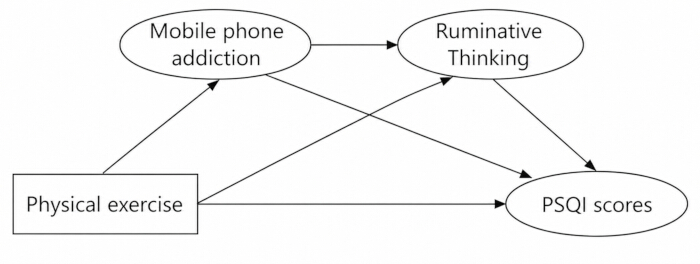
Figure 1: Hypothetical mediation model. This figure presents the proposed conceptual model linking physical exercise, mobile phone addiction, ruminative thinking, and PSQI scores. Higher PSQI scores indicate poorer sleep quality. Note: n = 1,300. Please click here to view a larger version of this figure.
Access restricted. Please log in or start a trial to view this content.
Protocol
All procedures involving human participants were conducted in accordance with the ethical standards of the Ankang University Review Committee and the 1964 Declaration of Helsinki and its later amendments. Ethical approval was obtained from the Ankang University Review Committee, Ankang University, China. No formal approval number was assigned. The study followed strict procedures to protect participant confidentiality. All participants provided written informed consent prior to participation. The research tools in the protocol are listed in the Table of Materials. Data preprocessing and descriptive analyses were performed using IBM SPSS Statistics 24.0. Structural equation modeling and model fit evaluation were conducted using IBM SPSS Amos 24.0. Mediation and chain mediation analyses were conducted using the PROCESS macro (version 3.5) with 5,000 bootstrap samples.
1. Stratified cluster sampling and participant recruitment
- Identify a target geographic region encompassing multiple accredited higher education institutions. Categorize all universities within the selected region into three distinct strata: comprehensive universities, normal (teaching) universities, and sports universities.
- Select a minimum of five universities across the defined strata using a random number generator to ensure institutional diversity. Access the official student enrollment directories for each selected institution.
- Stratify the student population within each university by academic year. Randomly select two intact academic classes from each academic year within each university to serve as the primary sampling clusters.
- Contact the course instructors or university counselors of the selected clusters and secure formal authorization for survey deployment.
2. Digital survey construction and deployment
- Digitize the Physical Activity Rating Scale-3 (PARS-3), the Mobile Phone Addiction Tendency Scale for College Students (MPATS), the Chinese version of the Ruminative Responses Scale (RRS), and the Chinese version of the Pittsburgh Sleep Quality Index (PSQI) into a unified digital questionnaire using the online survey platform listed in the Table of Materials. Configure the survey settings to require responses for all items to prevent missing data.
- Insert a digital informed consent form on the initial landing page. Configure the survey logic to terminate the session immediately if consent is declined.
- Generate unique URL links and scannable QR codes linked to the survey. Distribute the URLs and QR codes to students within the selected sampling clusters via class communication groups.
- Configure the survey platform to close data collection after a 14-day enrollment period. Export the finalized dataset in Comma-Separated Values (.csv) format.
3. Data importation and preprocessing
- Launch the statistical analysis software. Navigate to File → Open → Data and import the .csv dataset.
- Delete any row in which the standard deviation of Likert-scale responses equals zero, indicating straight-lining behavior. Identify the variable representing completion time and delete any row with a completion time of less than 120 s.
- Navigate to Transform → Replace Missing Values. Select MPATS and RRS items and apply the Series Mean imputation method.
- Exclude PARS-3 and PSQI items from imputation due to their scoring structures. Delete cases with missing data for these variables.
4. Variable scoring and computation
- Navigate to Transform → Compute Variable. Enter the formula Intensity × (Duration − 1) × Frequency to calculate the PARS-3 score.
- Navigate to Transform → Compute Variable. Enter SUM(MPATS_1 to MPATS_16) to compute the mobile phone addiction score.
- Navigate to Transform → Compute Variable. Enter SUM(RRS_1 to RRS_22) to compute the rumination score.
- Navigate to Transform → Recode into Different Variables to score the seven PSQI components (0–3 scale). Then compute the global PSQI score using SUM(PSQI_C1 to PSQI_C7). Higher PSQI scores indicate poorer sleep quality.
5. Common method bias evaluation
- Navigate to Analyze → Dimension Reduction → Factor. Move all scale items into the Variables box.
- Click Extraction. Set the method to Principal Components. Select a fixed number of factors and enter 1.
- Run Harman’s single-factor test. Verify that the variance explained by the first factor is less than 40.0%.
6. Descriptive statistics, standardization, and correlation analysis
- Navigate to Analyze → Descriptive Statistics → Descriptives. Move computed variables into the Variable(s) box.
- Select “Save standardized values as variables” to generate Z-scores.
- Navigate to Analyze → Correlate → Bivariate. Move standardized variables into the analysis box and select Pearson correlation.
7. Chain mediation analysis via regression macro (Model 6)
- Navigate to Analyze → Regression and launch the mediation macro. Assign the standardized PSQI variable as Y.
- Assign the standardized PARS-3 variable as X. Assign MPATS as the first mediator and RRS as the second mediator.
- Select Model 6. Enable total effect, effect size, and standardized coefficients.
- Set bootstrap samples to 5000. Run the analysis to obtain 95% confidence intervals for direct and indirect effects.
Access restricted. Please log in or start a trial to view this content.
Results
This study employed a cross-sectional design to explore college students’ physical exercise and related variables. Therefore, a common method bias test was conducted prior to analysis. An exploratory factor analysis was performed on all items from the Mobile Phone Addiction Scale, Ruminative Thinking Scale, Physical Activity Rating Scale, and the Pittsburgh Sleep Quality Index. The analysis revealed that seven factors had eigenvalues greater than 1, and the first factor explained 20.713% of the variance, which is below t...
Access restricted. Please log in or start a trial to view this content.
Discussion
This study showed that physical exercise was associated with PSQI scores through the mediating effect of mobile phone addiction, indicating that participation in physical exercise was associated with lower levels of mobile phone addiction and lower PSQI scores, which indicate better sleep quality, among college students. This finding broadens the understanding of the pathways through which physical activity is associated with sleep quality and highlights the significance of mobile phone addiction as a mediating variable....
Access restricted. Please log in or start a trial to view this content.
Disclosures
The authors declare that the research was conducted in the absence of any commercial or financial relationships that could be construed as a potential conflict of interest. An earlier version of this manuscript was posted as a preprint on Research Square33. The present version has been substantially revised and reformatted to meet JoVE requirements, including expanded protocol details, clarified statistical procedures, inclusion of materials information, revised figure and table legends, and improved interpretation of mediation results.
Acknowledgements
The authors thank all participants involved in this research. This work was supported by the Shaanxi Provincial Education Department Project for 2024 (Project Number 24JK0004), the Shaanxi Province “14th Five-Year Plan” Education Science Planning Project for 2024 (Project Number SGH24Q301), and the 2024 Shaanxi Provincial Sports Bureau Regular Project Initiation Project (Project Number 20240001).
Access restricted. Please log in or start a trial to view this content.
Materials
| Name | Company | Catalog Number | Comments |
|---|---|---|---|
| IBM SPSS Amos | IBM | Version 24.0 | Structural equation modeling and model fit evaluation |
| IBM SPSS Statistics | IBM | Version 24.0 | Data preprocessing, descriptive statistics, correlation analysis, and regression analysis |
| Mobile Phone Addiction Tendency Scale for College Students | Xiong et al. (2012)57 | N/A | Assessment of mobile phone addiction tendency |
| Online survey platform | Wenjuanxing | https://www.wjx.cn/ | Digital questionnaire construction and data collection |
| Physical Activity Rating Scale-3 | Liang (1994)58 | N/A | Assessment of physical exercise level |
| Pittsburgh Sleep Quality Index | Buysse et al. (1989)59; Liu et al. (1996)60 | N/A | Assessment of sleep quality over the previous month |
| PROCESS macro | Hayes (2022)61 | Version 3.5 | Bootstrap-based mediation and chain mediation analysis |
| Ruminative Responses Scale | Nolen-Hoeksema (1991)47; Nolen-Hoeksema et al. (2008)40; Han & Yang (2009)72 | N/A | Assessment of ruminative thinking |