This protocol outlines an integrated bioinformatic and machine-learning workflow to identify age-stratified pyroptosis biomarkers in acute respiratory distress syndrome (ARDS), coupled with an in vivo methodology using an LPS-induced rat model to experimentally validate the preliminary efficacy of spectrum energy water and far-infrared radiation.
Research Article
Age-Specific Pyroptosis Biomarker Analysis and Non-Pharmacological Intervention in Acute Respiratory Distress Syndrome
Yu Chen*1 , Tong Liu*2 , Yanpeng Zeng*3 , Yifan Chen4 , Qiao Zou5 , Yurong Kong5 , Yangmin Li1 , Guantong Shen3 , Xin Wang6 , Yan Li1
1Dongzhimen Hospital, Beijing University of Chinese Medicine, 2Third Affiliated Hospital, Beijing University of Chinese Medicine, 3Fangshan Hospital, Beijing University of Chinese Medicine, 4Xiamen Medical College, 5Beijing Huairou Hospital of Traditional Chinese Medicine, 6Guangdong Junfeng Spectrum Co., Ltd
Opens in a new tab
In This Article
Summary
Loading...
$$\rightleftharpoonup{xx}$$
$$\longleftharp{xx}$$,
$$\longrightharp{xx}$$,
Abstract
Loading...
$$\rightleftharpoonup{xx}$$
$$\longleftharp{xx}$$,
$$\longrightharp{xx}$$,
Acute respiratory distress syndrome (ARDS) is a life-threatening inflammatory lung disorder with high morbidity and mortality, in which pyroptosis has emerged as a pivotal pathogenic mechanism. Considering that age-related immune and molecular differences may influence pyroptosis and therapeutic response, this study aimed to identify age-specific pyroptosis-associated biomarkers and evaluate the therapeutic potential of spectrum energy water (SEW) combined with far-infrared radiation (FIR). The protocol's comprehensive workflow encompasses transcriptomic dataset processing, age stratification, machine learning, and immune infiltration analysis to identify age-specific hub genes. This computational phase is followed by in vivo experimental validation using an LPS-induced ARDS rat model, employing histological assessment, ELISA, and Western blotting to rigorously evaluate the SEW+FIR intervention and verify hub gene expression. Sixteen pyroptosis-associated genes were identified, among which AXL and GSDME were predominantly associated with ARDS severity in older patients, whereas SPP1 was more relevant in younger individuals. Distinct immune signatures were observed, with M2 macrophage enrichment and immunosuppression in older patients, contrasted by pro-inflammatory activation in younger ones. Functional analyses implicated these genes in metabolic, inflammatory, and immune regulatory pathways. In vivo, SEW+FIR treatment alleviated lung injury, suppressed the production of inflammatory cytokines (IL-1β, IL-18, IL-6, TNF-α), and modulated the expression of AXL, GSDME, and SPP1. Collectively, these findings underscore age-dependent differences in pyroptosis-related mechanisms in ARDS and identify AXL, GSDME, and SPP1 as preliminary biomarker candidates that warrant further clinical validation. In the current murine experimental model, SEW+FIR demonstrated protective effects by alleviating systemic inflammation and modulating pyroptosis-related signaling, providing foundational in vivo support for its potential as a non-pharmacological adjunctive strategy.
Introduction
Loading...
$$\rightleftharpoonup{xx}$$
$$\longleftharp{xx}$$,
$$\longrightharp{xx}$$,
Acute lung injury (ALI)/acute respiratory distress syndrome (ARDS) is a severe respiratory disease characterized by an acute onset of severe hypoxemia and non-cardiogenic pulmonary edema, primarily resulting from diffuse alveolar damage1. It can be triggered by a range of pulmonary and extrapulmonary insults. Pulmonary causes include infectious pneumonia, aspiration of gastric contents, and severe thoracic trauma, while extrapulmonary triggers arise from systemic inflammatory responses secondary to non-pulmonary insults, such as sepsis, pancreatitis, non-thoracic trauma, severe burns, massive transfusion, and reperfusion injury following lung transplantation or thrombectomy1,2. Despite advances in supportive care, ARDS remains a major clinical challenge in critical care medicine, with high morbidity and mortality rates worldwide3. Therefore, understanding the pathogenesis of ALI/ARDS is crucial for developing effective treatments.
Pyroptosis, an inflammatory form of programmed cell death that has been extensively characterized in the context of tumor suppression and oncological therapies4, is now recognized as a pivotal player in ARDS pathophysiology5. Unlike apoptosis, pyroptosis is mediated by inflammasome activation and subsequent cleavage of gasdermin D (GSDMD), leading to membrane pore formation, cell lysis, and the release of pro-inflammatory cytokines such as interleukin-1β (IL-1β) and interleukin-18 (IL-18)6. In ARDS, excessive pyroptosis activation in alveolar macrophages, epithelial cells, and endothelial cells contributes to an exaggerated inflammatory response, alveolar-capillary barrier disruption, pulmonary edema, and progression of hypoxemia7. Growing evidence suggests that targeting key regulators in the pyroptosis pathway may represent a novel strategy to attenuate inflammation and improve clinical outcomes in ARDS8,9. However, a critical knowledge gap remains regarding the impact of aging—a key determinant of ARDS susceptibility and prognosis—on the pyroptotic landscape. Current studies often treat ARDS as a monolithic condition, overlooking the potential for age-specific molecular drivers that could dictate personalized therapeutic responses.
In recent years, the application of novel biophysical interventions and advanced functional materials—such as SEW and far-infrared radiation (FIR) emitters—has gained traction as non-pharmacological strategies to modulate immune responses and suppress inflammation10,11. These therapies have been reported to enhance leukocyte proliferation and phagocytic activity, reduce tissue edema, and mitigate endotoxin-induced microcirculatory disturbances—including leukocyte adhesion, erythrocyte aggregation, platelet activation, and endothelial injury12,13,14. In lipopolysaccharide (LPS)-induced ARDS rats, combined SEW and FIR treatment significantly reduced the levels of IL-1β and IL-18—the signature downstream effectors of the pyroptotic cascade—in both serum and bronchoalveolar lavage fluid (BALF). This evidence strongly suggests that the protective effects of SEW+FIR may be mediated through the suppression of inflammasome-driven cell death. Furthermore, SEW, when applied either independently or as a solvent medium, was found to lower the expression levels of interleukin-8 (IL-8) and tumor necrosis factor-α (TNF-α), while raising the expression levels of interleukin-4 (IL-4) and interleukin-10 (IL-10) in blood serum and ameliorating histopathological lung damage15,16,17,18.
Building on these observations, we hypothesized that the therapeutic efficacy of combined SEW and FIR (SEW+FIR) in ARDS is predicated on its ability to modulate age-specific pyroptotic pathways, thereby restoring pulmonary immune homeostasis in a targeted manner. Currently, the mainstay of ARDS management relies on mechanical ventilation and limited pharmacological agents such as corticosteroids, which frequently carry risks of ventilator-induced lung injury or systemic immunosuppression19. Compared to these conventional therapies, SEW+FIR offers a non-invasive, non-pharmacological alternative that may safely attenuate early-stage inflammatory cascades without secondary organ toxicity. Practically, this protocol is most suitable as an early adjunctive intervention for mild-to-moderate ARDS. Its primary limitation is that its efficacy in severe, late-stage fibrotic ARDS remains unproven, and it cannot replace essential life-support measures in a critical care setting. To test our hypothesis, we pioneered an integrated pipeline that bridges age-stratified transcriptomic profiling and machine learning with vivo validation. This approach not only identifies AXL, GSDME, and SPP1 as novel, age-specific therapeutic targets but also provides the first mechanistic evidence for the clinical potential of SEW+FIR as a precision non-pharmacological intervention for ARDS.
Protocol
Loading...
$$\rightleftharpoonup{xx}$$
$$\longleftharp{xx}$$,
$$\longrightharp{xx}$$,
All animal experimental procedures were strictly performed in accordance with the guidelines approved by the Experimental Animal Welfare and Ethics Committee of Dongzhimen Hospital, Beijing University of Chinese Medicine (Approval No. 19-54), prior to the commencement of the study.
Data source and data processing
Two gene expression datasets (GSE89953 and GSE116560) were retrieved from the Gene Expression Omnibus (GEO) database20. The dataset GSE89953, which includes whole-alveolar macrophage transcriptomic data from ARDS patients across different age groups, was used for differential expression and network analysis. The GSE116560 dataset, which includes clinical information such as mechanical ventilation status, was used for machine learning and prognostic modeling. Additionally, 608 genes associated with pyroptosis were extracted from a comprehensive human gene annotation database, using a correlation score greater than 1 as the screening criterion. Gene expression data were normalized using the limma package in R. Clinical trial number: not applicable.
Identification of DEGs
The patients in the GSE89953 dataset were stratified into two age groups: low-age (<45 years) and high-age (≥45 years). This cutoff was selected based on epidemiological evidence suggesting that the median age of ARDS onset is approximately 45 years21. To ensure the robustness of this threshold, sensitivity analyses were conducted using alternative age cutoffs (50 and 55 years). These analyses demonstrated consistent patterns in hub gene identification and module clustering, thereby statistically validating the 45-year cutoff for subsequent downstream analyses. The dataset was normalized using the limma package in R. Differentially expressed genes (DEGs) between age groups were identified using linear modeling with empirical Bayes moderation. Genes with an adjusted P value < 0.05 and |log₂ fold change| ≥ 0.5 were considered statistically significant DEGs. Volcano plots and heatmaps were generated to visualize DEGs using the ggplot2 package in R.
Pyroptosis-associated gene identification and enrichment analysis
Pyroptosis-related genes were retrieved from the gene annotation database using the keyword “pyroptosis.” The intersection of DEGs and pyroptosis-associated genes was defined as differentially expressed pyroptosis-related genes (DEPGs). Gene Ontology (GO) and Kyoto Encyclopedia of Genes and Genomes (KEGG) pathway enrichment analyses of DEPGs were conducted using the clusterProfiler package in R22. The categories of Biological Process (BP), Cellular Component (CC), and Molecular Function (MF) were annotated, and Z-score ≥ 1 and adjusted P values < 0.05 were considered significant.
Weighted gene co-expression network analysis (WGCNA)
To identify gene modules associated with pyroptosis, WGCNA was performed using the WGCNA R package. A signed network was constructed using a soft-threshold power (β) of 26 to ensure scale-free topology23. Modules were identified via the dynamic tree-cut algorithm with a minimum module size of 30, a deep split of 2, and a merging threshold (cut height) of 0.25. The correlation between module eigengenes and pyroptosis traits was calculated. Gene set variation analysis (GSVA) was performed on selected modules using hallmark gene sets downloaded from MsigDB24,25.
Machine learning
The GSE116560 dataset was divided into high- and low-age groups using 45 years as the cutoff, and both groups were analyzed using machine learning algorithms. Least Absolute Shrinkage and Selection Operator (LASSO) regression analysis was implemented using the glmnet package (version 4.1-2) in R, with the optimal penalty parameter (λ) determined by 10-fold cross-validation (1-SE criteria). For the Random Forest (RF) algorithm, 500 trees (ntree = 500) were constructed, and the number of features sampled at each split (mtry) was set to the square root of the total number of predictors to ensure model stability. Overlapping genes from both methods were defined as age-specific signature genes.
Construction and evaluation of diagnostic models
A diagnostic prediction model was constructed based on the identified signature genes. Logistic regression was employed to develop the model, and a nomogram was created to visualize its predictive power. The model's performance was evaluated using a receiver operating characteristic (ROC) curve, and the area under the curve (AUC) was calculated to assess its diagnostic accuracy. Internal validation was performed via bootstrap resampling. Further assessment of model stability and clinical utility was performed using calibration plots and decision curve analysis (DCA).
Immune infiltration analysis
Immune cell composition in high-age and low-age groups was estimated using the CIBERSORT algorithm based on the LM22 signature matrix. The relative proportions of 22 immune cell types were compared between groups. Differential expression of hub genes across immune cell subsets was analyzed using single-sample data and visualized in heatmaps and histograms.
Gene set enrichment analysis (GSEA)
GSEA was performed separately on hub genes from the high- and low-age groups. Gene Set Enrichment Analysis (GSEA) was performed utilizing the Kyoto Encyclopedia of Genes and Genomes (KEGG) gene sets. Genes were ranked based on the signal-to-noise ratio (or fold Change) between high- and low-expression groups. Enrichment and normalized enrichment scores (NES) were then calculated using 1,000 permutations to identify significantly enriched pathways. Pathways with a false discovery rate (FDR) of less than 0.25 and a nominal P value of less than 0.05 were significantly enriched. This analysis was then used to infer the biological pathways that may be regulated by each hub gene.
Experimental animals
Eighteen male SPF Sprague Dawley rats (aged 6 to 7 weeks, 180 g ± 10 g) were utilized in this study. Detailed supplier information is listed in the Table of Materials.
Reagents and instruments
Electromagnetic field-treated water preparation devices and far-infrared emission instruments were utilized for experimental interventions to provide spectrum energy water (SEW) and far-infrared radiation (FIR), respectively. Lipopolysaccharide (LPS) was used to model ARDS. Cytokine levels (IL-1β, IL-18, IL-6, TNF-α) were quantified using specific ELISA kits. Protein expression levels (AXL, SPP1, Caspase-3, GSDME, GAPDH) were assessed using specific primary antibodies and corresponding HRP-conjugated secondary antibodies. Sample processing and analysis were performed using standard laboratory equipment, including a biomicroscope, a microtome, a high-speed centrifuge, an ultra-low-temperature freezer, and a microplate reader. Complete details of all reagents, antibodies, and instruments, along with their respective manufacturers, are provided in the Table of Materials.
Animal grouping and modeling
Eighteen Sprague-Dawley rats were randomly assigned to the Control, Model, and SEW+FIR groups, with six rats per group. Each group was weighed and documented daily. The SEW+FIR group received FIR therapy (wavelength 4 µm–14 µm, irradiation distance of 20 cm from the dorsal surface) for 20 min daily in a temperature-controlled environment (22 °C ± 2 °C), while simultaneously receiving SEW at a dose of 1 mL/100 g/d by oral gavage7. Distilled water was administered orally to the Control and Model groups at an equivalent dose of 1 mL/100 g/d. SEW and distilled water were administered once daily for 7 days after heating in a 60 °C warm bath. On the seventh day, 6 hours after feeding, the Model and SEW+FIR groups were injected with LPS solution at a dose of 2 mg/kg by weight through the tail vein, whereas the Control group was treated with 0.9% physiological saline at a dose of 2 mg/kg by weight. The modeling technique was considered a mature and stable method for inducing a systemic inflammatory response with a single LPS injection via the tail vein. Lung tissue from the lung pathology in the modeled groups was consistent with ARDS characteristics25. Checkpoint: Successful ARDS induction is indicated by visible lethargy, tachypnea, and a ~10% reduction in body weight within 16 h post-injection26.
Collection of rat-related indicators
Sixteen hours later, all three groups were injected intraperitoneally with 3% pentobarbital sodium at a dose of 30 mg/kg body weight to induce anesthesia. CRITICAL: Depth of anesthesia must be strictly confirmed by the loss of pedal withdrawal reflex prior to any procedural intervention. Furthermore, strict biosafety protocols were maintained; all LPS-contaminated materials, biological fluids, and animal carcasses were disposed of in designated biohazard waste containers for proper incineration. Five milliliters of blood were collected from the abdominal aorta into sterile tubes, and serum was isolated by centrifugation at 1,000 x g for 20 min at 4 °C. The serum was then stored at −80 °C for further analysis. Following thoracotomy and ligation of the right pulmonary hilum, bronchoalveolar lavage fluid (BALF) was obtained by flushing the left lung three times with pre-cooled phosphate-buffered saline (PBS) via an endotracheal cannula. The BALF was then centrifuged at 1,000 x g for 10 min at 4 °C, and the supernatant was stored at −80 °C. The upper lobe of the right lung was removed and cleaned in cold physiological saline to remove the blood. Nine volumes of physiological saline were added relative to the tissue weight, and the sample was minced in an ice bath using ophthalmic scissors. A 10% lung tissue homogenate was prepared using a homogenizer, followed by centrifugation at 700 x g for 15 min at 4 °C. The supernatant was collected and stored at −80 °C for further biochemical analysis. Additionally, a portion of the right lung tissue from each rat was fixed in 4% paraformaldehyde for histological examination.
Observation indicators and detection methods
The inferior lobe of the right lung was processed using standard embedding, tissue slicing, dewaxing, HE staining, color separation, dehydration, and film sealing after fixation in 4% paraformaldehyde. Each group's lung tissues showed pathological alterations observed under a light microscope.
Pathological abnormalities in alveolar architecture and septum, degree of inflammatory cell infiltration, hyperemia, and pulmonary capillary edema were identified under a light microscope. The Department of Pathology at Beijing University of Chinese Medicine assisted with the observation. Histological lung injury score was calculated to assess lung injury as follows: no injury = 0, injury in less than 25% of the field = 1, injury in 25–50% of the field = 2, injury in 50–75% of the field = 3, and injury in more than 75% of the field = 4. Ten fields were randomly selected and assessed by investigators blinded to the grouping.
ELISA was performed on the previously collected BALF supernatant, lung tissue homogenate, and blood serum samples according to the manufacturer's instructions. Briefly, samples were incubated in pre-coated wells at 37 °C for 90 min. After washing five times with wash buffer, biotinylated detection antibodies (1:100 dilution) were applied for 60 min at 37 °C. Following another washing step, HRP-conjugate was added and incubated in the dark for 30 min at 37 °C. Subsequently, absorbance was measured at 450 nm using a microplate reader to calculate sample concentrations.
Western blot analysis was performed to assess the expression levels of AXL, SPP1, caspase-1, GSDMD, caspase-3, GSDME, and GAPDH in lung tissue and BALF samples stored at −80°C. The proteins were harvested and lysed according to the instructions in the Protein Extraction Kit. Equal amounts of protein extracts (40 µg) were loaded per lane and resolved by SDS-PAGE. The polypeptides were then separated and transferred to PVDF membranes. The membranes were blocked with 5% non-fat dry milk in TBST for 1 h at room temperature and then incubated overnight at 4 °C with the specific primary antibodies (diluted 1:1000). After washing with TBST three times for 10 min each, the membranes were incubated with the corresponding HRP-conjugated secondary antibodies (diluted 1:5000) in blocking solution at room temperature for 1 h. GAPDH was used as an internal reference protein. Protein bands were visualized using an enhanced chemiluminescence (ECL) kit with an exposure time of 1–5 min, and the results were analyzed using image processing software. The relative expression levels of the target proteins were calculated as the ratio of the target protein to GAPDH.
Statistical analysis
Quantitative indices were expressed as mean ± standard deviation, and statistical analysis was performed using statistical software. The Kruskal–Wallis test or one-way ANOVA was used to compare differences across several groups, depending on whether the data were normally distributed. All statistics were assessed using a two-sided hypothesis test. For analyses involving multiple comparisons, such as differential gene expression and immune cell infiltration profiling, P values were adjusted using the Benjamini-Hochberg false discovery rate (FDR) method. An adjusted P value of 0.05 or lower was regarded as statistically significant. Graphing software was used for charting.
Results
Loading...
$$\rightleftharpoonup{xx}$$
$$\longleftharp{xx}$$,
$$\longrightharp{xx}$$,
Identification of DEGs in GSE89953 different age groups and corresponding functional enrichment analysis
Raw expression data from the GSE89953 dataset were normalized using the normalizeBetweenArrays function in the limma package (Figure 1A), and boxplots before and after normalization confirmed improved consistency across samples. Differential expression analysis based on the normalized matrix identified 228 DEGs (adjusted p < 0.05 using Benjamini-Hochberg correction, |log₂FC| ≥ 0.5), including 16 significantly upregulated and 43 significantly downregulated genes in the high-age group (Figure 1B, C). By intersecting these DEGs with pyroptosis-related genes from the database, 16 differentially expressed pyroptosis-associated genes (DEPGs) were obtained (Figure 1D). Notably, in the high-age group compared with the low-age group, the initial expression levels of AXL and GSDME were significantly upregulated, whereas SPP1 was markedly downregulated, establishing distinct age-dependent expression profiles. GO enrichment analysis revealed that these DEPGs were mainly involved in biological processes such as positive regulation of cytokine production and negative regulation of endopeptidase activity, were localized to structures including lipoprotein particles and mitochondrial outer membranes, and exhibited molecular functions such as NAD binding, antioxidant activity, and protein serine/threonine/tyrosine kinase activity (Figure 1E). No statistically significant KEGG pathways were identified, possibly due to the small number of DEPGs.
Identification of key gene modules in different age groups in GSE89953 via WGCNA analysis
We performed weighted gene co-expression network analysis (WGCNA) to identify the relationship between gene expression modules and pyroptosis-related traits in the GSE89953 dataset. A clustering dendrogram of the high-age and low-age samples was generated to identify co-expression modules (Figure 2A), and the correlations between these modules and clinical traits were evaluated (Figure 2B). Subsequently, a “soft” threshold β of 26 was chosen based on the scale independence and average connectivity to ensure a scale-free network (Figure 2C). Fifteen gene co-expression modules, colored differently, were obtained with a module merge threshold of 0.25 and a minimum module size of 30. Among these, the green module (r = 0.41, p = 0.04) was most significantly correlated with pyroptosis. The GSVA results revealed that pathways such as Oxidative phosphorylation, Unfolded protein response, PI3K-AKT-MTOR signaling, and TGF-β signaling were significantly upregulated in samples with higher pyroptosis module activity scores. In contrast, pathways related to KRAS signaling were significantly downregulated (Figure 2D). The blue module, containing 267 genes, was selected as the feature module based on the correlation coefficient and P value. Finally, we identified 16 common differential genes by cross-tabulating the blue module genes with the pyroptosis-related gene set (Figure 2E).
Machine learning identification of hub genes involved in ARDS progression in GSE116560 different age groups
To explore age-related differences in pyroptosis-associated gene expression and their prognostic value, patients in the GSE116560 dataset were stratified into high-age (≥45 years) and low-age (<45 years) groups. Sixteen previously identified pyroptosis-related genes were analyzed in each group using LASSO and Random Forest (RF) algorithms, with mechanical ventilation status as the clinical endpoint. Gene selection in LASSO was based on non-zero coefficients, while RF used Mean Decrease Accuracy (MDA) and Mean Decrease Gini (MDG).
In the high-age group, signature genes were identified using LASSO (Figure 3A) and RF (Figure 3B) algorithms. Similarly, in the low-age group, gene selection was performed using LASSO (Figure 3C) and RF (Figure 3D). Ultimately, 4 overlapping signature genes for the high-age group and 5 for the low-age group were identified from the intersection of these respective models (Figure 3E).
Diagnostic model construction for predicting ARDS progression
We further focused on the machine-learning-identified genes and evaluated their performance in predicting ARDS prognosis. Using ROC analysis, we found that multiple genes showed good diagnostic efficacy in predicting the need for mechanical ventilation. AXL and GSDME exhibited high area under the curve (AUC) values (all >0.70) in the high-age group, suggesting their potential to identify disease progression. Meanwhile, SPP1 demonstrated consistent predictive ability in the low-age group. These core genes identified across different age groups were subsequently integrated into diagnostic models for further validation (Figure 4).
To explore age-specific diagnostic efficacy, we constructed separate predictive models for the high- and low-age groups. In both groups, nomograms integrating key diagnostic genes were developed to visualize the individual risk of ARDS progression. The ROC curve analysis showed that in the high-age group, AXL and GSDME exhibited high discriminative power with AUC values exceeding 0.70 (Figure 4A), whereas in the low-age group, SPP1 showed consistent diagnostic accuracy (Figure 4B). The calibration curves in both age groups showed strong concordance between predicted and observed probabilities, indicating good calibration. Furthermore, the DCA curves supported the clinical benefit of incorporating these diagnostic genes into predictive models for both age groups.
Immune characteristics of hub genes in ARDS in different age groups
To explore immune microenvironment characteristics associated with ARDS across different age groups, we performed immune infiltration analysis using gene expression profiles from the high- and low-age subgroups. The results revealed distinct patterns of immune cell infiltration between the two groups. The low-age group demonstrated a pro-inflammatory signature characterized by elevated infiltration of undifferentiated Macrophages (M0) and Monocytes. Conversely, the high-age group exhibited dominant immunosuppressive features with significantly higher Macrophages M2 infiltration, which typically promote tissue remodeling and immune suppression. Additionally, the low-age group showed enhanced adaptive immune potential, evidenced by increased naive CD4+ T cells, absent in the high-age group (Figure 5A).
We analyzed the expression levels of AXL, GSDME, and SPP1 across various immune cell types in each age group to assess their potential roles in immune modulation. In the high-age group, AXL expression was significantly elevated in M2 macrophages and naive CD4+ T cells, decreased in monocytes and activated dendritic cells, suggesting a possible involvement in immunosuppressive pathways. GSDME was notably upregulated in activated dendritic cells and monocytes and downregulated in M1 and M0 macrophages, consistent with its role in pyroptosis-related inflammatory responses (Figure 5B). In the low-age group, SPP1 expression was notably upregulated in the activated dendritic cells and monocytes, indicating its association with a pro-inflammatory immune phenotype (Figure 5C). This aligns with SPP1's known role in promoting immune cell activation and inflammatory responses.
Gene set enrichment analysis (GSEA) of hub genes in ARDS different age groups
To elucidate the biological relevance of the hub genes in age-related ARDS, we performed gene set enrichment analysis (GSEA) in both high-age and low-age groups using KEGG gene sets, focusing on AXL, GSDME, and SPP1 expression patterns (Figure 6).
GSEA of AXL identified five pathways that were significantly enriched (nominal p < 0.05). Among them, lysine degradation (ES = 0.5916, p = 0.0040) and fatty acid metabolism (ES = 0.4930, p = 0.0373) were upregulated, suggesting enhanced metabolic activity in AXL-high individuals. Conversely, long-term potentiation (ES = –0.4446, p = 0.0041), ERBB signaling (ES = –0.3970, p = 0.0285), and GnRH signaling (ES = –0.3917, p = 0.0450) were downregulated, indicating potential impairment in neuroendocrine and proliferative signaling.
GSEA of GSDME expression revealed six significantly enriched pathways (nominal P value [NP] < 0.05). Among them, five pathways were significantly upregulated: protein export showed the strongest enrichment (ES = 0.7937, NP = 0.0291), followed by the NOD-like receptor signaling pathway (ES = 0.7497, NP = 0.0407), cytokine–cytokine receptor interaction (ES = 0.6175, NP = 0.0306), antigen processing and presentation (ES = 0.5235, NP = 0.0212), and phagosome (ES = 0.5052, NP = 0.0393). In contrast, one pathway was significantly downregulated: drug metabolism via cytochrome P450 (ES = −0.5016, NP = 0.0320), indicating potential suppression of metabolic detoxification processes in GSDME-high samples.
GSEA of SPP1 expression revealed eight significantly enriched pathways (nominal P value [NP] < 0.05). Among them, five pathways were significantly upregulated: protein export showed the highest enrichment score (ES = 0.7463, NP = 0.0224), followed by glycosaminoglycan biosynthesis – chondroitin sulfate (ES = 0.6430, NP = 0.0196), selenoamino acid metabolism (ES = 0.6401, NP = 0.0426), melanogenesis (ES = 0.5176, NP = 0.0213), and Vibrio cholerae infection (ES = 0.5106, NP = 0.0039). Conversely, three pathways were downregulated, with drug metabolism via cytochrome P450 exhibiting the most significant inhibition (ES = –0.6525, NP < 0.0001), followed by xenobiotic metabolism by cytochrome P450 (ES = –0.6188, NP = 0.0020) and arachidonic acid metabolism (ES = –0.5076, NP = 0.0251).
Treatment with SEW+FIR alleviates LPS-induced ARDS in rats
Initially, an LPS-induced ARDS rat model was established to systematically evaluate the potential protective efficacy of SEW+FIR intervention. The results indicate that SEW+FIR significantly alleviated the pathological changes and inflammatory response of LPS-induced rats. The lung tissues of the control group exhibited intact alveolar architecture with distinct septa, entirely devoid of interstitial hyperemia, edema, or inflammatory cell infiltration. Damage to the alveolar space and interstitium was seen in the lung tissue of the Model group, along with thicker alveolar walls, alveolar collapse, and inflammatory exudate. Conversely, SEW+FIR treatment substantially mitigated these pathological alterations, resulting in significantly reduced inflammatory exudation, hemorrhage, and alveolar collapse compared with the model group. A moderately clear alveolar structure could be observed (Figure 7A). The Histological Lung Injury Score in the model group was higher than that in the control group, whereas the score in the SEW + FIR group was significantly lower than that in the model group (Figure 7B). Compared to the control group, serum from the model group showed significantly increased IL-1β and IL-18 expression. Compared with the model group, serum from the SEW+FIR group showed significantly lower levels of IL-1β and IL-18 (Figure 7C).
To further evaluate the lung inflammatory response, we measured IL-1β, IL-18, IL-6, and TNF-α levels in lung tissue homogenates and BALF using ELISA. In the Model group, all four inflammatory cytokines were markedly elevated across all samples, indicating a robust inflammatory state. Following SEW+FIR intervention, the levels of all measured cytokines were significantly reduced in both lung tissue and BALF, reflecting a pronounced anti-inflammatory effect (Figure 7D,E). Integrated analysis of inflammatory cytokine changes further demonstrated that SEW+FIR effectively reduced the overall inflammatory burden associated with LPS-induced ARDS (Figure 7F). These findings suggest that SEW+FIR exerts therapeutic efficacy at least in part by suppressing the excessive inflammatory response associated with ARDS.
Effects of SEW+FIR intervention on molecular-level biomarkers: AXL, GSDME, and SPP1
To experimentally validate the machine-learning-identified hub genes, we measured protein expression levels of AXL, GSDME, and SPP1—three hub genes previously selected via integrative bioinformatics and feature selection methods (Figure 8A). Western blot analysis of lung homogenates revealed that AXL expression was significantly increased in the SEW+FIR treatment group compared with the model group, indicating activation of potential tissue-protective signaling pathways (Figure 8B). Conversely, GSDME, a pyroptosis-related effector, showed a marked reduction in expression following SEW+FIR intervention (Figure 8C, D). Furthermore, to evaluate the downstream pyroptotic execution, we measured the cleavage of Caspase-3 and GSDME. Consistent with the attenuation of pyroptosis, SEW+FIR treatment significantly reduced cleaved Caspase-3 and GSDME-N levels compared with the model group (Figure 8E,F). Additionally, the pro-inflammatory mediator SPP1 was significantly downregulated in the treated group (Figure 8G). These findings confirm that SEW+FIR modulates the expression of machine learning-derived core biomarkers at the protein level, supporting its role in mitigating inflammation and pyroptosis in lung tissue.
Summary of Key Findings: In conclusion, our multi-cohort analysis identified age-specific pyroptosis biomarkers, specifically AXL and GSDME for older patients and SPP1 for younger individuals, each associated with distinct immune microenvironments. Subsequent in vivo experiments confirmed that the SEW+FIR intervention effectively mitigates ARDS-related lung injury and systemic inflammation, demonstrating targeted modulation of these hub proteins.
DATA AVAILABILITY:
The raw transcriptomic datasets analyzed in this study are publicly available in the Gene Expression Omnibus (GEO) repository under accession numbers GSE89953 and GSE116560. The original experimental data generated during this study, including uncropped Western blot images, histological assessment data, and ELISA datasets, are available from the corresponding author upon reasonable request.
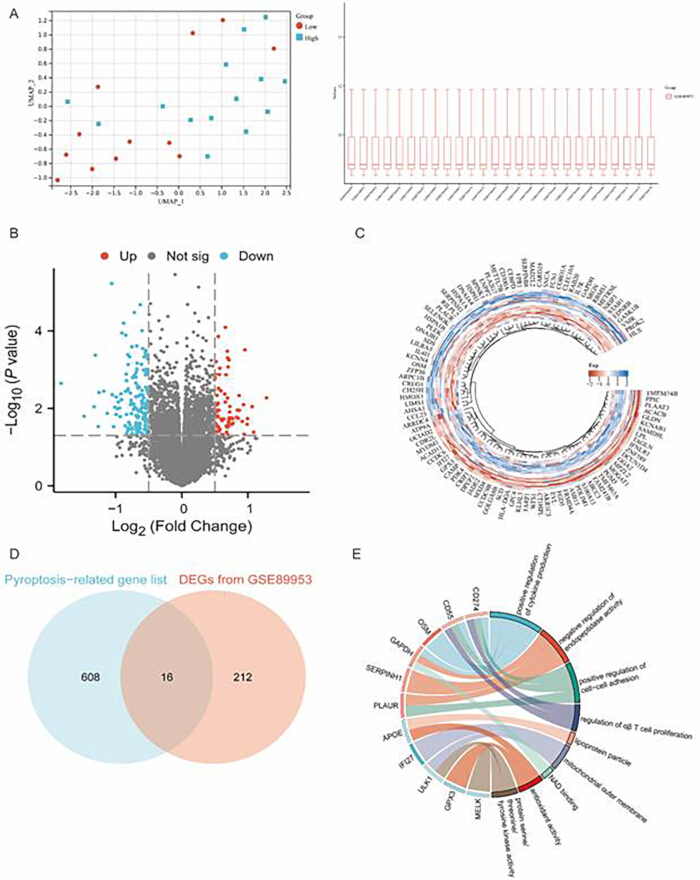
Figure 1: Multidimensional analysis and intersection of differentially expressed genes in the GSE89953 dataset. (A) UMAP dimensionality reduction (left) and boxplot normalization (right) of samples from the GSE89953 dataset. (B) The volcano plot shows DEGs, with red and blue triangles indicating significant genes. (C) Circular heatmap displaying the expression profiles of top DEGs. The inner-to-outer rings represent expression values from low to high, with red indicating upregulation and blue indicating downregulation. (D) Venn diagram showing the overlap between DEGs from the GSE89953 dataset and a curated list of pyroptosis-related genes. (E) Chord diagram showing the functional enrichment analysis (Gene Ontology biological processes) of the 16 intersected genes. Please click here to view a larger version of this figure.
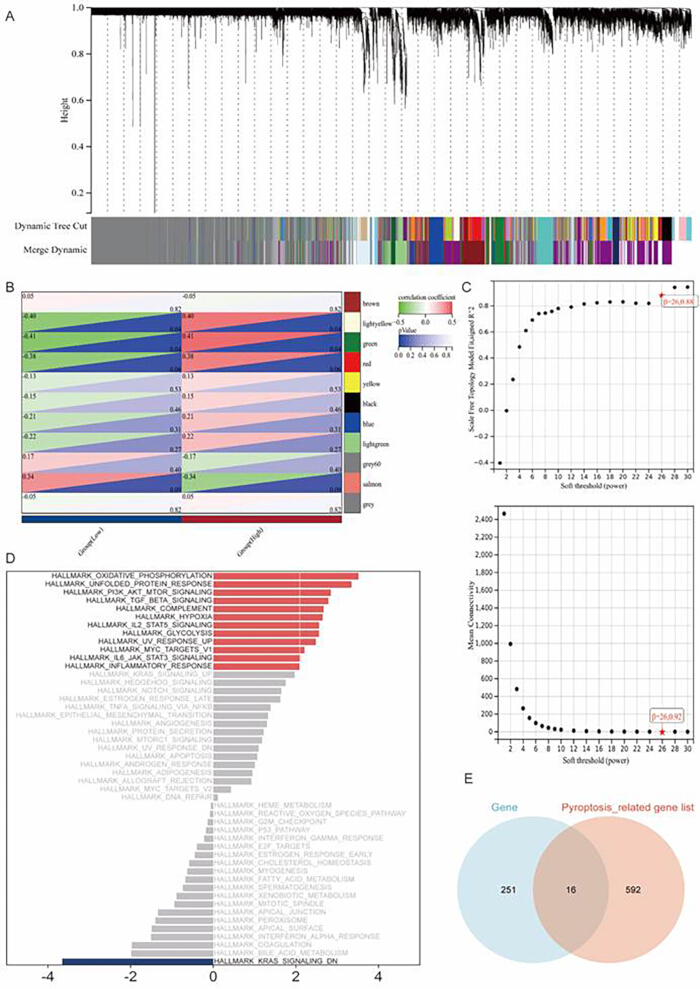
Figure 2: WGCNA and functional enrichment of key modules. (A) Clustering dendrogram of the high-age and low-age samples. (B) Heatmap showing the correlations between module eigengenes and clinical traits. (C) Analysis of the soft-thresholding power (β) for the scale-free topology fit index and mean connectivity. (D) Gene Set Variation Analysis (GSVA) of pathways in the selected modules. (E) Venn diagram displaying the overlap between genes in the blue module and the pyroptosis-related gene set. Please click here to view a larger version of this figure.
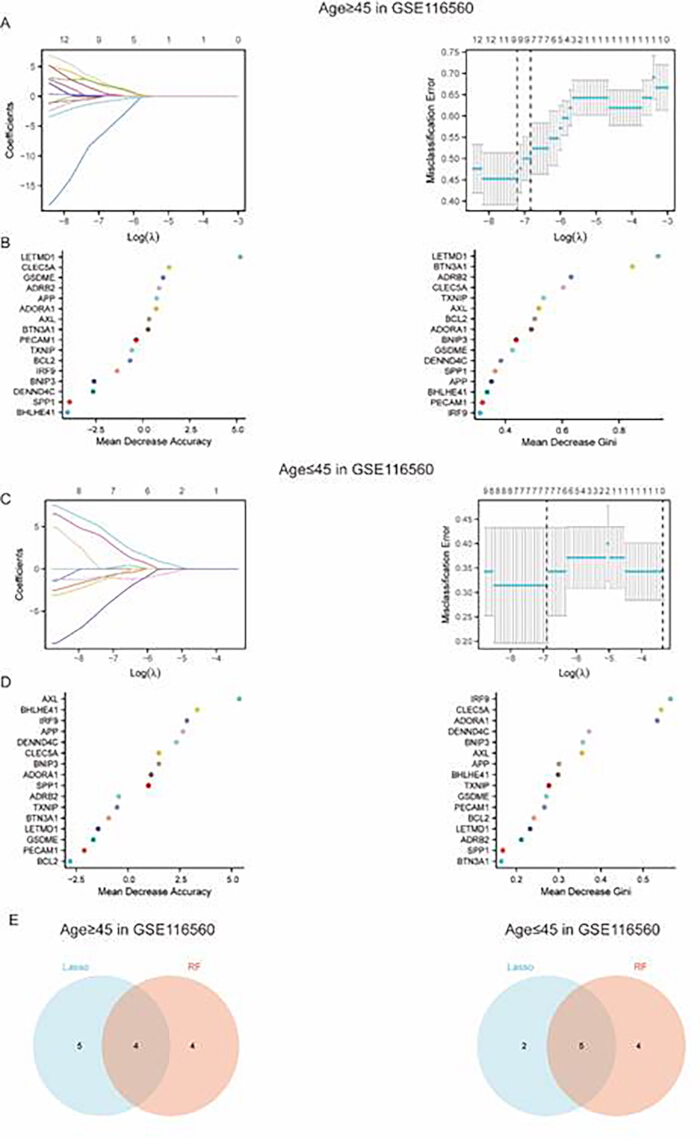
Figure 3: Machine learning identification of signature genes. (A) LASSO regression analysis for patients aged ≥ 45 years. (B) Random forest analysis for patients aged ≥ 45 years. (C) LASSO regression analysis for patients aged < 45 years. (D) Random forest analysis for patients aged < 45 years. (E) Venn diagrams showing the overlap of feature genes identified by LASSO and random forest methods for both age groups. Please click here to view a larger version of this figure.
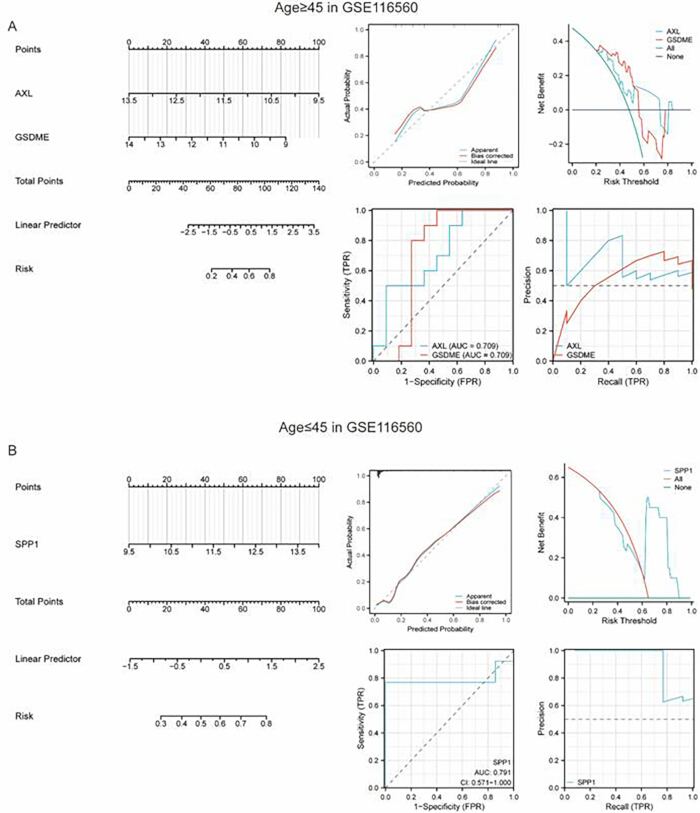
Figure 4: Diagnostic model evaluation. (A) Nomogram, calibration curve, decision curve analysis (DCA), receiver operating characteristic (ROC) curve, and precision-recall (PR) curve for predicting outcomes in the GSE116560 dataset for patients aged ≥ 45 years. The nomogram integrates AXL and GSDME to predict risk. (B) Nomogram, calibration curve, DCA, ROC curve, and PR curve for predicting outcomes in the GSE116560 dataset for patients aged < 45 years. The nomogram uses SPP1 to predict risk. Please click here to view a larger version of this figure.
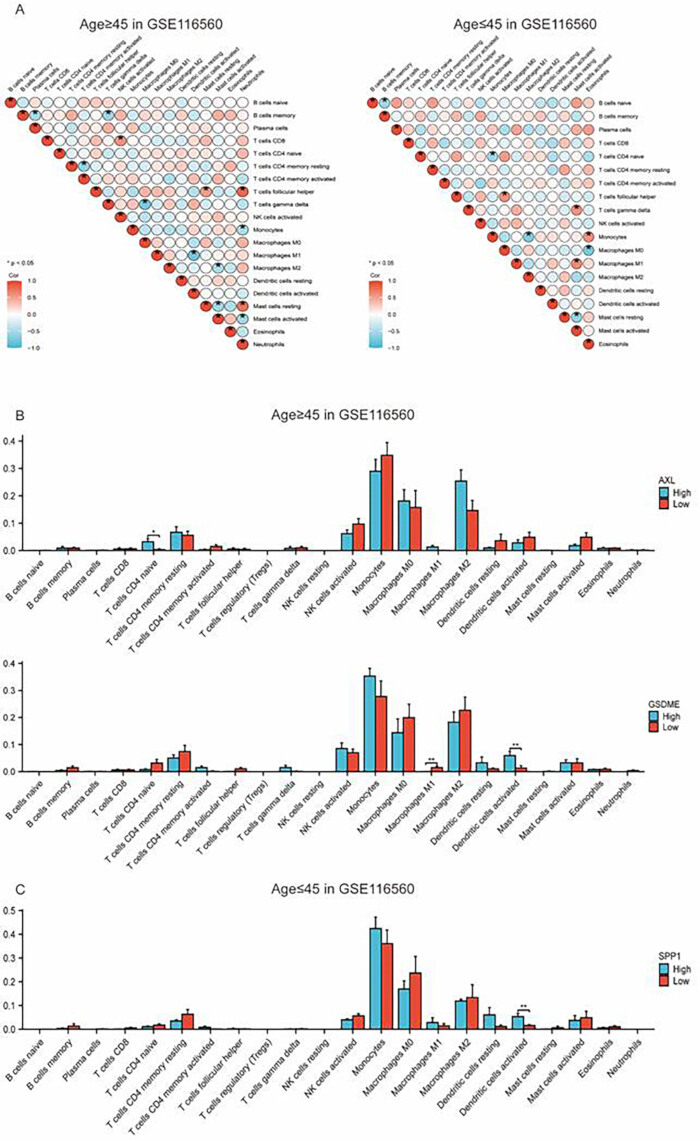
Figure 5: Immune infiltration landscape and immune cell correlations of hub genes in ARDS. (A) Correlation heatmaps of immune cell infiltration in the GSE116560 dataset, stratified by age (≥45 years on the left, ≤45 years on the right). Each dot represents a type of immune cell, with color indicating the correlation coefficient (red for positive, blue for negative) and significance (*p < 0.05) (B) Bar plots showing the differences in immune cell infiltration levels between high - and low - expression groups of AXL (upper) and GSDME (lower) in the GSE116560 dataset for patients aged ≥ 45 years (C) Bar plot depicting the differences in immune cell infiltration levels between high - and low - expression groups of SPP1 in the GSE116560 dataset for patients aged ≤ 45 years. Please click here to view a larger version of this figure.
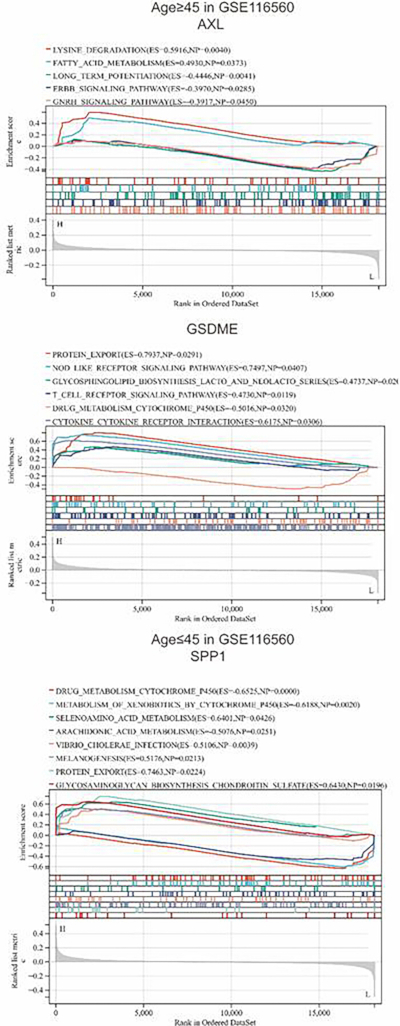
Figure 6: Enrichment plots for AXL (Age ≥ 45), GSDME (Age ≥ 45), and SPP1 (Age ≤ 45) in GSE116560. Please click here to view a larger version of this figure.
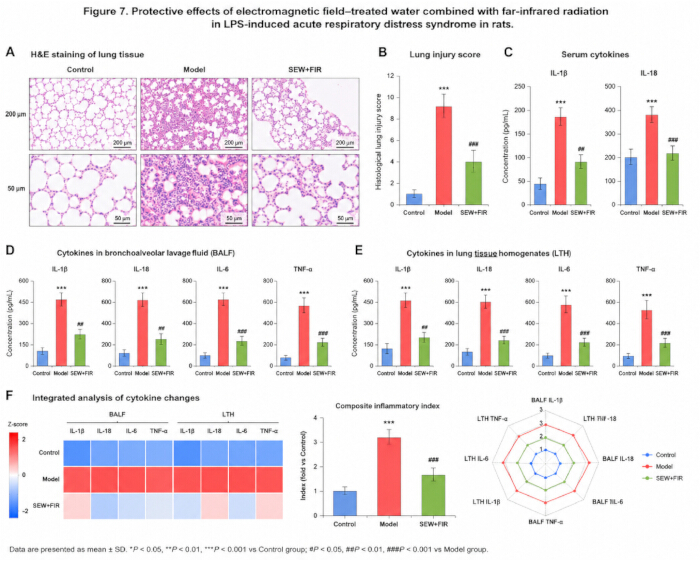
Figure 7: Protective effects of electromagnetic field-treated water combined with far-infrared radiation in lipopolysaccharide (LPS)-induced acute respiratory distress syndrome in rats. (A) Electromagnetic field-treated water combined with far-infrared radiation (SEW+FIR) alleviates lipopolysaccharide (LPS)-induced ARDS in rats. (B) Representative hematoxylin and eosin (H&E) staining of lung tissues. Scale bars represent 100 µm and 50 µm, respectively. (C) Histological lung injury scores. (D) Serum levels of IL-1β and IL-18. (E) Pro-inflammatory cytokine (IL-18, IL-6, IL-1β, TNF-α) levels in lung tissue homogenates (LTH). (F) Integrated analysis of inflammatory cytokine changes among the Control, Model, and SEW+FIR groups. Data are presented as mean ± SD (n = 5 for serum analysis; n = 6 for BALF and LTH analyses). *P < 0.05, **P < 0.01, ***P < 0.001 vs. control group; #P < 0.05, ##P < 0.01, ###P < 0.001 vs. model group. Abbreviations: SEW, electromagnetic field-treated water; FIR, far-infrared radiation. Please click here to view a larger version of this figure.
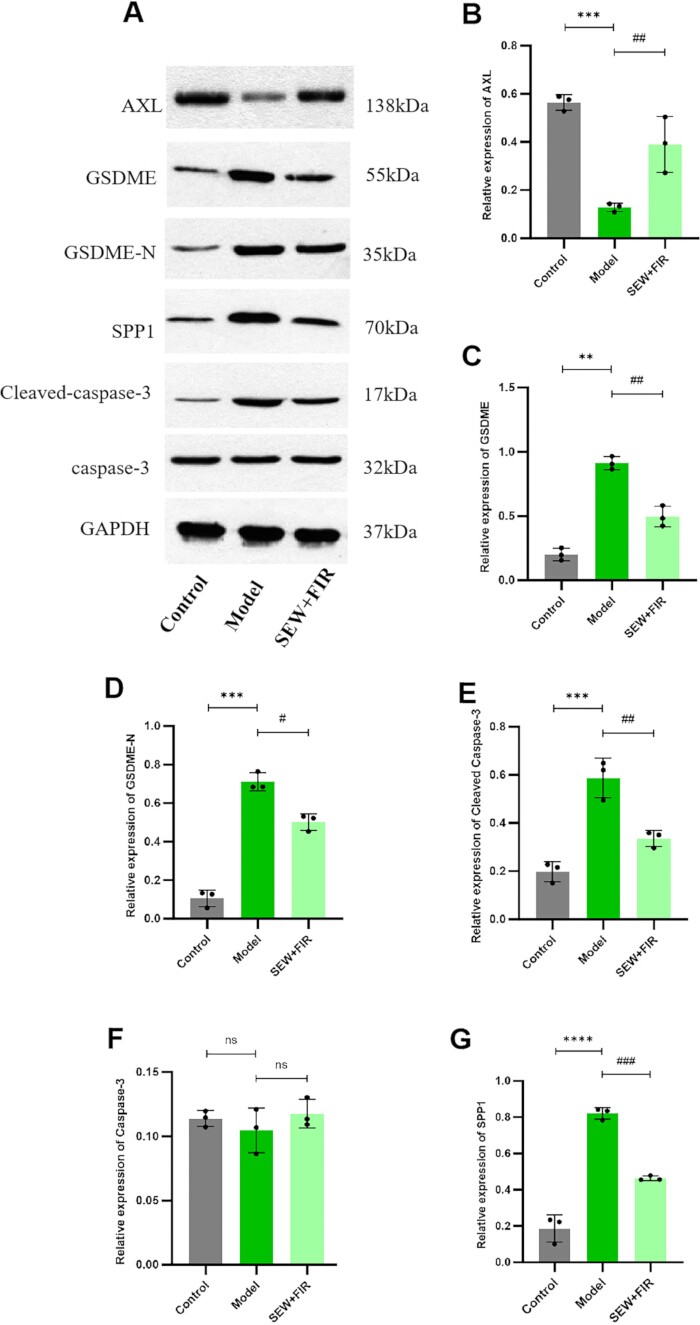
Figure 8: Effect of SEW+FIR intervention on the protein expression of age-specific biomarkers and pyroptosis pathway components. (A) Representative Western blot bands for AXL, GSDME, GSDME-N, SPP1, cleaved-caspase-3, caspase-3, and GAPDH in lung tissue homogenates (LTH). Relative protein quantification of (B) AXL, (C) GSDME, (D) GSDME-N, (E) cleaved-caspase-3, (F) Caspase-3, and (G) SPP1. GAPDH served as the internal loading control. Data are presented as mean ± SD (n = 3 per group). *P < 0.05, **P < 0.01, ***P < 0.001 vs. control group; #P < 0.05, ##P < 0.01, ###P < 0.001 vs. model group. Abbreviations: SEW, electromagnetic field-treated water; FIR, far-infrared radiation. Please click here to view a larger version of this figure.
Discussion
Loading...
$$\rightleftharpoonup{xx}$$
$$\longleftharp{xx}$$,
$$\longrightharp{xx}$$,
Accumulation of inflammatory injury and immune dysregulation is a hallmark of acute respiratory distress syndrome (ARDS), leading to severe pulmonary damage and high mortality. Due to the complex pathogenesis and lack of effective therapies, identifying precise therapeutic targets is critical to improve outcomes. Emerging evidence suggests that pyroptosis, a form of programmed cell death, plays a central role in ARDS progression. Given that age is an important factor influencing the onset and severity of ARDS, we stratified the dataset by age, using 45 years as the cutoff, to identify key pyroptosis-related targets across different age groups. In this study, we integrated transcriptomic analysis, immune infiltration profiling, and experimental validation to explore the age-specific molecular characteristics and therapeutic targets of ARDS. By focusing on pyroptosis-related gene expression and leveraging machine learning, we identified distinct hub genes—AXL, GSDME, and SPP1—that show diagnostic and mechanistic relevance to ARDS progression across age groups. As a methodology-focused study, it is important to emphasize that the critical steps of our protocol—ranging from the rigorous selection of the soft-thresholding power in WGCNA to the precise maintenance of LPS dosage and FIR irradiation parameters in the in vivo model—are paramount for ensuring reproducibility. Following this optimized pipeline, we demonstrated that SEW+FIR therapy exerts a protective effect in an LPS-induced ARDS rat model, at least in part by modulating these core genes and attenuating the inflammatory cascade.
Notably, stratification of the dataset by age revealed that pyroptosis-related gene expression patterns differed between younger and older ARDS patients, underscoring the importance of age-specific molecular signatures in disease progression and treatment response. These age-related differences suggest that personalized therapeutic strategies, tailored to patient age, may enhance clinical outcomes in ARDS.
Further subgroup analysis revealed that AXL and GSDME were prominently enriched as hub genes in the high-age group, suggesting age-dependent regulation of pyroptosis and inflammatory pathways in ARDS. Anaplastic lymphoma kinase (AXL), a TAM family receptor tyrosine kinase, is pivotal in modulating innate immunity and facilitating efferocytosis27. Our findings of elevated AXL expression in older patients’ M2 macrophages suggest its involvement in immune senescence and compensatory tissue repair mechanisms during ARDS progression. As a key pyroptotic effector, Gasdermin E (GSDME) mediates cell lysis and pro-inflammatory cytokine release. Its significant upregulation in the high-age group underscores a heightened susceptibility to the Caspase-3/GSDME “salvage inflammatory pathway”28, potentially shifting the balance from silent apoptosis to overt inflammatory death in the aged pulmonary microenvironment. Secreted phosphoprotein 1 (SPP1) acts as a potent pro-inflammatory mediator that skews immune responses toward activation29. Its identification as a hub gene in younger cohorts aligns with its role in driving acute immune cell recruitment and oxidative stress during the early stages of lung injury.
Compared to conventional exploratory studies, our integrated protocol offers a highly reproducible framework by bridging computational prediction with standardized in vivo validation. However, successful implementation requires careful troubleshooting. Common computational issues, such as severe batch effects in transcriptomic datasets, must be mitigated through stringent quality control and limma-based normalization. In animal models, variability in the LPS-induced ARDS response can be minimized by using age- and weight-matched specific pathogen-free (SPF) rats and by ensuring the LPS solution is freshly prepared. In the SEW/FIR intervention, maintaining a precise irradiation distance (20 cm) and a constant ambient temperature are critical to avoid thermal injury or insufficient energy delivery. For downstream validation, optimizing antibody dilutions and wash conditions is essential to eliminate high background signals in ELISA and Western blotting. Despite the robustness of this pipeline, several limitations warrant acknowledgment. This study relies on retrospective analysis of public datasets, and the sample size in our animal model was relatively small, which may limit the generalizability of the findings. While we utilized an integrated bioinformatics-to-experimental pipeline, alternative approaches—such as single-cell RNA sequencing for greater cellular resolution, or CRISPR-based gene silencing for direct causal validation—could further refine the cell-specific mechanisms involved. Future research should prioritize prospective clinical validation in diverse patient cohorts and explore the long-term safety and dose-response relationship of SEW+FIR intervention to facilitate its translation into critical care practice.
Consistent with our findings, prior studies have shown that SEW and FIR exhibit anti-inflammatory and immunoregulatory effects, supporting their potential as non-pharmacological therapies for ARDS.
In summary, this study provides a comprehensive analysis of age-related molecular signatures and potential therapeutic targets in acute respiratory distress syndrome (ARDS) with a specific focus on pyroptosis. Through integrated bioinformatics, machine learning, and experimental validation, we identified AXL, GSDME, and SPP1 as age-specific hub genes involved in ARDS progression. These genes not only demonstrated strong diagnostic potential but also revealed distinct roles in immune regulation and inflammatory responses across different age groups. Moreover, our findings demonstrate that combined SEW and FIR therapy significantly alleviates lung injury and inflammation in an LPS-induced ARDS rat model, at least in part by modulating these pyroptosis-related targets. These results support the use of SEW+FIR as a promising non-pharmacological intervention for ARDS. Collectively, our study demonstrates that age-stratified molecular profiling can uncover distinct pathogenic drivers of ARDS, moving beyond the current “one-size-fits-all” diagnostic paradigm. By identifying AXL, GSDME, and SPP1 as age-specific targets and validating the efficacy of SEW+FIR, this work establishes a scientific foundation for personalized, non-pharmacological adjunct therapies in precision critical care medicine. These insights may aid in early risk stratification and the development of targeted therapies to improve outcomes in patients with ARDS.
Disclosures
Loading...
$$\rightleftharpoonup{xx}$$
$$\longleftharp{xx}$$,
$$\longrightharp{xx}$$,
The authors have nothing to disclose.
Acknowledgements
Loading...
$$\rightleftharpoonup{xx}$$
$$\longleftharp{xx}$$,
$$\longrightharp{xx}$$,
The authors would like to thank all study participants. The authors thank AiMi Academic Services (www.aimieditor.com) for English language editing and review services. This research was funded and supported by the Horizontal Research Project of Dongzhimen Hospital, Beijing University of Chinese Medicine (HX-DZM: No.2017005/HX-DZM: No.2017019), the Research Project of Beijing University of Chinese Medicine (2025-JYB-JBGS-034), and the Clinical Research Program of High-level Traditional Chinese Medicine Hospitals funded by the Central Government (DZMG-MLZY-23004).
Materials
| Name | Company | Catalog Number | Comments |
|---|---|---|---|
| Anti-AXL antibody | Abcam | ab215205 | |
| Anti-Caspase-3 antibody | Abcam | ab184787 | |
| Anti-GAPDH antibody | Abcam | ab8245 | |
| Anti-GSDME antibody | Abcam | ab215191 | |
| Anti-SPP1 antibody | Abcam | ab307994 | |
| Biomicroscope | OLYMPUS, Japan | BH2 | |
| FIR instrument | Guangdong JFC Group | JF-802 | |
| Goat Anti-Rabbit IgG H&L (HRP) | Abcam | ab6721 | |
| GraphPad Prism 10.1.2 | GraphPad Software | - | |
| High-speed centrifuge | Thermo, USA | Sorvall ST16R | |
| IL-18 ELISA kit | Jiangsu Meibiao Biotechnology Co., Ltd. | MB-1735B | |
| IL-1β ELISA kit | Jiangsu Meibiao Biotechnology Co., Ltd. | MB-1588B | |
| IL-6 ELISA kit | Jiangsu Meibiao Biotechnology Co., Ltd. | MB-50054A | |
| ImageJ | NIH | - | |
| Lipopolysaccharide (LPS) | Sigma, USA | L6511 | |
| Male SPF Sprague Dawley rats (6-7 weeks) | Beijing HFK Bioscience Co., Ltd., China | SCXK(Beijing)2019-008 (License) | |
| Microplate reader (Varioskan Flash) | Thermo Scientific | Varioskan Flash | |
| Microtome | LEICA | RM2235 | |
| R software (limma, clusterProfiler, WGCNA, glmnet, randomForest) | R Foundation for Statistical Computing | - | |
| SEW preparation instrument | Guangdong JFC Group | JF-139 | |
| SPSS 26.0 | IBM | - | |
| Table balance | Shanghai Cany Precision Instruments Co., Ltd. | HC·TP11·10 | |
| TNF-α ELISA kit | Jiangsu Meibiao Biotechnology Co., Ltd. | MB-50051A | |
| Ultra-low temperature freezer | Thermo, USA | Forma 900 Series |
Reprints and Permissions
Request permission to reuse the text or figures of this JoVE article
Request Permission