We conducted a systematic review and stage-stratified meta-analysis in which disease stage was prespecified as the principal effect modifier. The analysis found no significant pooled cognitive benefit across all disease stages, while early-stage trials showed directionally favorable cognitive, functional, and structural signals that require independent replication.
Research Article
Stage-Dependent Cognitive Effects of a Multinutrient Intervention in Alzheimer's Disease: A Stage-Stratified Meta-Analysis
In This Article
Summary
Abstract
A specific multinutrient intervention provides precursors and cofactors for synaptic membrane synthesis. Randomized trials across the Alzheimer's disease (AD) continuum have reported mixed findings. We conducted a systematic review and stage-stratified meta-analysis of randomized, placebo-controlled trials. MEDLINE, Embase, CENTRAL, Web of Science, Scopus, ClinicalTrials.gov, and the WHO International Clinical Trials Registry Platform were searched through February 28, 2026. Disease stage was prespecified as an effect modifier. Standardized mean differences (SMDs; Hedges' g) were synthesized using restricted maximum likelihood random-effects models. Four trials met the inclusion criteria; three contributed to the quantitative synthesis (analyzed n = 906). Souvenir I was retained for qualitative synthesis because its distinct co-primary outcomes and reporting did not permit a compatible SMD for the prespecified pooled analysis. The exploratory pooled cognitive effect was small and not significant (SMD = 0.08; 95% CI, -0.09 to 0.26; p = 0.35; I2 = 41.8%). For biomarker-confirmed prodromal AD, the 24-month primary neuropsychological test battery (NTB) 5-item composite endpoint showed a small, nonsignificant effect (SMD = 0.16; 95% CI, -0.08 to 0.41; original trial p = 0.166). The primary NTB memory endpoint in mild, drug-naive AD showed a small effect (SMD = 0.21; 95% CI, -0.06 to 0.49; original longitudinal-model p = 0.023), whereas the primary Alzheimer's disease assessment scale-cognitive subscale (ADAS-Cog) endpoint in treated mild-to-moderate AD showed no benefit (SMD = -0.06; 95% CI, -0.25 to 0.13; p = 0.513). At 36 months, the LipiDiDiet extension reported significant differences in the NTB 5-item composite, clinical dementia rating – sum of boxes (CDR-SB), memory, and brain-volume outcomes. The intervention was well tolerated. The evidence is compatible with a potential early-stage signal, but the small evidence base, lack of replication across stages, and manufacturer sponsorship warrant cautious interpretation.
Introduction
Alzheimer's disease (AD) is a progressive neurodegenerative disorder and the leading cause of dementia. It is increasingly conceptualized as a biological continuum spanning preclinical disease, prodromal AD or mild cognitive impairment due to AD, and dementia with increasing functional dependence1,2. This framework has shifted therapeutic development toward earlier intervention, when neural networks and synaptic integrity may be more amenable to preservation.
Synaptic dysfunction and synapse loss are closely associated with cognitive impairment in AD and can precede advanced neurodegeneration3,4,5. A specific multinutrient formulation containing docosahexaenoic acid, eicosapentaenoic acid, uridine monophosphate, choline, phospholipids, B vitamins, antioxidant vitamins, folate, and selenium was developed to provide substrates and cofactors for neuronal membrane phospholipid synthesis6,7,8,9. Preclinical findings support biological plausibility, but clinical relevance depends on whether these effects translate into reproducible cognitive or functional benefit.
The randomized clinical program yielded different results across disease stages, durations, and outcome instruments. In Souvenir I, a 12-week study in 225 drug-naive participants with mild AD dementia, delayed verbal recall improved, whereas the co-primary modified 13-item Alzheimer's Disease Assessment Scale–Cognitive Subscale (ADAS-Cog) outcome did not10. Souvenir II enrolled 259 participants with very mild, drug-naive AD dementia for 24 weeks; its prespecified primary outcome was the neuropsychological test battery (NTB) memory-domain z-score, which showed a significant longitudinal-model difference (p = 0.023), while the standardized endpoint estimate remained small11. S-Connect enrolled 527 participants with mild-to-moderate AD dementia receiving background symptomatic therapy. Its 24-week design primarily assessed short-term symptomatic add-on effects, and its primary 11-item ADAS-Cog outcome was neutral12. The ADAS-Cog may also be less responsive in milder disease than memory-focused NTB measures or combined cognitive-functional instruments, which complicates direct cross-trial comparison.
LipiDiDiet extended evaluation to biomarker-confirmed prodromal AD. The prespecified NTB 5-item composite primary endpoint was not significant at 24 months (p = 0.166), while CDR-SB and hippocampal-volume outcomes favored intervention13. At 36 months, longitudinal differences were reported for the NTB 5-item composite, NTB memory domain, CDR-SB, and several brain-volume measures14. These results do not establish stage-dependent efficacy, but they support examining disease stage together with treatment duration, medication context, and endpoint sensitivity.
Previous reviews combined trials that differed in disease stage, duration, and outcome selection15. Pooling across these dimensions can obscure clinically relevant variation and can create a summary estimate that is difficult to interpret. We therefore conducted a systematic review and stage-stratified meta-analysis in which disease stage was prespecified as the principal effect modifier. Cognitive outcomes were the primary focus; memory-specific, cognitive-functional, volumetric, safety, and tolerability outcomes were synthesized when compatible data were available.
Protocol
Ethical approval was not required because the study involved secondary analysis of published randomized controlled trials and no new collection of participant-level data.
Study design and registration
A systematic review and stage-stratified meta-analysis of randomized controlled trials evaluating the specified multinutrient intervention across prodromal AD, mild AD dementia, and mild-to-moderate AD dementia was conducted. The review followed PRISMA 2020 reporting guidelines16 and was prospectively registered in PROSPERO (CRD42026129924) before data extraction. Protocol deviations, if any, were documented.
Define objectives and effect modifiers
Cognitive outcomes were designated as the primary outcome domain. Disease stage was prespecified as the principal effect modifier. Secondary objectives were defined for memory-specific, cognitive-functional, neuroimaging, safety, tolerability, risk-of-bias, and certainty-of-evidence outcomes.
Apply the eligibility criteria
Parallel-group randomized controlled trials comparing the multinutrient formulation with an isocaloric placebo or standard care were included. For crossover designs, only first-period data were used. Nonrandomized, uncontrolled, observational, severe-AD-only, and methodologically insufficient conference reports were excluded. The review was restricted to English-language reports.
Classify participants by disease stage
Prodromal AD was classified using mild cognitive impairment plus biomarker evidence of AD pathology. Mild AD dementia was classified using the trial diagnosis, baseline cognitive severity, and drug-naive treatment context. Mild-to-moderate AD dementia was classified using the trial diagnosis, an approximate MMSE range of 14–24, and background symptomatic pharmacotherapy. The overlap and lack of universality in published MMSE stage boundaries were recognized, and a score of 20 was not treated as a rigid upper boundary. When labels were ambiguous, the trial’s diagnostic criteria, full baseline MMSE range, and medication context were used rather than MMSE alone.
Define intervention, comparator, and outcomes
The intervention was generically defined as a once-daily 125 mL specific multinutrient formulation containing docosahexaenoic acid, eicosapentaenoic acid, uridine monophosphate, choline, phospholipids, vitamins B6, B12, C, and E, folate, and selenium. An isocaloric matched placebo or standard care was required. Cognitive, memory-specific, functional, neuroimaging, and safety outcomes were extracted at all reported time points. The prespecified primary endpoint of each trial was used for the primary meta-analysis, while alternative time points were analyzed in sensitivity analyses.
Search information sources
MEDLINE via PubMed, Embase, CENTRAL, Web of Science, and Scopus were searched from 1980 through February 28, 2026. AD terms, intervention terms used in the trial literature, and randomized-trial terms were combined. ClinicalTrials.gov and WHO ICTRP were searched, and the reference lists of included reports and relevant reviews were screened. The searches were conducted between February 2 and February 28, 2026; these dates represented search execution dates rather than a three-day restriction on publication coverage.
Select studies
Records were imported into EndNote, duplicates were removed, and the deduplicated library was uploaded to Rayyan. Titles and abstracts, followed by full texts, were independently screened by two reviewers. Disagreements were resolved through discussion or by consultation with a third reviewer. Reasons for full-text exclusion were recorded, and the study selection process was summarized in a PRISMA 2020 flow diagram.
Extract data
A prespecified, piloted data extraction form was used. Data on study design, setting, eligibility criteria, disease stage, sample size, intervention and comparator, concomitant medication, primary and secondary outcomes, follow-up, funding, and conflicts of interest were extracted. Change-from-baseline means and standard deviations were preferred for continuous outcomes. Missing standard deviations were derived from standard errors, confidence intervals, test statistics, or p values using established formulas.
Assess risk of bias
Each trial was assessed at the outcome level using the Cochrane Risk of Bias 2 (RoB 2) tool across the domains of randomization, deviations from intended interventions, missing outcome data, outcome measurement, and selective reporting17. Assessments were performed independently by two reviewers, and disagreements were resolved by consensus.
Synthesize data statistically
Standardized mean differences (SMDs) were calculated using Hedges' g because different cognitive instruments were used across the trials. Outcome directions were harmonized so that positive values favored the intervention. A random-effects model with restricted maximum likelihood estimation was used to account for anticipated variation in disease stage, treatment duration, medication context, and outcome responsiveness. Cochran's Q, I2, and τ2 were reported, and heterogeneity was interpreted cautiously because only three trials contributed to the pooled analysis. Stage-stratified results were treated as the primary clinical interpretation, whereas the pooled estimate across all disease stages was considered exploratory.
Perform sensitivity analyses and assess certainty
Sensitivity analyses were performed using the 36-month LipiDiDiet endpoint, earlier-stage or drug-naive trials only, leave-one-out analyses, primary endpoints only, memory-specific endpoints where possible, and a fixed-effect model. The certainty of the evidence was assessed using the GRADE approach across the domains of risk of bias, inconsistency, indirectness, imprecision, and publication bias18. Funnel plot asymmetry tests were not performed because fewer than 10 studies were available. Instead, trial registrations were compared with published reports, and trial registries were searched to assess the potential for publication bias19.
Results
Study selection
The search identified 234 records. After the removal of 63 duplicates, 171 records underwent title and abstract screening. Twenty-one full-text reports were assessed, and 17 were excluded, most commonly because they were nonrandomized reports, uncontrolled extensions, biomarker-only substudies, or duplicate publications from the same trial. Four randomized controlled trials were included qualitatively, and three contributed compatible data to the primary quantitative synthesis (Figure 1).
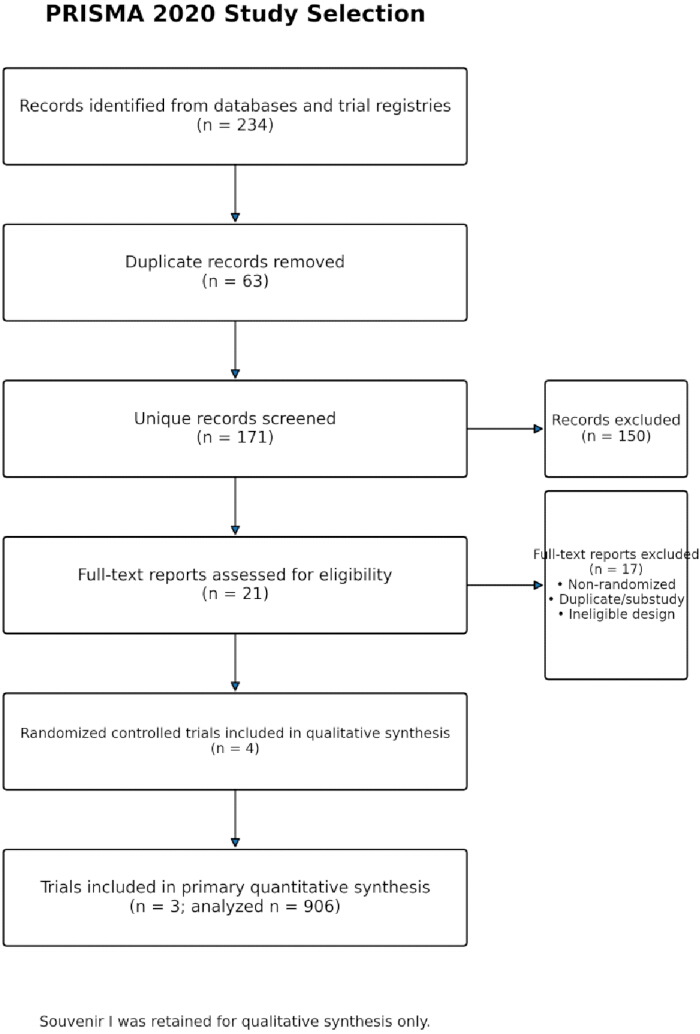
Figure 1: PRISMA 2020 flow diagram. The diagram summarizes identification, screening, full-text assessment, qualitative inclusion, and quantitative inclusion. Souvenir I was included qualitatively but not in the prespecified primary quantitative synthesis. Please click here to view a larger version of this figure.
Study characteristics and outcome hierarchy
Souvenir I and Souvenir II enrolled drug-naive participants with mild AD dementia. Souvenir I used delayed verbal recall and modified 13-item ADAS-Cog as co-primary outcomes, whereas Souvenir II used the NTB memory-domain z-score as its primary outcome. S-Connect enrolled participants with mild-to-moderate AD dementia receiving background cholinesterase inhibitors and/or memantine and used the 11-item ADAS-Cog as its primary outcome. LipiDiDiet enrolled participants with biomarker-confirmed prodromal AD and used the NTB 5-item composite z-score as its primary outcome. Table 1 distinguishes primary, secondary, and exploratory outcomes and identifies the data included in each synthesis.
Three trials contributed to the primary meta-analysis (analyzed n = 906): LipiDiDiet at 24 months (n = 275), Souvenir II at 24 weeks (n = 206), and S-Connect at 24 weeks (n = 425). Souvenir I remained in the qualitative synthesis because the available co-primary outcome reporting did not provide a compatible review-level change-score SMD for the prespecified primary synthesis. Figure 2 positions the trials along the AD continuum.
| Study | Population | Randomized | Analyzed | Duration | Primary outcome(s) | Secondary/exploratory outcomes | Role in review | ||||||
| Souvenir I | Mild AD dementia; drug-naive; MMSE 20–26 | 225 (112 active; 113 control) | 212 efficacy population | 12 weeks | WMS-R delayed verbal recall; modified 13-item ADAS-Cog (co-primary) | CIBIC-plus; NPI; ADCS-ADL; QoL-AD; safety | Qualitative only: distinct co-primary outcome structure and insufficient compatible data for review SMD | ||||||
| Souvenir II | Mild AD dementia; drug-naive; mean MMSE 25.0 | 259 (130 active; 129 control) | 206 for review endpoint dataset | 24 weeks | NTB memory-domain z-score | NTB total; NTB executive function; DAD; EEG; safety | Primary quantitative synthesis | ||||||
| S-Connect | Mild-to-moderate AD dementia; MMSE 14–24; >90% on symptomatic therapy | 527 (265 active; 262 control) | 425 for primary ADAS-Cog change-score dataset | 24 weeks | ADAS-Cog 11-item | Cognitive Test Battery; ADCS-ADL; CDR-SB; NPI; safety | Primary quantitative synthesis | ||||||
| LipiDiDiet | Biomarker-confirmed prodromal AD; drug-naive | 311 (153 active; 158 control) | 275 at 24 months; 81 in 36-month extension subset | 24 months; 36-month extension | NTB 5-item composite z-score | NTB memory; NTB executive; NTB total; CDR-SB; hippocampal, whole-brain, and ventricular volumes; safety | 24-month primary synthesis; 36-month sensitivity analysis | ||||||
Table 1: Simplified comparison of included randomized controlled trials, including population, randomized and analyzed samples, duration, prespecified primary outcomes, ordered secondary or exploratory outcomes, and role in the meta-analysis.
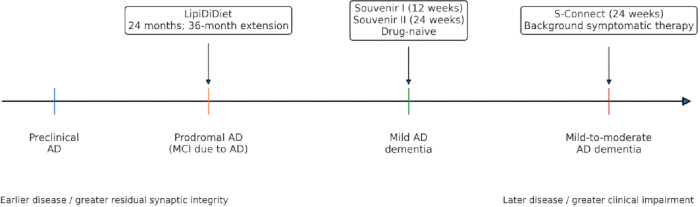
Figure 2: Position of the included trials along the Alzheimer's disease continuum. LipiDiDiet enrolled biomarker-confirmed prodromal AD; Souvenir I and II enrolled drug-naive mild AD dementia; S-Connect enrolled treated mild-to-moderate AD dementia. Please click here to view a larger version of this figure.
Risk of bias
All four trials were randomized and double-blind with matched placebo products. The primary outcome assessments were judged low risk across RoB 2 domains (Table 2). The evidence base was nevertheless entirely manufacturer-sponsored, which was considered separately in the interpretation and GRADE assessment.
| Study | Randomization | Deviations | Missing data | Outcome measurement | Reported result | Overall |
| Souvenir I | Low | Low | Low | Low | Low | Low |
| Souvenir II | Low | Low | Low | Low | Low | Low |
| S-Connect | Low | Low | Low | Low | Low | Low |
| LipiDiDiet | Low | Low | Low | Low | Low | Low |
Table 2: Outcome-level risk-of-bias assessment using Cochrane RoB 2.
All three trials combined
The exploratory random-effects synthesis of the three prespecified primary cognitive outcomes produced a small, nonsignificant pooled effect (SMD = 0.08; 95% CI, -0.09 to 0.26; p = 0.35). Heterogeneity was moderate (I2 = 41.8%; τ² = 0.010), but the Q test was not statistically significant (Q = 3.36; df = 2; p = 0.19). The moderate magnitude of I2, together with clinically important differences in stage, duration, medication context, and endpoint selection, supported presenting stage-specific estimates separately (Table 3). Figure 3 shows the primary outcome estimates.
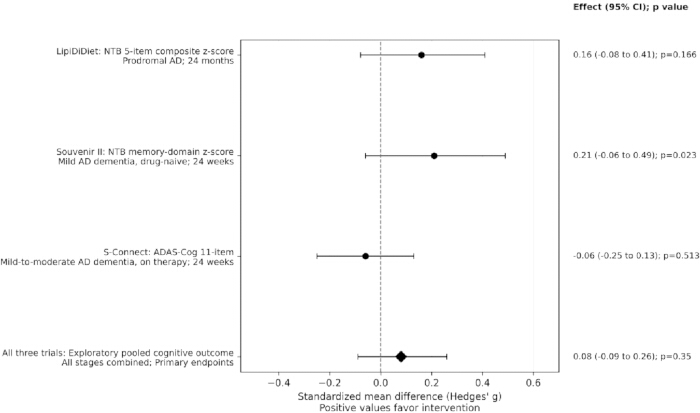
Figure 3: Forest plot of prespecified primary cognitive outcomes. Positive standardized mean differences favor the intervention. The pooled estimate uses a restricted maximum likelihood random-effects model. Original-trial longitudinal-model p values are reported where specified and should be distinguished from confidence intervals for reconstructed review-level SMDs. Please click here to view a larger version of this figure.
| Disease stage | Trial | Exact outcome | Time point | Analyzed n | SMD (95% CI) | p value | Percent slowing |
| Prodromal AD | LipiDiDiet | NTB 5-item composite z-score | 24 months | 275 | 0.16 (-0.08 to 0.41) | 0.166 | 74%* |
| Mild AD dementia, drug-naive | Souvenir II | NTB memory-domain z-score | 24 weeks | 206 | 0.21 (-0.06 to 0.49) | 0.023 | Not applicable‡ |
| Mild-to-moderate AD dementia, on therapy | S-Connect | ADAS-Cog 11-item | 24 weeks | 425 | -0.06 (-0.25 to 0.13) | 0.513 | Not applicable |
| All stages combined | All three trials | Exploratory pooled cognitive outcome | Primary endpoints | 906 | 0.08 (-0.09 to 0.26) | 0.35 | Not estimable |
Table 3: Stage-specific and pooled estimates for the prespecified primary cognitive outcomes. Exact outcome instruments and percentage-slowing where meaningfully estimable are shown.
Prodromal AD: 24-month primary endpoint
In LipiDiDiet, the prespecified NTB 5-item composite primary endpoint showed a small SMD at 24 months that was not statistically significant (SMD = 0.16; 95% CI, -0.08 to 0.41; original longitudinal-model p = 0.166). Based on the observed endpoint changes (-0.028 active vs -0.108 control), the numerical difference corresponds to approximately 74% less observed decline relative to control. This percentage is unstable because the decline in the control group was substantially smaller than anticipated and should not be interpreted independently of the nonsignificant model estimate.
Mild AD dementia: 24-week primary endpoint
In Souvenir II, the primary NTB memory-domain endpoint favored intervention (SMD = 0.21; 95% CI, -0.06 to 0.49). The original repeated-measures analysis reported p = 0.023. The apparent difference between that p-value and the review SMD confidence interval arises because the trial p-value tested longitudinal trajectories using repeated measurements and covariate adjustment, whereas the review confidence interval was reconstructed from the 24-week endpoint change-score data. Both results indicate a small effect, but the review-level estimate remains imprecise.
Mild-to-moderate AD dementia: 24-week primary endpoint
In S-Connect, no difference was observed on the primary 11-item ADAS-Cog endpoint (SMD = -0.06; 95% CI, -0.25 to 0.13; longitudinal-model p = 0.513). No significant differences were reported for the Cognitive Test Battery, CDR-SB, or ADCS-ADL. The 24-week design principally evaluated short-term symptomatic add-on effects in participants already receiving standard pharmacotherapy.
Sensitivity analyses
Substitution of the 36-month LipiDiDiet extension produced a moderate reconstructed standardized effect for the NTB 5-item composite (review SMD = 0.47; 95% CI, 0.02 to 0.91) (Table 4). The original longitudinal model reported a smaller standardized effect (Cohen d = 0.26), a mean difference of 0.212 (95% CI, 0.044 to 0.380), p = 0.014, and 60% less decline. The distinction reflects different analytic inputs and should be retained when interpreting the sensitivity estimate.
| Analysis | Data included | Effect estimate | p value | Interpretation |
| Primary random-effects REML | All 3 trials | 0.08 (-0.09 to 0.26) | 0.35 | I² = 41.8%; τ² = 0.010 |
| Earlier-stage/drug-naive only | LipiDiDiet 24 months + Souvenir II | 0.31 (-0.06 to 0.68) | 0.099 | I² = 0% |
| Fixed-effect model | All 3 trials | 0.08 (-0.07 to 0.22) | 0.31 | Conclusion unchanged |
| 36-month timepoint substituted | LipiDiDiet 36 months + Souvenir II + S-Connect | 0.16 (-0.13 to 0.44) | 0.283 | I² approximately 66% |
| LipiDiDiet 36-month trial estimate | NTB 5-item composite | Published d = 0.26; reconstructed review SMD = 0.47 (0.02 to 0.91) | 0.014 published model | Extension subset; analytic estimates differ by input |
Table 4: Sensitivity analyses for the primary cognitive synthesis.
When S-Connect was excluded, the pooled estimate for the two earlier-stage drug-naive trials was 0.31 (95% CI, -0.06 to 0.68; p = 0.099), and I2 was 0%. The fixed-effect estimate across all three trials was 0.08 (95% CI, -0.07 to 0.22; p = 0.31). These analyses did not change the conclusion that the all-stage pooled estimate was small and uncertain. Interpretive statements concerning treatment duration were reserved for the Discussion.
Memory, cognitive-functional, and volumetric outcomes
At 24 months, LipiDiDiet reported no significant difference in the NTB memory-domain score (p = 0.101), but less worsening in CDR-SB (p = 0.005; 45% less worsening), less hippocampal volume loss (p = 0.005), and less ventricular enlargement (p = 0.046). The whole-brain volume difference was not significant at 24 months (p = 0.265). At 36 months, the longitudinal analyses favored intervention for the NTB memory domain (p = 0.008; 76% less decline), CDR-SB (p = 0.014; 45% less worsening), hippocampal volume (p = 0.002; 33% less deterioration), whole-brain volume (p = 0.021; 22% less deterioration), and ventricular volume (p = 0.042; 20% less ventricular deterioration). Figure 4 displays standardized primary, secondary, and key secondary outcome estimates.
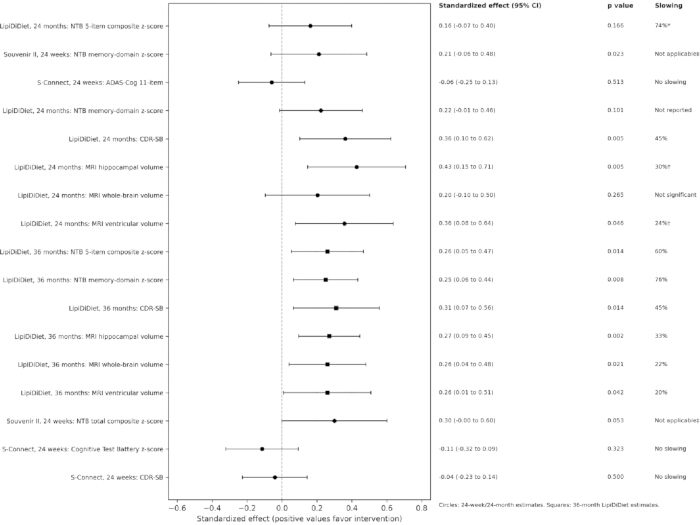
Figure 4: Standardized primary, secondary, and key secondary outcome estimates. Error bars show 95% confidence intervals. Positive values favor intervention after harmonization of scale direction. For 24-month rows, standardized effects were calculated from reported endpoint change-score data; for 36-month LipiDiDiet rows, published longitudinal-model Cohen d values are shown and confidence intervals were rescaled from the corresponding model estimates. Original model p values are shown, so p values and reconstructed standardized confidence intervals need not correspond exactly. *The approximately 74% value uses observed NTB mean changes and is unstable because placebo decline was small. †Descriptive percentage calculated from observed change. ‡Percentage slowing is not interpretable when both groups improved. Please click here to view a larger version of this figure.
In Souvenir II, the NTB total score showed a trend (p = 0.053), while the NTB executive-domain outcome was not significant (p = 0.686). In S-Connect, secondary cognitive and functional outcomes were neutral. Percentage slowing was not calculated for outcomes in which both groups improved or where the denominator was close to zero, because the resulting percentage would be misleading.
Safety and tolerability
The intervention was generally well tolerated. Adverse-event and serious-adverse-event patterns were similar between groups, and adherence exceeded 90% in the major trials. No consistent safety signal emerged.
Publication bias
Formal funnel-plot asymmetry testing was not performed because only three trials contributed to the quantitative synthesis. ClinicalTrials.gov and WHO ICTRP searches and comparison of registered protocols with publications did not identify a completed unpublished randomized trial. Publication bias cannot be excluded because the evidence base is small and manufacturer-sponsored.
Certainty of evidence
GRADE certainty for the exploratory pooled cognitive outcome was rated moderate, downgraded for inconsistency across clinical stages and outcome contexts. Stage-specific estimates were rated moderate or low depending on imprecision, extension-sample size, and lack of replication. Table 5 names the exact outcome instrument used for each certainty assessment.
| Outcome/population | Studies/participants | Exact outcome measure | Effect | GRADE certainty | Reason | |||||
| All stages combined | 3; n = 906 | NTB 5-item, NTB memory domain, and ADAS-Cog primary endpoints | SMD 0.08 (-0.09 to 0.26) | Moderate | Downgraded for clinical inconsistency across stage, duration, and instruments | |||||
| Prodromal AD, 24 months | 1; n = 275 | NTB 5-item composite z-score | SMD 0.16 (-0.08 to 0.41) | Moderate | Single trial; CI crosses null; no within-stage replication | |||||
| Prodromal AD, 36 months | 1; extension subset | NTB 5-item composite z-score | Published d 0.26; p = 0.014 | Low | Extension analysis; attrition/smaller sample; no replication | |||||
| Mild AD, drug-naive | 1; n = 206 | NTB memory-domain z-score | SMD 0.21 (-0.06 to 0.49) | Moderate | Single trial; reconstructed CI crosses null | |||||
| Mild-to-moderate AD, treated | 1; n = 425 | ADAS-Cog 11-item | SMD -0.06 (-0.25 to 0.13) | Moderate | Single trial; precise estimate centered near null | |||||
| Prodromal cognitive-functional outcome | 1 | CDR-SB at 24 and 36 months | p = 0.005 and p = 0.014 | Moderate | Single manufacturer-sponsored trial; consistent across time points | |||||
| Prodromal structural outcomes | 1 | Hippocampal, whole-brain, and ventricular MRI volumes | Mixed 24-month results; significant 36-month results | Low | Secondary outcomes; single trial; multiple comparisons | |||||
| Safety/tolerability | 4 | Adverse events, serious adverse events, adherence | Similar to placebo; adherence >90% | Moderate | Consistent, but limited sample and duration | |||||
Table 5: GRADE summary of findings with the exact outcome measure used for each row.
Data Availability
Study-level extraction data, the derived effect-size dataset, and reproducible Stata analysis code are provided in Supplementary File 1 and Supplementary File 2. The supplementary workbook includes source fields and calculation notes sufficient to audit the quantitative synthesis.
Supplementary File 1: Study-level extraction data and derived effect-size calculations. Please click here to download this file.
Supplementary File 2: Stata_Analysis_Code.do.Please click here to download this file.
Discussion
This review treated cognitive effects as the primary outcome domain and additionally synthesized memory-specific outcomes, CDR-SB, and volumetric outcomes when compatible data were available. Across the three primary cognitive endpoints, the all-stage pooled effect was small and not significant. Stage-specific results differed: the 24-month prodromal-AD NTB primary endpoint was not significant (p = 0.166), the mild drug-naive AD primary memory outcome showed a small effect with a significant longitudinal-model test (p = 0.023) but an imprecise review-level SMD, and the treated mild-to-moderate AD trial was neutral (p = 0.513). Because each stage was represented by one quantitative trial, these comparisons are hypothesis-generating rather than proof that disease stage modifies treatment efficacy.
The endpoint hierarchy is important. Souvenir I demonstrated improvement in delayed verbal recall but not in the co-primary modified ADAS-Cog outcome10. Souvenir II then selected the NTB memory domain as its prespecified primary endpoint and reported a small longitudinal effect11. S-Connect used the ADAS-Cog over 24 weeks in a later-stage treated population, a design more suited to detecting short-term symptomatic add-on effects than slow changes in synaptic biology12. LipiDiDiet used a broader NTB composite over 24 months in prodromal AD and did not meet that primary endpoint, despite favorable CDR-SB and hippocampal findings13. The studies, therefore, differ not only by stage but also by duration and by the construct and responsiveness of their primary instruments.
The CDR-SB findings deserve particular attention. CDR-SB integrates cognition and function and has become a central clinical endpoint in pivotal anti-amyloid monoclonal-antibody trials and regulatory evaluation. In Clarity AD, lecanemab reduced 18-month CDR-SB worsening by 0.45 points, corresponding to 27% slowing versus placebo20. In TRAILBLAZER-ALZ 2, donanemab produced significant CDR-SB differences at 76 weeks, although iADRS was the principal efficacy outcome21. These comparisons should not be interpreted as indirect efficacy comparisons: populations, mechanisms, durations, estimands, and safety profiles differ. They instead show why the significant LipiDiDiet CDR-SB findings at both 24 months (p = 0.005) and 36 months (p = 0.014) are clinically relevant and warrant independent replication.
At 24 months, the LipiDiDiet NTB primary endpoint showed approximately 74% less observed decline based on raw group means, but the model-based comparison was not significant, and the placebo decline was much smaller than anticipated. Percentage slowing can become unstable when the placebo denominator is small; SMDs, absolute model differences, confidence intervals, and p values must therefore be considered together. At 36 months, the published longitudinal model reported 60% less decline on the NTB 5-item composite, 76% less decline on the memory domain, and 45% less worsening on CDR-SB14. The convergence of cognitive-functional and volumetric outcomes, with nominal statistical significance for hippocampal, whole-brain, and ventricular measures, strengthens biological plausibility but does not replace confirmation of a prespecified clinical primary endpoint.
A post hoc time-component analysis translated the 24-month LipiDiDiet findings into an estimated 9 months of disease time saved across the combined NTB, CDR-SB, and hippocampal-volume components, corresponding to 38% slowing of disease time22. Individual estimates were approximately 9.0 months for NTB, 10.5 months for CDR-SB, and 7.2 months for hippocampal volume. This framework may improve clinical interpretability, but it is exploratory, was partly manufacturer-supported, and requires prospective validation before it can be used as an established measure of clinical meaningfulness.
The biological rationale remains plausible. The formulation supplies precursors and cofactors for membrane phospholipid synthesis, and combined precursor supplementation has increased synaptic markers in experimental models7,8,9,23. Earlier disease may retain more synaptic substrate for such an intervention, whereas later-stage neuronal and synaptic loss may limit measurable response. Nevertheless, stage, duration, medication use, and endpoint selection are confounded across trials; the current dataset cannot isolate the causal contribution of any one factor.
The moderate I2 estimate was not statistically significant by the Q test, but statistical nonsignificance does not demonstrate homogeneity when only three studies are available. Removal of S-Connect reduced I2 to 0%, indicating that the later-stage treated trial contributed importantly to between-study variation. Random-effects modeling was therefore retained because genuine clinical and methodological variation was expected a priori. The small number of studies limits the precision of τ² and makes formal meta-regression inappropriate.
The wider nutritional literature also supports a cautious interpretation. Single-nutrient trials in established AD have generally been neutral, while multidomain prevention approaches have shown their clearest signals in at-risk populations without established dementia24,25,26,27. A multinutrient strategy may differ mechanistically from a single nutrient, but this does not remove the need for adequately powered, independent trials with harmonized outcomes and prespecified estimands.
For clinical interpretation, the current evidence does not support presenting the intervention as an established adjunctive treatment for pharmacologically treated mild-to-moderate AD. A possible early-stage role is supported by the directional consistency of the two earlier-stage, drug-naive trials contributing to the quantitative synthesis, with the strongest longitudinal cognitive-functional and structural evidence arising from LipiDiDiet. Meaningful effects should not be expected over short courses; sustained exposure is biologically plausible, but longer duration is confounded with earlier stages in the available trials. Independent replication is recommended before firm practice recommendations are made.
All included trials were funded by the manufacturer. RoB 2 judgments were low for the assessed outcomes, but sponsorship can influence design, endpoint selection, analysis, and publication. Registry searches did not reveal unpublished completed trials, yet publication and development bias cannot be excluded.
Strengths include prospective PROSPERO registration, PRISMA 2020 reporting, independent screening and extraction, outcome-level RoB 2 assessment, prespecified stage stratification, sensitivity analyses, and GRADE assessment. Limitations include only three quantitative trials, one trial per stage, differing endpoint instruments and durations, reconstructed effect sizes for some outcomes, inability to perform formal small-study-bias tests, manufacturer sponsorship, predominantly high-income settings, and absence of individual participant data.
Future studies should enroll biomarker-confirmed early AD populations, use harmonized cognitive and cognitive-functional outcomes, including CDR-SB, report absolute differences and percentage slowing with denominator assumptions, and follow participants long enough to assess sustained effects. Independent replication outside manufacturer sponsorship is recommended. Individual participant data would allow examination of baseline cognition, APOE ε4 carrier status, nutritional biomarkers, and concomitant therapy as effect modifiers. Combination with disease-modifying anti-amyloid treatment should be tested prospectively rather than inferred.
In conclusion, the pooled primary cognitive effect across stages was small and not significant. Two early-stage drug-naive trials were directionally consistent, while the treated mild-to-moderate AD trial was neutral. LipiDiDiet provided the strongest cognitive-functional and volumetric signal over longer follow-up, but its 24-month cognitive primary endpoint was not significant, and stage-specific findings remain unreplicated. The evidence supports further independent investigation, not definitive clinical efficacy claims.
Disclosures
The authors declare no competing financial interests or other conflicts of interest related to this work.
Acknowledgements
This work was supported by the National Natural Science Foundation of China (Grant No. 81200184). The authors thank the investigators of the included randomized controlled trials for generating the primary data used in this review.
Materials
| Name | Company | Catalog Number | Comments |
|---|---|---|---|
| Cochrane RoB 2 | Cochrane | Current RoB 2 tool (https://www.riskofbias.info/welcome/rob-2-0-tool) | Outcome-level risk-of-bias assessment |
| EndNote | Clarivate | EndNote X9 (https://endnote.com/) | Reference management and deduplication |
| PRISMA 2020 checklist and flow diagram | PRISMA Statement Group | 2020 version (https://www.prisma-statement.org/) | Systematic-review reporting and study-flow documentation |
| Rayyan | Rayyan Systems Inc. | Web application (https://www.rayyan.ai/) | Independent title/abstract and full-text screening |
| Stata SE 18 | StataCorp LLC | Version 18 (https://www.stata.com/) | Statistical synthesis and forest-plot verification |
References
- Alzheimer's Disease International. World Alzheimer Report 2018: The State of the Art of Dementia Research: New Frontiers. London: Alzheimer's Disease International; 2018:https://www.alzint.org/u/WorldAlzheimerReport2018.pdf.
- Jack CR Jr, et al. NIA-AA Research Framework: Toward a biological definition of Alzheimer's disease. Alzheimers Dement. 2018;14(4):535-562.
- Selkoe DJ. Alzheimer's disease is a synaptic failure. Science. 2002;298(5594):789-791.
- Terry RD, et al. Physical basis of cognitive alterations in Alzheimer's disease: synapse loss is the major correlate of cognitive impairment. Ann Neurol. 1991;30(4):572-580.
- DeKosky ST, Scheff SW. Synapse loss in frontal cortex biopsies in Alzheimer's disease: correlation with cognitive severity. Ann Neurol. 1990;27(5):457-464.
- Cummings J, Zhou Y, Lee G, Zhong K, Fonseca J, Cheng F. Alzheimer's disease drug development pipeline: 2023. Alzheimers Dement (N Y). 2023;9(2):e12385.
- Wurtman RJ. A nutrient combination that can affect synapse formation. Nutrients. 2014;6(4):1701-1710.
- Wurtman RJ, Cansev M, Sakamoto T, Ulus IH. Nutritional modifiers of aging brain function: use of uridine and other phosphatide precursors to increase formation of brain synapses. Nutr Rev. 2010;68 Suppl 2:S88-S101.
- Wurtman RJ, Cansev M, Ulus IH. Synapse formation is enhanced by oral administration of uridine and DHA, the circulating precursors of brain phosphatides. J Nutr Health Aging. 2009;13(3):189-197.
- Scheltens P, et al. Efficacy of a medical food in mild Alzheimer's disease: a randomized, controlled trial. Alzheimers Dement. 2010;6(1):1-10.e1.
- Scheltens P, et al. Efficacy of Souvenaid in mild Alzheimer's disease: results from a randomized, controlled trial. J Alzheimers Dis. 2012;31(1):225-236.
- Shah RC, et al. The S-Connect study: results from a randomized, controlled trial of Souvenaid in mild-to-moderate Alzheimer's disease. Alzheimers Res Ther. 2013;5(6):59.
- Soininen H, et al. 24-month intervention with a specific multinutrient in people with prodromal Alzheimer's disease (LipiDiDiet): a randomized, double-blind, controlled trial. Lancet Neurol. 2017;16(12):965-975.
- Soininen H, et al. 36-month LipiDiDiet multinutrient clinical trial in prodromal Alzheimer's disease. Alzheimers Dement. 2021;17(1):29-40.
- Onakpoya IJ, Heneghan CJ. The efficacy of supplementation with the novel medical food, Souvenaid, in patients with Alzheimer's disease: a systematic review and meta-analysis of randomized clinical trials. Nutr Neurosci. 2017;20(4):219-227.
- Page MJ, et al. The PRISMA 2020 statement: an updated guideline for reporting systematic reviews. BMJ. 2021;372:n71.
- Sterne JAC, et al. RoB 2: a revised tool for assessing risk of bias in randomized trials. BMJ. 2019;366:l4898.
- Guyatt GH, et al. GRADE: an emerging consensus on rating quality of evidence and strength of recommendations. BMJ. 2008;336(7650):924-926.
- Sterne JAC, et al. Recommendations for examining and interpreting funnel plot asymmetry in meta-analyses of randomized controlled trials. BMJ. 2011;343:d4002.
- van Dyck CH, et al. Lecanemab in early Alzheimer's disease. N Engl J Med. 2023;388(1):9-21.
- Sims JR, et al. Donanemab in early symptomatic Alzheimer disease: the TRAILBLAZER-ALZ 2 randomized clinical trial. JAMA. 2023;330(6):512-527.
- Dickson SP, et al. Evaluation of clinical meaningfulness of Fortasyn Connect effects in prodromal Alzheimer's disease using a time-saved approach. J Prev Alzheimers Dis. 2024;11(4):1131-1139.
- Wurtman RJ, Cansev M, Sakamoto T, Ulus IH. Use of phosphatide precursors to promote synaptogenesis. Annu Rev Nutr. 2009;29:59-87.
- Freund-Levi Y, et al. Omega-3 fatty acid treatment in 174 patients with mild to moderate Alzheimer disease: OmegAD study. Arch Neurol. 2006;63(10):1402-1408.
- Quinn JF, et al. Docosahexaenoic acid supplementation and cognitive decline in Alzheimer disease: a randomized trial. JAMA. 2010;304(17):1903-1911.
- Ngandu T, et al. A 2-year multidomain intervention of diet, exercise, cognitive training, and vascular risk monitoring versus control to prevent cognitive decline in at-risk older people (FINGER). Lancet. 2015;385(9984):2255-2263.
- Andrieu S, et al. Effect of long-term omega-3 polyunsaturated fatty acid supplementation with or without multidomain intervention on cognitive function in elderly adults with memory complaints (MAPT). Lancet Neurol. 2017;16(5):377-389.