RAPID 血液处理方法可用于人类,能够获得更高的肽水平,同时允许对正确的分子形式进行评估。因此,该方法将成为肽类研究中一种有价值的工具。
需要JoVE订阅才能观看此内容。 请登录或开始免费试用
本文内容
摘要
摘要
食物摄入调控领域的研究正日益受到重视。这类研究通常包括对调控食物摄入的肽类物质进行测定。为了准确测定某种肽的浓度,该肽在血液处理过程中应保持稳定。然而,多种肽类物质在内源性肽酶的作用下会迅速降解,难以满足这一要求。近期,我们开发了一种用于大鼠的血液处理方法,该方法结合了低温、酸化、蛋白酶抑制、同位素标记的外源性对照和稀释(RAPID)等步骤。本文中,我们将该技术成功应用于人类,并评估了食欲调控激素的回收率、分子形态及其循环浓度。与标准处理方法(EDTA抗凝血置于冰上)相比,RAPID方法显著提高了125I标记的生长抑素-28(+39%)、胰高血糖素样肽-1(+35%)、酰化饥饿素和胰高血糖素(+32%)、胰岛素和吻素(+29%)、nesfatin-1(+28%)、瘦素(+21%)以及肽YY3-36(+19%)的回收率(p <0.001)。高效液相色谱分析显示,在采用RAPID方法处理后,内源性酰化饥饿素在预期位置出峰;而在标准处理后,62%的酰化饥饿素已被降解,出现较早的洗脱峰,可能代表去酰化饥饿素。经RAPID方法处理后,正常体重受试者血液中酰化/去酰化饥饿素的比例为1:3,而标准处理后为1:23(p = 0.03)。此外,与标准处理相比,RAPID处理后内源性吻素水平也更高(+99%,p = 0.02)。RAPID血液处理方法适用于人类,可获得更高的肽类水平,并能准确评估其分子形态。
引言
鉴于全球肥胖患病率不断上升的趋势1,2,食物摄入调控领域的研究正日益受到重视。迄今为止,已知仅有一种在外周产生并作用于中枢以促进食物摄入的肽,即胃饥饿素(ghrelin)。3在过去的几十年中,已鉴定出多种能够减少摄食量的肽类物质, 例如瘦素、肽YY(PYY)、胰高血糖素样肽-1(GLP-1)以及胰岛素4因此,在研究饥饿与饱腹感调控机制时,通常会检测相关肽类的水平,同时假定所研究的肽在血浆制备过程中具有稳定性且回收率较高。然而,实际情况往往并非如此,因为内源性快速降解会显著影响其稳定性,此前已有研究证实了这一点 例如. 酰化型胃饥饿素降解为去酰化型胃饥饿素5因此,我们近期描述了一种用于大鼠血液处理的 RAPID 方法 R降低的温度, A钙化, P蛋白酶抑制, I同位素标记的外源性对照和 D稀释6该方法提高了12种测试肽段中11种的回收率,并能够确定与标准血液处理(EDTA抗凝血置于冰上)相比的正确循环分子形式6该方法已在多项后续研究中被采用7-12 用于检测循环生长素释放肽及促肾上腺皮质激素释放因子13因此,该方法在啮齿类动物的肽类研究中已被证明具有实用价值。然而,由于啮齿类动物的研究结果并不总能外推至其他物种,该方法也应建立并应用于人类血液中。
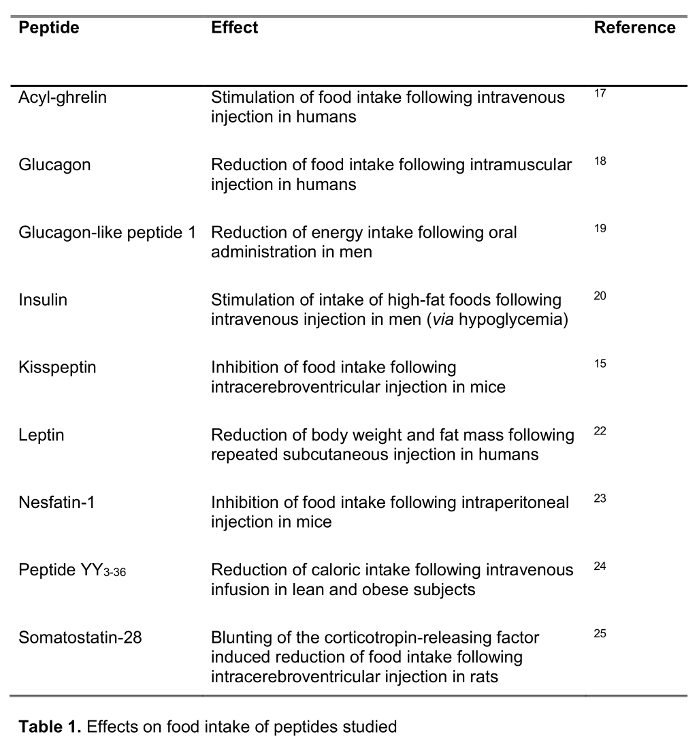
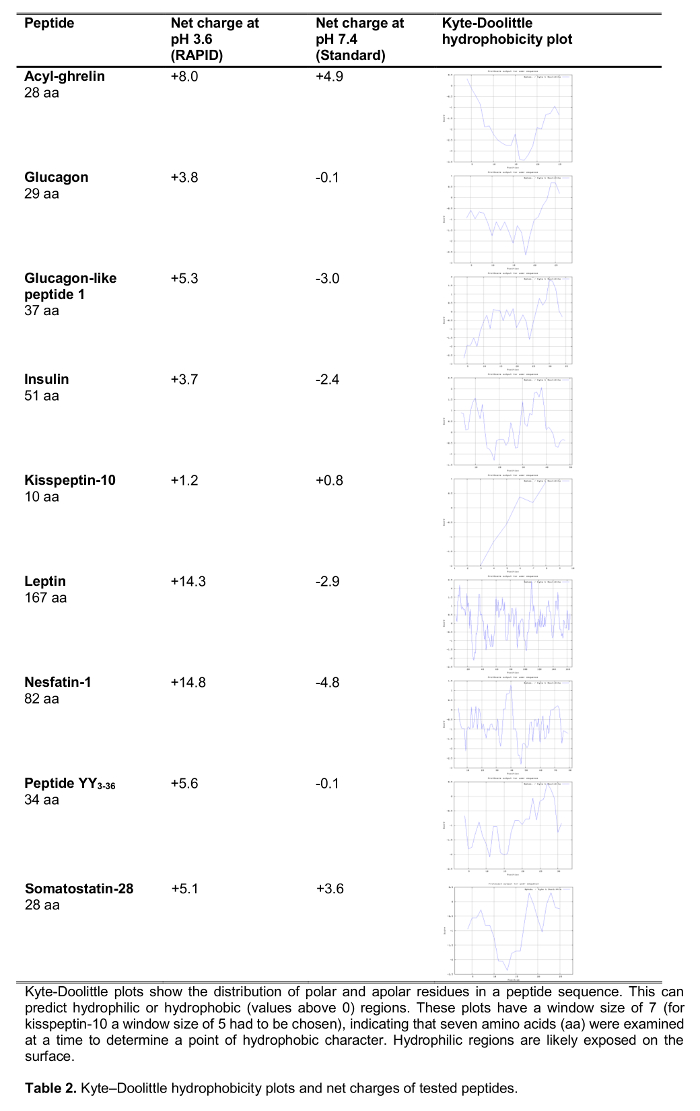
本研究旨在将 RAPID 法与标准血液处理方法(即 EDTA 抗凝血置于冰上)进行比较,后者在临床及科研领域被广泛推荐14并常用。我们检测了多种参与摄食调节的 125I 标记肽类在两种处理方法下的回收率,其中包括已被确认的肽类以及近期被认为可能参与摄食调控的新候选肽类(摄食影响效果见表1)。所选激素还涵盖了不同长度和电荷特性的肽类(见表2)。此外,针对胃饥饿素(ghrelin),我们分析了其在标准方法与 RAPID 方法处理后的分子形式。最后,我们评估了经 RAPID 或标准方法处理后内源性胃饥饿素(酰化与去酰化胃饥饿素)以及吻素(kisspeptin)的水平,后者也是一种近期被认为可能参与摄食调节的肽类15,16。此外,我们还在一组体重指数范围较广的受试者群体中(BMI 范围为 10.2–67.6 kg/m2)检测了这些肽类的水平,以探讨与长期体重改变相关的可能差异。
诊断、评估与方案:
研究参与者
所有研究参与者均为柏林夏里特医学院身心医学科的初入院患者(入院后两天内纳入),并均已签署书面知情同意书。为避免性别因素的影响,仅纳入女性患者。本研究共招募42名受试者,并将其分为三组:正常体重组(BMI 18.5–25 kg/m²)2,n = 12),神经性厌食症(BMI <17.5 kg/m2,n = 15)和肥胖(BMI >30 kg/m2,n = 15)。神经性厌食症和肥胖症患者根据《国际疾病分类第10版》(ICD-10)进行诊断,并分别因需要增重(神经性厌食症)或减重(肥胖症)而住院。所有正常体重患者仅因躯体形式症状住院,且无相关器质性疾病。排除伴有胃肠道躯体形式症状或有胃肠道手术史的患者。排除标准还包括年龄 <18岁,当前妊娠状态以及未经治疗的精神病性疾病。为了分别增加或减轻体重,在入院后第2天或第3天、开始饮食治疗前采集血液样本。同日进行人体测量参数评估。
访问受限。请登录或开始试用以查看此内容。
方案
该方案已获得当地人体研究伦理委员会批准(方案编号 EA1/114/10)。
1. 血液处理
- 在隔夜空腹后,于上午 07:00 至 08:00 之间从前臂静脉采集静脉血,并根据标准程序或 RAPID 方法进行处理。要求受试者在采血前避免运动和吸烟。
- 对于标准处理,将血液采集至预冷的含 EDTA 管中,并在 10 分钟内于 4 °C 以 3,000 x g 离心 10 分钟。收集上清液,并在进一步进行放射免疫分析前保存于 -80 °C。
- 对于 RAPID 处理,在采血后 1 分钟内立即用冰浴缓冲液(pH 3.6)将血液按 1:10 比例稀释,缓冲液含 0.1 M 醋酸铵、0.5 M NaCl 及酶抑制剂(diprotin A、E-64-d、antipain、leupeptin、chymostatin,各 1 µg/ml)。随后在 10 分钟内于 4 °C 以 3,000 x g 离心 10 分钟,并使用移液器将上清液收集至聚丙烯管中,具体操作如先前在大鼠中所述6。
- 使用 100% 乙腈(流速 10 ml/min)对层析柱(360 mg,55-105 µm)进行活化,再用 0.1% 三氟乙酸(TFA,流速 10 ml/min)平衡,并使用注射泵以恒定流速 1 ml/min 上样上清液。
- 随后用 3 ml 0.1% TFA(流速 10 ml/min)洗涤层析柱,并用含 0.1% TFA 的 70% 乙腈缓慢洗脱(2 ml/min,共 2 ml)。
- 使用真空离心法干燥洗脱样品,并在进一步进行放射免疫分析前保存于 -80 °C。
注意:所有步骤均应在聚丙烯管(RAPID 处理)和硼硅酸盐玻璃管(放射免疫分析)中进行,这些材料具有显著较低的表面结合特性,从而可最大限度减少此前研究中大多数肽类的损失26。
2. 测量
注意:本节中的步骤应在具备放射性物质操作资质的实验室中进行。操作125I时应采取标准防护措施。
- 放射性标记肽的回收
- 获取 125I-放射性标记的人源肽类例如酰基-胃饥饿素、GLP-1、胰高血糖素、胰岛素、吻素、瘦素、nesfatin-1、PYY3-36 和生长抑素-28)
- 实验前将肽类保持为粉末状态,然后用0.1%乙酸新鲜稀释(约每毫升100,000 cpm)。
- 对于标准血液处理,在将血液抽入含预冷EDTA的试管后,立即转移1 ml血液至另一试管中,该试管内含有50 µl放射性标记物,放射活性为3,000-6,000 cpm(在实验开始前直接测定)。
- 对于RAPID处理,将1 ml含EDTA的血液转移至含有9 ml RAPID缓冲液(成分见1.3)的试管中,并加入500 µl含30,000-60,000 cpm放射性标记物的溶液。由于进行了1:10稀释,RAPID处理时需使用10倍体积的放射性标记物。
- 随后,按照步骤 1.2 至 1.3.2 所述处理样品。
- 在回收实验中,不要通过真空离心干燥样品,也不要于 -80 °C 保存。应随后直接使用γ计数器检测放射性标记肽的回收率。
- 标准样品中测量全部上清液,而快速样品(RAPID samples)中分析总体积的1/10,以确保所用放射性标记物用量的可比性。测量时,将上清液转移至适用于γ计数器的试管中,测定每分钟计数(counts per minute)。
- 作为100%标准,使用两份50 µl的样品 125未经过加工处理的碘放射性标记肽。按照2.1.7中所述,与其他样品同时进行测量。
- 每种肽重复实验五到六次。
- 放射性标记胃饥饿素的高效液相色谱分析
- 使用预冷的含EDTA试管采集血液,取1 ml转移至含有200 µl放射性标记酰化饥饿素(实验开始前直接计数为15,000-20,000 cpm)的试管中。
- 对于RAPID处理,将1 ml血液转移至含有9 ml RAPID缓冲液(成分见1.3)和200 µl放射性标记的酰化饥饿素(含15,000-20,000 cpm)的试管中。
- 随后,按照步骤 1.2 至 1.3.2 所述处理样品。
- 为进行反相高效液相色谱进一步分析,直接将样品上样至已平衡的稳定键合C18柱(2.1 mm × 50 mm,1.8 µm),平衡液为含0.1%三氟乙酸的17%乙腈水溶液(乙腈和水均添加0.1% TFA)。
- 平衡5分钟后,使用乙腈浓度从17%到40%的梯度在40分钟内洗脱样品(流速为1 ml/min)。
- 每分钟收集1 ml馏分,使用γ计数器分析放射性。
- 在另一项实验中,直接将含有 15,000–20,000 cpm 的 200 µl 放射性标记的酰化胃饥饿素上样至色谱柱,并按照步骤 2.2.4 至 2.2.6 所述进行高效液相色谱分析。
- 放射免疫测定
- 进行放射免疫分析时,将冷冻的上清液(标准处理法)和真空干燥粉末(RAPID法)在室温下解冻。
- 放射免疫测定前立即用双蒸水重悬干燥的RAPID样品2O,根据血浆原始体积(500 µl)。
- 评估kisspeptin以及总ghrelin(包括去酰基和酰基ghrelin)和酰基ghrelin,方法同前12,27 使用商业放射免疫分析试剂盒,按照制造商的说明书操作。采用可形成稳定沉淀的硼硅酸盐试管。
- 第一天,将样品与检测缓冲液和一抗共同孵育例如. 抗饥饿素)按照制造商提供的稀释比例孵育24小时。
- 第二天,加入 125示踪剂例如 125I-ghrelin),涡旋混匀后于24小时内孵育。
- 第三天,加入沉淀试剂,涡旋混匀,并按照制造商推荐的条件进行孵育。随后,在 4 °C 下以 3,000 x g 离心 20 分钟。弃去上清液,使用γ计数器测定沉淀物中的放射活性。
- 将总饥饿素减去酰化饥饿素,计算去酰基饥饿素含量。通过将每个样本的酰化饥饿素除以去酰基饥饿素,计算酰化/去酰基饥饿素比值。
- 尽可能将所有样本在同一批次中进行处理,以避免批间差异。本实验中的批内差异为 <8% 用于吻肽, <7% 用于总计和 <酰基胃饥饿素为9%。
3. 统计分析
- 使用 Kolmogorov-Smirnov 检验确定数据的分布情况。数据以均值 ± 均值标准误(SEM)表示。
- 采用 t 检验评估两组之间的差异;采用所有成对多重比较程序(Tukey post hoc 检验)或双因素方差分析(two-way ANOVA)后接 Holm-Sidak 方法评估多组之间的差异。
- 认为 p <0.05 具有统计学显著性,并使用统计学软件进行分析。
访问受限。请登录或开始试用以查看此内容。
结果
与标准血液处理相比,快速血液处理(RAPID)可提高人全血中125I标记肽的回收率。
在标准血液处理(EDTA抗凝血置于冰上)后,9种肽中有9种的放射标记肽回收率约为60%(范围为48–68%,图1A–K)。RAPID处理使所有125I标记肽的回收率均得到提升,具体表现为:生长抑素-28(+39%,图1A)、胰高血糖素样肽-1(+35%,图1B)、酰化饥饿素(正辛酰饥饿素,+32%,图1C)、胰高血糖素(+32%,图1D)、胰岛素(+29%,图1E)、吻素(+29%,图1F)、神经降压素-1(+28%,图1G)、瘦素(+21%,图1H)以及肽YY3-36(+19%,...
访问受限。请登录或开始试用以查看此内容。
讨论
我们此前曾报道,在大鼠中,与标准血液处理方法相比,RAPID 血液处理方法可提高 12 种肽中 11 种的回收率6。在本研究中,我们证明该方法同样适用于人类。经 RAPID 处理后,所检测的 9 种 125I 标记肽的回收率均优于标准血液处理方法(EDTA 抗凝血置于冰上)。观察到的回收率提升幅度为 19–39%,这一差异可能具有重要意义,尤其是在预期差异较小时更为关键,因为当肽的回收率较低时,微小差异可能会被掩盖。
我们还发现,在快速(RAPID)血液处理后,经高效液相色谱(HPLC)检测,ghrelin 在正确的洗脱位置被检测到,表明其分子形式正确(酰化型 ghrelin);而在标准血液处理后,约有三分之二的 ghrelin 降解为去酰化型 ghrelin。由于酰基对于 ghrelin 与其受体的结合至关重要28,去酰化预计将显著改变该肽段的生物学功能。然而,越来越多的研究也认识到去酰化型 ghrelin 本身具有生物学活性29。有趣的是,已有研究提示去酰化型 ghrelin 可能拮抗 gh...
访问受限。请登录或开始试用以查看此内容。
披露
作者无任何利益冲突需要披露。
致谢
本工作由德国研究基金会 STE 1765/3-1(A.S.)和德国联邦教育与研究部 03IPT614A(C.G.)资助。我们感谢 Reinhard Lommel 和 Petra Buße 提供出色的技术支持,同时感谢 Karin Johansson 和 Christina Hentzschel 在人体测量数据的组织与实施过程中提供的帮助
访问受限。请登录或开始试用以查看此内容。
材料
| 姓名 | 公司 | 目录编号 | 评论 |
|---|---|---|---|
| 二肽基肽酶抑制剂A(Diprotin A) | Peptides International, Louisville, KY, USA | IDP-4132 | |
| E-64-d | Peptides International, Louisville, KY, USA | IED-4321-v | |
| 抑氨肽酶素(Antipain) | Peptides International, Louisville, KY, USA | IAP-4062 | |
| 亮抑蛋白酶肽(Leupeptin) | Peptides International, Louisville, KY, USA | ILP-4041 | |
| 抑胃蛋白酶肽(Chymostatin) | Peptides International, Louisville, KY, USA | ICY-4063 | |
| Sep-Pak C18 小柱 | Waters Corporation, Milford, MA, USA | WAT051910 | 360 mg, 55-105 µm |
| 酰化饥饿素(Acyl-ghrelin) | Millipore, Billerica, MA, USA | 9088-HK | 放射性 |
| 胰高血糖素样肽-1(GLP-1) | Millipore, Billerica, MA, USA | 9035-HK | 放射性 |
| 胰高血糖素(Glucagon) | Millipore, Billerica, MA, USA | 9030 | 放射性 |
| 胰岛素(Insulin) | Millipore, Billerica, MA, USA | 9011S | 放射性 |
| 瘦素(Leptin) | Millipore, Billerica, MA, USA | 9081-HK | 放射性 |
| Kisspeptin-10 | Phoenix Pharmaceuticals, Burlingame, CA, USA | T-048-56 | 放射性 |
| Nesfatin-1 | Phoenix Pharmaceuticals, Burlingame, CA, USA | T-003-26 | 放射性 |
| PYY3-36 | Phoenix Pharmaceuticals, Burlingame, CA, USA | T-059-02 | 放射性 |
| 生长抑素-28(Somatostatin-28) | Phoenix Pharmaceuticals, Burlingame, CA, USA | T-060-16 | 放射性 |
| ZORBAX Rapid Resolution HT SB-C18 色谱柱 | Agilent Technologies, Santa Clara, CA, USA | 822700-902 | 2.1 mm x 50 mm, 1.8 µm |
| Agilent 1200 LC | Agilent Technologies, Santa Clara, CA, USA | 高效液相色谱系统,包含多个组件,因此无单一货号 | |
| Kisspeptin 放射免疫分析试剂盒(RIA) | Phoenix Pharmaceuticals, Burlingame, CA, USA | # RK-048-56 | 放射性 |
| 总饥饿素放射免疫分析试剂盒(Total ghrelin RIA) | Millipore, Billerica, MA, USA | # GHRT-89HK | 放射性 |
| 活性饥饿素放射免疫分析试剂盒(Active ghrelin RIA) | Millipore, Billerica, MA, USA | # GHRA-88HK | 放射性 |
| SigmaStat 3.1 | Systat Software, San Jose, CA, USA | 在线下载 |
参考文献
- Finucane, M. M., et al. National, regional, and global trends in body-mass index since 1980: systematic analysis of health examination surveys and epidemiological studies with 960 country-years and 9.1 million participants. Lancet. 377 (9765), 557-567 (2011).
- James, W. P. The epidemiology of obesity: the size of the problem. J Intern Med. 263 (4), 336-352 (2008).
- Stengel, A., Taché, Y. Gastric peptides and their regulation of hunger and satiety. Curr Gastroenterol Rep. 14 (6), 480-488 (2012).
- Hussain, S. S., Bloom, S. R. The regulation of food intake by the gut-brain axis: implications for obesity. Int J Obes (Lond). 37 (5), 625-633 (2013).
- Hosoda, H., et al. Optimum collection and storage conditions for ghrelin measurements: octanoyl modification of ghrelin is rapidly hydrolyzed to desacyl ghrelin in blood samples). Clin Chem. 50 (6), 1077-1080 (2004).
- Stengel, A., et al. The RAPID method for blood processing yields new insight in plasma concentrations and molecular forms of circulating gut peptides. Endocrinology. 150 (11), 5113-5118 (2009).
- Stengel, A., et al. Lipopolysaccharide differentially decreases plasma acyl and desacyl ghrelin levels in rats: Potential role of the circulating ghrelin-acylating enzyme GOAT. Peptides. 31 (9), 1689-1696 (2010).
- Stengel, A., et al. Cold ambient temperature reverses abdominal surgery-induced delayed gastric emptying and decreased plasma ghrelin levels in rats. Peptides. 31, 2229-2235 (2010).
- Stengel, A., et al. Central administration of pan-somatostatin agonist ODT8-SST prevents abdominal surgery-induced inhibition of circulating ghrelin, food intake and gastric emptying in rats. Neurogastroenterol Motil. 23 (7), e294-e308 (2011).
- Stengel, A., et al. Abdominal surgery inhibits circulating acyl ghrelin and ghrelin-O-acyltransferase levels in rats: role of the somatostatin receptor subtype 2. Am J Physiol Gastrointest Liver Physiol. 301, G239-G248 (2011).
- Wang, L., et al. Intravenous injection of urocortin 1 induces a CRF2 mediated increase in circulating ghrelin and glucose levels through distinct mechanisms in rats. Peptides. 39, 164-170 (2013).
- Goebel-Stengel, M., Stengel, A., Wang, L., Taché, Y. Orexigenic response to tail pinch: role of brain NPY(1) and corticotropin releasing factor receptors. Am J Physiol Regul Integr Comp Physiol. 306 (3), R164-R174 (2014).
- Goebel, M., Stengel, A., Wang, L., Reeve, J., Taché, Y. Lipopolysaccharide increases plasma levels of corticotropin-releasing hormone in rats. Neuroendocrinology. 93 (3), 165-173 (2011).
- Banfi, G., Salvagno, G. L., Lippi, G. The role of ethylenediamine tetraacetic acid (EDTA) as in vitro anticoagulant for diagnostic purposes. Clin Chem Lab Med. 45 (5), 565-576 (2007).
- Stengel, A., Wang, L., Goebel-Stengel, M., Taché, Y. Centrally injected kisspeptin reduces food intake by increasing meal intervals in mice. Neuroreport. 22 (5), 253-257 (2011).
- De Bond, J. A., Smith, J. T. Kisspeptin and energy balance in reproduction. Reproduction. 147 (3), R53-R63 (2014).
- Wren, A. M., et al. Ghrelin enhances appetite and increases food intake in humans. J Clin Endocrinol Metab. 86 (12), 5992(2001).
- Schulman, J. L., Carleton, J. L., Whitney, G., Whitehorn, J. C. Effect of glucagon on food intake and body weight in man. J Appl Physiol. 11 (3), 419-421 (1957).
- Steinert, R. E., Poller, B., Castelli, M. C., Drewe, J., Beglinger, C. Oral administration of glucagon-like peptide 1 or peptide YY 3-36 affects food intake in healthy male subjects. Am J Clin Nutr. 92 (4), 810-817 (2010).
- Dewan, S., et al. Effects of insulin-induced hypoglycaemia on energy intake and food choice at a subsequent test meal. Diabetes Metab Res Rev. 20 (5), 405-410 (2004).
- Schlogl, M., et al. Increased 24-hour ad libitum food intake is associated with lower plasma irisin concentrations the following morning in adult humans. Appetite. 90, 154-159 (2015).
- Heymsfield, S. B., et al. Recombinant leptin for weight loss in obese and lean adults: a randomized, controlled, dose-escalation trial. JAMA. 282 (16), 1568-1575 (1999).
- Shimizu, H., et al. Peripheral administration of nesfatin-1 reduces food intake in mice: the leptin-independent mechanism. Endocrinology. 150, 662-671 (2009).
- Batterham, R. L., et al. Inhibition of food intake in obese subjects by peptide YY3-36. N Engl J Med. 349 (10), 941-948 (2003).
- Shibasaki, T., et al. Antagonistic effect of somatostatin on corticotropin-releasing factor-induced anorexia in the rat. Life Sci. 42 (3), 329-334 (1988).
- Goebel-Stengel, M., Stengel, A., Taché, Y., Reeve, J. R. Jr The importance of using the optimal plasticware and glassware in studies involving peptides. Anal Biochem. 414 (1), 38-46 (2011).
- Smets, E. M., et al. Decreased plasma levels of metastin in early pregnancy are associated with small for gestational age neonates. Prenat Diagn. 28 (4), 299-303 (2008).
- Kojima, M., et al. Ghrelin is a growth-hormone-releasing acylated peptide from stomach. Nature. 402 (6762), 656-660 (1999).
- Stengel, A., Yin Taché, Y., Yang, the Gastric X/A-like Cell as Possible Dual Regulator of Food Intake. J Neurogastroenterol Motil. 18 (2), 138-149 (2012).
- Inhoff, T., et al. Desacyl ghrelin inhibits the orexigenic effect of peripherally injected ghrelin in rats. Peptides. 29, 2159-2168 (2008).
- Hirayama, H., et al. Contrasting effects of ghrelin and des-acyl ghrelin on the lumbo-sacral defecation center and regulation of colorectal motility in rats. Neurogastroenterol Motil. 22 (10), 1124-1131 (2011).
- Horikoshi, Y., et al. Dramatic elevation of plasma metastin concentrations in human pregnancy: metastin as a novel placenta-derived hormone in humans. J Clin Endocrinol Metab. 88 (2), 914-919 (2003).
- Yang, Y. U., Xiong, X. Y., Yang, L. I., Xie, L., Huang, H. Testing of kisspeptin levels in girls with idiopathic central precocious puberty and its significance. Exp Ther Med. 9 (6), 2369-2373 (2015).
- Hosoda, H., Kojima, M., Matsuo, H., Kangawa, K. Ghrelin and des-acyl ghrelin: two major forms of rat ghrelin peptide in gastrointestinal tissue. Biochem Biophys Res Commun. 279 (3), 909-913 (2000).
- Raff, H. Total and active ghrelin in developing rats during hypoxia. Endocrine. 21 (2), 159-161 (2003).
- Evans, M. J., Livesey, J. H., Ellis, M. J., Yandle, T. G. Effect of anticoagulants and storage temperatures on stability of plasma and serum hormones. Clin Biochem. 34 (2), 107-112 (2001).
- Nabuchi, Y., Fujiwara, E., Kuboniwa, H., Asoh, Y., Ushio, H. The stability and degradation pathway of recombinant human parathyroid hormone: deamidation of asparaginyl residue and peptide bond cleavage at aspartyl and asparaginyl residues. Pharm Res. 14 (12), 1685-1690 (1997).
- White, A., Handler, P., Smith, E. L. Principles of Biochemistry. , 5th ed, McGraw-Hill Book Co. New York. (1973).
访问受限。请登录或开始试用以查看此内容。
重印与许可
