开花植物上的杀菌剂喷洒可能会使独居蜂暴露于高浓度的花粉携带杀菌剂残留物中。通过基于实验室的实验涉及 体外-饲养的蜜蜂幼虫,本研究探讨了取食来自寄主和非寄主植物的经杀菌剂处理的花粉所产生的交互效应。
需要JoVE订阅才能观看此内容。 请登录或开始免费试用
本文内容
摘要
摘要
尽管独居蜂为野生植物和栽培作物提供了至关重要的授粉服务,但这一物种多样性丰富的类群在农药监管研究中却长期被忽视。若在蜜蜂采集花粉以储备巢穴期间,于其寄主植物上或附近喷洒杀菌剂,则其暴露于杀菌剂残留的风险可能尤为显著。对于某些物种而言 Osmia 以特定植物花粉为食的独居蜂(寡食性),由于无法利用非寄主植物的花粉,可能增加其受杀菌剂毒害的风险。本文描述了成功饲养寡食性壁蜂所采用的实验方案。 Osmia ribifloris 在标准化实验室条件下,于细胞培养板中从卵期至预蛹期进行广义上的培养。 体外-饲养的蜜蜂随后被用于研究杀菌剂暴露和花粉来源对蜜蜂适应性的影响。该实验采用2 × 2全交叉析因设计,考察杀菌剂暴露和花粉来源对幼虫适应性的影响,包括预蛹生物量、幼虫发育时间和存活率,以量化其主效应及交互效应。该技术的一个主要优势在于使用 体外-饲养的蜜蜂可降低自然背景变异性,并允许同时操控多个实验参数。本方案描述了一种多功能工具,可用于检验涉及影响蜜蜂健康的一系列因素的假设。要实现显著且持久的保护成效,深入理解驱动蜜蜂种群衰退的生理与环境因素之间的复杂相互作用将至关重要。
引言
由于蜜蜂是昆虫传粉者中的主要类群1,其全球性种群衰退对粮食安全和生态系统稳定性构成了威胁2,3,4,5,6,7。无论是人工饲养还是野生蜂群的种群数量下降,均归因于若干共同的风险因素,包括栖息地破碎化、新出现的寄生虫和病原体、遗传多样性丧失以及外来入侵物种的引入3,4,7,8,9,10,11,12。特别是杀虫剂(例如新烟碱类)使用量的急剧增加,已被直接证实对蜜蜂产生有害影响13,14,15。多项研究表明,新烟碱类杀虫剂与麦角甾醇生物合成抑制剂(EBI)类杀菌剂之间的协同作用可导致多种蜜蜂的高死亡率16,17,18,19,20,21,22。然而,杀菌剂长期以来被认为对蜜蜂“安全”,因此仍被广泛喷洒于开花作物上,且缺乏充分监管23。已有记录显示,采集蜂经常将携带杀菌剂残留的花粉带回蜂巢24,25,26。摄入此类含杀菌剂的花粉可导致幼虫蜜蜂的高死亡率27,28,29,30,以及成年蜜蜂一系列亚致死效应16,31,32,33,34。最近一项研究提示,杀菌剂可能通过改变蜂巢中储存花粉的微生物群落结构,破坏蜜蜂与花粉携带微生物之间关键的共生关系,从而导致蜜蜂损失35。
尽管独居蜂对多种野生和农作物的授粉至关重要36,37,38,但这类多样化的传粉者在农药监测研究中受到的关注却少得多。一只成年独居雌蜂的巢穴包含5-10个封闭的育雏室,每个育雏室中储存有一定量由母体采集的花粉和花蜜,并含有一枚卵39。孵化后,幼虫依赖所分配的花粉资源以及伴随花粉带入的微生物群来获取充足的营养40,41。由于缺乏社会性生活方式的优势,独居蜂可能更容易受到农药暴露的影响42。例如,当遭遇喷药后,社会性蜜蜂种群中的功能缺损可能由工蜂或新羽化的后代在一定程度上予以补偿,而单只成年独居雌蜂的死亡则意味着其全部繁殖活动的终止43。这种在敏感性上的差异凸显了在生态毒理学研究中纳入多种蜜蜂类群的重要性,以确保对人工饲养蜂和野生蜂均提供充分保护。然而,除少数研究外,关于杀菌剂暴露影响的研究主要集中在社会性蜜蜂上18,23,32,44,45,46,47,48,49。
属于属的独居蜂 Osmia (图1) 已在全球范围内被用作多种重要水果和坚果作物的高效传粉者39,50,51,53,53与其他人工管理的传粉昆虫群体一样24,54,55,56,57,58,成年 Osmia 蜜蜂会常规性地接触到喷洒在开花作物上的杀菌剂44成年雌蜂在近期喷洒过杀菌剂的作物上觅食时,可能会采集含有杀菌剂的花粉并将其储存于育雏室中,这些花粉随后将成为发育中幼虫的唯一食物来源。幼虫摄食受污染的花粉储备后,可能因此暴露于杀菌剂残留物中。42寡食性物种仅在少数亲缘关系较近的寄主植物上觅食,其暴露风险可能更高59,60,61例如,某些切叶蜂似乎更倾向于采集低质量的菊科植物花粉,以此作为降低寄生风险的策略。62然而,杀菌剂对寡食性独居蜂幼虫适应性的影响程度尚未通过实验进行量化。本研究的目的是建立一种实验方案,用于检测杀菌剂暴露和花粉来源对寡食性独居蜂幼虫适应性的主效应及交互效应。 体外 人工饲养的独居蜂。为开展研究,采集其卵 O. ribifloris sensu lato (s.l.) 可从商业渠道获得(材料表)。该种群是理想的实验材料,因其作为本地传粉昆虫具有重要生态意义,且对富含花蜜的植物表现出强烈的偏好 Mahonia aquifolium (俄勒冈葡萄)分布于该地区53,63,64 (图2).
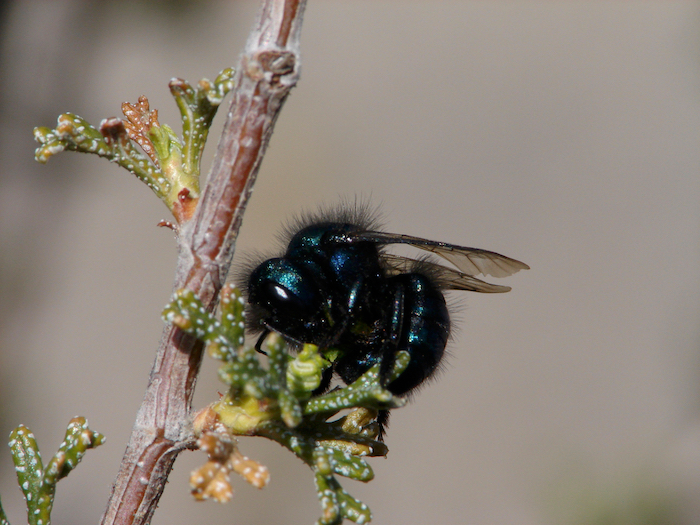
图1. 成年Osmia ribifloris的高分辨率照片。照片由美国农业部农业研究局(USDA-ARS)昆虫学研究员Jim Cane博士提供 请点击此处查看该图的放大版本。
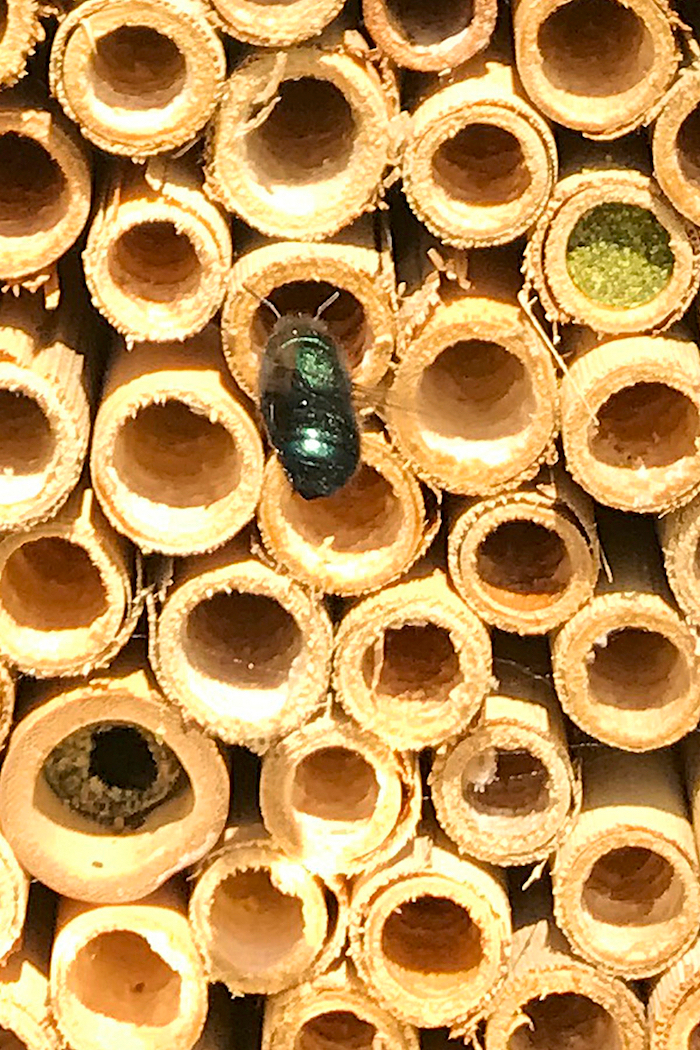
图 2. Osmia ribifloris (s.l.) 的芦苇巢管,前景中有一只正在筑巢的雌蜂。 芦苇中的巢室分隔物和末端封堵物由咀嚼过的叶片构成。照片由 Kimball Clark 先生提供,来源 NativeBees.com 请点击此处查看此图的放大版本。
本研究的第一个目标是评估取食经杀菌剂处理的花粉对幼虫适应性(以发育时间和预蛹生物量衡量)的影响。尽管已有研究表明,多种蜜蜂成虫暴露于常用杀菌剂丙环唑后死亡率升高23,24,32,44,45,54,55,56,57,58,65,66,67,但其对蜜蜂幼虫的影响尚不明确。本研究的第二个目标是评估取食非寄主花粉对幼虫适应性的影响。先前的研究表明,当寡食性蜜蜂幼虫被迫取食非寄主花粉时,无法正常发育68。此类结果可能与蜜蜂生理差异69、花粉生化成分差异70以及天然花粉营养物中所含的有益微生物群落有关71。本研究的第三个目标是评估杀菌剂处理与膳食花粉之间的交互作用对幼虫适应性的影响。
已知多种生物学性状会影响独居蜂幼虫的适合度,包括母体体型、营养供给速率、觅食策略以及花粉数量72,73,74,75。这些因素可能在不同茎秆之间引入显著变异,从而在评估幼虫健康状况时对建立可靠的实验设计构成挑战。此外,由于幼虫发育发生在封闭的巢管内部,若不采用非致死性技术,很难直接观察和量化此类变异对后代的影响(图3)。为克服这一难题,本研究中的所有假设均通过在巢管外人工饲养的幼虫进行检验。实验设计采用完全交叉的2 × 2析因设计,每个因素包含两个水平:因素1:杀菌剂暴露(施用杀菌剂、不施用杀菌剂);因素2:花粉来源(寄主花粉、非寄主花粉)。蜜蜂从卵期开始在无菌的多孔细胞培养板中、于受控的实验室条件下培育至前蛹期。每个孔中单独放置标准化量的花粉饲料和一枚卵。孵化后,幼虫在孔内取食分配的花粉,完成幼虫发育并启动化蛹过程。以往研究表明,在这种人工饲养环境中培育的蜜蜂,其无法解释的死亡率低于野外个体49,76。体外饲养蜜蜂相比基于野外的研究具有多项优势:1)可最大限度减少自然变异及野外研究中常见的非受控因素所带来的混杂效应;2)可在不同处理组中同时测试感兴趣因素的多个处理水平;3)可预先确定重复数量,并对每个重复的实验因素进行独立操控;4)可方便地独立观察和记录幼虫的响应变量,而不会干扰相邻幼虫;5)该方案可进行调整,以适应涉及多个因素和多个响应变量的更复杂实验设计。
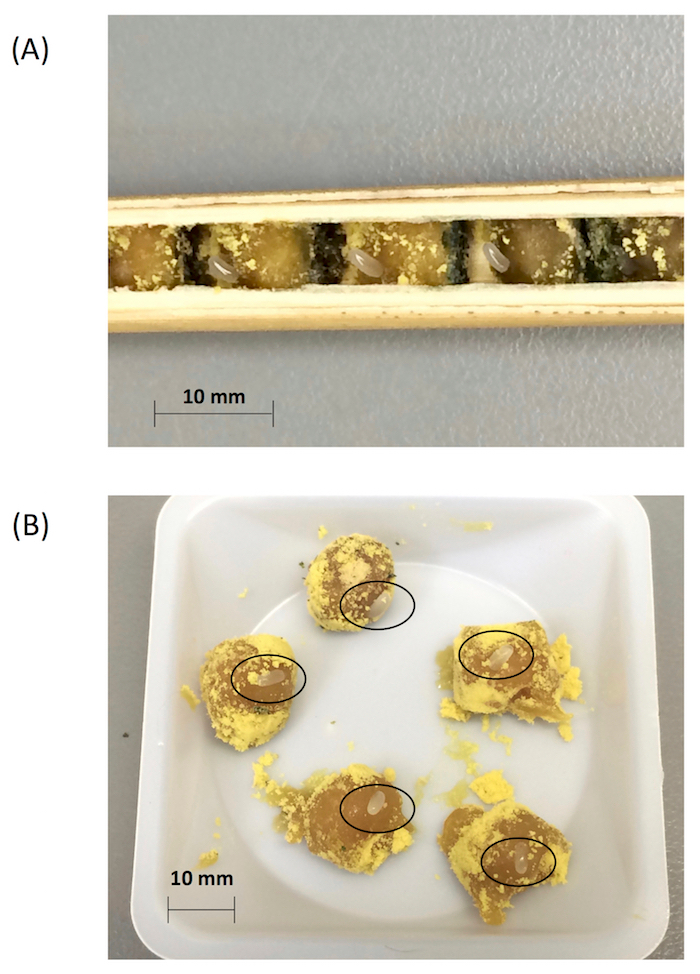
图3. 天然巢穴芦苇内部的内容 Osmia ribifloris (s.l.) 近距离观察 (A) 一支被解剖的芦苇,显示其单个腔室、花粉储备及隔膜,以及 (B) 新鲜采集的花粉饲料及其相关的卵(以黑色圆圈标示)。 请点击此处以查看此图的放大版本。
访问受限。请登录或开始试用以查看此内容。
方案
1. 准备杀菌剂暴露实验用丙环唑溶液
- 实验当天,通过将适量市售14.3%丙环唑溶解于无菌水中,配制0.1倍稀释的杀菌剂溶液。所有处理均须使用新鲜配制的杀菌剂溶液。
- 添加 23 µL 每克花粉饲料添加0.1倍稀释的杀菌剂溶液,以达到此前在蜜蜂采集花粉中报道的丙环唑最高浓度24 (0.361 PPM 或 µg 活性成分克数-1 花粉的
2. 从切叶蜂(Osmia)巢管中采集卵和寄主花粉团
- 使用灭菌的解剖刀解剖新筑巢的芦苇管中的切叶蜂(Osmia),沿芦苇长度方向将其切开成两部分,以暴露各个独立的巢室。
注意:每个蜂巢可能包含8至14个巢室,每个巢室内含有一枚卵。 - 通过肉眼检查芦苇,根据已发表的指南77识别含有雄性卵的巢室。使用灭菌的弯头针将每一份花粉食料连同其对应的卵从巢管中取出,并置于洁净的称量舟中。
- 使用洁净的细毛画笔轻轻将卵与食料分离,并使用标准实验室天平记录花粉食料及卵的鲜重。计算雄性花粉食料的平均重量。
- 后续操作应尽快完成,以尽量减少因暴露于过高温度或脱水环境而对卵造成损伤的风险。
3. 准备受体植物花粉制剂
- 目视检查从巢室中采集的母体寄主植物花粉,确保无寄生生物存在78为减少潜在的母本偏差,将花粉样本置于无菌培养皿中混合成一团,并使用无菌针头充分混匀。
- 将合并的物质均分为新的花粉饲料,确保每份重组饲料的重量约等于自然分配的雄性饲料平均重量(均值 ± 标准误,0.35 ± 0.01 g), N = 42).
注意:由于 Osmia sp为雄性后代分配较少的花粉食物,导致雄性幼虫的体重低于雌性幼虫77为避免因性别差异导致的任何此类偏差,实验中仅使用雄性卵。
4. 准备非寄主植物花粉饲料
- 使用标准实验室球磨机将市售的蜜蜂采集花粉研磨成细粉。
- 根据母体采集的寄主花粉营养物的含水量(约20%),加入适当体积的40%灭菌糖溶液79对花粉粉末进行水合,并充分混合,形成类似面团的质地。
- 将混合物分割成单个花粉团,每个花粉团的重量应大致等于自然分配的雄性营养物的平均重量。
注:母体采集的寄主花粉营养物的含水量可通过随机选取30个雄性巢室中的花粉营养物,比较其鲜重与干重进行标准化测定80。为获得干重,花粉营养物应在冷冻干燥机中进行冻干处理(1.5 Pa,72 h)。
5. 准备多孔细胞培养板
- 使用无菌镊子将灭菌的48孔培养板的每个孔用已高压灭菌的锡杯(5 × 9 cm)衬里。轻轻展开胶囊的顶部边缘,以便容纳花粉饲料。
- 根据处理组别,使用无菌工具将一份单独的寄主或非寄主花粉饲料放入锡杯内。
注意:为避免交叉污染,处理组和对照组应使用不同的培养板。
6. 添加杀菌剂
- 使用无菌木棒在花粉团中央压出一个凹陷。每份花粉处理均需使用新的木棒。
- 向凹陷中加入适量的杀菌剂溶液(处理组)或无菌水(对照组)。用无菌镊子轻轻夹合凹陷开口,以尽量减少杀菌剂或无菌水与卵的表面接触。
- 确保实验设计的因子设置与示意图(图4)中所示一致。
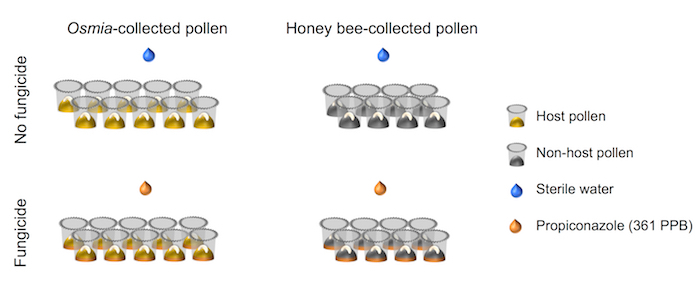
图 4. 实验设计示意图。 本实验采用完全交叉的 2 × 2 因子设计。因子 1 为杀菌剂暴露,包含两个水平:(i) 无杀菌剂(N = 10)和 (ii) 施用杀菌剂(N = 10)。因子 2 为花粉来源,包含两个水平:(i) 寄主花粉(N = 8)和 (ii) 非寄主花粉(N = 8)。请点击此处查看此图的放大版本。
7. 饲养并观察幼虫
- 使用干净的细毛刷,将一枚随机选取的雄性卵放置在花粉食料的上表面。所有卵放置完毕后,盖上细胞培养板的盖子,并用标签胶带在四个角固定密封。
- 将培养板置于洁净的托盘中,并用深色布料覆盖,以避免直接光照。在托盘内放置一个含有 30 mL 无菌水的 6 孔板,以防止干燥。将培养托盘静置于室温培养箱中,期间避免扰动。
- 每天在体视显微镜下观察培养板,观察时无需打开盖子。通过检查幼虫是否活动来确认其存活状态。若未观察到活动,则丢弃含有死亡幼虫的锡杯及剩余花粉食料。让所有存活幼虫在培养板内继续发育,直至进入前蛹期。
- 当前蛹期幼虫达到前蛹阶段时,将其从锡杯中取出41。使用毛刷清除丝质茧上的排泄物。在体视显微镜下小心剪开丝质茧,并用橡胶头镊子取出前蛹。
- 操作前蛹时应轻柔,避免工具刺破其柔软体壁。记录前蛹的鲜重(前蛹生物量)以及从卵发育至前蛹阶段所需的时间(幼虫发育时间)。
注意:任何死亡的幼虫应立即丢弃,以防止尸体及残留花粉食料上滋生不必要的微生物,从而降低对其他健康幼虫造成感染的风险。
访问受限。请登录或开始试用以查看此内容。
结果
幼虫适应性通过三个指标进行量化:(i)幼虫发育时间,(ii)预蛹期生物量,以及(iii)存活率。采用双因素方差分析(ANOVA),以杀菌剂暴露(两个水平:无杀菌剂、有杀菌剂)和花粉来源(两个水平:寄主花粉、非寄主花粉)作为自变量,幼虫发育时间为因变量。杀菌剂暴露的主效应不显著(F1,28 = 1.24,P = 0.28),其中经杀菌剂处理组(平均值 ± 标准误)为 28.14 ± 1.98 天(N = 14),未处理组为 25.39 ± 1.65 天(N = 18)。然而,花粉来源的主效应显示,以寄主花粉饲养的幼虫与以非寄主花粉饲养的幼虫在发育时间上存在显著差异(寄主花粉组:20.00 ± 0.50 天,N = 16;非寄主花粉组:33.19 ± 0.81 天,N = 16)(F1,28 = 179.83,P < 0.001)。经Bonferroni校正的事后比较表明,在寄主花粉(...
访问受限。请登录或开始试用以查看此内容。
讨论
在实验室条件下,将蜜蜂饲养于其天然巢管之外,可对与幼虫适应性相关的多种假设进行检验。鉴于仍存在一些未明因素导致蜜蜂死亡,利用体外(in vitro)实验开展风险评估研究,有助于识别此类物种丰富的野生传粉昆虫可能面临的风险,并为管理措施提供科学依据12,38,49,76,81,82。
通常,较短的发育时间以及较高的预蛹期生物量与较高的幼虫适合度相关。在所有处理组中,幼虫发育持续时间与预蛹期生物量呈负相关。然而,在四个组之间,幼虫发育持续时间与预蛹期生物量存在显著差异。未接受任何杀菌剂处理且可摄食寄主花粉的幼虫具有最短的幼虫发育时间以及最高的预蛹期生物量。相比之下,摄食经杀菌剂...
访问受限。请登录或开始试用以查看此内容。
披露
作者无任何利益冲突需要披露。
致谢
作者感谢 Kimball Clark 和 Tim Krogh 提供 Osmia 巢管材料,感谢 Meredith Nesbitt 和 Molly Bidwell 在实验室中的协助,感谢 Cameron Currie 博士、Christelle Guédot 博士、Terry Griswold 博士、Michael Branstetter 博士以及三位匿名审稿人提出的宝贵意见,这些意见显著改进了本文稿。本研究得到了美国农业部农业研究局拨款资金(当前研究信息系统编号 #3655-21220-001)、威斯康星州农业、贸易和消费者保护部(编号 #197199)、美国国家科学基金会(资助号 DEB-1442148)、美国能源部大湖生物能源研究中心(美国能源部科学办公室 BER DE-FC02-07ER64494)的支持。
访问受限。请登录或开始试用以查看此内容。
材料
| 姓名 | 公司 | 目录编号 | 评论 |
|---|---|---|---|
| O. ribifloris sensu lato (s.l.) 的卵 | 美国犹他州戴维斯县凯斯维尔 | ||
| 切叶蜂巢管 | Nativebees.com | NA | 新鲜封口的巢管 |
| 解剖工具组 | VWR | 89259-964 | 使用前需灭菌 |
| 尖嘴钳 | Husky | 1006 | |
| 6孔细胞培养板 | VWR | 10062-892 | 无菌密封 |
| 48孔细胞培养板 | VWR | 10062-898 | 无菌密封 |
| 培养皿 | VWR | 25373100 | 无菌密封 |
| 方形称量舟 | VWR | 10770-448 | |
| 骆驼毛刷 | Bioquip | 1153A | |
| 锡坩埚 | EA Consumables | D1021 | 使用前需灭菌 |
| 蔗糖 | VWR | 470302-808 | |
| 丙环唑 14.3 | Quali-Ppro | 60207-90-1 | 丙环唑 14.3% |
| 蜜蜂花粉 | Bee energised | 897098001244 | 未经处理的天然原生花粉 |
| 微量天平 | VWR | 10204-990 | |
| 球磨仪 | LAB SYNERGY INC. | 30334913 | |
| 木棒 | VWR | 470146908 | 使用前需灭菌 |
| 封口胶带 | VWR | 89097-912 | |
| 显微镜 | VWR | 89403-384 | |
| 种植托盘 | VWR | 470150-632 | |
| 乙醇 | VWR | BDH1158-4LP | |
| 离心管 | VWR | 21008936 | |
| 微量注射器 | Cole-Palmer | UX-07940-07 | |
| 橡胶镊子 | Amazon | B0135HWPN4 | |
| 注射器针头 | VWR | 89219-334 | |
| 冷冻干燥机 | Labcono | LFZ-1L | |
| 统计分析软件 | SPSS | Version 21.0 |
参考文献
- Klein, A. -M., et al. Importance of pollinators in changing landscapes for world crops. P Roy Soc Lond B Bio. 274 (1608), 303-313 (2007).
- Biesmeijer, J. C. J., et al. Parallel declines in pollinators and insect-pollinated plants in Britain and the Netherlands. Science. 313 (5785), 351-354 (2006).
- Potts, S. G., Biesmeijer, J. C., Kremen, C., Neumann, P., Schweiger, O., Kunin, W. E. Global pollinator declines: Trends, impacts and drivers. Trends Ecol Evol. 25 (6), 345-353 (2010).
- Cameron, S. A., et al. Patterns of widespread decline in North American bumble bees. P Natl Acad Sci USA. 108 (2), 662-667 (2011).
- Gallai, N., Salles, J. M., Settele, J., Vaissière, B. E. Economic valuation of the vunerability of world agriculture confronted with pollinator decline. Ecol Econ. 68 (3), 810-821 (2009).
- Fontaine, C., Dajoz, I., Meriguet, J., Loreau, M. Functional diversity of plant-pollinator interaction webs enhances the persistence of plant communities. Plos Biol. 4 (1), 0129-0135 (2006).
- Kluser, S., Peduzzi, P. Global pollinator decline: a literature review. , UNEP/GRID Europe. (2007).
- Brown, M. J. F., Paxton, R. J. The conservation of bees: a global perspective. Apidologie. 40 (3), (2009).
- Lebuhn, G., et al. Detecting insect pollinator declines on regional and global scales. Conserv Biol. 27 (1), (2013).
- Vanengelsdorp, D., Meixner, M. D. A historical review of managed honey bee populations in Europe and the United States and the factors that may affect them. J Invertebr Pathol. , Suppl 103. S80-S95 (2010).
- Pettis, J. S., Delaplane, K. S. Coordinated responses to honey bee decline in the USA. Apidologie. 41 (3), 256-263 (2010).
- Sandrock, C., Tanadini, L. G., Pettis, J. S., Biesmeijer, J. C., Potts, S. G., Neumann, P. Sublethal neonicotinoid insecticide exposure reduces solitary bee reproductive success. Agr Forest Entomol. 16 (2), (2014).
- Van der Sluijs, J. P., Simon-Delso, N., Goulson, D., Maxim, L., Bonmatin, J. M., Belzunces, L. P. Neonicotinoids, bee disorders and the sustainability of pollinator services. Curr Opin Env Sust. 5 (3), (2013).
- Goulson, D., Nicholls, E., Botías, C., Rotheray, E. L. Bee declines driven by combined stress from parasites, pesticides, and lack of flowers. Science. 347 (6229), (2015).
- Johnson, R. M., Ellis, M. D., Mullin, C. A., Frazier, M. Pesticides and honey bee toxicity - USA. Apidologie. 41 (3), (2010).
- Iwasa, T., Motoyama, N., Ambrose, J. T., Roe, R. M. Mechanism for the differential toxicity of neonicotinoid insecticides in the honey bee, Apis mellifera. Crop Protection. 23 (5), 371-378 (2004).
- Glavan, G., Bozic, J. The synergy of xenobiotics in honey bee Apis mellifera: mechanisms and effects. Acta Biol. Slov. 56, 11-27 (2013).
- Biddinger, D. J., et al. Comparative toxicities and synergism of apple orchard pesticides to Apis mellifera (L.) and Osmia cornifrons (Radoszkowski). PLoS ONE. 8 (9), e72587(2013).
- Thompson, H. M., Fryday, S. L., Harkin, S., Milner, S. Potential impacts of synergism in honeybees (Apis mellifera) of exposure to neonicotinoids and sprayed fungicides in crops. Apidologie. 45 (5), 545-553 (2014).
- Jansen, J. -P., Lauvaux, S., Gruntowy, J., Denayer, J. Possible synergistic effects of fungicide-insecticide mixtures on beneficial arthropods. IOBC-WPRS Bulletin. 125, 28-35 (2017).
- Robinson, A., Hesketh, H., et al. Comparing bee species responses to chemical mixtures: Common response patterns? PLoS ONE. 12 (6), (2017).
- Sgolastra, F., Medrzycki, P., et al. Synergistic mortality between a neonicotinoid insecticide and an ergosterol-biosynthesis-inhibiting fungicide in three bee species. Pest Management Science. 73 (6), 1236-1243 (2017).
- Ladurner, E., Bosch, J., Kemp, W. P., Maini, S. Assessing delayed and acute toxicity of five formulated fungicides to Osmia lignaria and Apis mellifera. Apidologie. 36 (3), 449-460 (2005).
- Mullin, C. A., et al. High levels of miticides and agrochemicals in North American apiaries: implications for honey bee health. PloS one. 5 (3), e9754(2010).
- Pettis, J. S., Lichtenberg, E. M., Andree, M., Stitzinger, J., Rose, R., Vanengelsdorp, D. Crop pollination exposes honey bees to pesticides which alters their susceptibility to the gut pathogen Nosema ceranae. PloS one. 8 (7), e70182(2013).
- David, A., et al. Widespread contamination of wildflower and bee-collected pollen with complex mixtures of neonicotinoids and fungicides commonly applied to crops. Environ Int. 88, 169-178 (2016).
- Zhu, W., Schmehl, D. R., Mullin, C. A., Frazier, J. L. Four common pesticides, their mixtures and a formulation solvent in the hive environment have high oral toxicity to honey bee larvae. PloS one. 9 (1), e77547(2014).
- Simon-Delso, N., Martin, G. S., Bruneau, E., Minsart, L. A., Mouret, C., Hautier, L. Honeybee colony disorder in crop areas: The role of pesticides and viruses. PLoS ONE. 9 (7), (2014).
- Park, M. G., Blitzer, E. J., Gibbs, J., Losey, J. E., Danforth, B. N. Negative effects of pesticides on wild bee communities can be buffered by landscape context. P Roy Soc B-Biol Sci. 282 (1809), 20150299-20150299 (2015).
- Bernauer, O. M., Gaines-Day, H. R., Steffan, S. A. Colonies of bumble bees (Bombus impatiens) produce fewer workers, less bee biomass, and have smaller mother queens following fungicide exposure. Insects. 6 (2), 478-488 (2015).
- Williamson, S. M., Wright, G. A. Exposure to multiple cholinergic pesticides impairs olfactory learning and memory in honeybees. J Exp Biol. 216 (10), 1799-1807 (2013).
- Artz, D. R., Pitts-Singer, T. L. Effects of fungicide and adjuvant sprays on nesting behavior in two managed solitary bees, Osmia lignaria and Megachile rotundata. PLoS ONE. 10 (8), e0135688(2015).
- Pilling, E. D., Bromleychallenor, K. A. C., Walker, C. H., Jepson, P. C. Mechanism of synergism between the pyrethroid insecticide lambda-cyhalothrin and the imidazole fungicide prochloraz, in the honeybee (Apis mellifera L). Pestic Biochem Phys. 51 (1), 1-11 (1995).
- Johnson, R. M., Wen, Z., Schuler, M. A., Berenbaum, M. R. Mediation of pyrethroid insecticide toxicity to honey bees (Hymenoptera: Apidae) by cytochrome P450 monooxygenases. J. Econ. Entomol. 99 (4), 1046-1050 (2006).
- Steffan, S. A., Dharampal, P. S., Diaz-Garcia, L. A., Currie, C. R., Zalapa, J. E., Hittinger, C. T. Empirical, metagenomic, and computational techniques illuminate the mechanisms by which fungicides compromise bee health. JoVE. (128), e54631(2017).
- Batra, S. W. T. Solitary bees. Sci Am. 250 (2), 120-127 (1984).
- Linsley, E. G. The ecology of solitary bees. Hilgardia. 27 (19), 543-599 (1958).
- Garibaldi, L. A., et al. Wild Pollinators Enhance Fruit Set of Crops Regardless of Honey Bee Abundance. Science. 339 (6127), 1608-1611 (2013).
- Bosch, J., Kemp, W. P. How to manage the blue orchard bee. , Sustainable Agriculture Network. Washington, DC. (2001).
- Keller, A., Grimmer, G., Steffan-Dewenter, I. Diverse microbiota identified in whole intact nest chambers of the red mason bee Osmia bicornis (Linnaeus 1758). PLoS ONE. 8 (10), e78296(2013).
- Bosch, J., Kemp, W. P. Development and Emergence of the Orchard Pollinator Osmia lignaria (Hymenoptera: Megachilidae). Environmental Entomology. 29 (1), 8-13 (2000).
- Brittain, C., Potts, S. G. The potential impacts of insecticides on the life-history traits of bees and the consequences for pollination. Basic and Applied Ecology. 12 (4), 321-331 (2011).
- Arena, M., Sgolastra, F. A meta-analysis comparing the sensitivity of bees to pesticides. Ecotoxicology. 23 (3), 324-334 (2014).
- Ladurner, E., Bosch, J., Kemp, W. P., Maini, S. Foraging and nesting behavior of Osmia lignaria (Hymenoptera: Megachilidae) in the presence of fungicides: cage studies. J Econ Entomol. 101 (3), 647-653 (2008).
- Huntzinger, A. C. I., James, R. R., Bosch, J., Kemp, W. P. Fungicide tests on adult alfalfa leafcutting bees (Hymenoptera: Megachilidae). J Econ Entomol. 101 (4), 1088-1094 (2008).
- Tsvetkov, N., et al. Chronic exposure to neonicotinoids reduces honey bee health near corn crops. Science. 356 (6345), 1395-1397 (2017).
- Mao, W., Schuler, M. A., Berenbaum, M. R. Disruption of quercetin metabolism by fungicide affects energy production in honey bees (Apis mellifera). P Natl Acad Sci. 114 (10), 2538-2543 (2017).
- Blacquière, T., Smagghe, G., Van Gestel, C. A. M., Mommaerts, V. Neonicotinoids in bees: A review on concentrations, side-effects and risk assessment. Ecotoxicology. 21 (4), 973-992 (2012).
- Sgolastra, F., Tosi, S., Medrzycki, P., Porrini, C., Burgio, G. Toxicity of spirotetramat on solitary bee larvae, Osmia cornuta (Hymenoptera: Megachilidae), in laboratory conditions. Journal of Apicultural Science. 59 (2), 73-83 (2015).
- Mader, E., Spivak, M., Evans, E. Managing Alternative Pollinators. , Sustainable Agriculture Research and Education (SARE), US Dept. of Agriculture. (2010).
- Bosch, J., Kemp, W. P. Developing and establishing bee species as crop pollinators: the example of Osmia spp.(Hymenoptera: Megachilidae) and fruit trees. B Entomol Res. 92 (1), 3-16 (2002).
- Sampson, B. J., Rinehart, T. A., Kirker, G. T., Stringer, S. J., Werle, C. T. Phenotypic variation in fitness traits of a managed solitary bee, Osmia ribifloris (Hymenoptera: Megachilidae). J Econ Entomol. 108 (6), 2589-2598 (2015).
- Sampson, B. J., Cane, J. H., Kirker, G. T., Stringer, S. J., Spiers, J. M. Biology and management potential for three orchard bee species (Hymenoptera: Megachilidae): Osmia ribifloris Cockerell, O. lignaria (Say) and O.chalybea Smith with emphasis on the former. Acta Hort. 810, 549-555 (2009).
- Hladik, M. L., Vandever, M., Smalling, K. L. Exposure of native bees foraging in an agricultural landscape to current-use pesticides. Sci Total Environ. 542, 469-477 (2016).
- Long, E. Y., Krupke, C. H. Non-cultivated plants present a season-long route of pesticide exposure for honey bees. Nat Commun. 7, (2016).
- Krupke, C. H., Hunt, G. J., Eitzer, B. D., Andino, G., Given, K. Multiple routes of pesticide exposure for honey bees living near agricultural fields. PLoS ONE. 7 (1), e29268(2012).
- Stoner, K. A., Eitzer, B. D. Using a hazard quotient to evaluate pesticide residues detected in pollen trapped from honey bees (Apis mellifera) in Connecticut. PLoS ONE. 8 (10), e77550(2013).
- Sánchez-Bayo, F., Goulson, D., Pennacchio, F., Nazzi, F., Goka, K., Desneux, N. Are bee diseases linked to pesticides? - A brief review. Environ Int. 89, 7-11 (2016).
- Steffan-Dewenter, I., Klein, A. -M., Gaebele, V., Alfert, T., Tscharntke, T. Bee diversity and plant-pollinator interactions in fragmented landscapes. Specialization and generalization in plant-pollinator interactions. , 387-410 (2006).
- Kremen, C., Ricketts, T. Global perspectives on pollination disruptions. Conserv Biol. 14 (5), 1226-1228 (2000).
- Memmott, J., Waser, N. M., Price, M. V. Tolerance of pollination networks to species extinctions. P Roy Soc B-Biol Sci. 271 (1557), 2605-2611 (2004).
- Spear, D. M., Silverman, S., Forrest, J. R. K. Asteraceae pollen provisions protect Osmia mason bees (Hymenoptera: Megachilidae) from brood parasitism. The American Naturalist. 187 (6), 797-803 (2016).
- Rust, R. W. Biology of Osmia (Osmia) ribifloris Cockerell (Hymenoptera: Megachilidae). J Kansas Entomol Soc. 59, 89-94 (1986).
- Torchio, P. F. Osmia ribifloris, a native bee species developed as a commercially managed pollinator of highbush blueberry (Hymenoptera: Megachilidae). J Kansas Entomol Soc. 63 (633), 427-436 (1990).
- Sanchez-Bayo, F., Goka, K. Pesticide residues and bees - A risk assessment. PLoS ONE. 9 (4), e94482(2014).
- Kasiotis, K. M., Anagnostopoulos, C., Anastasiadou, P., Machera, K. Pesticide residues in honeybees, honey and bee pollen by LC-MS/MS screening: Reported death incidents in honeybees. Sci Total Environ. 485 (1), 633-642 (2014).
- Stanley, J., Sah, K., Jain, S. K., Bhatt, J. C., Sushil, S. N. Evaluation of pesticide toxicity at their field recommended doses to honeybees, Apis cerana and A. mellifera through laboratory, semi-field and field studies. Chemosphere. 119, 668-674 (2015).
- Praz, C. J., Müller, A., Dorn, S. Specialized bees fail to develop on non-host pollen: Do plants chemically protect their pollen? Ecology. 89 (3), 795-804 (2008).
- Sedivy, C., Müller, A., Dorn, S. Closely related pollen generalist bees differ in their ability to develop on the same pollen diet: Evidence for physiological adaptations to digest pollen. Funct Ecol. 25 (3), 718-725 (2011).
- Williams, N. M. Use of novel pollen species by specialist and generalist solitary bees (Hymenoptera: Megachilidae). Oecologia. 134, (2003).
- Graystock, P., Rehan, S. M., McFrederick, Q. S. Hunting for healthy microbiomes: determining the core microbiomes of Ceratina, Megalopta, and Apis bees and how they associate with microbes in bee collected pollen. Conserv Genet. 18 (3), 1-11 (2017).
- Bosch, J., Vicens, N. Relationship between body size, provisioning rate, longevity and reproductive success in females of the solitary bee Osmia cornuta. Behav Ecol Sociobiol. 60 (1), 26-33 (2006).
- Bosch, J., Vicens, N. Body size as an estimator of production costs in a solitary bee. Ecol Entomol. 27 (2), 129-137 (2002).
- Radmacher, S., Strohm, E. Factors affecting offspring body size in the solitary bee Osmia bicornis (Hymenoptera, Megachilidae). Apidologie. 41 (2), 169-177 (2010).
- Seidelmann, K. Open-cell parasitism shapes maternal investment patterns in the Red Mason bee Osmia rufa. Behav Ecol. 17 (5), (2006).
- Becker, M. C., Keller, A. Laboratory rearing of solitary bees and wasps. Insect Science. 23 (6), 918-923 (2016).
- Bosch, J. The nesting behaviour of the mason bee Osmia cornuta (Latr) with special reference to its pollinating potential (Hymenoptera, Megachilidae). Apidologie. 25, 84-93 (1994).
- Krunić, M., Stanisavljević, L., Pinzauti, M., Felicioli, A. The accompanying fauna of Osmia cornuta and Osmia rufa and effective measures of protection. B Insectol. 58 (2), 141-152 (2005).
- Elliott, S. E., Irwin, R. E., Adler, L. S., Williams, N. M. The nectar alkaloid, gelsemine, does not affect offspring performance of a native solitary bee, Osmia lignaria (Megachilidae). Ecol Entomol. 33 (2), 298-304 (2008).
- Toby Mordkoff, J. The Assumption(s) of Normality. , Available from: http://www2.psychology.uiowa.edu/faculty/mordkoff/GradStats/part 1/I.07 normal.pdf (2016).
- Hendriksma, H. P., Härtel, S., Steffan-Dewenter, I. Honey bee risk assessment: New approaches for in vitro larvae rearing and data analyses. Methods Ecol and Evol. 2 (5), 509-517 (2011).
- Aupinel, P., et al. Improvement of artificial feeding in a standard in vitro method for rearing Apis mellifera larvae. B Insectol. 58 (2), 107-111 (2005).
- Beekman, M., Ratnieks, F. L. W. Long-range foraging by the honey-bee, Apis mellifera L. Funct Ecol. 14 (4), 490-496 (2000).
- Gathmann, A., Tscharntke, T. Foraging ranges of solitary bees. J Anim Ecol. 71 (5), 757-764 (2002).
- Greenleaf, S. S., Williams, N. M., Winfree, R., Kremen, C. Bee foraging ranges and their relationship to body size. Oecologia. 153 (3), 589-596 (2007).
- Bee Pollen Supplement - Bee Rescued. , Available from: https://beerescued.com/product/bee-rescued-bee-pollen-supplement/ (2018).
- Holly-Leaf Oregon-Grape (Mahonia aquifolium) Species Details and Allergy Info, Teton county, Wyoming. , Available from: http://www.pollenlibrary.com/Local/Specie/Mahonia+aquifolium/in/Teton County/WY/ (2018).
- Cane, J. H., Griswold, T., Parker, F. D. Substrates and Materials Used for Nesting by North American Osmia Bees (Hymenoptera: Apiformes: Megachilidae). Annals of the Entomological Society of America. 100 (3), 350-358 (2007).
访问受限。请登录或开始试用以查看此内容。
重印与许可
