本文介绍了一种高效合成螺环杂环化合物的实验方案。该五步合成法采用固相合成与可再生的迈克尔连接子策略。螺环化合物通常难以合成,本文所提出的方法具有可定制性,能够合成其他现代方法难以获得的螺环分子。
需要JoVE订阅才能观看此内容。 请登录或开始免费试用
本文内容
摘要
摘要
螺环杂环化合物因其在生物体系中的潜在应用而备受关注,其便捷的合成路线一直广受追求。通过固相合成、再生式迈克尔(REM)连接子策略以及1,3-偶极环加成反应,可构建出一系列结构相似的杂环化合物库,其中既包含具有螺环中心的分子,也包含不含螺环中心的分子。固相载体合成的主要优势如下:首先,每步反应均可使用大量过量试剂推动反应完全,从而获得高产率;其次,所用起始原料和试剂均为商业化产品,成本较低;最后,各反应步骤易于纯化。 通过 简单的过滤。REM连接子策略因其可回收性和无痕迹特性而具有吸引力。一旦反应方案完成,该连接子可多次重复使用。在典型的固相合成中,产物会包含部分或整个连接子,这可能带来不利影响。REM连接子能够避免这一问题。 "无痕" 产物与聚合物之间的连接点无法区分。分子内1,3-偶极环加成反应的高非对映选择性已有充分文献记载。由于固相载体的不溶性限制,反应进程只能通过官能团(若有)的变化进行监测。 通过 红外(IR)光谱法。因此,中间体的结构鉴定无法通过常规核磁共振(NMR)光谱法进行表征。该方法的其他局限性源于聚合物/连接臂与目标化学反应体系之间的相容性问题。本文报道了一种可便捷制备螺环杂环化合物的实验方案,经简单改进后可与高通量技术联用实现自动化。
引言
尽管近期在多种生物系统中发现了高度官能化的螺环杂环化合物的应用1,但仍需一种便捷的合成途径以实现其高效制备。这些杂环化合物的体系及其应用包括:MDM2抑制作用及其他抗癌活性2,3,4,5、酶抑制6,7,8、抗菌活性9,10、荧光标记10,11,12、DNA探针的手性选择性结合13,14,15以及RNA靶向16,以及众多潜在的治疗应用17,18,19。随着对这类杂环化合物需求的不断增长,目前文献中关于最佳合成路径仍存在分歧。现代合成方法通常以异靛素(isatin)及其衍生物为起始原料合成多种杂环化合物20,21,或采用复杂的分子内重排22,23,24,25、路易斯酸1,26,27或过渡金属催化17,28,29,30,或不对称反应过程31。尽管这些方法在合成特定结构且官能团有限的螺环肟类化合物方面已取得一定成功,但针对高非对映选择性地构建分子库的合成策略仍较少被深入研究32。
本文介绍的技术表明,这些目标分子可通过多种成熟且广为人知的合成方法联用而获得。该合成路径始于在固相载体上使用REM连接子和分子内硅基硝酮-烯烃环加成(ISOC)反应构建分子骨架,采用非线性合成路线,其特征是在三环体系中发生键断裂,最终生成高度官能化的杂环化合物。REM连接子因其操作便捷且可回收利用,常用于在固相载体上合成叔胺类化合物。33由于REM连接子具有易于纯化的特性 通过 简单的过滤操作,这种固相合成技术为科学家提供了一种可回收且无痕迹的连接子,本文中已采用该方法。反应完成后,REM连接子得以再生,并可多次重复使用。REM连接子也是无痕迹的,因为与许多固相连接子不同,产物与聚合物之间的连接位点在最终产物中无法识别。34,35异氰酸酯(ISOC)反应也得到了深入研究并被充分理解,可用于吡咯烷肟的合成。36,37或许更广为人知的是1,3-偶极环加成反应,这类反应可高效地立体选择性生成多种杂环化合物38,39,40,41,42,43,44,45采用改进的REM偶联ISOC技术合成螺环分子可得到高非对映选择性的产物。本文报道了一种高效合成螺环肟的新方法,该方法结合了两条已知的反应路径和易得的起始原料。
访问受限。请登录或开始试用以查看此内容。
方案
警告:使用前请查阅所有相关的材料安全数据表(MSDS)。这些合成中使用的多种化学品具有急性毒性和致癌性。进行以下反应时,请务必采取所有适当的安全措施,包括使用工程控制设备(通风橱、红外和核磁共振波谱仪)以及个人防护装备(安全护目镜、手套、实验服、长裤和封闭式鞋履)。
1. 呋喃甲胺对REM连接臂的迈克尔加成反应
注意:此步骤的设置时间为25分钟,反应时间为24小时。
- 在25 mL固相反应容器中加入1 g(1当量)REM树脂、20 mL(20当量)二甲基甲酰胺(DMF)和2.4 mL糠胺。
- 反应开始后,使用摇床在室温下振荡反应容器24小时。反应过程中容器保持密封。
注意:确保树脂不沉降于容器底部,并充分混合。 - 反应完成后,滤除溶液,并用5 mL DMF洗涤树脂1次。
- 随后交替使用5 mL二氯甲烷(DCM)和5 mL甲醇,共洗涤树脂4次。
- 洗涤结束后,在反应容器中用压缩空气彻底吹干树脂30分钟。
- 通过监测红外伸缩振动频率的变化来跟踪反应进程,如表1所示。
2. 迈克尔加成/1,3-偶极环加成串联反应
注意:此步骤的设置时间为25分钟,反应时间为48小时。
- 取干燥树脂,向反应容器中加入 1.48 mL(5 当量)三乙胺(TEA)、10 mL 干燥甲苯和 0.637 g(2 当量)硝基烯烃。
- 在通风良好的通风橱中,向反应容器中加入 1 mL(4 当量)三甲基氯硅烷(TMSCl)。
注意:该反应将生成氯化氢气体。在通风橱中释放气体之前,请勿密封反应容器。 - 将反应容器密封,于室温下使用摇床振荡反应 48 小时。确保树脂与试剂充分混合。
- 用 5 mL 甲醇淬灭反应。
- 将溶液从容器中排出,然后用 5 mL 二氯甲烷(DCM)和 5 mL 甲醇交替洗涤树脂 4 次。
- 洗涤完成后,在反应容器中用压缩空气彻底干燥树脂 30 分钟。
- 通过观察红外伸缩振动频率的变化监测反应进程,如 表 1 所示。
3. 树脂负载的异噁唑啉在四正丁基氟化铵作用下的开环反应
注意:此步骤需要 10 分钟进行设置,反应时间为 12 小时。
- 在反应容器中加入1 mL干燥的四氢呋喃(THF)和干燥树脂。然后向反应容器中加入1.24 mL(2当量)的1 M四正丁基氟化铵(TBAF)THF溶液。
- 使用摇床在室温下振荡溶液12小时,并确保树脂与溶液充分混合。
- 反应完成后,滤去溶液,并用5 mL THF洗涤树脂1次。
- 随后用5 mL二氯甲烷(DCM)和5 mL甲醇交替洗涤树脂4次。
- 洗涤结束后,在反应容器中用压缩空气彻底吹干树脂30分钟。
- 通过观察红外伸缩振动频率的变化来监测反应进程,如表1所示。
4. 树脂结合杂环的N-烷基化反应生成季铵盐
注意:此步骤需要 10 分钟进行设置,反应时间为 24 小时。
- 将干燥树脂放入反应容器中,加入 5 mL DMF。
- 然后向容器中加入 1 mL 烷基卤化物(10 当量),并在室温下使用摇床震荡反应 24 小时。确保树脂与试剂充分混合。
- 反应完成后,滤去溶液,并用 5 mL DMF 洗涤树脂 1 次。
- 随后交替使用 5 mL 二氯甲烷(DCM)和 5 mL 甲醇洗涤树脂,共洗涤 4 次。
- 洗涤结束后,在反应容器中用压缩空气彻底吹干树脂 30 分钟。
- 通过观察红外伸缩振动频率的变化来监测反应进程,如 表 1 所示。
5. 聚合物载体上季铵胺的β-消除反应
注意:此步骤需要 15 分钟进行设置,以及 24 小时反应时间。
- 取干燥树脂,加入3 mL二氯甲烷(DCM)至反应容器中。
- 然后,向反应容器中加入 1.5 mL(5 当量)的三乙胺(TEA),以将杂环从聚合物载体上裂解下来。
- 使用摇床振荡24小时,确保树脂与溶液充分混合。将溶液从树脂中沥出。
注意:不要丢弃,因为切割产物存在于三乙胺/二氯甲烷溶液中。
- 用5 mL二氯甲烷和5 mL甲醇交替洗涤树脂4次。
注意:请勿丢弃。- 将步骤 5.1.2 和 5.2 中所有洗脱液合并并浓缩 通过 旋转蒸发
- 通过研磨纯化螺环肟:加入0.5 mL热甲醇以溶解杂质。纯产物将从溶液中析出,并进行收集。 通过 重力过滤
- 用5 mL二氯甲烷洗涤树脂两次后,将其保留在反应容器中,用压缩空气彻底吹干30分钟,以备后续实验重复使用。
- 通过观察红外伸缩振动频率的变化来监测反应进程,如图所示 表1.
访问受限。请登录或开始试用以查看此内容。
结果
如上述步骤所述,螺环肟类化合物的合成路线(见图1)始于糠胺对化合物1(即REM连接子)的Michael加成反应,生成化合物2。随后,将固相载体2与多种β-硝基苯乙烯衍生物发生Michael加成及1,3-偶极环加成反应,得到具有四个独特立体中心的三环化合物3,即一种N-硅氧基异噁唑啉。使用TBAF对3进行去硅基化反应,得到仍连接在固相连接子上的螺环肟化合物4。在3去硅基化后,将聚合物负载的4与不同选择的亲电试剂进行N-烷基化反应,生成相应的铵盐,如化合物5所示。最后,通过β-消除反应将产物从聚合物载体上裂解,得到化合物6,同时再生结构完整的REM...
访问受限。请登录或开始试用以查看此内容。
讨论
在典型的REM连接子/固相合成策略中,在将胺从固相载体上释放之前,至关重要的是要形成季铵盐,如方案第4节所述。39由于三环体系的空间位阻效应以及大体积R基团的影响2 (苄基和辛基卤化物),该反应中仅能使用小体积烷基化试剂(甲基和烯丙基卤化物)46通过简单的修饰,允许添加和使用体积更大的位阻试剂,从而在之前降低了三环结构的刚性 N-通过首先打开异噁唑啉环进行烷基化步骤32这一点在下文中得以说明 图1三环中间体的开环反应 3 缓解了空间位阻,从而几乎可以加入任何所需的一级卤代烷。
该方法在螺环化合物的合成中成功实现了较高的dr值报道30,47,
访问受限。请登录或开始试用以查看此内容。
披露
作者无任何利益冲突需要披露。
致谢
本研究由阿苏萨太平洋大学(美国)教员研究委员会授予黄K.S.的资助项目提供经费支持。C.R. Drisko 获得了约翰·斯托弗奖学金和根卡雷拉本科生研究资助。S.A. Griffin 获得了生物与化学系颁发的S2S本科生研究奖学金。
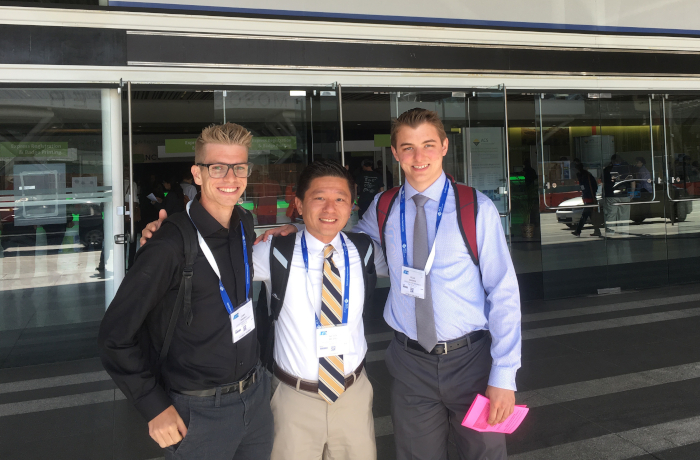
作者(从左到右)Cody Drisko、Dr. Kevin Huang 和 Silas Griffin 开展了实验并撰写了论文。Cody Drisko 是 John Stauffer 研究员 ,并获得了 Gencarela 研究资助。Silas 是 S2S 阿苏萨太平洋大学研究研究员。Dr. Kevin Huang 提供了科研指导,并获得了阿苏萨太平洋大学教师研究委员会资助。
访问受限。请登录或开始试用以查看此内容。
材料
| 姓名 | 公司 | 目录编号 | 评论 |
|---|---|---|---|
| 化学品 | |||
| REM 树脂 | Nova Biochem | 8551010005 | 固体聚合物载体;负载量 1.1 mmol/g |
| 糠胺 | Acros Organics | 119800050 | 试剂 |
| 二甲基甲酰胺(DMF) | Sigma-Aldrich | 227056 | 溶剂 |
| 二氯甲烷(DCM) | Sigma-Aldrich | 270997 | 溶剂 |
| 甲醇 | Sigma-Aldrich | 34860 | 溶剂 |
| trans-4-溴-β-硝基苯乙烯 | Sigma-Aldrich | 400017 | 硝基烯烃固体 |
| trans-3,4-二甲氧基-β-硝基苯乙烯 | Sigma-Aldrich | S752215 | 硝基烯烃固体 |
| trans-2,4-二氯-β-硝基苯乙烯 | Sigma-Aldrich | 642169 | 硝基烯烃固体 |
| trans-β-硝基苯乙烯 | Sigma-Aldrich | N26806 | 硝基烯烃固体 |
| 三乙胺(TEA) | Sigma-Aldrich | T0886 | 溶剂 |
| 三甲基氯硅烷(TMSCl) | Sigma-Aldrich | 386529 | 试剂;注意——高度挥发性,会产生 HCl 气体 |
| 四正丁基氟化铵(TBAF)的四氢呋喃(THF)溶液 | Sigma-Aldrich | 216143 | 试剂 |
| 四氢呋喃(THF) | Sigma-Aldrich | 401757 | 试剂 |
| 1-溴辛烷 | Sigma-Aldrich | 152951 | 烷基卤化物 |
| 碘甲烷 | Sigma-Aldrich | 289566 | 烷基卤化物 |
| 烯丙基溴 | Sigma-Aldrich | 337528 | 烷基卤化物 |
| 溴化苄 | Sigma-Aldrich | B17905 | 烷基卤化物 |
| 玻璃器皿/仪器 | |||
| 25 mL 固相反应瓶 | Chemglass | CG-1861-02 | 带滤板的玻璃器皿 |
| Thermo Scientific Nicole iS5 | Thermo Scientific | IQLAADGAAGFAHDMAZA | 仪器 |
| AVANCE III 核磁共振波谱仪 | Bruker | N/A | 仪器;300 MHz;溶剂:CDCl3 和 CD3OH |
| Wrist-Action 摇床 Model 75 | Burrell Scientific | 757950819 | 仪器 |
参考文献
- Bayat, M., Amiri, Z. Chemoselective synthesis of novel spiropyrano acenaphthylene derivatives via one-pot four-component reaction. Tetrahedron Letters. 58 (45), 4260-4263 (2017).
- Ding, K., et al. Structure-Based Design of Potent Non-Peptide MDM2 Inhibitors. Journal of the American Chemical Society. 127 (29), 10130-10131 (2005).
- D'Erasmo, M. P., et al. 7,9-Diaryl-1,6,8-trioxaspiro[4.5]dec-3-en-2-ones: Readily accessible and highly potent anticancer compounds. Bioorganic & Medicinal Chemistry Letters. 24 (16), 4035-4038 (2014).
- Gomez, C., et al. Phosphine-Catalyzed Synthesis of 3,3-Spirocyclopenteneoxindoles from γ-Substituted Allenoates: Systematic Studies and Targeted Applications. The Journal of Organic Chemistry. 78 (4), 1488-1496 (2013).
- Wu, S., et al. Novel spiropyrazolone antitumor scaffold with potent activity: Design, synthesis and structure-activity relationship. European Journal of Medicinal Chemistry. 115, 141-147 (2016).
- Allgardsson, A., et al. Structure of a prereaction complex between the nerve agent sarin, its biological target acetylcholinesterase, and the antidote HI-6. Proceedings of the National Academy of Sciences. 113 (20), 5514-5519 (2016).
- Cantín, Á, et al. Novel Inhibitors of the Mitochondrial Respiratory Chain: Oximes and Pyrrolines Isolated from Penicillium brevicompactum and Synthetic Analogues. Journal of Agricultural and Food Chemistry. 53 (21), 8296-8301 (2005).
- Wu, E. S. C., et al. et al. In Vitro Muscarinic Activity of Spiromuscarones and Related Analogs. Journal of Medicinal Chemistry. 38 (9), 1558-1570 (1995).
- Gober, C. M., Carroll, P. J., Joullié, M. M. Triazaspirocycles: Occurrence, Synthesis, and Applications. Mini-reviews in organic chemistry. 13 (2), 126-142 (2016).
- Hong, C. Y., et al. Novel Fluoroquinolone Antibacterial Agents Containing Oxime-Substituted (Aminomethyl)pyrrolidines: Synthesis and Antibacterial Activity of 7-(4-(Aminomethyl)-3-(methoxyimino)pyrrolidin-1-yl)-1-cyclopropyl-6-fluoro- 4-oxo-1,4-dihydro[1,8]naphthyridine-3-carboxylic Acid (LB20304),1. Journal of Medicinal Chemistry. 40 (22), 3584-3593 (1997).
- Ryzhakov, D., Jarret, M., Guillot, R., Kouklovsky, C., Vincent, G. Radical-Mediated Dearomatization of Indoles with Sulfinate Reagents for the Synthesis of Fluorinated Spirocyclic Indolines. Organic Letters. 19 (23), 6336-6339 (2017).
- Wang, L., et al. A Facile Radiolabeling of [18F]FDPA via Spirocyclic Iodonium Ylides: Preliminary PET Imaging Studies in Preclinical Models of Neuroinflammation. Journal of Medicinal Chemistry. 60 (12), 5222-5227 (2017).
- Lin, Y., Jones, G. B., Hwang, G. -S., Kappen, L., Goldberg, I. H. Convenient Synthesis of NCS−Chromophore Metabolite Isosteres: Binding Agents for Bulged DNA Microenvironments. Organic Letters. 7 (1), 71-74 (2005).
- Kappen, L. S., Lin, Y., Jones, G. B., Goldberg, I. H. Probing DNA Bulges with Designed Helical Spirocyclic Molecules. Biochemistry. 46 (2), 561-567 (2007).
- Zhang, N., Lin, Y., Xiao, Z., Jones, G. B., Goldberg, I. H. Solution Structure of a Designed Spirocyclic Helical Ligand Binding at a Two-Base Bulge Site in DNA. Biochemistry. 46 (16), 4793-4803 (2007).
- Thomas, J. R., Hergenrother, P. J. Targeting RNA with Small Molecules. Chemical Reviews. 108 (4), 1171-1224 (2008).
- Jones, B., Proud, M., Sridharan, V. Synthesis of oxetane/azetidine containing spirocycles via the 1,3-dipolar cycloaddition reaction. Tetrahedron Letters. 57 (25), 2811-2813 (2016).
- Martinez, N. J., et al. A High-Throughput Screen Identifies 2,9-Diazaspiro[5.5]Undecanes as Inducers of the Endoplasmic Reticulum Stress Response with Cytotoxic Activity in 3D Glioma Cell Models. PLoS ONE. 11 (8), e0161486(2016).
- Wang, Y., et al. Discovery and Optimization of Potent GPR40 Full Agonists Containing Tricyclic Spirocycles. ACS Medicinal Chemistry Letters. 4 (6), 551-555 (2013).
- Singh, G. S., Desta, Z. Y. Isatins As Privileged Molecules in Design and Synthesis of Spiro-Fused Cyclic Frameworks. Chemical Reviews. 112 (11), 6104-6155 (2012).
- Rana, S., et al. Isatin Derived Spirocyclic Analogues with α-Methylene-γ-butyrolactone as Anticancer Agents: A Structure-Activity Relationship Study. Journal of Medicinal Chemistry. 59 (10), 5121-5127 (2016).
- Sue, D., Kawabata, T., Sasamori, T., Tokitoh, N., Tsubaki, K. Synthesis of Spiro Compounds through Tandem Oxidative Coupling and a Framework Rearrangement Reaction. Organic Letters. 12 (2), 256-258 (2010).
- Perry, M. A., Hill, R. R., Rychnovsky, S. D. Trianion Synthon Approach to Spirocyclic Heterocycles. Organic Letters. 15 (9), 2226-2229 (2013).
- Palmer, L. I., Read de Alaniz, J. Rapid and Stereoselective Synthesis of Spirocyclic Ethers via the Intramolecular Piancatelli Rearrangement. Organic Letters. 15 (3), 476-479 (2013).
- Berton, J. K. E. T., Salemi, H., Pirat, J. -L., Virieux, D., Stevens, C. V. Three-Step Synthesis of Chiral Spirocyclic Oxaphospholenes. The Journal of Organic Chemistry. 82 (23), 12439-12446 (2017).
- Carreira, E. M., Fessard, T. C. Four-Membered Ring-Containing Spirocycles: Synthetic Strategies and Opportunities. Chemical Reviews. 114 (16), 8257-8322 (2014).
- Yamazaki, S., Naito, T., Niina, M., Kakiuchi, K. Lewis Acid Catalyzed Cyclization Reactions of Ethenetricarboxylates via Intramolecular Hydride Transfer. The Journal of Organic Chemistry. 82 (13), 6748-6763 (2017).
- Hung, A. W., et al. Route to three-dimensional fragments using diversity-oriented synthesis. Proceedings of the National Academy of Sciences. 108 (17), 6799-6804 (2011).
- Wright, D. L., Schulte, J. P., Page, M. A. An Imine Addition/Ring-Closing Metathesis Approach to the Spirocyclic Core of Halichlorine and Pinnaic Acid. Organic Letters. 2 (13), 1847-1850 (2000).
- Qiu, B., et al. Highly Enantioselective Oxidation of Spirocyclic Hydrocarbons by Bioinspired Manganese Catalysts and Hydrogen Peroxide. ACS Catalysis. 8 (3), 2479-2487 (2018).
- Richmond, E., Duguet, N., Slawin, A. M. Z., Lébl, T., Smith, A. D. Asymmetric Pericyclic Cascade Approach to Spirocyclic Oxindoles. Organic Letters. 14 (11), 2762-2765 (2012).
- Griffin, S. A., Drisko, C. R., Huang, K. S. Tricyclic heterocycles as precursors to functionalized spirocyclic oximes. Tetrahedron Letters. , (2017).
- Brown, A. R., Rees, D. C., Rankovic, Z., Morphy, J. R. Synthesis of Tertiary Amines Using a Polystyrene (REM) Resin. Journal of the American Chemical Society. 119 (14), 3288-3295 (1997).
- Blaney, P., Grigg, R., Sridharan, V. Traceless Solid-Phase Organic Synthesis. Chemical Reviews. 102 (7), 2607-2624 (2002).
- Morphy, J. R., Rankovic, Z., Rees, D. C. A novel linker strategy for solid-phase synthesis. Tetrahedron Letters. 37 (18), 3209-3212 (1996).
- Saruengkhanphasit, R., Collier, D., Coldham, I. Synthesis of Spirocyclic Amines by Using Dipolar Cycloadditions of Nitrones. The Journal of Organic Chemistry. 82 (12), 6489-6496 (2017).
- Li, F., et al. Assembly of Diverse Spirocyclic Pyrrolidines via Transient Directing Group Enabled Ortho-C(sp2)-H Alkylation of Benzaldehydes. Organic Letters. 20 (1), 146-149 (2018).
- Gottlieb, L., Hassner, A. Cycloadditions. 53. Stereoselective Synthesis of Functionalized Pyrrolidines via Intramolecular 1,3-Dipolar Silyl Nitronate Cycloaddition. The Journal of Organic Chemistry. 60 (12), 3759-3763 (1995).
- Namboothiri, I. N. N., Hassner, A., Gottlieb, H. E. A Highly Stereoselective One-Pot Tandem Consecutive 1,4-Addition−Intramolecular 1,3-Dipolar Cycloaddition Strategy for the Construction of Functionalized Five- and Six-Membered Carbocycles,1. The Journal of Organic Chemistry. 62 (3), 485-492 (1997).
- Dehaen, W., Hassner, A. Stereoselectivity in intramolecular 1,3-dipolar cycloadditions. Nitrile oxides versus silyl nitronates. Tetrahedron Letters. 31 (5), 743-746 (1990).
- Roger, P. -Y., Durand, A. -C., Rodriguez, J., Dulcère, J. -P. Unprecedented in Situ Oxidative Ring Cleavage of Isoxazolidines: Diastereoselective Transformation of Nitronic Acids and Derivatives into 3-Hydroxymethyl 4-Nitro Tetrahydrofurans and Pyrrolidines. Organic Letters. 6 (12), 2027-2029 (2004).
- Kudoh, T., Ishikawa, T., Shimizu, Y., Saito, S. Intramolecular Cycloaddition Reactions of Silyl Nitronate Tethered to Vinylsilyl Group: 2-Nitroalkanols as Precursors for Amino Polyols. Organic Letters. 5 (21), 3875-3878 (2003).
- Ishikawa, T., Shimizu, Y., Kudoh, T., Saito, S. Conversion of d-Glucose to Cyclitol with Hydroxymethyl Substituent via Intramolecular Silyl Nitronate Cycloaddition Reaction: Application to Total Synthesis of (+)-Cyclophellitol. Organic Letters. 5 (21), 3879-3882 (2003).
- Hashimoto, T., Maruoka, K. Recent Advances of Catalytic Asymmetric 1,3-Dipolar Cycloadditions. Chemical Reviews. 115 (11), 5366-5412 (2015).
- Li, X., et al. Highly Enantioselective One-Pot Synthesis of Spirocyclopentaneoxindoles Containing the Oxime Group by Organocatalyzed Michael Addition/ISOC/Fragmentation Sequence. Organic Letters. 13 (23), 6160-6163 (2011).
- Jensen, K. H., Hanson, J. E. Synthesis and Photochemistry of Tertiary Amine Photobase Generators. Chemistry of Materials. 14 (2), 918-923 (2002).
- Mondal, S., Mukherjee, S., Yetra, S. R., Gonnade, R. G., Biju, A. T. Organocatalytic Enantioselective Vinylogous Michael-Aldol Cascade for the Synthesis of Spirocyclic Compounds. Organic Letters. 19 (16), 4367-4370 (2017).
- Ni, C., et al. Phosphine-Catalyzed Asymmetric (3 + 2) Annulations of δ-Acetoxy Allenoates with β-Carbonyl Amides: Enantioselective Synthesis of Spirocyclic β-Keto γ-Lactams. Organic Letters. 19 (13), 3668-3671 (2017).
访问受限。请登录或开始试用以查看此内容。
重印与许可
![[4.4]螺环肟的固相合成](/_next/image?url=https%3A%2F%2Fcloudfront.jove.com%2FCDNSource%2Fteasers%2F58508.jpg&w=3840&q=75)