Oikopleura dioica 是生物学多个领域的被囊动物模式生物。本文介绍了该生物及其藻类饲料的取样方法、物种鉴定、培养系统设置以及培养方案。我们强调了有助于增强培养体系稳定性的关键因素,并讨论了可能遇到的问题及解决方案。
本文内容
摘要
摘要
Oikopleura dioica 是一种浮游性脊索动物,具有卓越的滤食能力、快速的世代周期、保守的早期发育过程以及紧凑的基因组。由于这些特性,它被认为是开展海洋生态学、进化发育生物学和基因组学研究的有用模式生物。鉴于研究通常需要稳定的动物资源供应,建立一个可靠且易于维护的培养系统十分必要。本文介绍了一步一步建立 O. dioica 培养体系的方法,包括如何选择潜在的采样地点、采集方法、目标动物的鉴定以及培养系统的搭建。我们结合自身经验提供了常见问题的解决方案,并强调了维持健康稳定培养体系的关键因素。尽管本文所提供的培养方案是针对 O. dioica 优化设计的,但我们希望所介绍的采样技术和培养设置能够为其他脆弱的远洋无脊椎动物的保育提供新的思路。
引言
模式生物在解答诸多生物学问题(包括发育、遗传和生理学相关问题)方面发挥了重要作用。此外,引入更多模式生物有助于推动新发现,因此对于更深入理解自然界至关重要1,2。海洋浮游动物是种类多样的生物类群,在海洋生态系统中扮演着重要角色3,4,5,6。尽管其数量丰富且生态意义重大,凝胶状生物(如浮游被囊动物)在浮游生物多样性研究中往往代表性不足,因其透明性和脆弱性导致野外采样和鉴定困难7,8。通过改进采样技术并在实验室中进行培养,可实现对这些动物的体外近距离观察,从而加深了对浮游被囊动物生物学特性的认识9,10,11,12。
幼形类(尾海鞘类)是一类自由游动的海洋被囊动物,全球已描述约70个物种8,13。由于它们是浮游动物群落中最丰富的类群之一14,15,16,17,幼形类构成了鱼类幼体等较大浮游生物的主要食物来源18,19。与固着生活的被囊动物——海鞘不同,幼形类在整个生命周期中保持类似蝌蚪的形态,并始终处于浮游状态20。每个个体生活在一个由自身构建的复杂滤食结构中,这种结构被称为“住室”。它们通过尾部波浪状摆动产生水流,将颗粒物聚集在住室内21。堵塞的住室会全天被丢弃,其中一些形成碳聚集体并最终沉降至海底22;因此,幼形类在全球碳通量中发挥着重要作用23。据报道,大多数物种生活在水柱上层100米范围内的远洋带13;然而,巨型幼形类 Bathochordaeus 可栖息于300米深的水域24。对美国加利福尼亚州蒙特雷湾 Bathochordaeus 的一项研究表明,这些动物也是微塑料的生物载体,提示尾海鞘类在海洋中微塑料的垂直输送与分布过程中可能具有重要意义25。
Oikopleura dioica,一种尾索动物,因其多种显著特征近年来作为模式生物受到关注。该物种在全球各大洋中均有报道,尤以近海水域中数量最为丰富26,可从岸边轻松采样。使用天然海水和人工海水均可实现长期稳定的培养27,28,29温度依赖性的世代周期在实验室条件下可短至4-9天。其繁殖力高,每只雌性个体可产生 >全年可产卵 300 枚。作为一种尾索动物,它在理解脊索动物进化方面具有重要的系统发育地位30,31在70 Mb时, O. dioica 在所有已知的脊索动物中拥有最小的基因组32在尾索动物中 O. dioica 是迄今为止唯一被描述的非雌雄同体物种33.
Paffenhöfer34 首次报道了使用实验室培养的微藻成功建立 O. dioica 培养体系。Fenaux 和 Gorsky35 开发了最初使用同步电机和搅拌桨的培养方案,后被多个实验室采用。近年来,Fujii 等人36 报道了在人工海水中培养 O. dioica 的方法,Bouquet 等人27 描述了一种稳定的培养体系及野外采样方法,Marti-Solans 等人29 报道了一种简化且经济的优化培养方案。除传统的 Oikopleura 培养系统外,一种新近报道的双管养殖罐设计也具备培养 Oikopleura sp.37 的潜力。
本文提供了一套详细的方案,用于建立 O. dioica 单一培养体系,该方案综合了萨尔斯国际海洋分子生物学中心27、巴塞罗那大学29、大阪大学28 等主要 Oikopleura 研究团队所开发的多种方案,并结合了我们自身的观察结果。在以往发表的培养方案中,有关藻类培养基的组成、近岸采样技术以及 Oikopleura 物种鉴定的细节描述较为粗略,存在诸多模糊之处。本文借助视频方案中的可视化信息,系统整合了从零开始建立 O. dioica 培养体系所需的全部关键信息,并以清晰、逐步的方式呈现。我们详细描述了如何将 O. dioica 与另一种常见报道物种 O. longicauda 相区分,这是其中最具挑战性的步骤之一。尽管现有的培养体系适用于全球范围内 O. dioica 的培养,我们仍强调根据当地环境条件对方案进行调整的重要性。本文所呈现的信息融合了广泛发表的数据以及实践经验所得的知识,当前方案特别适用于希望从头开始建立培养体系的研究人员。
方案
1. O. dioica 培养设施
- 水过滤系统(图1)
- 从港口2-3米深度处采集天然海水。将海水通过砂滤器(孔径1.4 mm)过滤后,输送至实验室的共用水箱。使用滤筒过滤器循环水体,以维持共用水箱中的水质。
- 在培养室内,设置一个多级过滤系统,该系统由一个100 L的储液罐和一个磁力驱动泵组成, 5 µm 和 1 µm 聚丙烯卷绕式滤芯过滤器和紫外灭菌器(100 V)图1).
- 将海水从公共储水罐转移至培养室储水罐。使海水通过一个 25 µm 滤器单元(图1A,B)后进入培养室储水箱。使海水依次流经5和 1 µm 过夜过滤,以彻底去除可能阻碍动物发育的颗粒。
注意:可额外使用孔径更大的滤网(25-50 µm)有助于防止较大颗粒堵塞网孔较小的滤筒式滤器。过滤后的海水(fSW)可在次日早晨使用。
- Oikopleura 培养单元图2)
- 将动物饲养在5升或10升的圆形透明塑料烧杯中。
- 将培养烧杯放置在稳定的双层不锈钢架(长×宽×高 = 150 cm × 45 cm × 90 cm)上,架面覆盖5 mm厚的透明丙烯酸板。
- 在亚克力板下方放置白色荧光灯,从烧杯底部照亮动物。
- 在烧杯后方放置一张黑色塑料板。黑色背景可形成对比,增强透明动物的可视性。
- 将同步电动机连接至亚克力桨叶(长 × 高 = 8 cm × 27 cm)补充文件 2)。将桨叶悬挂在培养烧杯中,桨叶由沿架子单元长度方向安装的平行轨道支撑(图 2A).
- 打开电机,使烧杯以15 RPM的转速产生轻柔的圆周运动。
注意:动物在其纤维素居所中呈中性浮力;然而,水流循环有助于使卵、幼虫和藻类食物悬浮并均匀分布在培养杯中。
- 自动加样泵(可选)
注意:自动喂食装置可减少人员需求,尤其在周末期间。- 根据制造商的说明,校准自动加样泵的液体 dispensing 体积。
- 使用50 mL离心管作为藻类储存容器。
- 在50 mL离心管盖上钻两个5 mm的孔,用于穿过通气管。将其中一根管连接至标准水族空气泵以引入气泡,另一根管连接至加样泵的进液口图2B).
注意:引入细小的气流有助于防止藻类在试管底部沉积。 - 设定特定日期藻类饲料的投喂时间和投喂量。
- 藻类观测站
- 使用一个置物架(长 × 宽 × 高 = 90 cm × 46 cm × 115 cm)放置四个装有藻类工作培养物的1 L圆底烧瓶(见步骤2.1)。
- 通过将荧光灯置于锥形瓶后方,对正在培养的细胞进行背光照射。
- 用双孔橡胶塞密封烧瓶。
- 将一支1 mL一次性移液管穿过橡胶塞。使用气管将移液管连接至水族箱空气泵。向烧瓶中通入气泡流。
2. 微藻食物
- 启动藻类培养
注意:为三种微藻物种Chaetoceros calcitrans、Isochrysis sp.、Rhinomonas reticulata以及一种蓝细菌Synechococcus sp.分别维持三套培养体系(储备培养、中间培养和工作培养)。储备培养和中间培养用作备份,工作培养用于日常投喂。- 准备微藻和蓝细菌培养所需的试剂(表1)。
- 启动储备培养时,将60–80 mL fSW加入100 mL锥形瓶中,121 °C高压灭菌25分钟。无菌条件下加入适量改良Conway培养基27及微藻(表2)。例如,接种C. calcitrans储备培养时,将60 mL海水灭菌后,无菌加入维生素溶液和溶液A各30 µL、硅酸钠15 µL、链霉素60 µL,以及来自前一批储备培养的C. calcitrans 30 µL。
注意:R. reticulata在光照过强时会由粉红色变为橙褐色。一旦培养液开始由澄清变为浅粉色,应立即将其移离强光环境。 - 将储备培养置于17 °C、连续光照的培养箱中。约10天后,培养物颜色发生变化,表明藻类已生长(图3)。一旦出现明显颜色,将其转移至4 °C长期保存,可维持长达1个月。
- 在洁净工作台内,从储备培养物中无菌接种中间培养(表2)。于17 °C、连续光照条件下培养。待藻类显色后,继续在培养箱中保存,最长可达2周。
- 从中间培养物中接种工作培养(表2)。用橡胶塞密封锥形瓶,并插入一支1 mL一次性移液器。将锥形瓶转移至藻类培养站,于室温、8小时光周期条件下维持培养,并持续通气。每4天更新一次工作培养。
- 每天摇晃两次储备培养和中间培养物以混匀。
注意:藻类培养物在固体培养基上的长期保存及冷冻保存分别可维持长达3个月和1年29。
- 构建藻类生长曲线(可选)
注意:准确评估投喂量对于维持稳定培养的O. dioica至关重要。我们为两种主要藻类饵料Chaetoceros calcitrans和Isochrysis sp.构建了生长曲线。- 准备C. calcitrans和Isochrysis sp.的工作培养物(表2)。
- 对每种工作培养物分别进行三次独立取样,使用分光光度计测定660 nm处的吸光度。取每组三次重复测量的平均值作为该工作培养物的吸光度值。
- 按照自动细胞计数仪的说明书制备藻类样品并进行计数。每份样品计数三次,取三次计数的平均值以确定每份样品中的总细胞数。
- 持续每日计数,直至记录到约50个平均测量值。
- 为两种藻类分别绘制生长曲线(图4)。
3. 野生样本的野外采集 Oikopleura 种(spp.)
- 改良的浮游生物网(图5)
注意:成功采集Oikopleura spp. 的关键是使用带有配重且末端不带滤膜的浮游生物网缓慢拖曳。图5 展示了改良浮游生物网的示意图。- 将手持式浮游生物网的网底替换为一个改良的500 mL螺口洗瓶。
- 在洗瓶4 cm直径的螺口盖上钻一个直径3 cm的孔,以便水和生物进入网底。
- 将瓶盖安装在浮游生物网末端,并用电工胶带紧密缠绕,再用不锈钢喉箍进一步固定瓶盖。
- 使用扎带将一个70 g的配重固定在改良网底的外部。
- 安装安全绳以进一步固定网底。
- 选择采样地点(图6)
注意:所有样本采集均获得OIST野外工作安全委员会的批准。Oikopleura spp. 的出现可能因地点不同而存在季节性变化(图6)。应避免在极端天气事件(如强暴雨)后立即进行采样。- 使用地图网站的卫星视图识别潜在的采样地点。我们重点关注了易于驾车到达、位于海湾内或靠近海洋陡坡区域的港口和渔码头,这些区域浮游生物容易聚集:日本冲绳县金湾的石川港(GPS:26°25'39.3"N 127°49'56.6"E)。
- 实地考察潜在采样点,评估各点的岸边可达性和安全性,并根据需要向当地主管部门申请采集许可。
- 采样步骤
- 将浮游生物网投入海中,使网底沉入水面以下1-2 m处。
- 以50-100 cm s-1的速度手动水平拖曳网具,通过来回走动持续拖曳2-5分钟。根据港口内浮游植物的丰度调整拖曳时间,浮游植物较多时应缩短拖曳时间。
注意:幼形动物(larvaceans)为脆弱生物,快速拖曳或反复抛网可能会损伤被困在网底的个体。 - 轻柔提起网具,缓慢将网底内容物转移至一个500 mL圆形玻璃瓶中,并用海水完全充满样本瓶,避免产生气泡。
注意:可通过将样本瓶置于黑色背景前观察来确认Oikopleura spp. 的存在。大多数个体在采集过程中会遗弃其住囊,因此需要显微观察才能进行物种水平的鉴定。 - 重复采样,直至收集满三个500 mL样本瓶。
- 使用CTD剖面仪测量盐度、温度和叶绿素a,记录动物自然生存环境的物理参数范围。
- 用桶采集10-15 L表层海水,用于实验室条件下动物的适应性培养。
4. 动物的分离与鉴定(图7,图8)
- Oikopleura 物种鉴定
注意:其他可能与之相似的浮游生物 Oikopleura spp. 初看包括毛颚动物, 贝母 物种、线虫、带卵黄囊的鱼幼体,以及 海鞘 spp. 幼虫- 为使动物适应实验室条件,将每个500 mL样品转移至含有采样点表层海水与实验室过滤海水(fSW)按1:1比例混合的10 L烧杯中图7A,B)。根据浮游生物样品的浓度,将烧杯体积调整为5-10 L。
注意:如果浮游生物样品中含有不需要的碎屑,需通过粗滤器过滤(筛网孔径 ~600 µm) 转移至10 L烧杯之前。 - 使用连接至同步电动机(15 RPM)的桨叶,将浮游生物保持悬浮过夜(步骤 1.2.5)。
- 识别 Oikopleura 通过寻找长约1-2 mm、呈蝌蚪形、在球形透明住囊内摆动尾部的动物来识别spp.。部分个体可能暂时无住囊,自由游动。使用钝端移液器将约5只动物轻轻转移至空的培养皿中。
- 为进行属级鉴定,用移液枪轻轻触碰螺壳,使动物从壳内移出。
- 在20-40倍暗视野显微镜下观察无宿主动物并确认 Oikopleura 种(spp)图8).
- 为使动物适应实验室条件,将每个500 mL样品转移至含有采样点表层海水与实验室过滤海水(fSW)按1:1比例混合的10 L烧杯中图7A,B)。根据浮游生物样品的浓度,将烧杯体积调整为5-10 L。
- O. dioica 鉴定
注意: O. dioica 可通过其尾部远端半侧存在完全成熟的雄性和雌性个体,或两个较大的亚软骨细胞来直观识别. 两个亚索细胞之间的距离在不同个体间可能存在差异。- 接下来,检查是否存在完全成熟的 Oikopleura 性腺充满卵子(图8A)或精子(图8B)。如果该动物仅具有卵子或精子,则跳至步骤 4.2.3,因为它是 O. dioica,唯一已描述的非雌雄同体物种。
- 如果动物未成熟(图8C),在其尾部末端寻找两个脊索下细胞(图8D).
- 物种确认后,将其转移至新的培养皿中。重复步骤 4.1.3–4.2.2,直至有 10–20 个个体被确认到物种水平。
注意:为便于识别,将动物置于含有0.015%三卡因甲磺酸盐(MS222)的fSW溶液的培养皿中进行麻醉。 - 如果没有 O. dioica 若发现有未成熟个体,需将烧杯继续悬置额外一至两天。可能存在未成熟个体 O. dioica 将继续生长并变得更容易被检测到。如果一周后仍未出现,应丢弃该样品,并重新采样。
5. O. dioica 的培养方案
- 从野外采集样本建立 O. dioica 单一培养体系(图7)
注意:藻类食物需每日从工作培养物中制备,每个单一培养烧杯分别在上午9点、中午12点和下午5点各投喂一次(见步骤5.2)。动物维持在23 °C条件下。在此条件下,冲绳 O. dioica 的生命周期为4天(图7C)。- 为建立 O. dioica 的单一培养,分离120只个体,并转移至含有5 L新鲜fSW的新烧杯中(图7B,C)。
- 次日早晨,寻找具有黄色性腺的完全成熟雄性个体,以及卵呈金黄色球状的雌性个体(图8A,B)。
- 使用5 mL钝头移液管,将15只雄性和30只雌性轻柔地转移至另一个含有2.5 L新鲜fSW的新烧杯中,制成产卵烧杯。
注意:若雄性和雌性数量不足,应尽可能多地转移成体至含有1 L fSW的烧杯中,使其自然产卵。为尽量减少手动转移过程中对动物造成的物理应激,应缓慢虹吸并在水面下释放动物。 - 让动物自然产卵以启动下一代。受精后约3小时应出现具尾幼体。
注意:产卵由完全成熟的个体弃舍、游向水体表层并释放配子完成。可通过从产卵烧杯底部抽取5–10 mL海水并在显微镜下观察是否存在卵裂卵来确认受精是否成功。 - 产卵后的第一个早晨(第1天),烧杯中应出现带有膨胀住囊的新一代个体。使用500 mL手持烧杯,将产卵烧杯内容物轻柔转移至另一个含有7.5 L新鲜fSW的新烧杯中(总体积达10 L)。倾倒时应倾斜角度,避免溅洒。
- 第二天早晨(第2天),手动转移150只个体至另一个含有5 L新鲜fSW的新烧杯中。
- 第三天早晨(第3天),手动转移120只个体至另一个含有5 L新鲜fSW的新烧杯中。
注意:为同步动物发育进程,在第2天和第3天的手动转移过程中,应选择体型相近的个体。每次转移最多虹吸10只动物。 - 第四天早晨(第4天),应出现完全成熟的个体。重复步骤5.1.3以完成生命周期循环。
注意:可在周末设置自动投喂泵于下午5点进行投喂,无需培养人员在场。
- 从工作培养物中每日制备藻类食物
- 测定工作培养物在660 nm处的吸光度。
- 根据每日投喂表,确定特定体型动物所需投喂的藻细胞数量(表3)。
- 利用藻类生长曲线(图4),解下列方程以计算当天所需的藻类食物体积(mL)。
- 为计算某一天某一投喂时间所需特定藻类的体积,请使用以下方程:


![藻类浓度方程 Yₐ=藻类浓度[细胞/mL],用于生物学分析。](/files/ftp_upload/61279/61279equ03.jpg "figure-protocol-3")



![藻类浓度公式,K=每次投喂的藻类浓度[细胞/mL],生态学研究图像。](/files/ftp_upload/61279/61279equ07.jpg "figure-protocol-7")
其中 YA 为某一天的藻类浓度,A 为每次投喂所需的藻类体积。此外,YA 与 x 之间的线性关系,以及截距(c)和斜率(m)的值如 图4 所示。K 值请参考表3。 - 例如,计算在5 L培养体系中第3天动物于上午9点投喂时所需 Isochrysis sp. 的体积,且藻类吸光度为0.234(660 nm测定),计算如下:


注意:将这些方程存储在电子表格中,以便根据吸光度测量值、动物体型和培养海水体积自动计算每日投喂量(补充文件1)。
- 为计算某一天某一投喂时间所需特定藻类的体积,请使用以下方程:
- 将计算所得体积的藻类转移至50 mL离心管中,在20 °C下以5000 × g 离心5分钟。
- 弃去上清液。用新鲜fSW重新加满至原始体积,替换旧的藻类培养基。
- 将制备好的食物储存于冰箱中,待下次投喂时使用。次日早晨新食物制备完成后,丢弃旧的藻类食物。
- 活性炭处理(可选)
注意:每个培养烧杯中加入10 g活性炭以维持水质。活性炭可重复使用最多四次。打开活性炭袋时应缓慢操作,避免炭粉进入培养烧杯。- 将约700 g活性炭转移至容器中,用新鲜水(FW)浸泡48小时,并使其沉降至底部。
- 用新鲜水冲洗以去除残留的炭粉。
- 在新鲜水中煮沸活性炭15–20分钟。停止加热后冷却至室温。
- 持续冲洗直至大部分炭粉被去除,且水变清澈。
- 将清洁后的活性炭储存于含有fSW的2 L烧杯中,并盖上盖子以防灰尘进入。
- 在转移动物前,向每个新烧杯中添加活性炭。
结果
可通过小船或在港口使用孔径为 100 µm 的浮游生物网进行缓慢轻柔拖网采集Oikopleura,拖网末端需使用非过滤性的集样管(图5)。由于该动物体质脆弱,必须避免任何可能造成物理损伤的操作,例如粗暴处理网具,或因样品瓶中残留气泡导致的溅洒。
了解当地Oikopleura种群的季节性变化模式以及采样点水体物理特性的相应波动非常重要。2015年至2019年的采样结果显示,冲绳石川港和金港的O. dioica存在一致的季节性变化(图6)。表层海水温度似乎是一个主要影响因素。当表层海水温度达到≥28 °C时,O. dioica为优势物种;在24 °C至27 °C之间,O. longicauda与O. dioica共存;然而,在低于23 °C时,O. longicauda占主导地位(图6A)。连续数天强降雨后盐度的逐渐变化与O. dioica的丰度无明显相关性(图6B)。
采用上述采样步骤,大多数 O. dioica 我们回收的样本处于其4天生命周期的第2至第3天图7C)。成熟雄性的性腺呈黄色,而雌性性腺因含有70-80 µm 直径(图8A,B)。未成熟 O. dioica 通过尾部的两个亚索细胞得以确认(图8D)。当地水域中的另一个优势物种, O. longicauda大小和形态相似。我们采用以下标准进行区分 O. longicauda 从 O. dioica38,39,40:尾部缺乏脊索下细胞,躯干部具有翼膜,以及具有雌雄同体的生殖腺(图8E,F)。不同的尾部形态也有助于区分 O. longicauda 从 O. dioica当一只完整的无壳动物侧向放置时,其尾部 O. longicauda 更直且弯曲度更小,使其外观比后者更“僵硬” O. dioica.
建立稳定的Oikopleura培养体系最重要的三个因素是:(i) 维持高水质,(ii) 确定最佳喂养方案,以及 (iii) 设置含有足够数量雄性和雌性个体的产卵烧杯。引入多级过滤系统(图1)显著改善了培养系统的水质和稳定性。对于人工海水而言,过滤系统并非必需;然而,由于天然海水具有成本低、易获取和使用方便等优势,因此对于位于沿海地区的实验室而言是更优选择。为了建立合适的喂养方案,我们建议测定适用于各实验室具体条件的藻类生长曲线,因为温度和光照条件在不同实验室之间差异较大。我们将实测的生长曲线与先前发表的喂养时间表相结合,以优化藻类饲料的浓度和组成27(图4)。此外,我们还遵循严格的藻类接种时间表,以确保藻类食物的新鲜供应(表2)。自动化喂养系统使我们能够在无人员值守的情况下维持稳定的每日喂养计划(图2B)。
一旦达到最佳的海水和喂养条件,应通过在2.5 L fSW中放入15只雄性和30只雌性来建立一个产卵烧杯,以启动新一代的繁殖。这可确保次日早晨获得足够数量的D1期个体,足以在D2分离出150只个体,D3分离出120只,以及在D4获得45只成熟成体用于产卵。如果D4时雄性和雌性数量不足,应尽可能收集并转移更多成熟个体至1 L fSW中,使其自然产卵,以期获得足够数量的幼虫延续下一代。按照所提供的实验方案,该生物的生命周期可得以持续。 O. dioica 4天 23 °C (图7C)。我们已成功建立了六个独立的野生种群 O. dioica,所有品系均持续培养超过20代。
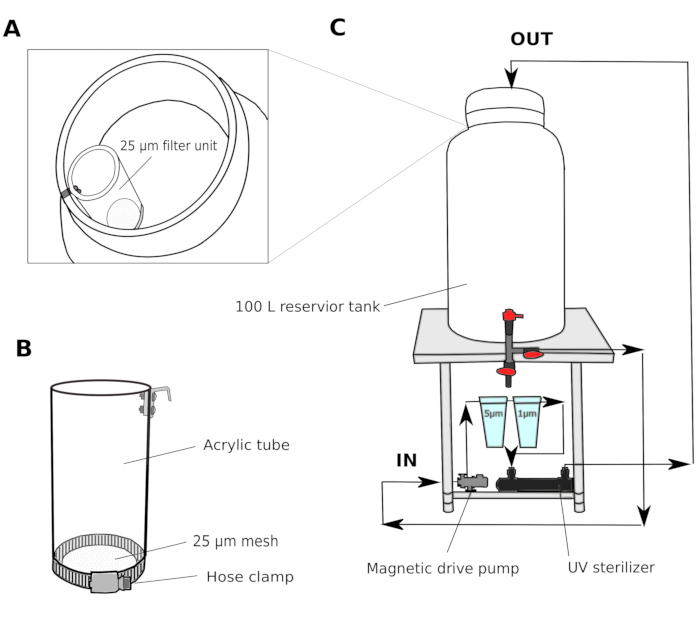
图1:海水过滤系统的示意图。
(A和B)海水首先进入25 µm的过滤单元进行初步过滤,然后流入储水罐(C)中。采用磁力驱动泵从储水罐中抽取海水,随后将海水依次通过两个聚丙烯过滤器和一个紫外线灭菌器,最后回流至储水罐。请点击此处查看该图的放大版本。
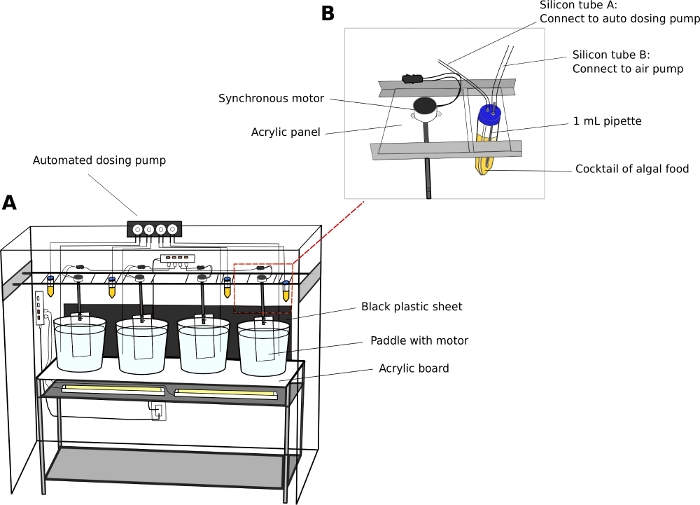
图 2:O. dioica 的培养系统。
(A)培养系统的整体结构示意图;(B)同步电机及自动加样泵藻类储液罐的放大视图。硅胶管 A 和 B 的内径分别为 2 mm 和 4 mm。请点击此处查看该图的放大版本。
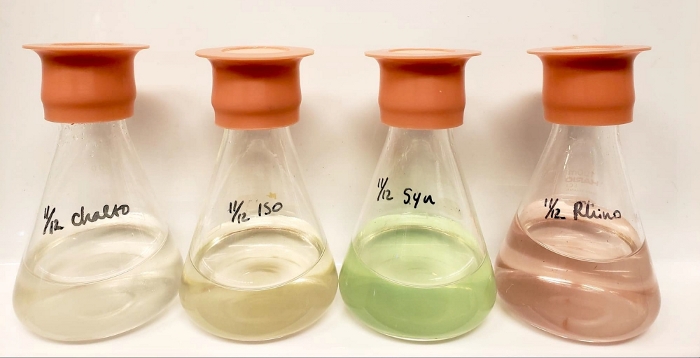
图3:O. dioica 的保藏培养物。
从左至右分别为 C. calcitrans、Isochrysis sp.、Synechococcus sp. 和 R. reticulata,在17 °C、连续光照条件下培养约10天后的状态。请点击此处查看该图的放大版本。
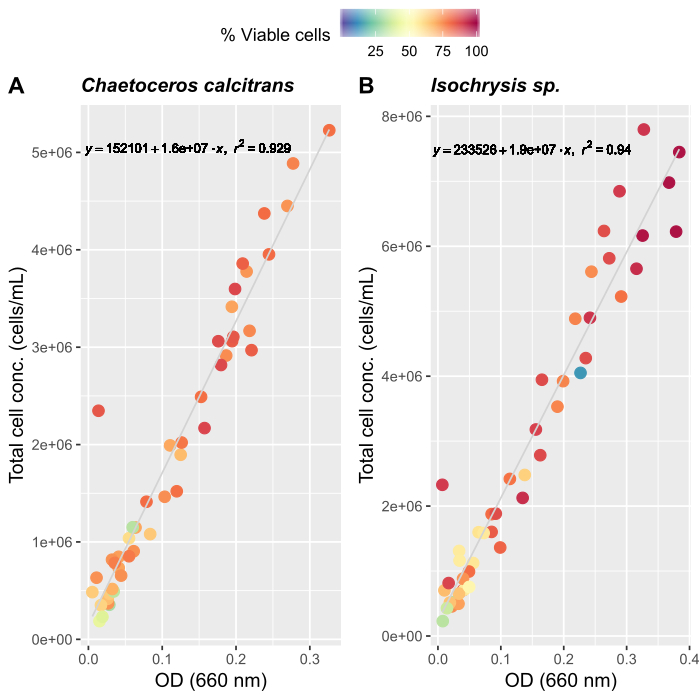
图4:两种主要饵料藻类 C. calcitrans 和 Isochrysis sp. 的生长曲线。
在660 nm处测得的光密度(OD)与总细胞浓度的散点图,分别为(A)C. calcitrans 和(B)Isochrysis sp.。每个数据点代表三次测量的平均值。使用细胞计数仪测定活细胞百分比和总细胞浓度(cells/mL)。连续记录20天的数据(n = 47)。请点击此处查看该图的高清版本。
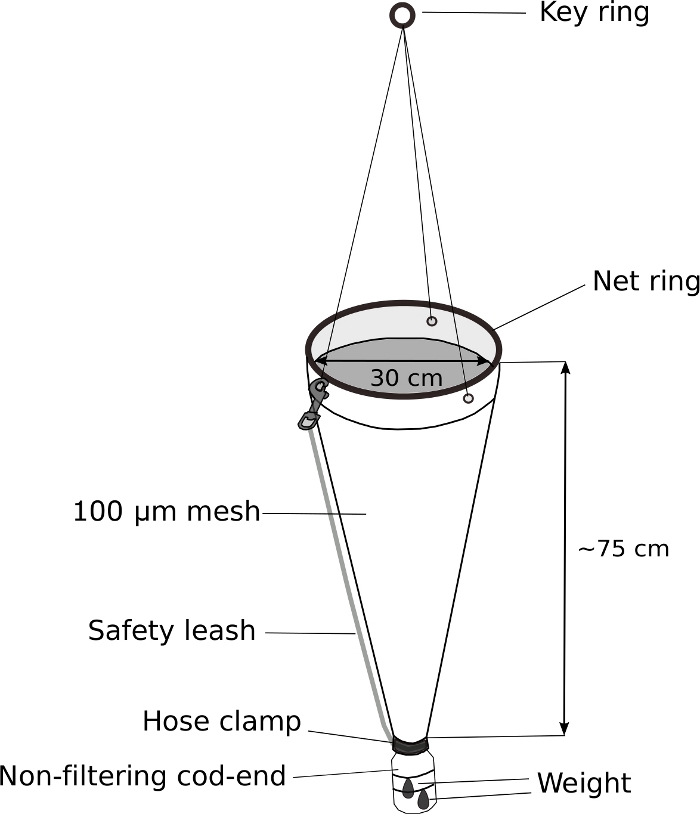
图 5:用于采集Oikopleura的改良式浮游生物网。
手持式浮游生物网(100 µm 网孔)的网底被替换为一个 500 mL 的洗瓶。在网底处附加一个 70 g 的重物。约 5 m 长的绳子连接在钥匙环上。另设一条安全绳以进一步固定网底。请点击此处查看该图的放大版本。
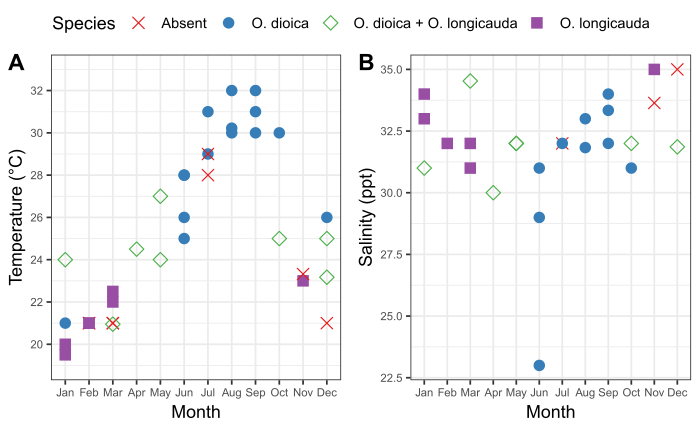
图6:季节性 O. dioica 中国台湾。
存在与缺失 O. dioica 和 O. longicauda 与季节变化相关的(A)温度和(B) 石川县港口的盐度26°25'39.3"北纬 127°49′56.6″E)和金(26°26'40.2"北纬 127°55′00.3″E)之间于2015年至2019年期间开展。若人工计数超过50只个体,则记录该物种为存在。记录了表层水的温度和盐度测量值。 请点击此处以查看此图的放大版本。
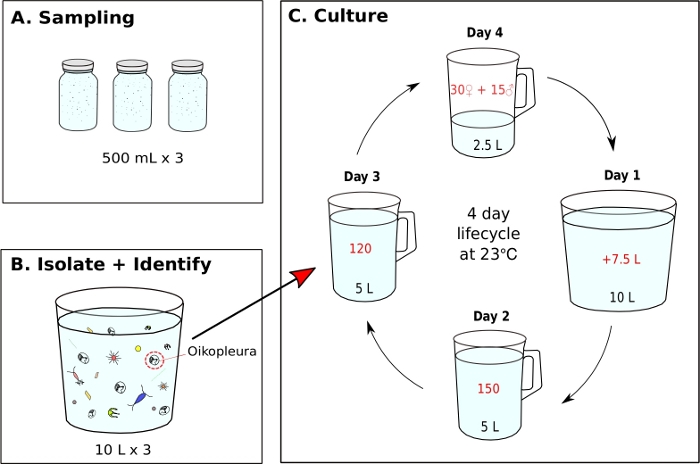
图7:启动流程图 O. dioica 单培养
(A在采样点采集三个500 mL的浮游生物样品(B每个样品瓶中的样品均进行稀释并 O. dioica 从其余浮游生物中分离出来(C单一种群培养 O. dioica 通过手动将120只第3天的动物转移到含有5 L新鲜过滤海水(fSW)的新烧杯中开始。设置一个产卵烧杯,其中包含30只雌性、15只雄性及2.5 L新鲜fSW。产卵后第一天(第1天),小心地将含有新一代动物的产卵烧杯内容物倒入另一个含有7.5 L新鲜fSW的烧杯中。产卵后第二天(第2天),将150只动物转移到含有5 L新鲜fSW的烧杯中。产卵后第三天(第3天),将120只动物转移到含有5 L新鲜fSW的烧杯中。在最后一天(第4天),设置一个新的产卵烧杯,包含30只雌性、15只雄性及2.5 L新鲜fSW,以准备下一代的繁殖。这些动物在4天周期内完成其生活周期 23 °C. 请点击此处以查看此图的放大版本。
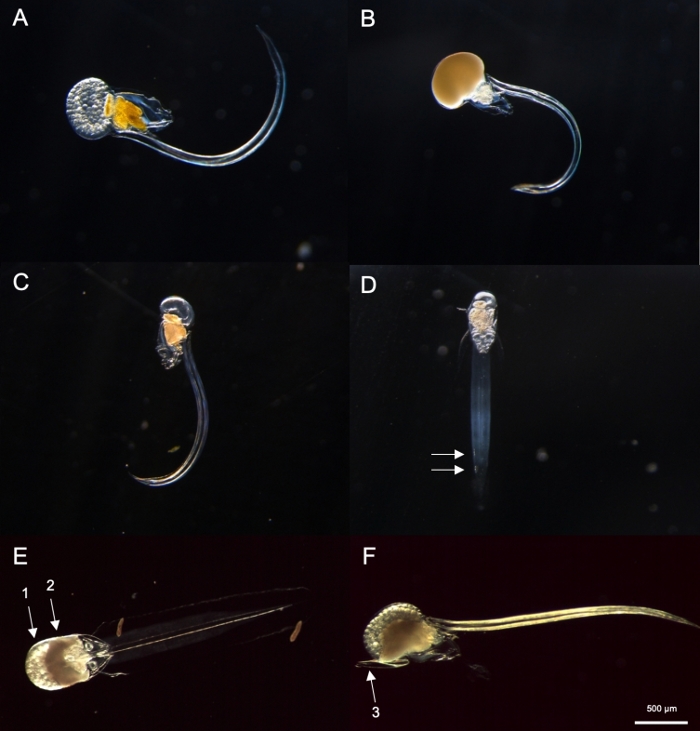
图8:Oikopleura 属物种的鉴定(A-D:O. dioica,E 和 F:O. longicauda)。
(A)携带卵子的雌性 O. dioica(B)携带精子的雄性 O. dioica(C)未成熟 O. dioica 的侧面观(D)未成熟 O. dioica 的腹面观,白色箭头指示两个脊索下细胞(E)携带卵子(箭头1)和精子(箭头2)的成熟 O. longicauda 的腹面观(F)O. longicauda 的侧面观,显示口帽结构(箭头3)。请点击此处查看该图的放大版本。
| 试剂 | 化学产品 | 用量 | 终体积 (mL) | 灭菌方式 | 储存条件 / 开启后 |
| 溶液 A | Na2EDTA | 45 g | 1000 | 高压灭菌 | -20 °C / 4 °C |
| NaNO3 | 100 g | ||||
| H3BO3 | 33.6 g | ||||
| NaH2PO4 | 20 g | ||||
| MnCl2·4H2O | 0.36 g | ||||
| FeCl3·6H2O | 1.3 g | ||||
| 溶液 B | 1.0 mL | ||||
| 溶液 B | ZnCl2 | 2.1 g | 1000 | 高压灭菌 | 4 °C / 4 °C |
| CoCl2·6H2O | 2.0 g | ||||
| (NH4)6Mo7O24·4H2O | 0.9 g | ||||
| CuSO4·5H2O | 2.0 g | ||||
| *HCl | -- mL | ||||
| 维生素 | 硫胺素 (B1) ·HCl | 200 mg | 1000 | 高压灭菌 | -20 °C / 4 °C |
| 生物素 | 1 mg | ||||
| 钴胺素 (B12) | 1 mg | ||||
| 硅酸钠 | Na2SiO3 | 5% | 1000 | 0.22 µm 滤膜过滤 | 4 °C / 4 °C |
| 链霉素 | C21H39N7O12 | 25 mg/mL | 50 | 0.22 µm 滤膜过滤 | -20 °C / -20 °C |
表1:藻类食物培养所需试剂配方。 配制溶液B时,需加入盐酸直至溶液澄清、无浑浊。所有试剂均通过高压灭菌(120 °C,25 分钟)或使用0.22 µm滤器进行灭菌。除维生素母液外,其余试剂均在添加指定化学物质后进行灭菌。对于维生素母液,应先对水进行高压灭菌,再溶解所列的化学物质。母液及开封后试剂的储存温度已在表中列出。
| 培养类型 | 藻类物种 | ASW (mL) | 维生素 | 溶液 A | 硅酸钠 | 链霉素 | 藻类 (mL) / 培养类型 | 培养 / 保存 | 频率 |
| 保藏培养 | Chaeto | 60 | 1/2000 | 1/2000 | 1/4000 (仅适用于 Chaeto) | 1/1000 (除 Syn 外均适用) | 0.03 / 保藏 | 17°C / 4°C | 每两周一次 |
| Iso | 60 | 0.03 / 保藏 | |||||||
| Rhino | 80 | 0.06 / 保藏 | |||||||
| Syn | 60 | 0.03 / 保藏 | |||||||
| 传代培养 | Chaeto | 500 | 1/2000 | 1/2000 | 1/4000 (仅适用于 Chaeto) | 1/1000 (除 Syn 外均适用) | 10 / 保藏 | 17°C / 17°C | 每周一次 |
| Iso | 500 | 10 / 保藏 | |||||||
| Rhino | 500 | 20 / 保藏 | |||||||
| Syn | 500 | 10 / 保藏 | |||||||
| 工作培养 | Chaeto | 400 | 1/2000 | 1/2000 | 1/4000 (仅适用于 Chaeto) | 1/1000 (除 Syn 外均适用) | 100 / 传代 | RM / RM | 每 4 天一次 |
| Iso | 400 | 100 / 传代 | |||||||
| Rhino | 400 | 150 / 传代 | |||||||
| Syn | 400 | 100 / 传代 |
表2:三种藻类培养类型的维护说明。 将指定量的添加剂加入含有高压灭菌海水的锥形瓶中。用指定量的藻类培养物接种每个锥形瓶。在指定温度下培养并保存藻类培养物。从上一代的主培养物接种新的主培养物和传代培养物,从上一代的传代培养物接种新的工作培养物。分别每两周、每周和每四天接种一次新的主培养物、传代培养物和工作培养物。此时间安排可为约10个装有O. dioica培养物的烧杯提供充足的食物。每种藻类培养类型应维持2–3套作为备用。RM – 室温。
| 天数 | 藻类物种 | 上午9点和下午5点 | 中午12点 |
| 1 | Chaeto | — | — |
| Iso | 1000 | 2000 | |
| Syn | 20,000 | 40,000 | |
| 2 | Chaeto | 1000 | 2000 |
| Iso | 2000 | 2000 | |
| Rhino | 1000 | 1000 | |
| 3 | Chaeto | 3000 | 4000 |
| Iso | 3000 | 4000 | |
| Rhino | 1500 | 1500 | |
| 4 | Chaeto | 1000 | 2000 |
| Iso | 1000 | 2000 | |
| Rhino | 1000 | 1000 |
表3:每日喂食的藻类浓度(修改自 Bouquet 等27)。 在冲绳型 O. dioica 的4天生命周期内,每日喂食所使用的藻类浓度(细胞数 mL-1)及藻类种类。
补充文件1:每日喂养记录表。 输入每个培养烧杯中微藻的每日吸光度(OD)、动物大小(Day)以及每个培养烧杯中海水体积(SW vol.)后,系统将自动计算每日喂养量。R. reticulata 和 Synechococcus sp. 的生长曲线改编自 Bouquet 等人27。请点击此处下载该文件。
补充文件 2:如何将同步电机连接至亚克力桨叶。 使用六角扳手将桨叶紧密地拧到电机上。请点击此处下载该文件。
讨论
为了便于灵活建立O. dioica的培养体系,了解该动物的自然生境至关重要。季节性数据可提供物理参数范围的信息,可用于指导实验室培养条件的设置,同时有助于理解动物丰度的季节性波动。在冲绳地区,O. dioica最稳定出现的时间为每年6月至10月;然而,在东京湾,其种群数量在2月和10月达到高峰41。尽管O. dioica的培养通常在20 °C或更低温度下进行报道27,28,29,但冲绳地区的O. dioica在高于20 °C的温度下表现出更好的存活率;这可能与冲绳海域表层海水最低温度约为20 °C有关(图6)。O. dioica的丰度还可能受到浮游植物水华42以及捕食者丰度43,44的影响。无论O. dioica的采集地点为何,了解当地种群的季节性规律均可最大程度地提高采样和培养的成功率。
在合适的季节和地点,使用网具采样是一种以最小 effort 收集大量 Oikopleura 的有效方法。使用网孔更小(60–70 µm)的浮游生物网也可用于采集该动物各个发育阶段的个体。由于生命周期末期个体极为脆弱,成熟个体在网采样品中很少被发现。因此,物种鉴定需在采样后通过显微镜观察尾索细胞(subchordal cells)完成。动物在实验室中会继续生长,通常在采样后一至两天内出现成熟个体。尽管网具采样效率较高,但在不同情况下可能需要采用其他替代采样方法。例如,在城市附近进行网采时可能收集到大量浮游植物,从而难以分离出 Oikopleura。在此类情况下,建议采用简单的水桶采集表层海水,或在港湾以外区域进行船只采样。研究结果表明,连续降雨导致的盐度渐变对 O. dioica 的丰度无显著影响;然而,应避免在热带气旋等极端天气事件发生后立即进行岸边采样。此类事件会导致封闭水体中发生突然而剧烈的生物地球化学变化45,46。暴雨径流可能携带污染物、沉积物和过量营养物质,导致水体浊度升高、水质下降47。由于摄食方式特殊且运动能力有限,滤食性浮游动物(如 Oikopleura)可能对此类变化尤为敏感。在此情况下,建议将采样推迟数天,直至当地环境条件恢复正常。
引入多步过滤系统对于维持小型滤食性生物(如O. dioica)的培养至关重要。在先前的培养系统中,若使用过滤不充分的海水(例如仅用25 µm孔径的筛网),培养过程往往不稳定,尤其在夏季更为明显,这可能与浮游植物丰度较高有关。尽管某些浮游植物有助于O. dioica的生长,但另一些种类可产生生物毒素,导致O. dioica胚胎发育异常48。此外,硅藻(如Chaetoceros spp.)浓度过高也可能对O. dioica的生长造成危害,因其具有较长的刚毛,可能堵塞住囊结构,妨碍有效摄食49。我们经常观察到小型个体的住囊被C. calcitrans的刚毛堵塞;因此,目前仅在第2天及以后的个体中投喂C. calcitrans(表3)。
尽管本研究中未出现该问题,但小规模长期培养O. dioica可能因遗传瓶颈而导致种群数量突然下降;在此情况下,Martí-Solans 等人29建议每隔20代向培养群体中引入新的野生个体。
Oikopleura 培养系统具有良好的灵活性。稳定的培养可在一周内建立。利用非专用设备和较低的经费即可实现 O. dioica 的长期培养。两人每日维护 5–10 个烧杯中的 Oikopleura 培养物所需工作时间通常少于 2 小时。O. dioica 也可在人工海水中维持培养,这对无法获取天然海水的研究者尤为有利28。藻类饵料可通过固体培养和冷冻保存实现长期储存29。此外,O. dioica 的精子可进行冷冻保存,并保持超过一年的活性50。上述所有因素使得培养物能够被轻松重建。最后,以往意外成功培养 Pleurobrachia sp. 的经验表明,为 Oikopleura 所发展的培养体系未来或许可推广应用于更广泛的脆弱浮游生物群体。
O. dioica 继续为各个生物学领域提供重要的研究启示。了解当地的季节性变化、建立精细的培养体系,并依靠少数专注的研究人员,便可轻松建立高效的培养系统。Oikopleura 培养体系为研究这一独特海洋脊索动物的生态学、发育学、基因组学和进化生物学等广泛领域提供了基础资源。
致谢
我们感谢Garth Ilsley在建立培养系统过程中提供的支持。我们感谢Ritsuko Suyama和Sylvain Guillot在早期采样及物种鉴定工作中的贡献。特别感谢Hiroki Nishida、Takeshi Onuma和Tatsuya Omotezako在整个研究过程中给予的慷慨支持与指导,包括本地培养系统的初步建立以及动物和微藻培养物的共享。我们还感谢Daniel Chourrout、Jean-Marie Bouquet、Anne Aasjord、Cristian Cañestro和Alfonso Ferrández-Roldán分享他们在采样与培养方面的专业知识。Jai Denton、Charles Plessy和Jeffrey Jolly对稿件提出了宝贵的修改意见。Charlotte West提出了用于藻类计算的通用方程。最后,我们感谢OIST提供的经费支持,感谢Mary Collins及OIST野外工作安全委员会在安全采样程序方面提供的建议,感谢OIST机械车间工作人员在培养与采样设备制造方面的协助,以及感谢Koichi Toda为实验输送海水。
材料
| 姓名 | 公司 | 目录编号 | 评论 |
|---|---|---|---|
| 活性炭 | Sigma | C2764-2.5KG | |
| 铝制滑轮 | Rainbow Products | 10604-10607 | |
| 生物素 | Sigma | B4501-100MG | |
| 硼酸 | Wako | 021-02195 | |
| 钴胺素(B12) | Sigma | V2876-100MG | |
| 氯化钴(II)六水合物 | Wako | 036-03682 | |
| 五水合硫酸铜(II) | Wako | 039-04412 | |
| 乙二胺四乙酸二钠水合物 | Wako | 044-29525 | |
| 四水合七钼酸六铵 | Wako | 019-03212 | |
| 六角扳手 | Anex | No.6600 | |
| 盐酸 | Wako | 080-01066 | |
| 六水合氯化铁(III) | Wako | 091-00872 | |
| Jebao 可编程自动加样泵 | Jebao | DP-4 | |
| 磁力泵 | REI-SEA | RMD-201 | |
| 四水合氯化锰(II) | Wako | 134-15302 | |
| 聚丙烯缠绕式滤芯过滤器 | Advantec | TCW-10N-PPS | |
| TCW-5N-PPS | |||
| TCW-1N-PPS | |||
| 无螺钉接线端子块 | SATO PARTS | SL4500 | |
| 简易浮游生物网 | RIGO, Japan | 5512-C | |
| 偏硅酸钠 | Sigma | 307815-1KG | |
| 硝酸钠 | Wako | 195-02545 | |
| 无水磷酸二氢钠 | MP Biomedicals | 194740 | |
| 硫酸链霉素盐 | Sigma | S6501-25G | |
| 同步电动机 | Servo | D5N6Z15M | |
| 盐酸硫胺素 | Wako | 201-00852 | |
| 紫外灭菌器 | Iwaki | UVF-1000 | |
| 氯化锌 | MP Biomedicals | 194858 |
参考文献
- Travis, J. Is It What We Know or Who We Know? Choice of Organism and Robustness of Inference in Ecology and Evolutionary Biology (American Society of Naturalists Presidential Address). The American Naturalist. 167 (3), 303-314 (2006).
- Jenner, R. A., Wills, M. A. The choice of model organisms in evo-devo. Nature Reviews Genetics. 8 (4), 311-314 (2007).
- Irigoien, X., Huisman, J., Harris, R. P. Global biodiversity patterns of marine phytoplankton and zooplankton. Nature. 429 (6994), 863-867 (2004).
- Wilson, S., Ruhl, H., Smith, J. Zooplankton fecal pellet flux in the abyssal northeast Pacific: A 15 year time-series study. Limnology and Oceanography. 58 (3), 881-892 (2013).
- Steinberg, D. K., Lomas, M. W., Cope, J. S. Long-term increase in mesozooplankton biomass in the Sargasso Sea: Linkage to climate and implications for food web dynamics and biogeochemical cycling. Global Biogeochemical Cycles. 26 (1), 1004(2012).
- Lombard, F., Kiørboe, T. Marine snow originating from appendicularian houses: Age-dependent settling characteristics. Deep Sea Research Part I: Oceanographic Research Papers. 57 (10), 1304-1313 (2010).
- Fenaux, R. The Biology of Pelagic Tunicates. Bone, Q. , Oxford University Press. 251-264 (1998).
- Hopcroft, R. R. Response of Marine Ecosystems to Global Change: Ecological Impact of Appendicularians. Gorsky, G., Youngbluth, M. J., Deibel, D. , Contemporaty Publishing International. 45-57 (2005).
- Walters, T. L., Gibson, D. M., Frischer, M. E. Cultivation of the Marine Pelagic Tunicate Dolioletta gegenbauri (Uljanin 1884) for Experimental Studies. Journal of Visualized Experiments. (150), e59832(2019).
- Deibel, D. Feeding mechanism and house of the appendicularian Oikopleura vanhoeffeni. Marine Biology. 93 (3), 429-436 (1986).
- Spada, F., et al. Molecular patterning of the oikoplastic epithelium of the larvacean tunicate Oikopleura dioica. Journal of Biological Chemistry. 276 (23), 20624-20632 (2001).
- Gorsky, G., Youngbluth, M. J., Deibel, D. Response of Marine Ecosystems to Global Change: Ecological Impact of Appendicularians. , Contemporaty Publishing International. 59-85 (2005).
- Tokioka, T. Studies on the distribution of appendicularians and some thaliaceans of the North Pacific, with some morphological notes. Publication of the Seto Marine Biological Laboratory. (8), 351-443 (1960).
- Alldredge, A. L. Discarded appendicularian houses as sources of food, surface habitats, and particulate organic matter in planktonic environments. Limnology and Oceanography. 21 (1), 14-24 (1976).
- Clarke, C., Roff, J. C. Abundance and biomass of herbivorous zooplankton off Kingston, Jamaica, with estimates of their annual production. Estuarine, Coastal and Shelf Science. 31 (4), 423-437 (1990).
- Hopcroft, R. R., Roff, J. C. Zooplankton growth rates: extraordinary production by the larvacean Oikopleura dioica in tropical waters. Journal of Plankton Research. 17 (2), 205-220 (1995).
- Hopcroft, R. R., Roff, J. C. Production of tropical larvaceans in Kingston Harbour, Jamaica: are we ignoring an important secondary producer. Journal of Plankton Research. 20 (3), 557-569 (1998).
- Mochioka, N., Iwamizu, M. Diet of anguilloid larvae: leptocephali feed selectively on larvacean houses and fecal pellets. Marine Biology. 125 (3), 447-452 (1996).
- Sakaguchi, S. O., et al. Morphological identity of a taxonomically unassigned cytochrome c oxidase subunit i sequence from stomach contents of juvenile chum salmon determined using polymerase chain reaction. Fisheries Science. 83 (5), 757-765 (2017).
- Fenaux, R. The Biology of Pelagic Tunicates. Bone, Q. , Oxford University Press. 25-34 (1998).
- Sato, R., Tanaka, Y., Ishimaru, T. House production by Oikopleura dioica (Tunicata, Appendicularia) under laboratory conditions. Journal of Plankton Research. 23 (4), 415-423 (2001).
- Flood, R., Deibel, D. The Biology of Pelagic Tunicates. Bone, Q. , Oxford University Press. 105-124 (1998).
- Alldredge, A. Response of Marine Ecosystems to Global Change: Ecological Impact of Appendicularians. Gorsky, G., Youngbluth, M. J., Deibel, D. , Contemporaty Publishing International. 309-326 (2005).
- Katija, K., Sherlock, R. E., Sherman, A. D., Robison, B. H. New technology reveals the role of giant larvaceans in oceanic carbon cycling. Science Advances. 3 (5), 1602374(2017).
- Katija, K., Choy, C. A., Sherlock, R. E., Sherman, A. D., Robison, B. H. From the surface to the seafloor: How giant larvaceans transport microplastics into the deep sea. Science Advances. 3 (8), 1700715(2017).
- Hidaka, K. Species composition and horizontal distribution of the appendicularian community in waters adjacent to the Kuroshio in winter-early spring. Plankton and Benthos Research. 3 (3), 152-164 (2008).
- Bouquet, J. M., et al. Culture optimization for the emergent zooplanktonic model organism Oikopleura dioica. Journal of Plankton Research. 31 (4), 359-370 (2009).
- Nishida, H. Development of the appendicularian Oikopleura dioica: culture, genome, and cell lineages. Development, Growth & Differentiation. 50, 239-256 (2008).
- Martí-Solans, J., et al. Oikopleura dioica culturing made easy: A Low-Cost facility for an emerging animal model in Evo Devo. Genesis. 53 (1), 183-193 (2015).
- Holland, L. Z. Tunicates. Current Biology. 26 (4), 146-152 (2016).
- Delsuc, F., Brinkmann, H., Chourrout, D., Philippe, H. Tunicates and not cephalochordates are the closest living relatives of vertebrates. Nature. 439 (7079), 965-968 (2006).
- Seo, H. C., et al. Miniature genome in the marine chordate Oikopleura dioica. Science. 294 (5551), 2506(2001).
- Fredriksson, G., Olsson, R. The subchordal cells of Oikopleura dioica and O. albicans (Appendicularia, Chordata). Acta Zoologica. 72 (4), 251-256 (1991).
- Paffenhöfer, G. A. The cultivation of an appendicularian through numerous generations. Marine Biology. 22 (2), 183-185 (1973).
- Fenaux, R., Gorsky, G. Nouvelle technique d'élevage des appendiculaires. Rapports et Procés-Verbaux des Réunions-Commission Internationale pour l'Exploration Scientifique de la Mer Méditerranée. 29, 291-292 (1985).
- Fujii, S., Nishio, T., Nishida, H. Cleavage pattern, gastrulation, and neurulation in the appendicularian, Oikopleura dioica. Development Genes and Evolution. 218 (2), 69-79 (2008).
- Patry, W. L., Bubel, M., Hansen, C., Knowles, T. Diffusion tubes: a method for the mass culture of ctenophores and other pelagic marine invertebrates. PeerJ. 8, 8938(2020).
- Fenaux, R. The classification of Appendicularia (Tunicata): history and current state. Memoires de I'Institut oceanographique. , (1993).
- Shiga, N. Illustrated Guide to Marine Plankton in Japan. Chihara, M., Murano, M. , Tokai University Press. 1393-1414 (1997).
- Gorsky, G., Castellani, C. Marine Plankton: A practical guide to ecology, methodology, and taxonomy. Castellani, C., Edwards, M. , Oxford University Press. 599-606 (2017).
- Sato, R., Ishibashi, Y., Tanaka, Y., Ishimaru, T., Dagg, M. J. Productivity and grazing impact of Oikopleura dioica (Tunicata, Appendicularia) in Tokyo Bay. Journal of Plankton Research. 30 (3), 299-309 (2008).
- Nakamura, Y., Suzuki, K., Suzuki, S. Y., Hiromi, J. Production of Oikopleura dioica (Appendicularia) following a picoplankton 'bloom'in a eutrophic coastal area. Journal of Plankton Research. 19 (1), 113-124 (1997).
- Nakamura, Y. Blooms of tunicates Oikopleura spp. and Dolioletta gegenbauri in the Seto Inland Sea, Japan, during summer. Hydrobiologia. 385 (1-3), 183-192 (1998).
- Uye, S. I., Ichino, S. Seasonal variations in abundance, size composition, biomass and production rate of Oikopleura dioica (Fol)(Tunicata: Appendicularia) in a temperate eutrophic inlet. Journal of Experimental Marine Biology and Ecology. 189 (1-2), 1-11 (1995).
- Tsuchiya, K., et al. Phytoplankton community response and succession in relation to typhoon passages in the coastal waters of Japan. Journal of Plankton Research. 36 (2), 424-438 (2014).
- Lopez-Lopez, L., et al. Effects of typhoons on gelatinous carnivore zooplankton off Northern Taiwan. Cahiers de Biologie Marine. 53, 349-355 (2012).
- Ares, Á, et al. Extreme storm-induced run-off causes rapid, context-dependent shifts in nearshore subtropical bacterial communities. bioRxiv. , (2019).
- Torres-Águila, N. P., et al. Diatom bloom-derived biotoxins cause aberrant development and gene expression in the appendicularian chordate Oikopleura dioica. Communications Biology. 1 (1), 1-11 (2018).
- Troedsson, C., Frischer, M. E., Nejstgaard, J. C., Thompson, E. M. Molecular quantification of differential ingestion and particle trapping rates by the appendicularian Oikopleura dioica as a function of prey size and shape. Limnology and Oceanography. 52 (1), 416-427 (2007).
- Ouchi, K., Nishino, A., Nishida, H. Simple procedure for sperm cryopreservation in the larvacean tunicate Oikopleura dioica. Zoological Science. 28 (1), 8-11 (2011).
重印与许可
