本文所述方案旨在指导用户对从甲虫中获得的细胞色素c氧化酶亚基I(COI)基因序列进行基于计算机的处理,从而能够从DNA数据中生成称为分子操作分类单元(MOTUs)的物种聚类假说。
需要JoVE订阅才能观看此内容。 请登录或开始免费试用
本文内容
摘要
摘要
生物多样性衰退正以难以想象的速度发生,然而生物多样性监测却受到诸多因素的阻碍,包括基线多样性本底数据不完整以及熟练分类学家数量不断减少。弥合物种编目中的这一障碍 "隐存分类群",或在分类学中常被忽视的高多样性类群,在面临巨大环境压力的热带地区尤其重要。尽管基于形态学的初级分类学仍是物种鉴定的金标准,基于DNA的方法在加速物种界定与发现方面已展现出巨大潜力。本文介绍了一种用于生成分子操作分类单元(MOTUs)的整合分析流程,该流程整合了在 两个极为不起眼的甲虫属,即 Byrrhinus Motschulsky,1858,属于扁甲科 Anacaena Thomson, 1859(隶属于水龟甲科 Hydrophilidae),采自菲律宾。由于本实验方案聚焦于DNA条形码的处理,且这些遗传数据既可通过测序获得,也可从在线数据库下载,因此本方案的起始点为DNA序列。在获得COI条形码后,该分析流程结合使用三种基于阈值的分子物种划分方法,即TaxonDNA、K2P和ASAP,这些方法以序列比对结果作为输入数据。此外,该流程还进一步采用三种基于溯祖理论的方法,即PTP-ML、PTP-BI和mPTP,这些方法需要以系统发育树文件作为输入数据。部分方法需借助网络服务器完成,而其他方法则使用本地软件。通过所选的算法组合,可基于共识或多数原则识别出分子操作分类单元(MOTUs)。值得注意的是,该分析流程成功区分了来自菲律宾的多种显著不同的甲虫物种,包括那些采自相同或相邻地区的物种。
引言
鉴于全球不同生物类群的物种正以前所未有的速度衰退1,2,3,4,全面清查生物多样性的紧迫性日益凸显,这一工作包括发现和描述此前未知的物种,已成为与时间赛跑的任务2,5。一方面,生物多样性保护只有在具备充分的分类学知识基础上才具有实际意义6,7。因此,在物种水平上鉴定生物多样性十分必要,因为亲缘关系相近但不同的物种可能具有独特的基础生态位8。
在甲虫分类学中,与大多数(即使不是全部)动物类群类似,分类学中的初级分类或传统分类是物种鉴定的金标准9该方法依赖形态学特征对生物进行高阶分类学归类,并实现物种水平的鉴定10,11在许多情况下,家庭12 或甚至属水平的鉴定13 仅通过外部形态特征(如体型和特化适应结构)即可完成。然而,甲虫的种级鉴定通常需要 通过 雄性外生殖器或阳茎结构细节的比较14,15,16.
尽管这种基于形态学的分类学方法被广泛接受,但该物种发现途径受到多种“分类学障碍”的限制6,17,18,尤其是在无脊椎动物中更为突出19。在甲虫系统学中,利用分类学进行物种鉴定和(或)发现面临诸多挑战,包括熟练的分类学家数量有限20,21、早期描述简略且信息量不足22,以及获取文献和模式标本方面的后勤难题23。
当所研究的分类单元具有隐存性或极难被察觉时,这一问题尤为突出。隐存种是指同一属甚至不同属中的一类物种,由于种间表型差异极为细微,难以通过比较形态学方法进行明确区分24。一些隐存类群被称为“黑暗类群”25,26,27,它们不仅物种多样性极高,还普遍存在研究严重不足的问题。遗憾的是,这种情况在河岸带和水生甲虫中并不罕见8,28。若未能解决隐存性“黑暗类群”中的物种界定问题,将对生物多样性保护构成威胁,因为具有不同生态位和生态需求的生物可能被统一施加相同的保护措施,从而导致保护策略失效8,29。
鉴于这些挑战,在过去二十年中,“整合分类学”23,即在传统形态分类(α分类学)基础上结合其他证据来确立新物种的方法,已逐渐得到广泛应用30,31,32。在甲虫33,34,35,36,37,38,39及其他昆虫目40,41,42,43,44,45的整合分类学研究中,常用的一种辅助证据是DNA序列。其中,线粒体细胞色素c氧化酶亚基I(COI)基因因其具有适度保守性,正被广泛用于对多种动物进行DNA条形码鉴定46,47,48。尽管其658 bp长的5′端(COI-5′),也被称为“条形码片段”或“Folmer片段”,已被提议作为“诊断性”序列49,但由于存在一系列针对3′端的高效引物,723 bp长的COI-3′也正被广泛使用50,51,52。
尽管利用COI进行DNA条形码分析最初是为物种水平的鉴定而设计的,但其应用受限于以下因素 先验的 序列数据库53,例如 GenBank54 和 BOLD55,分子物种界定方法仅利用提供的DNA序列来确定物种界限,无需预先建立的参考数据库56. 根据输入文件的不同,分子物种划分方法可分为两类。第一类以序列比对作为输入,基于阈值的方法利用设定的截断值来确定物种间和物种内的遗传分歧度48,57,58. 作为基于距离的方法,这些方法依赖于昆虫观察到的种内最大距离为3%,该值被称为“条形码间隙”51,59一些基于阈值的方法包括在 TaxonDNA 中实现的 SpeciesIdentifier60,遗传距离 通过 Kimura双参数(K2P)61,以及通过自动划分组装物种(ASAP)62.
其次,以系统发育树作为输入文件,基于溯祖理论的方法通过确定谱系分支速率的变化来识别物种边界并划分独立的谱系63,64,66。这类方法通常依赖于系统发育物种概念67,包括泊松树过程(Poisson tree processes, PTP)68及其变体——多速率PTP69。无论采用何种方法,分子物种划分方法所形成的聚类统称为分子操作分类单元(molecular operational taxonomic units, MOTUs)。
本文介绍了一种用于生成分子操作分类单元(MOTUs)的整合分析流程,该流程包含三种基于阈值的方法和三种基于合并模型(coalescent-based)的方法(图1)。该流程在两个数据集上进行了测试:(1)河岸带Byrrhinus Motschulsky, 1858 鞘翅目昆虫的 COI-3′ 序列,该数据集包含两个先前通过整合分类学方法确立的已发表物种35,以及来自未描述物种的额外序列;(2)Anacaena Thomson, 1859 鞘翅目昆虫的 COI-5′ 序列,该数据集包含两个先前通过α分类学方法确立的已发表物种70,以及来自未描述物种的额外序列。
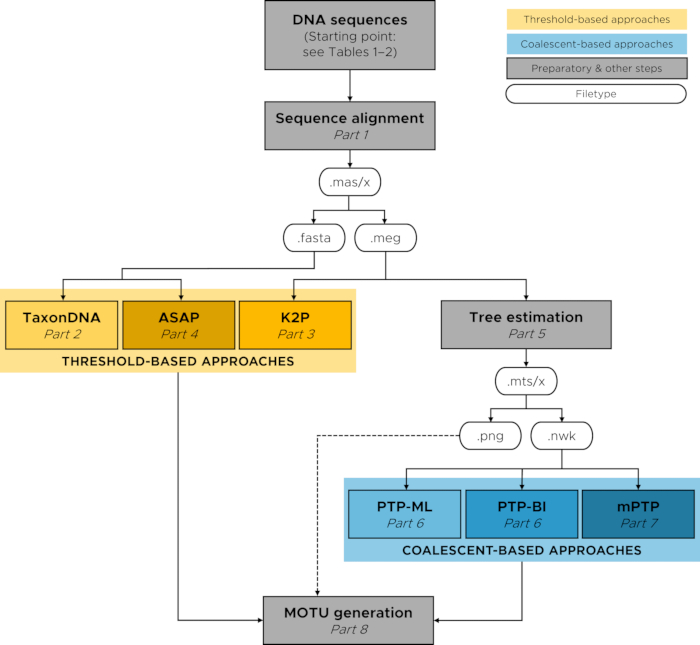
图1:生成MOTU的整合流程图。请点击此处查看该图的放大版本。
访问受限。请登录或开始试用以查看此内容。
方案
该组合分析流程的起始材料为DNA序列,这些序列可从在线数据库下载(例如BOLD、GenBank),或通过Sanger测序获得71。表1和表2列出了本文所展示代表性结果所对应数据集的登录号。
1. 基于阈值方法的准备步骤:序列比对
- 在 MEGA X72 中加载序列。
注意:MEGA X 可从 https://www.megasoftware.net/ 下载。- 点击 Align(比对) 以打开下拉菜单。点击 Edit/Build Alignment(编辑/构建比对),并选择 Create a new alignment(创建新比对)。点击 OK(确定) 确认选择。选择 DNA(DNA) 作为比对的数据类型。
- 将鼠标悬停在 Edit(编辑) 选项卡上,从文件中选择 Insert Sequence(插入序列)。导航至包含序列的目录,并选择要加载到 MEGA 中的文件。
- 点击 Alignment(比对),然后点击 Align by ClustalW(使用 ClustalW 比对)73,以比对序列。使用默认设置继续,点击 OK(确定)。
- 通过截去两端以及清除任何插入或缺失,手动编辑序列。
- 要删除插入片段,点击插入的碱基和/或位置,然后按键盘上的 Delete(删除) 键。
- 要修正缺失,点击由“-”表示的应被删除的位置。删除“-”,并输入正确的碱基。
- 找到所有序列均含有字符的最早位置。点击该位置左侧位置行首的空白框,并向右拖动,选中所有序列起始端多余的位点,然后按 Delete(删除) 键进行截短。
- 重复步骤 1.3.3,查找所有序列均含有字符的最后位置。点击该位置右侧位置行首的空白框,向左拖动,选中所有序列末端多余的位点,然后按 Delete(删除) 键。
注意:图 2A 展示了 DNA 序列的良好比对结果。最终数据集为长度相等的序列矩阵,因此序列长度不会影响研究结果。参考序列决定了比对矩阵的最终长度。
- 由于 COI 是蛋白编码序列,需将序列翻译为氨基酸以检查终止密码子。
- 选择所有序列,然后点击 Translated Protein Sequences(翻译后的蛋白序列) 选项卡。
- 当系统提示时,确认遗传密码为 Invertebrate Mitochondrial(无脊椎动物线粒体)。若遗传密码不同,点击 No(否),将弹出菜单,允许勾选 Invertebrate Mitochondrial(无脊椎动物线粒体) 遗传密码。
- 若比对区域中整列出现由星号表示的终止密码子,则点击 DNA Sequences(DNA 序列),并删除所有序列的第一个位点。
- 若仍存在终止密码子,重复上一步操作。
- 若仍存在终止密码子,恢复先前删除的位点。选择所有序列,将鼠标悬停在 Data(数据) 选项卡上,点击 Reverse(反向)。
- 重复步骤 1.4.1。若仍存在终止密码子,重复步骤 1.4.3 和 1.4.4。
注意:图 2B 展示了密码子的良好比对结果。
- 点击 DNA Sequences(DNA 序列),将序列比对结果保存为 .mas/x 格式。将序列导出为其他相关文件格式,例如 .meg 文件和 .fasta 文件。
注意:某些分子物种界定方法在不含外群的情况下效果更佳。因此,可考虑生成一份不含外群的比对文件副本。
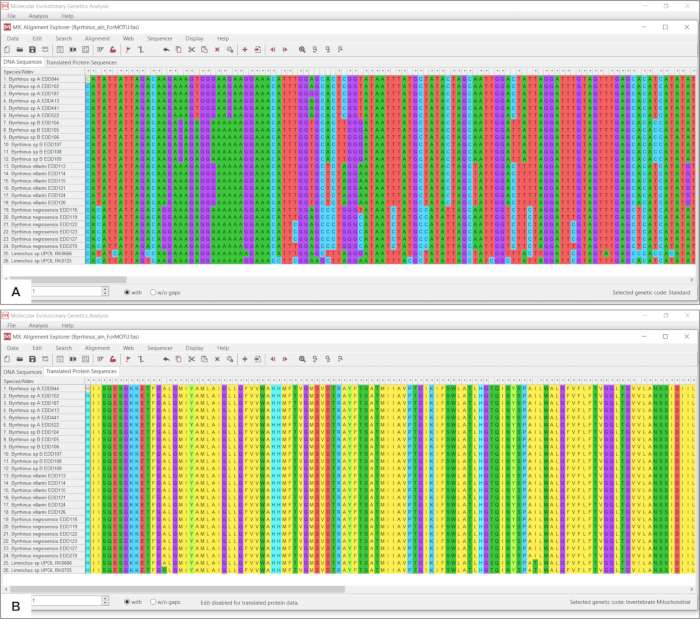
图 2:MEGA X 中的序列比对。(A)手动校正后的最终 DNA 序列比对结果,以及(B)Byrrhinus 数据集的翻译后蛋白质序列比对结果,显示无插入、缺失和空位。请点击此处查看该图的放大版本。
2. 在物种鉴定器 1.8 的分类单元 DNA 模块中进行界定
注意:物种标识符可从 https://taxondna.sourceforge.net/ 下载
- 打开 TaxonDNA,点击 Import,然后点击 FASTA,上传以 .fasta 格式保存的比对文件。
- 点击 Modules,然后点击 Cluster。将阈值设为 3%,然后勾选 Generate information about individual cluster(图 3)。
- 点击 Make clusters now!,通过截图保存结果。
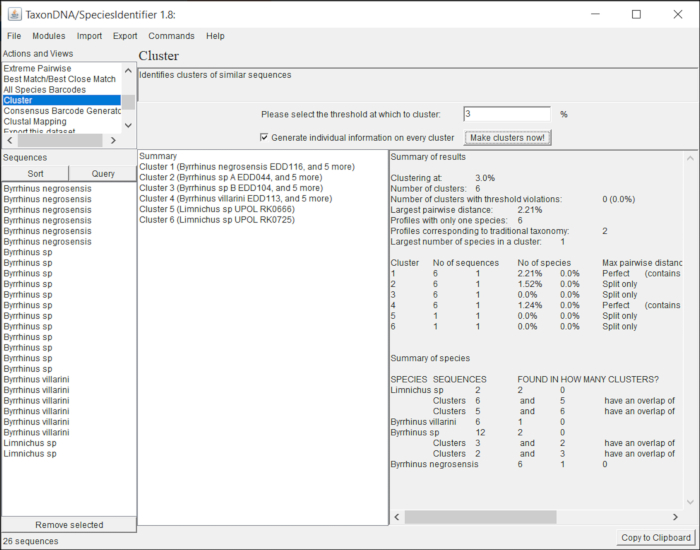
图3:Species Identifier 1.8 软件中 TaxonDNA 界面显示用户设定的3%聚类阈值用于物种划分。请点击此处查看该图的高清版本。
在 MEGA X 中使用 Kimura 2-参数(K2P)进行界定
- 在 MEGA 中,通过点击 文件,然后选择 打开文件/会话,来打开 .meg 文件。点击 距离,然后点击 计算成对距离。确认用于划分的 .meg 文件。
- 将鼠标悬停在“模型/方法”旁边的黄色框上,然后点击框右侧出现的下拉箭头。
- 从下拉菜单中选择 Kimura 2参数模型 。点击 确定 以运行程序。打开数据输出窗口(图4)。
- 点击 文件,然后选择 导出/打印距离。
- 在“输出格式”旁边的下拉菜单中,选择 XL:Microsoft Excel 工作簿。在“小数位数”中选择 4 位。
- 将生成的电子表格保存为 Microsoft Excel 格式。使用条件格式突出显示距离小于 0.03(或 3%)的数据。
注意:与本文讨论的其他方法不同,K2P 无法立即提供聚类结果,因为它依赖于用户设定的阈值。本流程假设阈值为 3%,即任何遗传距离小于 3% 的序列对属于同一分子簇。
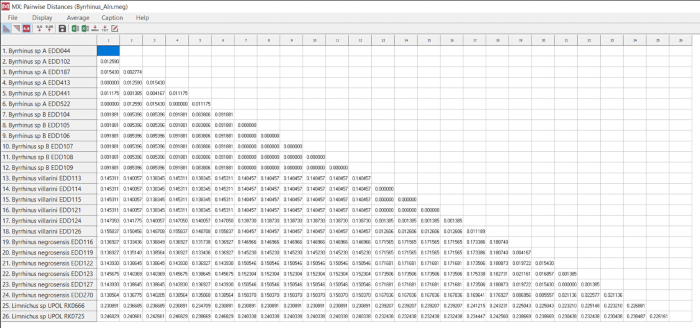
图4:MEGA X 中显示 Kimura-2 参数法结果的窗口。 请点击此处查看该图的放大版本。
4. 通过自动划分组装物种进行界定(ASAP)
- 访问 ASAP 网络服务器:https://bioinfo.mnhn.fr/abi/public/asap/asapweb.html
- 点击标有 选择文件… 的橙色框,选择 .fasta 文件以上传比对结果。或者,将 .fasta 文件拖拽至橙色框中。向下滚动,然后点击 开始。
- 要下载聚类结果,请点击 ASAP 评分最低且 p 值排名最高的那一行对应的 列表(图 5)。
注意:输出结果为一个 .txt 文件,其中列出了分子聚类的各个子集。
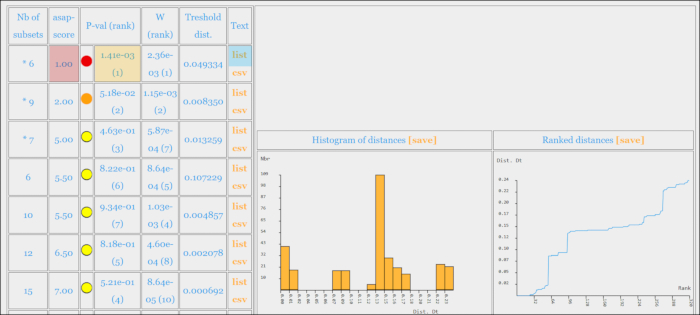
图5:ASAP中显示可能物种划分结果的窗口。 第一个结果(蓝色框)被接受,因其ASAP得分最低(红色框)且P值排名最高(黄色框)。请点击此处查看该图的放大版本。
5. 基于溯祖方法的准备步骤:系统发育树构建
- 通过点击 数据,然后点击 打开文件/会话,打开 .meg 文件。测试最佳适合的替换模型。
- 点击 模型,然后找到 最佳DNA/蛋白质模型(ML)。确认用于分析的 .meg 文件。
- 在 分析偏好 菜单中点击 确定(图6A)。记录结果窗口中具有最低BIC和AICc值的最优模型(图6B)。
注意:该模型通常位于结果窗口模型列表中的第一位。在结果窗口底部可查阅缩写模型名称的完整名称。
- 构建系统发育树。
- 点击 系统发育,然后选择 构建/检验最大似然树。
- 使用最佳适合的核苷酸替换模型。点击“模型/方法”旁边的黄色方框,在下拉菜单中选择相应的模型。
- 如果最佳适合的核苷酸替换模型包含“+G”或“+I”或两者均有,请点击“位点间速率”旁边的方框,并从下拉菜单中选择相应参数(G、I 或 G + I)(图6C)。
- 在 系统发育检验 下,点击“系统发育检验”旁边的方框,并从下拉菜单中选择 自举法。点击“自举重复次数”旁边的方框,输入 1000(图6C)。点击 确定 开始分析。
- 当出现包含结果树的窗口后(图6D),将树会话保存为 .mts/x 格式;将输出结果保存为 .nwk 文件;同时将树另存为 .png 图像文件。
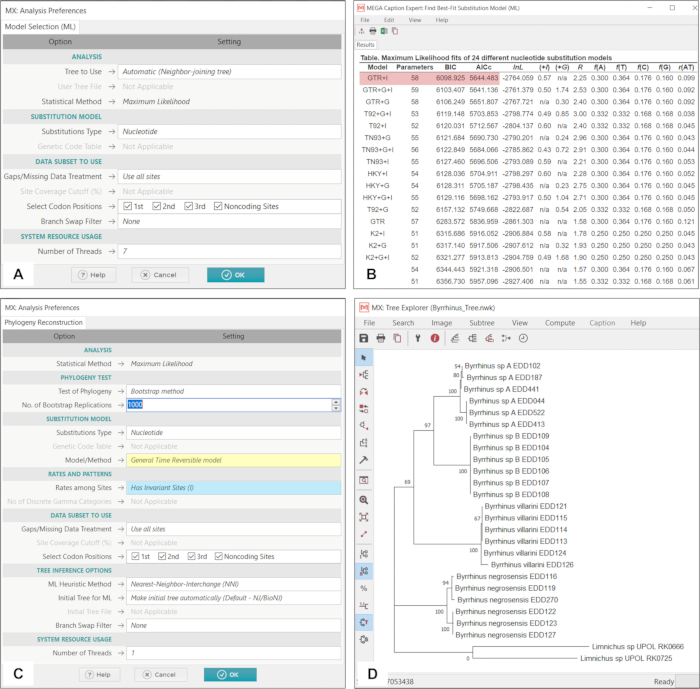
图6:在 MEGA X 中进行系统树推断,作为基于溯祖理论分析的前期步骤。(A)用于确定最优核苷酸替换模型的设置。(B)对于 Byrrhinus 数据集,由于 BIC 和 AICc 值最低(红框),最优模型为 GTR + I。(C)在运行最大似然法构建系统树时,参数设置为 GTR(黄框)+ I(蓝框)。(D)所得原始 ML 树,将用于后续分析。请点击此处查看该图的高清版本。
6. 基于泊松树过程(Poisson Tree Processes, PTP)的物种划分
注意:以下步骤将产生 PTP-ML 和 PTP-BI 的结果。
- 访问 PTP 网络服务器:https://species.h-its.org/ptp/
- 点击 选择文件 按钮上传 Newick 格式文件。在 我的系统发育树为 选项下,选择 有根树(图 7A)。
- 输入分析参数。在 MCMC 代数 下输入 100000;在 采样间隔 下输入 100;在 预烧期 下输入 0.1;在 随机种子 下输入 123。
- 在“外群分类单元名称(若有)”框中输入外群名称,键入末端分支的名称即可。输入框右侧提供了格式化输入的说明。
- 在相应字段中输入电子邮件地址,然后点击 提交。在 PTP 物种划分结果页面中,点击 此处 打开结果窗口。
- 在 最大似然解 下,点击 下载划分结果 以下载 PTP-ML 的分析结果(图 7B)。
- 在 贝叶斯支持解 下,点击 下载划分结果 以下载 PTP-BI 的分析结果。
注意:结果将显示序列在各分区中的分组情况,这些分组将以编号的物种形式标注,并附带支持值,其中 1.000 为理想值。
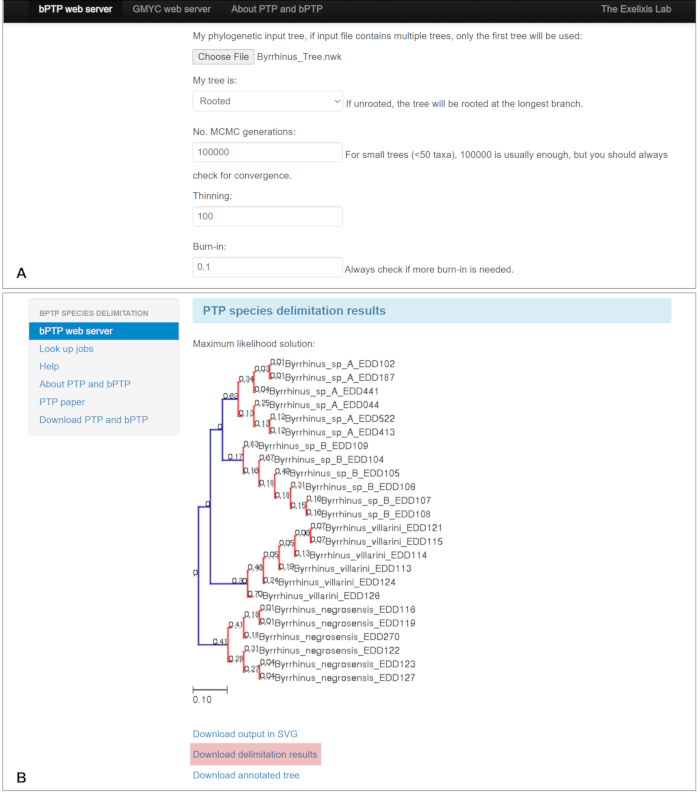
图7:基于泊松树过程的分子物种界定。(A)显示输入参数的窗口。(B)PTP网络服务器中的结果窗口,其中包含物种界定结果的链接(红色框)。请点击此处查看该图的放大版本。
7. 基于多速率泊松树过程(mPTP)的物种界定
- 前往 mPTP 网络服务器:https://mptp.h-its.org/#/tree
- 通过将 Newick 文件拖拽到灰色矩形区域或点击该矩形来上传文件。数据在同一页面加载后,点击 进行外群选择 (图8A).
- 在 外群设定 页,选择 外群 通过单击外群样本分类标签旁的复选框。单击 作物外群 序列底部的选项。点击 模型选择.
- 点击 MPTP,然后点击 可视化选项。在 可视化选项 页,接受默认设置。
注意:也可通过在SVG宽度下输入数值(单位为px)来调整整体图像大小。可通过在SVG字体大小、尖端间距、左页边距、右页边距、上页边距和下页边距下输入所需数值(单位为px)来调整文本的字体和间距。 - 点击 联系方式输入电子邮件地址,以便日后参考结果(可选)。
- 点击 概述. 请务必检查输入的分类单元数量以及选定的外群。
- 点击 提交. 右键单击下方文件 可下载文件 (图8B),并选择 另存为… 以保存结果。
注意:输出的文本文件将在结果开头标明分隔出的物种总数,随后列出每个聚类所包含的序列。这些聚类及其对应的序列排列方式与.svg文件中生成的系统发育树一致。mPTP SVG文件将展示序列的聚类情况,聚类由系统发育树上以红色分支连接的序列组表示,每一组独立的红色分支代表一个独立的分子操作分类单元(MOTU)。
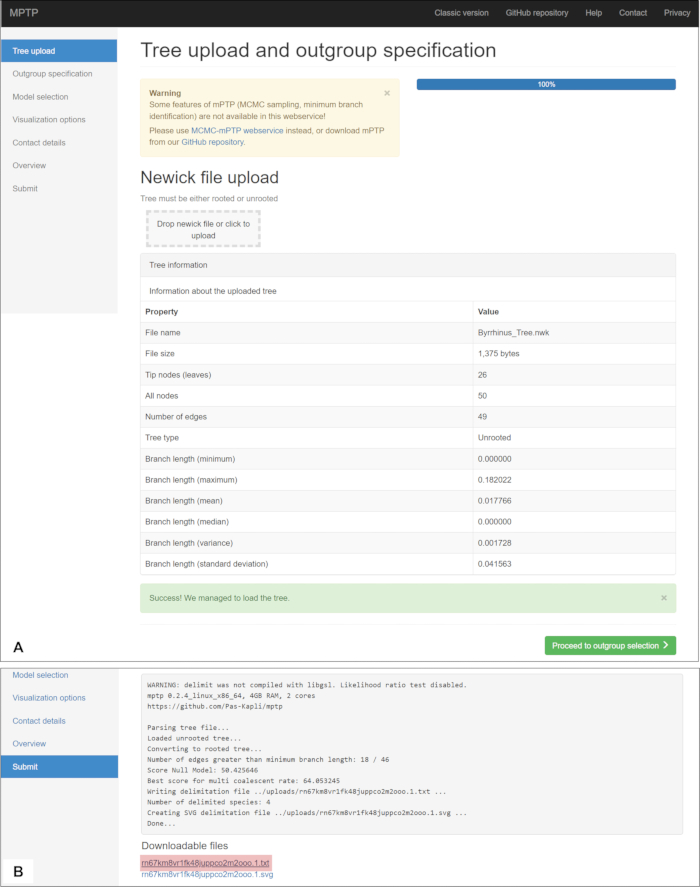
图 8:通过多速率泊松树过程进行分子物种界定。(A)显示 mPTP-read 关于已上传树信息的窗口。(B)mPTP 网络服务器中的结果窗口,包含物种界定结果的链接(红色框)。请点击此处查看此图的放大版本。
8. 生成 MOTU
- 使用图像编辑软件或 PowerPoint 打开系统发育树。
- 为每种分子物种划分方法的结果创建色条(示例见图9和图10)。确保每一条形与所包含序列对应的分子聚类对齐。
- 通过以下两种方法之一确定分子操作分类单元(MOTU)74
- 若所有方法对某一特定分子聚类产生相同结果,则依据共识将该分子聚类确立为一个MOTU。
- 若多数方法对某一特定分子聚类产生相同结果,则依据多数原则将该分子聚类确立为一个MOTU。
访问受限。请登录或开始试用以查看此内容。
结果
本文采用了一种分子物种界定复合分析流程,包括TaxonDNA、K2P、ASAP、两种变体的PTP以及mPTP方法,应用于水生及河岸带甲虫。六种方法各自所得结果称为“分子聚类”,而其综合结果则称为“分子操作分类单元”(MOTUs)75。
该分析流程在两个数据集上进行了测试。第一个数据集(表1,图9)包含24条来自菲律宾采集的河岸带Byrrhinus Motschulsky, 1858甲虫的COI-3'序列,以外群为两个未定种的Limnichus Latreille, 1829物种76。Byrrhinus序列包括两条来自先前已发表物种的序列35,这些物种基于形态学的α分类学并结合K2P划分方法建立,此外还包括来自五个不同省份的未知物种的序列。
访问受限。请登录或开始试用以查看此内容。
讨论
尽管DNA序列(尤其是COI49)可与在线公共数据库54,55,79,80中的参考序列22,53,78进行比对,以实现生物鉴定46,但该方法受限于已有的测序数据沉积情况。相比之下,分子物种界定方法可在无需预先建立序列数据库的前提下,确定物种边界并实现分子聚类56。鉴于分子物种界定方法可分为两类,在分析流程中存在两个关键步骤,即输入文件的准备,具体包括序列比对的构建和基因树的生成。
如本研究所示,当将组合...
访问受限。请登录或开始试用以查看此内容。
披露
我们没有需要披露的内容。
致谢
我们感谢菲律宾渔业和水产资源局(BFAR)以及相关地方政府部门授予我们事先知情同意,以开展生物多样性采样工作。感谢 Hendrik Freitag 博士在分类学研究方面提供的指导。同时感谢审稿人和编辑们提出的富有建设性的宝贵意见。最后,我们谨向马尼拉雅典耀大学大学研究委员会重大项目资助(URC 2022-09)和开放获取出版资助、雅典耀科学与工程研究所 SC Johnson 学生科研与环境领导力基金,以及伦敦林奈学会与系统分类学会联合设立的 LinnéSys:系统分类研究基金,对本研究提供的经费支持表示最诚挚的感谢。
访问受限。请登录或开始试用以查看此内容。
材料
| 姓名 | 公司 | 目录编号 | 评论 |
|---|---|---|---|
| ASAP | Spart 探索者 | https://bioinfo.mnhn.fr/abi/public/asap/asapweb.html | |
| 计算机 | 任意处理单元 | ||
| MEGA X | MEGA 软件 | https://www.megasoftware.net/ | |
| mPTP 网络服务器 | https://mptp.h-its.org/#/tree | ||
| PTP 网络服务器 | 海德堡理论研究学会(HITS) | https://species.h-its.org/ptp/ | |
| 物种鉴定器 | https://taxondna.sourceforge.net/ |
参考文献
- Ceballos, G., Ehrlich, P. R. Mammal population losses and the extinction crisis. Science. 296 (5569), 904-907 (2002).
- Dirzo, R., et al. Defaunation in the Anthropocene. Science. 345 (6195), 401-406 (2014).
- Cardoso, P., et al. Scientists' warning to humanity on insect extinctions. Biol Conserv. 242, 108426(2020).
- Wagner, D. L., Grames, E. M., Forister, M. L., Berenbaum, M. R., Stopak, D. Insect decline in the Anthropocene: Death by a thousand cuts. Proc Natl Acad Sci U S A. 118 (2), 1-10 (2021).
- Steffen, W., Crutzen, P. J., McNeill, J. R. Welcome to the Anthropocene. Ambio. 36 (8), 614-621 (2007).
- de Carvalho, M. R., et al. Taxonomic impediment or impediment to taxonomy? A commentary on systematics and the cybertaxonomic-automation paradigm. Evol Biol. 34 (3-4), 140-143 (2007).
- Satler, J. D., Carstens, B. C., Hedin, M. Multilocus species delimitation in a complex of morphologically conserved trapdoor spiders (Mygalomorphae, Antrodiaetidae, Aliatypus). Syst Biol. 62 (6), 805-823 (2013).
- Arribas, P., Andújar, C., Sánchez-Fernández, D., Abellán, P., Millán, A. Integrative taxonomy and conservation of cryptic beetles in the Mediterranean region (Hydrophilidae). Zool Scr. 42 (2), 182-200 (2013).
- Baker, K., et al. Carpooling with ecologists, geographers and taxonomists: Perceptions from conducting environmental research in tropical regions. Biodivers Conserv. 28 (4), 975-981 (2019).
- Tan, D. S. H., Ang, Y., Lim, G. S., Bin Ismail, M. R., Meier, R. From "cryptic species" to integrative taxonomy: An iterative process involving DNA sequences, morphology, and behaviour leads to the resurrection of Sepsis pyrrhosoma (Sepsidae: Diptera). Zool Scr. 39 (1), 51-61 (2010).
- Tan, M. K., Storozhenko, S. Y., Hwang, W. S., Meier, R. Integrative taxonomy reveals two sympatric species of the genus Eucriotettix Hebard, 1930 (Orthoptera: Tetrigidae). Zootaxa. 4268 (3), 377-394 (2017).
- Yule, C. M. Freshwater invertebrates. Freshwater Invertebrates of the Malaysian Region. , 23-31 (2004).
- Komarek, A., Jäch, M. A., Ji, L. Hydrophilidae: I. Check list and key to Palearctic and Oriental genera of aquatic Hydrophilidae (Coleoptera). Water Beetles of China. 3, 383-395 (2003).
- Rudoy, A., Ribera, I. The macroevolution of size and complexity in insect male genitalia. PeerJ. 4, e1882(2016).
- Rudoy, A., Beutel, R. G., Ribera, I. Evolution of the male genitalia in the genus Limnebius Leach, 1815 (Coleoptera, Hydraenidae). Zool J Linn Soc. 178, 97-127 (2016).
- Shapiro, A. The lock-and-key hypothesis: Evolutionary and biosystematic interpretation of insect genitalia. Annu Rev Entomol. 34 (1), 231-245 (1989).
- Scotland, R., Hughes, C., Bailey, D., Wortley, A. The big machine and the much-maligned taxonomist. Syst Biodivers. 1 (2), 139-143 (2003).
- Vinarski, M. V. Roots of the taxonomic impediment: Is the "integrativeness" a remedy. Integr Zool. 15 (1), 2-15 (2020).
- Cardoso, P., Erwin, T. L., Borges, P. A. V., New, T. R. The seven impediments in invertebrate conservation and how to overcome them. Biol Conserv. 144 (11), 2647-2655 (2011).
- Engel, M. S., et al. The taxonomic impediment: A shortage of taxonomists, not the lack of technical approaches. Zool J Linn Soc. XX, 1-7 (2021).
- Tancoigne, E., Dubois, A. Cladistics taxonomy: No decline, but inertia. Cladistics. , 1-4 (2013).
- Riedel, A., Sagata, K., Suhardjono, Y. R., Tänzler, R., Balke, M. Integrative taxonomy on the fast track: Towards more sustainability in biodiversity research. Front Zool. 10 (15), 1-9 (2013).
- Dayrat, B. Towards integrative taxonomy. Biol J Linn Soc. 85 (3), 407-415 (2005).
- Bickford, D., et al. Cryptic species as a window on diversity and conservation. Trends Ecol Evol. 22 (3), 148-155 (2007).
- Page, R. D. M. DNA barcoding and taxonomy: Dark taxa and dark texts. Philos Trans R Soc Lond B Biol Sci. 371 (1702), 20150334(2016).
- Morinière, J., et al. A DNA barcode library for 5,200 German flies and midges (Insecta: Diptera) and its implications for metabarcoding-based biomonitoring. Mol Ecol Resour. 19 (4), 900-928 (2019).
- Hartop, E., Srivathsan, A., Ronquist, F., Meier, R. Towards large-scale integrative taxonomy (LIT): Resolving the data conundrum for dark taxa. Syst Biol. 71 (6), 1404-1422 (2022).
- Fossen, E. I., Ekrem, T., Nilsson, A. N., Bergsten, J. Species delimitation in northern European water scavenger beetles of the genus Hydrobius (Coleoptera, Hydrophilidae). ZooKeys. 564, 71-120 (2016).
- Bálint, M., et al. Cryptic biodiversity loss linked to global climate change. Nat Clim Change. 1 (6), 313-318 (2011).
- Padial, J. M., De La Riva, I. A response to recent proposals for integrative taxonomy. Biol J Linn Soc. 101 (3), 747-756 (2010).
- Andújar, C., Arribas, P., Ruiz, C., Serrano, J., Gómez-Zurita, J. Integration of conflict into integrative taxonomy: Fitting hybridization in species delimitation of Mesocarabus (Coleoptera: Carabidae). Mol Ecol. 23 (17), 4344-4361 (2014).
- Schlick-Steiner, B. C., et al. Integrative taxonomy: A multisource approach to exploring biodiversity. Annu Rev Entomol. 55 (1), 421-438 (2010).
- Stüben, P. E., Astrin, J. J. Integrative taxonomy, phylogeny, and new species of the weevil genus Onyxacalles Stüben (Coleoptera: Curculionidae: Cryptorhynchinae). Psyche (Lond). 2012, 1-22 (2012).
- Hawlitschek, O., et al. Pleistocene climate change promoted rapid diversification of aquatic invertebrates in Southeast Australia. BMC Evol Biol. 12 (142), 1-15 (2012).
- Delocado, E. D., Freitag, H. Two new species of Byrrhinus Motschulsky, 1858 (Coleoptera, Limnichidae, Limnichinae) from Negros, Philippines. ZooKeys. 1070, 51-72 (2021).
- De Vera, G. C. M., Sia, J. I. L., Freitag, H., Delocado, E. D. The first new species of Leptelmis Sharp, 1888 (Coleoptera, Elmidae) from the Philippines in the last 50 years. Tijdschr Entomol. 166 (2-3), 175-186 (2023).
- Seno, C. B. N., Delocado, E. D., Freitag, H. Three new species of Ancyronyx Erichson, 1847 (Coleoptera, Elmidae) from Mindanao, Philippines. Tijdschr Entomol. 72, 61-80 (2022).
- López-López, A., Hudson, P., Galián, J. Islands in the desert: Species delimitation and evolutionary history of Pseudotetracha tiger beetles (Coleoptera: Cicindelidae: Megacephalini) from Australian salt lakes. Mol Phylogenet Evol. 101, 279-285 (2016).
- Ibarra, J. W. B., Bantiding, F. J. A., Delocado, E. D. First Georissidae (Coleoptera) from the Philippines with description of two new species of Georissus Latreille, 1809. Tijdschr Entomol. , 45-58 (2025).
- Boonsoong, B., Sartori, M. Review and integrative taxonomy of the genus Prosopistoma Latreille, 1833 (Ephemeroptera, Prosopistomatidae) in Thailand, with description of a new species. ZooKeys. 825, 123-144 (2019).
- Wang, Y., Nansen, C., Zhang, Y. Integrative insect taxonomy based on morphology, mitochondrial DNA, and hyperspectral reflectance profiling. Zool J Linn Soc. 177 (2), 378-394 (2016).
- Schutze, M. K., et al. One and the same: Integrative taxonomic evidence that Bactrocera invadens (Diptera: Tephritidae) is the same species as the Oriental fruit fly Bactrocera dorsalis. Syst Entomol. 40 (2), 472-486 (2015).
- Schär, S., et al. Integrative biodiversity inventory of ants from a Sicilian archipelago reveals high diversity on young volcanic islands (Hymenoptera: Formicidae). Org Divers Evol. 20, 405-416 (2020).
- Ševčík, J., et al. Integrative taxonomy of Central European Planetella (Diptera: Cecidomyiidae) indicates high species diversity, intraspecific variation and low host specificity. Acta Entomol Musei Natl Pragae. 63 (2), 413-450 (2023).
- Mengual, X., Ståhls, G., Vujić, A., Marcos-García, M. Á Integrative taxonomy of Iberian Merodon species (Diptera, Syrphidae). Zootaxa. 1377, 1-26 (2006).
- Hebert, P. D. N., et al. Biological identifications through DNA barcodes. Proc R Soc B Biol Sci. 270 (1512), 313-321 (2003).
- Hebert, P. D. N., et al. Ten species in one: DNA barcoding reveals cryptic species in the neotropical skipper butterfly Astraptes fulgerator. Proc Natl Acad Sci U S A. 101 (41), 14812-14817 (2004).
- Hebert, P. D. N., Gregory, T. R. The promise of DNA barcoding for taxonomy. Syst Biol. 54 (5), 852-859 (2005).
- Hebert, P. D. N., Ratnasingham, S., DeWaard, J. R. Barcoding animal life: Cytochrome c oxidase subunit 1 divergences among closely related species. Proc R Soc Lond B. 270 (Suppl), S96-S99 (2003).
- Simon, C., et al. Evolution, weighting, and phylogenetic utility of mitochondrial gene sequences and a compilation of conserved polymerase chain reaction primers. Ann Entomol Soc Am. 87 (6), 651-701 (1994).
- Hendrich, L., et al. Mitochondrial Cox1 sequence data reliably uncover patterns of insect diversity but suffer from high lineage-idiosyncratic error rates. PLoS ONE. 5 (12), e14448(2010).
- Balke, M., et al. Suggestions for a molecular biodiversity assessment of Southeast Asian freshwater invertebrates: Lessons from the megadiverse beetles (Coleoptera). J Limnol. 72 (Suppl 2), 61-68 (2013).
- Virgilio, M., et al. Comparative performances of DNA barcoding across insect orders. BMC Bioinformatics. 11, 206(2010).
- Benson, D. A., et al. GenBank. Nucleic Acids Res. 41 (D1), 36-42 (2013).
- Ratnasingham, S., Hebert, P. D. N. BOLD: The barcode of life data system. Mol Ecol Notes. 7, 355-364 (2007).
- Pons, J., et al. Sequence-based species delimitation for the DNA taxonomy of undescribed insects. Syst Biol. 55 (4), 595-609 (2006).
- Puillandre, N., et al. automatic barcode gap discovery for primary species delimitation. Mol Ecol. 21 (8), 1864-1877 (2012).
- Fontaneto, D., Flot, J. F., Tang, C. Q. Guidelines for DNA taxonomy, with a focus on the meiofauna. Mar Biodivers. 45 (3), 433-451 (2015).
- Balke, M., et al. New Guinea highland origin of a widespread arthropod supertramp. Proc R Soc B Biol Sci. 276 (1666), 2359-2367 (2009).
- Meier, R., et al. DNA barcoding and taxonomy in Diptera: A tale of high intraspecific variability and low identification success. Syst Biol. 55 (5), 715-728 (2006).
- Kimura, M. A simple method for estimating evolutionary rates of base substitutions through comparative studies of nucleotide sequences. J Mol Evol. 16 (2), 111-120 (1980).
- Puillandre, N., Brouillet, S., Achaz, G. ASAP: Assemble species by automatic partitioning. Mol Ecol Resour. 21 (2), 609-620 (2021).
- Wiens, J. J., Penkrot, T. A. Delimiting species using DNA and morphological variation and discordant species limits in spiny lizards (Sceloporus). Syst Biol. 51 (1), 69-91 (2002).
- Fujisawa, T., Barraclough, T. G. Delimiting species using single-locus data and the generalized mixed Yule coalescent approach: A revised method and evaluation on simulated data sets. Syst Biol. 62 (5), 707-724 (2013).
- Yang, Z., Rannala, B. Unguided species delimitation using DNA sequence data from multiple loci. Mol Biol Evol. 31 (12), 3125-3135 (2014).
- Leaché, A. D., Fujita, M. K. Bayesian species delimitation in West African forest geckos (Hemidactylus fasciatus). Proc R Soc B Biol Sci. 277 (1697), 3071-3077 (2010).
- Luo, A., et al. Comparison of methods for molecular species delimitation across a range of speciation scenarios. Syst Biol. 67 (5), 830-846 (2018).
- Zhang, J., et al. A general species delimitation method with applications to phylogenetic placements. Bioinformatics. 29 (22), 2869-2876 (2013).
- Kapli, P., et al. Multi-rate Poisson tree processes for single-locus species delimitation under maximum likelihood and Markov chain Monte Carlo. Bioinformatics. 33 (11), 1630-1638 (2017).
- Sanchez, E. G. S., Delocado, E. D., Freitag, H. Two new species of Anacaena Thomson, 1859 (Coleoptera, Hydrophilidae) from the Philippines. ZooKeys. 1112, 11-25 (2022).
- Sanger, F., Coulson, A. R. A rapid method for determining sequences in DNA by primed synthesis with DNA polymerase. J Mol Biol. 94 (3), 441-448 (1975).
- Kumar, S., et al. MEGA X: Molecular evolutionary genetics analysis across computing platforms. Mol Biol Evol. 35 (6), 1547-1549 (2018).
- Thompson, J. D., Higgins, D. G., Gibson, T. J. CLUSTAL W: Improving the sensitivity of progressive multiple sequence alignment through sequence weighting, position-specific gap penalties and weight matrix choice. Nucleic Acids Res. 22, 4673-4680 (1994).
- Pentinsaari, M., Vos, R., Mutanen, M. Algorithmic single-locus species delimitation: Effects of sampling effort, variation and nonmonophyly in four methods and 1870 species of beetles. Mol Ecol Resour. 17 (3), 393-404 (2017).
- Galimberti, A., et al. Integrated operational taxonomic units (IOTUs) in echolocating bats: A bridge between molecular and traditional taxonomy. PLoS ONE. 7 (6), e40122(2012).
- Kundrata, R., Jäch, M. A., Bocak, L. Molecular phylogeny of the Byrrhoidea-Buprestoidea complex (Coleoptera, Elateriformia). Zool Scr. 46 (2), 150-164 (2017).
- Komarek, A., Freitag, H. Taxonomic revision of Agraphydrus Règimbart, 1903 V. Philippine species and their first DNA barcodes. Koleopt Rundsch. 90, 201-242 (2020).
- Tautz, D., et al. A plea for DNA taxonomy. Trends Ecol Evol. 18 (2), 70-74 (2003).
- Altschul, S. F., et al. Basic local alignment search tool. J Mol Biol. 215 (3), 403-410 (1990).
- Porter, T., Hajibabaei, M. Over 2.5 million COI sequences in GenBank and growing. bioRxiv. , 353904(2018).
- Gómez, R. A., Reddell, J., Will, K., Moore, W. Up high and down low: Molecular systematics and insight into the diversification of the ground beetle genus Rhadine LeConte. Mol Phylogenet Evol. 98, 161-175 (2016).
- Kodada, J., et al. Ancyronyx clisteri, a new spider riffle beetle species from Borneo, redescription of A. sarawacensis Jäch including a description of the larva and new distribution data for A. procerus Jäch using DNA barcodes (Coleoptera, Elmidae). ZooKeys. 912, 25-64 (2020).
- Hajibabaei, M., Janzen, D. H., Burns, J. M., Hallwachs, W., Hebert, P. D. N. DNA barcodes distinguish species of tropical Lepidoptera. Proc Natl Acad Sci U S A. 103 (4), 968-971 (2006).
- Yeo, D., Srivathsan, A., Meier, R. Longer is not always better: Optimizing barcode length for large-scale species discovery and identification. Syst Biol. 69 (5), 999-1015 (2020).
- Sabordo, M. R., Delocado, E., Freitag, H. Two new species of the genus Ancyronyx Erichson, 1847 from the island of Negros, Philippines (Insecta, Coleoptera, Elmidae). Tijdschr Entomol. 163 (1), 13-30 (2020).
- Astrin, J. J., et al. Exploring diversity in cryptorhynchine weevils (Coleoptera) using distance-, character- and tree-based species delineation. Mol Phylogenet Evol. 63 (1), 1-14 (2012).
- Pritchard, J. K., Stephens, M., Donnelly, P. Inference of population structure using multilocus genotype data. Genetics. 155, 945-959 (2000).
- Huelsenbeck, J. P., Andolfatto, P., Huelsenbeck, E. T. Structurama: Bayesian inference of population structure. Evol Bioinform. 7, 55-59 (2011).
- Hausdorf, B., Hennig, C. Species delimitation using dominant and codominant multilocus markers. Syst Biol. 59 (5), 491-503 (2010).
- Fujita, M. K., et al. Coalescent-based species delimitation in an integrative taxonomy. Trends Ecol Evol. 27 (9), 480-488 (2012).
- Monaghan, M. T., et al. Accelerated species inventory on Madagascar using coalescent-based models of species delineation. Syst Biol. 58 (3), 298-311 (2009).
- Yang, Z., Rannala, B. Bayesian species delimitation using multilocus sequence data. Proc Natl Acad Sci U S A. 107 (20), 9264-9269 (2010).
- Ence, D. D., Carstens, B. C. SpedeSTEM: A rapid and accurate method for species delimitation. Mol Ecol Resour. 11 (3), 473-480 (2011).
- de Queiroz, K. Species concepts and species delimitation. Syst Biol. 56 (6), 879-886 (2007).
- Blair, C., Bryson, R. W. Cryptic diversity and discordance in single-locus species delimitation methods within horned lizards (Phrynosomatidae: Phrynosoma). Mol Ecol Resour. 17 (6), 1168-1182 (2017).
- Dellicour, S., Flot, J. F. Delimiting species-poor data sets using single molecular markers: A study of barcode gaps, haplowebs and GMYC. Syst Biol. 64 (6), 900-908 (2015).
- Dellicour, S., Flot, J. F. The hitchhiker's guide to single-locus species delimitation. Mol Ecol Resour. 18 (6), 1234-1246 (2018).
- Liu, L., et al. Estimating phylogenetic trees from genome-scale data. Ann N Y Acad Sci. 1360 (1), 36-53 (2015).
- Lim, G. S., Balke, M., Meier, R. Determining species boundaries in a world full of rarity: Singletons, species delimitation methods. Syst Biol. 61 (1), 165-169 (2012).
- Zhou, Z., et al. molecular species delimitation based on COI-5P barcode sequences revealed high cryptic/undescribed diversity for Chinese katydids (Orthoptera: Tettigoniidae). BMC Evol Biol. 19 (1), (2019).
- Toussaint, E. F. A., et al. Comparative molecular species delimitation in the charismatic Nawab butterflies (Nymphalidae, Charaxinae, Polyura). Mol Phylogenet Evol. 91, 194-209 (2015).
- Carstens, B. C., Dewey, T. A. Species delimitation using a combined coalescent and information-theoretic approach: An example from North American Myotis bats. Syst Biol. 59 (4), 400-414 (2010).
- Esselstyn, J. A., et al. Single-locus species delimitation: A test of the mixed Yule-coalescent model, with an empirical application to Philippine round-leaf bats. Proc R Soc Lond B. 279 (1743), 3678-3686 (2012).
- Stech, M., et al. Molecular species delimitation in the Racomitrium canescens complex (Grimmiaceae) and implications for DNA barcoding of species complexes in mosses. PLoS One. 8 (1), e53134(2013).
- Kekkonen, M., Hebert, P. D. N. DNA barcode-based delineation of putative species: Efficient start for taxonomic workflows. Mol Ecol Resour. 14 (4), 706-715 (2014).
- Meier, R., et al. "Dark taxonomy": A new protocol for overcoming the taxonomic impediments for dark taxa and broadening the taxon base for biodiversity assessment. Cladistics. 41, 223-238 (2025).
- Ebach, M. C., Holdrege, C. DNA barcoding is no substitute for taxonomy. Nature. 434, 697(2005).
- Ebach, M. C., Holdrege, C. More taxonomy, not DNA barcoding. BioScience. 55 (10), 822-823 (2005).
- Mora, C., et al. How many species are there on Earth and in the ocean. PLoS Biol. 9 (8), e1001127(2011).
- Stork, N. E. How many species of insects and other terrestrial arthropods are there on Earth. Annu Rev Entomol. 63, 31-45 (2018).
- Scheffers, B. R., et al. What we know and don't know about Earth's missing biodiversity. Trends Ecol Evol. 27 (9), 501-510 (2012).
- Carbayo, F., Marques, A. C. The cost of describing the entire animal kingdom. Trends Ecol Evol. 26 (4), 153-154 (2011).
- Walsh, J. C., et al. Trends and biases in the listing and recovery planning for threatened species: An Australian case study. Oryx. 47 (1), 134-143 (2013).
- Carrizo, S. F., et al. Freshwater megafauna: Flagships for freshwater biodiversity under threat. BioScience. 67 (10), 919-927 (2017).
访问受限。请登录或开始试用以查看此内容。
重印与许可
