Este análisis bibliométrico de 1.014 publicaciones sobre la enfermedad pilonidal sacrococcígea (2000–2025) describe las tendencias mundiales de investigación, las redes colaborativas, la evolución temática y las fronteras emergentes, revelando un enfoque investigativo en evolución hacia técnicas mínimamente invasivas y estrategias de prevención basadas en evidencia.
Artículo de investigación
Análisis bibliométrico y de mapeo del conocimiento de la investigación sobre la enfermedad pilonidal sacrococcígea (2000–2025)
* These authors contributed equally
En este artículo
Resumen
Resumen
Sacrococcygeal pilonidal disease (SPD) is an acquired inflammatory condition predominantly affecting young adults and adolescents, with a rising incidence and substantial clinical burden. Despite increasing research activity, the global scientific landscape of SPD, including research output, co-authorship patterns, knowledge diffusion pathways, thematic evolution, and emerging research frontiers, has not been systematically analyzed in the peer-reviewed literature. This study aimed to address this gap using a multitool bibliometric analysis. Bibliometric tools (VOSviewer, CiteSpace, and Pajek) were used to summarize the key features and generate visualizations. Articles and reviews on SPD published between 2000 and 2025 were retrieved from the Web of Science Core Collection. A total of 1,014 papers from 72 countries and 1,387 institutions were included. Research output steadily increased, with a marked acceleration after 2018. Turkey led in publication productivity and citation impact, whereas Germany, England, and the USA were key hubs for international collaboration. The University of Naples Federico II published the most articles, while the Technical University of Munich received the most citations. Dietrich Doll emerged as the most prominent and productive researcher in this field. Diseases of the Colon & Rectum was the most influential journal. Increasing research attention toward minimally invasive techniques, alongside continued interest in conventional surgical approaches, was identified. Current research interests emphasize less invasive strategies, etiological prevention, and evidence synthesis. This study provides valuable information for clinicians and researchers to better understand the current global status of SPD, recognize emerging research themes, and identify potential areas for future investigation and collaboration.
Introducción
La enfermedad pilonidal sacrococcígea (SPD) es una afección inflamatoria adquirida caracterizada por fosas asintomáticas en la línea media, abscesos agudos o tractos sinusales dolorosos, que afecta principalmente a adolescentes y adultos jóvenes1,2,3. Su incidencia ha ido en aumento en la práctica clínica, particularmente en países europeos4,5,6. En Alemania, entre 2005 y 2017, el número promedio de episodios hospitalizados por SPD por cada 100 000 hombres aumentó de 43 a 56, y por cada 100 000 mujeres de 14 a 185. En general, requiere intervención quirúrgica y es una enfermedad económicamente onerosa que contribuye a la pérdida de productividad y a costos sustanciales de tratamiento en pacientes en edad laboral, ejerciendo una presión creciente sobre los sistemas sanitarios en todo el mundo7. En los adolescentes, la SPD impone cargas físicas y psicológicas considerables, con dolor e secreción interglútea que interrumpen las actividades diarias, la práctica deportiva y la asistencia escolar, mientras que las altas tasas de recurrencia y el curso crónico reducen la calidad de vida y afectan el desarrollo psicosocial1,8.
Aunque las opciones conservadoras no quirúrgicas, como la inyección de fenol, ocupan un lugar importante en el manejo1,9, la cirugía sigue siendo un enfoque terapéutico estándar para la DSP sintomática, a pesar de sus posibles complicaciones y riesgo de recurrencia10. Se recomienda la incisión y drenaje para el absceso pilonidal11, y para la enfermedad crónica sintomática del seno, se han descrito numerosas modalidades quirúrgicas1,10, con la elección específica que depende en gran medida de las características de la enfermedad y de la experiencia del cirujano4. Históricamente, la escisión con cierre primario o curación secundaria representó enfoques quirúrgicos comúnmente utilizados para la DSP crónica, cada estrategia asociada con ventajas y limitaciones distintas3,12,13. Los procedimientos de cierre fuera de la línea media, incluidos los colgajos de Karydakis, los colgajos de Limberg y la elevación del surco de Bascom, se han adoptado cada vez más como opciones reconstructivas cuando se selecciona el cierre primario, debido a sus resultados favorables de cicatrización, menor morbilidad de la herida en comparación con el cierre en la línea media y tasas de recurrencia aceptables4. En la última década, las técnicas quirúrgicas mínimamente invasivas, incluidos procedimientos de escisión limitada como la sinusectomía (por ejemplo, el procedimiento de Gips) y los enfoques de tratamiento endoscópico, han atraído un creciente interés clínico e investigativo como alternativas menos invasivas frente a los procedimientos convencionales de escisión1,2,14. No obstante, la estrategia quirúrgica óptima para la DSP sigue estando influenciada por las características de la enfermedad, los factores del paciente y las preferencias del cirujano, con investigaciones continuas sobre la eficacia comparativa entre los enfoques disponibles.
A pesar de estos avances, la literatura científica sobre el TDP presenta varios desafíos macroscópicos que requieren una investigación sistemática. En concreto, aunque la producción investigadora en este ámbito ha crecido rápidamente15, las trayectorias evolutivas de los temas de investigación y las nuevas fronteras permanecen insuficientemente caracterizadas desde una perspectiva cuantitativa, y los caminos de difusión del conocimiento no se han explorado sistemáticamente. Además, la productividad investigadora varía notablemente entre regiones16, y aunque la colaboración dentro del campo es fundamental para fomentar el intercambio científico y el avance del conocimiento17, el análisis integral de las redes cooperativas entre los contribuyentes sigue siendo limitado. El análisis bibliométrico ha surgido como un enfoque sólido capaz de abordar estos desafíos y se ha utilizado para investigar diversas enfermedades ano-rectales, incluyendo hemorroides18,19, fístula perianal20 y prolapso rectal21. Estudios previos relacionados con el TDP han proporcionado información valiosa sobre aspectos específicos de la literatura, incluyendo el mapeo de evidencia clínica15, la productividad de publicaciones16, las características de citación22 y las tendencias metodológicas23. Sin embargo, estas investigaciones se han centrado principalmente en dimensiones individuales de la investigación sobre el TDP, como los dominios de evidencia clínica, la productividad por países, publicaciones altamente citadas o las características del diseño de estudios, mientras que una evaluación integral que integre redes globales de colaboración, estructuras intelectuales y evolución temática sigue siendo insuficiente. Por tanto, este estudio tiene como objetivo ofrecer una visión global actualizada de la investigación sobre el TDP mediante enfoques bibliométricos y de cartografía científica, caracterizando específicamente la estructura del conocimiento, identificando los contribuyentes clave, descifrando los patrones de colaboración internacional, detectando nuevos focos de investigación y destacando posibles direcciones para futuras investigaciones. La presentación de este artículo sigue la lista de verificación BIBLIO24.
Protocolo
Fuente de datos
La Colección Principal de Web of Science (WoS), proporcionada por Clarivate Analytics, se utilizó como fuente principal de datos para este estudio. Como base de datos científica multidisciplinaria ampliamente utilizada, la Colección Principal de WoS se ha adoptado frecuentemente como fuente de datos para análisis bibliométricos25. Los registros obtenidos de esta base de datos pueden exportarse en formatos directamente compatibles con herramientas bibliométricas como VOSviewer. Se aplicó una estrategia de búsqueda exhaustiva para identificar publicaciones relacionadas con SPD. La búsqueda se realizó dentro de la Colección Principal de WoS (véase la Tabla de materiales) sin restringir la recuperación a ningún índice específico, con el fin de maximizar la cobertura de la literatura y minimizar el riesgo de omitir publicaciones potencialmente relevantes.
Estrategia de búsqueda
Para identificar toda la literatura potencialmente relevante, se realizó inicialmente una búsqueda en la Colección Principal de WoS utilizando el campo Tema (TS) con la siguiente consulta: TS = (“pilonidal sinus” OR “pilonidal cyst” OR “pilonidal fistula” OR “pilonidal abscess” OR “pilonidal disease” OR “pilonidal tract” OR “sacrococcygeal cyst” OR “sacrococcygeal sinus” OR “sacrococcygeal fistula” OR “sacrococcygeal tract” OR “sacrococcygeal abscess” OR “sacrococcygeal pilonidal disease” OR “pilonidal cyst disease” OR “pilonidal sinus disease” OR “pilonidal fistula disease” OR “pilonidal tract disease” OR “pilonidal abscess disease” OR “jeep disease”). Dos investigadores (LC y WZ) realizaron de forma independiente la búsqueda bibliográfica el 1 de febrero de 2026, según la estrategia de búsqueda predefinida, resolviéndose las discrepancias mediante discusión con un tercer investigador (YL). Tras la recuperación inicial, se aplicaron secuencialmente filtros predefinidos por año de publicación (2000–2025), idioma (inglés) y tipo de documento (Artículo o Revisión). Tras el proceso inicial de filtrado, los registros restantes pasaron a una segunda fase de selección basada en la revisión de títulos y resúmenes de acuerdo con los criterios de elegibilidad preestablecidos. Dado que algunos informes de casos y series de casos aún pueden estar indexados como Artículo en la Colección Principal de WoS, estos tipos de publicación se identificaron adicionalmente durante este proceso de selección.
Criterios de elegibilidad
Se consideraron elegibles las publicaciones que se centraban en la enfermedad pilonidal sacrococcígea y proporcionaban información científica relevante relacionada con la EPC, incluyendo etiología, fisiopatología, epidemiología, diagnóstico, manejo quirúrgico o conservador, resultados del tratamiento o transformación maligna. Las publicaciones fuera del alcance predeterminado de este análisis bibliométrico se consideraron no elegibles. Se excluyeron los informes de casos y las series de casos porque este estudio tenía como objetivo caracterizar las tendencias de publicación, los patrones de colaboración y las estructuras del conocimiento a nivel del campo, mientras que las publicaciones basadas en casos individuales podrían ser menos representativas del desarrollo general de la investigación.
Selección de los estudios
La búsqueda inicial en la Colección Principal de WoS identificó 2,600 registros que podrían estar relacionados con la DSP. Tras aplicar los filtros predefinidos, se conservaron 1,354 registros para la revisión posterior del título y el resumen. Durante este proceso, se excluyeron los registros que no cumplían con los criterios de elegibilidad, incluyendo estudios sobre enfermedad pilonidal en localizaciones no sacrococcígeas, estudios en cadáveres y publicaciones retractadas. Se incluyó un corpus final de 1,014 publicaciones elegibles para el análisis bibliométrico posterior. Los registros completos y las citas de las publicaciones incluidas se exportaron en formato de texto plano (.txt) para el procesamiento y la visualización posteriores de los datos. El flujo detallado del proceso de recuperación y cribado de la literatura se muestra en Figura 1A.
Método analítico
La información bibliométrica, incluyendo títulos, años de publicación, número de citas, palabras clave, autores, países/regiones, afiliaciones, revistas y listas de referencias, se obtuvo de las publicaciones incluidas y de los registros exportados. Microsoft Excel 2024 se utilizó para la organización de los datos, su tabulación y la elaboración de resúmenes básicos de la información bibliométrica, incluyendo el número anual de publicaciones y las tendencias de publicación. La tasa media de crecimiento anual se calculó como: tasa media de crecimiento anual = (número final de artículos / número inicial de artículos)^(1/n) − 1. Se utilizaron tres herramientas analíticas para el análisis y la visualización bibliométrica: VOSviewer (versión 1.6.20)26, CiteSpace (versión 6.3.R3)27y Pajek (versión 6.02)28. Antes de la construcción de la red, se revisaron y normalizaron manualmente las variaciones y duplicados entre los nombres de países, instituciones, autores, revistas y palabras clave, basándose en los registros exportados de WoS y en la información original de las publicaciones. Para la armonización de palabras clave, se fusionaron en términos unificados aquellos que tenían significados equivalentes o diferencias menores en el formato, incluyendo variantes ortográficas, diferencias en el uso de guiones, variaciones singulares/plurales, abreviaturas y expresiones estrechamente relacionadas. Los procedimientos detallados de armonización de palabras clave y los cambios correspondientes se proporcionan en Tabla suplementaria 1.
Se utilizó VOSviewer para construir redes de colaboración entre países, instituciones y autores, y para visualizar redes de citas de revistas contribuyentes y redes de co-citas de referencias citadas. Se aplicaron el conteo completo y la normalización por fuerza de asociación en todos los análisis realizados con VOSviewer. En las redes de coautoría, la intensidad del enlace se definió como el número de publicaciones coautoradas entre dos elementos conectados, reflejando la intensidad de la colaboración directa. La intensidad total del enlace (TLS) representa la intensidad acumulada del enlace de un elemento con todos los demás elementos conectados en la red, y se utilizó para evaluar la intensidad global de colaboración de países, instituciones y autores. El agrupamiento de la red se realizó utilizando el algoritmo de agrupamiento de VOSviewer con un parámetro de resolución de 1,0. Se incluyeron elementos que cumplían con umbrales mínimos predefinidos de publicaciones para la visualización, establecidos en ≥ 10 publicaciones para países, ≥ 5 publicaciones para instituciones y revistas, y ≥ 2 publicaciones para autores. Para la visualización de referencias citadas, se incluyeron referencias con ≥ 50 citas. Se utilizó CiteSpace para el agrupamiento de palabras clave, la visualización de líneas de tiempo y la detección de ráfagas de citas de palabras clave y referencias citadas. El período de análisis se estableció desde enero de 2000 hasta diciembre de 2025, con intervalos de un año. Los análisis de palabras clave y referencias citadas se realizaron utilizando un criterio de selección top N de 20. Se aplicaron poda con ruta de búsqueda (pathfinder pruning), poda de redes divididas (pruning sliced networks) y poda de la red combinada (pruning the merged network) para optimizar las estructuras de la red. Los grupos de palabras clave se identificaron utilizando el algoritmo de razón de verosimilitud logarítmica (LLR). La detección de ráfagas de citas se realizó utilizando el modelo predeterminado de detección de ráfagas de Kleinberg de CiteSpace, con una duración mínima de la ráfaga de 2 años. Finalmente, se utilizó el software Pajek para perfeccionar la disposición gráfica de las redes generadas por VOSviewer, con el fin de mejorar la calidad y la interpretabilidad de la visualización.
Resultados
Bibliometric analysis of global publication output
Based on a predefined search strategy and inclusion criteria, 1,014 relevant publications were retrieved from the WoS Core Collection database, originating from 255 peer-reviewed journals. These comprised 916 articles and 98 reviews, with a total of 18,036 citations and an average of 17.79 citations per publication. In total, 3,942 authors from 72 countries and 1,387 institutions contributed to publications on SPD. Figure 1B illustrates the annual and cumulative publication output in this field from 2000–2025, with publication counts rising from nine in 2000 to a peak of 87 in 2025, a nearly tenfold increase, indicating a growing research interest in this topic. A compound annual growth rate of 9.52% was calculated using the geometric mean approach. From 2018 onwards, annual publication output has increased noticeably, while cumulative output has followed a stable upward trajectory, reaching 1,014 publications by 2025, indicating a robust and persistent expansion of research output in this area.
Contributions and collaboration of countries/regions
A total of 72 countries (and regions) contributed to the field of SPD from 2000 to 2025. Table 1 shows the top 10 most productive countries ranked by publications. Among these, Turkey leads with 294 publications (28.99%), followed by the United States (114, 11.24%), England (80, 7.89%), Germany (76, 7.50%), and Italy (76, 7.50%). In terms of total citations, Turkey ranked first with 5,282 citations, with an average of 17.97 citations per publication, followed by the United States (1,996, 17.51), Germany (1,783, 23.46), England (1,548, 19.35), and Italy (1,488, 19.58). Notably, Scotland achieved an outstanding average of 66.80 citations per publication despite having only 10 publications, indicating relatively high-impact research from this country. A network visualization of 21 countries (each with at least 10 publications) was generated using VOSviewer (Figure 2A). In this network, node size reflects publication volume, line thickness indicates link strength between connected countries, and colors denote clusters of similar collaboration patterns. Despite Turkey’s leading productivity, cooperation occurred more frequently between the United States and several European countries (e.g., Germany, England, Italy, Switzerland, and the Netherlands). Regarding TLS, a measure of collaborative intensity in co-authorship networks, Germany ranked first (TLS = 46), followed by the United States (TLS = 38), England (TLS = 33), Italy (TLS = 29), and Switzerland (TLS = 29), reflecting their central position in international collaboration.
Contributions and collaboration of institutions
In this analysis, a total of 1,387 institutions were involved in research pertaining to SPD, with 68 institutions contributing five or more articles. Table 2 presents the top 10 most prolific and most collaborative institutions. Regarding publication volume, the University of Naples Federico II is the leading contributor to SPD research with 28 publications and 615 citations, followed by Technical University of Munich (17, 674) and University of Bern (15, 608). As for collaborative intensity, the University of Sheffield has the strongest inter‑institutional collaboration (TLS = 70), followed by the University of Bern (TLS = 66) and St Mark’s Hospital (TLS = 61). Notably, six of the top 10 institutions by TLS are located in England, highlighting its central role in collaborative networks. A network of key institutions and their collaborative relationships is illustrated using VOSviewer (Figure 2B).
Contributions and collaboration of authors
Overall, 3,942 authors contributed to studies on SPD in this analysis. Table 3 offers an overview of the top 10 authors ranked by publication count, total citations, and TLS. Notably, Dietrich Doll from Germany ranks highest in publication volume, total citations, and collaborative intensity during the study period (2000–2025). With respect to publication output, following Doll (48 papers), other highly prolific authors are Marco Milone (18 papers) from Italy and Markus M. Luedi (16 papers) from Switzerland. Regarding total citations, Sven Petersen (660 citations), Markus M. Luedi (620 citations), and Iain J. D. McCallum (574 citations) also demonstrate strong scholarly impact. Figure 3A depicts collaborative relationships among authors with more than one publication, where node size represents publication volume, node color denotes cluster affiliation, and line thickness reflects link strength between connected authors. Most collaborative ties are concentrated among European researchers, particularly from Germany, Italy, and England. However, among the 544 authors who published at least two articles, only 132 formed large‑scale collaborations, represented as nodes scattered across 11 clusters of different colors in the network. The network shows several core collaborative groups, whereas many authors remained isolated or belonged to smaller collaborative teams.
Analysis of contributing journals
From 2000–2025, 255 academic journals have published articles in the realm of SPD. Table 4 lists the top 10 contributing journals with the most publications. The most prolific journal is Diseases of the Colon & Rectum from the United States, ranking first with 55 papers and 2,667 citations. This journal, with an impact factor (IF) of 3.7 and a Q1 Journal Citation Reports (JCR) ranking, has consistently served as the leading journal and is ranked among the major journals in colorectal surgery. Other productive journals include Techniques in Coloproctology (42 papers, 945 citations, IF 2.9, Q1), Colorectal Disease (41 papers, 829 citations, IF 2.7, Q1), and International Journal of Colorectal Disease (34 papers, 942 citations, IF 2.3, Q2), all of which have a strong reputation in this domain. In addition, the Journal of Pediatric Surgery has a considerable number of publications (33 papers, 781 citations, IF 2.5, Q1), highlighting current attention to the pediatric population affected by this disease.
A citation network of journals (Figure 3B) was constructed using VOSviewer software, with each node representing a journal, and the link strength between two journals reflecting the number of times that one journal has cited articles from the other. Nodes with higher link strength indicate journals that are heavily cited by others and play a central role in knowledge dissemination. A total of 50 journals with at least five papers were included in this network, and the above productive journals occupied central positions and were highly interconnected with other sources. Figure 3C presents an overlay visualization of the journal citation network, where node colors indicate the average publication year of relevant articles in each journal. In this overlay map, a color gradient ranging from white to red is used, with white nodes representing journals with earlier average years. For instance, Diseases of the Colon & Rectum and American Journal of Surgery have earlier average years than 2010, highlighting their foundational significance in this research period.
Analysis of keywords
Supplementary Table 2 lists the top 30 most frequently occurring keywords in SPD research from 2000–2025. Apart from the core terms “pilonidal sinus” and “disease”, keywords such as “primary closure”, “excision”, and “surgery” also appeared prominently in the literature, highlighting the importance of surgical treatment in this condition. The CiteSpace software to generate a keyword clustering network and timeline map to identify research topics and their evolution in SPD research. The parameter settings were as follows: the time slicing was from January 2000 to December 2025 with one-year intervals per slice, and the node type was “keyword”. To simplify the network structure and concentrate on core hotspots, the selection criterion was set to the top 20 items per slice. Network pruning and clustering were performed according to the predefined CiteSpace settings. The resulting network comprised 231 nodes and 1,011 links, forming 15 clusters labeled by the log likelihood ratio (LLR) method. The modularity Q value was 0.8134, indicating a significant clustering structure ( > 0.3), and the weighted mean silhouette S value was 0.9203, suggesting reliable clustering results ( > 0.7). Figure 4A presents the keyword clustering network generated by CiteSpace, while Figure 4B shows the timeline visualization of keyword clustering results, illustrating the temporal progression of focal topics in this research area. A total of 10 major clusters were retained in the clustering network, each labeled by a cluster number (0–9) and its top LLR term, representing distinct research themes in the SPD literature. As shown in Supplementary Table 3, the largest clusters are Cluster 0 “pilonidal disease” (size = 31, S = 0.984), followed by Cluster 1 “recurrence rate” (26, 0.861), Cluster 2 “Limberg flap” (20, 0.814), and Cluster 3 “Karydakis flap” (19, 0.777). Notably, seven clusters have S values above 0.9 (Cluster 0, 4–9), indicating high internal homogeneity and strong alignment with their assigned thematic labels. Supplementary Table 4 displays all keywords and their frequency of occurrence in each cluster. In the timeline map, each horizontal line corresponds to a keyword cluster, with its color indicating the cluster identity. The nodes on each line represent individual keywords, and their positions along the line indicate the year when the keyword first appeared in the literature.
Figure 5 shows the top 25 keywords with the strongest citation bursts, which reflect the thematic evolution and research hotspots in this field. The leftmost side of the dark blue bars in the map corresponds to the year when the keyword first appeared, while the red bars represent the duration of keyword bursts. The keyword with the highest burst strength was “minimally invasive treatment” (strength 14.35, 2019–2025), followed by “risk factors” (12.60, 2019–2025) and “video-assisted ablation” (10.63, 2017–2023). Research on this topic has experienced a two-phase trajectory. In the early period (2000–2013), bursts were mainly associated with surgical techniques such as “rhomboid flap”, “y‑advancement flap”, “z‑plasty”, “transposition”, and “follicle removal”, along with the keyword “randomized trial”, suggesting that the initial focus likely centered on evaluating a variety of asymmetric closure and full‑thickness flap techniques (also referred to collectively as “flattening procedures”) through clinical trials. In the latter period (2014–2025), keywords such as “video-assisted ablation”, “crystallized phenol”, and “minimally invasive treatment” experienced strong and relatively recent bursts, indicating an evolving research focus with increasing attention toward less invasive techniques. Furthermore, the most recent and ongoing hotspots include “risk factors”, “hair”, “guidelines”, and “society”, reflecting growing interest in etiological and preventive aspects, as well as increasing attention toward evidence synthesis and guideline-related research.
Analysis of cited references
Table 5 lists the top 10 most cited publications in this analysis. The most frequently cited article is “Easy and successful treatment of pilonidal sinus after explanation of its causative process” published in ANZ Journal of Surgery by Karydakis GE in 1992. Karydakis also authored the paper “New approach to the problem of pilonidal sinus,” published in The Lancet in 1973, which is the earliest publication in this list. The second most cited article is “Patient characteristics and symptoms in chronic pilonidal sinus disease,” published in the International Journal of Colorectal Disease by Sondenaa K in 1995. Of note, although all other highly cited references were published before 2010, the article “Common surgical procedures in pilonidal sinus disease: A meta-analysis, merged data analysis, and comprehensive study on recurrence” (Scientific Reports, Stauffer VK et al, 2018) ranks seventh with 165 citations.
Figure 6A displays the top 25 references with the strongest citation bursts, where the red bars correspond to the duration of reference bursts. Among these publications, the article by Stauffer VK et al published in Scientific Reports in 2018 exhibits the highest burst strength (40.61), reflecting its influence within the field. Figure 6B presents the co-citation network visualization of cited references, comprising 83 articles that met the 50-citation threshold. In the network, nodes represent cited references, and their sizes reflect citation frequency. Connections between nodes indicate that the two references have been co‑cited by the same later publication, with thicker lines representing stronger co‑citation relationships. Node colors indicate cluster membership, with nodes sharing the same color belonging to the same thematic cluster.
DATA AVAILABILITY:
The datasets generated and analyzed during the current study are included in this article as supplementary materials. The bibliographic records used for this analysis were retrieved from the Web of Science Core Collection, and the relevant search strategy and screening process are described in the manuscript. All data necessary to reproduce the analyses and interpret the findings are provided within this article and its Supplementary Tables 1–4 and Supplementary File 1.
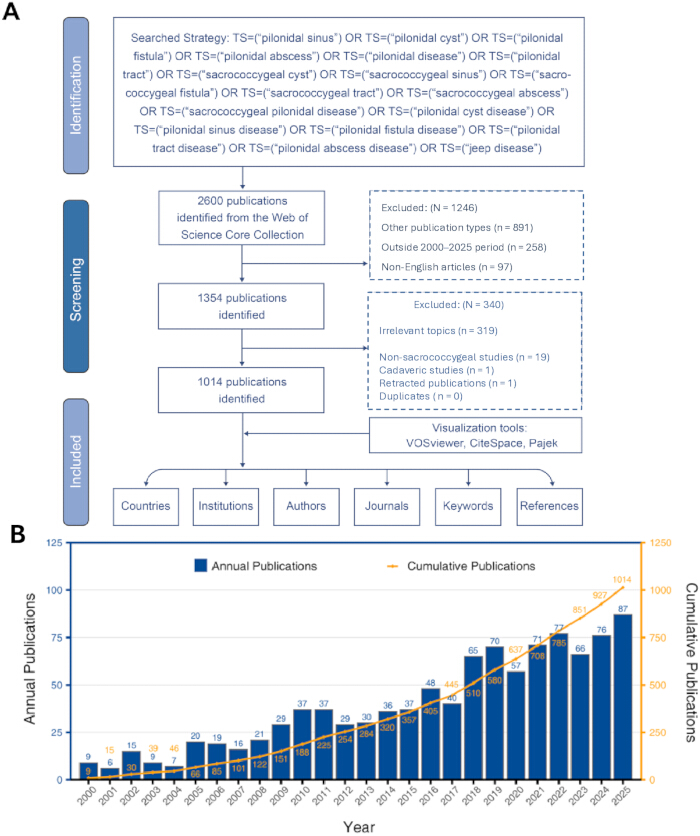
Figure 1: Study selection and publication trends. (A) Flow diagram illustrating the stepwise screening and inclusion process based on the WoS Core Collection, resulting in a final curated dataset of 1,014 original English-language publications on SPD. (B) Annual and cumulative numbers of publications on sacrococcygeal pilonidal disease between 2000 and 2025. Please click here to view a larger version of this figure.
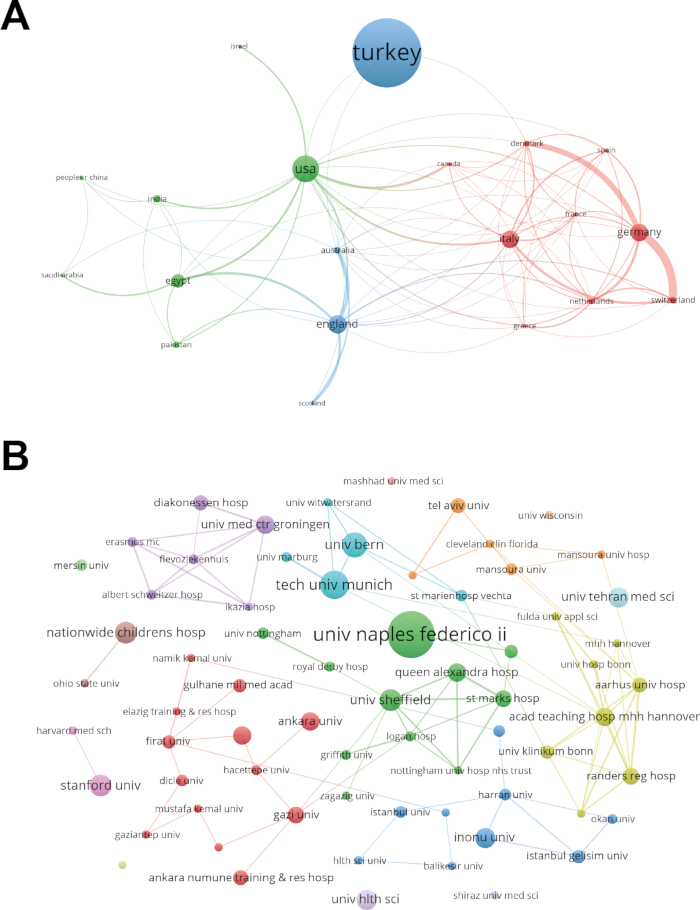
Figure 2: Network maps of the productive countries and institutions. (A) Collaborative network of countries. (B) Collaborative network of institutions. In both networks, larger nodes represent higher publication volume, node colors indicate different clusters, and thicker lines indicate stronger links between connected nodes. Please click here to view a larger version of this figure.
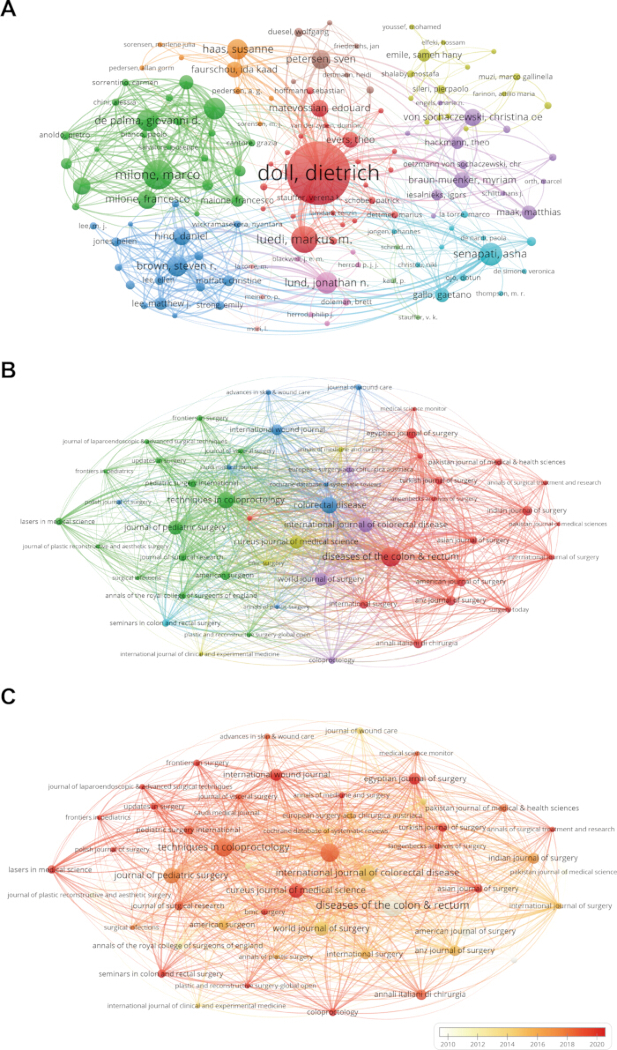
Figure 3: Network maps of prolific authors and journals. (A) Collaborative network visualization of authors. (B) Citation network visualization of contributing journals. (C) Overlay visualization of contributing journals. In (A) and (B), larger nodes represent higher publication volume, node colors indicate different clusters, and thicker lines indicate higher link strength between connected items. In (C), node colors indicate the average publication year of articles in each journal, using a gradient from white (earlier years) to red (later years). Please click here to view a larger version of this figure.
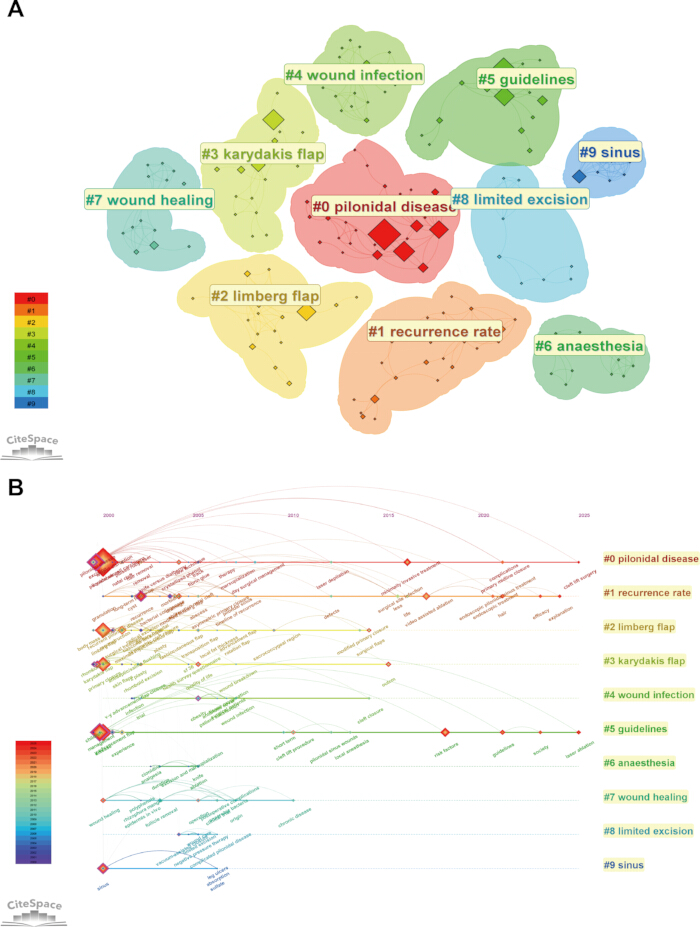
Figure 4: Keyword clustering and temporal evolution. (A) Keyword clustering network generated by CiteSpace, with clusters labeled by the log likelihood ratio (LLR) method. (B) Timeline visualization of keyword clustering analysis, showing the temporal progression of research topics from 2000–2025. Please click here to view a larger version of this figure.
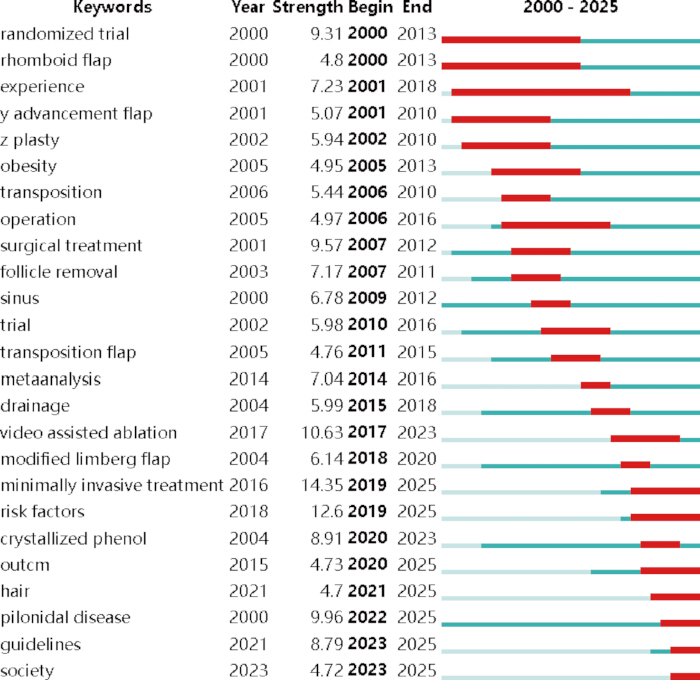
Figure 5: Top 25 keywords with the strongest citation bursts. The dark blue bars indicate the temporal distribution of each keyword, and the red bars denote burst duration. Please click here to view a larger version of this figure.
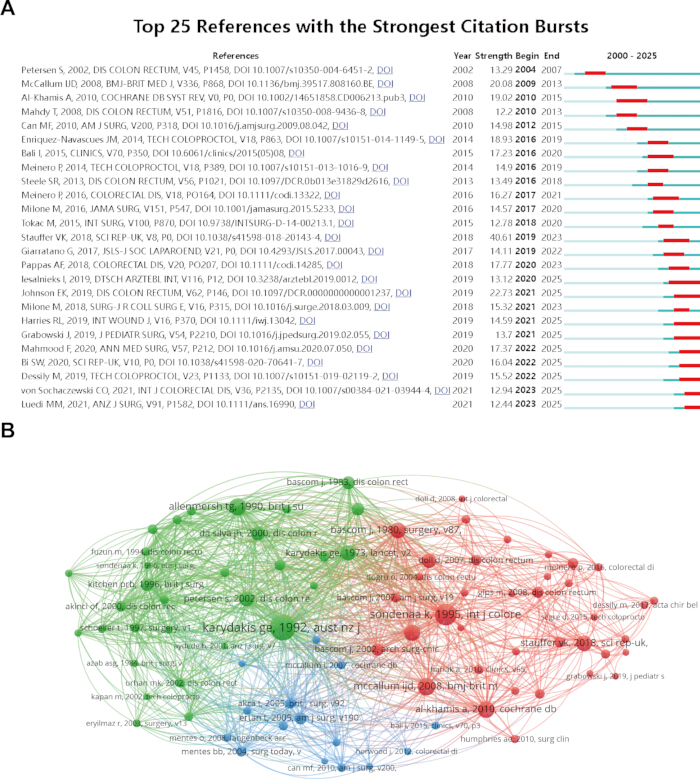
Figure 6: Visualization of references. (A) Top 25 references with the strongest citation bursts. (B) Co-citation network visualization of cited references. In this network, each node represents a cited reference; node size reflects citation frequency; line thickness denotes co‑citation strength; and colors represent thematic clusters. Please click here to view a larger version of this figure.
Table 1: Top 10 most productive countries in SPD research. This table presents country rankings by publication count, total citations, and total link strength. Abbreviations: ACPP = average citations per publication; TC = total citations; TLS = total link strength. Please click here to download this file.
Table 2: Top 10 most prolific institutions in SPD research. This table presents the top 10 institutions ranked according to total citations and total link strength, respectively. Abbreviations: TC = total citations; TLS = total link strength. Please click here to download this file.
Table 3: Top 10 highest-impact authors in SPD research. This table presents the top 10 authors ranked by publication count, total citations, and total link strength. Abbreviations: TC = total citations; TLS = total link strength. Please click here to download this file.
Table 4: Top 10 most productive journals. This table presents the top 10 journals ranked by publication count, with corresponding total citations, average citations per publication, Journal Citation Reports quartile, and impact factor. Abbreviations: ACPP = average citations per publication; IF = impact factor; JCR = Journal Citation Reports; TC = total citations. Please click here to download this file.
Table 5: Top 10 most cited references. This table presents the top 10 references ranked by citation count, including title, first author, journal, and publication year. Please click here to download this file.
Supplementary Table 1: Keywords harmonization. Keyword harmonization and standardization are applied during bibliometric data preprocessing.Please click here to download this file.
Supplementary Table 2: Keywords. The top 30 most frequently occurring keywords in SPD research from 2000 to 2025. Keywords with a greater log-likelihood ratio are more representative of the clusters. Abbreviations: LLR, log-likelihood ratio. Please click here to download this file.
Supplementary Table 3: Keyword clusters. The 10 largest keyword clusters and the top 5 label terms (by log-likelihood ratio) for each cluster.Please click here to download this file.
Supplementary Table 4: Frequency of keywords. All keywords and their frequency of occurrence in each cluster.Please click here to download this file.
Supplementary File 1: Completed BIBLIO checklist for reporting bibliometric reviews.
The checklist details the manuscript page, line, and section corresponding to each BIBLIO reporting item.Please click here to download this file.
Discusión
Esta síntesis bibliométrica integral de 1.014 publicaciones delinea la trayectoria de la investigación sobre el SPD en el primer cuarto del siglo XXI, revelando un campo con una actividad publicadora creciente, una diversidad temática en expansión y un cambio en los intereses de investigación. Este estudio propone un marco cuantitativo de carácter macroscópico que no solo traza la expansión de la producción científica, sino, más críticamente, descompone la arquitectura intelectual subyacente, las dinámicas colaborativas y los temas de investigación en evolución que caracterizan la investigación moderna sobre el SPD16,22. Más allá de las estadísticas descriptivas, este enfoque bibliométrico multitool —que integra análisis de desempeño, mapeo científico y detección de brotes— proporciona una síntesis única y sistemática de una literatura vasta y fragmentada. Al visualizar la red del conocimiento, hemos caracterizado a los principales contribuyentes, la centralidad de revistas específicas29 y la estructura heterogénea de las redes globales de colaboración30, ofreciendo así una referencia útil para comprender las tendencias de investigación y posibles direcciones futuras de colaboración. Esta metodología, ya demostrada como eficaz en otros campos anorrectales18,19,20,21, permite una evaluación objetiva de las tendencias de investigación, aportando información sobre la evolución desde estudios predominantemente centrados en técnicas quirúrgicas hacia investigaciones más amplias que incluyen prevención, síntesis de evidencia y resultados centrados en el paciente1,31.
Los hallazgos revelan una evolución temática sustancial, con una atención creciente hacia técnicas mínimamente invasivas y la prevención etiológica, junto con la continua investigación de enfoques quirúrgicos convencionales. Los análisis de agrupamiento de palabras clave y detección de ráfagas proporcionan evidencia de cambios en las prioridades de investigación en este campo1,2,14, con ráfagas sostenidas de alta intensidad para términos como «tratamiento mínimamente invasivo» y «ablación asistida por video» en los últimos años. La aparición de estos enfoques menos invasivos podría reflejar un interés creciente en reducir la carga del tratamiento y mejorar los resultados centrados en el paciente14,30,31. Sin embargo, los hallazgos bibliométricos indican principalmente cambios en las prioridades de investigación, más que evidencia definitiva de superioridad clínica entre las técnicas quirúrgicas disponibles. Al mismo tiempo, el auge de palabras clave como «factores de riesgo», «cabello» y «directrices» indica un panorama de investigación más maduro que explora cada vez más factores etiológicos, como el papel de la inserción del cabello en el desarrollo de la enfermedad32,33, al tiempo que refleja una atención creciente hacia la síntesis de evidencia y el desarrollo futuro de directrices4,34. Esta diversificación temática indica que la investigación sobre SPD se está extendiendo cada vez más más allá de las técnicas operatorias para incorporar perspectivas etiológicas, preventivas y de síntesis de evidencia.
El análisis revela variaciones en los patrones de colaboración internacional dentro del panorama de investigación sobre SPD, destacando oportunidades para fortalecer la conectividad internacional en la comunidad investigadora de SPD. Aunque Turquía domina en volumen de publicaciones16, los patrones de colaboración internacional variaron considerablemente entre países, con varios países de Europa Occidental que demostraron vínculos colaborativos transfronterizos más fuertes. Estas diferencias resaltan la estructura heterogénea de las redes globales de colaboración en la investigación sobre SPD. Esta distribución desigual de las redes de colaboración subraya los beneficios potenciales de una cooperación multinacional más amplia para la generación futura de evidencia30. Análisis metodológicos previos han señalado que el campo sigue dependiendo de cohortes retrospectivas monocéntricas y metaanálisis de datos heterogéneos, con una proporción preocupantemente decreciente de ensayos controlados aleatorizados (ECA)23. La investigación futura podría beneficiarse de una mayor colaboración internacional y de estudios prospectivos bien diseñados, capaces de comparar diferentes enfoques quirúrgicos en poblaciones y entornos sanitarios diversos34.
Las posibles implicaciones de estos hallazgos son de dos tipos: proporcionan a investigadores y clínicos una visión estructurada del panorama actual de la investigación sobre el SPD y pueden ayudar a identificar vacíos de conocimiento, temas emergentes y áreas potenciales para futuras investigaciones. La identificación de revistas clave29 y autores influyentes también puede ayudar a los investigadores a reconocer a los principales contribuyentes del conocimiento establecido y posibles redes colaborativas dentro del campo. Para investigadores y organizaciones científicas, la aparición de palabras clave emergentes como «guías» y «sociedad» resalta áreas de creciente interés investigativo y sugiere posibles direcciones para futuras investigaciones, incluyendo la síntesis de evidencia y estudios multicéntricos11,34. Las futuras líneas de investigación podrían beneficiarse de avanzar más allá de las series quirúrgicas descriptivas hacia estudios colaborativos basados en hipótesis. Las prioridades potenciales sugeridas por el panorama actual de la literatura incluyen: (1) realizar ensayos controlados aleatorizados con un tamaño muestral adecuado que comparen las técnicas mínimamente invasivas más prometedoras frente a los procedimientos establecidos con colgajos fuera de la línea media, utilizando la recurrencia a los 5–10 años como punto final primario34; (2) desarrollar y validar medidas estandarizadas de resultados autoinformados por el paciente que capturen el impacto completo del tratamiento sobre la calidad de vida y el bienestar psicosocial, especialmente en poblaciones adolescentes1,8; y (3) explorar el papel de las intervenciones profilácticas, como la depilación láser, en poblaciones de alto riesgo mediante estudios de cohortes rigurosos y a largo plazo para evaluar su costo-efectividad en la prevención de la enfermedad primaria y recurrente.
Deben reconocerse las limitaciones metodológicas de esta síntesis para contextualizar estos hallazgos. En primer lugar, la dependencia de una única base de datos (Colección Principal de WoS) y la restricción a publicaciones en idioma inglés podrían haber excluido inadvertidamente investigaciones significativas publicadas en otras bases de datos científicas importantes o en idiomas distintos del inglés. En segundo lugar, como ocurre con todos los análisis bibliométricos, las métricas de citas se ven influenciadas por la acumulación natural de citas a lo largo del tiempo, lo que favorece inherentemente las publicaciones más antiguas y puede no reflejar completamente el impacto contemporáneo de innovaciones recientes. Por último, los recuentos de citas y la frecuencia de publicaciones son marcadores sustitutos de la atención científica y la actividad, no medidas directas del rigor metodológico o de la utilidad clínica. Estudios futuros podrían mitigar estas limitaciones incorporando múltiples bases de datos y utilizando altmétricas para captar un impacto social y clínico más amplio, complementando así el análisis tradicional basado en citas y ofreciendo una visión más integral de la evolución del campo.
Este análisis bibliométrico de 1.014 publicaciones ofrece una visión sistemática y completa de la investigación sobre la enfermedad pilonidal sacrococcígea desde 2000 hasta 2025, cartografiando el panorama global, las redes colaborativas, la evolución temática y las fronteras emergentes. El campo ha experimentado un aumento notable y sostenido en la producción de investigación, con Turquía destacándose como el país más productivo, mientras que Alemania, Inglaterra y Estados Unidos desempeñaron roles relativamente prominentes en las redes de colaboración internacional. El profesor Dietrich Doll destaca como el investigador más productivo y más citado en el campo. La evolución temática revela un énfasis creciente en técnicas mínimamente invasivas junto con la continua investigación de enfoques quirúrgicos convencionales, manteniéndose la recurrencia como una medida central de resultados en la literatura. Los temas emergentes de investigación —destacados por palabras clave con ráfagas como «tratamiento mínimamente invasivo», «factores de riesgo», «pelo» y «directrices»— indican un creciente interés en estrategias menos invasivas, la prevención etiológica y la síntesis de evidencia. Al integrar patrones globales de productividad, estructuras colaborativas y evolución temática, este estudio proporciona un marco de referencia cuantitativo para identificar vacíos de conocimiento, prioridades emergentes de investigación y posibles oportunidades colaborativas en la investigación de la EPC.
Divulgaciones
Los autores declaran que no tienen intereses competidores. No se utilizaron herramientas de inteligencia artificial para la recopilación de datos, el análisis de datos, la interpretación de resultados ni la preparación de figuras. ChatGPT (OpenAI) se utilizó únicamente para la edición del lenguaje y la mejora del manuscrito.
Agradecimientos
Los autores no tienen reconocimientos que declarar.
Materiales
| Nombre | Empresa | Número de catálogo | Comentarios |
|---|---|---|---|
| CiteSpace | Universidad Drexel | versión 6.3.R3 | https://citespace.podia.com/ |
| Microsoft Excel | Corporación Microsoft | versión 2024 | https://www.microsoft.com/microsoft-365/excel |
| Pajek | Universidad de Liubliana | versión 6.02 | https://mrvar.fdv.uni-lj.si/pajek/ |
| VOSviewer | Universidad de Leiden | versión 1.6.20 | https://www.vosviewer.com/ |
| Colección principal de Web of Science | Clarivate | N/D | https://www.webofscience.com/ |
Referencias
- Gil LA, Deans KJ, Minneci PC. Management of Pilonidal Disease: A Review. JAMA Surg. 2023;158(8):875-883.
- Di Castro A, Guerra F, Levi Sandri GB, Ettorre GM. Minimally invasive surgery for the treatment of pilonidal disease. The Gips procedure on 2347 patients. Int J Surg. 2016;36(Pt A):201-205.
- McCallum IJ, King PM, Bruce J. Healing by primary closure versus open healing after surgery for pilonidal sinus: systematic review and meta-analysis. BMJ. 2008;336(7649):868-871.
- Wiinblad IM, Ulrichsen J, Brandstrup B. Outcome After Surgical Treatment for Chronic Pilonidal Sinus Disease: A Systematic Review of Common Surgical Techniques. Dis Colon Rectum. 2025;68(5):515-529.
- Oetzmann von Sochaczewski C, Gödeke J. Pilonidal sinus disease on the rise: a one-third incidence increase in inpatients in 13 years with substantial regional variation in Germany. Int J Colorectal Dis. 2021;36(10):2135-2145.
- Faurschou IK, Erichsen R, Doll D, Haas S. Time trends in incidence of pilonidal sinus disease from 1996 to 2021: A Danish population-based cohort study. Colorectal Dis. 2024;27(1):e17227.
- Brown SR et al. Real-world practice and outcomes in pilonidal surgery: Pilonidal Sinus Treatment Studying The Options (PITSTOP) cohort. Br J Surg. 2024;111(3):znae009.
- Salimi-Jazi F et al. Burden of pilonidal disease and improvement in quality of life after treatment in adolescents. Pediatr Surg Int. 2022;38(10):1453-1459.
- Calikoglu I et al. Phenol Injection Versus Excision With Open Healing in Pilonidal Disease: A Prospective Randomized Trial. Dis Colon Rectum. 2017;60(2):161-169.
- Walker H, Hamid O, Ramirez J, Glancy D. Diagnosis and management of sacrococcygeal pilonidal disease in primary care. BMJ. 2023;382:e071511.
- Johnson EK, Vogel JD, Cowan ML, Feingold DL, Steele SR. Clinical Practice Guidelines Committee of the American Society of Colon and Rectal Surgeons. The American Society of Colon and Rectal Surgeons’ Clinical Practice Guidelines for the Management of Pilonidal Disease. Dis Colon Rectum. 2019;62(2):146-157.
- Vartanian E, Gould DJ, Lee SW, Patel KM. Pilonidal Disease: Classic and Contemporary Concepts for Surgical Management. Ann Plast Surg. 2018;81(6):e12-e19.
- Al-Khamis A, McCallum I, King PM, Bruce J. Healing by primary versus secondary intention after surgical treatment for pilonidal sinus. Cochrane Database Syst Rev. 2010;2010(1):CD006213.
- Tien T, Athem R, Arulampalam T. Outcomes of endoscopic pilonidal sinus treatment (EPSiT): a systematic review. Tech Coloproctol. 2018;22(5):325-331.
- Kumar M, Clay WH, Lee MJ, Brown SR, Hind D. A mapping review of sacrococcygeal pilonidal sinus disease. Tech Coloproctol. 2021;25(6):675-682.
- Doll D, Stauffer V, Diekann M, Van Wyk P, Luedi MM. Turkey is leading in the 21st century pilonidal sinus disease research. Turk J Surg. 2020;36(3):284-290.
- Dhole S, Mahakalkar C. Advancements and Innovations in the Surgical Management of Sacrococcygeal Pilonidal Sinus: A Comprehensive Review. Cureus. 2024;16(5):e61141.
- Chen X. Global knowledge mapping and technological evolution in hemorrhoid therapy: a multi-tool bibliometric analysis. Updates Surg. 2025. doi:10.1007/s13304-025-02460-2.
- Wang Z et al. Top 100 most-cited articles on hemorrhoids: A bibliometric analysis and visualized study. Front Surg. 2022;9:1021534.
- Chen Q, Li Y, Wang X, Li H. Hot topics in global perianal fistula research: A SCOPUS-based bibliometric analysis. Medicine (Baltimore). 2020;99(17):e19659.
- Feng L, Wang M, Li X, Yang Q. A bibliometric analysis of surgical treatment for rectal prolapse. Medicine (Baltimore). 2025;104(32):e43763.
- Şahin A, Şimşek G. The One Hundred Most Cited Articles from Turkey about Pilonidal Disease: A Bibliometric Study. Turk J Colorectal Dis. 2022;32:123-133.
- Doll D et al. One century of pilonidal sinus research: trends in study size and the declining share of randomized controlled trials. Coloproctology. 2025;47:353-359.
- Montazeri A et al. Preliminary guideline for reporting bibliometric reviews of the biomedical literature (BIBLIO): a minimum requirements. Systematic Reviews. 2023;12(1):239.
- Thelwall M. Bibliometrics to webometrics. J Inf Sci. 2008;34(4):605-621.
- van Eck NJ, Waltman L. Software survey: VOSviewer, a computer program for bibliometric mapping. Scientometrics. 2010;84(2):523-538.
- Chen C. Searching for intellectual turning points: progressive knowledge domain visualization. Proc Natl Acad Sci U S A. 2004;101 Suppl 1(Suppl 1):5303-5310.
- Mrvar A, Batagelj V. Analysis and visualization of large networks with program package Pajek. Complex Adapt Syst Model. 2016;4:6.
- Becerra AZ et al. A New Bibliometric Index: The Top 100 Most Disruptive and Developmental Publications in Colorectal Surgery Journals. Dis Colon Rectum. 2022;65(3):429-443.
- Wagner CS, Leydesdorff L. Network structure, self-organization, and the growth of international collaboration in science. Res Policy. 2005;34(10):1608-1618.
- Esposito C et al. Quality of life of pediatric patients operated for pilonidal sinus disease. Eur J Pediatr. 2023;182(1):25-30.
- Halleran DR et al. Recurrence of Pilonidal Disease: Our Best is Not Good Enough. J Surg Res. 2018;232:430-436.
- Karydakis GE. Easy and successful treatment of pilonidal sinus after explanation of its causative process. Aust N Z J Surg. 1992;62(5):385-389.
- Stauffer VK et al. Common surgical procedures in pilonidal sinus disease: A meta-analysis, merged data analysis, and comprehensive study on recurrence. Sci Rep. 2018;8(1):3058.