This study examines plasma miR-181b-5p in first-episode drug-naive schizophrenia, evaluating its diagnostic value, clinical correlations, and in vitro targeting of EGR1, with exploratory nursing subgroup analysis.
Artykuł badawczy
miR-181b-5p is Upregulated in First-Episode Drug-Naive Schizophrenia and Correlates with Symptom Severity and Cognitive Deficits: A Case-Control Study
W tym artykule
Podsumowanie
Streszczenie
This study aimed to explore miR-181b-5p's diagnostic value in schizophrenia, analyze its correlations with symptoms and cognition, and evaluate biomarker-guided personalized nursing efficacy to inform early diagnosis and precision care. A total of 126 patients with first-episode, drug-naive schizophrenia and 126 age- and gender-matched healthy controls were enrolled between January 2024 and June 2025. Plasma miR-181b-5p and Early Growth Response 1 (EGR1) mRNA levels were measured by qRT-PCR, and their targeting was validated via dual-luciferase assay. Symptoms and cognition were assessed with the Positive and Negative Syndrome Scale (PANSS) and the MATRICS Consensus Cognitive Battery (MCCB). Receiver Operating Characteristic (ROC) curve and Pearson correlation were used for statistical analysis. Patients were grouped by median miR-181b-5p expression, with the high-expression group receiving personalized nursing. Outcomes were compared after 8 weeks. The results showed that Plasma miR-181b-5p was significantly upregulated, while EGR1 mRNA was downregulated in schizophrenia patients. miR-181b-5p showed good diagnostic performance [Area Under the Curve (AUC) = 0.898, 95% CI: 0.858–0.938]. Its expression positively correlated with all PANSS subscales and total scores and negatively correlated with all seven MCCB cognitive domains and overall scores. The inhibitory effect of miR-181b-5p on EGR1 expression was demonstrated to occur via direct binding to its 3'UTR by the dual-luciferase experiments. Exploratory subgroup analysis demonstrated significant improvements in both the high-expression subgroup receiving add-on individualized precision nursing and the low-expression subgroup receiving only routine care. In conclusion, miR‑181b‑5p is upregulated in schizophrenia and shows sequence‑specific binding to the EGR1 3′‑UTR in vitro. While improvements in the high‑expression subgroup tentatively suggest miR‑181b‑5p as a reference biomarker for selecting candidates for intensified rehabilitation, these nursing findings remain exploratory and cannot confirm the efficacy of biomarker‑guided personalized nursing due to the non‑randomized design.
Wprowadzenie
Schizophrenia is a severe chronic mental disorder with a global prevalence of approximately 0.32% (about 24 million people)1. It typically onsets in late adolescence or early adulthood, characterized by disruptions in perception, thinking, emotion, and behavior, as well as disorganized thinking and behavior2,3. Its disease burden is substantial, accounting for 14.82 million disability‑adjusted life years (DALYs) lost globally in 20214,5, and it has become one of the foremost unmet challenges facing the global public health field. The etiology of schizophrenia is complicated, involving genetic factors, neurodevelopmental abnormalities, neurotransmitter imbalance, and environmental triggers6. Currently, the diagnosis of schizophrenia mainly relies on clinical symptom evaluation based on criteria such as the Diagnostic and Statistical Manual of Mental Disorders, Fifth Edition (DSM‑5), and the lack of objective biomarkers leads to difficulties in early diagnosis7. Due to overlapping symptoms with other psychiatric disorders, misdiagnosis remains a significant clinical challenge8. Hence, the discovery of sensitive and specific biomarkers has profound implications for early detection, condition monitoring, and prognostic assessment in schizophrenia.
MicroRNAs, commonly abbreviated as miRNAs, are small non-coding RNA molecules consisting of roughly 22 nucleotides, and they modulate gene expression at the post-transcriptional stage through physical binding to the 3' untranslated regions of their target messenger RNAs9. Accumulating studies have demonstrated that miRNAs play critical roles in brain development, neural plasticity, and synaptic function regulation, and their dysregulation is closely linked to various psychiatric disorders10,11,12. Beyond the well‑characterized miR‑137, which has been validated at a schizophrenia risk locus and shown to regulate glutamatergic transmission and cognitive performance, and miR‑132, which modulates synaptic plasticity and is dysregulated in the prefrontal cortex13,14,15. Other miRNAs, such as miR‑134 and miR‑29a, have also been implicated in schizophrenia pathogenesis through pathways involving neurodevelopment and oligodendrocyte function16,17. miR‑181b‑5p, a key member of the miR‑181 family, is highly enriched in the central nervous system and governs neuronal proliferation, differentiation, apoptosis, and synaptogenesis18,19. It is the most consistently upregulated miRNA in schizophrenia, with overexpression repeatedly observed in both post‑mortem brain and peripheral blood across independent cohorts20. Nevertheless, the exact mechanism of miR-181b-5p in schizophrenia remains poorly elucidated, and its correlations with clinical symptoms and cognitive function require further verification.
Early growth response 1 (EGR1) is a C₂H₂-type zinc-finger transcription factor and a paradigmatic immediate early gene that is rapidly induced in response to a wide range of extracellular stimuli21. It exerts core functions in regulating neuronal activity-dependent gene expression and is involved in learning and memory, synaptic plasticity, and neuroinflammation22,23. Bioinformatics analysis predicts that EGR1 is a potential target gene of miR-181b-5p, and their direct targeting relationship has been verified in the liver, cardiovascular system, and tumors24. Additionally, downregulated EGR1 expression has been found in the peripheral blood and prefrontal cortex of schizophrenia patients, which is strongly correlated with cognitive dysfunction25. Accordingly, these data prompted the hypothesis that miR-181b-5p exerts its pathogenic effects in schizophrenia via the targeted inhibition of EGR1.
In the present work, plasma miR‑181b‑5p and EGR1 mRNA levels were quantified in first‑episode drug‑naive schizophrenia patients and healthy controls. The correlations between plasma miR‑181b‑5p and clinical symptomatology as well as cognitive performance were also analyzed, and its diagnostic potential was evaluated. Dual‑luciferase reporter assays demonstrated in vitro sequence‑specific binding between miR‑181b‑5p and the 3′‑UTR of EGR1. This study seeks to yield preliminary insights for future research on precision medicine and nursing care in schizophrenia.
Protokół
This human‑subject study was reviewed and approved by the Medical Ethics Committee of Qinhuangdao Fifth Hospital (approval number: No. 2023–0813). All enrolled schizophrenia patients and healthy control participants, or their legally authorized representatives, provided written informed consent before sample collection and clinical assessment. For participants with impaired decision‑making capacity secondary to psychotic symptoms, written informed consent was acquired from their legally authorized representative. The study was performed in accordance with the principles of the Declaration of Helsinki. This was a hospital‑based case‑control study aimed at exploring the expression profile of plasma miR‑181b‑5p, its diagnostic potential, correlations with clinical symptoms and cognitive deficits, as well as its downstream regulatory mechanism in patients with first‑episode drug‑naive schizophrenia and age‑ and gender‑matched healthy controls. All reagents and equipment utilized in this study are provided in the Table of Materials.
Study subjects
From January 2024 to June 2025, 126 inpatients diagnosed with first-episode drug-naive schizophrenia at Qinhuangdao Fifth Hospital were enrolled as the case group. Inclusion criteria: (1) Met the diagnostic criteria for schizophrenia specified in the DSM-526. (2) First onset with disease duration ≤1 year. (3) No prior treatment with any antipsychotic drugs. (4) Aged 18–45 years old. (5) Patients and their family members provided written informed consent. Exclusion criteria: (1) Complicated with other mental disorders such as depression and bipolar disorder. (2) Combined with severe somatic diseases involving the heart, liver, kidney, or other vital organs. (3) Comorbid neurological diseases, including cerebrovascular diseases and epilepsy. (4) History of drug or alcohol abuse. (5) Pregnant or lactating women.
In parallel, 126 apparently healthy individuals presenting for routine health examinations at Qinhuangdao Fifth Hospital were enrolled as the control cohort. Inclusion criteria: (1) No personal or family history of mental illness. (2) No severe somatic diseases. (3) Aged 18–45 years old. (4) Voluntarily participated in this study and signed informed consent.
Sample collection
Following a minimum 8 h overnight fast, 5 mL of peripheral blood was collected from each subject via antecubital venipuncture in the early morning and dispensed into EDTA-containing tubes for subsequent processing. All specimens were processed within 2 h after blood collection. After being maintained at 4 °C for 30 min, the blood samples were centrifuged at 1,600 × g for 10 min to obtain the initial plasma supernatant. A second centrifugation step at 10,000 × g for 10 min at 4 °C was immediately performed to eliminate residual platelets and cellular debris. Only non‑hemolyzed plasma samples were included. The resulting plasma fraction was then dispensed into multiple single‑use aliquots and frozen at -80 °C for later experiments, and repeated freeze‑thaw cycles were strictly prohibited before RNA isolation.
RNA extraction and quantitative real‑time polymerase chain reaction (qRT‑PCR)
Total RNA was extracted from plasma specimens using the total RNA extraction reagent strictly following the manufacturer's recommended protocol. To eliminate potential genomic DNA contamination, the extracted RNA was treated with RNase-free DNase I at 37 °C for 30 min, then heat-inactivated at 85 °C for 5 min. The quantity and quality of the isolated RNA were evaluated using a microvolume spectrophotometer, and only samples exhibiting an A260/A280 ratio of 1.8–2.0 were subjected to subsequent experiments.
For miR‑181b‑5p detection, stem‑loop reverse transcription primers were applied for mature miRNA reverse transcription. For each reverse transcription reaction, 1 µg of total RNA was converted into complementary DNA (cDNA) using a reverse transcription reagent kit with the following cycling conditions: 37 °C for 15 min and 85 °C for 5 s. U6 served as the endogenous reference for miR-181b-5p, while GAPDH was used as the internal control for EGR1 mRNA. U6 was selected for miR‑181b‑5p normalization based on its frequent application in plasma circulating‑miRNA research of neuropsychiatric diseases27,28. A preliminary stability assessment across samples from this cohort demonstrated relatively consistent U6 expression in the measured plasma cohort. Primer specificity was confirmed using a primer‑specificity checking tool against the human reference genome to exclude non-target amplification. Additionally, the specificity of miR-181b-5p amplification was verified by melt curve analysis, which yielded a single peak at the expected melting temperature. No-template controls (NTC) were included in each run to exclude primer-dimer formation and contamination. The primer sequences were as follows: miR-181b-5p: Forward 5'-AACATTCATTGCTGTCGGTGGG-3', Reverse 5'-GTGCAGGGTCCGAGGT-3'; U6: Forward 5'-CTCGCTTCGGCAGCACA-3', Reverse 5'-AACGCTTCACGAATTTGCGT-3'; EGR1: Forward 5'-AGCGAACAACCCTATGAGCAC-3', Reverse 5'-GGATGGAGATGAGCAGGAAGAG-3'; GAPDH: Forward 5'-GAAGGTGAAGGTCGGAGTC-3', Reverse 5'-GAAGATGGTGATGGGATTTC-3'.
Standardized qRT-PCR reactions were conducted in a 20 µL final volume containing 10 µL of SYBR‑green‑based qPCR master mix, 0.5 µL each of forward and reverse gene-specific primers, 2 µL cDNA template, and 7 µL nuclease-free water. Cycling conditions: 95 °C for 30 s; 40 cycles of 95 °C 5 s, 60 °C 30 s. Each sample was assayed in triplicate technical replicates, and amplification efficiency was maintained within the acceptable range of 90%–110%. The relative expression of miR-181b-5p and EGR1 mRNA was determined using the comparative 2^-ΔΔCt method.
Dual-Luciferase reporter gene assay
The putative miR-181b-5p binding site in the 3'UTR of EGR1 was predicted using a miRNA target-prediction database. The wild-type (WT) EGR1 3'UTR fragment was amplified by PCR and cloned into a dual-luciferase reporter vector, while the mutant-type (MUT) vector with disrupted binding sites was generated by site-directed mutagenesis. Human embryonic kidney 293T (HEK293T) cells were seeded in 24-well plates at a density of 2 × 10⁵ cells/well and cultured in Dulbecco’s Modified Eagle Medium (DMEM) supplemented with 10% fetal bovine serum at 37 °C with 5% CO₂ until reaching 70% confluence.
For transfection, cells were transfected using lipid‑based transfection reagent according to the manufacturer's protocol; each well received 500 ng of WT-EGR1 or MUT-EGR1 reporter plasmid, 50 ng of Renilla luciferase control plasmid, and 50 nM miR-181b-5p mimics or negative control (NC) mimics. Forty-eight hours following transfection, the culture medium was removed, and cells were lysed with passive lysis buffer at room temperature for 15 min with gentle shaking. The activities of firefly luciferase and Renilla luciferase were sequentially evaluated using the dual‑luciferase reporter assay system on a luminometer, following the manufacturer's protocols. Renilla luciferase activity was taken as the internal reference to normalize transfection efficiency, and relative luciferase activity was calculated as the ratio of firefly to Renilla luminescence, with values normalized to the NC mimics + EGR1-WT group. Each assay contained triplicate technical wells and was repeated at least three times for independent biological replicates. Data were expressed as mean ± SD.
Assessment of psychiatric symptoms and cognitive function
Two professionally trained psychiatrists performed clinical assessments. The Chinese validated version of the Positive and Negative Syndrome Scale (PANSS) and the Chinese‑language version of the MATRICS Consensus Cognitive Battery (MCCB) were applied; both scales have been formally validated for use in Chinese schizophrenia populations29,30. PANSS consists of three subscales: positive symptoms, negative symptoms, and general psychopathology. A higher total score indicates more severe symptoms. Cognitive function was evaluated using the Chinese‑validated version of the MCCB. The two administering psychiatrists have received formal standardized training in both PANSS and MCCB assessments and participated in regular case‑based consensus calibration sessions to ensure rating consistency. Clinical assessments were completed before plasma miR-181b-5p testing, and the assessors had no access to biomarker results or miR-181b-5p grouping information at the time of assessment. The MCCB covers seven cognitive domains: working memory, verbal learning and memory, visual learning and memory, reasoning and problem solving, attention/vigilance, social cognition, and processing speed. The overall composite cognitive score was calculated strictly according to the official MCCB scoring manual, with higher scores indicating better cognitive function.
Nursing interventions
All patients received conventional first-line second-generation atypical antipsychotics as the foundational pharmacological treatment, in combination with routine psychiatric nursing covering daily life care, safety management, medication care, psychological nursing and rehabilitation training. All prescribed agents belong to the same therapeutic class with similar pharmacological mechanisms, and are widely used, cost-effective basic medications in routine clinical practice. The specific agent and dosage were selected and titrated by attending psychiatrists according to individual clinical manifestations, symptom response, and drug tolerance, and were not assigned based on miR‑181b‑5p expression status.
According to the median relative expression of miR-181b-5p, patients were divided into the high‑expression group (relative expression ≥ 2.23) and the low‑expression group (relative expression < 2.23). Based on the aforementioned routine treatment and nursing, individualized precision nursing was additionally implemented for patients in the high-expression group: 1) Intensified cognitive training: Increased the frequency and duration of training for working memory, attention, and executive function, twice daily for 30 min per session. 2) Targeted nursing for negative symptoms: Encouraged patients to participate in social activities and recreational therapy, cultivate hobbies, and improve abilities of daily living. 3) Optimized psychological nursing: Adopted cognitive behavioral therapy and supportive psychotherapy to relieve anxiety and depression and improve treatment adherence. 4) Family nursing intervention: Conducted health education for family members, guided them to provide adequate emotional support and daily care, and built a favorable environment for rehabilitation.
Statistical analysis
All statistical analyses were performed using SPSS Statistics. Continuous data were expressed as mean ± standard deviation (SD), and categorical data were presented as counts (percentages). Categorical variables including gender and family history of schizophrenia were analyzed using the chi‑square (χ2) test, while the age variable was compared using the Mann‑Whitney U test. Within‑group pre‑post intervention comparisons for each subgroup were conducted using paired‑samples t‑tests. Raw P values were independently corrected for multiple comparisons via the Benjamini‑Hochberg procedure to generate FDR‑q values. Pearson correlation analysis was applied to assess the correlation between miR‑181b‑5p expression levels and clinical indicators. The diagnostic performance of miR‑181b‑5p was evaluated via receiver operating characteristic (ROC) curve analysis. Statistical comparisons for the dual‑luciferase reporter assay were performed using two‑way ANOVA. A P value < 0.05 was considered statistically significant, and an FDR‑q < 0.05 was set as the significance threshold.
Wyniki
Comparison of general data between the two groups
The case group included 126 patients (63M/63F) aged 18–42 years (mean: 29.37 ± 6.97 years), while the control group comprised 126 healthy subjects (65M/61F) aged 18–44 years (mean: 30.04 ± 7.12 years). Statistical analysis revealed no significant differences in age or gender between the two groups (Table 1, all P > 0.05), demonstrating good baseline comparability.
Expression levels of miR-181b-5p and EGR1 mRNA in plasma
The relative expression level of miR-181b-5p in the case group was (2.56 ± 1.18), which was significantly higher than (1.09 ± 0.44) in the control group (Figure 1A, t = 13.06, P < 0.001). Compared with the control group (1.06 ± 0.43), the case group exhibited a significant reduction in EGR1 mRNA relative expression, with a mean value of 0.68 ± 0.34 (Figure 1B, t = 7.73, P < 0.001).
Diagnostic value of miR-181b-5p for schizophrenia
The AUC of plasma miR-181b-5p for diagnosing schizophrenia was 0.898 (Figure 1C, 95% CI: 0.858–0.938), with 80.16% sensitivity and 88.89% specificity at a cut-off value of 1.64.
Correlation between miR-181b-5p expression and psychiatric symptoms
Notably, miR‑181b‑5p expression was significantly positively correlated with PANSS positive symptom score (Figure 2A, r = 0.6704, P < 0.001), negative symptom score (Figure 2B, r = 0.5373, P < 0.001), general psychopathology score (Figure 2C, r = 0.5658, P < 0.001), and total score (Figure 2D, r = 0.7788, P < 0.001).
Correlation between miR-181b-5p expression and cognitive function
miR-181b-5p expression was significantly negatively correlated with scores of MCCB processing speed (Figure 3A, r = -0.5388, P < 0.001), attention/vigilance (Figure 3B, r = -0.5614, P < 0.001), working memory (Figure 3C, r = -0.5826, P < 0.001), verbal learning and memory (Figure 3D, r = -0.5062, P < 0.001), visual learning and memory (Figure 3E, r = -0.4329, P < 0.001), reasoning and problem solving (Figure 3F, r = -0.6213, P < 0.001), social cognition (Figure 3G, r = -0.5530, P < 0.001) and the overall cognitive score (Figure 3H, r = -0.8249, P < 0.001).
Verification of the targeting relationship between miR-181b-5p and EGR1
Bioinformatic prediction identified putative miR‑181b‑5p binding sites within the EGR1 3′UTR (Figure 4A). The results of the dual-luciferase reporter assay provided evidence for sequence‑specific in vitro interaction between miR‑181b‑5p and EGR1 3'UTR, as evidenced by the marked decrease in relative luciferase activity in the miR-181b-5p mimics + EGR1-WT group compared with the NC mimics + EGR1-WT group (Figure 4B, P < 0.001). While the wild-type construct showed significant luciferase inhibition, no significant difference was observed in the EGR1-MUT group compared with the control (P > 0.05). This observation indicates that miR‑181b‑5p can bind to the predicted 3'‑UTR site under in vitro transfection conditions.
Comparison of nursing outcomes among patients with different miR-181b-5p expression levels
After Benjamini-Hochberg false discovery rate (FDR) correction for multiple comparisons, the high miR-181b-5p expression subgroup, which received individualized precision nursing in addition to routine antipsychotic pharmacotherapy and standard psychiatric nursing care, exhibited significant reductions in all PANSS subscale scores and the total score, as well as significant improvements across all MCCB cognitive domain scores including the composite cognitive score from baseline. The low miR-181b-5p expression subgroup, treated with routine antipsychotic pharmacotherapy and standard psychiatric nursing care alone, showed statistically significant changes in all these indices (Table 2, FDR‑q < 0.05).
In conclusion, plasma miR‑181b‑5p is significantly upregulated in schizophrenia patients. Its expression level is closely correlated with the severity of psychiatric symptoms and cognitive impairment, and it exhibits promising potential as an adjunctive diagnostic biomarker. In vitro assays demonstrate that miR‑181b‑5p can sequence‑specifically target the 3′‑UTR of EGR1. Significant pre‑to‑post improvements following the nursing intervention were observed in both the high‑ and low‑expression subgroups. The improvements observed in the high‑expression subgroup suggest that miR‑181b‑5p may serve as a reference biomarker for identifying individuals who could benefit from intensified rehabilitation support. However, owing to the non‑randomized study design, the nursing‑related findings are exploratory in nature and cannot confirm the efficacy of biomarker‑guided personalized nursing.
DATA AVAILABILITY:
All raw data generated in this study, including clinical sample data, gene expression quantification data, and clinical scale assessment data, are provided as Supplementary File 1 attached to this manuscript. The TargetScan Release 8.0 database used for miRNA target prediction is publicly available at https://www.targetscan.org/vert_80/.
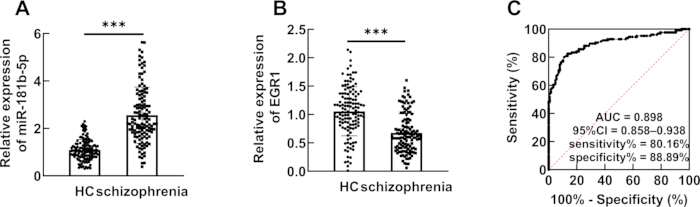
Figure 1: Expression levels of miR-181b-5p and EGR1 mRNA and diagnostic value of miR-181b-5p in schizophrenia. (A) Relative expression levels of miR-181b-5p in plasma of schizophrenia patients and healthy controls detected by qRT-PCR. n = 126 per group; independent‑samples t‑test; error bars represent mean ± SD. (B) Relative expression levels of EGR1 mRNA in plasma of the two groups detected by qRT-PCR. n = 126 per group; independent‑samples t‑test; error bars represent mean ± SD. (C) ROC curve analysis of the diagnostic efficacy of plasma miR-181b-5p for schizophrenia. AUC = 0.898, 95% CI: 0.858–0.938; n = 126 per group. Compared with the healthy control group, ***P < 0.001. Please click here to view a larger version of this figure.
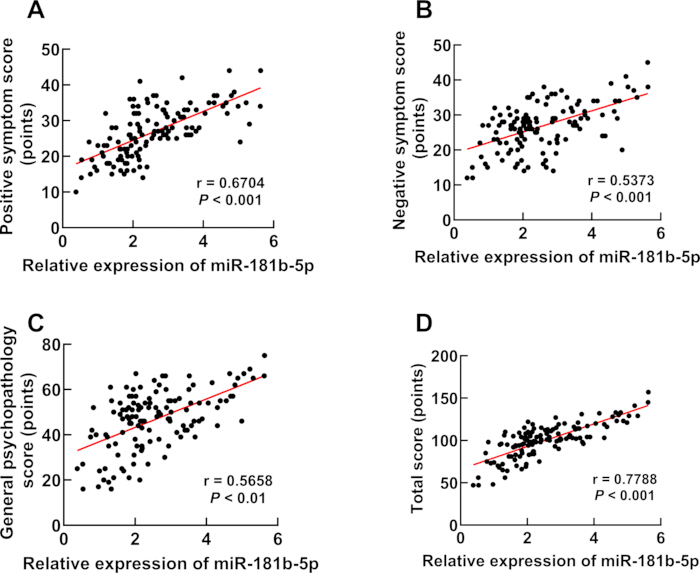
Figure 2: Correlation between miR-181b-5p expression and PANSS scores in schizophrenia patients. (A) Positive symptom scores (r = 0.6704, P < 0.001). (B) Negative symptom scores (r = 0.5373, P < 0.001). (C) General psychopathology scores (r = 0.5658, P < 0.001). (D) Total PANSS scores (r = 0.7788, P < 0.001). Pearson correlation analysis was applied for all panels; n = 126. Please click here to view a larger version of this figure.
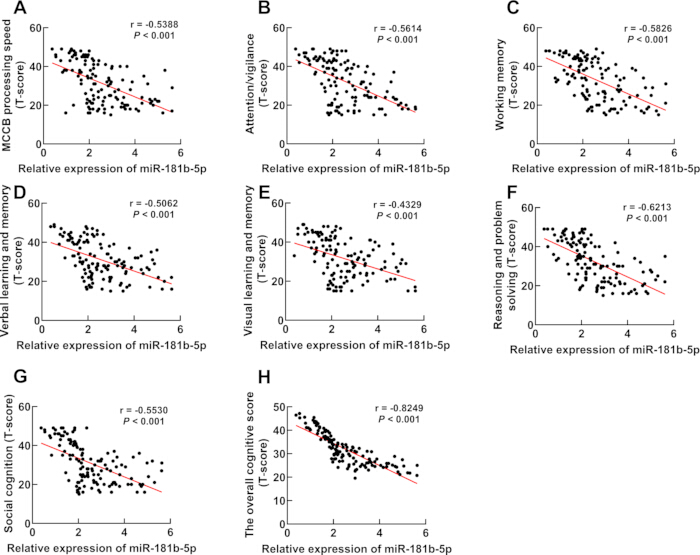
Figure 3: Correlation between miR-181b-5p expression and MCCB cognitive scores in schizophrenia patients. (A) Processing speed (r = -0.5388, P < 0.001). (B) Attention/vigilance (r = -0.5614, P < 0.001). (C) Working memory (r = -0.5826, P < 0.001). (D) Verbal learning and memory (r = -0.5062, P < 0.001). (E) Visual learning and memory (r = -0.4329, P < 0.001). (F) Reasoning and problem solving (r = -0.6213, P < 0.001). (G) Social cognition (r = -0.5530, P < 0.001). (H) Overall cognitive score (r = -0.8249, P < 0.001). Pearson correlation analysis was applied for all panels; n = 126. Please click here to view a larger version of this figure.
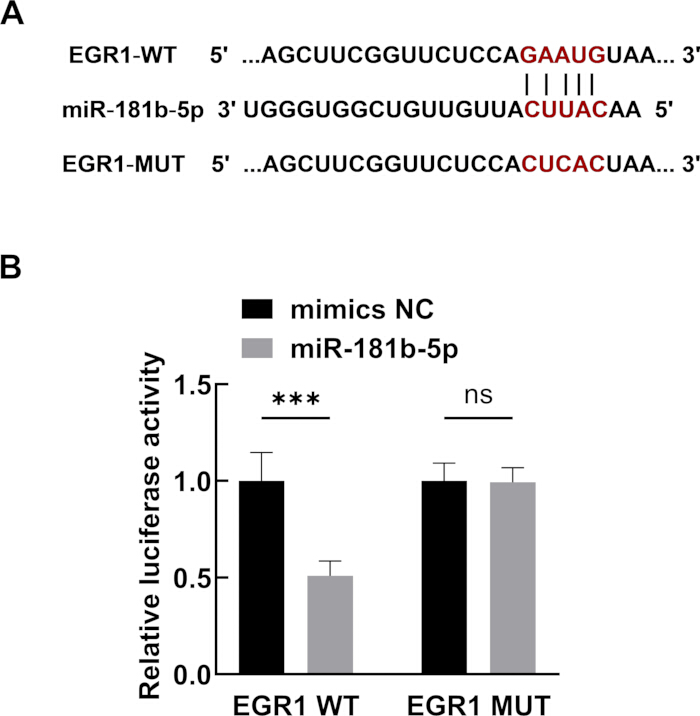
Figure 4: Verification of the targeting relationship between miR-181b-5p and EGR1. (A) Prediction of the potential binding site between miR‑181b‑5p and the 3' untranslated region (3'UTR) of EGR1 using a miRNA target‑prediction database. The complementary sequences were mutated in EGR1‑MUT to abolish miRNA binding. (B) Results of dual-luciferase reporter assay. Two‑way ANOVA was applied for statistical analysis; each experiment was performed with three technical replicates and was repeated for three independent biological replicates (n = 3 biological replicates per group); Error bars represent mean ± SD. Compared with the mimics NC + EGR1 WT group, ***P < 0.001; compared with the mimics NC + EGR1 MUT group, ns, not significant. Please click here to view a larger version of this figure.
| HC (n = 126) | Schizophrenia (n = 126) | P value | |
| Gender | 0.801 | ||
| Male (%) | 65 (51.59) | 63 (50.00) | |
| Female (%) | 61 (48.41) | 63 (50.00) | |
| Age (years) | 30.04 ± 7.12 | 29.37 ± 6.97 | 0.465 |
| Family history of schizophrenia | <0.001 | ||
| Yes (%) | 0 (0) | 14 (11.11) | |
| No (%) | 126 (100) | 112 (88.89) | |
Table 1: General Characteristics of the Schizophrenic Patient Group and the Healthy Control Group. Chi‑square (χ2) tests were performed for categorical variables including gender and family history of schizophrenia. The age variable violated the normality assumption; accordingly, the Mann‑Whitney U test was used for inter‑group comparison. n = 126 per group. P < 0.05 was considered statistically significant.
| High expression (n = 63) | Low expression (n = 63) | |||||||
| Untreated | After 8 weeks of nursing intervention | P value | FDR‑q value | Untreated | After 8 weeks of nursing intervention | P value | FDR‑q value | |
| PANSS | ||||||||
| Positive symptom score | 30.68 ± 5.65 | 25.75 ± 4.01 | <0.001 | <0.001 | 22.79 ± 6.27 | 19.78 ± 4.67 | <0.001 | <0.001 |
| Negative symptom score | 29.22 ± 6.60 | 24.16 ± 4.44 | <0.001 | <0.001 | 24.44 ± 5.87 | 20.92 ± 4.31 | <0.001 | <0.001 |
| General psychopathology score | 52.48 ± 10.10 | 46.35 ± 9.10 | <0.001 | <0.001 | 41.03 ± 13.40 | 37.29 ± 11.06 | <0.001 | <0.001 |
| Total score | 112.38 ± 14.31 | 96.25 ± 11.85 | <0.001 | <0.001 | 88.27 ± 18.16 | 77.98 ± 14.29 | <0.001 | <0.001 |
| MCCB | ||||||||
| Processing speed | 25.92 ± 7.64 | 34.70 ± 8.10 | <0.001 | <0.001 | 36.65 ± 10.51 | 39.68 ± 6.72 | <0.001 | <0.001 |
| Pay attention to the alertness | 27.27 ± 9.17 | 33.08 ± 9.15 | <0.001 | <0.001 | 37.10 ± 10.28 | 39.21 ± 6.91 | <0.001 | <0.001 |
| Working memory | 27.51 ± 9.60 | 32.25 ± 6.22 | <0.001 | <0.001 | 38.86 ± 7.96 | 39.94 ± 6.17 | 0.001 | 0.001 |
| Language learning and memory | 27.76 ± 7.63 | 32.70 ± 4.31 | <0.001 | <0.001 | 34.41 ± 9.91 | 37.05 ± 6.68 | <0.001 | <0.001 |
| Visual learning and memory | 27.67 ± 7.65 | 31.98 ± 5.12 | <0.001 | <0.001 | 35.40 ± 10.60 | 37.89 ± 6.94 | <0.001 | <0.001 |
| Reasoning and problem solving | 26.30 ± 7.88 | 33.17 ± 5.45 | <0.001 | <0.001 | 38.37 ± 8.91 | 39.67 ± 6.82 | 0.001 | 0.001 |
| Social cognition | 25.46 ± 6.57 | 30.41 ± 3.68 | <0.001 | <0.001 | 36.13 ± 10.53 | 38.56 ± 7.02 | <0.001 | <0.001 |
| Composite cognitive score | 26.84 ± 3.54 | 32.61 ± 2.13 | <0.001 | <0.001 | 36.70 ± 5.53 | 38.85 ± 3.76 | <0.001 | <0.001 |
Table 2: Comparison of various scores before and after nursing care. Individuals with schizophrenia were divided into high‑expression and low‑expression subgroups based on the median plasma miR‑181b‑5p expression level (2.23). n = 63 per subgroup. Within‑group pre‑post intervention comparisons were conducted using paired‑samples t‑tests. For each subgroup, raw P values derived from within‑group paired‑samples t‑tests were independently adjusted by the Benjamini‑Hochberg procedure to generate FDR‑q values for multiple‑comparison correction. Statistical significance was defined as FDR‑q < 0.05.
Supplementary File 1. Please click here to download this File.
Dyskusja
In the present study, plasma miR‑181b‑5p was significantly upregulated in first‑episode, drug‑naive schizophrenia patients, and its expression levels correlated with clinical symptomatology and cognitive impairment. These findings are strongly supported by a recent systematic review that synthesized 77 studies and identified miR-181b-5p as one of the most consistently overexpressed miRNAs across both blood and brain tissues in schizophrenia. Notably, the review highlighted that miR-181b-5p and miR-34a-5p are functionally enriched in apoptosis, neurodevelopment, and cell survival, which are biological processes critically implicated in schizophrenia pathophysiology31. Collectively, these data, in concert with this robust evidence, reinforce the notion that miR-181b-5p dysregulation may serve as a hallmark of schizophrenia pathogenesis.
ROC curve analysis demonstrated that miR-181b-5p had favorable diagnostic performance with an AUC of 0.898. Compared with other schizophrenia-related miRNAs, miR-181b-5p presents stable expression across different sample types and has been validated in multiple independent cohorts. For example, the diagnostic AUC of miR-4467 and miR-29a for schizophrenia is generally between 0.70 and 0.80, which is lower than that of miR-181b-5p in this study17,32. Notably, miR-181b-5p upregulation was observed in drug-naive first-episode patients before antipsychotic treatment. However, the present study did not longitudinally evaluate whether subsequent antipsychotic treatment alters plasma miR-181b-5p levels. Hence, miR-181b-5p is a promising biomarker for auxiliary early diagnosis of schizophrenia. Further correlation analysis indicated that higher miR-181b-5p expression was correlated with higher PANSS scores and lower scores across all MCCB cognitive subscales. This indicates that miR-181b-5p expression can not only support diagnosis but also reflect the severity of symptoms of schizophrenia and cognitive impairment. These findings demonstrate a particular association between miR‑181b‑5p expression and both the severity of psychotic symptoms and the degree of cognitive dysfunction.
To clarify the underlying mechanism, bioinformatics analysis and dual‑luciferase reporter assay were combined, and a sequence‑specific targeting interaction between miR‑181b‑5p and the 3′‑UTR of EGR1 was confirmed. As a crucial transcription factor in the central nervous system, EGR1 participates in neuronal activity-dependent gene expression, synaptic plasticity, learning, and memory33. Downregulated EGR1 in the prefrontal cortex of schizophrenia patients is closely linked to cognitive impairment34. Indeed, recent studies have confirmed significantly lower EGR1 expression in the peripheral blood of schizophrenia patients compared with healthy controls35. In this study, EGR1 mRNA was significantly downregulated in patients. Notably, bioinformatics analysis has revealed that miR-181b targets 1,344 genes widely involved in biological processes, including molecular function, RNA binding, and cell composition, with enrichment in multiple signaling pathways, including the Hippo, p53, and HIF-1 pathways 36. Furthermore, miR-181b has been shown to target schizophrenia susceptibility genes, including VSNL1 and GRIA2/AMPA receptors, and has been implicated in the regulation of apoptotic, neurodevelopmental, and cell survival pathways37. These observations suggest that the pathogenic effects of miR-181b-5p in schizophrenia likely arise from the cumulative dysregulation of a broad miRNA-mRNA interaction network, rather than the modulation of a single target gene. Conversely, EGR1 expression may be regulated by multiple miRNAs; therefore, its regulation in vivo cannot be attributed solely to miR‑181b‑5p38. Multiple complementary strategies are available to further test this regulatory hypothesis: functional rescue assays in neuronal cell models, EGR1 protein-level validation, and in vivo animal studies will help delineate the causal roles of the miR‑181b‑5p/EGR1 axis, and larger multi-center clinical cohorts are required to verify the translational biomarker value of plasma miR‑181b‑5p.
Subjects in both the high and low miR‑181b‑5p expression subgroups showed significant pre‑to‑post intervention improvements across all PANSS subscales and total scores, as well as all MCCB cognitive domain scores. However, direct between‑group comparison of improvement magnitude is not valid and cannot confirm the causal effect of intensified nursing, given baseline imbalances in symptom severity and cognitive impairment and unequal intervention intensity, with the high‑expression subgroup receiving additional individualized precision nursing on top of routine care. This stratified design was adopted for clinical ethical reasons and the exploratory nature of this biomarker study, as high miR‑181b‑5p expression correlates with more severe negative symptoms and cognitive deficits and accordingly these subjects have a more urgent need for intensified rehabilitation interventions. Furthermore, all patients received first‑line antipsychotics with similar pharmacological mechanisms, and medication regimens were adjusted according to clinical response rather than miR‑181b‑5p expression levels, a strategy supported by evidence demonstrating comparable efficacy and safety profiles of these agents in routine clinical practice to minimize pharmacologic confounding39. Nevertheless, the improvements observed in the high‑expression subgroup tentatively suggest that miR‑181b‑5p may serve as a reference biomarker for identifying individuals likely to benefit from intensified rehabilitation support, yet this findings do not conclusively confirm its clinical utility, and formal prospective randomized controlled trials with well‑balanced baseline characteristics are still required to verify the independent clinical benefits of biomarker‑stratified precision nursing.
Several limitations exist in this study. First, this is a single-center study with a limited sample size, which may introduce bias. Second, gene expression was detected only in plasma, not in brain tissues. Third, for the selection of endogenous reference genes for qRT-PCR quantification, U6 was used to normalize miR-181b-5p expression, and GAPDH was used as the internal control for EGR1 mRNA. However, accumulating evidence indicates that U6 is not an optimal reference gene for circulating miRNA detection in blood-derived samples due to its relatively low expression stability, which may introduce systematic bias in miRNA expression quantification40. Similarly, GAPDH, as a conventionally used housekeeping gene, may exhibit inter-individual expression variability under different physiological and pathological states, which could affect the accuracy of mRNA expression normalization. Future studies should adopt a panel of stably expressed reference miRNAs and multiple validated housekeeping genes to improve the reliability of gene expression quantification. Fourth, long-term follow-up was not performed, so the relationship between miR-181b-5p expression and prognosis remains unclear. Fifth, this study lacks EGR1 protein‑level data and functional validation using disease‑relevant biological models. Although the dual‑luciferase assay confirms in vitro 3'‑UTR interaction, further cellular and in vivo schizophrenia‑model experiments are required to validate the functional activity of the miR‑181b‑5p/EGR1 regulatory axis. The overall findings await confirmation in well‑powered, multi‑center studies with larger cohorts to fully dissect this regulatory mechanism.
Oświadczenia
The authors have no relevant financial or non-financial interests to disclose.
AUTHOR CONTRIBUTIONS:
H.L: Conceptualization, Data curation, Formal analysis, Investigation, Writing - original draft, review, and editing, Project administration.
X.H: Methodology, Resources, Software.
C.W: Supervision, Validation, Visualization.
Podziękowania
The authors declare that no funds, grants, or other support were received during the preparation of this manuscript.
Materiały
| Nazwa | Firma | Numer katalogowy | Komentarze |
|---|---|---|---|
| ABI 7500 Real-Time PCR System | Applied Biosystems (Thermo Fisher Scientific) | 7500 (4406984) | Used for quantitative real-time PCR (qRT-PCR) detection of miR-181b-5p and EGR1 mRNA expression |
| Centrifuge, refrigerated | Eppendorf | 5427 R | Used for plasma separation from blood samples and centrifugation steps in RNA extraction |
| Culture plate, 24-well | Corning | 3524 | Used for seeding and culturing HEK293T cells in dual-luciferase reporter assays |
| DMEM medium | Gibco (Thermo Fisher Scientific) | 11965092 | Used as basal culture medium for HEK293T cells |
| GloMax® 20/20 Luminometer | Promega | E5311 | Used for measuring firefly and Renilla luciferase activities in dual-luciferase assays |
| Dual-Luciferase Reporter Assay System | Promega | E1910 | Used for sequential detection of dual-luciferase activities to validate miRNA-target binding |
| EDTA-containing blood collection tube | BD (Becton Dickinson) | 367861 (K2 EDTA) | Used for collection and anticoagulation of peripheral venous blood samples |
| EGR1 forward primer | Sangon Biotech (Shanghai, China) | Custom; https://www.sangon.com/ | Used for amplification of EGR1 mRNA in qRT-PCR assays |
| EGR1 reverse primer | Sangon Biotech (Shanghai, China) | Custom; https://www.sangon.com/ | Used for amplification of EGR1 mRNA in qRT-PCR assays |
| Fetal bovine serum (FBS) | Gibco (Thermo Fisher Scientific) | 10099141 | Used as a supplement for HEK293T cell culture medium |
| GAPDH forward primer | Sangon Biotech (Shanghai, China) | Custom; https://www.sangon.com/ | Used for amplification of endogenous reference gene GAPDH in qRT-PCR assays |
| GAPDH reverse primer | Sangon Biotech (Shanghai, China) | Custom; https://www.sangon.com/ | Used for amplification of endogenous reference gene GAPDH in qRT-PCR assays |
| HEK293T cells | ATCC | CRL-11268 | Used as host cell line for dual-luciferase reporter transfection experiments |
| Lipofectamine 3000 | Invitrogen (Thermo Fisher Scientific) | L3000001 | Used as lipid-based transfection reagent for plasmids and miRNA mimics |
| miR-181b-5p forward primer | Sangon Biotech (Shanghai, China) | Custom; https://www.sangon.com/ | Used for amplification of mature miR-181b-5p in qRT-PCR assays |
| miR-181b-5p mimics / Negative control (NC) mimics | RiboBio (Guangzhou, China) | Custom; https://www.ribobio.com/ | Used for gain-of-function verification and negative control in dual-luciferase assays |
| miR-181b-5p reverse primer | Sangon Biotech (Shanghai, China) | Custom; https://www.sangon.com/ | Used for amplification of mature miR-181b-5p in qRT-PCR assays |
| MUT-EGR1 3'UTR reporter plasmid | Sangon Biotech (Shanghai, China) | Custom; https://www.sangon.com/ | Mutant construct used to verify sequence-specific binding between miR-181b-5p and EGR1 3'UTR |
| NanoDrop 2000 spectrophotometer | Thermo Fisher Scientific | ND-2000 | Used for quantification and purity assessment of extracted total RNA |
| Nuclease-free water | Invitrogen (Thermo Fisher Scientific) | 10977015 | Used for reagent dilution and reaction system preparation in molecular experiments |
| Passive Lysis Buffer | Promega | E1941 | Used for lysis of transfected HEK293T cells before luciferase activity measurement |
| PrimeScript RT Reagent Kit | TaKaRa (Japan) | RR037A | Used for reverse transcription of total RNA into cDNA for qRT-PCR |
| SPSS Statistics | IBM | version 26.0 | Used for all statistical analyses in this study |
| RNase-free DNase I | TaKaRa (Japan) | 2270A | Used to eliminate genomic DNA contamination in extracted RNA samples |
| TargetScan | Open-Source Web Server | 8.0; https://www.targetscan.org/vert_80/ | Used for bioinformatic prediction of miR-181b-5p binding sites in EGR1 3'UTR |
| SYBR Green PCR Master Mix | Applied Biosystems (Thermo Fisher Scientific) | 4309155 | Used as the reaction mix for SYBR green-based qRT-PCR assays |
| TRIzol Reagent | Invitrogen (Thermo Fisher Scientific) | 15596026 (100 mL) / 15596018 (200 mL) | Used for total RNA extraction from human plasma samples |
| U6 forward primer | Sangon Biotech (Shanghai, China) | Custom; https://www.sangon.com/ | Used for amplification of endogenous reference gene U6 for miRNA normalization |
| U6 reverse primer | Sangon Biotech (Shanghai, China) | Custom; https://www.sangon.com/ | Used for amplification of endogenous reference gene U6 for miRNA normalization |
| Ultra-low temperature freezer, -80°C | Thermo Fisher Scientific | Forma 900 Series (906) | Used for long-term storage of plasma samples and extracted RNA at -80 °C |
| WT-EGR1 3'UTR reporter plasmid | Sangon Biotech (Shanghai, China) | Custom; https://www.sangon.com/ | Wild-type construct used to validate binding between miR-181b-5p and EGR1 3'UTR |
| pmirGLO Dual-Luciferase miRNA Target Expression Vector | Promega | E1330 | Used as the backbone vector for constructing EGR1 3'UTR reporter plasmids |
| pRL-TK Renilla control plasmid | Promega | E2241 | Used as internal reference to normalize transfection efficiency in dual-luciferase assays |
| Primer-BLAST | NCBI | https://www.ncbi.nlm.nih.gov/tools/primer-blast/ | Used to verify primer specificity against the human reference genome |
Bibliografia
- Luo W, et al. Trends and cross-country inequalities in schizophrenia from 1990 to 2021, with prediction to 2035: a systematic analysis of the Global Burden of Disease Study 2021. BMC Psychiatry. 2025;25(1):928.
- Solmi M, et al. Age at onset of mental disorders worldwide: large-scale meta-analysis of 192 epidemiological studies. Mol Psychiatry. 2022;27(1):281-295.
- Schultz SK, Ho BC, Andreasen NC. Clinical features characterizing young-onset and intermediate-onset schizophrenia. J Neuropsychiatry Clin Neurosci. 2000;12(4):502-505.
- Feng Z, et al. Global burden of schizophrenia in 204 countries and regions from 1990 to 2021 and machine learning-based projections to 2036: an analysis of the 2021 Global Burden of Disease Study. Front Psychiatry. 2026;16:1684168.
- Zhou W, et al. Global, regional, and national burden of schizophrenia: epidemiological trends, decomposition, joinpoint analysis, and projections to 2036 based on GBD 2021. Front Psychiatry. 2026;17:1702808.
- Schmitt A, Falkai P, Papiol S. Neurodevelopmental disturbances in schizophrenia: evidence from genetic and environmental factors. J Neural Transm (Vienna). 2023;130(3):195-205.
- Adly NM, Khalifa D, Abdel-Ghany S, Sabit H. MicroRNAs as biomarkers and molecular mediators of cognitive dysfunction in schizophrenia. J Neural Transm (Vienna). 2026;133(1):35-56.
- Ayano G, et al. Misdiagnosis, detection rate, and associated factors of severe psychiatric disorders in specialized psychiatry centers in Ethiopia. Ann Gen Psychiatry. 2021;20(1):10.
- Erson-Bensan AE. Introduction to microRNAs in biological systems. Methods Mol Biol. 2014;1107:1-14.
- Fan C, et al. Microglia secrete miR-146a-5p-containing exosomes to regulate neurogenesis in depression. Mol Ther. 2022;30(3):1300-1314.
- Casciati A, et al. Deregulation of synaptic plasticity-related microRNAs after repetitive transcranial magnetic stimulation in Alzheimer’s disease. Mol Neurobiol. 2026;63(1):442.
- Song M. miRNAs-dependent regulation of synapse formation and function. Genes Genomics. 2020;42(8):837-845.
- Feng N, et al. Schizophrenia risk-associated SNPs affect expression of microRNA 137 host gene: a postmortem study. Hum Mol Genet. 2024;33(22):1939-1947.
- Miller BH, et al. MicroRNA-132 dysregulation in schizophrenia has implications for both neurodevelopment and adult brain function. Proc Natl Acad Sci U S A. 2012;109(8):3125-3130.
- Gangachannaiah S, et al. Potential of extracellular vesicle cargo as molecular signals in schizophrenia: a scoping review. Schizophrenia (Heidelb). 2025;11(1):17.
- Santarelli DM, et al. Schizophrenia-associated microRNA-gene interactions in the dorsolateral prefrontal cortex. Genomics Proteomics Bioinformatics. 2019;17(6):623-634.
- Khosroshahi PA, et al. Downregulation of miR-29a as a possible diagnostic biomarker for schizophrenia. Mol Biol Rep. 2024;51(1):617.
- Indrieri A, et al. The pervasive role of the miR-181 family in development, neurodegeneration, and cancer. Int J Mol Sci. 2020;21(6):2092.
- Zhi F, et al. MiR-181b-5p downregulates NOVA1 to suppress proliferation, migration and invasion and promote apoptosis in astrocytoma. PLoS One. 2014;9(10):e109124.
- You X, et al. Investigating aberrantly expressed microRNAs in peripheral blood mononuclear cells from patients with treatment-resistant schizophrenia using miRNA sequencing and integrated bioinformatics. Mol Med Rep. 2020;22(5):4340-4350.
- Pang Z, Xu Y, Zhu Q. Early growth response 1 suppresses macrophage phagocytosis by inhibiting NRF2 activation through upregulation of autophagy during Pseudomonas aeruginosa infection. Front Cell Infect Microbiol. 2022;11:773665.
- Sugo N, Atsumi Y, Yamamoto N. Transcription and epigenetic factor dynamics in neuronal activity-dependent gene regulation. Trends Genet. 2025;41(5):425-436.
- Morice E, Enderlin V, Gautron S, Laroche S. Contrasting functions of mitogen- and stress-activated protein kinases 1 and 2 in recognition memory and in vivo hippocampal synaptic transmission. Neuroscience. 2021;463:70-85.
- Wang S, et al. Hepatic miR-181b-5p contributes to glycogen synthesis through targeting EGR1. Dig Dis Sci. 2019;64(6):1548-1559.
- Pérez-Santiago J, et al. A combined analysis of microarray gene expression studies of the human prefrontal cortex identifies genes implicated in schizophrenia. J Psychiatr Res. 2012;46(11):1464-1474.
- Tandon R, et al. Definition and description of schizophrenia in the DSM-5. Schizophr Res. 2013;150(1):3-10.
- Liu X, et al. Identification of suitable plasma-based reference genes for miRNAome analysis of major depressive disorder. J Affect Disord. 2014;163:133-139.
- Du X, et al. CircRNA-miRNA-mRNA networks in plasma extracellular vesicles as biomarkers for first-onset schizophrenia. BMC Psychiatry. 2025;25(1):688.
- Liang S, et al. Psychometric properties of the MATRICS Consensus Cognitive Battery (MCCB) in Chinese patients with major depressive disorder. J Affect Disord. 2020;265:132-138.
- Huang KW, et al. Validation of the Chinese version of the Schizophrenia Cognition Rating Scale. Psychiatry Investig. 2022;19(7):511-518.
- Kotas M, et al. A systematic review of miRNA expression in schizophrenia spectrum disorders across the blood and the brain. Neurosci Biobehav Rev. 2025;176:106292.
- Jin M, et al. Identification of peripheral blood miRNA biomarkers in first-episode drug-free schizophrenia patients using bioinformatics strategy. Mol Neurobiol. 2022;59(8):4730-4746.
- Duclot F, Kabbaj M. The role of early growth response 1 (EGR1) in brain plasticity and neuropsychiatric disorders. Front Behav Neurosci. 2017;11:35.
- Marballi KK, Gallitano AL. Immediate early genes anchor a biological pathway of proteins required for memory formation, long-term depression and risk for schizophrenia. Front Behav Neurosci. 2018;12:23.
- Liu Y, et al. Differential expression of miR-26b-5p, EGR1, and STAT1 in peripheral blood of schizophrenia patients. Psychiatry Clin Psychopharmacol. 2024;34(4):275-284.
- Song H, et al. Bioinformatics analysis of the differential expression of miRNA-181b in peripheral blood of schizophrenic patients. Journal of Bengbu Medical University. 2019;44(2):173-177.
- Beveridge NJ, et al. Dysregulation of miRNA 181b in the temporal cortex in schizophrenia. Hum Mol Genet. 2008;17(8):1156-1168.
- Khachigian LM. Early growth response-1 in the pathogenesis of cardiovascular disease. J Mol Med (Berl). 2016;94(7):747-753.
- Schneider-Thoma J, et al. Comparative efficacy and tolerability of antidopaminergic and muscarinic antipsychotics for acute schizophrenia: a network meta-analysis of randomised controlled trials indexed in international English and Chinese databases. Lancet. 2026;407(10531):876-891.
- Xiang M, et al. U6 is not a suitable endogenous control for the quantification of circulating microRNAs. Biochem Biophys Res Commun. 2014;454(1):210-214.