
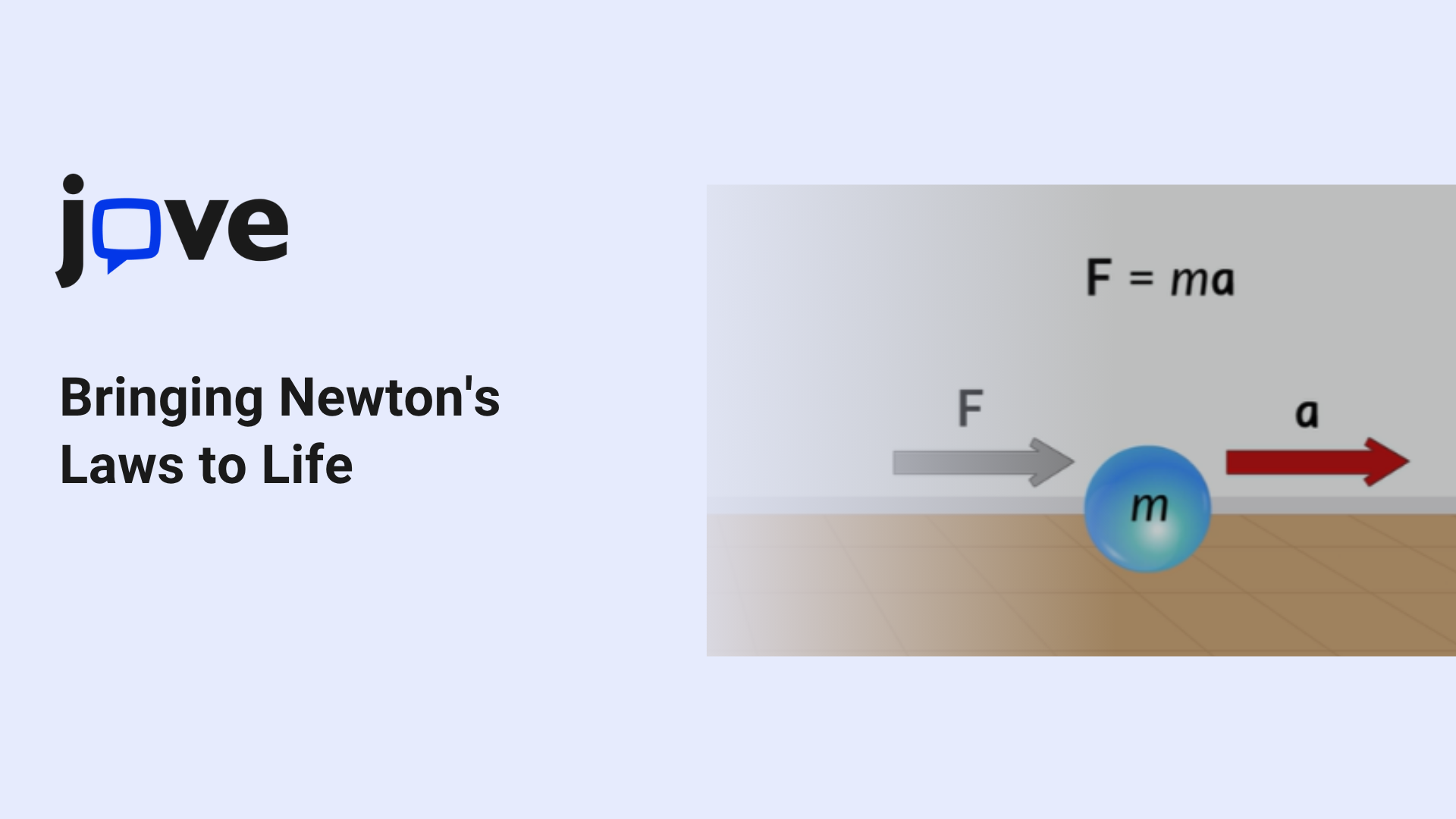
Bringing Newton's Laws to Life: Engaging Experiments for High School Physics
Imagine a classroom where students don’t just learn about Newton’s Laws of Motion—they experience them firsthand. Research indicates that active learning approaches, such as interactive experiments, can significantly enhance students’ understanding of physics concepts. For instance, a meta-analysis of 225 studies found that active learning reduces failure rates from 32% to 21% and increases student performance on assessments by an average of 0.47 standard deviations.(source)
By transforming theoretical concepts into interactive experiments, educators can ignite curiosity and deepen understanding in high school physics students.
The Significance of Newton's Laws in Physics Education
Newton’s Laws of Motion form the foundation of classical mechanics, explaining how objects move and interact. A solid grasp of these principles is essential for students, as they apply to everything from everyday phenomena to advanced scientific studies.
Interactive Experiments Demonstrating Newton's Laws
1. Newton's First Law: The Tablecloth Pull
Objective: Demonstrate inertia and the concept that an object at rest stays at rest unless acted upon by an external force.
Materials Needed:
- Tablecloth with smooth surface
- Various dishes and utensils
- Flat, sturdy table
Procedure:
- Setup: Place the tablecloth on the table, ensuring it hangs evenly over the edges. Arrange dishes and utensils on top.
- Demonstration: Quickly pull the tablecloth horizontally from under the dishes. Observe how the inertia of the objects keeps them in place.
Scientific Explanation: This classic demonstration shows that objects resist changes in their state of motion. The rapid removal of the tablecloth minimizes the horizontal force applied to the dishes, allowing them to remain stationary due to inertia.
Also Read: Newton’s First Law of Experiment
2. Newton's Second Law: Variable Mass Cart Experiment
Objective: Explore the relationship between force, mass, and acceleration.
Materials Needed:
- Low-friction cart
- Adjustable weights
- Pulley system
- String
- Timer or motion sensor
Procedure:
- Setup: Attach the string to the cart, run it over the pulley, and attach weights to the other end.
- Experiment: Release the system, allowing the weights to pull the cart. Measure the acceleration with different masses on the cart.
- Analysis: Plot acceleration versus mass to observe the inverse relationship, confirming F=maF = maF=ma.
Scientific Explanation: This experiment illustrates that acceleration is directly proportional to force and inversely proportional to mass. By varying the mass and measuring acceleration, students can see Newton’s Second Law in action.
Also Read: Newton’s Second Law of Experiment
3. Newton's Third Law: Balloon Rocket Race
Objective: Demonstrate action-reaction force pairs.
Materials Needed:
- Balloons
- String
- Straws
- Tape
Procedure:
- Setup: Thread the string through a straw and secure both ends of the string to fixed points, creating a horizontal track.
- Preparation: Inflate a balloon without tying it, tape it to the straw, and position it at one end of the string.
- Launch: Release the balloon and observe it propel along the string as air escapes.
Scientific Explanation: As the balloon expels air backward, an equal and opposite force propels it forward, exemplifying Newton’s Third Law.
Also Read: Newton‘s Third Law of Experiment
Enhancing Learning with JoVE Science Education Videos
To complement these hands-on activities, JoVE offers a vast library of science education videos that provide visual demonstrations of physics concepts. These resources can reinforce learning and offer students a different perspective on Newton’s Laws.
Benefits of Using JoVE Videos:
- Visual Reinforcement: High-quality videos illustrate experiments, aiding in comprehension.
- Curriculum Integration: Content aligns with educational standards, ensuring relevance.
- Flexible Access: Students can review materials at their own pace, enhancing retention.
Safety Considerations
When conducting these experiments, prioritize safety by:
- Supervision: Ensure all activities are monitored by an instructor.
- Protective Gear: Use appropriate safety equipment, such as goggles and gloves.
- Equipment Checks: Regularly inspect materials for wear or damage.
Conclusion
Integrating interactive experiments into the study of Newton’s Laws transforms abstract principles into tangible experiences. By combining hands-on activities with JoVE’s educational videos, educators can create a dynamic and engaging learning environment that fosters a deeper understanding of fundamental physics concepts.
Bring JoVE to your classroom starting as low as $2 per student.*
Explore funding resources to learn how your school can start using JoVE’s complete STEM video library today.
*Pricing based on 1,500 students.

