
Radar Systems: Applications
Radar systems are tools that use waves—usually radio or microwaves—to detect the location, speed, and shape of objects. RADAR stands for Radio Detecti
Video Duration: 1 minute and 21 secondsMIDDLE SCHOOL
Physical Science
Radar systems are tools that use waves—usually radio or microwaves—to detect the location, speed, and shape of objects. RADAR stands for Radio Detecti
Video Duration: 1 minute and 21 seconds
Sonar, which stands for Sound Navigation and Ranging, is a technology that uses sound waves to detect and locate objects underwater. It works by sendi
Video Duration: 1 minute and 22 seconds
Signals help carry information over distances, whether through sound, light, or electronic devices. There are two main types: analog and digital. Anal
Video Duration: 1 minute and 18 seconds
Communication technologies use the science of waves to send, receive, and store information. From smartphones to satellites, these technologies depend
Video Duration: 1 minute and 15 seconds
Medical imaging is the use of technology to create pictures of the inside of the human body without surgery. It helps doctors diagnose and treat illne
Video Duration: 1 minute and 26 seconds
Fiber optics is a technology that uses thin strands of glass or plastic to transmit light signals over long distances. These light signals carry infor
Video Duration: 1 minute and 26 seconds
Waves are all around us and play an important role in our daily lives. A wave is a disturbance that transfers energy from one place to another. It can
Video Duration: 1 minute and 21 seconds
Wave amplitude is the height of a wave from its resting position (the midpoint) to the top of a crest or the bottom of a trough. It tells us how stron
Video Duration: 1 minute and 25 seconds
Wave amplitude is the distance from the resting point of a wave to its highest or lowest point. It helps us understand how much energy a wave is carry
Video Duration: 1 minute and 19 seconds
Wave frequency refers to the number of wave cycles that pass a point in one second. It is measured in hertz (Hz). The higher the frequency, the more w
Video Duration: 1 minute and 24 seconds
A wave is a repeating disturbance or vibration that transfers energy from one place to another without the transfer of matter. Waves are found in many
Video Duration: 1 minute and 20 seconds
Mechanical waves are waves that move through a medium, like air, water, or solid materials. These waves carry energy, no matter where, from one place
Video Duration: 1 minute and 28 seconds
Electromagnetic waves are waves that can travel through space without needing a medium such as air or water. They include radio waves, microwaves, inf
Video Duration: 1 minute and 25 seconds
The electromagnetic spectrum is the full range of electromagnetic waves, from very long radio waves to extremely short gamma rays. Each part of the sp
Video Duration: 1 minute and 25 seconds
Electromagnetic waves travel through space at the speed of light, which is about 300,000 kilometers per second. These waves have two important propert
Video Duration: 1 minute and 28 seconds
When electromagnetic radiation, such as light, interacts with matter, it can behave in different ways depending on the material it hits. Light can be
Video Duration: 1 minute and 21 seconds
Electromagnetic waves are all around us, even though we can only see a small part of them—visible light. These waves don’t need air or any other matte
Video Duration: 1 minute and 28 seconds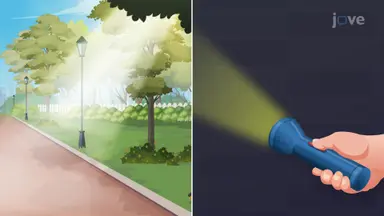
Light is a special kind of energy because it behaves in two different ways—it acts like a wave and also like a particle. This is known as the dual nat
Video Duration: 1 minute and 22 seconds
Earth behaves like a giant magnet. Deep inside, the movement of molten iron in the outer core creates a magnetic field that surrounds the planet. This
Video Duration: 1 minute and 17 seconds
Magnetic field reversal is a natural process where Earth’s magnetic poles switch places—north becomes south, and south becomes north. This doesn’t hap
Video Duration: 1 minute and 21 seconds
A solenoid is a coil of wire that acts like a magnet when an electric current flows through it. It creates a magnetic field, similar to the one around
Video Duration: 1 minute and 17 seconds
An electromagnet is a magnet that is powered by electricity. It’s made by wrapping wire around a piece of metal (usually iron) and then running an ele
Video Duration: 1 minute and 17 seconds
A generator is a device that turns motion into electricity using the science of electromagnetic induction. Inside a generator, coils of wire spin insi
Video Duration: 1 minute and 24 seconds
Ferromagnetic materials are special types of substances that can become strongly magnetized. This means their atoms have tiny magnetic fields that can
Video Duration: 1 minute and 25 seconds
Sound is a wave that travels through matter, such as air, water, or solids. It is created when something vibrates. These vibrations cause particles in
Video Duration: 1 minute and 17 seconds
Sound travels as a longitudinal wave. This means the particles of the medium move back and forth in the same direction the wave is traveling. These wa
Video Duration: 1 minute and 20 seconds
The speed of sound is how fast sound travels through a material. It doesn’t always travel at the same speed—it depends on several factors. The type of
Video Duration: 1 minute and 24 seconds
The Doppler Effect is a change in the pitch of a sound caused by the movement of the sound source. When the source moves toward the listener, the soun
Video Duration: 1 minute and 20 seconds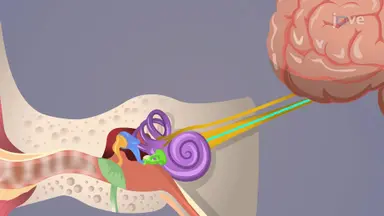
Hearing is one of your five senses and plays an important role in how you experience the world. Your ears help you detect sounds like voices, music, a
Video Duration: 1 minute and 18 seconds
Every sound you hear is made by vibrations moving through the air. These vibrations create sound waves. The frequency of a sound tells you how fast th
Video Duration: 1 minute and 26 seconds
Light usually travels in a straight line through air or space. But when it passes into a new material like water or glass, it changes speed and bends.
Video Duration: 1 minute and 13 seconds
Refraction happens when light bends while moving through different transparent materials. But not all materials bend light the same way. That’s becaus
Video Duration: 1 minute and 21 seconds
When light passes from one material into another at an angle, it bends. This is called refraction. To understand it better, you can label the parts of
Video Duration: 1 minute and 20 seconds
Natural sources of light are all around us, and they are essential for life on Earth. The most important source is the Sun, which gives off visible li
Video Duration: 1 minute and 1 second
Artificial light sources are objects that produce visible light using energy, and they help us see when natural light is not available. Some common ex
Video Duration: 1 minute and 28 seconds
Artificial light is a form of visible energy created by humans to brighten dark spaces, work at night, or send signals. Unlike sunlight, which is natu
Video Duration: 1 minute and 23 seconds