Protein extraction for proteomic analyses in fungal species requires high levels of standardization to be accomplished according with the minimum information about a proteomic experiment (MIAPE) guidelines. We present a video-protocol that includes a procedure for minimizing experimental bias during toxin induction and protein extraction from Fusarium spp.
Method Article
Toxin Induction and Protein Extraction from Fusarium spp. Cultures for Proteomic Studies
In This Article
Summary
Abstract
Fusaria are filamentous fungi able to produce different toxins. Fusarium mycotoxins such as deoxynivalenol, nivalenol, T2, zearelenone, fusaric acid, moniliformin, etc... have adverse effects on both human and animal health and some are considered as pathogenicity factors. Proteomic studies showed to be effective for deciphering toxin production mechanisms (Taylor et al., 2008) as well as for identifying potential pathogenic factors (Paper et al., 2007, Houterman et al., 2007) in Fusaria. It becomes therefore fundamental to establish reliable methods for comparing between proteomic studies in order to rely on true differences found in protein expression among experiments, strains and laboratories. The procedure that will be described should contribute to an increased level of standardization of proteomic procedures by two ways. The filmed protocol is used to increase the level of details that can be described precisely. Moreover, the availability of standardized procedures to process biological replicates should guarantee a higher robustness of data, taking into account also the human factor within the technical reproducibility of the extraction procedure.
The protocol described requires 16 days for its completion: fourteen days for cultures and two days for protein extraction (figure 1).
Briefly, Fusarium strains are grown on solid media for 4 days; they are then manually fragmented and transferred into a modified toxin inducing media (Jiao et al., 2008) for 10 days. Mycelium is collected by filtration through a Miracloth layer. Grinding is performed in a cold chamber. Different operators performed extraction replicates (n=3) in order to take into account the bias due to technical variations (figure 2). Extraction was based on a SDS/DTT buffer as described in Taylor et al. (2008) with slight modifications. Total protein extraction required a precipitation process of the proteins using Aceton/TCA/DTT buffer overnight and Acetone /DTT washing (figure 3a,3b). Proteins were finally resolubilized in the protein-labelling buffer and quantified. Results of the extraction were visualized on a 1D gel (Figure 4, SDS-PAGE), before proceeding to 2D gels (IEF/SDS-PAGE). The same procedure can be applied for proteomic analyses on other growing media and other filamentous fungi (Miles et al., 2007).
Protocol
The protocol requires 16 days for its completion. The timeframe is detailed in figure 1.
Details for buffer preparation
- Preparation of the lysis buffer (3mL per sample).
- Preparation of the washing buffer (50mL per sample). This buffer should be pre-chilled and stored at -20°C in the freezer until further analysis and kept on ice during the entire procedure.
- Preparation of the precipitation buffer (20mL per sample). This buffer should be pre-chilled and stored at -20°C in the freezer until needed and kept on ice during the entire procedure.
- The work should preferentially be carried out into the cold chamber at 4°C.
Fungal species
Three strains used for proteomic analyses were classified to be Fusarium graminearum on the basis of their morphological features and Translation-Elongation factor Alpha-1 analysis (O'Donnell et al., 1998)
These strains belonged to the CRP-Gabriel Lippmann collection and were maintained and stored at - 80°C in 15% glycerol.
Preparation of mycelia
Fungi were cultivated on V8 for 4 days at 25°C alternating light and dark period each 12 hrs. Cultures were fragmented using a sterile blade and pieces of these cultures were used to inoculate 250 ml Erlenmeyer flasks containing 100 mL of toxin-inducing media. Mycelia were harvested after 10 days and were separated from medium by filtering the culture with a sterile filter. Mycelia were washed 3 times with sterile water to remove medium residues and other compounds. We then immediately froze the cells by adding liquid nitrogen and kept the samples at -80°C.
General description of the protein extraction
Protein samples were extracted using the method described in the figure 3A and 3B. The Fusarium samples were ground in liquid nitrogen and the powder was collected in 10 ml Teflon tubes. The samples were then incubated 30 minutes with the lysis buffer, boiled for 10 minutes, and centrifuged 2 times at room temperature (12000g for 15 minutes). The supernatants were collected and incubated at -20 °C with precipitation buffer overnight. After centrifugation at 4°C 30000g for 45 minutes, the pellets of the precipitated proteins were washed 3 times with cold acetone containing DTT. Finally, the pellets were air-dried and the proteins were resolubilized in the labelling buffer, adjusting pH to 8. A sub-sample of 30 ml was removed for total protein quantification and the remaining supernatant was stored at -20°C until protein electrophoresis.

Figure 1. Timeline of the procedure.

Figure 2. Scheme for multiple operators sample-processing.

Figure 3a.
Figure 3b. Please click here to see a larger version of figure 3a, or here for a larger version of figure 3b.
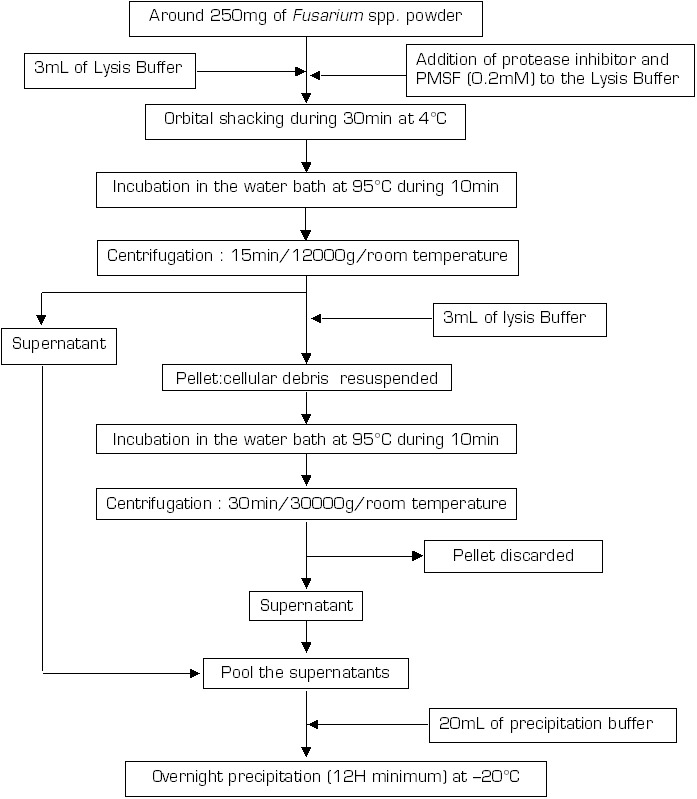
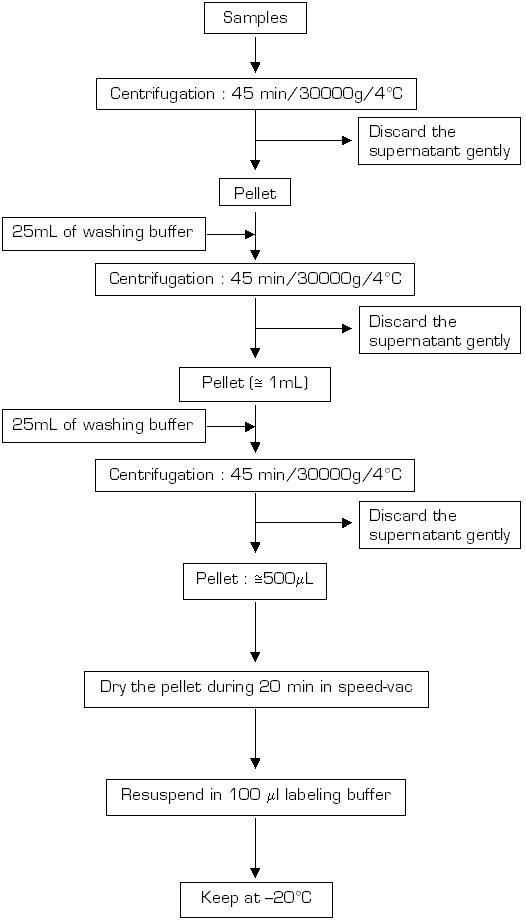
Figures 3a-b. Flow charts for the protein extraction procedure (A: first day; B: second day).

Figure 4. 1D picture of protein extracts. Proteins were run until complete migration of blue to the end of the gel that was stained with lava Purple. Please click here to see a larger version of figure 4.

Discussion
Recent interest in proteomic approaches within the fungal biology domain led to an increased number of publications using this technique (as reviewed in Kim et al., 2007). Methods for protein extraction rely on a combination of extraction procedures; they are often scarcely described in the methodological sections and require expertise in dealing with the potential troubleshooting methods.
As for other "omics" approaches, setting standards for sample and data processing is essential in order to generate reliable scientific information. Moreover samples and procedures of manipulation should be adequately described in order to allow shared result interpretation among different "omics" experiments. This would be essential for fully exploiting potentiality of cross-data mining in genomics, proteomics, metabolomics, ... (Morrison et al., 2006). Minimum information about a proteomic experiment has been drafted and working groups have been established in order to tackle all the aspects of an experiment (Gel electrophoresis, Mass Spectrometry, Molecular Interactions, Protein Modifications, Proteomics Informatics, Sample Processing). At the moment no defined information are available on sample processing procedures. Given the importance of protein extraction procedures in determining the final quality of proteomic studies, in order to implement procedures that can increase standardization within the framework of MIAPE guidelines (Taylor et al., 2007), we proposed the use of a video protocol detailing sample processing. Video description of experiments may contribute substantially to increase the number of information on sample processing that may result in better reproducibility of "omics" experiments (Pasquali, 2007).
Indeed, reproducibility across laboratories is a fundamental requirement in order to guarantee validity of proteomics results (http://www.fixingproteomics.org). The cross-laboratory reproducibility is influenced by two factors: different instrumentations and different operators manipulating samples.
In the described protocol, we propose to perform biological replicates involving multiple operators (Figure 2 and video) to increase the reliability of data (i.e. technical variation of the results is taken into account).
The procedure described for protein extraction is based on SDS and heating. This was previously shown to guarantee a good purity and quantity of proteins (Bridge 1996). SDS coupled with boiling dissolves cell walls, hydrophobic proteins and prevents the formation of oligomers that abort precipitation of proteins. Boiling allows also inactivation of proteases. The same effect is produced also by EDTA, PMSF and complete mini protease inhibitor. DTT removes disulfide bridges in and between proteins facilitating protein solubilization.
In order to remove SDS before IEF, proteins are precipitated by acetone/TCA/DTT. Furthermore, acetone/TCA/DTT precipitation allows removing some contaminants such as lipids, nucleic acids, salts or/and phenolic compounds when these compounds are present. Like SDS, these molecules prevent a good migration during IEF. Following this precipitation, it is necessary to wash the precipitated proteins by acetone/DTT, in order to remove TCA as it can interfere with IEF.
A good sample preparation is the key to good results. For this, it is also essential to avoid contamination of proteins from the environment working with powder free gloves and respecting good laboratory practices. From a technical point of view, within the described protocol, the most critical steps for obtaining sufficient amounts and purity of proteins are two phases. First, the grinding phase where complete destruction of the cell is fundamental to release proteins; and second, the purification of total proteins, a phase encompassing the removal of the majority of lipids, DNA and other contaminants that may interfere with the migration of proteins.
Acknowledgements
We thank Servane Contal and Boris Untereiner for their technical contribution. We acknowledge the support of FNR "FUTOX" project.
Materials
| Name | Company | Catalog Number | Comments | ||||||||||||||||||||||||||||||||||||||||||||||||||||||||||||||||||||
|---|---|---|---|---|---|---|---|---|---|---|---|---|---|---|---|---|---|---|---|---|---|---|---|---|---|---|---|---|---|---|---|---|---|---|---|---|---|---|---|---|---|---|---|---|---|---|---|---|---|---|---|---|---|---|---|---|---|---|---|---|---|---|---|---|---|---|---|---|---|---|---|
Media and solutions PDA: 39 g Potato Dextrose Agar (Difco); 1 L distilled water. Toxin inducing media: 1g K2HPO4, 0.5g KCl, 0.5g MgSO4 7H2O, 10 mg FeEDTA, 2g L glutamic acid, 10g sucrose in 1L of distilled water. Lysis Buffer:
Precipitation Buffer:
Washing Buffer:
Labelling Buffer (store at -18°C in small aliquots):
|
References
- Bridge, P. Protein Extraction from Fungi. Protein Purification Protocols. , 39-48 (1996).
- Jiao, F. Effects of different carbon sources on trichothecene production and Tri gene expression by Fusarium graminearum in liquid culture. FEMS Microbiol Lett. 285, 212-219 (2008).
- Kim, Y. Proteomics of filamentous fungi. Trends in Biotechnology. 25, 395-400 (2007).
- Milles, J. Development of a proteomic approach to monitor protein synthesis in mycotoxin producing moulds. Mycotoxin Res. 23, 161-165 (2007).
- Morrison, N., Field, D. Concept of sample in OMICS technology. OMICS. 10, 127-137 (2006).
- O'Donnell, K., Kistler, H. C., Cigelnik, E., Ploetz, R. C. Multiple evolutionary origins of the fungus causing Panama disease of banana: Concordant evidence from nuclear and mitochondrial gene genealogies. PNAS. 95, 2044-2049 (1998).
- Paper, J. M. Comparative proteomics of extracellular proteins in vitro and in planta from the pathogenic fungus Fusarium graminearum. Proteomics. 7, 3171-3183 (2007).
- Pasquali, M. Video in science. Protocol videos: the implications for research and society. EMBO Rep. 8, 712-716 (2007).
- Taylor, C. F. The minimum information about a proteomics experiment (MIAPE). Nat Biotechnol. 25, 887-893 (2007).
- Taylor, R. D. Proteomic analyses of Fusarium graminearum grown under mycotoxin-inducing conditions. Proteomics. 8, 2256-2265 (2008).
Reprints and Permissions
