All procedures involving human participants have been performed in compliance with the institutional, national, and international guidelines for human welfare and have been reviewed by the local institutional review board.
This protocol involves working with radioisotopes. Anyone conducting this procedure must be properly trained in handling unsealed radioactive materials and must have approval from their institution's radiation safety officer. The reagents and equipment used in this study are listed in the Table of Materials.
1. Preparation of materials
- Check that the peristaltic pump was correctly connected to the AC beforehand and is sufficiently charged. Bring all necessary equipment close to the room or box where targeted radionuclide therapy (TRT) will be administered.
- Clean dressing: put on overshoes, wash hands, and put on a shielded apron, a gown, a surgical mask, and a hair cover. Wash hands again and disinfect with a hydroalcoholic solution. Wear single-use gloves. Place a sterile drape on a clean work surface and peel off the sterile drape with the supplies to be assembled.
2. Installation of the cassette on the pump
NOTE: The perfusion set is based on a 2-way cassette, which involves a first line called "A" connected to a 0.9% NaCl 250 mL bag via the set's built-in infuser, and a second line called "B" connected to the radiopharmaceutical vial for TRT via a 2-way extension kit (also used for post-administration purge of the radiopharmaceutical vial).
- Line A setup: connection to a saline bag
- Clamp the infusion set before puncturing the saline bag. On the cassette, check that the flow regulator (white screw) is closed.
- Insert the infusion set spike into the inlet of the 0.9% NaCl 250 mL bag, then fill the infusion chamber three-quarters full by applying gentle pressure. Keep the infusion filter closed.
- Line A setup: purge of the infusion tubing by gravity
- Declamp the infusion set, slightly unscrew the flow regulator, and turn the perfusion set cassette upside down. Turn the cassette upside down and back to its original position as soon as the first drops of saline enter the chamber.
- Finish purging the cassette by tapping it to remove any air bubbles, and top the purge by pressing the flow regulator.
- Cassette installation in the pump
- Switch on the pump by pressing the on/off button and lifting the lever to open the pump compartment. Hold the cassette by the flow regulator grip and, position the cassette in the slots of the compartment flap, and slide it all the way in.
- Pull down the lever to close the compartment flap and hold the line A coming out of the cassette using the guide stamped into the pump, above the compartment.
- Line B setup
- Remove the stylet from the 19 G spinal needle and screw it onto the free luer lock adapter included in the 2-way extension kit set. Keep the needle in its protective outer packaging. Connect the spinal needle via this luer lock adapter to the extension kit line via the closed system transfer valve.
- Connect a sterile 10 mL saline syringe to the other end of the extension line (on the straight infusion connector) and purge the tubing with 0.9% NaCl (approx. 5 mL). Disinfect the valve of port B on the cassette of the perfusion set using an alcohol-soaked sterile compress.
- Connect the luer lock end of the extension line to the line B valve; keep the sterile saline syringe connected to the straight infusion connector. Once all connections have been made, start a backpriming of line B by pressing and holding the corresponding button on the pump, until saline flows through the 19 G spinal needle.
3. Pump programming
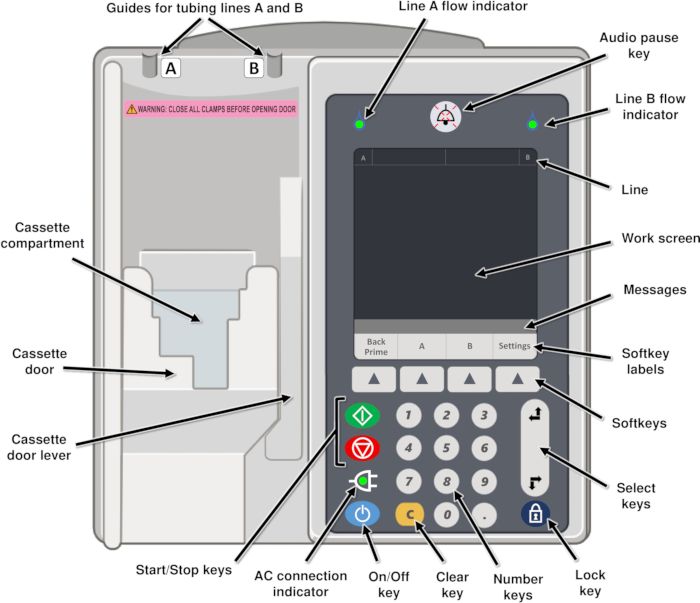
NOTE: A description of the pump interface is provided in Figure 1.
- To program line A, select the corresponding command on the pump and enter the appropriate parameters. The administration of TRT treatments generally uses a total of 100 mL of saline administered over 30-40 min (total TRT administration time).
NOTE: Usual appropriate parameters are 100 mL injection in 40 min (line A) and 50 mL injection overall in 40 min (line B). - To program line B, select the corresponding command on the pump and choose Simultaneous mode (the sum of line A and line B flow rates must not exceed 500 mL/h). The administration of TRT treatments generally requires a volume between 30 and 60 mL to be delivered via line B.
- To avoid using a pre-existing protocol, select Drug list, select No drug select, then press Select. On the dose unit selection screen, select mL/h, then Choose.
- To set the parameters for the various successive administration steps, select Multiple steps and define the parameters for the following consecutive steps:
- Step 1 refers to the initial administration of the radiopharmaceutical for TRT. For this stage, set the volume administered to a value equal to the volume actually present in the vial + 0.5 mL. Set the administration time for this step equal to the total administration time divided by 2.
- Step 2 refers to a pause between initial infusion and rinsing, during which saline from a 10 mL syringe is injected into the empty radiopharmaceutical vial for rinsing, via the 2-way extension line. For the volume and duration of this pause step, set 0.5 mL in 1 min.
- Step 3 refers to the infusion of the saline rinsing flush previously added to the radiopharmaceutical vial. For this step, set the volume administered to a value equal to the volume actually present in the vial + 3 mL (to minimize the liquid waste in the dead volume of the tubing). Set the administration time for this step equal to half the total protocol administration time, minus 1 min.
- The pump indicates that it is ready to stand-by; confirm Yes.
4. Infusion initiation
- Line A connection to a patient
- Connect the end of line A, terminated with a luer lock connector, to the patient's catheter valve.
- Move the mobile shielded screen so that it is in line with the pump and patient and, therefore, protects it from radiation. Start line A to initiate saline infusion to the patient.
- Line B connection to the Targeted Radionuclide Treatment (TRT) vial
- Put on a second pair of single-use gloves. Place forceps, alcohol-soaked swabs, and a venting filter on the tray of the mobile shielded screen.
- Place the shielded container with the TRT vial on the inclined vial stand on the tray of the shielded paravent, then remove the cap from the shielded container. Using the forceps, apply an alcohol-soaked compress and disinfect the septum of the TRT vial. Insert the venting filter into the septum of the TRT vial, ensuring that the needle does not touch the liquid.
- Insert the 19 G spinal needle connected to the end of line B into the septum of the TRT vial. If necessary, rotate the vial on its inclined stand so that the spinal needle remains at the bottom.
- Initiation of radiopharmaceutical infusion.
- Start infusion in simultaneous mode by pressing the green button on the pump. Check that the green lights are flashing and displaying "In progress" for both channels and note the injection start time. Figure 2 provides a schematic representation of the final configuration.
5. End of infusion
- Clamp line A and note injection end time. Disconnect the vial from line B by pinching the wings of the closed system transfer valve.
- Place a sterile swab under the patient's catheter and carefully disconnect line B. Immediately recap line B coming from the pump to avoid any contamination. Eject the perfusion set from the pump and immediately discard it in a shielded waste container.
- Collect the empty TRT vial and return it to the radiopharmaceutical preparation laboratory in the nuclear medicine department.
- Once in the lab, carefully remove the 19 G spinal needle and venting filter from the TRT vial and discard them immediately in a shielded waste container. Using a dose calibrator, inside a shielded cell, measure the residual activity in the TRT vial, so that it can be deducted from the initial activity to be dispensed, and thus calculate the activity effectively administered to the patient.
- Store the TRT vial in a shielded container for decay during a suitable time, depending on the radioelement and residual activity (usually 7-10 half-lives).