This video demonstrates microinjection-assisted delivery of lentiviral vectors into fertilized rat embryos to achieve stable transgene integration for the generation of transgenic rats.
A subscription to JoVE is required to view this content. Sign in or start your free trial.
Method Article
Lentiviral Vector-Based Transduction of Rat Fertilized Embryos
72 views
⸱
August 31st, 2026
In This Article
Abstract
Protocol
All procedures involving animal samples have been reviewed and approved by the appropriate animal ethical review committee.
- Microinjection of lentiviral vectors to one-cell-stage embryo under the zona pellucida
NOTE: Use one-cell-stage embryos with two visible pronuclei for microinjection (Figure 1).- Thaw the lentivirus (LV) aliquot at room temperature and centrifuge at 10,000 x g and room temperature (RT) for 2 min to pellet any remaining cellular debris.
- Microinjection setup
- Prepare glass holding pipettes (borosilicate glass capillary) using a microforge. Pull the glass capillary over a flame to produce a 5–10 cm tip. Break the pipette leaving a ~4 cm tip. The outside diameter should be ~80–120 µm.
NOTE: Ensure that the pipette tip is perfectly straight and smooth. - Assemble the pulled pipette in a microforge with the tip in front of the heating filament. Heat the filament very close to the pipette tip and allow it to shrink to a diameter of ~15 µm (approximately 20% of embryo size). Position the pipette perpendicularly to the heating filament, 2–3 mm from the pipette tip, and begin to heat. The glass will soften. Heat until it reaches a 15° angle.
- Prepare microinjection borosilicate glass capillaries with a filament using a pipette puller. Insert the capillary in the pulling chamber. Run a ramp test (for the first time for new glass and every time after changing the filament). Set the Heat to the ramp value -10, Pull to 100, Velocity to 150 and Time to 100.
NOTE: Modify the parameters to obtain an optimal injection capillary. - Under a biosafety laminar flow hood, load approximately 2 µL of the viral solution into the microinjection pipette with a microloader tip.
- Prepare a microinjection dish (lid of 60 mm Petri dish) with a 100 µL drop of M2 medium (in the middle), covered by liquid paraffin or mineral oil.
- Mount the holding pipette and microinjection capillary that is loaded with viral solution to a micromanipulator and microinjection dish under an inverted microscope.
- Prepare glass holding pipettes (borosilicate glass capillary) using a microforge. Pull the glass capillary over a flame to produce a 5–10 cm tip. Break the pipette leaving a ~4 cm tip. The outside diameter should be ~80–120 µm.
- Perform the microinjection
- Transfer 15–20 one-cell-stage embryos to the M2 drop on the microinjection dish. Hold the embryo using a holding pipette.
- Using 400x magnification, inject the LV solution under the zona pellucida to the perivitelline space using the glass capillary that is connected to an automatic injector. Hold the capillary under the zona pellucida for a moment.
NOTE: Using gentle positive pressure, the viral solution will flow continuously out of the injection capillary, but the volume of the suspension that is delivered cannot be controlled. - Using a fine pipette, return the embryos to the culture dish in the incubator at 37 °C in a 5% CO2 atmosphere. The number of injections of one zygote may vary and can be adapted based on the viral vector concentration.
NOTE: The injected embryos can be transferred to foster mothers at the one-cell stage or incubated O/N in M16 medium before being transferred at the two-cell stage. Prolonged in vitro culture of rat embryos should be avoided.
Access restricted. Please log in or start a trial to view this content.
Results
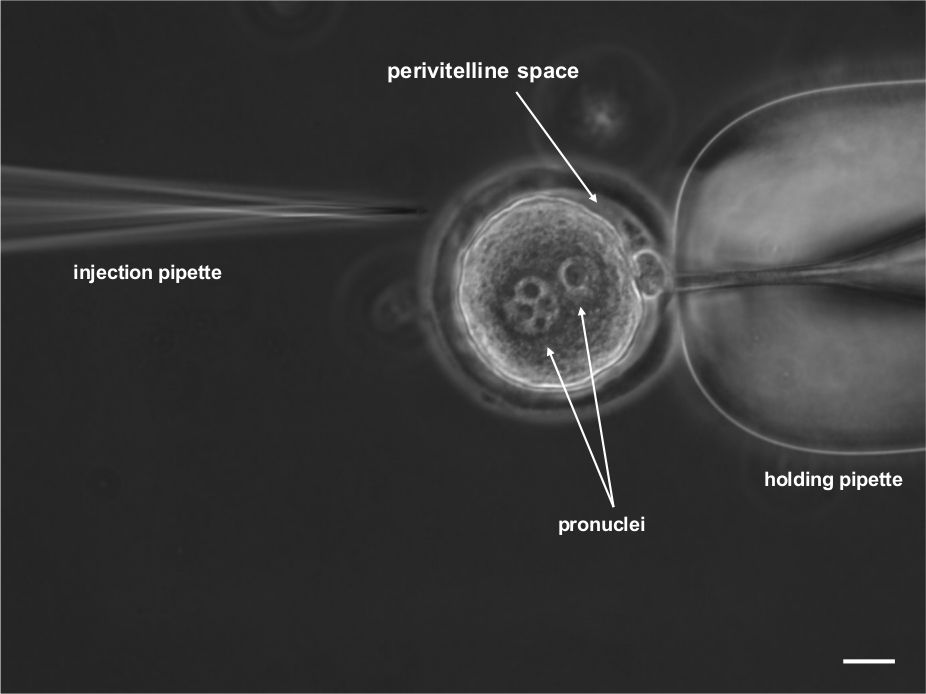
Figure 1. Microscopic photograph of one-cell-stage rat embryo that was prepared for subzonal lentiviral vector injection. The embryo was immobilized with a holding pipette. Two pronuclei that contained maternal and paternal ...
Access restricted. Please log in or start a trial to view this content.
Materials
| Name | Company | Catalog Number | Comments |
|---|---|---|---|
| Aspirator tube assemblies for calibrated microcapillary pipettes | Sigma | A5177-5EA | |
| Borosilicate glass capillaries with filament GC100TF-15 | Harvard Apparatus Limited | 30-0039 | Injection capillary |
| CELLSTAR Tissue Cell Culture Dish 35-mm | Greiner Bio-One | 627160 | |
| CELLSTAR Tissue Cell Culture Dish 60-mm | Greiner Bio-One | 628160 | |
| Mineral Oil | Sigma | M8410-500ML | |
| Inverted Microscope | Zeiss | Axiovert 200 | |
| M2 medium | Sigma | M7167 | |
| VacuTip | Eppendorf | 5175108 | Holders capillary |
| M16 medium EmbryoMax | Sigma | MR-016-D |
