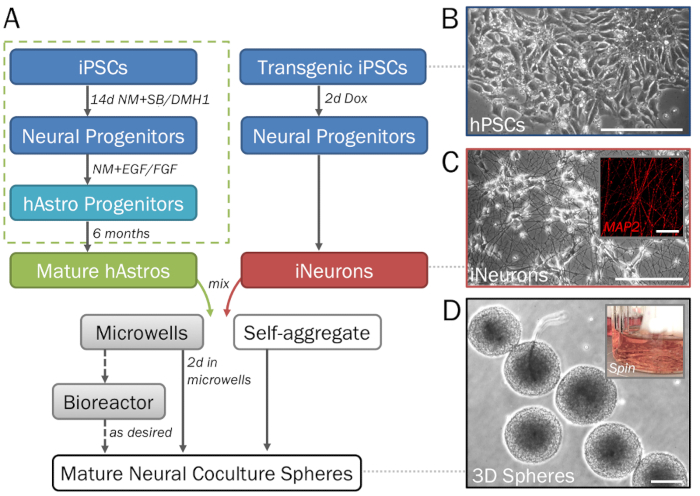
Ethic approvals were obtained when performing the experiments.
1. Cell Culture and Reagent Preparation
- Prepare coated plates for cell culture.
- Dilute extracellular matrix (ECM) coating solution with Dulbecco's Modified Eagle Medium/Nutrient Mixture F-12 (DMEM/F12) media to prepare a 1 mg/mL stock solution. Aliquot the diluted ECM stock solution into 30 conical tubes of 3 mL each and immediately store in -20 °C. For a working solution, resuspend 3 mL of ECM stock into 33 mL of pre-chilled DMEM/F12 media, bringing the total volume to 36 mL for a concentration of 80 µg/mL.
- Coat 1 mL per well of a 6-well cell culture plate with ECM working solution. Add an additional 1 mL DMEM/F12 per well (if necessary) to ensure that the surface of the well is fully covered. Allow the coated 6-well cell culture plates to sit at room temperature for at least 1 h before use.
NOTE: Coated plates may be stored in the incubator or at 4 °C for up to 2 weeks.
- Prepare media formulations, growth factors, and small molecules.
- To prepare 500 mL of human pluripotent stem cell (hPSC) medium, add 20x and 500x supplements according to manufacturers' instructions.
- To prepare 500 mL of neural medium (NM), add heparin to a final concentration of 2 mg/mL, 1x of antibiotic/antimycotic solution, 1x B27 supplement or 1x N2 supplement to a 500 mL bottle of DMEM/F12 with L-glutamine supplement as previously detailed.
- To prepare a 10 mM (1,000x) stock solution of Rho-Kinase Inhibitor Y27632 (Y), add 10 mg of powder into 3 mL of phosphate buffered saline (PBS). Filter sterilize, aliquot, and store at -20 °C. Use at a 10 µM working concentration in media.
- To prepare a 20 mM (10,000x) stock solution of SB431542, add 10 mg of powder into 1.3 mL of dimethyl sulfoxide (DMSO). To prepare a 2 mM (1,000x) stock solution of DMH1 (4-[6-(4-Isopropoxyphenyl)pyrazolo[1,5-a]pyrimidin-3-yl]quinoline, 4-[6-[4-(1-Methylethoxy)phenyl]pyrazolo[1,5-a]pyrimidin-3-yl]-quinoline), add 10 mg of powder into 13.1 mL of DMSO. Filter sterilize, aliquot, and store each solution at -20 °C. Use each at a 2 µM working concentration in media (NM + SB431542 + DMH1).
NOTE: This protocol recommends 2 µM working concentrations of both SB431542 and DMH1 based upon our observations and reports from others stating that this concentration effectively promotes neural induction from hPSCs. Higher concentrations have also been reported. Additionally, with alternative media, it has also been shown that small molecules are not necessary for high neural conversion. Thus, working concentrations will vary depending on alternative cell culture environments, and optimal concentrations should be tested by individual researchers.
- To prepare a stock solution of doxycycline hydrochloride (Dox), first dissolve powder in DMSO to 100 mg/mL and store at -20 °C. Further dilute it to make a 2 mg/mL (1,000x) stock solution in PBS and store at -20 °C. Use at 2 µg/mL working concentration in media; e.g., add 50 µL Dox to 50 mL of NM (NM + Dox).
Note: Do not re-freeze solutions after thawing.
2. Generation of Neural Subtypes from Human Induced Pluripotent Cells (hPSCs)
NOTE: All cell cultures should be maintained in an incubator with 5% CO2 at 37 °C. These cultures are maintained at room oxygen levels, though lower levels may be utilized.
- Generate and maintain astrocyte progenitors (hAstros) from hPSCs.
NOTE: This section provides a brief and simplified differentiation protocol. (Figure 1A, dotted green box).
- Seed clusters of hPSCs (Figure 1B) onto ECM-coated 6-well plates with 2 mL of hPSC medium + Y per well. Feed the stem cells every day until they are about 50% confluent and split as needed.
- To split hPSCs, add 1 mL of passaging reagent to wells and aspirate after 1 min. Incubate cells at room temperature for 5 min, add 1 mL of hPSC medium, and split aggregates 1:10 onto new ECM-coated wells in 2 mL of hPSC medium + Y per well.
- Maintain the stem cells until they are about 50% confluent, then change media to NM + SB431542 + DMH1 to induce neural differentiation (day 0). When cells are about 95% confluent, split 1:6 into new ECM-coated wells in the same medium.
- On day 14, dissociate the cells with detachment solution and transfer to a non-coated flask with Y to promote formation of aggregates.
NOTE: The addition of Y is utilized to promote cell survival and sphere formation but is not included during every feed.
- For the generation of neuronal progenitors and neurons (hNeurons), use these day-14 cells to differentiate as described for transgenic cells.
- Generate and maintain inducible neurons (iNeurons) from hPSCs.
- Seed transgenic hPSCs (with a stable doxycycline-inducible neurogenin 2 transgene) on ECM-coated 6-well plates with 2 mL of hPSC medium + Y per well (as described above for non-transgenic lines). Feed everyday with 2 mL of media per well until they are ready to lift at 70% confluency. Split cells as described above.
- When cells are about 35% confluent, add NM + Dox to induce differentiation into iNeurons.
NOTE: Cells will transition into neuronal progenitors but will not yet extend neurites.