A subscription to JoVE is required to view this content. Sign in or start your free trial.

Method Article

Cell Fate Reprogramming of Nematode Germ Cells into Neurons

728 views

⸱

July 8th, 2025

In This Article

Abstract

Source: Kolundzic, E., et al. Application of RNAi and Heat-shock-induced Transcription Factor Expression to Reprogram Germ Cells to Neurons in C. elegans. J. Vis. Exp. (2018).

This video demonstrates cell fate reprogramming of nematode germ cells into neurons. Transgenic larvae of the nematode Caenorhabditis elegans are subjected to RNA interference (RNAi) to knock down a specific chromatin-regulating factor, making the germ cells of their progeny more susceptible to cell fate reprogramming. Heat shock is applied to the progeny, inducing the germ cells to express a neuron-specific transcription factor that triggers their transformation into neurons, which is identified using an expressed fluorescent reporter.
Protocol

All procedures involving animal models have been reviewed by the local institutional animal care committee and the JoVE veterinary review board.

1. Solution Preparation

  1. NGM-Agar plates (1 L)
    1. Add 3 g of NaCl, 2.5 g of peptone media (e.g., Bacto-Peptone), and 20 g of agar. After autoclaving, add 1 mL of cholesterol (5 mg/mL in 95% ethanol [EtOH] stock), 1 mL of 1 M MgSO4, 1 mL of 1 M CaCl2, 25 mL of 1 M K2PO4, and 1 mL of amphotericin B (2.5 mg/mL stock).
  2. NGM-Agar RNAi plates (1 L)
    1. Add 3 g ....

Access restricted. Please log in or start a trial to view this content.

Results

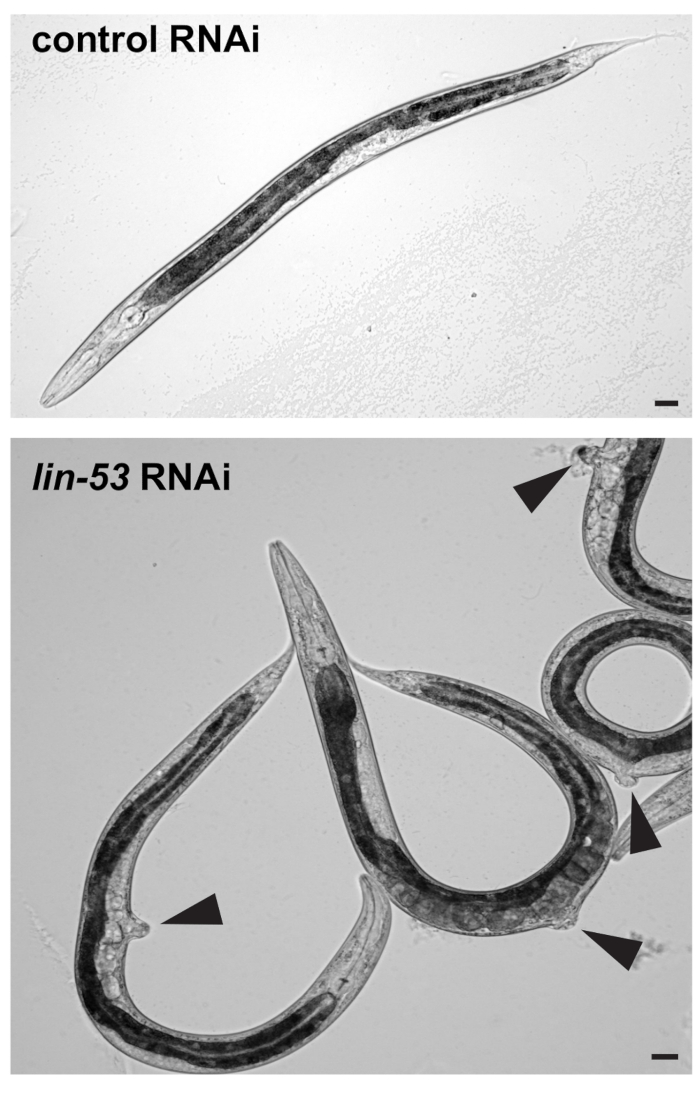
RNAi effect on nematodes; control vs lin-53 RNAi treatment; microscopy experiment comparison.
Figure 1: pvul phenotype caused by RNAi against lin-53. (Top) Differential interference contrast (DIC) picture of L4/young adult stage F1 progeny worms derived from control or lin-53 RNAi treated mothers. Scale bars = 20 µm. (Bottom) Ani.......

Access restricted. Please log in or start a trial to view this content.

Disclosures

No conflicts of interest declared.

Materials

List of materials used in this article
NameCompanyCatalog NumberComments
Chemicals
Agar-Agar, Kobe IRoth5210.1
Bactopeptone A. Hartenstein GmbH211 677Peptone Media
Yeast extract AppliChemA1552,0100
Amphotericin BUSBiologicalA2220
CaCl2Merck Biosciences208290
CholesterolRoth8866.2
GelatineRoth4275.3
IPTGSigma15502-10G
K2PO4RothT875.2
KH2PO4Roth 3904.2
MgSO4VWR2,51,63,364
Na2HPO4RothP030.1
NaClRoth9265.1
NaClORoth9062.3
NaOH (5 N)Roth KK71.1
TrisRothAE15.2
CarbenicillinRoth634412
TetracyclineRoth2371.2
Incubators
Incubator New Brunswick Scientific C24M1247-0052for heat-shock
Incubator Sanyo MIR-55534210for maintenance of worm strains at 15 °C or 25 °C
Microscopes
Fluorescence microscopeM205 FALeica
Microscope (Imaging) + cameraAxio Imager 2Zeiss
Microscope (Imaging) + cameraSensicamPCO
StereomicroscopeSMZ745Nikon
Bacterial strains
Escherichia coli HT115F-, mcrA, mcrB, IN(rrnD-rrnE)1, rnc14::Tn10(DE3 lysogen: lavUV5 promoter -T7 polymerase) (IPTG-inducible T7 polymerase) (RNAse III minus).
Escherichia coli OP50 Uracil auxotroph E. coli strain
Worm strains
BAT28: otIs305 (hsp16.2prom::che-1::3xHA) ntIs1 (gcy-5prom::gfp) V.derived from OH9846 by 4x times more back crossing with N2
RNAi Clones
lin-53SourceBioscienceID I-4D14Ahringer library 16B07 ChromI, K07A1.12
empty vetor: L4440Addgene #1654
Misc.
Worm pick self-made using a pasteur pipette and a platinum wire

Explore More Articles

RNA InterferenceHeat Shock InductionTranscription Factor ExpressionFluorescent Reporter ProteinChromatin Regulating FactorCaenorhabditis elegansProgeny ScreeningFluorescence Microscopy