A subscription to JoVE is required to view this content. Sign in or start your free trial.

Method Article

Establishing a Whole-Cell Configuration through the Patch Clamp Method

2.2K views

⸱

July 8th, 2025

In This Article

Abstract

Source: Segev, A. et al., Whole-cell Patch-clamp Recordings in Brain Slices. J. Vis. Exp. (2016)

This video demonstrates the whole-cell patch clamp technique in a mouse brain slice. This technique establishes a stable connection between micropipette and neuron membrane, which is further disrupted to establish a whole-cell configuration to study the neuron's health and physiological responses.
Protocol

All procedures involving animal models have been reviewed by the local institutional animal care committee and the JoVE veterinary review board.

1. Slice Preparation

  1. Construct or obtain a slice recovery chamber.
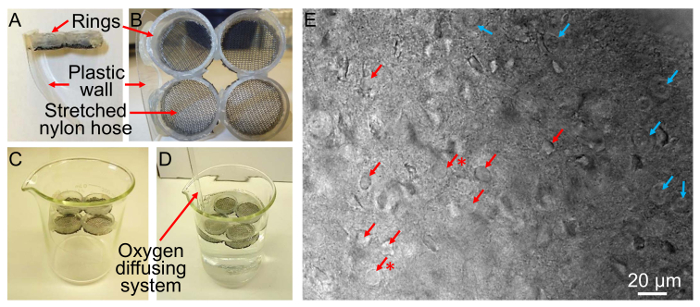
    NOTE: The principle for a recovery chamber is straightforward and can be made in the laboratory (Figure 1). Briefly, the chamber is a receptacle in which a basket is inserted to hold the brain slices at a level that is lower than the surface of artificial cerebrospinal fluid (aCSF).
  2. As an example, obtain ....

Access restricted. Please log in or start a trial to view this content.

Results

Oxygen diffusion experiment setup with nylon hose, diffusion system, and cellular structure analysis.
Figure 1. Custom-made Recovery Chamber (A-D) and a Picture of a Brain Slice at 400X Showing Healthy and Dead Neurons (E). A-D) The procedure to make a custom recovery chamber is described in step 2.1. E) Picture of NAc medial shell MSN.......

Access restricted. Please log in or start a trial to view this content.

Disclosures

No conflicts of interest declared.

Materials

List of materials used in this article
NameCompanyCatalog NumberComments
Isolated pulse stimulus generatorA.M.P.IMaster-8
Isolation unit (ISO-Flex)A.M.P.IISO-Flex
Computer controlled Amplifier Molecular DevicesMulticlamp 700B
Digital Acquisition systemMolecular DevicesDigidata 1500
MicroscopeOlympusBX-51
MicromanipulatorSutter InstrumentsMPC-200
Chamber and in-line HeaterWarner InstrumentsTC-344B
Vibratome SlicerLeica VT1000 S
Micropipette PullerNarishigePC-10
Imaging CameraQ ImagingQIClick-F-M-12
Narishige pipette puller PC-10NarishigePC-10
Glass capillariesWPITW150F-3
Slice hold-down (harp)Warner Instruments64-0255
Slice ChamberWarner InstrumentsRC-26
Nonmetallic syringe needleWorld Precision InstrumentsMF28G67-5
Syringe filtersNalgene176-0045
Glue GunHome Depotvarious
Gas dispersion tubeAce Glass Inc.various
Decapitation scissorsHome Depot100649198
Scalpel Handle #3World Precision Instruments500236
Small straight sharp tips scissorsWorld Precision Instruments14218
Vessel canulation forceps World Precision Instruments500453
Curved hemostatic forcepsWorld Precision Instruments501288
Economy Tweezers #3World Precision Instruments501976-6
SpatulaFisher Scientific14357Q
Scooping spatulaFisher Scientific14-357Q
Petri dishFisher Scientific08-747B
Filter paperLab DepotCFP1-110
Solutions
K-Gluconate internal solution (pH 7.2–7.3, 280–290 mOsm)
K D-gluconate, 120 mMSigma Aldrich/variousG4500
KCl, 20 mMSigma Aldrich/variousP3911
HEPES, 10 mMSigma Aldrich/variousH3375
EGTA, 0.2 mMSigma Aldrich/variousE4378
MgCl2Sigma Aldrich/variousM8266
Na2GTP, 0.3 mMSigma Aldrich/variousG8877
MgATP, 2 mMSigma Aldrich/variousA9187
Standard artificial cerebrospinal fluid (ACSF, osmolarity ≈ 300-310 mOsm)
KCl, 2.5 mMSigma Aldrich/variousP3911
NaCl, 119 mMSigma Aldrich/variousS7653
NaH2PO4-H2O, 1 mMSigma Aldrich/variousS9638
NaHCO3, 26.2 mMSigma Aldrich/variousS8875
Glucose, 11 mMSigma Aldrich/variousG8270
MgSO4-7H2O, 1.3 mMSigma Aldrich/various230391
CaCl2-2H2O, 2.5 mMSigma Aldrich/variousC3881
Additional compounds used for solutions preparation
KOHvarious
Kynurenic acidSigma Aldrich/variousK3375

Explore More Articles

Whole-cell Patch ClampBrain Slice RecordingMicropipette TechniqueGigaseal FormationMembrane RuptureElectrophysiology SetupNeuronal ViabilityCerebrospinal FluidPressure ControlAmplifier Commander