Method Article

Recording Auditory Brainstem Responses in a Rat Pup

July 8th, 2025

In This Article

Abstract

Loading...
$$\rightleftharpoonup{xx}$$ $$\longleftharp{xx}$$, $$\longrightharp{xx}$$,

Source: Chang, A. et al., Auditory Brainstem Response and Outer Hair Cell Whole-cell Patch Clamp Recording in Postnatal Rats. J. Vis. Exp. (2018).

This video demonstrates a method for recording auditory brainstem responses (ABRs) from rat pups. It outlines the steps for electrode placement, sound stimulus application, and signal processing analysis in the brainstem to assess neural responses.

Protocol

Loading...
$$\rightleftharpoonup{xx}$$ $$\longleftharp{xx}$$, $$\longrightharp{xx}$$,

All procedures involving animal models have been reviewed by the local institutional animal care committee and the JoVE veterinary review board.

1. Auditory Brainstem Response (ABR) Recording

  1. Anesthetize Sprague Dawley (SD) rats (1-14 day old pups and 2-month-old adults, both sexes) with a single injection of 1.5% sodium pentobarbital (22 mg/kg for pups and 30 mg/kg for adults, intraperitoneal (i.p.).
  2. Place the anesthetized animal in a polyethylene-foam mold to immobilize the animal's body. Place the animal on an anti-vibration table in a sound-attenuating room. Keep the animal's body temperature at 37.5 °C with a heating pad.
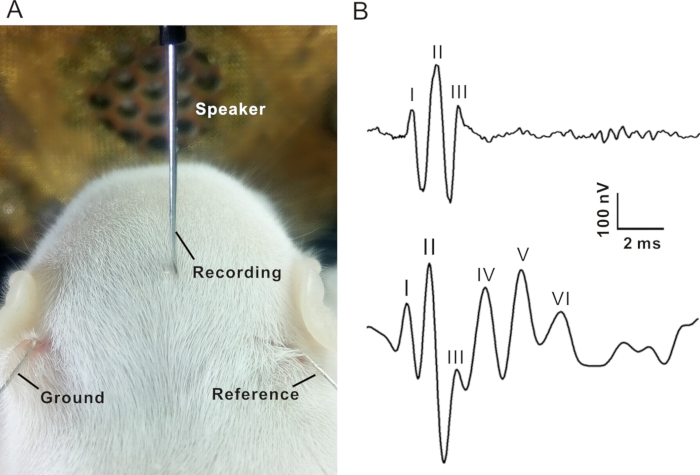
  3. Wipe the head area with 70% (vol/vol) ethanol. By using a fine scissors, make a 1-2 mm incision ventrolateral to the external pinna to place the reference electrode or ground. A subdermal needle electrode (recording electrode) is located over the skull vertex (Figure 1A).
  4. Using the function generator, generate calibrated tone bursts (1 ms rise/fall, 3 ms plateau) of various frequencies (2, 4, 8, 16, 24, and 32 kHz) and intensities (decreased from 85 to 10 dB SPL in 5 dB step). Vary the frequency and amplitude manually or using a computer. Deliver sound stimuli through an electrostatic speaker located 10 cm away toward the head of the animal.
  5. Filter (100-1,000 Hz), amplify, and average (256 times) the sound elicited potential using a multi-function processor to get the ABRs. The ABR traces are monitored online and stored for offline analysis. It takes about 40 min to complete the ABR recording from one animal.
    NOTE: Usually, three to seven peaks (wave I to wave VII) with latencies less than 15 ms can be identified (Figure 1B). The ABR threshold is defined as the minimum sound level at which wave I and II could be detected.
  6. Euthanize before the animals awake from anesthesia (with an intraperitoneal injection of 0.3 mL 1.5% sodium pentobarbital).
Access restricted. Please log in or start a trial to view this content.

Results

Loading...
$$\rightleftharpoonup{xx}$$ $$\longleftharp{xx}$$, $$\longrightharp{xx}$$,

Electrophysiology diagram; rat brain recording setup with speaker; neural signal waveforms.
Figure 1. Auditory brainstem response recording. (A) The recording electrode was inserted into the scalp between two ears. Ground and reference electrodes were placed under the left and right pinna, respectively. An open field speaker was placed...

Access restricted. Please log in or start a trial to view this content.

Disclosures

Loading...
$$\rightleftharpoonup{xx}$$ $$\longleftharp{xx}$$, $$\longrightharp{xx}$$,
No conflicts of interest declared.

Materials

List of materials used in this article
NameCompanyCatalog NumberComments
Pentobarbital sodiumSigmaP37611.5% in water
SD ratExperimental Animal Center of Southern Medical University
ES1 speakerTucker-Davis Technologies
TDT system 3Tucker-Davis Technologies
SigGenRP softwareTucker-Davis Technologies
BioSigRP softwareTucker-Davis Technologies
jClampScientific Solutions
Low-Noise Data Acquisition SystemAxon 1440A

Reprints and Permissions

Request permission to reuse the text or figures of this JoVE article

Request Permission

Tags

Auditory Brainstem ResponseElectrode PlacementSound StimulusSignal ProcessingAnti vibration TableHeating PadSubdermal ElectrodeTone BurstsMultifunction Processor

Related Articles