We present a user-friendly, high-throughput operant system for the evaluation of pain behaviors in awake, conscious rodents. The Orofacial Pain Assessment Device (OPAD) can assess pain through a reward/conflict paradigm thus providing a more humane way of testing. This protocol will yield more clinically relevant and translational data from rodents.
Method Article
Use of the Operant Orofacial Pain Assessment Device (OPAD) to Measure Changes in Nociceptive Behavior
In This Article
Summary
Abstract
We present an operant system for the detection of pain in awake, conscious rodents. The Orofacial Pain Assessment Device (OPAD) assesses pain behaviors in a more clinically relevant way by not relying on reflex-based measures of nociception. Food fasted, hairless (or shaved) rodents are placed into a Plexiglas chamber which has two Peltier-based thermodes that can be programmed to any temperature between 7 °C and 60 °C. The rodent is trained to make contact with these in order to access a reward bottle. During a session, a number of behavioral pain outcomes are automatically recorded and saved. These measures include the number of reward bottle activations (licks) and facial contact stimuli (face contacts), but custom measures like the lick/face ratio (total number of licks per session/total number of contacts) can also be created. The stimulus temperature can be set to a single temperature or multiple temperatures within a session. The OPAD is a high-throughput, easy to use operant assay which will lead to better translation of pain research in the future as it includes cortical input instead of relying on spinal reflex-based nociceptive assays.
Introduction
Chronic, uncontrolled pain remains a major public health problem and novel analgesic treatments often fail to translate from the bench to bedside. This lack of success is partly due to the use of inefficient behavioral assays in reflex based measures of pain which do not necessarily or completely model the human pain condition 1,2, and specifically, a lack of a reliable, high-throughput, commercially available, in vivo pain-assessment assay for both rats and mice. We present here a high throughput, easy to use version of our operant based nociception assay. This new system is based on our previous operant orofacial pain assay which has been demonstrated to be sensitive to detecting different pain modalities including heat, cold, and mechanical 3,4,5. From these measures, a wide variety of fields have been studied, including analgesics 6,3,4,5,7, pain conditions like inflammation, hyperalgesia, and allodynia 3,8, trigeminal neuralgia 9, and peripheral nociceptive modulation via TRP channels with capsaicin, resiniferatoxin, menthol, and icillin 8,10,5,11. Psychological effects like anxiety-induced modulation of pain 12 and the placebo effect 13have also been demonstrated with orofacial operant testing suggesting it may be appropriate for measuring the full experience of pain and not simply nociception.
The Orofacial Pain Assessment Device (OPAD) uses a reward/conflict assay which allows a rodent to choose between receiving a reinforcing reward or escaping an aversive stimulus thus controlling the amount of pain it feels during a session 14,15. Rodents are first trained to press their faces into temperature controlled thermodes in order to gain access to a food bottle containing a liquid reward. After training, the stimulus temperature can be heated or cooled and differences in responding can indicate the level of nociception or analgesia the animal perceives. The OPAD is also capable of rapid changes in temperature which allows baseline testing and the assessment of pain at hot and cold temperatures within a single testing session. Here we present a simple protocol which highlights the OPAD's ability to detect changes in pain caused by heat, cold, and the TRPV1 agonist capsaicin 16. Capsaicin is used below as a thermal sensitizing agent because it has several benefits to this assay as it is non-tissue damaging and has been demonstrated previously to induce facial allodynia and hyperalgesia in rodent models 8. We will demonstrate how the OPAD software can rapidly obtain, analyze, graph, and perform statistical analyses on rodent behavioral data.
Protocol
Here the use of the OPAD (Stoelting Co., Wood Dale, IL) is described in general terms for an example experiment using capsaicin. The operator has the freedom to program numerous experiments with many options and pain models though. For instance, the administration of analgesics reduce nociceptive measures 6,3,4,5,7 and other pain models like chronic constriction injury produce and inflammation increased nociceptive behaviors 3,9. These models are easily adaptable to the following protocol.
For all experiments, maleSprague-Dawley rats (250-300 g, Charles River, Raleigh, NC) were used. These were housed in pairs in 22 °C temperature and 31% humidity controlled rooms with a normal 12-hr light/dark cycles (6am-6pm lights on) and had free access to food and water except when fasted. Behavioral sessions were performed during the light phase. These facilities were AAALAC accredited and all procedures were approved by the University of Florida IACUC.
1.Training and Baseline Sessions
- Food fast rodents the night before each OPAD session (ex. 15+/- 1 hr for this experiment).
- Rodents must first be trained until consistent behavior at non-aversive temperatures (ex. 33-37 °C) is observed. Generally, about six sessions (three times a week for two weeks) is sufficient to train mice or rats to lick about 600-1,000 or 2,000 times per session, respectively.
2. Pretest Preparation and Capsaicin Treatment
- Hairless rodents are best for all operant procedures, if this is not possible, rodents must have their facial hair (buccal hair only and not vibrissae pad/whiskers as this has an effect on a rodent's navigation) removed 1-2 days before testing for accurate recording of the behavior.
- Buccal hair acts as a temperature insulator and makes heat and cold less nociceptive. To remove hair, anesthetize rats, add eye ointment, shave cheek hair with clippers, apply hair removal cream, wait 2-4 min, then wash with water. See Neubert et al. 3 for full methodology.
- On the day of testing, anesthetize the animal (ex. 1-2.5% isoflurane inhalation) and place opthalamic vet ointment on both eyes to prevent them from drying out and to keep any topical drug treatments from getting in the eye.
- Apply capsaicin cream (0.1%) bilaterally on the exposed cheeks with a sterile cotton swab. Wait 5 min. Wipe off cream with gauze pads soaked in warm water (at about 40 °C). Wipe cheeks off with an alcohol swab and set a timer for 30 min.
- Allow the rodent sufficient time to recover from anesthesia before returning it to the cage. Wait until it can raise its head in a sternal posture in order to prevent the aspiration of cage bedding.
3. Programming the OPAD System for Protocols and Experiments
- The key innovation of the OPAD system to behavioral testing is the OroFacial software, an ANY-maze (Stoelting Co., Wood Dale, IL) driven system that allows the user to program and create new experiments.
- A general example of how to program a simple experiment is provided below, but many more options for temperature ramping protocols and pain models other than capsaicin are available.
- Experiments can be designed and saved at any point. Turn on OPADs and open software. Turn on white noise to control for ambient noise. Under "File" select New Experiment. Under the subheading "Protocol" name the protocol and select whether to be blinded.
- Under "OPAD cages" select "New OPAD cage" then "Add all connected OPAD cages." Under "Outputs" select "Temperature Controllers" then "Thermal element". Adjust starting temperature (for example, a neutral 33-37 °C).
- If needed, adjust ramping temperatures under "OPAD temperature cycle." In order to change the temperature from neutral to hot to cold make adjustments here.
- For "1", "Set temperature to (°C)" = 45, "Ramp duration" = 30 sec, and "Remain at value for" = 3 min. For "2", 33, 30 sec, and 3 min. For "3", 7, 60 sec, and 3 min. For "4", 33, 60 sec, and 3 min. Check the box for "After the following period of time:" and select 3 min.
- Under "Fields" add any extra notes about the subjects. For example, make an area for animal ID by selecting "New Field" and change the name to "Animal ID." Then choose "Animals", "Text", and "Use this field as the animal ID."
- Under "Stage", the OPAD will automatically set a "First stage." Set duration of test period and name the stage if needed. For this ramping session, set this to 18 min.
- A note on stages: for most experiments, behavioral sessions shouldn't last for longer than 10-20 min. After that, rodents are satiated. For experiments over several days, additional stages can be added for each day to make the data analysis simpler.
- Under "Calculations" select "New Calculation" and name it "L/F" for lick/face ratio. In the section labeled "Enter the calculation in the area below" adjust to say "Lick : number of activations / Contact : number of activations".
- To create time periods for a simpler data analysis select "Analysis" and "New time period". Name one "33 °C" and select the box for "This period is the same in all stages" For "Starts at:" write 0 and for "Ends at:" put 3 min.
- Repeat the above step for each time period. Name: "Ramp 33-45 °C." Starts at: 3 min. Ends at: 3.5 min. "45 °C", 3.5 min, 6.5 min. "Ramp 45-33 °C", 6.5 min, 7 min. "33 °C", 7 min, 10 min. "Ramp 33-7 °C", 10 min, 11 min. "7 °C", 11 min, 14 min. "Ramp 7-33 °C", 14 min, 15 min. "33 °C", 15 min, 18 min.
- Save and name the protocol. Note: saved protocols can be re-used in new experiments.
4. Running the Assay
- Prepare a room temperature reward mixture and place in OPAD bottles. A 2:1 ratio of water:sweetened condensed milk works well although sucrose or saccharin solutions may also be used.
- Place liquid catch tray, Plexiglas cage, and metal flooring grate on the OPAD machine. Attach wiring to cage.
- Place reward bottle on stand and adjust so the spout can be reached by the rodent. Initially, the bottle can be placed further back in the cage then withdrawn to produce better facial contacts.
- Load the experiment into the OPAD software. Add the number of animals to be tested. Under the subheading "Experiment" add a "Title" and then add the treatment groups (capsaicin and control). Add the number of animals in each group.
- Under the subheading "Tests", select "Animal treatments and data". Add the letter of the treatment (A, B, C, etc.) and the animal ID. The boxes should now have the designated animal ID on their screens.
- Press the button on the OPAD box. This will adjust the thermodes to the right temperature. When the light goes orange, place the rodent inside and press the button again. For this experiment, rats will be started 30 min after the capsaicin cream was wiped off.
- The green light will turn on. Adjust the distance the bottle is from the box so the rat must make contact with the thermodes on its buccal, not vibrissa, region to be able to lick. Proper adjustment will result in a solid red box for licking above an outlined orange box for contacts.
- Proper placement of the reward bottle is vital for the assay. If the bottle is too close the rat will either lick without making a contact or to touch its nose to the reward bottle so that many licks will appear as only one (denoted by an outlined red box for licks instead of a solid box).
- Once the testing session is over the OPAD will alert the experimenter with a tone. Return the rodent to its cage. If another rodent is to be tested afterward the box will indicate its Animal ID. Repeat steps 4.5-4.7 as needed until the experiment is complete.
5. Analyzing, Graphing, and Statistical Analysis of Data with OPAD Software
- Under the subheading "Results" select whether to see a text, graph, or statistical analysis report.
- In the "Graph report settings" box, select which variable to examine. For instance, under "Calculation results" check the "L/F" box.
- Specify "On the x-axis show" as "Time period" and "Show different series for" as "Treatment." Select "View the report". Saving, printing, copying, or emailing the report can be done at this time. Certain data points may be excluded in the box below the grouping step if needed.
- Under the subheading "Data" is an adjustable listing of the raw data from the experiment in spreadsheet form if needed. Note: all the data is now saved and can be manipulated and analyzed at a later time.
6. Clean Up
- Shut off the machine and remove cage wiring. Wash and sanitize the grate, box, bottle, and liquid tray. These components can be washed by hand or dishwasher.
Results
Typical results are illustrated for a single rodent's behavior on the OPAD in Figures 1A-D. The number of licks is high for every segment of the session at the neutral 33 °C temperature, but low for aversive ones (45 °C and 7 °C) as illustrated in Figure 1A. As Figure 1B demonstrates, long bouts of contact are made at 33 °C as is typical for non-nociceptive stimulus temperatures. The duration decreases and the number of contacts increase during periods where the temperatures are painful. Figure 1C is a diagram of the ramping protocol the OPAD was programmed to use for all test sessions. Figure 1D displays the total amount of reward ingested over time in grams. Similarly to the number of licks, animals prefer the neutral temperatures over the painful ones. The lick/face ratio (L/F) for the baseline session was calculated by the OPAD and is illustrated in Figure 1E. This ratio is much higher during the three non-painful 33 °C sessions (20-46 licks per facial contact) than at the painful sessions of 45 °C (3 licks per facial contact) and 7 °C (1 lick per facial contact). A Repeated Measures One-Way ANOVA was significant (F(4,52)=6.2182, p<0.001) for an effect of temperature on the L/F ratio. Bonferroni's test were significant when comparing 33 °C vs. 7 °C (p<0.05), 45 °C vs. 33 °C (2) (p<0.01), and 33 °C (2) vs. 7 °C (p<0.01). N=16 for all temperatures. In Figure 1F the capsaicin treated rodents (N=8) were not significantly different from naive rats (N=8) at any of the neutral 33 °C temperatures. Capsaicin treated rodents did have a significantly lower L/F ratio at 45 °C (t-test, t(13)=2.9350, p=0.012). The capsaicin group had higher L/F ratios at 7 °C, but this was not significant.
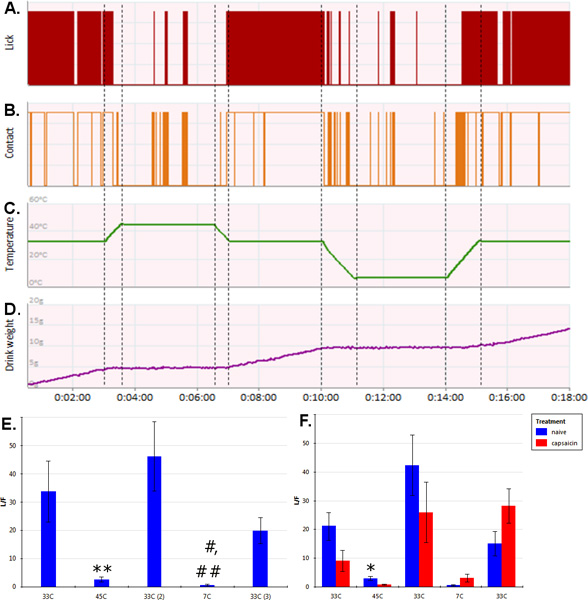
Figure 1. Measuring nociception with the OPAD. A single rodent's behavior on the OPAD is graphed for A) number of licks, B) contacts, C) temperature of the thermode during the session, and D) reward intake in grams. E) The lick/face ratio is high during the three non-painful 33 °C sessions and is significantly lower at the painful sessions of 45 °C and 7 °C (Repeated Measures One-Way ANOVA, F(4,52)=6.2182, p<0.001, Bonferroni's test 33 °C vs. 7 °C (p<0.05, #), 45 °C vs. 33 °C (2) (p<0.01, **), and 33 °C (2) vs. 7 °C (p<0.01, ##). F) Capsaicin treated rodents had a significantly lower L/F ratio at 45 °C (t-test, t(13)=2.9350, p=0.012, *) but at none of the neutral temperatures. N=16 for 1E and N=8 for capsaicin and N=8 for naive for 1F. Click here to view larger figure.
Discussion
The OPAD system is an easy to use, high throughput assay capable of detecting changes in pain perception in rodents. The high throughput nature of this system means that numerous animals can be tested in a single day by a single person. This is due to the OPAD software system as it allows up to 16 boxes to be run concurrently on a single computer. This means that after the initial setup time, about 48 operant runs (at 18 min per run) can be performed an hour, even more if the session time is set to less time per stage. This allows for pain testing in hundreds of animals a day. This amount of testing would not be practical with most traditional pain assays.
Consistent with our previous work, rodent behavior is altered under painful conditions. During the non-noxious periods rodents typically have long bouts of drinking in which they maintain contact with the thermodes. During aversive 45 °C or 7 °C conditions, the rodents have much shorter bouts as they cannot maintain contact for long periods of time. Therefore the lick/face ratio (number of licks divided by the number of facial contacts within a session) alters with pain. Capsaicin increased the sensitivity to heat pain as demonstrated by a lower L/F ratio in the treated versus untreated rodents at the 45 °C temperature. Analgesics can return this lick/face ratio to levels similar to non-painful conditions 3. Although pain conditions that are easily produced on skin (like the application of capsaicin cream) are the simplest methods of detecting pain on this assay, animal models of more clinically relevant deep neural tissue pain like trigeminal neuralgia can also alter behavior on operant orofacial assays 9. Taken together these data are supporting evidence that the OPAD is sensitive to alterations in heat and cold pain, pain thresholds, and noxious chemical agents like capsaicin in addition to the operant orofacial pain assay's ability to detect numerous other conditions of pain and analgesia 6,3,8,17,10,5,12,18,11,9.
The OPAD's system of measuring pain is a more clinically relevant, meaningful, and humane method of detecting pain than reflex-based measures. These traditional measures of nociception like the paw withdrawal with von Frey filaments 19 and the tail-flick assay 20 have been used for over a century but they only measure the response to an experimenter-inflicted stimulus. The animal has little control and the "nociception" is mainly localized to the spinal cord. For humans, the subjective pain experience is also important as people are simply asked to report their subjective levels of pain. The ability for animals to self-report their pain in operant based procedures would be a breakthrough for basic pain research 1. With the OPAD, animals are given the choice of whether to respond during a painful stimulus or not. If it is too painful, animals simply reduce their attempts to reach the reward and thus limit their exposure to pain. This is a much more humane and less stressful assay when compared to many reflex-based measures in which animals often have their movement restricted and have no control over the amount of painful stimuli to which they are exposed. The need to escape from pain is an inherent drive in all animals and the OPAD incorporates this behavior instead of compensating for it like other nociceptive assays. The movement away from reflex-based measures of pain into operant tasks is becoming more common in the field. Other groups have used non-reflex-based measures like examining meal duration 21,22,23 and thermal heat pain escape paradigms 24 (For a review of other pain measures we suggest our first reference 1). The OPAD is able to combine elements of these into a unified measure, the Lick/Face ratio, which examines food intake and the need to escape from painful stimuli. Another benefit is that this assay is capable of measuring pain over long periods of time (1-2 months) without losing sensitivity 7,9. Due to its advantages over reflex-based testing, this less stressful and more humane assay is well adapted to measuring long-term changes in nociceptive behavior in rodents.
Operant pain measures often give different results when compared to reflex-based measures in terms of opioid dose effects and pain thresholds. While high doses of opioids are typically used for reflex-based measures 25 several studies indicate that lower doses are needed for responses on operant assays 26,27,28. High drug doses could also interfere with operant measures but these are detectable with the OPAD 6. Other studies have also demonstrated that the thresholds for escape from a painful stimulus are different for operant versus reflex-based measures 29,2,30 suggesting a major difference between an animals' perception of pain versus the speed of their spinal reflexes. A benefit of the OPAD is that the rodent can choose whether or not to perform the task, this allows the rodent to express escape or avoidance behavior. This complex behavior requires cortical decision making to control the amount of nociception the rodent feels 14,29,15,30. While escape and avoidance behaviors can interfere with reflex based measures these pain behaviors are an integral component of the OPAD. The differences in pain thresholds and the lower doses of opioids needed for operant assays suggest a higher sensitivity to pain and analgesia than traditional reflex-based measures.
Although the OPAD can measure pain more directly than traditional assays, several experimental conditions and drugs could have an adverse effect on this assay and must be controlled for. Alterations in appetitive motivation can alter behavior on this assay. This could be reflected by a difference in the reward itself 31 or by the motivation for the reward 6. Care must be taken to ensure that the animal's motivation for the reward is constant as many drugs can interfere with motivation. For instance, high doses of morphine and other opioids can cause hyperphagia for sweet, fatty substances 32 which will alter responding on the operant orofacial assay 6. While this does suggest that this operant-based reward-conflict paradigm has wider implications for use including the fields of anxiety and addiction (i.e. changing the rewarding aspects in the presence of a given painful stimulus) it is important to control for appetitive alterations during pain testing sessions. These alterations in motivation do not appear at these clinically relevant lower doses but the analgesic effects remain intact 3. One way to control for this possible confound is to ensure the dose of the drug given does not increase behavior at a neutral (33-37 °C) temperature. Testing a drug versus a non-drug group at a neutral temperature should be a first step before adding a pain component. Also, given that several baseline sessions are possible within a test session using the OPAD these issues can be detected and can be controlled for within a single behavioral session. As the fasting schedule can alter motivation on this assay it is important to keep this consistent. We typically do an overnight fast, but other schedules are possible. For instance, we have experimented with a daily short fast of 6 hr before (unpublished results). This allows for testing daily instead of every other day. Also, unfasted rats have also responded well on the assay 9. Whatever fasting techniques are used it is mainly important to keep it consistent throughout testing to control for motivational factors.
In conclusion, the OPAD is an easy to use operant assay which measures pain on a level much more similar to the human condition than traditional pain assays. The key feature of this system is integration of the experimental parameters and protocols, data acquisition, and analysis/outcome measures using a software-controlled system. This will provide a wealth of user-controlled options and parameters to collect and analyze numerous outcome measures in a high-throughput fashion. This contrasts the commonly used pain-testing systems (e.g. tail flick, von Frey filaments) which are neither software-driven nor high-throughput. The software-driven system provides a significant advancement for how behavioral studies are designed and the how the data is collected and analyzed and an increase in the use of this assay will allow basic pain research to become more clinically translatable in the future. This system is expected to have a significant impact on advancing future research related to pain because these operant behavioral studies can provide the necessary link for understanding the influence of higher order structures on overall pain behavior.
Disclosures
Richard Mills and Chris Lloyd are employees of Stoelting Co.
Production and Free Access to this article is sponsored by Stoelting Co.
Acknowledgements
National Institute on Drug Abuse, NIH grant 5R44DA026220-03
Materials
| Name | Company | Catalog Number | Comments |
|---|---|---|---|
| Sweetended Condensed Milk | Borden | 5272910108 | |
| Capzasin-HP 0.1% | Chattem, Inc. | 0032648-02 | |
| Isopropyl alcohol | CVS | 5042826245 | |
| Isoflurane | Piramal Healthcare | 66794-013-25 | |
| Opthalamic vet ointment | Dechra | 17033-211-38 | |
| Hair remover lotion | Church and Dwight Co., Inc | NRLBB-22339-04 | |
| OPAD System |  Stoelting Stoelting | 67500 | |
| Additional OPAD cages | Stoelting | 67501 | |
| Granulated cylinder | Cole-Parmer | EW-34512-11 | |
| Paper towels | ANY | ANY | |
| Cotton tipped applicators | Fisher | 23-400-101 | |
| Fluotec 4 Vaporizer | Ohmeda | 39711 | |
| Hair clippers | Oster | 78005-010 |
References
- Mogil, J. S. Animal models of pain: progress and challenges. Nat. Rev. Neurosci. 10, 283-294 (2009).
- Vierck, C. J., Hansson, P. T., Yezierski, R. P. Clinical and pre-clinical pain assessment: are we measuring the same thing. Pain. , 135-137 (2008).
- Neubert, J. K., Widmer, C. G., Malphurs, W., Rossi, H. L., Vierck, C. J., Caudle, R. M. Use of a novel thermal operant behavioral assay for characterization of orofacial pain sensitivity. Pain. 116, 386-395 (2005).
- Nolan, T. A., Hester, J., Bokrand-Donatelli, Y., Caudle, R. M., Neubert, J. K. Adaptation of a novel operant orofacial testing system to characterize both mechanical and thermal pain. Behav. Brain Res. 217, 477-480 (2011).
- Rossi, H. L., Vierck, C. J., Caudle, R. M., Neubert, J. K. Characterization of cold sensitivity and thermal preference using an operant orofacial assay. Mol. Pain. 2, 37(2006).
- Anderson, E. M., Valle-Pinero, A. Y., Suckow, S. K., Nolan, T. A., Neubert, J. K., Caudle, R. M. Morphine and MK-801 administration leads to alternative N-methyl-d-aspartate receptor 1 splicing and associated changes in reward seeking behavior and nociception on an operant orofacial assay. Neuroscience. 214, 14-27 (2012).
- Anderson, E. M., Neubert, J. K., Caudle, R. M. Long-term changes in reward-seeking following morphine withdrawal are associated with altered N-methyl-d-aspartate receptor 1 splice variants in the amygdala. Neuroscience. 223, 45-55 (2012).
- Neubert, J. K., Rossi, H. L., Malphurs, W., Vierck, C. J., Caudle, R. M. Differentiation between capsaicin-induced allodynia and hyperalgesia using a thermal operant assay. Behav. Brain Res. 170, 308-315 (2006).
- Rossi, H. L., Jenkins, A. C., Kaufman, J., Bhattacharyya, I., Caudle, R. M., Neubert, J. K. Characterization of bilateral trigeminal constriction injury using an operant facial pain assay. Neuroscience. 224, 294-306 (2012).
- Neubert, J. K., King, C., Malphurs, W., Wong, F., Weaver, J. P., Jenkins, A. C., Rossi, H. L., Caudle, R. M. Characterization of mouse orofacial pain and the effects of lesioning TRPV1-expressing neurons on operant behavior. Mol. Pain. 4, 43(2008).
- Rossi, H. L., Vierck, C. J., Caudle, R. M., Yezierski, R. P., Neubert, J. K. Dose-dependent effects of icilin on thermal preference in the hindpaw and face of rats. J. Pain. 10, 646-653 (2009).
- Rossi, H. L., Neubert, J. K. Effects of environmental enrichment on thermal sensitivity in an operant orofacial pain assay. Behav. Brain Res. 187, 478-482 (2008).
- Nolan, T. A., Price, D. D., Caudle, R. M., Murphy, N. P., Neubert, J. K. Placebo-induced analgesia in an operant pain model in rats. Pain. , (2012).
- Dubner, R., Beitel, R. E., Brown, F. J. A behavioral animal model for the study of pain mechanisms in primates. Pain: New Perspectives in Therapy and Research. Weisenberg, M., Tursky, B. , Plenum Press. 155-170 (1976).
- Vierck, C. J., Hamilton, D. M., Thornby, J. I. Pain reactivity of monkeys after lesions to the dorsal and lateral columns of the spinal cord. Exp. Brain Res. 13, 140-158 (1971).
- Caterina, M. J., Schumacher, M. A., Tominaga, M., Rosen, T. A., Levine, J. D., Julius, D. The capsaicin receptor: a heat-activated ion channel in the pain pathway. Nature. 389, 816-824 (1997).
- Neubert, J. K., Rossi, H. L., Pogar, J., Jenkins, A. C., Caudle, R. M. Effects of mu- and kappa-2 opioid receptor agonists on pain and rearing behaviors. Behav. Brain Funct. 3, 49(2007).
- Rossi, H. L., Neubert, J. K. Effects of hot and cold stimulus combinations on the thermal preference of rats. Behav. Brain Res. 203, 240-246 (2009).
- von Frey, M. Untersuchungen über die Sinnesfunctionen der menschlichen Haut. Abh. Sachs. Ges. Wiss. 23, 175-266 Forthcoming.
- D'Amour, F. E., Smith, D. L. A method for determining loss of pain sensation. J. Pharmacol. Exp. Ther. 75, 74-79 (1941).
- Kerins, C. A., Carlson, D. S., Hinton, R. J., Hutchins, B., Grogan, D. M., Marr, K., Kramer, P. R., Spears, R. D., Bellinger, L. L. Specificity of meal pattern analysis as an animal model of determining temporomandibular joint inflammation/pain. Int. J. Oral Maxillofac. Surg. 34, 425-431 (2005).
- Kramer, P. R., He, J., Puri, J., Bellinger, L. L. A non-invasive model for measuring nociception after tooth pulp exposure. J. Dent. Res. 91, 883-887 (2012).
- Thut, P. D., Hermanstyne, T. O., Flake, N. M., Gold, M. S. An operant conditioning model to assess changes in feeding behavior associated with temporomandibular joint inflammation in the rat. J. Orofac. Pain. 21, 7-18 (2007).
- Vierck, C. J., Acosta-Rua, A. J., Johnson, R. D. Bilateral chronic constriction of the sciatic nerve: a model of long-term cold hyperalgesia. J. Pain. 6, 507-517 (2005).
- Trujillo, K. A., Akil, H. Inhibition of morphine tolerance and dependence by the NMDA receptor antagonist MK-801. Science. 251, 85-87 (1991).
- King, C. D., Devine, D. P., Vierck, C. J., Mauderli, A., Yezierski, R. P. Opioid modulation of reflex versus operant responses following stress in the rat. Neuroscience. 147, 174-182 (2007).
- Morgan, D., Carter, C. S., DuPree, J. P., Yezierski, R. P., Vierck, C. J. Evaluation of prescription opioids using operant-based pain measures in rats. Exp. Clin. Psychopharmacol. 16, 367-375 (2008).
- Vincler, M., Maixner, W., Vierck, C. J., Light, A. R. Effects of systemic morphine on escape latency and a hindlimb reflex response in the rat. J. Pain. 2, 83-90 (2001).
- Mauderli, A. P., Acosta-Rua, A., Vierck, C. J. An operant assay of thermal pain in conscious, unrestrained rats. J. Neurosci. Methods. 97, 19-29 (2000).
- Vierck, C. J., Kline, R., Wiley, R. G. Comparison of operant escape and innate reflex responses to nociceptive skin temperatures produced by heat and cold stimulation of rats. Behav. Neurosci. 118, 627-635 (2004).
- Nolan, T. A., Caudle, R. M., Neubert, J. K. Effect of caloric and non-caloric sweet reward solutions on thermal facial operant conditioning. Behav. Brain Res. 216, 723-725 (2011).
- Taha, S. A., Katsuura, Y., Noorvash, D., Seroussi, A., Fields, H. L. Convergent, not serial, striatal and pallidal circuits regulate opioid-induced food intake. Neuroscience. 161, 718-733 (2009).
Reprints and Permissions
