This article describes the cockroach ventral nerve cord dissection and extracellular recordings from the cercal nerve and connectives. Evoked responses are generated by electrical stimulation of the cercal nerve or direct mechanical stimulation of the cerci.
Method Article
Neural Circuit Recording from an Intact Cockroach Nervous System
Opens in a new tab
In This Article
Summary
Loading...
$$\rightleftharpoonup{xx}$$
$$\longleftharp{xx}$$,
$$\longrightharp{xx}$$,
Abstract
Loading...
$$\rightleftharpoonup{xx}$$
$$\longleftharp{xx}$$,
$$\longrightharp{xx}$$,
The cockroach ventral nerve cord preparation is a tractable system for neuroethology experiments, neural network modeling, and testing the physiological effects of insecticides. This article describes the scope of cockroach sensory modalities that can be used to assay how an insect nervous system responds to environmental perturbations. Emphasis here is on the escape behavior mediated by cerci to giant fiber transmission in Periplaneta americana. This in situ preparation requires only moderate dissecting skill and electrophysiological expertise to generate reproducible recordings of neuronal activity. Peptides or other chemical reagents can then be applied directly to the nervous system in solution with the physiological saline. Insecticides could also be administered prior to dissection and the escape circuit can serve as a proxy for the excitable state of the central nervous system. In this context the assays described herein would also be useful to researchers interested in limb regeneration and the evolution of nervous system development for which P. americana is an established model organism.
Introduction
Loading...
$$\rightleftharpoonup{xx}$$
$$\longleftharp{xx}$$,
$$\longrightharp{xx}$$,
There are more than 4,000 cockroach species but only about 30 are household pests. Perhaps the most recognized is the misnamed American cockroach Periplaneta americana which originated in Africa, and is now found nearly everywhere on the planet. In addition to its rapid running speed1 and evasive behavior, in the tropics P. americana is capable of flight2,3.
The predominant characteristics of the cockroach central nervous system (CNS) are its segmented nature and decentralization of control processes4,5. The brain, thoracic, and abdominal ganglia are joined together by paired interganglionic connectives to form the ventral nerve cord (VNC).
The ganglia at each segment are integrating centers. They are composed of an outer, cortical region containing cells responsible for the blood-brain permeability barrier just beneath them, and the somata of neurons originating in that ganglion. These somata may belong to interneurons, modulatory neurons, or motor neurons. They supply axons that remain within the ganglion of origin (local interneuron), or axons that project between the ganglia of the CNS (interganglionic interneurons) or that terminate on peripheral muscle cells (motor neurons). Most somata are positioned ventrally or ventrolaterally in the ganglionic cortex5. The paired, interganglionic connectives contain only axons and no neuronal cell bodies.
The neuropil of a ganglion contains glial cells (neuroglia), axon tracts, bundles of axons, and dendrites (neurites) of neurons. The neuropil is devoid of neuronal cell bodies. This is the region within the ganglion where direct synaptic communication among nerve cells and integration of inputs occur.
The ability of the American cockroach P. americana to detect and suddenly respond to an approaching predator (foot, hand, etc.) has been attributed to a reflex circuit that consists of the cerci and giant fiber system6,7. The cerci are a pair of horn-like, wind-sensitive structures located on the end of the abdomen (Figure 1). In P. americana the ventral surface of each cercus contains about 200 filiform (thread) hairs that are organized into 14 columns. Nine of these columns can be consistently identified in different animals according to the response properties of the associated receptor cell and axon. Each hair is in a socket that allows it to bend most readily in one plane that is column specific. Movement of the hair in one direction along its plane induces a depolarization in the receptor cell and a burst of action potentials (APs) in the sensory neuron. Movement in the opposite direction inhibits any ongoing spontaneous APs8. The preferred plane of deflection and directionality of the response is different in each column. Thus, the filiform hair-receptor complexes are responsible not only for detecting the movement of air but also for 'coding', in the form of APs, the direction from which the air current originated. Processing of this information by the CNS results in an 'appropriate' escape response6,7. This functional, columnar specificity of the sensory hairs is preserved from animal to animal.
The receptor cell of each filiform hair is responsible for transducing the mechanical deflection of the hair into a neural event (resulting in a burst or inhibition of APs in the receptor cell's axon9. The APs travel to the terminal abdominal ganglion (A6) via cercal nerve XI, where they synapse with giant axons of the ventral nerve cord (VNC). The giant axons are believed to be responsible for the transmission and subsequent excitation of motor neurons that results in an escape behavior6,10,11.
The behavioral latency of the escape response of P. americana is one of the shortest of any animal7. Behavioral latency is the time between the arrival of a stimulus at a mechanoreceptor and the initiation of an escape response. In experiments using high speed cinematography to record the attempted escape from an attacking toad, the cockroach was observed to begin its turn away from the toad in about 40 msec (time from beginning of tongue extension to cockroach movement7,12. Using controlled wind puffs, the behavioral latency could be reduced to 11 msec. Other experiments revealed that a minimum wind puff velocity of 12 mm/msec (with an acceleration of 600 mm/msec2) can evoke an escape response, while even lower velocities (3 mm/sec) caused slowly walking cockroaches to stop moving12.
The strong correlation that typically exists between giant fiber systems and escape behavior has been well documented13,14. In instances where a particular cell is necessary and sufficient to evoke a particular behavior the cell is referred to as a command neuron15,16. Giant interneurons (GIs) in the wind escape circuit of P. americana are not necessary for the reflex. Animals that have experimentally ablated GIs still exhibit the escape behavior therefore these GIs are not considered command neurons17,18. Severing cervical connectives that are rostral to the sensorimotor circuit also influences the behavior, indicating that descending input from the brain has an effect on the direction of escape19. These aspects of fine control and redundancy are paramount to the organism's survival and are complemented by neurochemical modulation via biogenic amines20.
The P. americana nerve cord preparation has been an elegant model system for neuroethologists over the past many decades starting with the pioneering work of Roeder21. It permits students to record, display and analyze primary sensory activity and the resultant responses by giant interneurons to their input22,23,24. In addition to conveying the idea that identifiable neural circuits underlie behavioral responses to the environment, these exercises should instill an appreciation for the biological contributions made by this common household pest.
Protocol
Loading...
$$\rightleftharpoonup{xx}$$
$$\longleftharp{xx}$$,
$$\longrightharp{xx}$$,
1. Dissection
Cockroach saline solution used throughout this protocol has the following composition:
Cockroach saline solution36: (grams for 100 ml)
210 mM NaCl (1.227 g)
2.9 mM KCl (0.0216 g)
1.8 mM CaCl2 (0.0265 g)
0.2 mM NaH2PO4•2H2O (0.0032 g)
1.8 mM Na2HPO4•7H2O (0.0483 g)
(pH 7.2. Adjust pH with 1 M NaOH or 1 M HCl).
- Select a male cockroach from the holding tank that has robust cerci (Figure 1). The last segments of the male are narrow compared to the female; and containing no ovaries and egg mass, males are easier to dissect. The males of P. americana have a pair of short styli between the cerci. These styli are not observed in the females.
- Cut off the wings, legs and head and pin the body, ventral side up, to a dish lined with silicone elastomer.
- With forceps pick up the ventral plates and cut them off with fine scissors, starting at the posterior end and working anteriorly. Always keep the internal organs moist with saline while trying to keep the cerci dry. One can use wax or pieces of rubber to position the abdomen upwards to prevent the saline from wetting the cerci. If they do get wet, dry them with a piece of tissue paper. Push to the side the internal organs and the white matter (fat body). The VNC is in the center of the field, runs the length of the abdomen and should be visible between the shiny tracheae. The nerve cord is translucent and may initially be difficult to see until the lighting is adjusted properly (Figure 2). DO NOT handle the VNC with forceps or insect pins; instead manipulate it using glass probes.
- Clear away the animal's tracheae system as best as possible from the nerve cord with forceps and with a pair of fine glass needles, very carefully split the VNC connectives longitudinally between A6 and A5 or A5 and A4 ganglia (Figure 3). Cradle the cerci and abdomen upwards out of the saline bath with shortened insect pins and wax or a wedge of the silicone elastomer that can be cut to fit the preparation (Figures 4A and B). Be extra careful in the last abdominal segment not to damage the cercal nerves that project into the ganglion (Figures 2D and 5).
2. Extracellular Recording
- The dissected preparation, microscope, and recording apparatus should be setup inside a Faraday cage to block external, particularly AC, electric fields that could override signals from neurons (Figure 6).
- Position the microscope so that it is overlooking the microscope stage. Once the preparation is placed on the stage, adjust the position of the high intensity illuminator beam for best visualization of it.
- Connect the AC/DC differential amplifier to the integrated data recording unit (details on the specific hardware and software settings have been previously described 25). The head stage holding a suction electrode should be connected to the amplifier. A silver ground wire that has been coated with Cl- inserted into the abdomen results in more stable recordings. The reason is if the solution in the body cavity is not in contact with the bathing fluid in the dish, the fluid associated with the recording electrode remains grounded.
- Set the recording frequency to 4 kHz. Set the voltage scale (y-axis) to 500 mV (this can be adjusted to optimize visualization of the trace). Run the recording software in continuous or oscilloscope mode to record neural activity in response to stimulations.
- Cut one of the VNC connectives close to A5 and place the cut end attached to A6 into a suction electrode. Be sure to pull saline into the suction electrode to cover the silver wire inside it before sucking in the nerve.
- With a dry pipette blow air on to the hairs located on each cercus. See if stimulating the hairs on the cercus ipsilateral to the recorded connective gives a different response than the contralateral one. Take note of the amplitude of the responses and the number of spikes in a given time interval during the stimulation.
- Move the suction electrode to a cercal nerve for recording. To get a better fit, switch to an electrode tip with a smaller opening if necessary.
- Cut the cercal nerve close to A6 and then suck up the nerve leading to the cercus. There should be spontaneous firing of action potentials. Now, blow air onto the cercus and note the responses.
3. Electrically Stimulating the Sensory Nerves to Determine Recruitment
- Change the recording software to sweep mode so that it records traces (100-500 msec.) each time a stimulus is triggered.
- Connect the stimulating electrode to the output of the stimulator.
- Connect the stimulator cable with the two mini-hook leads or clips.
- Connect the BNC trigger output from the stimulator to the trigger input on the recording unit.
- The following stimulation parameters should evoke a response: Duration: 0.3 sec; Delay: 10 msec; Frequency: 1 Hz; Voltage: adjust as needed to obtain a signal in the recordings (just over threshold and being able to obtain a maximal response). There is no reason to go to voltages much higher than maximal threshold for recruitment as a high voltage can be damaging to the nerve.
- Cut the cercal nerve as distal as possible so that a long nerve root can be pulled into the stimulating suction electrode (Figure 7, arrow head). The connective between A6 and A5 or another segment more anterior can be used.
- Set the recording suction electrode so you can pull up a cut connective into the electrode. Be sure to pull some saline into the suction electrodes to cover the silver wire inside it before sucking in the nerves. Make sure the stimulating electrode is also grounded in the bath saline (in the abdomen near A3 is ideal).
- Deliver a series of single stimuli of increasing voltage until an action potential appears on the screen. One should make a record of the minimal stimulating voltage and duration to recruit a response. Increase the intensity until a synaptic response in the connectives is observed. The large spike (extracellular APs) from the giant axons appears first, and then other smaller AP's may also be observed.
Results
Loading...
$$\rightleftharpoonup{xx}$$
$$\longleftharp{xx}$$,
$$\longrightharp{xx}$$,
Stimulation of hairs on the cerci by a puff of air causes discharges of primary sensory neurons that can be recorded using extracellular suction electrodes attached either to connectives between abdominal ganglia or the cercal nerve itself (Figure 8). Spike amplitudes recorded from the two regions are on the order of several micro-volts to millivolts. Because of sensory integration in the ganglion the number of spikes observed in the compound action potential or as individual spikes recorded from the cercal nerve is remarkably greater than observed in recordings from the connectives. However also note that there is substantially less noise in the recording at the connective due to the tighter seal between the electrode and the nervous tissue.
By puffing air at the cerci large spikes can be observed in the connectives (Figure 8A). Using this stimulating method, recordings between A3 and A4 typically show a large spike characteristic of the giant interneuron(s). Recording from a cercal nerve while physically rubbing the cerci with forceps produced a strong bust of activity (Figure 8B1). In another recording, 2 puffs of air each produced a rapid busting response in the cercal nerve (Figure 8B2). When electrically stimulating the cercal nerve with a suction electrode and recording in the connective between A3 and A4, one can observe a threshold in the stimulation to evoked responses (Figure 8C1). The electrical stimulation of the cercal nerve clearly elicits a response in connectives which can be quantified for manipulative studies with pharmacological agents or the local environmental surrounds, such as temperature (Figure 8C2).
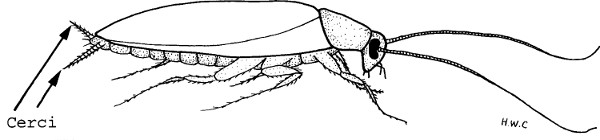
Figure 1. Periplaneta americana with intact cerci.
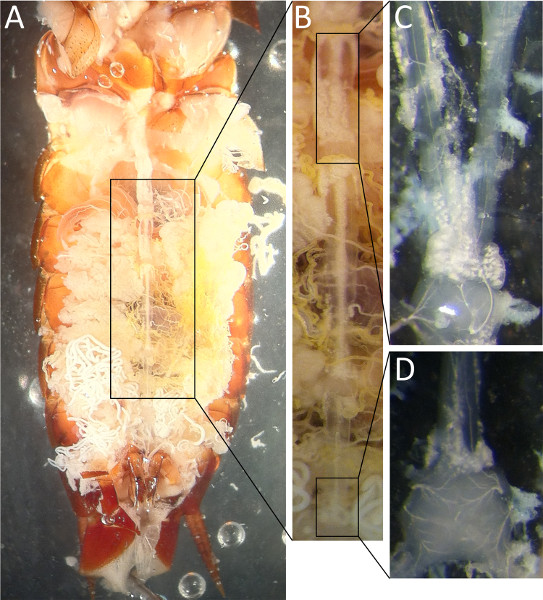
Figure 2. Ventral view of cockroach nerve cord as seen with the ventral cuticle removed (A). An enlarged view of the segment outlined by arrows is seen in (B). In (C) the connectives were spilt between A4 and A3 with a glass probe. The 6th abdominal ganglion is shown in (D) with the two cercal nerves leaving at the caudal end.

Figure 3. Schematic ventral view of cockroach nerve cord.

Figure 4. The cerci are positioned upwards out of the saline bath. The opened abdomen can be flooded with saline (A) with the caudal end of the roach being elevated with a small wedged shaped piece of silicone elastomer in order to keep the cerci out of the bath (B).
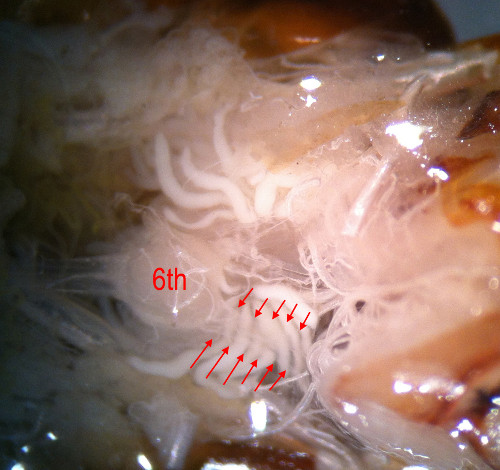
Figure 5. The 6th abdominal ganglion with the cercal nerve (outlined by arrows).
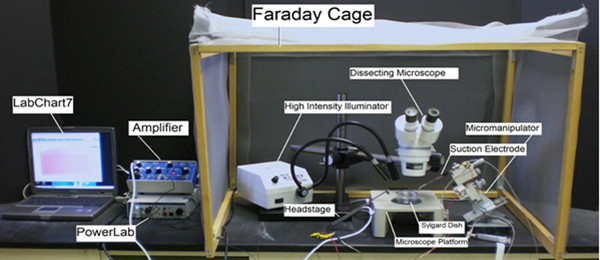
Figure 6. The equipment set up. Click here to view larger figure.

Figure 7. Stimulating and recording electrode set up.
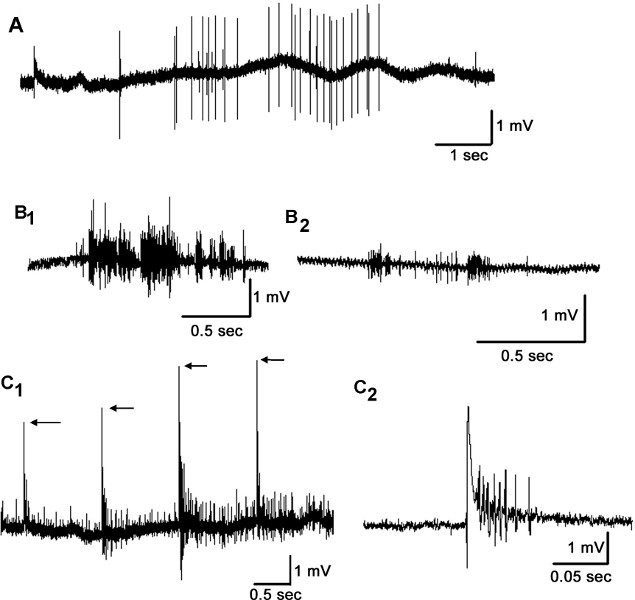
Figure 8. Neural recordings of the connectives and cercal nerve with various stimulation procedures. Recording with a suction electrode from the connectives between A3 and A4 while puffing air at the cerci (A). Recording from the primary cercal neurons with a suction electrode while either physically rubbing (B1) or providing air puffs (B2) results in rapid bursts of activity in the cercal nerve. Electrically stimulating the cercal nerve produces responses in connectives (C1). Note the gradual increase in the stimulating intensity (arrows indicate the amplitude of the stimulating artifact) and the intensity of the following evoked responses. The electrical stimulation of the cercal nerve provides a relatively more controlled means of stimulating the cercal nerve for consistency in stimulation for quantifying the responses (C2).
Discussion
Loading...
$$\rightleftharpoonup{xx}$$
$$\longleftharp{xx}$$,
$$\longrightharp{xx}$$,
One of the reasons for exhibiting techniques for this classical preparation is that the cerci system has been and still is an active area of research in addressing questions of the development of neural circuitry as well as questions regarding synaptic repair and regeneration 26-31. Either method of evoking activity in the cockroach ventral nerve cord can be used to examine the effects of pharmacological agents or insecticides on nervous system function. These experiments are done by simply dissolving neuroactive chemicals into saline. After exchanging this solution with the normal bathing medium, changes in evoked or spontaneous activity may be observed while recording from connectives or a motor nerve to give a consistent readout of the chemical's effect on CNS function.
As in all neurophysiological experiments a common problem is electrical noise. Probably the biggest factor in signal quality for these preparations is the suction electrode seal on the nerve tissue. A tight seal that does not completely draw in the cercal nerve or connective is ideal. Recordings can also be made with dual hook electrodes placed under the nerve cord and insulating the VNC with a mixture of mineral oil and petrolatum. The mixture can be loaded into a syringe and expelled around the nerve cord32. Also a careful dissection is as critical here as in any CNS preparation. Some may find it easier to access the CNS by dissecting the dorsal cuticle. While this reduces the possibility of damaging the ventral nerve cord it can be more difficult to remove all of the viscera using this approach.
It is not described here but this preparation is amenable to intracellular recording in the giant interneurons 32,33. The entire nerve cord can also be removed to accommodate several recording and stimulating electrodes simultaneously. In fact exploration of the antennal lobe, mushroom body, and other anterior CNS structures is still in progress34-35. While the cockroach CNS continues to shed light on modern neurobiological research this particular preparation is simple enough to be used in undergraduate academic laboratories.
Disclosures
Loading...
$$\rightleftharpoonup{xx}$$
$$\longleftharp{xx}$$,
$$\longrightharp{xx}$$,
The authors declare that there are no conflicts of interest.
Acknowledgements
Loading...
$$\rightleftharpoonup{xx}$$
$$\longleftharp{xx}$$,
$$\longrightharp{xx}$$,
We thank Hyewon Cooper for illustrations.
Materials
| Name | Company | Catalog Number | Comments |
|---|---|---|---|
| Reagent | |||
| Sylgard | Dow Corning | 182 silicone kit | 182 silicone elastomer kit |
| NaCl | Sigma-Aldrich | S7653 | |
| KCl | Sigma-Aldrich | P9333 | |
| CaCl2 | Sigma-Aldrich | C5670 | |
| NaH2PO4•2H2O | Sigma-Aldrich | 71505 | |
| Na2HPO4•7H2O | Sigma-Aldrich | S9390 | |
| NaOH | Sigma-Aldrich | 221465 | To adjust pH |
| HCl | Sigma-Aldrich | H1758 | To adjust pH |
| Material Name | |||
| Dissecting tools | World Precision Instruments | assortment | |
| Insect Pins | Fine Science Tools, Inc | 26001-60 | |
| Dissecting microscope | World Precision Instruments | PZMIII-BS | |
| Glass electrodes | Sigma-Aldrich | CLS7095B5X | Box of 200, suction electrodes |
| Micromanipulator | World Precision Instruments | MD4-M3-R | Can fix for base or on a metal rod |
| Silver wire (10/1,000 inch) | A-M Systems | 782500 | |
| Computer | any company | ||
| AC/DC differential amplifier | A-M Systems | Model 3000 | |
| PowerLab 26T |  AD Instruments AD Instruments | 27T | |
| Head stage | AD Instruments | Comes with AC/DC amplifier | |
| LabChart7 | AD Instruments | ||
| Electrical leads | any company | ||
| Glass tools | make yourself | For manipulating nerves | |
| Cable and connectors | any company | ||
| Pipettes with bulbs | Fisher Scientific | 13-711-7 | Box of 500 |
| Beakers | any company | ||
| Wax or modeling clay | any company or local stores | ||
| Stimulator | Grass Instruments | SD9 or S88 | |
| Plastic tip for suction electrode | local hardware store (Watt's brand) | ¼ inch OD x 0.170 inch ID | Cut in small pieces. Pull out over a flame and cut back the tip to the correct size. |
References
Loading...
$$\rightleftharpoonup{xx}$$
$$\longleftharp{xx}$$,
$$\longrightharp{xx}$$,
- Full, R. J., Tu, M. S. Mechanics of a rapid running insect: two-, four- and six-legged locomotion. J. Exp. Biol. 156, 215-231 (1991).
- Ritzmann, R. E., Tobias, M. L., Fourtner, C. R. Flight activity initiated via giant interneurons of the cockroach: Evidence for bifunctional trigger interneurons. Science. 210, 443-445 (1980).
- Libersat, F., Camhi, J. M. Control of cercal position during flight in the cockroach: a mechanism for regulating sensory feedback. J. Exp. Biol. 136, 483-488 (1988).
- Ganihar, D., Libersat, F., Wendler, G., Cambi, J. M. Wind-evoked evasive responses in flying cockroaches. Journal of Comparative Physiology. A, Sensory, Neural, and Behavioral Physiology. 175, 49-65 (1994).
- Pipa, R. aD., F, The American Cockroach. , Chapman and Hall. 175-216 (1981).
- Westin, J., Langberg, J. J., Camhi, J. M. Responses of giant interneurons of the cockroach; Periplaneta americana to wind puffs of different directions and velocities. Journal of Comparative Physiology A: Neuroethology, Sensory, Neural, and Behavioral Physiology. 121, 307-324 (1977).
- Camhi, J. M., Tom, W., Volman, S. The escape behavior of the cockroach Periplaneta americana. J. Comp. Physiol. A Neuroethol. Sens. Neural Physiol. 128, 203-212 (1978).
- Nicklaus, R. Die Erregung einzelner Fadenhaare von Periplaneta americana in Abhängigkeit von der Grösse und Richtung der Auslenkung. Z. Vgl. Physiol. 50, 331-362 (1965).
- Westin, J. Responses to wind recorded from the cercal nerve of the cockroach Periplaneta americana. J. Comp. Physiol. A Neuroethol. Sens. Neural Physiol. 133, 97-102 (1979).
- Ritzmann, R. E. Neural Mechanisms of Startle Behavior. , Plenum Press. 93-131 (1984).
- Ritzmann, R. E., Pollack, A. J. Identification of thoracic interneurons that mediate giant interneuron-to-motor pathways in the cockroach. J. Comp. Physiol. A Neuroethol. Sens. Neural Physiol. 159, 639-654 (1986).
- Plummer, M. R., Camhi, J. M. Discrimination of sensory signals from noise in the escape system of the cockroach - the role of wind acceleration. J. Comp. Physiol. 142, 347-357 (1981).
- Bullock, T. H. Neural Mechanisms of Startle Behavior. , Plenum Press. 1-14 (1984).
- Pollack, A. J., Ritzmann, R. E., Watson, J. T. Dual pathways for tactile sensory information to thoracic interneurons in the cockroach. J. Neurobiol. 26, 33-46 (1995).
- Atwood, H. L., Wiersma, C. A. Command interneurons in the crayfish central nervous system. J. Exp. Biol. 46, 249-261 (1967).
- Olson, G. C., Krasne, F. B. The crayfish lateral giants as command neurons for escape behavior. Brain Res. 214, 89-100 (1981).
- Comer, C. M. Analyzing cockroach escape behavior with lesions of individual giant interneurons. Brain Res. 335, 342-346 (1985).
- Comer, C. M., Dowd, J. P., Stubblefield, G. T. Escape responses following elimination of the giant interneuron pathway in the cockroach, Periplaneta americana. Brain Res. 445, 370-375 (1988).
- Keegan, A. P., Comer, C. M. The wind-elicited escape response of cockroaches (Periplaneta americana) is influenced by lesions rostral to the escape circuit. Brain Res. 620, 310-316 (1993).
- Casagrand, J. L., Ritzmann, R. E. Biogenic amines modulate synaptic transmission between identified giant interneurons and thoracic interneurons in the escape system of the cockroach. J. Neurobiol. 23, 644-655 (1992).
- Roeder, K. D. Organization of the ascending giant fiber system in the cockroach, Periplaneta americana. J. Exp. Zool. 108, 243-261 (1948).
- Ramos, R. L., Moiseff, A., Brumberg, J. C. Utility and versatility of extracellular recordings from the cockroach for neurophysiological instruction and demonstration. J. Undergrad. Neurosci. Educ. 5, (2007).
- Oakley, B., Schafer, R. Experimental neurobiology. , University of Michigan Press. Ann Arbor. (1978).
- Welsh, J. H., Smith, R. I., Kammer, A. E. Laboratory exercises in invertebrate physiology. , Burgess Publishing Company. Minneapolis. (1968).
- Leksrisawat, B., Cooper, A. S., Gilberts, A. B., Cooper, R. L. Muscle receptor organs in the crayfish abdomen: a student laboratory exercise in proprioception. J. Vis. Exp. (45), e2323(2010).
- Bacon, J. P., Blagburn, J. M. Ectopic sensory neurons in mutant cockroaches compete with normal cells for central targets. Development. 115, 773-784 (1992).
- Blagburn, J. M. Co-factors and co-repressors of Engrailed: expression in the central nervous system and cerci of the cockroach, Periplaneta americana. Cell Tiss. Res. 327, 177-187 (2007).
- Blagburn, J. M., Gibbon, C. R., Bacon, J. P. Expression of engrailed in an array of identified sensory neurons: comparison with position, axonal arborization, and synaptic connectivity. J. Neurobiol. 28, 493-505 (1995).
- Booth, D., Marie, B., Domenici, P., Blagburn, J. M., Bacon, J. P. Transcriptional control of behavior: engrailed knock-out changes cockroach escape trajectories. J. Neurosci. 29, 7181-7190 (2009).
- Schrader, S., Horseman, G., Cokl, A. Directional sensitivity of wind-sensitive giant interneurons in the cave cricket Troglophilus neglectus. J. Exp. Zool. 292, 73-81 (2002).
- Libersat, F., Goldstein, R. S., Camhi, J. M. Nonsynaptic regulation of sensory activity during movement in cockroaches. Proc. Natl. Acad. Sci. U.S.A. 84, 8150-8154 (1987).
- Stern, M., Ediger, V. L., Gibbon, C. R., Blagburn, J. M., Bacon, J. P. Regeneration of cercal filiform hair sensory neurons in the first-instar cockroach restores escape behavior. J. Neurobiol. 33, 439-458 (1997).
- Blagburn, J. M. Synaptic specificity in the first instar cockroach: patterns of monosynaptic input from filiform hair afferents to giant interneurons. J. Comp. Physiol A. 166, 133-142 (1989).
- Watanabe, H., Ai, H., Yokohari, F. Spatio-temporal activity patterns of odor-induced synchronized potentials revealed by voltage-sensitive dye imaging and intracellular recording in the antennal lobe of the cockroach. Front. Sys. Neurosci. (6), 55(2012).
- Nishino, H., et al. Visual and olfactory input segregation in the mushroom body calyces in a basal neopteran, the American cockroach. Arthropod Struct. Dev. 41, 3-16 (2012).
- Elia, A. J., Gardner, D. R. Long-term effects of DDT on the behavior and central nervous system activity in Periplaneta americana. Pestic. Biochem. Physiol. 21, 326-335 (1984).
Reprints and Permissions
Request permission to reuse the text or figures of this JoVE article
Request Permission