To elucidate the complex transition from Local Field Potentials (LFPs) to spikes a suitable stimulator for light mechanical peripheral stimuli was built. As an application, the spiking activities recorded from somatosensory cortex were analyzed by a multi-objective optimization strategy. The results demonstrated that the proposed stimulator was able to deliver tactile stimuli with millisecond and millimeter precisions.
A subscription to JoVE is required to view this content. Sign in or start your free trial.
Method Article
A Simple Stimulatory Device for Evoking Point-like Tactile Stimuli: A Searchlight for LFP to Spike Transitions
In This Article
Summary
Abstract
Current neurophysiological research has the aim to develop methodologies to investigate the signal route from neuron to neuron, namely in the transitions from spikes to Local Field Potentials (LFPs) and from LFPs to spikes.
LFPs have a complex dependence on spike activity and their relation is still poorly understood1. The elucidation of these signal relations would be helpful both for clinical diagnostics (e.g. stimulation paradigms for Deep Brain Stimulation) and for a deeper comprehension of neural coding strategies in normal and pathological conditions (e.g. epilepsy, Parkinson disease, chronic pain). To this aim, one has to solve technical issues related to stimulation devices, stimulation paradigms and computational analyses. Therefore, a custom-made stimulation device was developed in order to deliver stimuli well regulated in space and time that does not incur in mechanical resonance. Subsequently, as an exemplification, a set of reliable LFP-spike relationships was extracted.
The performance of the device was investigated by extracellular recordings, jointly spikes and LFP responses to the applied stimuli, from the rat Primary Somatosensory cortex. Then, by means of a multi-objective optimization strategy, a predictive model for spike occurrence based on LFPs was estimated.
The application of this paradigm shows that the device is adequately suited to deliver high frequency tactile stimulation, outperforming common piezoelectric actuators. As a proof of the efficacy of the device, the following results were presented: 1) the timing and reliability of LFP responses well match the spike responses, 2) LFPs are sensitive to the stimulation history and capture not only the average response but also the trial-to-trial fluctuations in the spike activity and, finally, 3) by using the LFP signal it is possible to estimate a range of predictive models that capture different aspects of the spike activity.
Introduction
In the context of signal processing the impulse response provides a fundamental characterization of the behavior of a dynamical system.
Although the ideal impulse stimulus is practically not achievable, it is possible to obtain a reasonable approximation of it by using an actuator element that generates high frequency displacements. This type of light tactile-vibratory stimulation is known to target both deep skin (e.g. fast responding, fast adapting Pacinian corpuscles)2 and superficial receptors (e.g. low-threshold slowly adapting Merkel discoid structures)2.
Current stimulation devices, mainly piezoelectric actuators, are charged with a number of drawbacks, not least resonances and small displacements. To overcome these flaws, an alternative implementation of impulse-like stimulation is proposed by using a blunted tip (a cactus smoothed tip in our case) vertically mounted on the membrane center of a mid-range speaker cone. This provides the advantage of larger displacements and broader frequency spectrum.
An effective application of such a device was the study of the relevant neurophysiological problem of the LFPs to spikes dependency. Because of the subtle temporal association between these electrical events a finely regulated device was needed for delivering peripheral stimuli. The stimuli had to be as fast and spatially selective as possible in order to reduce the "background noise" and sharpen the signals of interest. To this purpose, the stimulation device and the stimulus delivery protocol were jointly optimized for the task. In this paper, we describe the technique and present some representative results.
A stimulation protocol based on randomized paired-pulses has been designed and optimized in order to avoid habituation. This protocol offered the advantage of classical paired pulses and reduced the possibility of spurious locking between stimuli and spontaneous periodical bursts of neuronal activity.
By using this randomized paired pulse it was possible to obtain fast and reliable LFP and spike responses and to capture the special feature of these responses related to the dependence of both LFPs and spikes on the stimulation history. Indeed, from the raw LFP responses, a set of three LFP features (the LFP itself, the LFP first derivative and phase of the first derivative) strongly correlating with the average spike response, was also extracted.
Few methods have been proposed to fit models that predict spikes from LFPs3,4. In general a critical point of the model fitting process, common also to the prediction of spike event from the stimulus signal, is constituted by the appropriate choice of the objective function to maximize/minimize. While a range of objective functions has been proposed (e.g. correlation and coherence)5 none of these jointly captures the whole complexity of spike responses. Accordingly, a novel framework based on multi-objective optimization is introduced. We show that by using the proposed devised and this computational framework it is possible to estimate a set of predictive models based on strong LFP to spike relationships.
Access restricted. Please log in or start a trial to view this content.
Protocol
Ethical Statement
To study how sensory stimuli are represented by neuronal activity there is no alternative to the use of animals and the use of an in vivo approach. All the animals have been treated along the Italian and European Laws on animal treatment in Scientific Research (Italian Bioethical Committee, Law Decree on the Treatment of Animals in Research, 27 Jan 1992, No. 116). The National Research Council, where the experiments have been performed, adheres to the International Committee on Laboratory Animal Science (ICLAS) on behalf of the United Nations Educational, Scientific and Cultural Organizations (UNESCO), the Council for International Organizations of Medical Sciences (CIOMS) and the International Union of Biological Sciences (IUBS). As such, no protocol-specific approval was required. The approval of the Ministry of Health is classified as "Biella 1, 3/2011" into the files of the Ethical Committee of the University of Milan.
1. Preparation of the Experimental Animals
- Select male rats approximately 300-400 g in size.
- Anesthetize the rats for the experimental preparation.
- Inject intraperitoneally a barbiturate solution (pentobarbital, 50 mg/kg for induction, 10 mg/kg for maintenance).
- Check the anesthesia level by low threshold and high threshold mechanical stimuli over a paw ensuring that no retraction reflex occurs.
- Prepare the cranial skin by shaving the cranial vault accurately and then make an incision to expose the cranial surface.
- Cannulate the trachea, by a tracheal cannula (inner diameter of 2 mm and outer diameter of 2.5 mm) fixing it by surgical ligation around the trachea itself.
- Laterally to the tracheal segment expose the jugular vein and cannulate it inserting a cannula (PE10) connected to a syringe fixing it by surgical ligation around the vessel.
- Mount the rat onto a stereotaxic apparatus.
- Secure rat body and place in a supine position.
- Fix the head by ear bars and block the snout. Put one or two drops of local anaesthetic (lidocaine) in the rat's ear before placing ear bars.
- Regulate the temperature of the stereotaxic pad by an electronically controlled heating pad, maintaining the temperature at 37.5 °C.
- Connect the tracheal tube to the respiratory anesthesia device.
- Set the respiratory anesthesia device at 1 stroke/s delivering Isoflurane (2.5% 0.4-0.8 L/min) and O2 (0.15-0.2 L/min).
- Clean carefully the cranial vault by a povidone-iodine topical antiseptic.
- Take a sterile scalpel and cut longitudinally on the midline from the basis of the snout to the angle of the occipital bone.
- Divaricate the wound borders by a retractor and fix them by two small cocker forceps applied to the wound borders.
- Identify the periosteum by pointing a light over a skull vault observing the translucent surface. Scratch carefully the bone vault removing the periosteum and exposing the bone surface.
- Provide hemostasis with a cotton tip or surgical sponge over the bone surface if focal hemorrhages appear over the bone.
- With a fine tip pen, identify the stereotactic point bregma at the cross point of the mediosagittal and coronal suturas.
- Under surgical microscope control, identify the stereotactic area (S1HL) overlaying the somatosensory cortex contralateral to the posterior paw used for the experiment (Bregma, AP -0.5 to 1.2 mm, LL -2.3 to 2.5 mm).
- With a fine tip pen draw the square perimeter delimiting the hole to be drilled.
- Drill a 9 mm2 hole on the previously identified blue square removing the bone tile.
- Clean and absorb potential bone bleedings.
- Carefully remove the dura mater and cover the cortical surface with a surgical sponge soaked in artificial cerebrospinal fluid maintained at 37.5 °C.
- Fix the electrode matrix to a holder connected to an electronic micromanipulator.
- Connect the head of the matrix to the preamplifier by a microconnector.
- Drive manually the electrode matrix (under surgical microscope control) up to the cortical surface (without touching it).
- Switch on the amplifiers with auditory signal.
- Drive, by the electronic control, the electrode matrix to touch the cortical surface until the contact is reached, signaled by a clear noise sound change.
- Pull down the electrode matrix by electronically controlled steps (2 μm/step) until a depth of 350-400 μm is reached (cortical layer IV).
- Check the responsiveness of neurons by light touches on the contralateral posterior paw.
- Adjust the depth by a few further steps until a clear spiking response is observed.
- Paralyze the rat by intravenous Gallamine thriethiodide (20 mg/kg/hr). Use refracted doses throughout the experiment to maintain curarization levels (0.2 ml/1 hr).
2. Signal Treatment
- Set the software bandpass filter to [0.1 6000] Hz.
- Record the neuronal signals of the 8 channels microelectrode matrix sampled at 32 kHz.
- After the acquisition ends, export the recorded signals into a binary format suitable for post-processing.
- Perform the spike sorting procedure by means of the Wave_clus toolbox11.
3. Manufacture and Configuration of the Stimulation Device
- Mount a cactus stalk (with blunted tip) orthogonally to the surface of a mid-range speaker gluing the stalk basis to the cap.
- Program a microcontroller to deliver voltage pulses to a driver circuit for the speaker.
- Program the microcontroller to deliver two paired pulses of current each second (see Figure 1C).
- Assemble the speaker and the microcontroller by means of a L293D h-bridge with basic passive components (see Figure 1A).
- Connect the microcontroller to a 12 V rechargeable battery.
4. Stimulation Protocol
- Glue the dorsal aspect of the hind-paw to a solid frame, exposing the volar surface and avoiding articular torsions.
- Place the tip of the stimulation device onto the desired limb/paw position.
- Switch on the stimulation device.
Offline steps:
5. Evaluation of Spike Responses
- For each recorded neuron, compute the Shannon Mutual Information (MI) of the stimulus evoked spiking activity (stimulus category is either 1, stimulus, or 0, no stimulus).
- Estimate the conditional response probability p(r | s) where s represents the stimulus category and r represents the number of spikes emitted within a fixed time window.
- Correct the MI estimate by using the shuffling procedure described9.
6. Evaluation of LFP Responses
- Filter the recorded signal in the frequency range [0.1 100] Hz in order to obtain the LFP signal
- Compute LFPSNR, a measure of LFP responsiveness, as explained in the reference10.
7. Model Estimation
- Generate a model of the form

where the x arguments represent three different LFP features (x1the LFP itself, x2 its derivative and x3 the Hilbert phase of its derivative) and F is expressed as follows

the g coefficients are weights of a linear combination and f is an operator that takes either the absolute value, the power or the original value of each xi. - Use the NSGAII algorithm to estimate the model parameters and operators by using the following three objects: i) a local, trial-to-trial basis, measure of fit
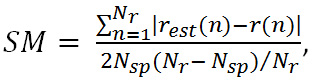 , where Nsp and Nr represent respectively the overall spikes count and the length of the response vector; ii)a global measure of fit based on the average response
 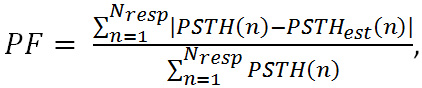 where Nresp represents the length of the average response; iii) a measure of model complexity (see also)10
  .
.
8. Histological Confirmation
- Sacrifice the rat.
- At the end of experimental recordings, put the animal under deep gaseous anaesthesia (Isoflurane 2%, 4 L/min) and inject intravenously a barbiturate overdose (>50 mg/kg, pentobarbital).
- Wait the heart arrest.
- Unmount the rat from the stereotaxic apparatus
- Perfusion.
- Place the rat laying over a grid onto a basin to collect the blood and fluids from the perfusion.
- Open the thorax by dissecting the sternum separating from the rib insertions.
- Block the sternal xyphoid process with a cocker forceps and overturning cranially the sternum and divaricate the ribs over the heart.
- Identify the left ventricle and the right atrium, place a nine gauge blunted tip needle (connected to the perfusion cannula) into the ventricle and open with surgical fine scissors the right atrium.
- Start the perfusion with cold (4 °C) heparinized physiological solution (250 ml) followed by the perfusion of a 4% formalin solution (250 ml).
- Extract the brain from the skull by opening the cranial vault with a suitable forceps and place the brain in a 10% formalin solution.
- After a week, prepare the histological slices by a microtome (10 μm thickness).
- Stain the brain coronal and sagittal sections with cresyl violet solution.
Access restricted. Please log in or start a trial to view this content.
Results
Tip excursion features
To characterize the dynamical properties of the proposed stimulating device, a series of experiments were set up. A specific device which consists of a gallium arsenide infrared emitting diode coupled with a silicon phototransistor was used to assess the tip displacement, the displacement duration and the possible displacement delays. By means of this optical interrupter switch we placed the stimulator tip on the edge of the emitting diode hole (height = 1 mm) and both the ...
Access restricted. Please log in or start a trial to view this content.
Discussion
This work firstly presented a new, simple and low-cost device enabling to deliver fast and spatially point-like sensory stimuli. Then a randomized paired pulse stimulation protocol and a set of computational analyses were validated. The overall aim was to establish a framework for the estimation of LFP-spike relations in electrophysiological recordings during tactile stimulation.
The device, the protocol and the analytical approach have jointly contributed to the result, namely the first demon...
Access restricted. Please log in or start a trial to view this content.
Disclosures
The authors declare no competing financial interests.
Acknowledgements
SN and AGZ were supported by the PON 01-01297 VIRTUALAB funds.
Access restricted. Please log in or start a trial to view this content.
Materials
| Name | Company | Catalog Number | Comments |
|---|---|---|---|
| Microstepper | AB Transvertex (Stockholm, Sweden) | The microstepper used to pull down the electrode matrix | |
| 32-channel Cheetah System | Neuralynx (MT, USA) | The electrophysiological recording system | |
| L293D h-bridge | RS Components (Cinisello Balsamo, Italy) | The bridge used to connect the microcontroller to the speaker | |
| H21A3 Optical Interrupter Switch | Fairchild Semiconductor Corporation (San Jose, California) | The phototransistor used to estabilish the tip displacement | |
| Arduino Uno | Arduino (Duemilanove, Italy) | The microcontroller used to deliver current pulse to the speaker | |
| Microelectrode Matrices GB1 | FHC | ||
| Isoflurane | Rhodia Organique Fine Ltd. | The anesthetic used to prepare animals | |
| Stereotaxic apparatus | Narishighe (Tokyo, Japan) | ||
| Sprague-Dawley male rats | Charles River (Calco, LC, Italy) | ||
| Gallamine thriethiodide | Sigma-Aldrich | The compound used to curarize the animals | |
| Cresyl violet | Sigma-Aldrich | ||
| Topical antiseptics (Betadine 10%) | Meda Pharma (Milanm Italy) | ||
| Heparine | Sigma-Aldrich | ||
| Formaldehyde | Carlo Erba Reagents (Pomigliano Milanese, Milan, Italy) |
References
- Pesaran, B. Uncovering the Mysterious Origins of Local Field Potentials. Neuron. 61 (1-2), (2009).
- Delmas, P., Hao, J., Rodat-Despoix, L. Molecular Mechanisms of Mechanotrasduction in Mammalian Sensory Neurons. Nat. Rev. Neurosci. 12, 139-153 (2011).
- Rasch, M. J., Gretton, A., Murayama, Y., Maass, W., Logothetis, N. K. Inferring spike trains from local field potentials. J. Neurophys. 99 (3), 1461-1476 (2008).
- Galindo-Leon, E. E., Liu, R. C. Predicting stimulus-locked single unit spiking from cortical local field potentials. J. Comput. Neurosci. 29 (3), 581-597 (2010).
- Theunissen, F. E., David, S. V., Singh, N. C., Hsu, A., Vinje, W. E., Gallant, J. L. Estimating spatio-temporal receptive fields of auditory and visual neurons from their responses to natural stimuli. Network. 12 (3), 289 (2001).
- Victor, J. D., Purpura, K. Metric-space analysis of spike trains: theory, algorithms, and application. Network. 8, 127-164 (1997).
- Foffani, G., Chapin, J. K., Moxon, K. A. Computational Role of Large Receptive Fields in the Primary Somatosensory Cortex. J. Neurophysiol. 100 (1), 268-280 (2008).
- Microcontroller website. , Duemilanove, Italy. Available: http://arduino.cc (2014).
- Panzeri, S., Senatore, R., Montemurro, M. A., Petersen, R. S. Correcting for the sampling bias problem in spike train information measures. J. Neurophysiol. 98, 1064-1072 (2007).
- Storchi, R., Zippo, A. G., Caramenti, G. C., Valente, M., Biella, G. E. M. Predicting Spike Occurrence and Neuronal Responsiveness from LFPs in Primary Somatosensory Cortex. PLoS ONE. 7 (5), (2012).
- Quiroga, R. Q., Nadasdy, Z., Ben-Shaul, Y. Unsupervised Spike Detection and Sorting with Wavelets and Superparamagnetic Clustering. Neural Comput. 16, 1661-1687 (2004).
- Deb, K., Agrawal, A., Pratab, A., Meyarivan, T. A fast elitist non-dominated sorting genetic algorithm for multi-objective optimization: NSGA-II IEEE. Trans. Evol. Comput. 6 (2), 181-197 (2000).
Access restricted. Please log in or start a trial to view this content.
Reprints and Permissions
