Availability of somatic SCs is crucial for regenerative medicine, disease modeling and to gain insight into SC properties. Here we present experimental strategies to reprogram, in vitro, differentiated adult cells into their corresponding expandable tissue-specific stem/progenitor cells by the transient expression of the single transcriptional co-activator YAP.
Method Article
De Novo Generation of Somatic Stem Cells by YAP/TAZ
In This Article
Summary
Abstract
Here we present protocols to isolate primary differentiated cells and turn them into stem/progenitor cells (SCs) of the same lineage by transient expression of the transcription factor YAP. With this method, luminal differentiated (LD) cells of the mouse mammary gland are converted into cells that exhibit molecular and functional properties of mammary SCs. YAP also turns fully differentiated pancreatic exocrine cells into pancreatic duct-like progenitors. Similarly, to endogenous, natural SCs, YAP-induced stem-like cells ("ySCs") can be eventually expanded as organoid cultures long term in vitro, without further need of ectopic YAP/TAZ, as ySCs are endowed with a heritable self-renewing SC-like state.
The reprogramming procedure presented here offers the possibility to generate and expand in vitro progenitor cells of various tissue sources starting from differentiated cells. The straightforward expansion of somatic cells ex vivo has implications for regenerative medicine, for understanding mechanisms of tumor initiation and, more in general, for cell and developmental biology studies.
Introduction
Tissue-specific somatic stem cells (SCs) are critical for tissue renewal and repair after injury. The possibility to easily isolate and unlimitedly expand ex vivo somatic SCs represents a critical issue for potential regenerative therapies, as well as for SC applications in basic research and disease modeling. Progress in this direction, however, has been limited by the difficulty of capturing the SC state of various epithelial organs in vitro. Indeed, in several adult tissues resident SCs may not exist, or not be readily available, or their number and regenerative potential may be eroded by aging or disease conditions. In 2016, we started to fill this gap by reporting that expression of a single transcriptional coactivator, YAP (YES-associated protein) or its closely related protein TAZ (transcriptional activator with a PDZ motif), into terminally differentiated cells efficiently creates functional, expandable, non-tumorigenic, autologous cell populations that are operationally and molecularly indistinguishable from their corresponding tissue-specific SCs1. A pulse of sustained YAP or TAZ activity for few days is sufficient to induce the appearance of self-renewing somatic SCs. This is a stable condition that is no longer dependent on continuous transgene expression, as it can be transmitted through cell generations without further expression of ectopic YAP/TAZ1. The protocol presented here details the procedure used to generate de novo epithelial stem/progenitor cells of the mammary gland and pancreas, starting from differentiated cells of these tissues. This procedure fills a black box in the current reprogramming/transdifferentiation arena. Main efforts in these directions have indeed so far centered on cell transition to an induced pluripotent stem cell (iPSC) state, followed by conversion of these embryonic and pluripotent SCs into more differentiated cells. However, iPSCs are tumorigenic once introduced in adult tissues, raising the need of developing protocols for their complete and efficient differentiation2. However, this differentiation step, even when possible, comes at the price of long-term expandability, self-organization and organ repopulation potentials. These are essential attributes for organ regeneration that are in fact typical only of endogenous tissue-specific SCs and of the presently described YAP-induced SCs (ySCs). Similarly, direct transdifferentiation of one cell type into another by using cocktails of various transcription factors also generate differentiated cells that lack essential proliferative and stemness potential3.
The procedure described here also takes advantage of the recently introduced organoid technology, by which endogenous SCs can be expanded and differentiated ex vivo4. YAP-induced SCs may generate organoid-forming SCs even in experimental, biological or disease conditions in which endogenous SCs are not present. We would like to note that, at the difference with other reprogramming procedures, the type of cell plasticity imparted by YAP may correspond to the only form of the reversion to a SC-like status that occurs in living tissues. Reacquisition of SC-like traits has been associated with tissue repair or oncogenic activation5. Although dispensable for the homeostasis of several adult tissues, YAP and/or TAZ are absolutely essential for regeneration, tumor growth and expansion of somatic SCs in vitro1,6,7,8,9,10,11,12
Protocol
All animal procedures were performed adhering to our institutional guidelines and approved by OPBA and the Ministry of Health
1. Generation of YAP-induced Mammary Stem-like Cells (yMaSCs)
NOTE: All media and solution compositions for section 1 are specified in Table 1.
- Isolation of primary mammary cell populations
- Prepare under a cell culture hood: disposable scalpels, hyaluronidase solution, dissociation medium, hemolytic solution, sorting solution, collagen I coating solution, Ca2+ chelating solution, wash medium #1, wash medium #2, dispase solution, mammary 2D culture medium, ice cold HBSS/PS.
- For a typical experiment, sacrifice 10 female mice (either CD-1 of C57BL/6 strain), 8-12 weeks old by cervical dislocation. Sterilize the abdomen with abundant 70% ethanol solution before dissection.
- Dissect the mammary glands by making a Y-shaped incision along the abdominal skin and carefully separating the glands from the peritoneum by gently pulling with Dumont forceps. Place the dissected glands in a non-cell adhesive dish with 10 mL ice cold HBSS/PS (20 glands for each dish), making sure not to carry over any skin fragment.
- Under a tissue culture hood, wash each gland once in 10 mL of fresh HBSS/PS and place them in an empty non-cell adhesive dish (20 glands for each dish). Do not use tissue culture plates, as cells will tend to stick to them causing significant loss of material.
- Finely mince the mammary glands with scalpels until a homogenous mix of 1 mm3 fragments is obtained.Recover the minced tissue from each dish in 10 mL of dissociation medium with a 25 mL serological pipette to avoid clogging and transfer the suspension in a 50 mL conical tube pipetting at least 5x to disaggregate tissue clumps.
NOTE: For an efficient digestion, proper mincing of the tissue in step 1.1.5 is crucial. - Incubate for 1 h at 37 °C with continuous vigorous shaking. After 1 h, check the homogenate and prolong incubation by 10 min if clumps are still present. Spin down the digested tissue at 400 x g for 5 min at room temperature and discard the supernatant. Resuspend the tissue pellet in 3 mL of hemolytic solution and incubate 3 min on ice.
NOTE: Hemolysis is a rather harsh treatment, so strict timing is crucial at this step. - Wash cells with 10 mL of wash medium #1, spin down the digested tissue at 400 x g for 5 min and discard the supernatant. Resuspend the tissue pellet in 10 mL of the wash medium # 2 and plate in 10 cm tissue culture dishes. Incubate the dishes for 1 h at 37 °C in a cell culture incubator.
NOTE: This step will allow removal of the majority of fibroblasts, that should adhere to the culture dish. - Recover the cell suspension from the dishes and pour into a 50 mL conical tube. Spin at 400 x g for 5 min and eliminate the supernatant. Wash the pellet twice in 10 mL of the Ca2+ chelating solution by spinning down at 400 x g for 5 min each time. Resuspend the pellet in 5 mL of 0.25% Trypsin/EDTA and incubate for 5 min at 37 °C.
- Add 5 mL of dispase solution on the top of the trypsin solution and supplement with DNase I 1μg/mL. Pipette up and down at least 5x through a 1 mL-tip to disaggregate DNA clumps and incubate for 10 min at 37 °C, shaking every 3 min.
- Add 10 mL of wash medium #2 and filter in a new 50 mL conical tube through a 40 μm cell strainer. Spin down the cell suspension at 400 x g for 5 min and discard the supernatant, making sure to eliminate all the liquid.
- Purification of mammary epithelial cells by FACS
- Prepare the antibody mix by adding 10 μL Lin (mouse lineage antibody cocktail), 12 μL anti- CD326 (Ep-CAM), to a final concentration of 30 ng/mL, 10 μL anti- CD49f, to a final concentration of 25 ng/mL, 10 μL anti- CD61, to a final concentration of 10 ng/mL, 2.5 μL anti- CD29, to a final concentration of 2.5 ng/mL.
NOTE: From this step to step 1.3, always operate in the dark, to avoid bleaching of the fluorescently labeled antibodies. For each pellet: - Keep a small number of cells (by dipping a 100 μL tip in the pellet) in a separate tube. Resuspend the cells in 500 μL of sorting solution in a FACS tube and keep on ice as the unlabeled sample for the FACS procedure.
- Resuspend each pellet in 200 μL of wash medium #1, add 44.5 μL of antibody mix, pipette thoroughly and incubate for 30 min on ice in the dark. Dilute the cell suspension in 10 mL of wash medium #1, spin down at 400 x g for 5 min and discard the supernatant.
- Resuspend the cell pellet in 2 mL of sorting solution and filter through a cap-strainer FACS tubeand proceed to FACS-separation of the cell populations (as in Figure 1B). Before performing the multicolor FACS protocol, make sure to correct for the possible spillover of each fluorochrome into each of the others. To do this, incubate each fluorophore-conjugated antibody separately with the cell suspension and measure spectral overlap values for all fluorophores and in all detectors, via single-color controls, in order to create a compensation matrix.
NOTE: In this experiment, sorter equipped with 85 μm nozzle was employed. A typical preparation from 10 female mice will yield approximately 800,000 LD cells. Proceed to secondary filtration if clumps form during FACS procedure.
- Prepare the antibody mix by adding 10 μL Lin (mouse lineage antibody cocktail), 12 μL anti- CD326 (Ep-CAM), to a final concentration of 30 ng/mL, 10 μL anti- CD49f, to a final concentration of 25 ng/mL, 10 μL anti- CD61, to a final concentration of 10 ng/mL, 2.5 μL anti- CD29, to a final concentration of 2.5 ng/mL.
- Seeding of primary mammary LD cells
- During FACS procedure coat a multi well tissue culture plate with collagen I coating solution. Incubate for 1 h at 37 °C, 5% CO2 in a cell culture incubator. Remove the coating solution and wash with wash medium #1 just before plating.
- Wash cells recovered from FACS procedure with 10 mL of wash solution #1, spin down 400 x g for 5 min and eliminate supernatant. Resuspend the cell pellet in mammary 2D culture medium (500 µL/well) and collagen treated plate. Let the cells sit in a cell culture incubator for 48 h to allow for proper cell attachment and spreading.
NOTE: For a typical sorting from 10 female mice, 6-8 wells of a 24-well multi well plate will yield an optimal cell density (100 000 cells/well).
- Induction of yMaSCs (YAP-induced Mammary Stem Cells)
NOTE: From this step onward, all procedures should be performed under BSL-2 conditions.- Prepare mammary colony medium. Freshly add the basement membrane matrix to the medium just before cell seeding.
- For induction of YAP-induced mammary stem cells (yMaSCs), transduce the primary LD cells by lentiviral infection by mixing one volume of FUdeltaGW-rtTA viral supernatant, one volume of the FUW-tetO-YAP (or TAZ) supernatant, with two volumes of serum-free mammary 2D culture medium 2x concentrations of supplements, in a total volume of 500 mL. Incubate cells with lentiviral supernatants for 48 h. For a typical lentiviral preparation, please refer to the online protocol22.
- After infection, wash adherent cells and treat with mammary 2D culture medium supplemented with 2 µg/mL doxycycline to induce exogenous YAP (or TAZ) gene expression. Use cells infected with empty, EGFP or YAPS94A expressing vectors, or cells infected with inducible YAP (or TAZ) vectors, but left without doxycycline as negative controls.
NOTE: Successful infection can be validated by qRT-PCR with primers specific for human YAP transgene, as previously described1. - After 7 days of induction with doxycycline, detach adherent cells by incubation with 0.05% Trypsin/EDTA (150 μL/well) for 10 min at 37 °C; stop trypsinization by diluting 1:5 in wash medium #2 (600 μL/well) and count cells. Resuspend cells in the mammary colony medium (1 mL for each well), supplemented with 2 μg/mL doxycycline and seed at a clonogenic density of 1,000 cells/well in 24-well ultralow attachment plates.
NOTE: Make sure that the mammary colony medium is ice cold at the time of basement membrane matrix addition. The basement membrane matrix must always be stored at -20 °C upon arrival, and thawed slowly at 4 °C overnight; once thawed, it must always be handled on the ice, according to manufacturer's guidelines. - Once YAP- expressing LD cells start proliferating and grow as MaSC-like colonies in suspension (yMaSC colonies) (14 days after seeding), count and process for further analysis (Figure 1C).
NOTE: Negative control cells (as in point 1.4.3) will remain as single cells. - Replenish the culture with fresh Mammary Colony Medium every 72 h during the 14 days of yMaSC colony growth; to do this prepare an aliquot of mammary colony medium without 5% basement membrane matrix, supplemented with 10x concentration of supplements and add 1:10 of the total volume to each well (e.g. 100 μL in 1 mL of total medium), to avoid excessive dilution of the matrix suspension.
- Sub-culturing of yMaSCs
- Recover the primary colonies from the mammary colony medium, then dissociate and reseed.
NOTE: yMaSC colonies derived from YAP-reprogrammed LD cells acquire self-renewal capacity and can be successfully sub-cultured without further doxycycline administration (i.e, independently of the expression of transgenic YAP/TAZ). - Prepare, under a cell culture hood, mammary colony medium as in step 1.4.1 and mammary organoid medium.
- Collect each sample and incubate in the excess volume (10:1) of ice cold HBSS for 1 h on ice, in order to solubilize the basement membrane matrix. Wash colonies 3x by centrifuging at 180 x g for 5 min and resuspend in ice cold HBSS. Incubate colonies in 0.05% trypsin/EDTA for 10 min at 37 °C to obtain a single cell suspension. Pipette colonies up and down 10x with a p1000 tip to ensure complete dissociation to single cell level.
- Count and reseed cells in the mammary colony medium (1 mL for each well) without doxycycline at a clonogenic density of 1,000 cells/well in 24-well ultralow attachment plates. Repeat this passaging procedure every 10-14 days to assess self-renewal.
- Before the third passage, passage yMaSC colonies in organoid culture conditions, to enhance yMaSC expansion and to allow for the formation of mini-glands, that self-organize in a bilayered epithelium closely reminiscent of the in vivo mammary gland histological organization.
- Recover colonies from the mammary colony medium as in step 1.5.3 to 1.5.4. Resuspend colonies in 100% growth factor reduced the basement membrane matrix, considering to replate a maximum of 20-25 colonies for each well of a 24-well ultralow attachment plate in 150 µL of the matrix.
- Incubate the plates in a cell culture incubator for 40 min at 37 °C and let the basement membrane matrix solidify and then overlay the gels with 500 μL of the mammary organoid medium.
- After a few days check for the formation of colonies to form budding organoids (Figure 1E).
- After 10-14 days, passage or process the organoids for further analysis.
- To passage organoids cultures, recover organoids by collecting each sample and incubating in excess volume (10:1) of ice cold HBSS for 1 h on ice, in order to solubilize the basement membrane matrix. Wash organoids 3x by spin down at 180 x g for 5 min and resuspend in ice cold HBSS.
- Incubate organoids in 0.05% trypsin/EDTA for 10 min at 37 °C to obtain a single cell suspension. Pipette organoids up and down 10x with a p1000 tip to ensure complete dissociation to single cell level.
- Reseed as a single cell suspension in a drop of 100% growth factor reduced basement membrane matrix (150 μL for each well of a 24-well ultralow attachment plate). Let the basement membrane matrix form a gel by incubating 40 min at 37 °C in a cell culture incubator and overlay the gels with 500 μL of the mammary organoid medium.
NOTE: yMaSC organoids can be cryopreserved by recovering from 100% basement membrane matrix culture as in step 1.5.13, avoiding trypsinization. Store in the mammary organoid medium supplemented with 10% DMSO. - Quickly freeze the yMaSC organoids at -80 °C and then preserved in liquid nitrogen.
- Recover the primary colonies from the mammary colony medium, then dissociate and reseed.
2. Generation of yDucts
NOTE: All media and solution compositions for section 2 are specified in Table 2.
- Isolation of primary pancreatic acini
- Place dissection forceps and scissors in 70% EtOH and prepare under a cell culture hood acinar culture medium, 15 mL for each mouse; acinar recovery medium, 60 mL for each mouse; PBS/PS; stock solution collagenase I; collagenase I solution A, 15 mL for each mouse; neutralized rat tail Collagen I solution. Neutralize rat tail collagen I to pH = 7, by adjusting first with 0.1 N NaOH to buffer the acetic acid in which the collagen is dissolved, and then with 10N HCl. Dilute to 2.5 mg/mL in PBS/PS. Keep the Rat Tail Collagen I and all the reagents on ice to neutralize it. Sacrifice 6 to 9 weeks-old mice of the proper genotype.
- Place each mouse on its back, and wash the abdomen with 70% ethanol solution. Make a longitudinal incision along the abdominal wall. Locate and dissect the pancreas (by using the spleen as a guide) and place it in a 10 cm non-cell adhesive dish in 10 mL ice cold PBS/PS. Transfer the dishes immediately under a cell culture hood. From this step onwards, work always under a cell culture hood.
- Transfer each pancreas in a new non-cell adhesive dish previously filled with 7 mL of collagenase I solution A.
- Quickly mince each pancreas with a pair of disposable scalpels, to obtain a homogeneous tissue suspension of roughly 1 mm3 fragments.
NOTE: It is important to note that this procedure should take no more than 2 min for optimal cell viability. - Incubate the dish for collagenase digestion at 37 °C, 5% CO2 in a cell culture incubator for 10 min, shaking every 3 min to assure homogenous tissue digestion.
- Recover the digested tissue in a 50 mL conical tube (one for each pancreas), wash the dish with 10 mL of Acinar Wash Medium and place it in the same 50 mL conical tube, pipetting digested tissue up and down not more than 3x.
- Spin down the digested tissue for 5 min at 100 x g at 18 °C and remove the supernatant.
NOTE: Spin down the cells at 18 °C to lower collagenase activity during this step. - Resuspend the tissue pellet in 7 mL of collagenase I solution A and pour this solution into a new 10 cm non-cell adhesive dish.
- Incubate the dish for a second round of collagenase digestion at 37 °C for 10 min as in step 2.1.5, shaking every 3 min to assure homogenous tissue digestion. In the meantime, prepare one clean 50-mL conical tube for each pancreas topped with a 100 μm cell strainer.
- Recover the digested tissue and pass through the 100 μm cell strainer by macerating the tissue with a sterile 10 mL syringe plunger (make sure to carefully press down the tissue, avoiding shear forces tangential to the strainer surface). Wash the dish with 10 mL of acinar wash medium, and pass this 10 mL through the same 100 μm cell strainer.
- Spin down the digested tissue for 5 min at 100 x g at 18 °C and remove the supernatant.
- Recover the tissue pellet with 10 mL of acinar wash medium. Transfer the cell solution in a 50 mL conical tube already containing additional 10 mL of fresh acinar wash medium, avoiding excessive pipetting for resuspension of the pellet.
- Spin down the digested tissue for 5 min at 100 x g at 18 °C and remove the supernatant.
- Carefully resuspend the digested tissue in 6 mL of acinar recovery medium and distribute it in 2 wells of 6-well multi well tissue culture plate, 3 mL each. Under a stereomicroscope carefully assess the quality of the acinar isolation, which appear as a homogenous suspension of acinar clusters, with a minor proportion of single cells (see Figure 2B); remove any big tissue clumps eventually present (typically visible also to the naked eye), by pipetting them out of the solution.
- Seeding of primary pancreatic acini
- Incubate the digested acinar clusters at 37 °C in a cell culture incubator for 2 h, to allow for the cell recovery.
- During the cell recovery coat 48-well multi wells with 100 μL of neutralized rat tail collagen I and incubate for 1 h at 37 °C in a cell culture incubator to allow a hydrogel cushion to form.
- After 2 h of cell recovery, collect acinar cell suspension in a conical tube, spin down for 5 min at 100 x g at 18 °C and remove the supernatant.
- Resuspend the acini in the appropriate volume of acinar culture medium (150 μL for each well of a 48 well tissue culture plate). Seed each dissociated pancreas into 16 wells to obtain an optimal density (100-120 acinar clusters/well).
- Dilute this acinar suspension with an equal volume of neutralized rat tail collagen I solution, keeping tubes on ice. Mix carefully and quickly seed the cell suspension on top of the collagen cushion described in 2.2.2 (300 μL for each well of a 48 well multi well tissue culture plate).
- Incubate 1 h at 37 °C in a cell culture incubator to allow a hydrogel to form.
- Induction of pancreatic organoids
- Overlay collagen hydrogels with 500 μL of Acinar Culture Medium supplemented with 2 μg/ml doxycycline for YAP-dependent induction of pancreatic organoids from R26-rtTAM2; TetO-YAPS127A mice; negative controls are provided by wt cells cultured in the same conditions or R26-rtTAM2; TetO-YAPS127A cells cultured in absence of doxycycline.
- Culture acinar cells in Acinar Culture Medium supplemented with 2 μg/mL doxycycline for 5 to 7 days refreshing culture medium (300 μL/well) every 48 h and following organoid formation by morphological changes towards cyst forming ductal-like structures (Figure 2C). Once organoids are formed, cells can be passaged in pancreatic organoid culture conditions or harvested for further analyses (e.g.: RNA extraction, immunofluorescence).
- Sub-culturing of pancreatic organoids
- To assess their self-renewal capacity, clonally passage YAP-induced pancreatic organoids (yDucts) in three-dimensional basement membrane matrix hydrogels (pancreatic organoid culture conditions) independently of exogenous YAP/TAZ supply (i.e., independently of doxycycline administration).
- Prepare Trypsin 0,05%/EDTA; 100% growth factor reduced basement membrane matrix; Pancreatic Organoid Medium and Collagenase I solution B.
- Prepare a 15 mL conical tube with 4 mL of Collagenase I solution B for each well to be passaged.
- Discard culture medium, carefully extract hydrogels from the wells by gentle aspiration and transfer them to the conical tubes.
- Incubate tubes at 37 °C for 30 min, with continuous vigorous shaking to allow complete digestion of the collagen matrix (check every 10 min until the hydrogel is completely solubilized). Spin down recovered cells at 750 x g for 2 min and remove supernatant.
- Incubate recovered cells in 1 mL of Trypsin 0,05%/EDTA for 10 min at 37 °C to obtain a single cell suspension. Dilute trypsin with 9 mL of PBS 1x, spin down at 750 x g for 2 min and remove supernatant.
- Resuspend the cell pellet in ice cold growth factor reduced basement membrane matrix and seed in ultra-low attachment plates (typically a drop of 150 μL in one well of a 24-well plate).
- Let the basement membrane matrix hydrogel solidify by incubating the plates in a cell culture incubator 40 min at 37 °C and then overlay with Pancreatic Organoid Medium (500 μL for each well). yDucts will grow as cyst-like organoids in 7-10 days (Figure 2D).
- For further passaging organoids can be removed from basement membrane matrix by incubation in ice cold PBS 1x for 30 min, followed by washing 3 times by spin down at 180 x g for 5 min and resuspension in ice cold PBS 1x to avoid matrix carryover. Organoids are then dissociated with trypsin 0.05% for 10 min to obtain a single cells suspension and reseeded in fresh basement membrane matrix and then overlaid with Pancreatic Organoid Medium (as in 2.4.7-2.4.8).
- yDuct organoids can be cryopreserved in liquid Nitrogen by recovering from 100% basement membrane matrix culture as in step 2.4.9, avoiding trypsinization, and storing into Pancreatic Organoid Medium supplemented with 10% DMSO.
- yDuct organoids are quickly frozen at -80 ºC and then preserved in liquid Nitrogen.
Results
Generation of yMaSCs
An overview of the experimental strategy to reprogram primary mammary LD cells by transient expression of YAP is presented in Figure 1A. Primary mammary LD epithelial cells are purified by fluorescent-activated cell sorting13. Figure 1B represents a typical sorting procedure to obtain three distinct subpopulations: Basal cells (EpCAMlowCD49fhighCD61-), Luminal Progenitor (LP) cells (EpCAMhighCD49flowCD61+) and LD Cells (EpCAMhighCD49flowCD61-). Careful gating of the three subpopulations is essential to isolate a pure preparation of LD cells, that are fully differentiated and completely growth arrested when seeded in mammary gland colony forming conditions (see Figure 1C, left panel). Conversely, when induced to express exogenous YAP, LD cells start proliferating to form easily recognizable dense epithelial colonies in 5% basement membrane matrix suspension cultures (Figure 1C). The efficiency of reprogramming, attested around 3% for a typical experiment, can be scored by counting the number of colonies over the number of single cells originally seeded in basement membrane matrix suspension cultures (Figure 1D). Reprogrammed luminal cells (yMaSCs) can then be passage into 100% basement membrane matrix organoid culture conditions (see scheme in Figure 1A), self-organizing into complex organoid-like structures that develop around multiple lumens and display remarkable self-renewal ability even in absence of doxycycline (i.e. in absence of transgenic YAP expression) (Figure 1E). Histologically, yMaSC-derived organoids display a basal layer (K14 positive), facing the basement membrane matrix reconstituted ECM and a luminal layer (K8 positive), facing the lumen-like cavities within the organoid (Figure 1F). This architecture is indistinguishable from that of organoids formed by native MaSCs (Figure 1F).
Generation of yDucts
An overview of the experimental strategy to reprogram primary pancreatic acini by transient expression of YAP is presented in Figure 2A. Entire acinar clusters are isolated from the bulk of the pancreatic tissue by a combination of mild dissociation and size exclusion through filtration. A typical preparation is presented in Figure 2B. After isolation, the acinar cell clusters should appear as a suspension of exocrine acinar units of homogeneous size, with no contamination by endocrine Langerhans islets or fragments of the pancreatic ductal tree and minimal dissociation to single cells. Contamination by endocrine islets or ductal fragments is an indication of deficient selective filtration (step 2.1.10), possibly due to harsh handling; unwanted dissociation of acinar clusters to single cells might be due to excessive collagenase treatment or unbuffered activity of proteolytic enzymes released by the tissue, which can be curbed by additional SBTI treatment.
A typical acinar reprogramming experiment is presented in Figure 2C; within 5-7 days of culture in 3D Collagen-I based hydrogel in the presence of doxycycline, pancreatic acini derived from R26-rtTAM2/tetO-YAPS127A mice readily turn into duct-like clusters (that we named yDucts), composed by a thin monolayer of epithelial cells that proliferate around an expanding central cavity. The reprogramming efficiency, which is around 70% for a typical experiment, can be easily measured by scoring the number of duct-like clusters over the total number of seeded acini (Figure 2D). The negative control cells, that is R26-rtTAM2/+ cells or R26-rtTAM2/tetO-YAPS127A cells left without doxycycline, invariably remain as post-mitotic acinar clusters in these culture conditions, as previously reported1,14,15. Reprogrammed yDucts can then be passaged at the single cell level into Matrigel-based organoid culture conditions16 (see scheme in Figure 2A), displaying remarkable self-renewal ability even in absence of doxycycline (i.e. in absence of transgenic YAP expression) (Figure 2E).
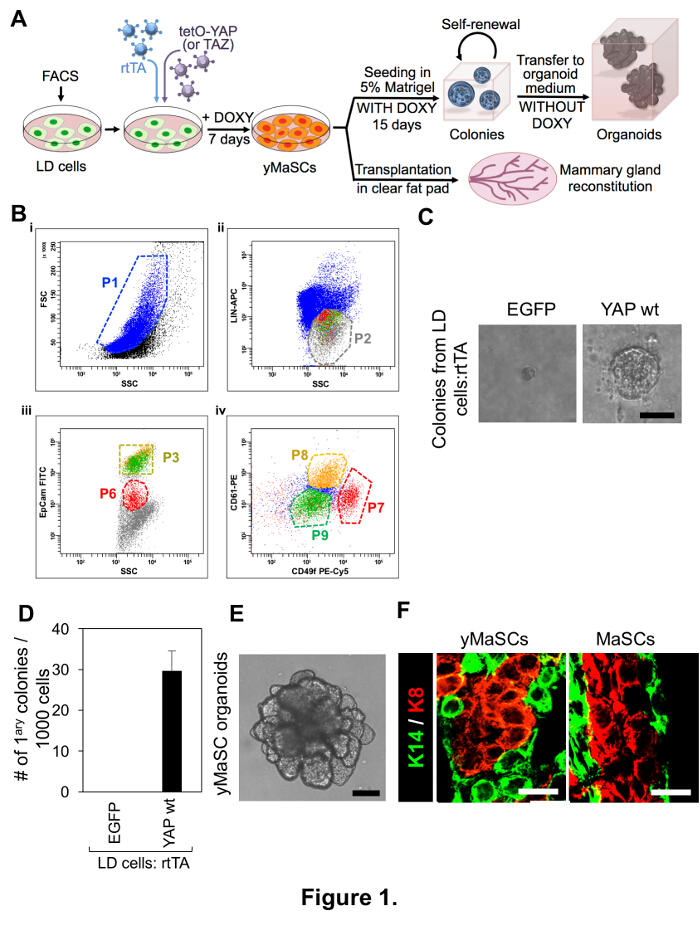
Figure 1: Isolation of primary mammary LD cells and induction of mammary stem cells. (A) Schematic representation of the experimental procedure adopted to reprogram primary mammary LD cells. (B) Representative FACS-plots illustrating a typical sorting procedure to purify LD cells. i) dissociated cells are gated according to forward and side scatter for live cells (P1; blue); ii) population P1 is then further gated according to its Lin profile: the subpopulation of Lineage-negative cells (P2; grey) is selected, excluding Lineage-positive hematopoietic cells; iii) population P2 is then separated into an EpCAMhigh (P3; yellow + green) and an EpCAMlow (P6; red) subpopulations; iv) P3 and P6 are then further gated according to their CD61/CD49f profile into three subpopulations: EpCAMlowCD49fhighCD61- Basal cells (P7; red), EpCAMhighCD49flowCD61+ LP cells (P8; yellow) and EpCAMhighCD49flowCD61- LD cells (P9; green). (C) Images are illustrative of the ability of LD cells, infected with the indicated constructs, to form mammary colonies 15 days after seeding in mammary colony medium. Only YAP-expressing cells turn into colony-forming cells, whereas negative control cells (EGFP-infected) remain as growth-arrested single cells. Scale bar = 50 μm. (D) Quantification of the colony forming ability of the indicated cells, as in (C). Data are presented as mean + s.d. and are representative of five independent experiments, each with six technical replicates. (E) Representative image of YAP-reprogrammed mammary stem cell-like cells (yMaSCs) after 12 days into organoid culture conditions in fresh three-dimensional 100% basement membrane matrix hydrogel in the absence of Doxycycline. Scale bar = 100 μm. (F) Representative immunofluorescence images for the basal marker K14 (green) and the luminal marker K8 (red) of organoids derived from the indicated cells, after 12 days into organoid culture conditions. Scale bar = 10 μm. This figure is reproduced from Panciera et al., 20161. Please click here to view a larger version of this figure.
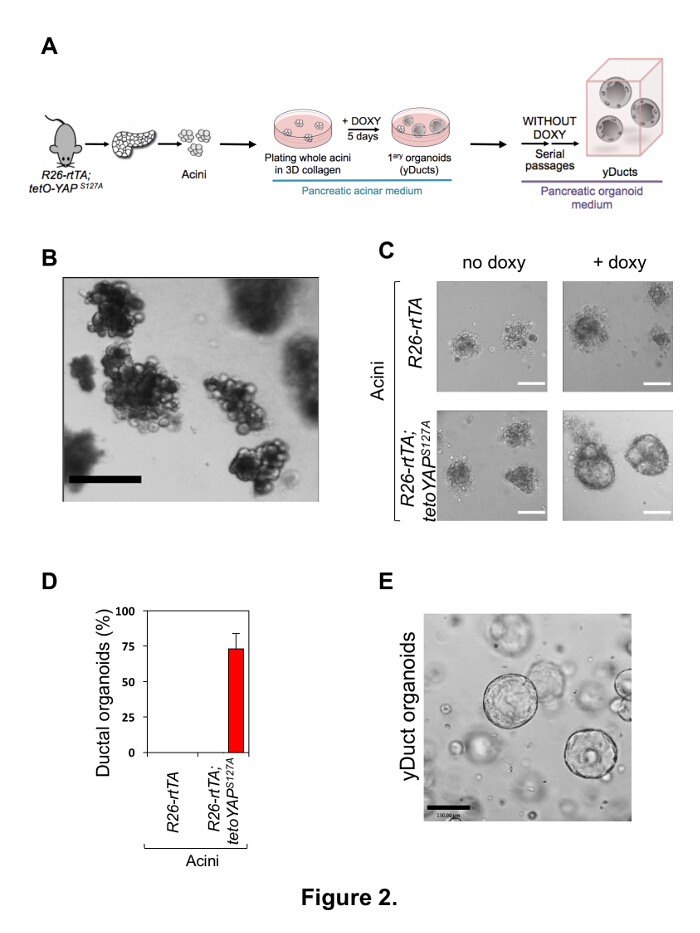
Figure 2: Isolation of primary pancreatic acinar cells and induction of pancreatic progenitors. (A) Schematic representation of the experimental procedure adopted to reprogram primary pancreatic exocrine acinar cells. (B) Representative image of primary pancreatic acini just after the isolation procedure (step 2.1.14). The acinar preparation should appear as a homogeneous suspension of acinar clusters, with minimal presence of single cells. Scale bar = 400 μm. (C) Representative images of primary pancreatic acini derived from R26-rtTAM2 (upper panels)or R26-rtTAM2; tetO-YAPS127A (lower panels) mice and cultured in 3-D Collagen I -based hydrogel for 5 days with or without Doxycycline (doxy), as indicated. Only YAP-expressing primary acini convert to cells growing as cyst-like organoid after Doxycycline addition. Scale bars = 70 μm. (D) Quantification of the ability of pancreatic acini to form ductal organoids upon transgenic YAP overexpression as in (C). Data are presented as mean + s.d. and are representative of five independent experiments, performed with four technical replicates. (E) Representative image of YAP-reprogramed ductal-like cells (yDucts) after three passages in fresh three-dimensional 100% basement membrane matrix hydrogel in the absence of Doxycycline. Scale bar = 130 μm. Please click here to view a larger version of this figure.
| Isolation of primary mammary cells | |
| Ca2+ chelating solution | Store at 4 °C |
| EDTA | 0.02% w/V |
| PBS | |
| Collagen I coating solution | |
| Acetic Acid 0.02N, pH 3,23 | |
| Rat Tail Collagen (coating) | 1:50 |
| Dispase solution | Store at 4 °C |
| Dispase | 5 mg/ml |
| PBS | |
| Dissociation Medium | |
| DMEM:F12 | |
| Hyaluronidase Stock Solution | 400 U/mL |
| Pen/Strep | 1x |
| Stock solution collagenase I | 600 U/mL |
| Haemolytic Solution | Store at 4 °C |
| NH4Cl Solution | 1 parts |
| TrisBase 20.6 g/L | 9 parts |
| adjust pH to 7.2 | |
| HBSS/PS | Store at 4 °C |
| HBSS | |
| Pen/Strep | 2x |
| Hyaluronidase Stock Solution | Filter 0.2 µm, store at 4 °C |
| Hyaluronidase from bovine testes (powder) | 2,000 U/mL |
| Sodium phosphate Buffer 1M pH7.3 | |
| NH4Cl Solution | Store at T. amb. |
| H2O | |
| NH4Cl | 7.1 g/L |
| adjust pH to 7.65 | |
| Sorting Solution | Filter 0.2 µm, store at 4 °C |
| BSA | 0.1% |
| EDTA | 1 mM |
| HEPES pH 7 | 25 mM |
| PBS | |
| Wash Medium #1 | |
| DMEM/F12 | |
| Pen/Strep | 1x |
| Wash Medium #2 | |
| DMEM/F12 | |
| FBS | 5% |
| Pen/Strep | 1x |
| Mammary 2D culture medium | |
| DMEM/F12 | |
| FBS | 2% |
| heparin | 4 mg/mL |
| L-Glutamine | 1x |
| murine bFGF | 10 ng/mL |
| murine EGF | 10 ng/mL |
| Pen/Strep | 1x |
| Induction and Passaging of yMaSCs | |
| Mammary Colony Medium | |
| DMEM:F12 | |
| FBS | 5% |
| heparin | 4 µg/mL |
| L-Glutamine | 1x |
| Matrigel (add immediately before seeding) | 5% |
| murine bFGF | 20 ng/mL |
| murine EGF | 10 ng/mL |
| Pen/Strep | 1x |
| Mammary Organoid Medium | |
| Advanced DMEM:F12 | |
| B27 | 1x |
| GlutaMax | 1x |
| heparin | 4 µg/mL |
| Hepes | 1x |
| human Noggin | 100 ng/mL |
| murine bEGF | 20 ng/mL |
| murine EGF | 50 ng/mL |
| R-Spondin 1 | 1 µg/mL |
Table 1: Generation of yMaSCs. Composition of all different culture media and solutions required for isolation of primary mammary LD cells and induction of yMaSCs (section 1.)
| Isolation of primary pancreatic acini | |
| Acinar Culture Medium | |
| BPE | 50 µg/mL |
| BSA | 0.1% |
| Dexamethasone | 1 µg/mL |
| FBS | 0.1% |
| ITS-X | 1x |
| Pen/Strep | 1x |
| SBTI | 0.2 mg/mL |
| Waymouth’s Medium | |
| Acinar Wash Medium | |
| BSA | 0.1% |
| Pen/Strep | 1x |
| RPMI Medium | |
| SBTI | 0.2 mg/mL |
| Acinar Recovery Medium | |
| Acinar Culture Medium | |
| FBS | 30% |
| Collagenase I solution A | |
| Acinar Wash Medium | |
| Stock solution collagenase I | 360 U/mL |
| PBS/PS | Store at 4 °C |
| PBS (Phosphate-buffered saline) | |
| Pen/Strep | 1x |
| Stock solution collagenase I | Store at -20 °C |
| Collagenase, type I (powder) | 6,000 U/mL |
| PBS | |
| Passaging of pancreatic organoids | |
| Collagenase I solution B | |
| PBS 1x | |
| Stock solution collagenase I | 240 U/mL |
| Pancreatic Organoid Medium | |
| Advanced DMEM/F12 | |
| B27 | 1x |
| gastrin | 10 nM |
| human FGF10 | 100 ng/mL |
| human Noggin | 100 ng/mL |
| murine EGF | 50 ng/ml |
| N-Acetylcysteine | 1.25 mM |
| Nicotinamide | 10 mM |
| Pen/Strep | 1x |
| R-Spondin 1 | 1 mg/mL |
| SBTI | 0.2 mg/mL |
Table 2: Generation of yDucts. Composition of all different culture media and solutions required for isolation of primary acinar cells and induction and passaging of yDucts (section 2.)
Discussion
Here we present protocols to reprogram ex vivo terminally differentiated epithelial cells of different tissues into their corresponding tissue-specific progenitor cells (or ySCs) by transient expression of YAP, as reported previously1. We have detailed two procedures: one allowing reprogramming of FACS-purified cells through lentiviral vectors and a second one that avoids viral infection and takes advantage of transgenic YAP expression. Each protocol presents an efficient strategy to isolate and culture primary differentiated cells and a strategy to force exogenous YAP gene expression in differentiated cells, generating de novo somatic tissue-specific expandable stem cells (see schemes in Figures 1A and 2A).
We demonstrated that the isolation strategies here presented effectively isolate a pure population of differentiated cells, as demonstrated by the fact that we never detected any outgrowth from negative control samples (Figures 1C and 2C).
The lentiviral vectors used in this study for the reprogramming of primary mammary LD cells are doxycycline inducible, offering the possibility of a tight control of the transgene expression; this allows to turn on and off exogenous YAP expression at will. Particular attention should be placed in avoiding the use of an excessive viral titer, as this can be detrimental in terms of reprogramming efficiency. In the case of primary acinar cells, we switched to a fully transgenic approach to obtain a YAP-dependent reprogramming with minimal manipulations. This latter strategy is also particularly appropriate for primary pancreatic acini, as isolated acinar clusters are scarcely amenable to lentiviral infection and very fragile. The transgenic strategy employed offers the same advantage of doxycycline-dependent lentiviral vectors for the tight control of gene expression. Moreover, the transgenic strategy exploited with primary pancreatic acini bears the additional advantage of a much higher reprogramming efficiency compared to the viral-induced reprogramming of mammary LD cells. Beyond the different intrinsic plasticity associated to cells derived from different tissues, the higher rate of pancreatic reprogramming might be derived from the higher efficiency of expression associated to uniform and autonomous YAP expression in all explanted cells. Notably, we have demonstrated that exogenous YAP is no longer required after generation of ySCs (yMaSC colonies and yDucts), without affecting their self-renewal capacity. This is because ySCs reactivate endogenous YAP/TAZ and use them for self-renewal when exogenous YAP is turned off1.
We validated the notion that ySCs indeed emerge from differentiated cells by controlling the cell of origin of our reprogramming experiments through genetic lineage-tracing validations1.
Extensive characterization of ySCs shows that YAP-induced reprogramming generates normal somatic SCs1 as i) at the transcriptomic level, ySCs display massive overlaps with native SCs; ii) ySCs display differentiation potential and can generate a multilineage progeny always restricted to the identity of their tissue of origin; iii) ySCs are non-transformed and non-tumorigenic when transplanted in vivo.
Here we also describe procedures to maintain and expand in culture both yMaSCs and yDucts as organoids embedded in 100% basement membrane matrix hydrogels. These conditions allow for the self-organization of ySCs into three-dimensional organoids that ensure the maintenance of stemness properties long-term in culture, enabling to expand these stem populations at will for downstream analyses and applications. For unknown reasons, we failed to obtain yMaSC organoids by placing infected LD cells directly in organoid culture conditions 7 days after doxycycline treatment in plastic tissue culture plate; in other words, the intermediate growth step in mammary colony conditions is essential. In our hands, even native MaSCs require mammary colony conditions before passaging in organoid culture. Furthermore, the most efficient organoid outgrowth is obtained when we avoid dissociating the primary colonies into single cells, but rather transfer the intact colonies into organoid culture conditions.
Organoid culture conditions also bear the advantage of giving the possibility to cryopreserve ySCs, provided that the organoids are recovered from their matrices, avoiding cell dissociation prior to cryopreservation in nitrogen bath.
The YAP reprogramming procedure presented can convert distinct differentiated cell types derived from different adult tissues into their corresponding tissue-specific stem cells (we have tested it using mammary, pancreatic and neuronal cells)1. At difference from iPSCs or other reprogramming efforts, YAP/induced SCs can maintain the memories of their tissue of origin. Of note, de-differentiation of somatic cells into cells endowed with stem-like properties is the only form of cell fate plasticity and reprogramming observed in vivo, for example after tissue damage and to support wound healing5,17,18,19,20. It is noteworthy that YAP and TAZ are largely dispensable for normal homeostasis but crucial for tissue repair in multiple tissues11,21. Consistently with a physiological function of the reprogramming steps here described, YAP/TAZ have been recently shown to be required in intestinal regeneration in mouse models of ulcerative colitis patients by causing a conversion of adult intestinal cells into a repairing epithelium that displays features of the fetal gut19. YAP reprogramming thus expands the current induced cell plasticity strategies by providing a means to generate somatic stem cells, a state that has been so far challenging to capture in vitro. This approach, if extended also to human-derived cells, might have broad relevance from regenerative medicine applications to the study of the somatic stemness state and for expansion of somatic stem cells in vitro.
Disclosures
The authors declare no competing financial interests.
Acknowledgements
We thank F. Camargo for the gift of tetO- YAPS127A mice; R26-rtTAM2 mice (stock #006965) were purchased from The Jackson Laboratory. We thank Chiara Frasson and Giuseppe Basso for help with FACS procedures. This work is supported by AIRC Special Program Molecular Clinical Oncology ''5 per mille'' and an AIRC PI-Grant to S.P, and by Epigenetics Flagship project CNR-Miur grants to S.P. This project has received funding from the European Research Council (ERC) under the European Union's Horizon 2020 research and innovation programme (grant agreement DENOVOSTEM No. 670126).
Materials
| Name | Company | Catalog Number | Comments |
|---|---|---|---|
| 10 mL sterile syringes | Rays | 10LC | |
| 100 mm cell strainer | Corning | 352360 | |
| 15 mL sterile conical tubes | Corning | 430052 | |
| 24-well ultra low attachment plates | Costar | 3473 | |
| 40 mm cell strainers | Corning | 352340 | |
| 48-well multiwell plates | Corning | 353078 | |
| 50 mL sterile conical tubes | Corning | 430290 | |
| 6-well multiwell plates | Corning | 353046 | |
| Advanced DMEM/F12 | Gibco | 12634028 | |
| B27 supplement (50x) | Gibco | 17504001 | |
| BPE | Gibco | 13028014 | |
| BSA | Sigma | A9418 | |
| Collagenase, type I | Sigma | 17018029 | |
| dexamethasone | Sigma | D4902 | |
| Dispase | Gibco | 1705-041 | |
| Disposable scalpels | Swann-Morton | 0503 | |
| DMEM/F12 | Gibco | 11320033 | |
| DMSO | Sigma | D2650 | |
| DnaseI | Roche | 11284932001 | |
| doxycycline hyclate | Sigma | D9891 | |
| EDTA | Sigma | E5134 | |
| Ethanol 100% | Sigma | 51976 | |
| FACS tubes (with strainer caps) | Falcon | 352235 | |
| FBS | Gibco | 10270106 | |
| FITC anti-mouse CD326 (Ep-CAM) | BioLegend | 118208 | |
| FUdeltaGW-rtTA | Addgene | #19780 | |
| FUW-tetO-EGFP | Addgene | #84041 | used as negative control |
| FUW-tetO-MCS | Addgene | #84008 | used as negative control |
| FUW-tetO-wtYAP | Addgene | #84009 | |
| FUW-tetO-YAPS94A | Addgene | #84010 | used as negative control (transcriptionally dead YAP mutant) |
| GlutaMax | Gibco | 35050061 | |
| HBSS | Gibco | 24020117 | |
| HCl | Sigma | 30721 | |
| heparin sodium salt | Sigma | H3149 | |
| HEPES buffer solution (1M) | Gibco | 15630-056 | |
| human R-Spondin1 (His Tag) | Sino Biological | 11083-H08H-5 | |
| Hyaluronidase from bovine testes | Sigma | H3506 | |
| ITS-X | Gibco | 51500056 | |
| K-14 antibody | Life Technologies | Ab7800 | |
| K-8 antibody | Life Technologies | Ab14053 | |
| L-Glutamine | Gibco | 25030081 | |
| Lin (allophycocyanin [APC] mouse lineage antibody cocktail) | BD Biosciences | 51-9003632 | |
| Matrigel® Growth Factor Reduced Basement Membrane Matrix, Phenol Red-Free | Corning | 356231 | |
| N-Acetylcysteine | Sigma | A9165 | |
| NaOH | J.T.Baker | 0402 | |
| NH4Cl | Sigma | A9434 | |
| Nicotinamide | Sigma | 72340 | |
| non-cell adhesive 10 cm dishes (sterile polystirol petri dish ø 94) | ROLL | 18248 | |
| PBS 10x | Euroclone | ECM4004XL | |
| PE Hamster Anti-Mouse CD61 | BD Biosciences | 553347 | |
| PE-Cy5 Rat Anti-Human CD49f | BD Biosciences | 551129 | |
| PE/Cy7 anti-mouse/rat CD29 Antibody | BioLegend | 102222 | |
| Pen/Strep (10,000 U/mL) | Gibco | 15140122 | |
| Rat Tail Collagen I (coating) | Sigma | 122-20 | |
| Rat Tail Collagen I for 3D culture | Cultrex | 3447-020-01 | |
| recombinant human FGF10 | Peprotech | 100-26 | |
| recombinant human Noggin | Peprotech | 120-10C | |
| recombinant murine EGF | Peprotech | 315-09 | |
| recombinant murine FGF basic (bFGF) | Peprotech | 450-33 | |
| RPMI 1640 medium | Gibco | 31870025 | |
| SBTI (Trypsin inhibitor from Glycine max) | Sigma | T6522 | |
| Tris BASE | Roche | 11814273001 | |
| Trypsin-EDTA 0,05% | Gibco | 25300054 | |
| Waymouth medium | Gibco | 31220023 |
References
- Panciera, T. Induction of Expandable Tissue-Specific Stem/Progenitor Cells through Transient Expression of YAP/TAZ. Cell Stem Cell. 19 (6), 725-737 (2016).
- Bar-Nur, O. Lineage conversion induced by pluripotency factors involves transient passage through an iPSC stage. Nat Biotechnol. 33 (7), 761-768 (2015).
- Xu, J., Du, Y., Deng, H. Direct lineage reprogramming: strategies, mechanisms, and applications. Cell Stem Cell. 16 (2), 119-134 (2015).
- Clevers, H. Modeling Development and Disease with Organoids. Cell. 165 (7), 1586-1597 (2016).
- Blanpain, C., Fuchs, E. Stem cell plasticity. Plasticity of epithelial stem cells in tissue regeneration. Science. 344 (6189), 1242281(2014).
- Bai, H. Yes-associated protein regulates the hepatic response after bile duct ligation. Hepatology. 56 (3), 1097-1107 (2012).
- Cai, J. The Hippo signaling pathway restricts the oncogenic potential of an intestinal regeneration program. Genes Dev. 24 (21), 2383-2388 (2010).
- Elbediwy, A. Integrin signalling regulates YAP and TAZ to control skin homeostasis. Development. 143 (10), 1674-1687 (2016).
- Taniguchi, K. A gp130-Src-YAP module links inflammation to epithelial regeneration. Nature. 519 (7541), 57-62 (2015).
- Zhang, W. Downstream of mutant KRAS, the transcription regulator YAP is essential for neoplastic progression to pancreatic ductal adenocarcinoma. Sci Signal. 7 (324), ra42(2014).
- Zanconato, F., Cordenonsi, M., Piccolo, S. YAP/TAZ at the Roots of Cancer. Cancer Cell. 29 (6), 783-803 (2016).
- Azzolin, L. YAP/TAZ incorporation in the beta-catenin destruction complex orchestrates the Wnt response. Cell. 158 (1), 157-170 (2014).
- Stingl, J. Purification and unique properties of mammary epithelial stem cells. Nature. 439 (7079), 993-997 (2006).
- Means, A. L. Pancreatic epithelial plasticity mediated by acinar cell transdifferentiation and generation of nestin-positive intermediates. Development. 132 (16), 3767-3776 (2005).
- Shi, G. Maintenance of acinar cell organization is critical to preventing Kras-induced acinar-ductal metaplasia. Oncogene. 32 (15), 1950-1958 (2013).
- Huch, M. Unlimited in vitro expansion of adult bi-potent pancreas progenitors through the Lgr5/R-spondin axis. EMBO J. 32, 2708-2721 (2013).
- Fernandez Vallone, V. Trop2 marks transient gastric fetal epithelium and adult regenerating cells after epithelial damage. Development. 143 (9), 1452-1463 (2016).
- Yanger, K. Robust cellular reprogramming occurs spontaneously during liver regeneration. Genes Dev. 27 (7), 719-724 (2013).
- Yui, S. YAP/TAZ-Dependent Reprogramming of Colonic Epithelium Links ECM Remodeling to Tissue Regeneration. Cell Stem Cell. , (2017).
- Pan, F. C. Spatiotemporal patterns of multipotentiality in Ptf1a-expressing cells during pancreas organogenesis and injury-induced facultative restoration. Development. 140 (4), 751-764 (2013).
- Panciera, T., Azzolin, L., Cordenonsi, M., Piccolo, S. Mechanobiology of YAP and TAZ in physiology and disease. Nat Rev Mol Cell Biol. 18 (12), 758-770 (2017).
- Lentiviral production and infection. , http://www.bio.unipd.it/piccolo/protocols/YAP_reprogramming_protocols.pdf (2016).
Reprints and Permissions
