Here we describe two non-invasive methods to chronically control neuronal activity using chemogenetics in mice. Eye-drops were used to deliver clozapine-N-oxide (CNO) daily. We also describe two methods for prolonged administration of CNO in drinking water. These strategies for chronic neuronal control require minimal intervention reducing animals’ stress.
Method Article
Non-invasive Strategies for Chronic Manipulation of DREADD-controlled Neuronal Activity
In This Article
Summary
Abstract
Chemogenetic strategies have emerged as reliable tools for remote control of neuronal activity. Among these, designer receptors exclusively activated by designer drugs (DREADDs) have become the most popular chemogenetic approach used in modern neuroscience. Most studies deliver the ligand clozapine-N-oxide (CNO) using a single intraperitoneal injection, which is suitable for the acute activation/inhibition of the targeted neuronal population. There are, however, only a few examples of strategies for chronic modulation of DREADD-controlled neurons, the majority of which rely on the use of delivery systems that require surgical intervention. Here, we expand on two non-invasive strategies for delivering the ligand CNO to chronically manipulate neural population in mice. CNO was administered either by using repetitive (daily) eye-drops, or chronically through the animal's drinking water. These non-invasive paradigms result in robust activation of the designer receptors that persisted throughout the CNO treatments. The methods described here offer alternatives for the chronic DREADD-mediated control of neuronal activity and may be useful for experiments designed to evaluate behavior in freely moving animals, focusing on less-invasive CNO delivery methods.
Introduction
Technical advances in the field of neuroscience have allowed scientists to precisely identify and control the activity of particular neuronal populations1. This has contributed to better understand the basis of neuronal circuits and their impact on animal behavior, as well as, revising established dogmas2,3. Among these novel tools, optogenetic and chemogenetic strategies have had a profound impact not only on the quality of discoveries but also on the way experiments are conceived and designed4. In the present manuscript, we focus on chemogenetic strategies for controlling the activation of neurons via engineered receptor-ligand strategies. Designer receptors exclusively activated by designer drugs (DREADDs) represent one of the most popular chemogenetic tools for the remote control of neuronal activity, as reviewed by Roth 20165. DREADDs utilize modified muscarinic acetylcholine receptors that are specifically activated by an inert ligand, clozapine-N-oxide (CNO)6.
Most studies use CNO administered by intraperitoneal (i.p.) injections, which effectively controls the dosage and timing of engineered receptors activation in an acute fashion. However, when repetitive or chronic DREADD activation is required, the use of multiple i.p. injections become unfeasible. To address this issue, different strategies for the chronic CNO delivery have been reported, including implanted minipumps7 and intracranial cannulas8,9. To different extents, all these strategies cause the animals stress and pain10, and require a surgical intervention that could also have a direct impact on the behavioral responses to be tested11. Here, we describe three non-invasive strategies for the chronic CNO delivery.
For this purpose, mice were stereotaxically injected in the hippocampus with an adeno-associated virus (AAV) encoding an engineered version of the excitatory M3 muscarinic receptor (hM3Dq) that when activated by the ligand CNO leads to the burst-like firing of neurons6. It was previously shown that a single eye-drop containing CNO can effectively elicit a robust activation of DREADD-expressing neurons12. Here we describe a modified method for the repetitive delivery of eye drops. To achieve chronic and sustained control of the designer receptors, we next describe a non-invasive strategy to deliver CNO to mice through the drinking water. Finally, we describe an alternative paradigm for delivering CNO in drinking water during a restricted time window. Mice locomotor activity, as well as drinking behavior and the consumption of sweet caloric solutions, are mostly restricted to the dark portion of the light/dark cycle13,14. Therefore, we adopted a protocol based on the mouse’s preference for sucrose. By measuring the induction of the immediate-early gene c-Fos in AAV-infected cells, as a readout for neuronal activation12,15, we found that these CNO delivery strategies robustly activate DREADD-controlled neurons over extended durations.
Protocol
All animals were handled in accordance with guidelines of the Animal Care and Use Committees of the National Institute of Mental Health (NIMH). All efforts were made to minimize the pain and the number of animals used.
1. Adeno-associated virus injections in the hippocampus
NOTE: Wild type male mice of mixed background (B6/129 F1 hybrid, 3 months old) were for stereotaxically injected with an AAV encoding the M3 muscarinic receptor (hM3Dq) into the hippocampus. During the entire experiment, mice were single-housed, under a regular 12 h light: 12 h dark (T24) cycle, with access to food and water ad libitum.
- Before performing stereotaxic surgeries, clean and sterilize the stereotaxic frame and all needed instruments.
NOTE: Surgical drapes could be used to maintain a sterile field and reduce mouse's heat loss. - Deeply anesthetize the mouse using isoflurane. To do this, first adjust the oxygen flow meter to approximately 1.5 L/ min, and then adjust the isoflurane vaporizer to approximately 3-5% for induction and approximately 1-3% for maintenance.
- To ensure that the animal is fully unconscious, pinch the mouse’s paw; the animal is properly anesthetized when the flinching response to pinch is absent.
- Place the mouse on a heating pad to maintain the stability of the mouse’s body temperature.
- Shave the top of the head and fix the head of the mouse to the stereotaxic frame. Then, apply ocular protective lubricant on the eyes, clean the surface by scrubbing with povidone-iodine and 70% ethanol, and expose the skull using a sterile scalpel.
- Calibrate the frame to bregma point, then drill at a medial-lateral coordinate of 2.9 mm and an anterior-posterior coordinate -2.7 mm to target the hippocampus.
NOTE: If other brain target needs to be injected, determine the desired coordinates for injection using the Paxinos and Franklin mouse atlas16. - Once the brain is exposed, unilaterally inject 90 nL of the AAV at the dorsal-ventral depth of -3.0 mm in the hippocampus using a microinjector and pulled microcapillary pipettes (Figure 1A).
NOTE: See Table of Materials for the titer of AAV used in this experiment. For other brain areas, adjust the AAV volume of injection as needed. - At the end of the surgical procedure, close the incision with nylon sutures and apply topical antibiotics to the wound site.
- Administer analgesics (buprenorphine, 0.1 mg/kg) systemically immediately following surgery, and 4-6 hours after.
- Beginning 4 weeks post-injection, subject mice to any of the paradigms described in the following section to chronically control neurons expressing the designer excitatory receptor.
2. Repetitive CNO delivery using eye-drops
- Acclimate the animals to handling by scruffing each mouse 3 min daily for 3-4 days prior to the administration of eye-drops.
- Dissolve Clozapine-N-oxide (CNO, 5 mg) in 1 mL of sterile 0.9% saline solution (stock solution: 5 mg CNO/ mL). Keep the solution refrigerated at 4 °C.
- Weigh each mouse before starting the experiment to determine the amount of CNO to be delivered. Use 1-3 μL drop (per eye) to achieve 1.0 mg CNO/ kg body weight.
NOTE: As an example, a 20 g mouse should receive bilateral (2 μL each) eye-drops. - Deliver the eye-drops during the inactive (light) phase of mice, 2 h before lights turn off (zeitgeber time (ZT) 10). In cases where CNO needs to be delivered during the active (dark) phase of mice, ensure the presence of dim red light for proper animal handling.
NOTE: Precautions should be taken to avoid disrupting the circadian (and light/dark) cycle of experimental animals.- Using a P10 micropipette, load the required amount (1-3 μL) of CNO solution to achieve 1.0 mg CNO/ kg.
NOTE: Use a new and sterile pipette tip for each eye-drop. In this set of experiments, bilateral eye-drops of CNO were performed; however, if a lower CNO concentration is required, unilateral eye-drops could be also applied. - Immobilize the mouse via scruff.
- Slowly expel the solution until a stable droplet forms on the pipette tip.
- Carefully bring the droplet close to the cornea of the mouse’s eye until the solution is delivered. The pipette tip should never contact the mouse’s eye.
- Release the mouse, placing it back in its home cage.
- Using a P10 micropipette, load the required amount (1-3 μL) of CNO solution to achieve 1.0 mg CNO/ kg.
- Repeat this procedure every day for 5 days.
NOTE: This duration can be adjusted as per the experimental requirements. - For control experiments, use AAV/DREADD-injected mice subjected to sham treatment (eye-drops containing only saline solution), and mice injected with an empty vector (e.g., AAV/mCherry) exposed to the described CNO eye-drops protocol.
3. Chronic CNO treatment delivered through drinking water
- Make small bottles using 50 mL (plastic) conical tubes and rubber stopper spouts; cover with aluminum foil to avoid any light-mediated effects on CNO stability.
- Three days before starting with the CNO treatment, replace regular water bottles with small bottles, containing 10 mL of regular water, to allow mice to acclimate to them. Secure the bottles to the cages using tape.
- Measure the daily water consumption for each mouse.
- Weigh each mouse before starting the experiment.
- Dissolve Clozapine-N-oxide (CNO, 5 mg) in 1 mL of 0.9% sterile saline solution. Refrigerate the stock solution at 4 °C.
- Use the body weight and the average amount of water consumed to define the concentration of CNO solution to achieve 1.0 mg CNO/ kg (body weight).
NOTE: Adult male mice (~20 g body weight) consume ~5 mL of water per day (Figure 2A). Therefore, to achieve a CNO concentration of 1 mg CNO/ kg, 6.4 μL of CNO stock solution should be added to a final volume of 8 mL of water (final concentration: 4 μg CNO/ mL). Thus, the dose of CNO for a 20 g animal that drinks 5 mL water per day results in 1 mg CNO/ kg. - Determine the optimal CNO dose that displays the maximum effectiveness with minimal CNO concentration by testing a range of concentrations. Perform a dose response analysis to determine the optimal CNO dose for the drinking water method.
NOTE: The following CNO doses were tested for this experiment: 1.0 mg/ mL, 0.5 mg/ mL, 0.25 mg/ mL, 0.1 mg/ mL, and saline. 1.0 mg CNO/ kg was first tested, based on i.p. and eye-drops protocols. - On day 1, fill the bottle with 8 mL of regular water and add the required amount of CNO.
NOTE: This amount of water is enough for 24 h of ad libitum water access for an adult male mouse. In case other rodent species are used, first measure the amount of water consumed daily to determine the volume needed. - Monitor the health of the animals throughout the protocol to ensure that there are no adverse side effects caused by water + CNO consumption.
- After 24 h, replace the bottles with fresh water + CNO solution. Record the volume consumed during the previous day.
- Dispose of the water + CNO solution that was not consumed in waste containers. Discard plastic bottles and replace the rubber stoppers every day, after sanitizing them according to the animal facility guidelines.
NOTE: Do not mix aqueous wastes with organic solvents. Contact the Chemical Disposal Service for instructions for storage and pick-up. - Replace the bottles at the same time every day for 5 days.
NOTE: This duration can be adjusted as per the experimental requirements. - Include control groups, as described in step 2.6.
4. Restricted CNO treatment using mice’s preference for sucrose
- 3 days before starting with the CNO treatment, place a small bottle containing 10 mL of water + 1% sucrose on the cage, preferably away from the original water bottle.
NOTE: Use the same small bottles described in Step 3.1. - Expose animals to water + 1% sucrose during the last portion of their active phase (ZT 18 – 24). After this exposure, remove the bottle with water + sucrose from the cage.
NOTE: Different time windows of CNO delivery could be used. Additionally, mice could be placed under an inverted light/dark cycle, where the onset of light occurs in the evening hours to facilitate the CNO delivery. - Measure the daily water + 1% sucrose consumption for each mouse.
- Weigh each mouse before starting the experiment.
- Use the body weight and the average amount of water + 1% sucrose consumed to determine the dose of CNO solution to achieve 1.0 mg CNO/ kg (body weight).
NOTE: The optimal CNO dose that displays the maximum effectiveness with minimal CNO concentration should be tested, as explained in step 3.6. - On day 1, fill bottles with 5 mL of water + 1% sucrose + CNO (1 mg CNO/ Kg) and place them on the cage (always at the same location) during the determined time window.
- At the end of the restricted time window, remove the bottles and measure the amount of water + sucrose + CNO consumed.
NOTE: Materials and solutions are sanitized or discarded as previously described in step 3.11. - Repeat this procedure every day for 5 days.
NOTE: This duration can be adjusted as per the experimental requirements. - Include a control group, as described in step 2.6.
5. Data analysis
- Perfuse mice intracardially with 4% paraformaldehyde (PFA) either 2 or 6 h after receiving the last repetitive (5th day) CNO eye-drop. When CNO is delivered through drinking water, replace CNO + water with water at the end of the mouse’s active phase, then perfuse the mouse after either 2 or 6 h post-CNO access.
NOTE: If light exposure could affect the c-Fos induction in the area of interest, keep mice in constant darkness during the last day of the experiments, and before the perfusion. - Carefully dissect the brain out and submerge in 4% PFA solution for 9-12h.
- After PFA fixation, cryoprotect the brain tissue using a 30% sucrose solution (wait until the brain sinks), then section the brain using a cryostat.
- Transfer the coronal brain sections (35 μm) into a solution containing 1x PBS, 10% bovine serum albumin, and 0.3% Triton X-100 for 1 h at room temperature.
- Incubate the brain sections with an anti-c-Fos (1:2500) antibody solution at 4 °C overnight with constant agitation.
- After 3 washes of 5 min each with a solution containing 1x PBS and 0.3% Triton X-100, incubate the samples with an Alexa-conjugated secondary antibody (1:500) solution for 1 h at room temperature away from light and with constant agitation.
- Obtain digital images using a confocal microscope. Assemble and process captured images with a photo editing and analysis software (e.g., Adobe Photoshop).
- For data analysis, outline and measure the AAV-infected area (mCherry(+) cells) using ImageJ software, and quantify the number of c-Fos(+) cells within this region to obtain the number of activated cells per area. Combine the results obtained from 3 separate sections per animal.
Results
We observed that repetitive CNO delivery using eye-drops elicited a robust induction of c-Fos expression in most infected neurons (Figure 1C), showing that the effectiveness of CNO delivery is sustained during the repetitive exposure. Furthermore, a significant induction of c-Fos was observed in samples collected 2 h after CNO treatment, compared to samples obtained 6 h after CNO exposure (Figures 1D-E), demonstrating that changes induced by CNO are time-dependent.
We then measured the effectiveness of the chronic CNO treatment delivered through drinking water. We observed that the daily consumption of water + CNO was not significantly different compared with the total volume of regular water consumed (Figure 2A). Similarly, the amount of water + 1% sucrose consumed during the night (6 h time window) was not affected by the addition of CNO (Figure 2B). Further, no differences in the daily consumption (5 days) of both water + CNO (Figure 2C) and water + sucrose + CNO (Figure 2D) were found throughout the experiment for all the animals.
Similar to what we found using CNO eye-drops, robust induction of c-Fos was observed after 2 h but not 6 h upon CNO access (Figures 2E-F).
Finally, we measured the dose response of CNO added to drinking water. To do this, mice were exposed to the following CNO doses: 1.0 mg/ mL, 0.5 mg/ mL, 0.25 mg/ mL, 0.1 mg/ mL, saline. In all cases, animals were perfused 2 h after CNO exposure. We found that there is a clear threshold of effectiveness for CNO, where a low CNO dose (0.1 mg/ mL) does not elicit c-Fos activation compared to saline control, whereas higher doses (0.25 mg/ mL, 0.5 mg/mL and 1.0 mg/ mL) induced robust and similar c-Fos induction (Figure 2G).
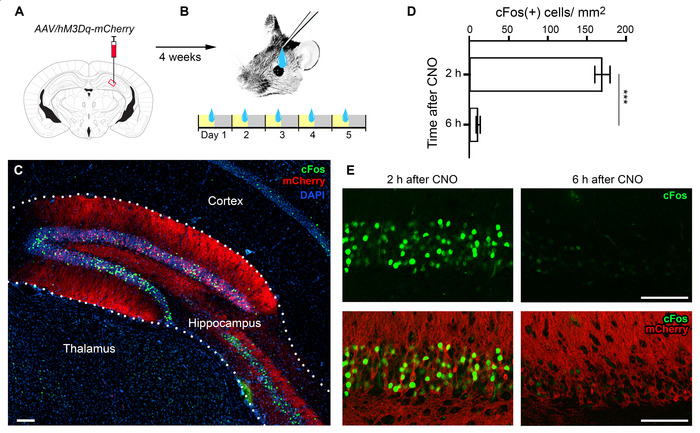
Figure 1: Repetitive CNO delivery using eye-drops. (A) AAV/hM3Dq-mCherry was stereotaxically injected in the hippocampus of adult (3 months old) male mice. (B) Four weeks post-injection, CNO was administered using eye-drops once daily for 5 consecutive days. A dose of 1.0 mg CNO/ kg was used. (C) Finally, mice were sacrificed, and brain tissue was tested for c-Fos (green) immunoreactivity in the AAV-infected area (mCherry-positive cells, red). A representative coronal section of the injection site and the CNO-mediated c-Fos activation is shown. (D) The number of c-Fos positive cells in the AAV-infected area was measured in mice that were perfused 2 or 6 h after the last CNO administration. Data are mean ± SEM. ***p < 0.001; by Student’s t-test (n = 2-3 mice). (E) Representative images for the two groups are shown. Scale bar: 100 μm Please click here to view a larger version of this figure.
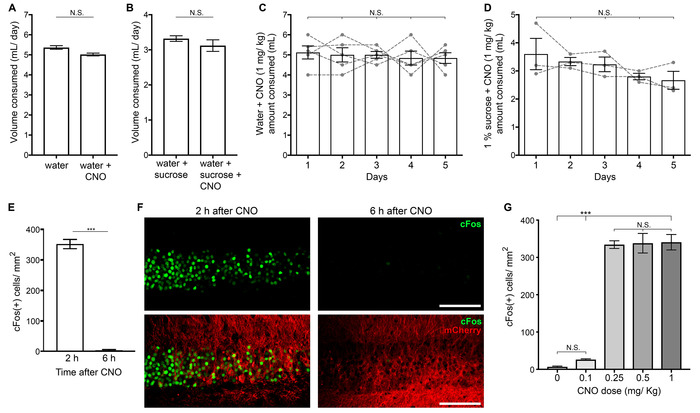
Figure 2: Chronic CNO treatment delivered through drinking water. (A) No differences in the total liquid consumption were observed between control (water) or treated (water + CNO, dose: 1.0 mg CNO/ kg) animals. Data are mean ± SEM (n = 13-14 mice). (B) Similarly, no significant differences were observed in the volume of water + 1 % sucrose consumed (during a 6 h time window), after adding CNO (1.0 mg/ Kg). Data are mean ± SEM (n = 5 mice). (C) Daily consumption of water + CNO (1.0 mg/ kg) for individual mice is shown. No differences in the daily consumption were observed. Data are mean ± SEM (n = 5 mice). (D) Daily liquid consumption (during a 6 h time window) of 1% sucrose + CNO (1.0 mg/ kg) for individual mice is shown. No differences in the daily consumption were observed. Data are mean ± SEM (n = 3 mice). (E) 2 or 6 h after the last CNO administration, mice were sacrificed, and the number of c-Fos positive cells was quantified in the AAV-infected area. Data are mean ± SEM. ***p < 0.001; by Student’s t-test (n = 5 mice). (F) Brain coronal sections were tested for c-Fos (green) immunoreactivity in the AAV-infected (mCherry-positive cells, red) region. Representative images are shown. (G) Four CNO doses were administered (0.1, 0.25, 0.5, and 1.0 mg CNO/ kg), and the c-Fos induction was measured. Data are mean ± SEM. ***p < 0.001; by ANOVA, followed by Tukey’s test (n = 2 mice). Scale bar: 100 μm Please click here to view a larger version of this figure.
Discussion
DREADDs have emerged as a popular and effective approach to remotely manipulate neuronal activity17. The design of alternative strategies for CNO delivery will broadly increase the spectrum of options available for specific experimental settings. In addition, non-invasive strategies for the delivery of CNO minimize any potential misinterpretation of results by reducing adverse side effects that can directly impact the animal’s health. Here, we described two non-invasive strategies for CNO delivery that confer a robust activation of DREADDs (hM3Dq) and offer a wide spectrum of possibilities. Further, we believe that the protocols described here might also be useful for different DREADD variants for neuronal manipulation, including genetically engineered muscarinic or opioid receptors.
CNO delivery using repetitive eye-drops represents a painless alternative to repetitive intraperitoneal CNO injections while preserving the power to precisely control dosage and timing of CNO delivery. Therefore, we recommend using this protocol when repetitive DREADD activation is required. Eye-drops are also the least expensive option for CNO delivery, particularly compared with the protocol using CNO added to the drinking water. CNO delivered through drinking water, on the other hand, confers a chronic and sustained activation of DREADDS, avoiding any mouse handling. It is important to mention that this protocol lacks precise control over the timing of CNO delivery. A third alternative, time-restricted access to a sucrose solution containing CNO, combines advantages of both protocols previously discussed. This strategy is at the same time non-invasive, repetitive and easy to perform. Additionally, it offers a better control of the timing of CNO delivery compared with the 24 h access to water with CNO. A caveat of this approach is that it can only be used during the active phase of animals. We recommend using both strategies involving CNO in drinking water in combination with infrared cameras or a lick-o-meter system to obtain precise temporal information about CNO consumption and, therefore, DREADD activation.
Long-lasting effects conferred by CNO delivered through drinking water were previously reported. We have successfully applied a chronic CNO (5 μg/ mL) treatment during 14 consecutive days15 to evaluate the behavioral consequences of tonic activation of a thalamo-cortical circuit involved in mood control. Alternatively, CNO provided in the drinking water at a concentration of 40 mg/L has been used to chronically modulate the activity of serotonergic neurons of the dorsal raphe nucleus18, whereas the function of pancreatic β-cells was controlled using CNO at a concentration of 0.25 mg/mL water19. Combined, these results suggest that different CNO concentrations can be tuned to effectively control DREADDs. Here, we found that different doses of CNO added to drinking water elicited similar c-Fos activation, suggesting that a dose-response analysis should be performed to define the lowest and effective CNO dose required. Recent studies have shown that CNO is not entirely pharmacologically inert20; in addition, it was also demonstrated that the in vivo activation of DREADDs is mediated by the CNO metabolite clozapine, which has several endogenous targets21. Therefore, the authors suggest using subthreshold doses of clozapine, instead of high CNO doses. Although we have not evaluated the effectiveness of clozapine in the methods described, we found that CNO concentration could be reduced without significantly reducing neuronal activation, and therefore, minimizing side effects caused by the CNO-to-clozapine conversion.
In summary, the strategies presented here represent potential schemes for CNO delivery that can be easily adapted to a variety of experimental designs. They were conceived as non-invasive strategies that may be useful for repetitive or chronic CNO-mediated activation of DREADD-controlled neurons, reducing the impact of CNO delivery on animal behavior.
Disclosures
The authors have nothing to disclose.
Acknowledgements
This work was supported by the intramural research program at the National Institute of Mental Health (ZIA MH002964-02). We would like to thank the support of the NIMH IRP Rodent Behavioral Core (ZIC MH002952).
Materials
| Name | Company | Catalog Number | Comments |
|---|---|---|---|
| BSA | Sigma life science | #A2153-100G | Lyophilized powder ≥96% (agarose gel electrophoresis) |
| C57BL/6J mice | The Jackson laboratory | #000664 | male mice, 3 months old |
| Capillaries | Drummond Scientific Company | #3-000-203-G/X | Outer diameter: 1.14 inch |
| Clozapine-N-oxide | Sigma | #C0832 | 5 mg |
| Forane | Baxter | #NDC 10019-360-60 | Isoflurane, USP |
| Microinjector III | Drummond Scientific Company | #3-000-207 | Nanoject III - Programmable Nanoliter Injector |
| Mounting media | Invitrogen | #P36930 | Prolong Gold antifade reagent |
| Paraformaldehyde | Electron Microscopy Sciences | #15710 | 16% aqueous solution (methanol free), 10 mL |
| Primary c-Fos Antibody | Cell signaling technology | #2250S | c-Fos (9F6) Rabbit mAb (100µL) |
| rAAV5/hSyn-hm3D-mCherry | UNC Vector Core | Titer: ~3 x 10¹² vg/mL | |
| rAAV5/hSyn-mCherry | UNC Vector Core | Titer: ~3x10e12 vg/mL | |
| Secondary Antibody | Invitrogen | #A21206 | Alexa Fluor TM 488 Donkey anti-rabbit IgG(H+L), 2mg/ml |
| Triton X-100 | americanbio.com | #AB02025-00100 |
References
- Park, H. G., Carmel, J. B. Selective Manipulation of Neural Circuits. Neurotherapeutics. 13 (2), 311-324 (2016).
- Muir, J., Lopez, J., Bagot, R. C. Wiring the depressed brain: optogenetic and chemogenetic circuit interrogation in animal models of depression. Neuropsychopharmacology. 1, (2018).
- Wiegert, J. S., Mahn, M., Prigge, M., Printz, Y., Yizhar, O. Review Silencing Neurons: Tools, Applications, and Experimental Constraints. , (2017).
- Urban, D. J., Roth, B. L. DREADDs (Designer Receptors Exclusively Activated by Designer Drugs): Chemogenetic Tools with Therapeutic Utility. Annual Review of Pharmacology and Toxicology. 55 (1), 399-417 (2015).
- Roth, B. L. DREADDs for Neuroscientists. Neuron. 89 (4), 683-694 (2016).
- Armbruster, B. N., Li, X., Pausch, M. H., Herlitze, S., Roth, B. L. Evolving the lock to fit the key to create a family of G protein-coupled receptors potently activated by an inert ligand. Proceedings of the National Academy of Sciences. 104 (12), 5163-5168 (2007).
- Donato, F., Jacobsen, R. I., Moser, M. -B., Moser, E. I. Stellate cells drive maturation of the entorhinal-hippocampal circuit. Science. 355 (6330), (2017).
- Mahler, S. V., et al. Designer receptors show role for ventral pallidum input to ventral tegmental area in cocaine seeking. Nature Neuroscience. 17 (4), 577-585 (2014).
- Lichtenberg, N. T., et al. Basolateral Amygdala to Orbitofrontal Cortex Projections Enable Cue-Triggered Reward Expectations. The Journal of Neuroscience. 37 (35), 8374-8384 (2017).
- Schotman, P., Reith, M. E. A., Gispen, W. H. Effects of stressful procedures as ether anesthesia and intracranial injections on amino acid incorporation into brain protein. Brain Research Bulletin. , (1977).
- Frumberg, D. B., Fernando, M. S., Lee, D. E., Biegon, A., Schiffer, W. K. Metabolic and behavioral deficits following a routine surgical procedure in rats. Brain Research. , (2007).
- Keenan, W. T., Fernandez, D. C., Shumway, L. J., Zhao, H., Hattar, S. Eye-Drops for Activation of DREADDs. Frontiers in Neural Circuits. 11, 93(2017).
- LeGates, T. A., Altimus, C. M. Measuring circadian and acute light responses in mice using wheel running activity. Journal of Visualized Experiments. (48), (2011).
- Bainier, C., Mateo, M., Felder-Schmittbuhl, M. -P., Mendoza, J. Circadian rhythms of hedonic drinking behavior in mice. Neuroscience. 349, 229-238 (2017).
- Fernandez, D. C., et al. Light Affects Mood and Learning through Distinct Retina-Brain Pathways. Cell. 175 (1), 71-84 (2018).
- Franklin, K. B. J., Paxinos, G. Paxinos and Franklin’s The mouse brain in stereotaxic coordinates. , (2019).
- Urban, D. J., Roth, B. L. DREADDs (designer receptors exclusively activated by designer drugs): chemogenetic tools with therapeutic utility. Annual Review of Pharmacology and Toxicology. 55, 399-417 (2015).
- Urban, D. J., et al. Elucidation of The Behavioral Program and Neuronal Network Encoded by Dorsal Raphe Serotonergic Neurons. Neuropsychopharmacology official publication of the American College of Neuropsychopharmacology. 41 (5), 1404-1415 (2016).
- Jain, S., Ruiz De Azua, I., Lu, H., White, M. F., Guettier, J. -M., Wess, J. Chronic activation of a designer G q-coupled receptor improves β cell function. The Journal of Clinical Investigation. 123, (2013).
- MacLaren, D. A. A., et al. Clozapine N-Oxide Administration Produces Behavioral Effects in Long-Evans Rats: Implications for Designing DREADD Experiments. eNeuro. 3 (5), (2016).
- Gomez, J. L., et al. Chemogenetics revealed: DREADD occupancy and activation via converted clozapine. Science. 357 (6350), 503-507 (2017).
Reprints and Permissions
