Described here is a stereotactic procedure that can target challenging and difficult-to-reach brain regions (due to spatial limitations) using an angled coronal approach. This protocol is adaptable to both mouse and rat models and can be applied to diverse neuroscientific applications, including cannula implantation and microinjections of viral constructs.
A subscription to JoVE is required to view this content. Sign in or start your free trial.
Method Article
Adaptable Angled Stereotactic Approach for Versatile Neuroscience Techniques
In This Article
Summary
Abstract
Stereotactic surgery is an essential tool in the modern neuroscience lab. However, the ability to precisely and accurately target difficult-to-reach brain regions still presents a challenge, particularly when targeting brain structures along the midline. These challenges include avoiding of the superior sagittal sinus and third ventricle and the ability to consistently target selective and discrete brain nuclei. In addition, more advanced neuroscience techniques (e.g., optogenetics, fiber photometry, and two-photon imaging) rely on targeted implantation of significant hardware to the brain, and spatial limitations are a common hindrance. Presented here is a modifiable protocol for stereotactic targeting of rodent brain structures using an angled coronal approach. It can be adapted to 1) mouse or rat models, 2) various neuroscience techniques, and 3) multiple brain regions. As a representative example, it includes the calculation of stereotactic coordinates for targeting of the mouse hypothalamic ventromedial nucleus (VMN) for an optogenetic inhibition experiment. This procedure begins with the bilateral microinjection of an adeno-associated virus (AAV) encoding a light-sensitive chloride channel (SwiChR++) to a Cre-dependent mouse model, followed by the angled bilateral implantation of fiberoptic cannulae. Using this approach, findings show that activation of a subset of VMN neurons is required for intact glucose counterregulatory responses to insulin-induced hypoglycemia.
Introduction
Neural control of behavior, feeding, and metabolism involves coordination of highly complex, integrative, and redundant neurocircuits. A driving goal of the neuroscience field is to dissect the relationship between neuronal circuit structure and function. Although classical neuroscience tools (i.e., lesioning, local pharmacological injections, and electrical stimulation) have uncovered vital knowledge regarding the role of specific brain regions that control behavior and metabolism, these tools are limited by their lack of specificity and reversibility1.
Recent advances in the neuroscience field have greatly improved the ability to interrogate and manipulate circuit function in a cell-type specific manner with high spatiotemporal resolution. Optogenetic2 and chemogenetic3 approaches, for instance, allow the rapid and reversible manipulation of activity in genetically defined cell types of freely moving animals. Optogenetics involves the use of light-sensitive ion channels, termed channelrhodopsins, to control neuronal activity. Key to this technique is the gene delivery of channelrhodopsin and a source of light to activate the opsin. A common strategy for gene delivery is through a combination of 1) genetically engineered mice expressing Cre-recombinase in discrete neurons, and 2) Cre-dependent viral vectors encoding channelrhodopsin.
While optogenetics provides an elegant, highly precise means to control neuronal activity, the method is contingent upon successful stereotactic microinjection of the viral vector and fiberoptic placement into a defined brain region. Although stereotactic procedures are commonplace within the modern neuroscience lab (and there are several excellent protocols describing this procedure)4,5,6, being able to consistently and reproducibly target discrete brain regions along the midline (i.e., the mediobasal hypothalamus, a brain area critical to the regulation of homeostatic functions7) presents additional challenges. These challenges include avoiding of the superior sagittal sinus, third ventricle, and adjacent hypothalamic nuclei. In addition, there are significant spatial limitations to the bilateral implantation of hardware that is required for inhibition studies. With these challenges in mind, this protocol herein presents a modifiable procedure for targeting discrete brain regions via an angled stereotactic approach.
Access restricted. Please log in or start a trial to view this content.
Protocol
All procedures were approved in accordance with the National Institutes of Health, the Guide for the Care and Use of Animals and were approved by both the Institutional Animal Care and Use Committee (IACUC) and Environmental Health and Safety at the University of Washington.
1. Calculation of angled coordinates
- Using a coronal brain atlas, mark a right triangle so that the hypotenuse passes through the target region of interest. In the representative example (Figure 1), the hypothalamic ventromedial nucleus (VMN) is targeted at a 15° angle from the coronal midline.
NOTE: The placement of the axis of rotation depicted in Figure 1 (and thus, the length of side C) is arbitrary and can be modified to target any brain region. Although this may seem counterintuitive, later steps in the protocol will adjust the position of the head in the z-axis such that this point aligns with the stereotactic center of rotation (see section 6). However, it is recommended not to exceed a coronal rotation angle of 15° due to physical constraints of the head holder apparatus. - Establish the desired angle (a) and estimated length of side B and use trigonometry to calculate the length of sides A and C. This step is important for properly positioning the head during rotation.
NOTE: In the example in Figure 1, atlas gridlines are used to approximate the length of side B, yielding a length of 7.576 mm. This information is used to calculate the length of side A:
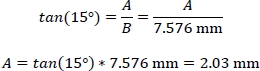
In this example, 2.03 mm indicates the R/L distance from the midline at which the fiberoptic cannula enters the brain when the head is rotated by 15°.- Optionally, calculate the length of side C to approximate the D/V coordinate:

NOTE: 1) The length of the hypotenuse (C) does not represent the depth of injection but will be helpful in determining the D/V coordinate, which may need to be adjusted to accommodate for the increased length vs. side B for straight-in injections. It is therefore recommended to perform test injections to optimize the D/V coordinate. 2) In this example targeting the VMN, two sets of coordinates are obtained: one for the microinjection that is non-angled (A/P = -1.4, R/L = 0.4 at 0°, D/V = -5.7) and one for the angled fiberoptic implantation (A/P = -1.4, R/L = 0.0 at 15°, D/V = -5.4).
- Optionally, calculate the length of side C to approximate the D/V coordinate:
2. Preparation of the stereotax for angled procedure
- Confirm that the stereotactic frame and micromanipulator have been calibrated (see Kopf manual for full protocol).
- Place the center height gauge into the socket of the head holder base plate.
- Secure the centering scope in the tool holder, then sight down the scope. Adjust the position of the micromanipulator until the crosshairs are aligned and focused on the gauge crosshairs.
NOTE: During this step, the scope is being positioned into the focal plane of the head holder’s center of rotation. Once established, the micromanipulator should not be moved during the remaining steps. - Place the ear bars into the holders and center them such that the indicator lines on both sides are at 0 (Figure 3A).
- Use the medial-lateral and anterior-posterior knobs on the head holder (Figure 2) to center-align the ear bars in the x- and y-planes above the crosshair of the center height gauge (Figure 3A).
- To align the ear bar position in the z-axis, remove the ear bars from the holder and remove the center height gauge. Replace the ear bars and center them again at 0.
- Sight down the scope. Use the vertical shift knob (Figure 3B) and coronal tilt knob, respectively, to lower and rotate the ear bars until the scope crosshairs remain centered between the ear bars throughout coronal rotation.
- The stereotax is now calibrated and ready. Do not make any further adjustments to the position of the head holder.
3. Preparation of materials for injection/implantation
- Ensure that all instruments, surgical tools, and materials are sterilized and placed in a sterile surgical field next to the stereotax.
- Handle and store viral constructs according to their biosafety level and relevant institutional biosafety regulatory requirements.
- Draw up the virus into the syringe, taking care to use proper handling practices and personal protective equipment.
4. Anesthesia
- Record the mouse’s body weight prior to surgery.
- Deeply anesthetize the mouse using isoflurane.
- Ensure that the mouse is deeply anesthetized by performing a toe pinch test until the flinching response is absent. If the animal continues to show strong reflexes, increase the concentration and/or duration of anesthesia.
- Apply eye ointment to each eye to keep them moist during surgery.
- Shave the scalp from just behind the ears to just behind the eyes with a hair clipper.
- Provide the mouse with IACUC-approved analgesic.
- Continuously monitor the animal throughout the surgical procedure and provide thermal support.
5. Surgical procedure
- Place the head into the head holder by placing the upper incisors into the gap in the bite bar, making sure that the tongue is below the bite bar.
- Secure the head in the ear bars by gently inserting the ear bars into the external auditory meatus, ensuring that the ear bars are symmetrically placed (typically between three and four for an adult mouse). This step is critical to ensure the head is stable and centered for rotation.
- Aseptically prepare the shaved incision area with three alternating scrubs of betadine and alcohol swabs, or with alternative institutionally approved surgical site preparation.
- Place a surgical drape over the animal to maintain a sterile surgical field and to reduce the risk of post-operative infection.
- Expose the skull by making an incision along the sagittal midline of the scalp. Gently scrape the surface of the skull to remove any fascia and expose the sutures.
NOTE: If suture lines are difficult to visualize, hydrogen peroxide can be applied to the skull using a sterile cotton-tipped applicator to improve suture visualization. - Place the centering scope into the holder and center the crosshairs on bregma (Figure 4, left panel). Zero the micromanipulator.
- Move the crosshairs caudally to lambda, noting the bregma-lambda (B-L) distance.
NOTE: If the suture lines do not follow a straight line along the midline, it is recommended to establish the midline using the “line of best fit” through both bregma and lambda. However, if the above steps are followed, the initial placement of the scope reticle should be halfway between the ear bars and closely approximate the B-L midline suture. - If the B-L distance is significantly less or greater than 4.21 mm, incrementally adjust the assigned bregma to obtain a B-L distance of 4.21 mm ± 0.2 mm.
- Replace the centering scope with the alignment indicator. Place the probes on lambda and bregma and adjust the dorsal tilt knob on the head holder to level in the sagittal plane (nose facing up or down), then use the centering scope to reassign bregma.
- Use the alignment indicator to level in the coronal plane using the coronal tilt knob. Measure at multiple points throughout the rostral/caudal axis to account for surface deformations in the skull.
- Note the position on the dial of the coronal tilt knob, as this is the 0° rotation position.
6. Aligning the central axes of rotation for angled coordinates
- Secure the centering scope in the tool holder and position the micromanipulator to the calculated coordinate from section 1. Note that the R/L coordinate for the angled implantation corresponds to the length of side A.
- In the example in Figure 1, the angled coordinates for fiberoptic placement targeting the VMN are (A/P = -1.4, R/L = [2.03] at 0° coronal rotation, [0.00] at 15° coronal rotation, D/V = -5.4).
- Sighting down the scope and mark this coordinate (R/L 2.03 mm from the midline per the VMN example; Figure 4, middle panel). This mark represents the point at which the cannula will enter the brain once the head is rotated.
- Reposition the micromanipulator over the midline (R/L = 0.00). Use the coronal tilt knob to rotate the head to the angle calculated in section 1.
- If the scope crosshairs already line up with the mark, proceed to section 7.
- If the scope crosshairs do not line up with the reference mark, adjust the head position in the z-axis using the vertical shift knob (Figure 2) until the crosshairs line up as close as possible to the mark.
- Rotate the head back to the 0° coronal position. If the vertical shift was adjusted in step 6.3, reassign bregma using the centering scope.
- Repeat steps 6.3 and 6.4 until the crosshairs consistently hit the reference mark when the head is rotated (Figure 4C).
- At this point, the arbitrary point of rotation established in section 1 should now be aligned with the stereotactic center of rotation.
7. Microinjection
- Place the stereotactic drill in the holder and maneuver the micromanipulator to the first injection coordinate.
- Per the example for targeting the VMN, drill at A/P = -1.4 and R/L = 0.4 while the head is level.
- Lower the drill until the bit is just above the skull. Turn on the drill, and gently lower until the bit has just drilled through the skull (not the dura).
- Repeat for the contralateral injection site.
- Use a sterile needle-driver to introduce a 90° bend into a 27-30G needle (e.g., of a sterile 0.5 mL insulin syringe), and use the bent needle to gently poke through the dura mater.
- NOTE: If bleeding occurs, apply pressure with a sterile cotton-tipped applicator and clean with sterile water until the bleeding has stopped.
- When ready to inject, carefully place a filled Hamilton syringe into the stereotactic holder.
NOTE: The coordinates on the micromanipulator no longer apply after switching to a new tool. Use the center of the burr hole as the new target for injection. - Carefully position the needle above the burr hole.
- Lower the needle until it slightly touches the dura within the center of the burr hole. CRITICAL: Zero the micromanipulator only in the z-axis, such that the coordinates on the micromanipulator for the stereotactic centering scope and drill are maintained.
- Slowly lower the needle into the brain, watching closely to ensure that the needle does not deflect on the edge of the burr hole. Continue to lower until 0.05 mm ventral to the D/V injection coordinate and wait 1 min. This extra step creates a small “pocket” to minimize viral backflow on needle removal.
- Slowly raise the needle to the D/V coordinate and start the injection.
NOTE: Flow rate and volume will vary depending on target region and experimental design. For optogenetic silencing of VMN neurons, sufficient coverage is desired, so 200 nL of virus is injected at a rate of 1 nL/s. - Following microinjection, wait 10 min at the injection site to minimize efflux of virus during withdrawal.
- Slowly withdraw the micropipette from the brain at an approximate rate of 1 mm/min.
- Once the needle is clear of the skull, eject a small volume of virus to ensure the needle has not clogged with blood or tissue. Use a sterile cotton-tipped applicator to remove the virus before continuing.
- Repeat steps 7.6–7.12 for the contralateral side.
- Seal the microinjection burr holes with bone wax to improve healing (Figure 5B).
8. Fiberoptic implantation
NOTE: After viral injection, bilateral fiberoptic cannulas are implanted at the calculated angle per section 1. Note that these coordinates should already be marked on the skull from section 6.
- Repeat steps 7.1 –7.4 for the angled coordinates.
- Return the head to the level 0° position.
- Next, use the hand drill to produce four additional holes for the bone screws: two should be placed anteriorly and two posteriorly (Figure 5A). These will serve as anchors to affix the fiberoptics to the skull (Figure 5D).
NOTE: Make sure to space the holes far enough away from the angled coordinate burr holes to accommodate the ferrule portion of the fiberoptic that sits above the skull. - As gently as possible, use the small flathead screwdriver to set the bone screws such that they sit firmly in the skull but do not penetrate the brain.
- Clamp a fiberoptic cannula into the cannula holder and place it in the stereotactic holder.
- Rotate the head to the calculated angle, noting again that the coordinates on the micromanipulator do not apply to the new tool. Use the center of the angled burr holes as the implantation target.
- Lower the fiberoptic until it just touches the dura within the center of the burr hole (Figure 5C). Zero the micromanipulator in the z-axis, then slowly slower the fiberoptic to the D/V angled coordinate (-5.4 per the VMN example).
- Use cyanoacrylate gel to connect the fiberoptic ferrule to the ipsilateral anchor screws, then apply an accelerant with a micropipette tip (Figure 5D).
- Once the cyanoacrylate gel has completely hardened, gently loosen the cannula holder and raise until clear of the fiberoptic ferrule.
- Repeat steps 8.5–8.9 for the contralateral angled coordinate, then level the head. For extra security, make an additional connection between the two angled fiberoptic cannulas with the cyanoacrylate gel and accelerant (Figure 5D).
- Prepare a small, relatively thin amount of dental cement. Apply to the surface of the skull, making sure to thoroughly cover the anchor screws and base of the fiberoptic cannulas. Leave enough of the ferrule clean for subsequent mating with the fiberoptic patch cables.
- Once the cement is completed dry, remove the mouse from the stereotactic apparatus.
- Place mouse in a recovery cage with thermal support. Allow it to recover and transfer to the home cage once it appears alert, mobile, and is grooming.
9. Post-surgical care
- Monitor animals daily for 3 days post-operatively for behavior, posture, activity, and grooming, and keep records of food intake and body weight.
- If animals exhibit any general indicators of pain or poor health, consult with veterinarian services.
- Allow mice at least 2 weeks for recovery and for viral expression before starting behavioral studies.
10. Optogenetics
- For the performance of optogenetics studies, refer to Sidor et al.8.
- Validate viral expression and fiber placement at the completion of studies.
Access restricted. Please log in or start a trial to view this content.
Results
This protocol describes a surgical procedure for performing optogenetics studies to interrogate the role of hypothalamic VMN neurons in glycemic control9. First utilized was a standard (non-angled) stereotactic approach for the bilateral microinjection of an inhibitory channelrhodopsin virus to the VMN. While an angled approach would also be suitable, the standard (non-angled) approach was selected because it is sufficient to target the brain region of interest and is an easy, reliable and consist...
Access restricted. Please log in or start a trial to view this content.
Discussion
Recent advances in neuroscience have supported advanced insight and understanding into the activity and function of brain neurocircuits. This includes the application of optogenetic and chemogenetic technologies to activate or silence discrete neuronal populations and their projection sites in vivo. More recently, this has included the development of genetically encoded calcium indicators (e.g., GCaMP, RCaMP) and other fluorometric biosensors (e.g., dopamine, norepinephrine) for in vivo recording of neuronal activity in ...
Access restricted. Please log in or start a trial to view this content.
Disclosures
The authors have nothing to disclose.
Acknowledgements
This work was supported by the National Institute of Diabetes and Digestive and Kidney Diseases (NIDDK) grants F31-DK-113673 (C.L.F.), T32-GM-095421 (C.L.F.), DK-089056 (G.J.M.), an American Diabetes Association Innovative Basic Science Award (#1-19-IBS-192 to G.J.M.) and the NIDDK-funded Nutrition Obesity Research Center (DK-035816), Diabetes Research Center (DK-017047) and Diabetes, Obesity and Metabolism Training Grant T32 DK0007247 (T.H.M) at the University of Washington.
Access restricted. Please log in or start a trial to view this content.
Materials
| Name | Company | Catalog Number | Comments |
|---|---|---|---|
| Fiberoptic Cannulae | Doric Lenses | MFC_200/230-0.57_###_MF1.25_FLT | Customizable |
| Kopf Model 1900 Stereotaxic Alignment System | Kopf | Model 1900 | |
| Kopf Model 1900-51 Center Height Gauge | Kopf | Model 1900-51 | |
| Kopf Model 1905 Alignment Indicator | Kopf | Model 1905 | |
| Kopf Model 1911 Stereotaxic Drill | Kopf | Model 1911 | |
| Kopf Model 1915 Centering Scope | Kopf | Model 1915 | |
| Kopf Model 1922 60-Degree Non-Rupture Ear Bars | Kopf | Model 1922 | |
| Kopf Model 1923-B Mouse Gas Anesthesia Head Holder | Kopf | Model 1923-B | |
| Kopf Model 1940 Micro Manipulator | Kopf | Model 1940 | |
| Micro4 Microinjection System | World Precision Instruments | -- | |
| Mouse bone screws | Plastics One | 00-96 X 1/16 | |
| Stereotaxic Cannula Holder, 1.25mm ferrule | Thor Labs | XCL | |
| Surgical Drill | Cell Point Scientific | Ideal Micro Drill |
References
- King, B. M. The rise, fall, and resurrection of the ventromedial hypothalamus in the regulation of feeding behavior and body weight. Physiology and Behavior. 87, 221-244 (2006).
- Boyden, E. S., Zhang, F., Bamberg, E., Nagel, G., Deisseroth, K. Millisecond-timescale, genetically targeted optical control of neural activity. Nature Neuroscience. 8, 1263-1268 (2005).
- Roth, B. L. DREADDs for Neuroscientists. Neuron. 89, 683-694 (2016).
- Richevaux, L., Schenberg, L., Beraneck, M., Fricker, D. In Vivo Intracerebral Stereotaxic Injections for Optogenetic Stimulation of Long-Range Inputs in Mouse Brain Slices. Journal of Visualized Experiments. , e59534(2019).
- Fricano-Kugler, C. J., Williams, M. R., Luikart, B., Salinaro, J. R., Li, M. Designing, packaging, and delivery of high titer crispr retro and lentiviruses via stereotaxic injection. Journal of Visualized Experiments. , e53783(2016).
- McSweeney, C., Mao, Y. Applying Stereotactic Injection Technique to Study Genetic Effects on Animal Behaviors. Journal of Visualized Experiments. (99), e52653(2015).
- Lowell, B. B. New Neuroscience of Homeostasis and Drives for Food, Water, and Salt. New England Journal of Medicine. 380, 459-471 (2019).
- Sidor, M. M., et al. In vivo optogenetic stimulation of the rodent central nervous system. Journal of Visualized Experiments. , e51483(2015).
- Faber, C. L., et al. Distinct Neuronal Projections from the Hypothalamic Ventromedial Nucleus Mediate Glycemic and Behavioral Effects. Diabetes. 67, 2518-2529 (2018).
- Berndt, A., et al. Structural foundations of optogenetics: Determinants of channelrhodopsin ion selectivity. Proceedings of the National Academy of Scences. 113, 822-829 (2016).
- Faber, C. L., Matsen, M. E., Meek, T. H., Krull, J. E., Morton, G. J. A customizable procedure for angled stereotaxic implantation and microinjection in the rodent brain. Kopf Carrier. 96, (2019).
- Correia, P., Matias, S., Mainen, Z. Stereotaxic Adeno-associated Virus Injection and Cannula Implantation in the Dorsal Raphe Nucleus of Mice. Bio-Protocol. 7, 2549(2017).
- Cardozo Pinto, D. F., Lammel, S. Hot topic in optogenetics: new implications of in vivo tissue heating. Nature Neuroscience. 22, 1039-1041 (2019).
Access restricted. Please log in or start a trial to view this content.
Reprints and Permissions
