Presented is the tactile semiautomated passive-finger angle stimulator TSPAS, a new way to assess tactile spatial acuity and tactile angle discrimination using a computer-controlled tactile stimulus system that applies raised angle stimuli to a subject's passive fingerpad, while controlling for movement speed, distance, and contact duration.
Method Article
Tactile Semiautomatic Passive-Finger Angle Stimulator (TSPAS)
Wu Wang1 , Jiajia Yang2,4 , Yinghua Yu2,3,4 , Qiong Wu5,2 , Satoshi Takahashi2 , Yoshimichi Ejima2 , Jinglong Wu6,2
1Cognitive Neuroscience Laboratory, Graduate School of Natural Science and Technology, Okayama University, 2Cognitive Neuroscience Laboratory, Graduate School of Interdisciplinary Science and Engineering in Health Systems, Okayama University, 3Center for Information and Neural Networks, National Institute of Information and Communications Technology, 4Section on Functional Imaging Methods, National Institute of Mental Health, 5School of Education, Suzhou University of Science and Technology, 6Beijing Institute of Technology
Opens in a new tab
In This Article
Summary
Loading...
$$\rightleftharpoonup{xx}$$
$$\longleftharp{xx}$$,
$$\longrightharp{xx}$$,
Abstract
Loading...
$$\rightleftharpoonup{xx}$$
$$\longleftharp{xx}$$,
$$\longrightharp{xx}$$,
Passive tactile perception is the ability to passively and statically perceive stimulus information coming from the skin; for example, the ability to sense spatial information is the strongest in the skin on the hands. This ability is termed tactile spatial acuity, and is measured by the tactile threshold or discrimination threshold. At present, the two-point threshold is extensively used as a measure of tactile spatial acuity, although many studies have indicated that critical deficits exist in two-point discrimination. Therefore, a computer-controlled tactile stimulus system was developed, the tactile semiautomated passive-finger angle stimulator (TSPAS), using the tactile angle discrimination threshold as a new measure for tactile spatial acuity. The TSPAS is a simple, easily operated system that applies raised angle stimuli to a subject's passive fingerpad, while controlling movement speed, distance, and contact duration. The components of the TSPAS are described in detail as well as the procedure to calculate the tactile angle discrimination threshold.
Introduction
Loading...
$$\rightleftharpoonup{xx}$$
$$\longleftharp{xx}$$,
$$\longrightharp{xx}$$,
Touch perception is a fundamental form of the sensations processed by the somatosensory system, including haptic perception and tactile perception. Passive tactile perception, as opposed to active exploration, means that the object is moved to make contact with static skin1,2. As in other senses, spatial resolution in tactile perception, also termed tactile spatial acuity, is usually represented by the tactile threshold, detection threshold, or discrimination threshold2,3. In the past 100 years, the two-point threshold has commonly been used as a measure of tactile spatial acuity4. However, many studies have indicated that the two-point threshold is an invalid index of tactile spatial ability because two-point discrimination (TPD) cannot exclude nonspatial cues (e.g., if two points are too close, they may locate a single afferent receptive field, which readily evokes increased neural activity) and maintain a stable criterion for responses3,4,5. Owing to the number of drawbacks of TPD, several new and promising methods have been developed as replacements, such as tactile grating orientation (GO)3,6, two-point orientation discrimination5, raised letter recognition, gap detection7, dot patterns, Landolt C rings8, and angle discrimination (AD)9,10. At present, because of the advantages in operating GO, as well as the spatial structure and complexity of the stimulus used, GO is increasingly used to measure tactile spatial acuity11,12,13.
Although tactile GO is thought to rely on underlying spatial mechanisms, thereby yielding a reliable measure of tactile spatial acuity, it is still debated whether GO performance is partly affected by nonspatial cues14 (e.g., intensive signs that may provide a cue to identify the difference between orientation stimuli). Additionally, GO only consists of simple spatial orientation (i.e., horizontal and vertical) tasks and primarily involves sensory processing, which limits its use when exploring the hierarchical interplay between tactile primary processing in the primary somatosensory cortex and tactile advanced possessing involving the posterior parietal cortex (PPC) and supramarginal gyrus (SMG)15,16,17. To compensate for these drawbacks, tactile AD was developed to measure tactile spatial acuity9,10. In AD, a pair of angles passively slide across the fingertip. The angles vary in size, and the subject needs to determine which of the angles is larger. To consistently accomplish this task, spatial features of tactile angles must be represented and stored in the working memory and then compared and discerned. Therefore, tactile AD involves not only primary processing but also advanced cognition of tactile perception, such as working memory and attention.
As in a variety of line orientation perception tests, in tactile AD the subject is presented successively with one reference angle and one comparison angle and is asked to indicate which is the larger angle18,19,20,21. The lines composing the angles are equal in length and symmetrically distributed along an imaginary bisector. By symmetrically changing the spatial dimensions of the lines, all types of raised plane angles can be created. Therefore, a critical advantage of this method is that the angles being differentiated have similar spatial structures. In addition, the spatial representation gained in the AD is more sequential than that gained in GO. However, the AD threshold provides evidence that tactile spatial acuity is sufficient to allow spatial discrimination between objects22. Furthermore, the tactile spatial perception of the angle may be experienced from point to line and finally form a two-dimensional plane angle in which nonspatial cues may play only a small role.
The AD threshold was found to increase with increasing age, which might result from the need for high cognitive load in the tactile AD task. Thus, it may provide a monitoring mechanism in cognitive impairment diagnosis9,10. Although AD performance is affected by age-related decline, it can be significantly improved in young people by continuous training or similar tactile task training23. Furthermore, fMRI studies showed that a delayed match-to-sample tactile angle task activated certain cortical regions responsible for working memory, such as the posterior parietal cortex17,24. These findings suggest that tactile angle discrimination is a promising measure for tactile spatial acuity involving advanced cognition. Here, the tactile AD equipment and its use is described in detail. Other tactile researchers can reproduce the AD equipment and use it in their research.
The tactile AD equipment, or tactile semiautomatic passive-finger angle stimulator (TSPAS), uses an electronic slide to convey a pair of angle stimuli to slide passively across the skin (Figure 1). The subjects' arms lie comfortably, prostrate on a tabletop. The right hand sits on a hand plate in the table, and an index fingerpad is situated slightly below the opening of the plate. Computer software can control the slide, move it at a fixed speed, and move it forward and backward. As the slide moves forward, the angle stimuli slide passively across the skin at a fixed speed starting at the fingertip. When the slide moves backward to its starting position and changes to another pair of angle stimuli, the subject needs to lift the index finger up and wait for an order to lightly place it again at the opening. Thus, the equipment presents tactile angle stimuli at a controlled speed, stable contact duration, and constant interstimulus interval. The subject orally reports a sequence number, and the experimenter registers it as a response and proceeds to conduct the next trial.
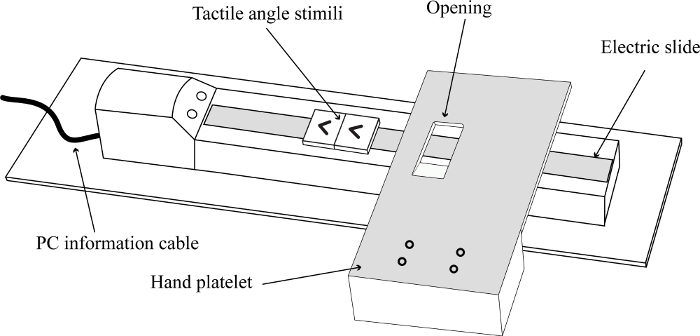
Figure 1: Overview of the TSPAS.
The equipment consists of four parts: 1) tactile angle stimuli (i.e., the reference angle and ten comparison angles); 2) the hand plate that fixes the hand of the subject in place and keeps only the index finger in contact with the stimuli; 3) the electronic slider that carries the tactile stimuli; and 4) the personal computer (PC) control system that controls the speed and the movement distance of the electronic slide. Please click here to view a larger version of this figure.
Access restricted. Please log in or start a trial to view this content.
Protocol
Loading...
$$\rightleftharpoonup{xx}$$
$$\longleftharp{xx}$$,
$$\longrightharp{xx}$$,
Written informed consent was obtained from the subjects in compliance with the policies of the local medical ethics committee of Okayama University. The testing procedures gained review and consent from the local medical ethics committee of Okayama University.
1. Detailed composition and function of equipment
- Tactile angle stimuli
- The TSPAS uses two-dimensional (2D) raised angles to slide passively across the skin and form a tactile spatial representation of the angles (Figure 2). The tactile angles consist of plastic lines and square bases, which are both made from a transparent acrylic sheet. Because the lines composing the angles are equal and symmetrical, by symmetrically changing the spatial dimensions of the lines, all types of raised plane angles can be created.
- Using a milling machine, cut the acrylic sheet into the polyline with two equal lines (8.0 mm long, 1.5 mm wide, and 1.0 mm high) symmetrically distributed along an imaginary bisector and the square base (40.0 mm long and wide, 3.0 mm high).
- Glue the polyline to the center of the square base to create a 2D raised tactile angle stimulus.
- Make pieces with angle sizes ranging from 50° to 70° in 2° increments. The end point distances (d, see Figure 2) of these angles are 6.8 mm, 7.0 mm, 7.3 mm, 7.5 mm, 7.8 mm, 8.0 mm (60° angle), 8.2 mm, 8.5 mm, 8.7 mm, 8.9 mm, and 9.2 mm. To reduce the impact of the end point distance on angle discrimination to the minimum, use a 60° angle as the reference angle, and other angles as comparison angles.
- Make up 20 pairs of discriminated angles, including 20 identical reference angles and 10 pairs of identical comparison angles whose measured accuracies are ± 0.2°. Ensure that the reference angle is presented first 50% of the time when each pair is tested. The experiment can be easily and conveniently updated with tactile angle stimuli.

Figure 2: Example of tactile angle stimuli.
(A) An example of the reference angle (60°) and two (50° and 70°) of the ten comparison angles used in the experiment. In particular, detailed parameters of the reference angle were drawn. d represents the end point distance, R represents the radius of curvature in the local apex, and r represents the radius of curvature in the end point. (B) Example of a raised angle seen in 3D. The height of the raised line is 1.0 mm from the 3D view. Please click here to view a larger version of this figure.
- Hand plate
- To stabilize the subject's hand, craft a hand plate perpendicular to the electronic slide (Figure 3). First, using a milling machine, cut a 5.0 mm thick acrylic sheet into a 14.0 cm x 22.0 cm rectangle plate, and then fasten the rectangle plate to a base (14.0 cm wide, 14.0 cm long, and 8.5 high) with tape and glue. After that, using a milling machine, cut a rectangular opening (2.5 cm wide and 5.0 cm long) in the upper left corner of the plate. This allows only the index finger to contact the angle stimulus. Before the experiment, fix the subject's right hand wrist with nylon tape, and then instruct the subjects to lightly place their right index fingers at the opening of the plate.

Figure 3: Hand position of the subject and tactile angle stimuli movement direction.
The right hand of the subject was secured with nylon tape, and the subject was instructed to place his or her right index finger into the opening in the plate. The angle stimuli were clamped on the apparatus and were horizontally moved by the electronic slide to passively slide across the fingerpad. Please click here to view a larger version of this figure.
- Motorized linear slide
- The electronic slide with a maximum motion distance of 51.0 cm is moved in a straight direction using an easy linear motion motor with 5.0 cm high, 5.4 cm wide, and 71.0 cm long (see Table of Materials), which is a linear-motion system. Connect the motor to a personal computer and set and edit various data using dedicated data editing software (see Table of Materials). Ensure that these settings can make the electronic slide move a specified distance using a given speed with respect to the reference point. This is necessary when moving the angle stimuli directly from an arbitrary position to a specified position.
- Computer control system
- The TSPAS is a semiautomatic, computer-controlled system. The data editing software used to control the movement of the slide is PC-based software for editing the data necessary for the operation of motorized actuators. In the experiment, set the velocity of the slide at 20 mm/s and its moving distance at 80 mm for each trial. Each time a button is clicked, the slide moves as previously set.
2. Running an experiment
- Before the experiment, first set the motion type as ‘INC’, motion distance as ‘80 mm’, motion speed as ‘20 mm/s’, motion function as ‘single’, and axis as ‘ID = 0’ in the data editing software (see the operating manual in the Table of Materials for instructions on how to set parameters) to ensure that the electronic slide can move both at a distance of 80 mm and a speed of 20 mm/s forward and backward, and at other distances and speeds.
- Recruit subjects whose fingers are free of injuries and calluses. Try to recruit an equal number of male and female subjects within the age range from 18–35 years old. Note that there is a difference in tactile spatial acuity between female and male subjects, as well as old and young subjects25,26.
- Blindfold the subject and sit him or her at a table with the apparatus (Figure 1). Fix the right hand of the subject with nylon tape and subsequently instruct the subject to lightly place his or her right index finger at the opening of the hand plate (Figure 3).
- Clamp a pair of angles, including the reference angle and the comparison angle, on the slide. After clicking the button, the pair of angles slide for a total distance of 80 mm. They passively go across the index fingerpad at a speed of 20 mm/s. Because there is a distance of 31.8 ± 0.8 mm between the reference angle and comparison angle, their interstimulus time interval is approximately 1.6 s.
- After the subject perceives the sizes of the angles, he or she orally reports which of the two angles is larger. If the subject cannot identify which angle is larger, he or she can indicate that the angles are the same. Register the answer of the subject as the response data. After that, the next pair of angles will be continually replaced, presented, and perceived in the same way.
- There are a total of 10 pairs of angles in the formal experiment. Present each pair 10x in a pseudorandom order in which the reference angle passes first 50% of the time. Thus, the experiment contains 100 trials. To avoid uncomfortable sensations on the index finger, after each series of 20 trials have the subject take a 3 min break. Before the experiment, each subject practices 10 trials with other angles to be familiar with the experimental procedure. The experiment should last ~40 min.
Access restricted. Please log in or start a trial to view this content.
Results
Loading...
$$\rightleftharpoonup{xx}$$
$$\longleftharp{xx}$$,
$$\longrightharp{xx}$$,
In this study, the 3AFC (3-alternative forced-choice) technique and the logistic curve were used to estimate the tactile AD threshold. Participants were instructed to orally report the larger of the two angles perceived, or if they did not detect the difference, they could indicate the same. The equation of the logistic curve, which has been commonly applied to psychophysical experiments to measure thresholds27,28,29 is:
Access restricted. Please log in or start a trial to view this content.
Discussion
Loading...
$$\rightleftharpoonup{xx}$$
$$\longleftharp{xx}$$,
$$\longrightharp{xx}$$,
A new measure for tactile spatial acuity, tactile AD, is presented. In this system a pair of angles passively slides across the immobilized index fingerpad of a subject. AD combines the advantages of GO and TPD, reducing the impact of intensive cues and the neural peak impulse rate of a single point. This study shows that there is a gradual change in perceptual discrimination as the angle difference changes between the reference angle and the comparison angle4. In addition to the age effect, train...
Access restricted. Please log in or start a trial to view this content.
Disclosures
Loading...
$$\rightleftharpoonup{xx}$$
$$\longleftharp{xx}$$,
$$\longrightharp{xx}$$,
The authors declare that they have no competing conflicts of interest, financial or otherwise.
Acknowledgements
Loading...
$$\rightleftharpoonup{xx}$$
$$\longleftharp{xx}$$,
$$\longrightharp{xx}$$,
This work was supported by the Japan Society for the Promotion of Science KAKENHI Grants JP17J40084, JP18K15339, JP18H05009, JP18H01411, JP18K18835, and JP17K18855. We also thank the technician (Yoshihiko Tamura) in our laboratory for helping us craft the raised angle.
Access restricted. Please log in or start a trial to view this content.
Materials
| Name | Company | Catalog Number | Comments |
|---|---|---|---|
| Acrylic sheet (3 mm) | MonotaRO Co.,Ltd. | 33159874 | Good Material |
| Acrylic sheet (1 mm) | MonotaRO Co.,Ltd. | 45547101 | Good Material |
| EZ limo (easy linear motion motor) | ORIENTAL MOTOR CO., LTD. Made in Japan | EZS3 | Good Motorized Linear Slides |
| Data Editing Software | ORIENTAL MOTOR CO., LTD. Made in Japan | EZED2 | easy to use |
| Operating Manual (Orientalmotor) | ORIENTAL MOTOR CO., LTD. Made in Japan | HL-17151-2 | Good Guidebook |
References
Loading...
$$\rightleftharpoonup{xx}$$
$$\longleftharp{xx}$$,
$$\longrightharp{xx}$$,
- Smith, A. M., Chapman, C. E., Donati, F., Fortier-Poisson, P., Hayward, V. Perception of simulated local shapes using active and passive touch. Journal of Neurophysiology. 102 (6), 3519-3529 (2009).
- Reuter, E. M., Voelcker-Rehage, C., Vieluf, S., Godde, B. Touch perception throughout working life: Effects of age and expertise. Experimental Brain Research. 216 (2), 287-297 (2012).
- Craig, J. C. Grating orientation as a measure of tactile spatial acuity. Somatosensory and Motor Research. 16 (3), 197-206 (1999).
- Craig, J. C., Johnson, K. O. The two-point threshold: Not a measure of tactile spatial resolution. Current Directions in Psychological Science. 9 (1), 29-32 (2000).
- Tong, J., Mao, O., Goldreich, D. Two-point orientation discrimination versus the traditional two-point test for tactile spatial acuity assessment. Frontiers in Human Neuroscience. 7, SEP 1-11 (2013).
- Goldreich, D., Wong, M., Peters, R. M., Kanics, I. M. A tactile automated passive-finger stimulator (TAPS). Journal of Visualized Experiments. (28), e1374(2009).
- Johnson, K. O., Phillips, J. R. Tactile spatial resolution. I. Two-point discrimination, gap detection, grating resolution, and letter recognition. Journal of Neurophysiology. 46 (6), 1177-1191 (1981).
- Legge, G. E., Madison, C., Vaughn, B. N., Cheong, A. M. Y., Miller, J. C. Retention of high tactile acuity throughout the life span in blindness. Perception and Psychophysics. 70 (8), 1471-1488 (2008).
- Yang, J., Ogasa, T., Ohta, Y., Abe, K., Wu, J. Decline of human tactile angle discrimination in patients with mild cognitive impairment and Alzheimer's disease. Journal of Alzheimer's Disease. 22 (1), 225-234 (2010).
- Wu, J., Yang, J., Ogasa, T. Raised-angle discrimination under passive finger movement. Perception. 39 (7), 993-1006 (2010).
- Sathian, K., Zangaladze, A. Tactile learning is task specific but transfers between fingers. Perception and Psychophysics. 59 (1), 119-128 (1997).
- Wong, M., Peters, R. M., Goldreich, D. A physical constraint on perceptual learning: tactile spatial acuity improves with training to a limit set by finger size. Journal of Neuroscience. 33 (22), 9345-9352 (2013).
- Trzcinski, N. K., Gomez-Ramirez, M., Hsiao, S. S. Functional consequences of experience-dependent plasticity on tactile perception following perceptual learning. European Journal of Neuroscience. 44 (6), 2375-2386 (2016).
- Essock, E. A., Krebs, W. K., Prather, J. R. Superior Sensitivity for Tactile Stimuli Oriented Proximally-Distally on the Finger: Implications for Mixed Class 1 and Class 2 Anisotropies. Journal of Experimental Psychology: Human Perception and Performance. 23 (2), 515-527 (1997).
- Gurtubay-Antolin, A., Leon-Cabrera, P., Rodriguez-Fornells, A. Neural evidence of hierarchical cognitive control during Haptic processing: An fMRI study. eNeuro. 5 (6), (2018).
- Yang, J., et al. Tactile priming modulates the activation of the fronto-parietal circuit during tactile angle match and non-match processing: an fMRI study. Frontiers in Human Neuroscience. 8, 926(2014).
- Yu, Y., Yang, J., Ejima, Y., Fukuyama, H., Wu, J. Asymmetric Functional Connectivity of the Contra- and Ipsilateral Secondary Somatosensory Cortex during Tactile Object Recognition. Frontiers in Human Neuroscience. 11, January (2018).
- Olczak, D., Sukumar, V., Pruszynski, J. A. Edge orientation perception during active touch. Journal of Neurophysiology. 120 (5), 2423-2429 (2018).
- Lederman, S. J., Taylor, M. M. Perception of interpolated position and orientation by vision and active touch. Perception and Psychophysics. 6 (3), 153-159 (1969).
- Peters, R. M., Staibano, P., Goldreich, D. Tactile orientation perception: An ideal observer analysis of human psychophysical performance in relation to macaque area 3b receptive fields. Journal of Neurophysiology. 114 (6), 3076-3096 (2015).
- Bensmaia, S. J., Hsiao, S. S., Denchev, P. V., Killebrew, J. H., Craig, J. C. The tactile perception of stimulus orientation. Somatosensory and Motor Research. 25 (1), 49-59 (2008).
- Morash, V., Pensky, A. E. C., Alfaro, A. U., McKerracher, A. A review of haptic spatial abilities in the blind. Spatial Cognition and Computation. 12 (2-3), 83-95 (2012).
- Wang, W., et al. Tactile angle discriminability improvement: roles of training time intervals and different types of training tasks. Journal of Neurophysiology. 122 (5), 1918-1927 (2019).
- Yang, J., et al. Tactile priming modulates the activation of the fronto-parietal circuit during tactile angle match and non-match processing: an fMRI study. Frontiers in Human Neuroscience. 8, December 926(2014).
- Peters, R. M., Hackeman, E., Goldreich, D. Diminutive Digits Discern Delicate Details: Fingertip Size and the Sex Difference in Tactile Spatial Acuity. Journal of Neuroscience. 29 (50), 15756-15761 (2009).
- Sathian, K., Zangaladze, A., Green, J., Vitek, J. L., DeLong, M. R. Tactile spatial acuity and roughness discrimination: Impairments due to aging and Parkinson's disease. Neurology. 49 (1), 168-177 (1997).
- Hoehler, F. K. Logistic equations in the analysis of S-shaped curves. Computers in Biology and Medicine. 5 (3), 367-371 (1995).
- Kuehn, E., Doehler, J., Pleger, B. The influence of vision on tactile Hebbian learning. Scientific Reports. 7 (1), 1-11 (2017).
- Weder, B., Nienhusmeier, M., Keel, A., Leenders, K. L., Ludin, H. P. Somatosensory discrimination of shape: Prediction of success in normal volunteers and parkinsonian patients. Experimental Brain Research. 120 (1), 104-108 (1998).
Access restricted. Please log in or start a trial to view this content.
Reprints and Permissions
Request permission to reuse the text or figures of this JoVE article
Request Permission