A detailed protocol is provided for using CRISPR/Cas9 technology to achieve highly efficient targeted knock-in of large, multicistronic constructs in primary human T cells via the homology-mediated end joining (HMEJ) DNA repair pathway. T cells engineered with this cGMP-adaptable protocol maintain excellent cell expansion, cytotoxicity, and cytokine production.
Method Article
Non-Viral Engineering of Primary Human T Cells via Homology-Mediated End-Joining Targeted Integration of Large DNA Templates
In This Article
Summary
Abstract
Many current adoptive cellular therapies rely on lenti- or retroviral vectors to engineer T cells for the expression of a chimeric antigen receptor (CAR) or exogenous T cell receptor (TCR) to target a specific tumor-associated antigen. Reliance on viral vectors for the production of therapeutic T cells significantly increases the timeline, cost, and complexity of manufacturing while limiting the translation of new therapies, particularly in the academic setting. A process is presented for efficient non-viral engineering of T cells using CRISPR/Cas9 and homology-mediated end joining to achieve targeted integration of large, multicistronic DNA cargo. This approach has achieved integration frequencies comparable to those of viral vectors while yielding highly functional T cells capable of potent anti-tumor efficacy both in vitro and in vivo. Notably, this method is rapidly adaptable to current good manufacturing practices (cGMP) and clinical scale-up, providing a near-term option for the manufacturing of therapeutic T cells for use in clinical trials.
Introduction
T cells are a key component of the adaptive immune system, possessing direct cytolytic ability, the ability to modulate the immune response through the production of cytokines, licensing of B cells and dendritic cells, and establishment of immunological memory1. They play critical roles in immune development, homeostasis and surveillance, protection from pathogens, and prevention and defense from cancer, as well as allergy and autoimmunity1. T cells possess a massive diversity of T cell receptors (TCRs) that are generated through V(D)J recombination, allowing T cells to recognize a vast array of antigens and mount effective immune responses against various pathogens1,2. T cells can be generally categorized into two categories, CD4 T cells, also known as helper T cells, that primarily assist other immune cells, such as B cells, in coordinating the immune response, and CD8 T cells, or cytotoxic T cells, that directly kill infected or cancerous cells by recognizing specific antigens presented on their surfaces1.
The development of chimeric antigen receptors (CAR) has led to a massive increase in interest in the genome engineering of T cells for immunotherapies. CARs are engineered proteins that merge antibody-derived antigen-binding domains with T cell signaling domains, allowing T cells to identify and target cells that express the specific epitope recognized by the antibody portion of the CAR3. These receptors have been used for a variety of immunotherapies, including infectious disease and autoimmunity, but the technology is most advanced for cancer immunotherapies.
CAR-T cells have been extremely successful in the treatment of leukemias and lymphoma, but have shown limited efficacy for the treatment of solid tumors4,5. This has led to a wave of further development seeking to improve the effectiveness of CAR-T cells for solid tumor indications. Multiple approaches have been developed, including cytokine armoring, checkpoint gene knockout, dominant negative receptors, chemokine receptors, expressing multiple CARs in one cell, modification of the CAR to enhance intracellular signaling, and integration into predetermined loci, e.g., the TRAC locus, to exploit host regulatory mechanisms to prevent exhaustion6,7,8. Many of these approaches require either larger genetic cargo and/or site-specific integration. Alternative approaches also include using transgenic TCRs to allow T cells to target intracellular neoantigens9,10. However, this has the significant drawback of requiring the TCR to have specificity to both the neoantigen epitope and the HLA molecule, restricting the use of the eventual therapeutic product to patients expressing the cognate HLA. Furthermore, many tumors alter or reduce HLA expression in response to immunotherapy, greatly reducing the effectiveness of T cells expressing transgenic TCRs11.
Most CAR-T or TCR-T cell therapies in clinical trials are manufactured using retroviral vectors, such as lentivirus or gammaretrovirus, achieving high integration frequency with moderately sized cargo. However, viral vectors suffer from long manufacturing timelines due to current good manufacturing practices (cGMP) requirements and non-specific integration profiles that create a risk of insertional mutagenesis12,13. Furthermore, it can be difficult to produce transgenic retrovirus at high titers if the cargo exceeds 5 kb14. Other vectors, such as those derived from recombinant adeno-associated virus (rAAV), do not integrate naturally but can shuttle DNA donor template to the nucleus and can be used in combination with CRISPR/Cas9 to facilitate traditional homology-directed recombination (HDR) mediated genome engineering. However, these viruses also have long and complicated production workflows and are limited by cargo size (<4.7 kb) and the need to include long homology arms (500-1000 bp)15,16,17,18.
Non-viral genome engineering using transposons or a combination of targeted nucleases and a DNA donor template has been reported in primary human lymphocytes8,19,20. However, these approaches are limited by the toxic response to naked DNA molecules in the cytoplasm following recognition by cytoplasmic DNA sensors expressed in lymphocytes21. Attempts have been made to use small molecule inhibitors of these DNA sensing pathways during transfection, but the redundancy of these pathways may complicate their use in cGMP protocols22. Notably, transposon vectors, such as Sleeping Beauty, PiggyBac, and Tc Buster, allow for the integration of large genetic cargo with high efficiencies, but have a non-specific integration profile23,24. Non-viral, targeted transgene integration using plasmid, linear, or single-stranded DNA templates in combination with a targeted nuclease for HDR is an appealing alternative, but has been limited by poor efficiency, especially with increasingly large genetic cargos, with less than 10% efficiency reported when using cargo over 1.5 kb8,19.
Here, we present the step-by-step protocol for non-viral, homology-mediated end joining (HMEJ) insertion of large DNA payloads in primary human T cells, as described in Webber, Johnson et al.25. HMEJ utilizes short 48 bp homology arms flanked by Cas9 gRNA target sites to allow for high-efficacy targeted integration of large DNA cargo when compared with traditional HDR. One method for reducing the cytotoxicity of plasmid DNA in primary T cells is to employ plasmids with minimized backbones, such as minicircles or nanoplasmids25. Minicircles are miniaturized plasmid vectors produced by excision of the origin of replication and antibiotic resistance gene through recombination after plasmid amplification; they have been shown to improve non-viral engineering of T cells and reduce cell toxicity23,24. Nanoplasmids also have a reduced overall size accomplished through the use of a minimal origin of replication and a non-traditional selection marker26. In our experience, minicircle and nanoplasmid vector platforms offer comparable improvement in efficiency and reduced toxicity over traditional plasmids25.
Here, we present a detailed protocol synergizing temporal optimization of reagent delivery and reagent composition as well as using HMEJ and CRISPR/Cas9 to achieve high efficacy, site-specific genome engineering of primary human T cells with large (>6.3 kb), multicistronic DNA templates for use in immunotherapies and a variety of other applications25. We achieve higher integration with HMEJ and 48 bp homology arms than with traditional HR using 1 kb homology arms, particularly with genetic cargos >1.5 kb25,27. Importantly, T cells engineered through HMEJ repair retain excellent cell expansion, cytotoxicity, and cytokine production, while retaining a non-exhausted phenotype25. This protocol is readily adaptable to cGMP standards and is scalable to clinically relevant cell numbers, enabling a rapid transition to future use in a variety of clinical trials25.
Protocol
All experiments were performed with universal precautions for bloodborne pathogens, with sterile/aseptic technique, personal protective equipment, and proper biosafety level 2 (BSL2) equipment. All experiments described here were approved by the Institutional Biosafety Committee (IBC) at the University of Minnesota. Details of the reagents and the equipment used in this study are listed in the Table of Materials.
1. Media preparation
- Prepare supplements for T cell Complete Media (TCM).
- Reconstitute recombinant human IL-2 to a concentration of 12000 IU/mL by adding filter-sterilized 100 mM acetic acid and mix well by pipetting. Then, further dilute to a concentration of 6000 IU/mL with filter-sterilized 0.2% Bovine Serum Albumin (BSA) in 1x Phosphate Buffered Saline (1x PBS) and mix well by pipetting to make an extended storage solution.
- Reconstitute recombinant human IL-7 to a concentration of 200 ng/µL with sterile water and mix well by pipetting. Then, further dilute to a concentration of 100 ng/µL with filter-sterilized 0.2% BSA in PBS and mix well by pipetting to make an extended storage solution.
- Reconstitute recombinant human IL-15 to a concentration of 200 ng/µL with sterile water and mix well by pipetting. Then, further dilute to a concentration of 100 ng/µL with filter-sterilized 0.2% BSA in PBS and mix well by pipetting to make an extended storage solution.
NOTE: Keep each cytokine in small aliquots at -20 °C to -80 °C for up to six months and avoid repeated freeze/thaw cycles.
- Prepare TCM media.
- Prepare basal media by adding 2.6% T-Cell Expansion Supplement and 2.5% Immune Cell Serum Replacement to T-Cell Expansion basal medium. See Table of Materials for details.
- Prepare TCM by adding 1% L-Glutamine, 1% Penicillin/Streptomycin, 10 mM of N-Acetyl-L-cysteine, 300 IU/mL Recombinant Human IL-2, 5 ng/mL Recombinant Human IL-7, and 5 ng/mL Recombinant Human IL-15 to basal media.
- Sterilize TCM by passing media through a 0.22 µm filter into a sterile media bottle.
- Keep TCM at 4 °C for up to 2 weeks.
- Prepare basal media by adding 2.6% T-Cell Expansion Supplement and 2.5% Immune Cell Serum Replacement to T-Cell Expansion basal medium. See Table of Materials for details.
- Prepare Recovery media.
- Prepare basal media by adding 2.6% T-Cell Expansion Supplement, and 2.5% Immune Cell Serum Replacement to T-Cell Expansion basal medium.
- Prepare Recovery media by adding 1% L-Glutamine, 10 mM of N-Acetyl-L-cysteine, 300 IU/mL Recombinant Human IL-2, 5 ng/mL Recombinant Human IL-7, 5 ng/mL Recombinant Human IL-15 to basal media and 1 µg/mL DNase.
NOTE: Do not add Penicillin/Streptomycin to Recovery media, as it can reduce post-electroporation cell recovery. - Sterilize the Recovery media by passing media through a 0.22 µm filter into a sterilized media bottle.
- Keep Recovery media at 4 °C for up to 2 weeks.
- Prepare Recovery media by adding 1% L-Glutamine, 10 mM of N-Acetyl-L-cysteine, 300 IU/mL Recombinant Human IL-2, 5 ng/mL Recombinant Human IL-7, 5 ng/mL Recombinant Human IL-15 to basal media and 1 µg/mL DNase.
- Prepare basal media by adding 2.6% T-Cell Expansion Supplement, and 2.5% Immune Cell Serum Replacement to T-Cell Expansion basal medium.
2. Knock-in site selection and template design
- Determine a genomic target location for knock-in.
NOTE: A safe harbor location, such as AAVS1, can be used if minimal impact on the target cell is desired. A target site that disrupts gene expression can be used to simultaneously knock out the target gene and knock-in the construct of interest in a single step. A target site and donor designed to integrate in-frame with an endogenous gene can be used to create gene fusions or in combination with a 2A ribosomal skip sequence to place the construct under the transcriptional control of an endogenous promoter (Figure 1). - Design the cargo template such that the expression cassette is flanked by 48 bp homology arms matching the integration site and flanked by linearizing gRNA target sites.
NOTE: The plasmid-linearizing gRNA can be a universal gRNA28 (UgRNA) (GGGAGGCGUUCGGGCCACAG) designed to target a sequence (GGGAGGCGTTCGGGCCACAG) not found in the human or murine genome25, or the genomic target gRNA sequence, such that a single gRNA can cut at the genomic knock-in site and also linearize the cargo template (Figure 1). Either nanoplasmids or minicircles can be used as vectors for the cargo template. Standard plasmids can be used in place of nanoplasmids or minicircles for some transformed lines, but will result in reduced knock-in and cell expansion in more sensitive primary cells such as T cells.
3. T cell isolation and activation
- Obtain T cells from a commercial vendor or isolate T cells from PBMCs using immunomagnetic sorting18.
- Determine the number of T cells necessary for the experiment and then thaw, wash, and resuspend T cells at a concentration of 1 × 10⁶ cells per mL in TCM. Add 1 mL of this mix to wells of a 24-well plate.
- Vortex the T cell activation beads to resuspend the beads and add the beads at a ratio of 2:1 beads: cell to each well. Incubate these cells for 36 h in a 37 °C and 5% CO2 incubator before beginning T cell engineering.
NOTE: An incubation time of less than or greater than 36 h after activation will reduce T cell knock-in efficiency, viability, and post-engineering cell expansion25.
- Vortex the T cell activation beads to resuspend the beads and add the beads at a ratio of 2:1 beads: cell to each well. Incubate these cells for 36 h in a 37 °C and 5% CO2 incubator before beginning T cell engineering.
4. T cell engineering
- Determine experimental conditions required to complete the experiment, including experimental controls.
NOTE: It is important to include a plasmid-only condition as a control for episomal expression. An electroporation condition with the chemically modified target site gRNA28 and/or Cas9 mRNA in the absence of a plasmid donor can also be used as a negative control. - Prepare a recovery plate.
- For each experimental condition, including experimental controls, add 300 µL of recovery media to a well of a 24-well tissue culture plate and warm the plate in a 37 °C and 5% CO2 incubator.
NOTE: See Table 1 for alternative cell numbers, recovery volume, and conditions.
- For each experimental condition, including experimental controls, add 300 µL of recovery media to a well of a 24-well tissue culture plate and warm the plate in a 37 °C and 5% CO2 incubator.
- Prepare T cells.
- Harvest the stimulated T cell/T cell activation bead mixture, count viable cells, and resuspend the T cells/T cell activation beads at a concentration of 1-5 × 10⁶ cells/mL in TCM media in a 1.5 mL microcentrifuge tube.
- Place the microcentrifuge tube in a magnet (see Table of Materials) and allow it to incubate for 3 min.
NOTE: Bead removal is required if T cell activation beads are used to activate T cells. Bead removal may not be necessary if an alternative method of activation is used. - After incubation and without removing from the magnet, transfer the media and T cells to a new tube. This tube contains stimulated T cells with the T cell activation beads removed. Recount the T cells and place them in either 14 mL or 50 mL conical tubes. Top off the tube with 1× PBS and keep cells in a 37 °C and 5% CO2 incubator until ready to centrifuge.
- Prepare T cell mix.
- Determine the amount of Master Mix Buffer (82% Primary Cell Solution and 18% Supplement) needed by multiplying the number of electroporation conditions plus one (n + 1). (e.g. 6 electroporation conditions planned + 1 = 7. 7 × 18 µL per condition = 126 µL of Master Mix Buffer).
NOTE: These volumes are specific for the 4D electroporation system used in this study (see Table of Materials). Other electroporation systems will require different volumes and concentrations.Volume of Primary Cell Solution = Total volume of Master Mix Buffer needed × 0.82 and Volume of Supplement = Total volume of Master Mix Buffer needed x 0.18. (e.g. 0.82 × 126 µL = 103.32 µL of Primary Cell Solution and 0.18 × 126 µL = 22.68 µL). - Mix Primary Cell Solution and Supplement together to make Master Mix Buffer.
- Centrifuge T cells in 1x PBS for 10 min at 200 × g (at room temperature) and aspirate off the supernatant.
- Resuspend the T cells in the Master Mix Buffer at a concentration of 1 × 10⁶ cells per 18 µL of Master Mix Buffer.
- Determine the amount of Master Mix Buffer (82% Primary Cell Solution and 18% Supplement) needed by multiplying the number of electroporation conditions plus one (n + 1). (e.g. 6 electroporation conditions planned + 1 = 7. 7 × 18 µL per condition = 126 µL of Master Mix Buffer).
- Prepare reagents.
- Using the concentrations of the stock solutions, determine the volume of HMEJ plasmid, target site gRNA, plasmid linearization gRNA (UgRNA), and Cas9 mRNA needed to achieve the indicated mass per electroporation (Table 2).
- Add reagents to a well of a 96-well plate on ice for each condition.
- Prepare Electroporation Mix.
- Add 18 µL of T cell Mix to each well of the 96 well plate as needed.
- Add additional Master Mix Buffer as needed to ensure all electroporation conditions are at a final total volume of 22 µL.
NOTE: 22 µL volume includes a 10% excess volume to account for potential pipetting loss.
- Perform electroporation.
- Turn on the equipment and load the program.
- Determine the number of cuvettes needed and open the required number of cuvettes. Mark one end of the cuvette and cap and remove the cap from the cuvette.
NOTE: There are 16 wells per cuvette for 20 µL reactions. - Gently pipette 20 µL of the Electroporation Mix from wells of the 96 well plate up and down 1-2 times and load in cuvettes.
- Recap the cuvette using the marking made in step 4.7.2 to avoid putting the cap on backward. Tap the cuvette 3-5 times to remove potential air bubbles, and then place the equipment and electroporate the cuvette.
- Gently remove the cuvette from the equipment, place it in the hood, and allow the cells to rest for 15 min at room temperature.
- After the rest, pull 80 µL of warmed recovery media from the recovery plate and add to each sample (add to the side of the cuvette, not directly to cells), very gently pipette up and down once, and transfer the total 100 µL volume back to the recovery plate.
NOTE: Cells are very fragile post-electroporation. Gentle handling is critically important. - Incubate the cells at 37 °C and 5% CO2 for 30 min.
- Add TCM to dilute the cells to a concentration of 1 × 10⁶ cells/mL. Replace half the media the next day and then every 3-4 days with TCM with 2× cytokine concentrations for the duration of the experiment.
- After diluting to 1 × 10⁶ cells/mL, restimulate the cells by adding T cell activation beads at a ratio of 0.5:1 beads: cell to each well.
NOTE: Cells may be expanding rapidly. Half media changes may need to be performed, and cells may need to be moved to larger wells. - On day 3, remove T cell activation beads.
- After the desired outgrowth duration, harvest the cells.
NOTE: If there are unused wells in the cuvette, the used wells can be marked, and the entire cuvette can be placed in a 50 mL conical and stored at 4 °C for future use.
Results
Here, a large (>6.3 kb) multicistronic template called the "Giant Minicircle" construct was integrated into the TRAC locus in primary human T cells using CRISPR/Cas9 editing; a TRAC-specific gRNA (TCTCTCAGCTGGTACACGGC), the UgRNA, and HMEJ nanoplasmid (Figure 2A) with a condition lacking TRAC-specific gRNA, the universal gRNA, and Cas9 mRNA used as a negative control. Samples that include the Giant Minicircle construct, TRAC-specific gRNA, the universal gRNA, and Cas9 mRNA had an average knock-in rate of 23.35% when measuring GFP expression (23.5% ± 5.247), while the negative control showed no GFP expression (Figure 2B). There were no significant differences in fold expansion (Figure 2C) and viability (Figure 2D) between experimental conditions. These results demonstrate a high-efficiency knock-in of a very large template while maintaining excellent cell viability and cell expansion.

Figure 1: Schematic representation of HMEJ construct design. Please click here to view a larger version of this figure.
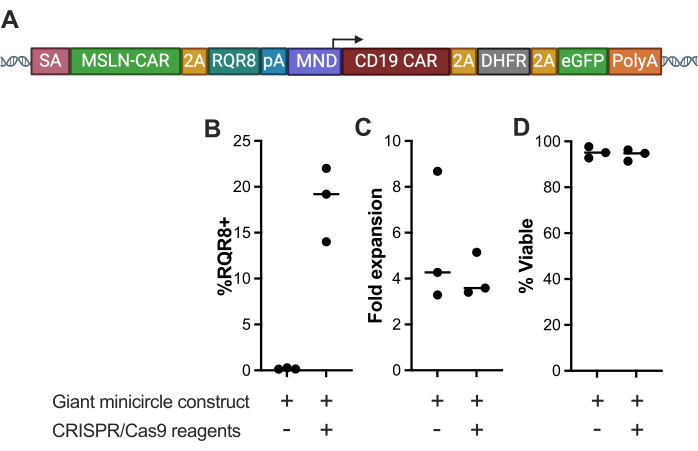
Figure 2: Characterization of T cells electroporated with the giant minicircle construct. (A) Schematic representation of the Giant Minicircle construct, a large (>6.3 kb) multicistronic template encoding an anti-mesothelin CAR and RQR8 under the TRAC promoter with a GSG linker, an anti-CD19 CAR, and a DHFR mutein and eGFP under the MND promoter. (B) RQR8 expression percentage, (C) fold expansion, and (D) viability of T cells nine days post-electroporation with the Giant Minicircle construct and CRISPR-Cas9 reagents, compared to a negative control electroporated with the Giant Minicircle lacking CRISPR-Cas9 reagents. (***p < 0.001). Please click here to view a larger version of this figure.
| Plate Size | Cuvette Volume | Cells/Well | Volume of Recovery Media | Volume of 1x TCM w/NAC | Total Final Volume |
| 24-well plate | 22/22 µL | 1-3 x 10⁶ | 300 µL | 680 µL | 1 mL |
| 6-well plate | 100/110 µL | 4-20 x 106 | 1 mL | 2.9 mL | 4 mL |
| 24-well G-Rex plate | 20-110 µL | 1-20 x 106 | 400 µL | 5.6 mL | 6 mL |
Table 1: Cell concentrations for cuvettes and recovery plates.
| Cuvette Size | Template Plasmid | Target site gRNA | Plasmid linearization gRNA | Cas9 mRNA |
| 20 µL | 1-2 µg (1 µg) | 1-3 µg (1 µg) | 1-3 µg (1 µg) | 1-3 µg (1.5 µg) |
| 100 µL | 5-10 µg (5 µg) | 5-15 µg (5 µg) | 5-15 µg (5 µg) | 5-15 µg (5 µg) |
Table 2: Amount of CRISPR/Cas9 reagents and DNA template needed.
Discussion
As adoptive cell therapy (ACT) continues to evolve, there is an increasing demand for efficient, non-viral methods to engineer immune cells without the high cost and complexity associated with virus-based vectors. A key goal in this area is achieving site-specific integration, which improves the consistency, safety, and function of engineered cellular products. While recent studies have demonstrated successful non-viral integration of small genetic constructs, such as reporter genes and single CAR or TCR sequences29, there is a need to extend these methods to larger, multi-gene expression cassettes. These larger cassettes are necessary to enhance immune cell function, such as the addition of chemokine receptors or cytokine armoring, improve specificity (e.g., logic gate systems), or increase safety with kill switches. To this end, we sought to develop non-viral approaches capable of efficient site-specific integration of larger genetic cargo25.
There are several critical steps throughout the protocol. High-quality, clean nanoplasmid or minicircle is required to minimize toxicity. In this study, commercially prepared plasmids have performed best. The 36 h period between T cell activation and electroporation is also critical for ideal outcomes. It is also important to minimize cell handling and manipulation immediately after electroporation while the cells recover. It is also important to re-add new T cell activation beads to the culture after the electroporation to achieve the best possible cargo integration frequency and cell expansion.
The protocol, as described here, uses a commercially available electroporation system (see Table of Materials). Other electroporation systems may be suitable as well, but they will likely require optimization of the device-specific electroporation conditions and possibly post-electroporation cell handling.
There are several limitations to the HMEJ-mediated engineering of human T cells. The protocol can work with plasmid, but optimal results require the use of nanoplasmids or minicircles for cargo delivery, which are not as easy to manufacture as standard plasmids. Furthermore, although successful integration of a very large, multicistronic cassette is demonstrated, there is likely an upper cargo limit where gene integration frequency will begin to fall off.
This study presents HMEJ as a powerful and efficient non-viral genome engineering method for the production of engineered T cells, particularly in the context of cancer immunotherapy. By overcoming the limitations of traditional viral vectors, this approach offers a cost-effective, scalable, and safer alternative for generating genetically modified T cells with enhanced functionality. The ability to integrate large, multi-gene cassettes with precision opens up new possibilities for engineering immune cells to treat a wide range of diseases, including cancers, infectious diseases, and autoimmune disorders. Furthermore, the HMEJ method's compatibility with clinical-grade manufacturing processes ensures its practical applicability in real-world therapeutic settings, paving the way for more accessible and efficient cell-based therapies in the near future.
Disclosures
B.R.W. and B.S.M. are principal investigators of Sponsored Research Agreements funded by Intima Biosciences to support the work in this manuscript. Patents have been filed covering the methods and approaches outlined in this manuscript.
Acknowledgements
B.R.W. acknowledges funding from Office of Discovery and Translation, NIH grants R21CA237789, R21AI163731, P01CA254849, P50CA136393, U54CA268069, R01AI146009, DOD grants HT9425-24-1-1005, HT9425-24-1-1002, HT9425-24-1-0231 and, Children's Cancer Research Fund, the Fanconi Anemia Research Fund, and the Randy Shaver Cancer and Community Fund. B.S.M. acknowledges funding from the Office of Discovery and Translation, NIH grants R01AI146009, R01AI161017, P01CA254849, P50CA136393, U24OD026641, U54CA232561, P30CA077598, U54 CA268069, DOD grants HT9425-24-1-1005, HT9425-24-1-1002, HT9425-24-1-0231, and Children's Cancer Research Fund, the Fanconi Anemia Research Fund, and the Randy Shaver Cancer and Community Fund.
Materials
| Name | Company | Catalog Number | Comments |
|---|---|---|---|
| Acetic Acid | Millipore Sigma | A6283 | |
| 1x DPBS, no calcium, no magnesium | Thermo Fisher Scientific | 14190144 | |
| 2.5% CTS Immune Cell Serum Replacement | Thermo Fisher Scientific | A2596101 | |
| Amaxa P3 Primary Cell 4D-Nucleofactor X Kit L | Lonza | V4XP-3024 | |
| Amaxa P3 Primary Cell 4D-Nucleofactor X Kit S | Lonza | V4XP-3032 | |
| Bovine Serum Albumin | Thermo Fisher Scientific | 15561020 | |
| Chemically Modified Guide RNAs | Integrated DNA Technologies | na | Custom design |
| CleanCap Cas9 mRNA | Trilink | L-7206 | |
| CTS OpTmizer T cell Expansion Media SFM +OpTmizer T cell Expansion Supplement | Thermo Fisher Scientific | A1048501 | |
| DNase I | Stem Cell Technologies | 07900 | |
| Dynabeads Human T-Activator CD3/CD28 | Thermo Fisher Scientific | 11141D | |
| DynaMag-2 | Thermo Fisher Scientific | 12321D | |
| Human IL15 | PeproTech | 200-15 | |
| Human IL2 | PeproTech | 200-02 | |
| Human IL7 | PeproTech | 200-07 | |
| L-Glutamine | Thermo Scientific | 25030081 | |
| Lonza 4D nucelofector Core | Lonza | AAF-1003B | |
| Lonza 4D nucelofector X Unit | Lonza | AAF-1003X | |
| Minicircle | System Biosciences | MN910A-1 | Custom design |
| N-Acetyl-L-cysteine | MiliporeSigma | A9165 | |
| Nanoplasmid | Aldevron | na | Custom design |
| Penicillin/Streptomycin | Thermo Fisher Scientific | 15-140-122 |
References
- Sun, L., Su, Y., Jiao, A., Wang, X., Zhang, B. T cells in health and disease. Signal Transduct Target Ther. 8 (1), 235(2023).
- Takahama, Y. Journey through the thymus: stromal guides for T-cell development and selection. Nature reviews. Immunology. 6 (2), 127-135 (2006).
- Dotti, G., Gottschalk, S., Savoldo, B., Brenner, M. K. Design and development of therapies using chimeric antigen receptor-expressing T cells. Immunol Rev. 257 (1), 107-126 (2014).
- DeRenzo, C., Gottschalk, S. Genetic modification strategies to enhance CAR T cell persistence for patients with solid tumors. Front Immunol. 10, 218(2019).
- Liu, X., et al. A chimeric switch-receptor targeting PD1 augments the efficacy of second-generation CAR T cells in advanced solid tumors. Cancer Res. 76 (6), 1578-1590 (2016).
- Yeku, O. O., Purdon, T. J., Koneru, M., Spriggs, D., Brentjens, R. J. Armored CAR T cells enhance anti-tumor efficacy and overcome the tumor microenvironment. Sci Rep. 7 (1), 10541(2017).
- Schober, K., et al. Orthotopic replacement of T-cell receptor α- and β-chains with preservation of near-physiological T-cell function. Nat Biomed Eng. 3 (12), 974-984 (2019).
- Roth, T. L., et al. Reprogramming human T cell function and specificity with non-viral genome targeting. Nature. 559 (7714), 405-409 (2018).
- Chandran, S. S., Klebanoff, C. A. T cell receptor-based cancer immunotherapy: Emerging efficacy and pathways of resistance. Immunol Rev. 290 (1), 127-147 (2019).
- Rosenberg, S. A., Restifo, N. P. Adoptive cell transfer as personalized immunotherapy for human cancer. Science (New York, N.Y.). 348 (6230), 62-68 (2015).
- Campoli, M., Ferrone, S. HLA antigen and NK cell activating ligand expression in malignant cells: a story of loss or acquisition. Semin Immunopathol. 33 (4), 321-334 (2011).
- Walther, W., Stein, U. Viral vectors for gene transfer: a review of their use in the treatment of human diseases. Drugs. 60 (2), 249-271 (2000).
- Bulcha, J. T., Wang, Y., Ma, H., Tai, P. W. L., Gao, G. Viral vector platforms within the gene therapy landscape. Signal Transduct Target Ther. 6 (1), 53(2021).
- Kumar, M., Keller, B., Makalou, N., Sutton, R. E. Systematic determination of the packaging limit of lentiviral vectors. Hum Gene Ther. 12 (15), 1893-1905 (2001).
- Samulski, R. J., Muzyczka, N. AAV-mediated gene therapy for research and therapeutic purposes. Annu Rev Virol. 1 (1), 427-451 (2014).
- Wang, D., Tai, P. W. L., Gao, G. Adeno-associated virus vector as a platform for gene therapy delivery. Nature reviews. Drug Discov. 18 (5), 358-378 (2019).
- Pomeroy, E. J., et al. a genetically engineered primary human natural killer cell platform for cancer immunotherapy. Mol Ther. 28 (1), 52-63 (2020).
- Johnson, M. J., Laoharawee, K., Lahr, W. S., Webber, B. R., Moriarity, B. S. Engineering of primary human B cells with CRISPR/Cas9 targeted nuclease. Sci Rep. 8 (1), 12144(2018).
- Nguyen, D. N., et al. Polymer-stabilized Cas9 nanoparticles and modified repair templates increase genome editing efficiency. Nat Biotechnol. 38 (1), 44-49 (2020).
- Lock, D., et al. Automated, scaled, transposon-based production of CAR T cells. J Immunother Cancer. 10 (9), e005189(2022).
- Semenova, N., et al. Multiple cytosolic DNA sensors bind plasmid DNA after transfection. Nucleic Acids Res. 47 (19), 10235-10246 (2019).
- Wimberger, S., et al. Simultaneous inhibition of DNA-PK and Polϴ improves integration efficiency and precision of genome editing. Nat Comm. 14 (1), 4761(2023).
- Monjezi, R., et al. Enhanced CAR T-cell engineering using non-viral Sleeping Beauty transposition from minicircle vectors. Leukemia. 31 (1), 186-194 (2017).
- Kay, M. A., He, C. -Y., Chen, Z. -Y. A robust system for production of minicircle DNA vectors. Nat Biotechnol. 28 (12), 1287-1289 (2010).
- Webber, B. R., et al. Cas9-induced targeted integration of large DNA payloads in primary human T cells via homology-mediated end-joining DNA repair. Nat Biomed Eng. 8, 1553-1570 (2024).
- Williams, J. A., Paez, P. A. Improving cell and gene therapy safety and performance using next-generation Nanoplasmid vectors. Mol Ther Nucleic Acids. 32, 494-503 (2023).
- Wierson, W. A., et al. Efficient targeted integration directed by short homology in zebrafish and mammalian cells. eLife. 9, 53968(2020).
- Hendel, A., et al. Chemically modified guide RNAs enhance CRISPR-Cas genome editing in human primary cells. Nat Biotechnol. 33 (9), 985-989 (2015).
- Moretti, A., et al. The past, present, and future of non-viral CAR T cells. Front Immunol. 13, 867013(2022).
Reprints and Permissions
