We present a three-color chromatin single molecule localization microscopy (SMLM) staining and analysis protocol that enables reproducible mapping of euchromatin, heterochromatin, and RNAP II for spatial analysis. This protocol enables efficient multicolor labeling in dense nuclear environments, including chromatin-associated targets, allowing reliable simultaneous detection.
Method Article
A Multilabel Single Molecule Localization Microscopy Protocol for Investigation of Chromatin in the Dense Nuclear Environment
* These authors contributed equally
In This Article
Summary
Abstract
Super-resolution microscopy has dramatically advanced our ability to interrogate biological structures beyond the diffraction limit, making it indispensable for studying densely packed nuclear structures such as chromatin, nuclear lamina and nuclear bodies such as nucleoli. Chromatin exhibits multiscale organization-from nanometer-sized nucleosomes to micron-scale domains-necessitating imaging approaches capable of both high resolution and molecular specificity. Single molecule localization microscopy (SMLM), particularly stochastic optical reconstruction microscopy (STORM) , enables precise mapping of epigenetic marks, offering critical insight into chromatin structure and function. However, multi-label imaging in the nuclear environment presents unique challenges, including reduced antibody accessibility, increased non-specific binding, and fluorophore instability. To address these issues, we present a sequential immunolabeling protocol optimized for high-density nuclear environments, enabling robust three-color SMLM with minimal crosstalk and less signal degradation. This method includes optimized buffer formulations, fluorophore selection, and antibody validation strategies to ensure reproducible, high-fidelity labeling across multiple targets. Importantly, we integrate this protocol with a computational analysis pipeline that leverages localizations from one molecular target as spatial anchors (seed points) to quantify inter-target distances, local densities, and multi-label co-affinity. This allows for a detailed spatial analysis of chromatin components at the nanoscale. This protocol serves as a reproducible framework for multi-component imaging and quantitative analysis in dense subcellular environments, offering a powerful tool for researchers investigating complex nuclear architectures like chromatin.
Introduction
The advent of single-molecule localization microscopy (SMLM) has enabled unprecedented exploration of biological structures at the nanometer scale1,2,3,4,5. Beyond single-target imaging, the extension to multi-color SMLM has further advanced the field by allowing simultaneous visualization of multiple molecular species, as well as the spatial and temporal relationships among sub-diffraction structures6,7,8,9,10,11. However, applying multiplexed SMLM to abundantly distributed histone modifications remains challenging because of the dense, polymeric nature of nuclear DNA and the limited accessibility of antibodies within this environment12,13,14,15,16,17,18.
Chromatin exhibits a hierarchical, multiscale organization spanning several orders of magnitude in length, from nanometer-scale nucleosome assemblies to micrometer-scale nuclear architecture. At the largest scales, chromosomes occupy distinct chromosome territories, within which the genome is further partitioned into A/B compartments and topologically associated domains (TADs) that constrain long-range regulatory interactions through mechanisms such as loop extrusion19,20,21,22. At sub-200 nm scales, chromatin is organized as a disordered polymer composed of heterogeneous packing domains (PDs) rather than discrete euchromatin and heterochromatin blocks, with transcriptionally active regions preferentially localizing to PD boundaries23,24,25,26,27,28,29. At the smallest scales (5-20 nm), chromatin consists of irregular nucleosome assemblies and nucleosome clutches, underscoring the absence of a uniform higher-order folding motif and emphasizing the emergent, scale-dependent nature of genome organization24,26,30. With the rapid advancement of sequencing-based approaches such as chromatin immunoprecipitation sequencing and high-throughput chromatin conformation capture19,30,31,32,33, various features of chromatin mesoscale organizational structures have been identified31,32. However, these techniques, in contrast to imaging, fail to capture spatial geometry that is only observed after resolving these structures. Electron microscopy methods such as chromatin electron microscopy (ChromEM24) and chromatin scanning transmission electron microscopy ( ChromSTEM25) have revealed that chromatin is heterogeneous and organized into packing domains at length scales of 50-200 nm25,28,29. While these techniques enable impressive resolution to identify chromatin packing domains, they cannot provide molecularly specific mapping that SMLM offers. DNA points accumulation for imaging in nanoscale topography (DNA-PAINT22) and multiplexed fluorescence in situ hybridization (FISH)19enable high multiplexing; however, DNA-PAINT is strongly affected by elevated background noise arising from random binding events in the oligonucleotide-rich nuclear environment12,34, while traditional heat denaturing based FISH methods require disrupted native chromatin folding. Prior studies have applied super resolution imaging techniques to investigate chromatin at this length scale and have identified a hybrid composition of packing domains, opposing prior phase separation models12,23,34,35. This protocol stems from a previously published paper discussing the biological significance of these findings34. Thus, given its high resolution and multiplexing capabilities, immunostaining-based dSTORM remains the most viable strategy for multi-color chromatin imaging under near-native conditions.
This protocol is not the first to demonstrate labeling of greater than two nuclear targets, with prior studies labeling individual protein complexes or genes12,36. Despite successful labeling of nucleosome post-translational histone modifications, multicolor chromatin SMLM labeling, imaging, and analysis present significant challenges. First, immunostaining in the dense chromatin environment requires optimization of antibody concentration, incubation sequence, and buffer composition to ensure adequate penetration and binding without excessive background. Second, comprehensive analysis of multiple labels is necessary, as the interactions between euchromatin, heterochromatin, and enzymes such as RNA polymerase are likely to extend beyond simple binary exclusions. Thus far, the maximum number of colors demonstrated in chromatin dSTORM imaging remains two18,37,38,39.
Here we present a robust protocol for three-color chromatin SMLM imaging and analysis. Our staining workflow optimizes antibody incubation time and employs improved imaging buffers40for prolonged imaging session for multiple labels. We further describe computational pipelines for two-color distance analysis and three-color joint density analysis, enabling quantitative characterization of relationships between heterochromatin, euchromatin, and transcription machinery. In contrast to earlier two-color chromatin SMLM studies that suggested a separation of heterochromatin and euchromatin, three-color chromatin imaging reveals that the genome is organized into packing domains, with euchromatin and active transcription localized at the periphery of constitutive heterochromatin cores34.
This protocol provides the community with a reproducible framework for performing multi-color chromatin SMLM and establishes analysis strategies suited for multiple functionally conjugated nuclear targets. By bridging methodological gaps, it enables systematic exploration of chromatin domain organization at the supra-nucleosomal level, complementing sequencing and electron microscopy approaches while preserving native nuclear architecture. This article is an extended protocol of a published paper34.
Protocol
NOTE: The subsequent protocol section will be split into the staining process and acquisition process outlined below. For data analysis tutorials please refer the associated publication34 that details analysis of multi-label for labeled histone modifications.
1. Staining process:
NOTE: Throughout the protocol, there is mention of 35 mm dishes or 8 well chambered plates. These are the vessels our group uses for cell culture, however smaller and more efficient methods are possible. Ensure if alternative materials are used that the recommended concentrations for buffers antibodies are maintained. Due to the sequential nature of this protocol, antibody selection is important for successful labeling. We use standard reasoning to ensure that our host antibodies for our targets are different such that our secondary antibodies can target distinct host species effectively minimizing off target effects. Labeling order is determined based on target location within the nucleus. Since we are targeting chromatin packing domains25,28,34,35 and understand that this is a diffusion driven process, we always label heterochromatic targets first, followed by euchromatin and lastly by RNAPII to minimize steric exclusion in dense heterochromatic regions. Optimization of buffers was done empirically during development of the protocol. We found that inclusion of goat serum after the first target was helpful for reducing off target effects in subsequent steps.
- Buffer preparation
- Buffer components:
NOTE: For more information about the components including storage and preparation times please see the Table of materials. We recommend that the user have all solutions ready prior to beginning protocol to avoid experimental errors. Quenching solution should be made last. - Make blocking buffer
- Weigh out bovine serum albumin (BSA) such that the final concentration in the buffer volume needed for the experiment is 3% and add to a centrifuge tube. Tilt tube to a 45˚ angle so that BSA crystals are spread out in the tube, then add phosphate buffered saline (PBS). This is done to prevent formation of crystal clumps that will not dissolve.
- Leave the tube at room temperature until all crystals are dissolved. Do not shake tube or vortex - this will cause bubble formation which will attract proteins to the surface and prevent BSA from dissolving completely.
- Once completely dissolved, add Triton X-100 such that that its final concentration is 0.2% (v/v) given the volume chosen in step 1.3. If crystals are not completely dissolved, pipette up and down several times to mix the solution slowly without forming bubbles.
NOTE: If making modified buffer, include the 10% goat serum in this process. However modified blocking buffers should be made fresh during use and not stored for long times but ensure final concentrations are the same as stated in Table of materials- 3% BSA, 0.2% Triton X-100. - Make washing buffer:
Repeat steps for blocking buffer in 1.1.2, but use the concentrations listed in the materials section and here for your convenience (0.2% BSA, 0.1% Triton X-100 in 1X -DPBS, and for modified include 1% goat serum) - Make fixative solution:
- Add PBS to a centrifuge tube.
- Add appropriate quantity of 16% paraformaldehyde to the centrifuge tube for a final concentration of 4%.
NOTE: Prepare fresh and ready when taking cells out of the incubator. While the current fixative solution does not normally use glutaraldehyde, it can be included and may be useful due to more robust fixation and longer lasting fixation when compared to paraformaldehyde. The setup for dSTORM do not possess capabilities for fluorescence lifetime signals from glutaraldehyde (GA), however users who have the ability may find this useful to separate from fluorophore labeled structures.
- Make quenching solution:
- Weigh out sodium borohydride on weighing paper.
- Prepare centrifuge tube.
- Add Sodium borohydride to tube.
- Add PBS to tube.
NOTE: Solution should have bubbles after adding the PBS.
- Make imaging buffer:
- Dissolve 1,4-Diazabicyclooctane (DABCO) in deionized RNASE, DNASE free water to make 13 mL DABCO solution with a concentration of 1 M.
- Add 12 M HCl (~240 µL) until the DABCO is completely dissolved and the pH reaches 8.0.
- Prepare 1 M Sodium Sulfite by dissolving in 10X PBS. DTT does not need any preparation.
- For final preparation, use prior stocks to make 65 mM DABCO with 30 mM Sodium Sulfite and 30 mM DTT (1 M Stock) in de-ionized water.
- Adjust pH through titration with HCl and NaOH until pH is 8.0. Store covered and sealed with Parafilm at 4˚ C no more than 2 months. Monitor pH throughout use.
- Buffer components:
- First label staining process details:
- Fixation:
- Take live cells from the incubator and remove the cell culture medium from the dish. Discard the cell culture medium in a biohazard waste container.
- Add enough PBS to cover the cells (1 mL for a 35 mm dish and 500 µL for a chamber glass slide).
- Swirl the dish gently to wash the cells with PBS, then remove the PBS from the dish. Discard the PBS in a biohazard waste container.
- Add enough fixative solution to cover the cells (1 mL for a 35 mm dish and 500 µL for a chamber glass slide), then leave the cells to fix for 10 min.
- While the cells are being fixed, weigh out sodium borohydride for the quenching solution and add it to a centrifuge tube.
- Remove the fixative solution from the dish and discard it in the appropriately labeled liquid chemical waste container.
- Quenching
- Add enough PBS to the dish to cover the surface (1 mL for a 35 mm dish and 500 µL for a chamber glass slide), then place the dish on a shaker (any standard shaker is fine) for 5 min to wash the cells.
- Take the dish off the shaker, remove the PBS, and discard it in the appropriately labeled liquid chemical waste container.
- Add enough (250 µL, 8-well dish) quenching solution to the dish to cover the surface (1 mL for a 35 mm dish and 500 µL for a chamber glass slide), then place the dish on a shaker for 7 min to quench autofluorescence in the cells.
- While the cells are on the shaker, discard the remaining quenching solution in the centrifuge tube in the appropriately labeled liquid chemical waste container.
- Take the dish off the shaker, remove the quenching solution, and discard it in the appropriately labeled liquid chemical waste container.
- Add enough (250 µL, 8-well dish) PBS to the dish to cover the surface (1 mL for a 35 mm dish and 500 µL for a chamber glass slide), then place the dish on a shaker for 5 min to wash the cells.
- Take the dish off the shaker, remove the PBS, and discard it in the appropriately labeled liquid chemical waste container.
- Repeat steps 1.2.2.6 and 1.2.2.7 two more times (for a total of 3 PBS washes).
- Blocking
- Add enough blocking buffer to the dish to cover the surface (250 µL, 8-well dish, 1 mL for a 35 mm dish and 500 µL for a chamber glass slide).
- Place the dish on a shaker for at least 1 h to permeabilize the cell membranes and block binding sites (occupy the unspecified sites, so that they would not interfere with the target ones). (While we have tested various times to determine the minimum successful blocking duration as 20 min, we strongly recommend blocking for at least 1 h or longer up to overnight. Optimization might be needed given target and cell line.)
- While the cells are on the shaker, prepare primary antibody staining solution (see recommended concentration on vendor website or refer to table in the materials section).
- To determine the total volume of staining solutions to make, add 0.5 mL to the volume needed to cover the cells (ex. for one 35 mm dish, prepare a 1.5 mL solution).
- Remove the volume determined in section 1.2.3.1 from the blocking buffer stock and add this volume to a new centrifuge tube to prepare the staining solution.
- Add an appropriate volume of primary antibody stock to the blocking buffer to get the correct final concentration. Primary antibody stock volumes for several frequently used antibodies can be found in the materials section.
- Take the dish off the shaker, remove the blocking buffer, and discard it in the appropriately labeled liquid chemical waste container.
- Primary antibody staining:
- Add enough primary antibody staining solution to the dish to cover the surface (1 mL for a 35 mm dish and 500 µL for a chamber glass slide), then place the dish on a shaker for at least 1-2 h up to overnight to label the cellular targets.
- Take the dish off the shaker, remove the primary antibody staining solution, and discard it in the appropriately labeled liquid chemical waste container.
- Add enough washing buffer to the dish to cover the surface (1 mL for a 35 mm dish and 500 µL for a chamber glass slide), then place the dish on a shaker for 5 min to wash the cells.
- Take the dish off the shaker, remove the washing buffer, and discard it in the appropriately labeled liquid chemical waste container.
- Repeat steps 1.2.4.3 and 1.2.4.4 two more times (for a total of 3 washing buffer washes).
- While the cells are on the shaker during the last wash, prepare secondary antibody staining solution (see recommended concentration on vendor website or refer to previous experiments).
- To determine the total volume of staining solutions to make, add 0.5 mL to the volume needed to cover the cells (ex. for one 35 mm dish, prepare a 1.5 mL solution).
- Remove the volume determined in section 1.2.4.7 from the blocking buffer and add this volume to a new centrifuge tube to prepare the staining solution.
- Add an appropriate volume of secondary antibody stock to the blocking buffer to get the correct final concentration. Secondary antibody stock volumes for several frequently used antibodies can be found in the table of materials.
- Wrap the centrifuge tube with the secondary antibody staining solution with aluminum foil until ready to add to the cells in the dish.
- Secondary antibody staining:
- Add enough secondary antibody staining solution to the dish to cover the surface (1 mL for a 35 mm dish and 500 µL for a chamber glass slide), then place the dish on a shaker for at least 40 min to add fluorophores to the labeled cellular targets.
- Make sure the dish is covered in aluminum foil to prevent fluorophore bleaching.
- Take the dish off the shaker, remove the secondary antibody staining solution, and discard it in the appropriately labeled liquid chemical waste container.
- Add enough PBS to the dish to cover the surface (1 mL for a 35 mm dish and 500 µL for a chamber glass slide), then place the dish on a shaker for 5 min to wash the cells.
- Take the dish off the shaker, remove the PBS, and discard it in the appropriately labeled liquid chemical waste container.
- Repeat sections 1.2.5.4 and 1.2.5.5 one more time (for a total of 2 PBS washes).
- The cells can now be imaged or stored for imaging later. If imaging immediately, follow the steps in Acquisition section. If storing for imaging later, continue following the steps below.
- Add enough PBS to the dish to cover the surface (1 mL for a 35 mm dish and 500 µL for a chamber glass slide) before storing.
- Wrap the dish with parafilm, then with aluminum foil to prevent both liquid evaporation and fluorophore bleaching.
- Store the wrapped dish at 4°C until ready to image.
NOTE: For the labels used in this protocol, dishes can be stored for 2-3 days before image quality is significantly impacted; however, different antibodies may have varying stabilities but with proper storage, are stable for some time after the protocol is complete. Storage of a labeled dish for longer than a week is not recommended as the fixative solution is not concentrated enough for long-term stability.
- Fixation:
- Subsequent label staining process:
- Blocking:
- Refer to 1.2.3.1 - 1.2.3.2 but use blocking buffer with goat serum. The incubation time for blocking can be as short as 1 h, but we recommend longer times with an upper limit of overnight (18-24 h) for these subsequent labels to reduce off target binding. Please refer to previous experiments.
- Meanwhile, prepare primary antibody solutions, instead of blocking buffer, in blocking buffer with goat serum.
- Primary antibody staining:
- Prepare the modified blocking buffer and washing buffer with goat serum and washing buffer with goat serum as detailed in the buffer preparation section.
- Refer to step sections 1.2.3-1.2.4 (Blocking and primary antibody staining) using the modified blocking and washing buffers:
NOTE: The incubation time for primary antibody can be as short as 1 h, and as long as overnight (8-24 h). Although best labeling performance has been achieved with longer incubation times, especially for multi-label. Data in this protocol has been prepared with overnight incubation steps. - Shortly before the incubation time is done, prepare secondary antibody solutions in the modified blocking buffer 1.1.3.
- Secondary antibody staining:
- Refer to section 1.2.5 (Secondary antibody staining) but use blocking buffer with goat serum.
NOTE: Please note that the incubation time can be as short as 1 h, but we have tested longer times (2-4 h) with similar performance. For the next labels, please repeat section 1.3.
- Refer to section 1.2.5 (Secondary antibody staining) but use blocking buffer with goat serum.
- Blocking:
2. Acquisition process
NOTE: For data acquisition, use Nikon Imaging Software (NIS) elements software compatible with the used microscope. Any software that can control filter, light path and camera settings is fine for this protocol. The following Imaging protocol is adapted for Total Internal Reflectance Fluorescence (TIRF) illumination of the sample; however, the labeling protocol is compatible with multiple forms of imaging. Non-TIRF Imaging is possible with this labeling protocol for STORM and is needed for 3D STORM applications. Please use a standard protocol for alternate imaging methodologies.
- Subsequent label staining process:
- Turn on optical components needed and establish connection with proper software. In most cases, like in NIS, the software will not fully initialize unless the computer can properly communicate with the microscope, camera and stage control.
- Open NIS Software (or equivalent).
- Set up live view: Turn on live view >toggle Keep auto scale > under camera settings set exposure time to 30 ms.
- Set up data path for acquisitions.
- Navigate to top panel Acquire> Fast Time Lapse> Path
- Select proper file name for first acquisition and set number of frames to 10,000.
NOTE: These steps are taken to limit the time the sample is exposed to the light source once imaging begins. - Ensure that the critical angle and zero angle of TIRF are pre-set prior to acquisition. Please refer to online sources on tutorials on how to accomplish this. As stated before, if you do not use TIRF illumination, this step can be skipped.
- Select proper light path for camera and toggle the Epi Illumination option under Lamps(on NIS or equivalent software) to ensure the mirror is set up for wide field illumination from non-laser standard light source.
- Sample preparation:
- Retrieve samples and add imaging buffer (formulation described in section 1.1 Buffer Preparation) to the sample. (Depending on imaging buffer used, different pre-cautions may need to be taken place. Protect samples from light.)
- After adding oil to the objective, place sample on stage with proper holder and toggle Perfect Focus and then subsequently focus on sample.
- Imaging steps:
- Find laser spot and navigate to a spot on the dish/plate with no cells.
- Toggle TIRF illumination.
- Change filter to match the appropriate filter to pass red (or whichever laser used to acquire data for this specific sample) light.
NOTE: Use a multi-notch filter as described in the table of materials. Multi-notch filter is not necessary, and users can alternatively do imaging non distinct filter cubes designed for the fluorophores used in their staining. - Turn on the laser at the lowest laser power ~ 1 mW(this is dependent on illumination source but is done so to prevent accidental bleaching) and set mirror angle to critical angle.
- If no cells are nearby, increase laser power until the laser spot is clearly seen in the live view.
- Use the Region of Interest (ROI) tool, draw, set and save ROI where the laser spot is located.
NOTE: For multi-label samples, please ensure that the laser spots for all necessary light sources for the sample are aligned. In this protocol we use three lasers and ensure that all spots are aligned. This is essential as co-registration of spatial data requires laser alignment. - Return to Epi illumination and the Bright field filter.
- Using the ROI definition tool, navigate to find an appropriate healthy cell (e.g. an appropriate HCT116 cell should have adherent, polygonal or oval shape with clear cell boundary).
- Center the ROI on the nucleus and click OK to zoom into ROI position (Perform using bright field illumination as the health of cell cannot be determined directly from wide field fluorescent images of the nucleus.
- Return to TIRF illumination using the same method used in 2.3.2.
- Select appropriate filter for longest wavelength labeled target (in most cases this is far red i.e. Alexa Fluor 647 labeled target). Usually, longest wavelength selected first to avoid photo-bleaching sample with shorter wavelengths in case labeled targets have secondaries that overlap spectra.
- On LOW laser power for each needed laser (in multi-label case this would be 3 lasers) turn on laser and illuminate nucleus to ensure that the sample is properly aligned.
- Use TIRF controls to ensure that the sample is illuminated with TIRF.
- Select appropriate Z-position for acquisition based on needs. However, this can be adjusted right before acquisition.
- Set exposure time based on needs of the fluorophores (use anywhere between 10-30 ms).
- Click Acquire> Fast Timelapse.
- Set frames to ≥10,000 and click Apply to create the file in specified directory.
- Turn on laser power to 50% and photo-bleach sample.
- The nucleus should initially bleach but shortly after (seconds later) it should begin to blink.
- Return to desired critical angle and Z-position by toggling saved positions or manually controlling the mirror angle and Z-position and acquire fast time lapse.
- Ensure there is no drift in the stage or co-registration of multi-channel images will not be done correctly. Use fiduciary markers (fluorescent microbeads) or save Z-position at beginning of acquisition to use later for drift correction using position save method for multi-point acquisition in the device.
- Change filter (or leave it if using multi-notch with pass band for needed fluorophore) and repeat section 2.3.17-2.3.20 (For subsequent labels, make sure to always start on low laser power, adjust parameters and acquire).
- Data processing:
- Load the raw image stack into FIJI using the Bio-Formats plugin. Generate a minimum-intensity projection by selecting Image> Stacks> Z Project and choosing Min intensity as the projection type. Subtract this minimum projection from the raw image stack using Process > Image Calculator. On the resulting image, perform background subtraction (Process > Subtract Background) with a rolling ball radius of 5 pixels.
- Define the region of interest (ROI) for individual cells either manually or with the Nuclei Outline plugin (Plugins > GDSC > Cells > Nuclei Outline).
- Perform localization analysis on the preprocessed image stack within the defined ROI using the ThunderSTORM plugin (Plugins > ThunderSTORM > Run analysis). Use appropriate parameters for robust localization (e.g., image filter: B-spline, order = 3, scale = 2; peak intensity threshold = 1.5× std (Wave.F1); sub-pixel localization method: Gaussian, sigma = 2; fit radius = 4; fitting method: maximum likelihood). The resulting coordinates can be used to reconstruct the super-resolution image.
- For multi-channel experiments, merge channels to generate a composite chromatin reconstructed dSTORM image (Image > Color > Merge Channels).
Results
Representative three-color chromatin dSTORM images
The proposed sequential staining protocol has been tested valid for a variety of cell lines, including BJ fibroblast, HCT116, AC16, HeLa, MCF10A, etc. Figure 1 shows the representative images from BJ fibroblast, HeLa and MCF10A cells.
Validation of analysis pipeline using simulated datasets
The development of a three-color immuno fluorescence protocol necessitated the creation of a specialized computational approach capable of handling the complexity of multi-target nuclear SMLM data (Figure 2A,2B). Given the dense chromatin environment where multiple targets co-exist in proximity, we implemented a point-cloud analysis framework that directly processes localization coordinates rather than reconstructed images. This approach leverages the extensive clustering analysis tools available for point-cloud data40,41,42. We systematically evaluated the analysis pipeline's ability to distinguish biologically meaningful spatial patterns using controlled simulated datasets. Four distribution types were generated to represent distinct chromatin organization scenarios: normal distribution for tightly clustered modifications, uniform distribution for dispersed patterns, toroidal distribution modeling exclusion zones, and random distribution as an organizational control (Figure 2C). These simulated patterns were anchored to genuine heterochromatin cluster positions derived from experimental H3K9me3 data, preserving realistic nuclear spatial constraints. This analysis framework utilizes DBSCAN clustering (epsilon = 50 nm, minimum points = 3) which is one of the many methods for cluster analysis in SMLM data40,41,42. To ensure proper clustering parameters, we have previously described an optimization method tailored for detection of chromatin packing domains34. Please note that when using this as an initial step in the analysis, users will need to optimize the parameters informing the selection through the structure, environment and function of their target. Here the cluster boundaries are determined through convex hull calculations, eliminating assumptions about domain geometry. Our validation demonstrated clear discrimination between all simulated distribution patterns through distinctive distance histogram profiles (Figure 2D). Each spatial organization type produced characteristic signatures when localizations were analyzed relative to heterochromatin centroids. Joint occupancy analysis was tested using dual-marker simulations with controlled spatial relationships (Figure 2E).Spatially segregated markers (normal-toroidal configuration) yielded minimal joint density as expected, resulting in flat distribution profiles (Figure 2E). Overlapping marker patterns (normal-random configuration) produced decreasing joint density with increasing distance from reference points, matching theoretical predictions. These validation results demonstrate our framework's capacity to detect and quantify spatial coupling relationships in complex multi-target datasets. For more information on how these simulated datasets were generated please refer to the full publication34.
Representative results from chromatin organization analysis
Implementation of our validated analysis approach in biological samples reveals characteristic spatial organization patterns achievable through this protocol. Using HeLa cells processed with our three-color staining procedure for H3K9me3, H3K27ac, and RNA Polymerase II, we demonstrate the analytical capabilities enabled by this methodology. H3K9me3 heterochromatin serves as ideal reference system given established evidence for concentric chromatin organization at the 200 nm scale from previous super-resolution investigations23,28,35. Analysis begins with DBSCAN-based identification of heterochromatin domains, which are subsequently categorized by effective radius: small domains (25-40 nm), medium domains (40-80 nm), and large domains (80-253 nm). This size stratification accounts for the documented heterogeneity in DNA packing domain dimensions, with average domains measuring approximately 80 nm in radius25. Distance measurements employ a 1.5x cluster radius search window (Figure 2B top) to capture proximal euchromatin and polymerase signals (Figure 3A,B).
Representative results show both H3K27ac and RNA Polymerase II consistently localizing near heterochromatin boundaries across all domain categories aligning with prior studies28,44 and models for transcription location relative to chromatin domains23,35,45,46. Quantitative distance analysis reveals mean positions very close to domain peripheries: large domains show H3K27ac at -1.0 nm and RNA Polymerase II at 8.4 nm from boundaries, while smaller domains exhibit comparable peripheral associations with minor positional differences. These measurements indicate active chromatin elements concentrate at the interface between repressive and permissive domains rather than being completely excluded. Joint density analysis demonstrates the protocol's capacity to reveal spatial coupling between co-labeled targets (Figure 3C-F). Analysis relative to heterochromatin domains shows peak joint density occurring just outside domain boundaries (r/r₀> 1), indicating preferential H3K27ac-RNA Polymerase II co-localization in peripheral regions (Figure 3G-I). These results showcase how this staining and analysis pipeline can help investigate complex spatial relationships in dense environments.
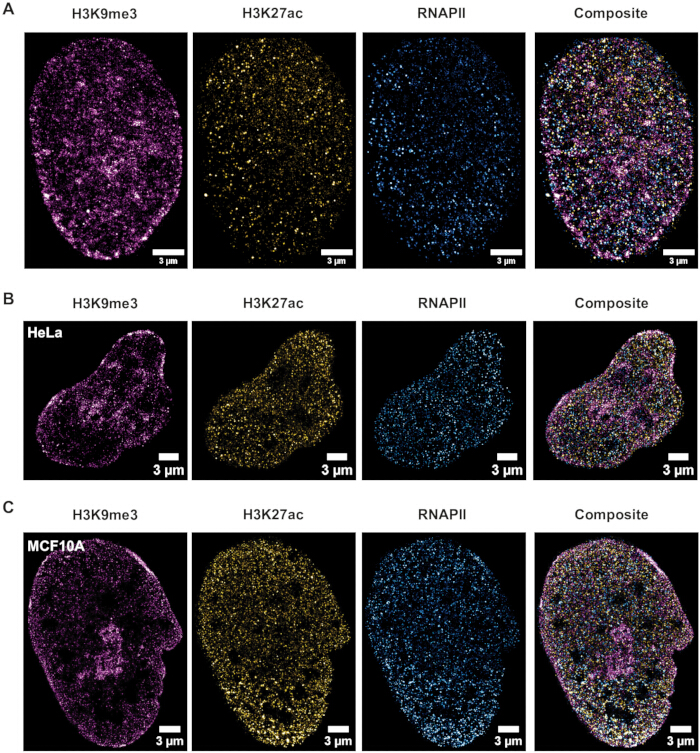
Figure 1: Three color images of the cells used. Three-color images of (A) BJ fibroblast (B) HeLa and (C) MCF10A. Please click here to view a larger version of this figure.
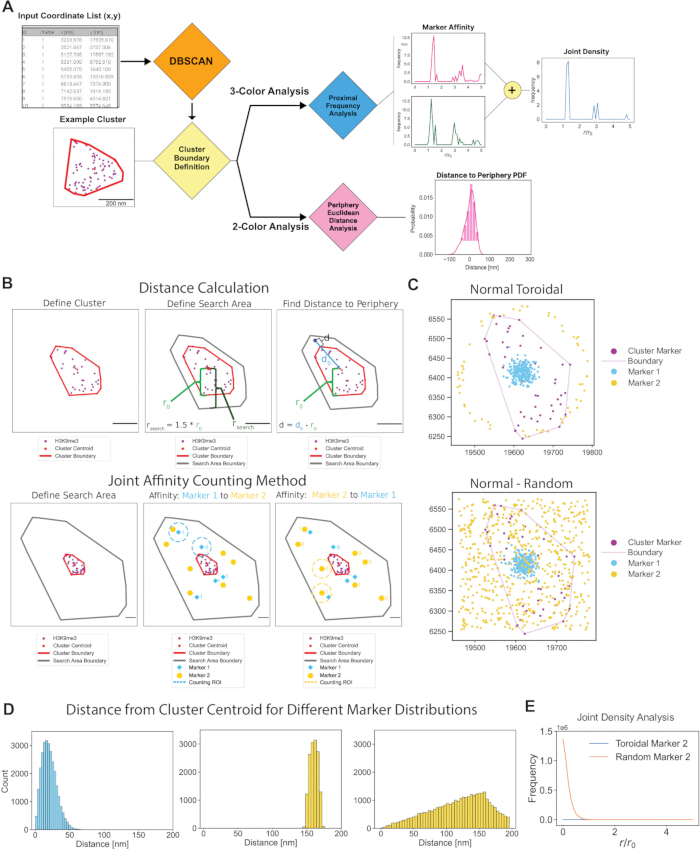
Figure 2: Quantitative analysis framework for spatial organization of targets relative to heterochromatin clusters. (A) Analysis Pipeline for multi-channel SMLM data used in this study. (B) Schematic of distance to periphery calculations for identified heterochromatin clusters and Joint Affinity Counting method. Both methods are used to quantitatively determine the arrangement of two targets relative to the heterochromatin cluster structure. (C) Example scatter distributions around specific heterochromatin clusters used in a study34 to determine distinct biological organizations of targeted structures (clustered inside a domain vs around domain vs not associated and randomly distributed). (D) Distance to periphery histogram for centrally clustered, randomly distributed and toroidally distributed and (E) Joint affinity curves for simulation cases. Please click here to view a larger version of this figure.
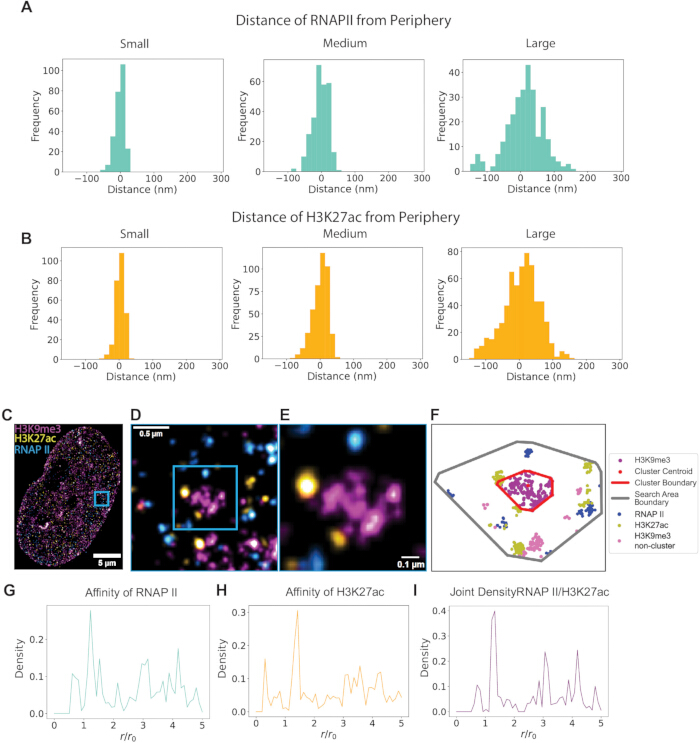
Figure 3: Quantitative spatial relationships of transcription markers around histone domains. (A) Distance to periphery histogram results for exemplary biological data of multi-labeled HeLa cells. For small ( <40 nm), medium (40-80 nm), and large (>120 nm) domains for RNAPII and (B) H3K27ac relative to H3K9me3 clusters. (C-E) Example Images for three label dSTORM image of a HeLa Cells (H3K9me3, H3k27ac, RNAPII2-S2p, with inset and zoomed image for a single domain. (F) Convex hull (red) fitting of domain pictured in E with analysis zone in gray. (G) Affinity plots for RNAPII relative to H3K27ac and H3K27ac (H) relative to RNAPII in the analysis ROI for all domains in the data of medium size in the dataset. (I) Joint density of RNAPII and H3K27ac in analysis ROI for all medium sized domains. Please click here to view a larger version of this figure.
Discussion
This three-color SMLM protocol represents a significant advancement in our ability to investigate chromatin organization within the dense nuclear environment. The sequential immunofluorescence labeling approach, combined with point-cloud spatial analysis which uses localization estimates as points as the basis of the analysis, provides researchers with a powerful tool for examining nanoscale relationships between different chromatin modifications and active transcription machinery that were previously undetectable using conventional microscopy techniques.
The protocol's sequential staining strategy addresses fundamental challenges inherent to multi-target nuclear imaging. Unlike cytoplasmic or membrane-associated structures that are relatively sparse, nuclear chromatin targets exist in extremely high density with overlapping spatial domains. Our modified blocking approach, incorporating serum from secondary antibody host species after each labeling round, effectively prevents cross-reactivity between antibody pairs while maintaining target specificity. The overnight incubations at 4°C ensure complete antibody penetration throughout the nuclear volume, critical for achieving uniform labeling density necessary for quantitative SMLM analysis. This protocol reliably produces images with 15-20 nm resolution across multiple cell lines, making it broadly applicable for chromatin organization studies.
The following are the trouble shooting tips for the imaging session. If the nuclei do not bleach, the most likely cause is insufficient laser intensity at the sample, which may result from a low power setting or an incorrect TIRF angle; in this case, troubleshoot by checking the laser alignment, increasing the laser power, and carefully adjusting the TIRF angle. If blinks in the nucleus are very few but remain constantly bright, this indicates that the nuclei have not bleached sufficiently. If blinks are very sparse and the nuclei are not visible at all, the most likely explanation is unsuccessful staining, and the reagents and antibodies should be checked before repeating the protocol. Conversely, if the number of nuclear blinks is very high (a desirable outcome), a longer bleaching time is required until individual, well-separated single-molecule blinks can be visually resolved. In conventional SMLM experiments, appropriate labeling density can often be estimated using well-defined reference structures such as microtubules; however, chromatin exhibits highly heterogeneous organization and lacks a well-defined ground-truth structure, making such estimation more challenging. Based on empirical optimization and prior experience, we therefore ensure that the effective labeling density reaches approximately 100 localizations per µm² to enable robust reconstruction of chromatin packing domains. In our protocol, we did not use any fiduciary markers but recommend if the users have them. In our experiments, the lateral shifts remain within 0.2 pixels (less than ~5nm), which can be neglected. Therefore, we did not use fiduciary markers.
The choice of H3K9me3, H3K27ac, and RNA polymerase II provides complementary information about chromatin organization at nanoscale level. H3K9me3 serves as an ideal spatial reference because it forms discrete, well-defined clusters that represent constitutive heterochromatin and can be reliably identified through automated clustering algorithms. H3K27ac marks enhancer-associated chromatin that actively participates in gene regulation, while RNA Polymerase II directly indicates sites of active transcription. Together, these three targets allow investigation of how transcriptional machinery and regulatory chromatin modifications organize relative to heterochromatic regions within the nuclear architecture.
The point-cloud analysis framework addresses critical limitations of previous chromatin organization studies by enabling comprehensive spatial analysis in dense nuclear environments. Traditional pairwise comparison methods cannot capture the complex spatial relationships that occur when multiple chromatin modifications coexist within the same nuclear regions. Our approach utilizes joint density analysis to reveal where H3K27ac and RNA polymerase II co-localize relative to H3K9me3 clusters, providing quantitative information that cannot be obtained from separate two-color experiments.
Representative results consistently demonstrate a cohesive organizational model rather than strict chromatin compartmentalization. Both H3K27ac and RNA polymerase II localize preferentially at heterochromatin cluster peripheries across different domain sizes, with quantitative measurements showing positioning within 10 nm of cluster boundaries which supports findings from other groups with similar methods and models of transcription23,28,35,45,46. The joint density analysis reveals that active transcription machinery and enhancer-associated chromatin couple most frequently in regions surrounding heterochromatic clusters. These findings challenge simple phase separation models and support integrated organizational principles where different chromatin modifications maintain close spatial proximity rather than forming distinct separate compartments.
The protocol's modular design enables investigation of diverse chromatin biology questions through target substitution while maintaining the same analytical framework. Studies of replication timing can substitute for cell cycle proteins such as proliferation cell nuclear antigen (PCNA) and mini chromosome maintenance (MCM), while DNA damage response investigations might target γH2AX and repair factors. Cell cycle studies could examine histone modifications that change throughout division, and differentiation research might focus on epigenetic marks associated with lineage commitment. The sequential labeling approach accommodates any combination of nuclear proteins or chromatin modifications for which reliable antibodies exist, limited primarily by spectral compatibility and cross-reactivity considerations. This flexibility allows researchers to address fundamental questions about chromatin dynamics during various cellular processes while maintaining quantitative spatial analysis capabilities.
Disclosures
The authors of this protocol have no disclosures or competing interests.
Acknowledgements
This work was supported by NIH grants U54CA268084, U54CA261694, and R01CA228272, National Science Foundation grants EFMA-1830961 and CBET-2430743, and philanthropic support from Rob and Kristin Goldman, Mr. David Sachs, and the Christina Carinato Charitable Foundation.
Materials
| Name | Company | Catalog Number | Comments |
|---|---|---|---|
| Andor iXon Ultra 888 electron-multiplying CCD | Andor | DU-888U3-CSO-#BV | NA |
| Bovine serum albumin | Sigma Aldrich | A7030 | Used in blocking and washing buffers. Do not store BSA based blocking buffer for more than 1 month at 4°C |
| Changchun New Industries Optoelectronics Tech. Co., Ltd., Model MGL-FN-532 (532 nm) | PSU-H-LED | https://www.cnilaser.com/MGL-FN-532.htm | NA |
| Coherent OBIS Laser Box (405 nm, 488 nm, 532 nm, 552 nm, 637 nm) | Coherent | 1228877 | Lasers collimated with 3–10 kW/cm³ average power at sample, minimum 10,000 frames collected per wavelength channel with 10–30 ms acquisition time. |
| DABCO (1,4-Diazabicyclo-(2.2.2)-octane) | Sigma | D27802 | NA |
| DBPS (1X) | Thermo Fisher | 14190-136 | NA |
| Distilled water | NA | NA | Any Distilled Water is fine |
| DTT (Dithiothreitol), 1M | Sigma | 43816 | NA |
| Eight well chambered cover glass | Cellvis | C8-1.5H-N | Can be any glass bottom plate, but volumes must be adjusted depending on vessel. |
| Goat anti Mouse AF568 | Thermo Fisher | A11004 | Stock Concentration: 2 mg/mL Stability Post Labeling: 2–3 days |
| Goat anti Rabbit AF647 | Thermo Fisher | A21245 | Stock Concentration: 2 mg/mL Stability Post Labeling: 4–5 days |
| Goat anti Rat A488 | Thermo Fisher | A11006 | Stock Concentration: 2 mg/mL Stability Post Labeling: 2–3 days |
| H3K27ac Primary Antibody | Thermo Fisher | MA5-23516 | Stock Concentration: 1.0 mg/mL |
| H3K9me3 Primary Antibody | Abcam | AB1769156 | Stock Concentration: 1.287 mg/mL |
| High Clarity Poly-Propylene Conical Tube 15 mL | Corning | 352096 | Used for Fixative and Quenching solutions |
| High Clarity Poly-Propylene Conical Tube 50 mL | Corning | 352070 | Used for 40 mL working stocks of blocking and washing buffers |
| Hydrochloric acid (HCl), 12M | Sigma | 258148 | NA |
| Nikon Eclipse Ti-E with perfect focus system | NIikon | TI-DH 611392 | Inverted microscope |
| Nikon SR APO TIRF, 100x magnification, 1.49 NA | Nikon | https://www.microscope.healthcare.nikon.com/products/optics/cfi-apochromat-tirf-series | NA |
| Normal goat serum | Abcam | AB7481-1002 | Used after first label is done. Should be present in Blocking and Washing Buffers |
| Paraformaldehyde 16 % | Electron Microscopy Sciences | 15710 | Used in fixative solution which should be used up within 2 weeks of making. Keep protected from light at 4°C |
| Phosphate buffered saline (PBS) 10X | Ambion | AM9625 | NA |
| Pipette Tips 1000 uL | SureOne | 02-707-404 | Any pipette tip is fine as long as it’s appropriate for the volume |
| RNAPII-PS2 | Abcam | AB252855 | Stock Concentraion: 0.98 mg/mL |
| Sodium Borohydride | Thermo Fisher | S678-10 | Use fresh for quenching buffer every single time. |
| Sodium hydroxide(NaOH) | Thermo Fisher | A16037.36 | NA |
| Sodium sulfite | Sigma | S0505 | NA |
| Triton X-100 10% | Thermo Fisher | 28314 | NA |
References
- Bond, C., Hugelier, S., Xing, J., Sorokina, E. M., Lakadamyali, M. Multiplexed DNA-PAINT imaging of the heterogeneity of late endosome/lysosome protein composition. bioRxiv: The Preprint Server for Biology. , (2024).
- Hugelier, S., Colosi, P. L., Lakadamyali, M. Quantitative single-molecule localization microscopy. Annu. Rev. Biophys. 52 (1), 139-160 (2023).
- Lelek, M., et al. Single-molecule localization microscopy. Nat. Rev. Methods Primers. 1, 39(2021).
- Oddone, A., Vilanova, I. V., Tam, J., Lakadamyali, M. Super-resolution imaging with stochastic single-molecule localization: concepts, technical developments, and biological applications. Microsc Res Tech. 77 (7), 502-509 (2014).
- Bates, M., Huang, B., Dempsey, G. T., Zhuang, X. Multicolor super-resolution imaging with photo-switchable fluorescent probes. Science. 317 (5845), 1749-1753 (2007).
- Ricci, M. A., Cosma, M. P., Lakadamyali, M. Super resolution imaging of chromatin in pluripotency, differentiation, and reprogramming. Curr Opin Genet Dev. 46, 186-193 (2017).
- Heo, S. J., et al. Aberrant chromatin reorganization in cells from diseased fibrous connective tissue in response to altered chemomechanical cues. Nat Biomed Eng. 7 (2), 177-191 (2023).
- Wang, Y., et al. Comprehensive molecular characterization of the hippo signaling pathway in cancer. Cell Rep. 25 (5), 1304-1317.e5 (2018).
- Zhang, Y., et al. Multicolor super-resolution imaging using spectroscopic single-molecule localization microscopy with optimal spectral dispersion. Appl Opt. 58 (9), 2248-2255 (2019).
- Daugird, T. A., et al. Correlative single molecule lattice light sheet imaging reveals the dynamic relationship between nucleosomes and the local chromatin environment. Nat Comm. 15 (1), 4178(2024).
- Kant, A., et al. Active transcription and epigenetic reactions synergistically regulate meso-scale genomic organization. Nat Comm. 15 (1), 4338(2024).
- Esa, A., et al. Three-dimensional spectral precision distance microscopy of chromatin nanostructures after triple-colour DNA labelling: a study of the BCR region on chromosome 22 and the Philadelphia chromosome. J Microsc. 199 (2), 96-105 (2000).
- Lelek, M., Di Nunzio, F., Henriques, R., Charneau, P., Arhel, N., Zimmer, C. Superresolution imaging of HIV in infected cells with FlAsH-PALM. Proc Natl Acad Sci. 109 (22), 8564-8569 (2012).
- Yushchenko, D. A., Bruchez, M. P. Tailoring fluorescent labels for far-field nanoscopy. Far-Field Optical Nanoscopy. , 159-188 (2015).
- Min, W., Freudiger, C. W., Lu, S., Xie, X. S. Coherent nonlinear optical imaging: beyond fluorescence microscopy. Annu rev phys chem. 62, 507-530 (2011).
- Walker, R. A. Quantification of immunohistochemistry--issues concerning methods, utility and semiquantitative assessment I. Histopath. 49 (4), 406-410 (2006).
- Dunn, K. W., Kamocka, M. M., McDonald, J. H. A practical guide to evaluating colocalization in biological microscopy. Am J Physiol Cell Physiol. 300 (4), C723-C742 (2011).
- Castells-Garcia, A., et al. Super resolution microscopy reveals how elongating RNA polymerase II and nascent RNA interact with nucleosome clutches. Nucl Acids Res. 50 (1), 175-190 (2022).
- Finn, E. H., Misteli, T. A high-throughput DNA FISH protocol to visualize genome regions in human cells. STAR protocols. 2 (3), 100741(2021).
- Nuebler, J., Fudenberg, G., Imakaev, M., Abdennur, N., Mirny, L. A. Chromatin organization by an interplay of loop extrusion and compartmental segregation. Proc Natl Acad Sci. 115 (29), E6697-E6706 (2018).
- Davidson, I. F., Peters, J. M. Genome folding through loop extrusion by SMC complexes. Nat Rev Mol Cell Biol. 22 (7), 445-464 (2021).
- Schueder, F., et al. Unraveling cellular complexity with transient adapters in highly multiplexed super-resolution imaging. Cell. 187 (7), 1769-1784.e18 (2024).
- Miron, E., et al. Chromatin arranges in chains of mesoscale domains with nanoscale functional topography independent of cohesin. Sci Adv. 6 (39), eaba8811(2020).
- Ou, H. D., Phan, S., Deerinck, T. J., Thor, A., Ellisman, M. H., O'Shea, C. C. ChromEMT: Visualizing 3D chromatin structure and compaction n interphase and mitotic cells. Science. 357 (6349), eaag0025(2017).
- Li, Y., et al. Analysis of three-dimensional chromatin packing domains by chromatin scanning transmission electron microscopy (ChromSTEM). Sci Rep. 12 (1), 12198(2022).
- Penagos-Puig, A., Furlan-Magaril, M. Heterochromatin as an important driver of genome organization. Front Cell Dev Biol. 8, (2020).
- Millán-Zambrano, G., Burton, A., Bannister, A. J., Schneider, R. Histone post-translational modifications - cause and consequence of genome function. Nat Rev Genet. 23 (9), 563-580 (2022).
- Li, Y., et al. Nanoscale chromatin imaging and analysis platform bridges 4D chromatin organization with molecular function. Sci Adv. 7 (1), eabe4310(2021).
- Li, W. S., et al. Mature chromatin packing domains persist after RAD21 depletion in 3D. Sci Adv. 11 (4), eadp0855(2025).
- Mansisidor, A. R., Risca, V. I. Chromatin accessibility: methods, mechanisms, and biological insights. Nucleus. 13 (1), 236-276 (2022).
- Li, A., et al. Decoding topologically associating domains with ultra-low resolution Hi-C data by graph structural entropy. Nat Comm. 9 (1), 3265(2018).
- Szabo, Q., Bantignies, F., Cavalli, G. Principles of genome folding into topologically associating domains. Sci Adv. 5 (4), eaaw1668(2019).
- Satam, H., et al. Next-generation sequencing technology: current trends and advancements. Biology. 12 (7), 997(2023).
- Acosta, N., et al. Three-color single-molecule localization microscopy in chromatin. Light: Sci Appl. 14 (1), 123(2025).
- Almassalha, L. M., et al. Chromatin conformation, gene transcription, and nucleosome remodeling as an emergent system. Sci Adv. 11 (2), eadq6652(2025).
- Yin, Y., Lee, W. T. C., Rothenberg, E. Ultrafast data mining of molecular assemblies in multiplexed high-density super-resolution images. Nat Comm. 10 (1), 119(2019).
- Xu, J., et al. Super-resolution imaging of higher-order chromatin structures at different epigenomic states in single mammalian cells. Cell Rep. 24 (4), 873-882 (2018).
- Xu, J., Liu, Y. Imaging higher-order chromatin structures in single cells using stochastic optical reconstruction microscopy. Bio-Protocol. 9 (3), e3160(2019).
- Otterstrom, J., Castells-Garcia, A., Vicario, C., Gomez-Garcia, P. A., Cosma, M. P., Lakadamyali, M. Super-resolution microscopy reveals how histone tail acetylation affects DNA compaction within nucleosomes in vivo. Nucleic Acids Res. 47 (16), (2019).
- Abdelsayed, V., Boukhatem, H., Olivier, N. An optimized buffer for repeatable multicolor STORM. ACS Photonics. 9 (12), 3926-3934 (2022).
- Weidner, J., et al. Advanced image-free analysis of the nano-organization of chromatin and other biomolecules by single molecule localization microscopy (SMLM). Comput Struct Biotechnol J. 21, 2018-2034 (2023).
- Nieves, D. J., et al. A framework for evaluating the performance of SMLM cluster analysis algorithms. Nat Methods. 20 (2), 259-267 (2023).
- Hyun, Y., Kim, D. Recent development of computational cluster analysis methods for single-molecule localization microscopy images. Comput Struct Biotechnol J. 21, 879-888 (2023).
- Markaki, Y., et al. Functional nuclear organization of transcription and DNA replication: a topographical marriage between chromatin domains and the interchromatin compartment. Cold Spring Harb Symp Quant Biol. 75 (0), 475-492 (2010).
- Gelléri, M., Sterr, M., Strickfaden, H., Cremer, C., Cremer, T., Cremer, M. Space-time dynamics of genome replication studied with super-resolved microscopy. Postepy biochem. 70 (1), 8-21 (2024).
- Cremer, T., et al. The 4D nucleome: Evidence for a dynamic nuclear landscape based on co-aligned active and inactive nuclear compartments. FEBS Letters. 589 (20), 2931-2943 (2015).
Reprints and Permissions
