Rodent Identification II

Source: Kay Stewart, RVT, RLATG, CMAR; Valerie A. Schroeder, RVT, RLATG. University of Notre Dame, IN
Animal records must be accurately maintained to…
All animal procedures described here must be conducted in accordance with institutional animal ethics guidelines and approved by IACUC. All procedures must follow the principles of the 3Rs—Replacement, Reduction, and Refinement—and must be performed by trained personnel.
1. Tail tattoo
Tail tattoos are easily read without the need to handle the animal.
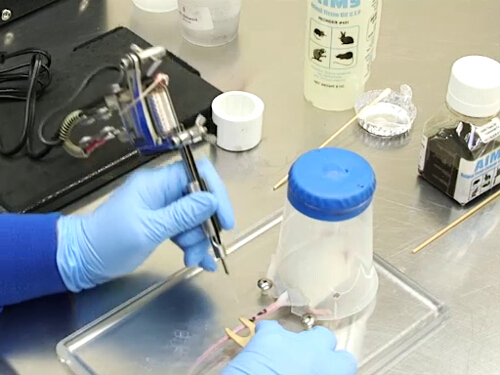
Figure 1. Tail tattooing on adult mice
- Prepare the tattoo equipment according to the manufacturer's instructions. A small amount of ink is required. Black dye should be used for albino mice or rats, and green dye for pigmented mice or rats.
- Prepare the animals for identification.
NOTE: To minimize apprehension or distress, tail tattooing should be performed in a procedure room rather than in an animal housing area.- Appropriately restrain the animal for tattooing so that movement is minimal.
- Weanling rats are restrained using a plastic-notched cup, with the lip of the cup secured under the bolts on the tattoo platform, and the tail extending through the notch.
- Adult mice can be restrained by means of a cup restrainer, with the tail pulled taut from the opening and the flange of the cup held in place via a platform or other device.
- Clean the tail with a small amount of diluted tissue cleaner applied with a cotton-tipped swab. Adult rats generally have a buildup of scale and debris on the tail that must be cleaned prior to applying the tattoo. A soap and water scrub of the tail will remove the majority of the dirt and debris. Dry the tail well before proceeding.
- Apply tissue oil to the skin with a cotton-tipped swab just prior to tattooing. The tissue oil is necessary to minimize tissue damage by softening the skin and lubricating the tattoo needle. In addition, the oil dissolves any dirt not removed by the cleaning process and prevents ink staining of nontattooed skin.
- Apply the tattoo.
- Dip the tip of the needle into the pigment with the machine off.
- Bring the tip of the needle to the tattoo site with the gun activated by the foot pedal.
- Make short, even strokes in one direction. Numerals and letters should be tattooed in such a way so that they are constructed in segments with minimal angles and curves (when possible).
- Penetrate deeply enough into the dermis with the needle for permanent pigment deposition. A change in the sound of the activated needle can help discern the depth.
- Approach the skin with the needle at a 90o angle for adequate deposition of pigment.
- Post-tattoo cleanup and care
- Blot (do not wipe) the completed tattoo of excess pigment with a paper towel.
- The presence of blood on the tattoo or the paper towel indicates that the tattoo was made too deep, and is therefore unlikely to be permanent.
- Reinforce thin areas of tattoo characters with additional pigment. Characters are reinforced with pigment deposited parallel to, but not on top of, already-deposited pigment.
- To add additional pigment, dip the tip of the needle into the dye reservoir for every two characters for mice and every one character for rats.
- Reasons for fading tattoos include inadequate amounts of pigment, tattoos made too shallow, tattoos made too deeply, an inappropriate angle of the needle to the skin, blunt or hooked needles being used, or the tattoo being made too quickly.
- Thoroughly clean the tattoo equipment after each use according to the manufacturer's instructions.
2. Toe tattooing of neonates
Experimental protocols can require the genotyping of neonates as early as day one, which makes it essential that these pups be permanently identified. The use of toe tattooing allows the animals to be identified until they are large enough for ear tagging or ear punching.
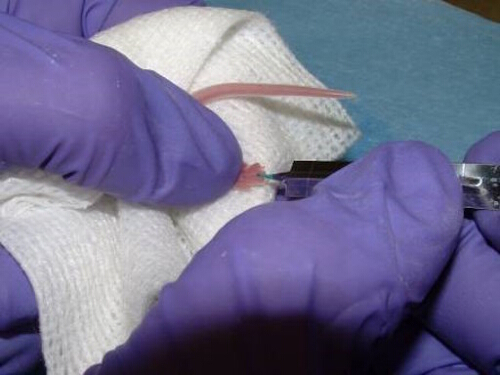
Figure 2. The proper restraint technique for tattooing a neonate mouse. The lancet has the green dye on the tip.
- Restrain preweaned pups.
- Cup the neonate in the hand on a gauze pad. Position the foot between the thumb and crook of the index finger to expose the chosen toe, or toes, for tattooing.
- Hold the foot close to the toes so that the toe has a solid surface behind it, preventing it from bending away.
- Do not overtwist the leg when positioning the foot. Pups that are restrained may wiggle, but no vocalization is necessarily heard.
- Prepare the equipment.
- Select a 4.5 mm Goldenrod animal lancet.
- Place a small spot of green tattoo paste on a nonporous surface; aluminum foil works well.
- Dip only the tip of the lancet in the tattoo paste.
- Use only a small amount of paste.
- Apply the tattoo.
- Poke the desired toe with the Goldenrod lancet according to an identification code.
- Puncture the skin to introduce the paste into the skin, leaving a mark.
- Poke the same spot three times to insure proper penetration.
- Avoid poking so deeply that the toe bleeds; this can result in a fainter tattoo.
- Post-tattoo cleanup and care
- Gently blot the spot with an absorbent wipe/towel to remove excess paste.
- Do not attempt to clean excess paste from the foot or body.
- Return the animal to its cage.
- When nursing pups are tattooed, it is advisable to also tattoo the dam. This may prevent her from overreacting to the paste on the pups, which could lead to excessive grooming of the tattoo.
- Use a new lancet for each litter.
- The tattoos should be verified on the day after the procedure. Redo the tattoo if the dots are faint or not visible. If the dots are visible the day after tattooing, they should remain visible for the lifetime of the animal.
3. Toe tattooing of adult rats and mice
When a litter of neonates is tattooed, it is suggested that the mother also be tattooed so that the paste on her pups is not foreign to her.
- Restraint of the animal.
- Restrain the animal using either a plastic cone or a Plexiglass restrainer that allows access to the hind feet.
- Extend the foot from the restraint device.
- Position the foot between the thumb and crook of the index finger to expose the chosen toe, or toes, for tattooing
- Hold the foot close to the toes so that the toe has a solid surface behind it, preventing the toe from bending away.
- Do not overtwist the leg when positioning the foot. Adults that are restrained may try to withdraw the foot.
- Prepare the equipment.
- Select a 5 mm Goldenrod animal lancet.
- Place a small spot of green tattoo paste on a nonporous surface; aluminum foil works well.
- Dip only the tip of the lancet in the tattoo paste.
- Use only a small amount of paste.
- Apply the tattoo.
- Poke the desired toe with the Goldenrod lancet according to an identification code.
- Puncture the skin to introduce the paste into the skin, leaving a mark.
- Poke the same spot three times to insure proper penetration.
- Avoid poking so deeply that the toe bleeds; this can result in a fainter tattoo.
- Post-tattoo cleanup and care
- Gently blot the spot on an absorbent wipe/towel to remove excess paste.
- Do not attempt to clean excess paste from the foot or body.
- Return the animal to its cage.
- Use a new lancet for each animal.
- The tattoos should be verified on the day after the procedure. Redo the tattoo if the dots are faint or not visible. If the dots are visible the day after tattooing, they should remain visible for the lifetime of the animal.
4. Microchipping
The implantation of an RFID chip is a commonly used method for identifying animals.
- Load the microchip into the applier, or select a preloaded syringe.
- Restrain the animal using a Plexiglass restraint tube that allows grasping of the skin over the shoulders.
- Tent the skin, creating a pocket.
- Place the needle through the skin, bevel up and parallel to the spine, and directed it toward the tail.
- Eject the microchip subcutaneously.
- Withdraw the needle and pinch the skin closed at the point of injection. This prevents the microchip from following the needle out of the skin. Continue to apply pressure to provide hemostasis for any skin bleeding.
- Remove the animal from the restraint device and scan the chip to confirm the identification code.
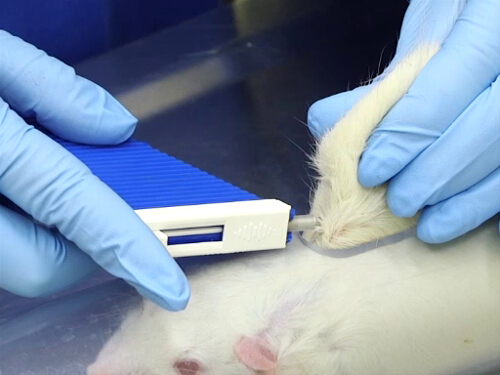
Figure 3. Microchip placement in adult rats.
5. Temporary identification for mice
Nontoxic dyes and animal markers can be used for temporary identification of mice.
- Restrain the mouse such that the area between the scapulae is accessible for markings on the fur.
- Place a marker, spot, or streak of dye on the fur in this area. This region is used to prevent the animal from removing the marking while grooming.
- Check the marking periodically if using it as the sole identifier for more than a few days.
- The tail can also be used for short durations. However, the animal may remove a mark from it while grooming.
6. Temporary identification for rats
- Restrain the rat so that the area for dye or marker application is easily accessible. In some cases, when only a stripe or dot is needed, the animal will not need to be restrained but is allowed to move freely in the cage.
- Manual restraint by grasping the tail and holding it taut while applying the identification is commonly done.
- Temporary immobilization using inhalant anesthetics can be done for fractious animals.
- Check the marking periodically if using this method as the sole identifier for more than a few days.
Key Terms and Definitions
The use of tail tattooing is beneficial in many research protocols. Tail tattoos are ideal for an animal that is to be imaged in an MRI machine, or one that is genetically predisposed to ulcerative dermatitis. For quick identification of an animal in a cage, without having to restrain it, the tail tattoo is easily visualized. However, this technique requires skill, practice, and a steady hand; specialized equipment is also required.
Experimental protocols may require the genotyping of neonates as early as day one. As a result, it is essential that these pups be permanently identified. At this young age, the ear pinnae are not developed enough to insert an ear tag, and an ear punch cannot yet be used on them. In the past, it was common for a researcher to use a toe removal code to identify neonates. However, this was stressful to both to the young animal and the dam, and thus has been considered inhumane. The use of toe tattooing allows the animals to be permanently identified until they are large enough for ear tagging or ear punching.
Although the process for implantation of a microchip is relatively easy, there are several factors that limit its usefulness for identification in mice. The sterile microchips are the size of a large grain of rice, and require a 10 to 12 gauge needle for delivery. Thus, they are very large for a mouse. The cost of microchips and the reading device can also be prohibitive, as the life span of the mouse is short and the number of animals is usually extensive. Animals that are destined to be imaged in an MRI machine cannot have implants in them. However, if there is a group of valuable animals that must be permanently identified, microchips can be used.
Acute studies that require animals to be identified for hours, or a few days, do not necessitate the use of permanent identification. Nontoxic markers are made specifically for coloring the fur of animals, and are available in several colors. These marker dyes can remain visible for several weeks. The markers can also be used in conjunction with other methods to easily spot specific animals in a group.
Questions that this video will help you answer
When choosing the appropriate identification method, many factors must be deliberated. Each technique has advantages and disadvantages that must be considered in relation to experimental needs. While the costs must be weighed along with other factors, the ease of the technique and the level of discomfort to the animals should be the primary considerations.
The ability to identify individual research animals is an essential aspect of scientific recordkeeping and data collection. Distinguishing between animals ensures that the correct subject is used for the intended experimental procedure.
Firstly, animals must be correctly assigned to their respective cages, and male and female rodents should be housed separately.
To support this, cage cards should clearly document identification details, including animal ID, sex, strain, and protocol information, in accordance with institutionally approved IACUC guidelines.
To enable accurate identification several methods are used, including tattooing adult rodent tail, neonate toes, and adult toes, subcutaneous microchip placement technique commonly performed in adult rats, and temporary identification using non-toxic dyes.
Before delving into protocols for these methods, let’s review the key considerations, benefits, and shortcomings of each of these techniques.
Tail tattooing is beneficial in many research protocols, such as experiments involving MRI imaging or those where animals are genetically predisposed to skin conditions, including ulcerative dermatitis.
Another advantage of tail tattoos is that they are easily visualized without having to manually restrain the animal.
Certain experimental protocols require genotyping of neonates as early as day one, which makes it essential that these pups be permanently identified. The use of toe tattooing allows such animals to be identified until they are large enough for ear tagging or ear punching.
While advantageous, it requires trained personnel, appropriate equipment, and technical proficiency, while minimizing tissue damage and animal discomfort.
The next permanent identification method is microchipping. Although implanting microchips is a relatively easy process, there are several factors that limit their usefulness.
Microchips are expensive and are therefore not ideal for identifying large numbers of animals. Also, microchips cannot be used in the experiments involving MRI.
However, if there is a group of valuable animals like breeder animals with unique genetics that must be permanently identified, microchips can be used.
The last method is temporary identification using non-toxic markers. The non-toxic markers are made for coloring the fur of research animals.
This method is ideal for short-term studies that require animals to be identified for only a few hours or days, although the dyes can remain visible for several weeks.
Some researchers use these markers in conjunction with other identification methods to easily spot specific animals in a group, to minimize handling.
Let's start with the tail tattooing procedure. Here, we will demonstrate the procedure on adult mice, but the same can be applied to weanling and adult rats.
To minimize any apprehension or distress to the animals, tail tattooing should be performed in the procedure room.
Before applying the tattoo, restrain the mouse. To reduce the stress, it can be performed on an anesthetized animal in accordance with the institutional guidelines.
Next, clean the tail with a small amount of diluted tissue cleaner on a cotton-tipped swab. This step is important to remove any buildup of scale and debris that might interfere with the tattoo.
Next, apply tissue oil to the tail skin with another swab. This minimizes tissue damage by softening the skin and providing lubrication for the tattoo needle.
In addition, the oil dissolves dirt not removed by the cleaning process and prevents ink staining on the non-tattooed skin. Now you're ready to apply the tattoo.
While the machine is off, dip the tip of the tattoo needle, which is either a lancet or hypodermic needle, into the pigment.
Next, activate the gun using the foot pedal, place the tattoo tool on the tail, and bring the tip of the needle to the tattoo site.
Approach the skin with the needle at a 90-degree angle and penetrate deeply enough into the dermis such that pigment is permanently deposited. A change in the sound of the activated needle can help discern the depth.
Make short even strokes in one direction, forming numerals and letters. Try to use minimal curves and angles when applying the tattoo.
To add additional pigment, dip the tip of the needle into the dye reservoir for every one-two characters for mice and every one character for rats.
Blot the completed tattoo with a paper towel to remove excess pigment.
The presence of blood on the tattoo or the paper towel indicates that the tattoo was made too deeply and is therefore unlikely to be permanent.
Reinforce thin characters with additional pigment by placing the needle parallel to, not on the top of, the already deposited pigment.
Thoroughly clean the tattoo equipment after each use, and a new or sterilized needle and a fresh supply of ink should be used between cages to prevent disease transmission.
To apply toe tattoos to neonates and adults, we will demonstrate the procedure in mice, but the same steps are applicable to rats.
This procedure must be performed in accordance with institutionally approved protocols and by trained personnel.
The neonates are tattooed on their toes as the tailbones are not ossified, and the length of the tail is too small.
Also, as the tail grows, the skin would be stretched, and the numbers may become distorted, faint, and unreadable.
Start by placing a spot of green tattoo paste on a non-porous surface such as aluminum foil.
Next, cup the pre-weaned pup in your hand using a gauze pad.
Position the foot between your thumb and the crook of your index finger to expose the chosen toes for tattooing.
Hold the foot close to the toes so that the selected toe has a solid surface behind it to prevent it from bending away.
Now, dip the tip of a 4.5 mm lancet into the tattoo paste.
Then, poke the desired toe as per the pre-determined code. To ensure proper permeation, poke the same spot three times.
Penetrate the skin enough so that the paste leaves a mark, but avoid poking so deeply that the toe bleeds.
Gently blot the new tattoo with the gauze to remove any excess tattoo paste, and return the animal to its cage.
Use a new lancet for the next litter. One day after the procedure, verify that the tattoo is visible.
To apply a toe tattoo to an adult, again, first place a small spot of green tattoo paste on an aluminum foil.
Then, restrain the animal for the shortest duration necessary to minimize stress, in accordance with institutionally approved handling guidelines.
Extend the foot from the restraint device and position the foot between your thumb and the crook of your index finger to expose the chosen toes for tattooing.
Now, dip the tip of the lancet in the tattoo paste.
And apply the tattoo by poking and puncturing the skin of the desired toe at least three times to ensure proper penetration.
Next, gently blot the tattoo to remove any excess paste, and return the animal to its cage.
As with the neonates, verify the tattoo one day after the procedure. If the mark is visible the day after tattooing, it should remain visible for the animal's lifetime.
If it is faint or not visible, then redo the tattoo as described previously.
The next identification method involves implanting microchips into rodents.
The chip commonly used for labeling lab animals is a Radio-frequency Identification, or RFID, chip. Usually, the chip is preloaded in needles or cannula, which can then be placed into the applier.
For chip insertion, use a restraint device to restrain the animal making sure that you can still grasp the skin over the shoulders.
Microchip implantation is typically performed without anesthesia in rodents; however, the use of anesthesia or analgesia should be considered based on animal welfare, procedural difficulty, and in accordance with institutionally approved guidelines.
First, tent the skin to create a pocket. Then place the needle through the skin, bevel up, parallel to the spine, and directed toward the tail.
Eject the microchip subcutaneously and withdraw the needle.
Pinch the skin closed at the injection site to prevent the chip from following the needle out of the skin.
Continue to apply pressure to provide hemostasis for any skin bleeding.
Remove the animal from the restraint device and scan the chip using the reader provided by the manufacturer to confirm the identification code.
Another method is to apply temporary dyes to rodents for identification.
First, restrain the animal such that the area between the shoulder blades is accessible. This part of the body is safe from self-grooming.
Place a spot or streak of the dye on the fur in this area and place the animal back into its cage.
For rats, restrain the animal manually. This ensures that the area for dye application is easily accessible, which could be the head, shoulders, or rump.
Place a spot or streak of the dye on the fur.
It is sometimes possible to apply the non-toxic dye without restraining the animal.
In summary, appropriate rodent identification methods should be selected based on experimental needs, minimal animal discomfort, and compliance with institutionally approved IACUC guidelines.
Now that we have reviewed the procedures of these different identification methods, let's see how scientists are using them in different research studies today.
The use of rodents in behavior experiments is pretty common. Here, the researchers used the tail tattooing to mark the animals permanently and then observed them for a several days in an artificially constructed home-cage environment. The data collected revealed differences in behaviors, like distance moved, between the control and the experimental animals, over a 10-day post surgery period.
In another behavior experiment, the investigators performed toe tattooing in neonates and placed them in a recording box with special microphones to record ultrasonic vocalizations. The purpose of this experiment was to look at the differences in call rate, that is number of vocalizations per minute, in wild type and Shank2 deficient mice-a model of autism-over 12-day neonatal period and adult hood.
Lastly, as discussed earlier, the use of non-toxic dye is an efficient way to mark animals for short-term experiments. Here, the scientists were interested in transient expression of a plasma protein. So they marked the animals with temporary markers, injected the plasmid DNA intravenously, and collected the blood sample two days later to determine protein expression using the western blot technique.
You've just watched JoVE's introduction to tattooing, microchip placement, and temporary identification methods for laboratory mice and rats. Animal identification is a primary component of recordkeeping in research.
Therefore, when choosing the appropriate identification method, many factors must be deliberated. This includes the level of discomfort to the animal, the ease of the technique, the experimental needs, and finally the cost associated with the method.
View the full transcript and gain access to JoVE Science Education videos
Q1: Why is individual animal identification important in laboratory research?
Individual identification ensures accurate scientific recordkeeping and correct data collection. Distinguishing between animals guarantees that the correct subject is used for the intended experimental procedure, which is essential for maintaining research integrity and preventing errors in data attribution across multiple subjects in studies.
Q2: What are the advantages of tail tattooing for rodent identification?
Tail tattoos are easily visualized without manually restraining the animal, making monitoring convenient. They are beneficial for experiments involving MRI imaging or animals genetically predisposed to skin conditions like ulcerative dermatitis, since the tattoo avoids problematic body areas and remains permanently visible.
Q3: Why is toe tattooing preferred for identifying neonatal rodents?
Neonates require early permanent identification for genotyping as early as day one. Toe tattooing allows identification until pups are large enough for rodent identification ear punching and tagging. The tail is unsuitable because tailbones are not ossified and tail skin stretches as the animal grows, causing tattoo marks to become distorted and unreadable.
Q4: What are the limitations of microchip identification in laboratory rodents?
Microchips require a 10-12 gauge needle for implantation, which is too large for mice, limiting use to adult rats. They are expensive and unsuitable for identifying large numbers of animals. Additionally, microchips cannot be used in MRI experiments, though they remain useful for identifying valuable breeder animals with unique genetics.
Q5: When should researchers use non-toxic dyes for rodent identification?
Non-toxic dyes are ideal for short-term studies requiring identification for only a few hours or days, though dyes can remain visible for several weeks. Some researchers use markers in conjunction with other identification methods to easily spot specific animals in a group during temporary monitoring periods.
Q6: What preparation steps are necessary before applying a tail tattoo to a rodent?
Restrain the mouse using a cup restrainer with the tail pulled taut. Clean the tail with diluted tissue cleaner on a cotton-tipped swab to remove scale and debris. Apply tissue oil with another swab to soften skin, provide lubrication, and prevent ink staining on non-tattooed areas.
Q7: How should proper handling and restraining techniques be applied during toe tattooing procedures?
For neonates, cup the pup in your hand using gauze and position the foot between your thumb and index finger crook to expose toes. For adults, use a plastic cone or Plexiglass restrainer allowing hind foot access. Proper handling and restraining techniques ensure safe, accurate tattoo placement while minimizing animal stress.