Compound Administration II

All animal procedures described here must be conducted in accordance with institutional animal ethics guidelines and approved by IACUC. All procedures must follow the principles of the 3Rs—Replacement, Reduction, and Refinement—and must be performed by trained personnel.
1. Topical application
- Anesthesia should be used when necessary to minimize pain and distress during preparation and application procedures.
- Before applying any ointments and creams, remove all fur from the area through the use of a depilatory cream or by shaving.
- Thoroughly clean and dry the skin.
- Apply the substance directly to the skin with a cotton-tipped applicator or via a directly-placed drop to avoid contact with the technician.
- For best results, apply several thin layers of ointment or cream opposed to a onetime application of a thick layer.
- Apply liquid by parting the hair and applying a drop on the exposed skin.
- When applying a substance topically, there is a chance of systemic absorption due to the animal grooming the area. Preventative measures should be taken to avoid accident ingestion or early removal of the substance. Small collars or shields are available to prevent the animal from reaching affected body parts. Individual housing may also be required to prevent allogrooming from cage mates.
- Animals may be housed individually only when necessary and for the minimum required duration; as single housing is a recognized stressor and potential confounding factor, its use must be scientifically justified and minimized.
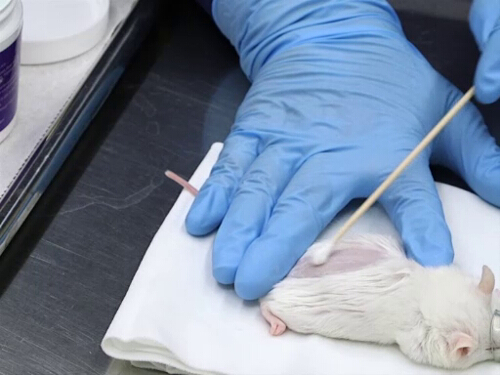
Figure 1. Topical application in mice.
2. Oral dosing
- When providing compounds to animals via feed or water, a minimum daily dose based on body weight must be calculated. The average weight of the mouse or rat strain being used in the experiment can be used to make the calculations, unless it is specified that each animal be weighed and the dose figured for each individual.
- For example, if the intended dose is 10 milligrams per kilogram per day, the average animal weight is 30 grams or 0.03 kilograms, and there are 5 animals in one cage.
- Multiplying these values gives the total amount needed per cage per day. The final amount is 1.5 milligrams per cage per day. This is the amount that should be present in the average daily intake for that cage.
- For protocols that require that food and/or water intake be precisely measured, animals need to be housed individually.
- Animals must have continuous access to feed, and ad libitum feeding should be provided where appropriate in accordance with study requirements.
- Specialized feed or treats can be manufactured to meet experimental needs.
- Replace the standard diet with the formulated one, which allows the animals to ingest the compound throughout the day.
- The food may need to be replaced more frequently than standard food due to compound instability.
- Substances may also be administered by dissolving them in the drinking water, allowing for the animals to receive a compound throughout the day
- A small amount of sugar is added to the water to make it palatable. The exact amount to add is determined by the acceptance of the water by the mice. Use the smallest increment possible.
- The frequency of changing the water is dependent on the stability of the compound. Some substances may be light-sensitive or precipitate over time.
3. Oral gavageprocedure
18-20 gauge x 1.5 inch straight or curved dosing needles are used for mice. For rats, 16-18 gauge x 2-3 inch straight or curved dosing needles are used. These are available as reusable stainless steel needles or as disposable needles. The disposable needles can have a metal or flexible plastic shaft with a silicone tip.
- Attach the dosing needle to a syringe selected based on the volume and viscosity of the test solution. For dosing thick liquids, a Luer lock syringe is preferred. These are generally available beginning with a 3 cc size that has 100 µl graduations. This may not be suitable for smaller volumes or when there is a need for exact-dose volumes at smaller increments.
- Affix the syringe to the needle such that the graduations on the barrel can be read without turning the needle. Once the needle has been placed into the esophagus, any rotation can rupture the esophagus, resulting in death of the animal.
- Fill a syringe with the appropriate volume of article to be administered (optimal volume = 5 ml/kg and maximum volume = 20 ml/kg)
- The proper restraint is essential for this procedure.
- Manually restrain mice by grasping the skin at the base of the head and scruffing them. It is important that the body be held such that it is suspended in a straight line from the head to the tail. Any twisting of the body will impede the placement of the gavage needle into the esophagus.
- Grasp the scruff tightly so that the head has minimal side-to-side movement. The hindquarters must be stabilized to prevent body rotation.
- For gavaging a rat, grasp it over the shoulders using the index and middle fingers on each side of the neck, and the palm on the animal's back. The thumb, third, and fourth fingers should encircle the chest to prevent the animal from being able to move forward or backward. The position of the fingers on each side of the neck prevents the rat from turning its head.
- It is important that the body be in a straight line and not twisted to assist in the placement of the gavage needle without damage to the mouth, pharynx, esophagus, or stomach.
- Make sure the head does not have excess side-to-side movement.
- The hindquarters may be stabilized to prevent body rotation. This is accomplished by allowing the back feet to rest on the counter or cage top.
- During restraint, animals should be monitored to ensure normal respiration is maintained.
- Although oral gavage is commonly performed in conscious animals, light anesthesia may be considered in cases involving highly stressed or difficult-to-restrain animals, or when repeated dosing is required; however, its use should be carefully evaluated due to potential effects on physiological parameters.
- Administration of the substance
- Before dosing, measure the tube externally from the head to the sternum, mark it at the nose, and do not insert beyond this point to avoid stomach perforation.
- Position the needle with the curve facing downward and in line with the natural curve of the neck. Introduce the needle into the mouth from the right or left side, between the incisors and molars at an angle toward the back of the pharynx.
- Once the needle is in the oral cavity, tilt the head back using the gavage needle until the nose is pointed up. This is especially important when using straight needles. The needle should slide easily into the esophagus. Do not force the needle down. If any resistance is felt, back the needle out and try again.
- Once the needle is in position in the stomach, gently deposit the compound.
- Remove the needle, making sure that no rotation of the curved needle takes place. The gavage needle should be removed slowly and gently, in the same motion that it was introduced.
- If the animal begins to struggle, remove the dosing needle and restrain the animal more securely.
- While performing the procedure, if the animal shows signs of cyanosis or respiratory distress, or if there is solution flowing from its mouth, the dosing needle should be immediately removed and the animal released into its cage.
- In general, when gavaging rats and mice, particularly with a caustic substance, it is a recommended practice to initially deliver a small amount – to test for coughing – before the entire volume is given. That way, if the needle is incorrectly positioned, the volume delivered to the lungs is small and the animal has a better chance at recovery.
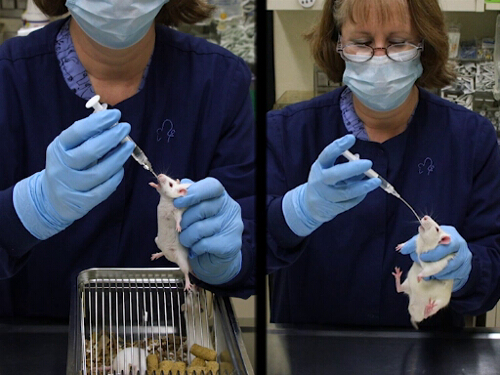
Figure 2. Oral gavage in mice (left) and rats (right).
Key Terms and Definitions
The two main administration routes are enteral (via the digestive tract) and parenteral (administered outside of the digestive tract). The choice of the administration route is primarily determined by the requirements of the study. The main advantage of parenteral dosing is that the compound is not subjected to hepatic metabolism, resulting in higher bioavailability. However, there are many experimental protocols that require the compounds to be administered orally to better mimic the natural intake of a substance. The best route to utilize is determined by the properties of the test compound.
Oral dosing: Oral dosing is the most commonly used method of drug administration in humans. This is done with tablets, capsules, or liquid forms of medication. Tablets and capsule administration are impractical in rodents, so the common oral dosing for mice and rats is accomplished by either dissolving the compound in drinking water, using specialized food that incorporates the test compound into the formula, or by placing the compound in treats. When dosing via drinking water, sucrose is often added to the water to enhance palatability. However, it should be finely balanced to encourage normal water intake and not excessive drinking because of the sugary taste.
Many studies have demonstrated that repeated oral gavage is stressful to both mice and rats. It is also labor-intensive for the animal care staff. There is commercially available feed that has commonly dosed compounds, such as fenbendazole, which is used to eliminate parasites in rodents, incorporated into it. Other companies provide medicated treats that contain anti-inflammatories, analgesics, antiparasitics, or antibiotics. Feed companies that manufacture the formulated diets for mice and rats will create specialized test diets to meet an experimental requirement. Many laboratories have formulated their own treats with the use of honey, peanut butter, or fruit-flavored gelatin.
Oral dosing lacks precision because the intake of a compound is dependent on the acceptance of the food or water, the stability of the compound, and the number of animals present in the cage. However, if exact dosing is not critical to the experiment, this noninvasive method of dosing is best for the well-being of the animals.
Oral gavage: Oral gavage is a much more precise method of enteral dosing, as it allows for the deposition of the compound directly into the stomach of the animal at a specific time and at a specified volume. However, training is required to ensure success. Proper restraint of the animal is crucial to the success of this technique. Injury to the oral cavity, pharynx, larynx, trachea, esophagus, and stomach can result from improper positioning of the head and the body. The animal must be tightly gripped, such that the head is unable to twist, to prevent such injuries.
Dosing needles are available in reusable or disposable formats. Though costly, the use of disposable needles removes the threat of cross-contamination when dosing multiple animals. There are several sizes of gavage needles, ranging from 20-22 gauge for mice and 18-20 gauge for rats. The choice of needle is determined by the size of the animal, the volume of liquid, and the viscosity of the solution to be administered.
Oral gavage should be performed on a conscious animal to decrease the possibility of placing the needle into the trachea. An animal that is conscious will retain the swallowing reflex as well as the gag reflex, facilitating the proper placement into the esophagus. A study was conducted demonstrating that precoating the gavage needle with sucrose induced the swallowing reflex and decreased the amount of time needed to pass the needle into the esophagus.
Topical administration: A topical agent that is placed directly on the surface of the skin is generally intended to affect only the area to which it is applied. These can be creams, lotions, ointments, foams, or gels. As animals will tend to groom the area where the agent is applied, the toxicity of oral consumption must be considered.
Topical agents are generally used to produce local effects; however, systemic absorption can occur depending on factors such as skin integrity, application area, concentration, exposure duration, and lipid solubility. Well-hydrated and thin skin layers will decrease the absorption time.
When applying a substance topically, there is the chance for systemic absorption due to the animal grooming the area. Preventative measures should be taken to avoid accident ingestion or early removal of the substance. Small collars or shields are available to prevent the animal from reaching affected body parts. Individual housing may also be required to prevent allogrooming from cage mates. However, animals may be singly housed only when necessary and for the shortest duration; as it is a stressor and potential confounder, it must be justified and minimized.
Questions that this video will help you answer
The safest and most humane method of compound administration is through oral dosing if it is possible to incorporate it into the feed or water. Oral gavage is a precise dosing method but is also very stressful to the animal, and it requires technical proficiency. Topical administration is usually accomplished with little or no restraint of the animal, once the area is properly prepared. Careful consideration of the route of administration should factor in the potential stress to the animals.
Source: Kay Stewart, RVT, RLATG, CMAR; Valerie A. Schroeder, RVT, RLATG. University of Notre Dame, IN
Compound administration is often an integral com…
Chapters in this video
0:00
Overview
0:23
Oral Dosing via Feed or Water
2:45
Oral Gavage Procedure
5:38
Topical Application
7:22
Applications
9:08
Summary
Copyright © 2026 MyJoVE Corporation. All rights reserved.