2.8
View the full transcript and gain access to JoVE Core videos
Q1: How does the Arrhenius equation relate temperature to reaction rate?
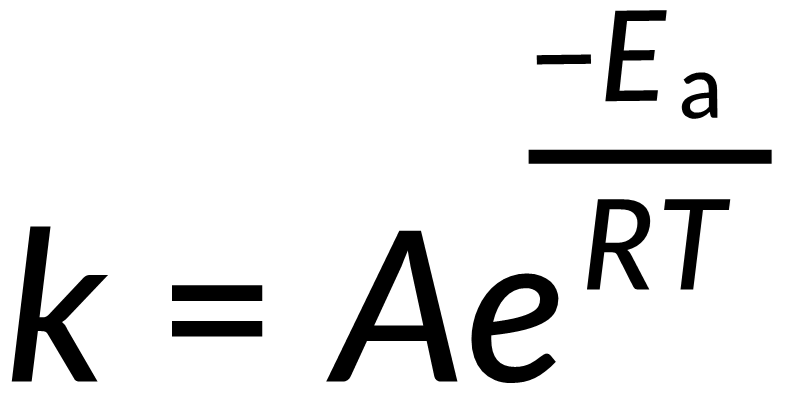
The Arrhenius equation connects the rate constant k to temperature through two key components: the frequency factor A and the exponential term e−Eₐ/RT. As temperature increases, molecules move faster with higher thermal energies, increasing both collision frequency and the fraction of molecules with sufficient energy to overcome the activation barrier, thereby accelerating the reaction rate.
Q2: What is activation energy and why does it affect reaction rates?
Activation energy is the minimum energy required for reactant molecules to form products during collision. If activation energy is much larger than the average kinetic energy of molecules, only a few fast-moving molecules can react, slowing the reaction. Conversely, when activation energy is smaller than average kinetic energy, a large fraction of molecules possess sufficient energy, causing the reaction to proceed rapidly.
Q3: What role does collision theory play in explaining temperature effects on reactions?
Collision theory states that reacting molecules must collide with sufficient energy and correct orientation to initiate a reaction. The frequency factor comprises collision frequency and orientation factor. At elevated temperatures, molecules collide more frequently and forcefully, increasing both the number of collisions and the probability of favorable orientations, leading to faster reaction rates.
Q4: What is a transition state and how does it form during a reaction?
A transition state, or activated complex, is a short-lived, unstable high-energy intermediate formed when reactant molecules collide with sufficient kinetic energy to bend, stretch, or break bonds. This unstable complex loses energy to form stable products with lower total energy than the reactants, representing the highest energy point along the reaction pathway.
Q5: How do the frequency factor and exponential factor influence reaction rate constants?
The frequency factor A reflects collision frequency and molecular orientation probability, while the exponential factor e−Eₐ/RT represents the fraction of successful collisions producing products. Both factors increase with temperature: higher temperatures boost collision rates and energize more molecules, causing both components to rise and increasing the rate constant k proportionally.
Q6: Why do only some molecular collisions result in a chemical reaction?
Only a small fraction of collisions produce reactions because molecules must overcome an energy barrier called activation energy. Reacting molecules need sufficient kinetic energy to bend, stretch, or break bonds and form the transition state. Collisions lacking this minimum energy simply result in molecules bouncing apart unchanged, regardless of collision frequency or orientation.
Q7: How does kinetic molecular theory explain the temperature dependence of reaction rates?
Kinetic molecular theory defines temperature as the average kinetic energy of molecules. Higher temperatures mean molecules move faster and possess greater thermal energy. This increased kinetic energy allows a larger fraction of molecules to exceed the activation energy threshold during collisions, exponentially increasing the number of successful reactions and accelerating overall reaction rates.
Explore Related Chapters